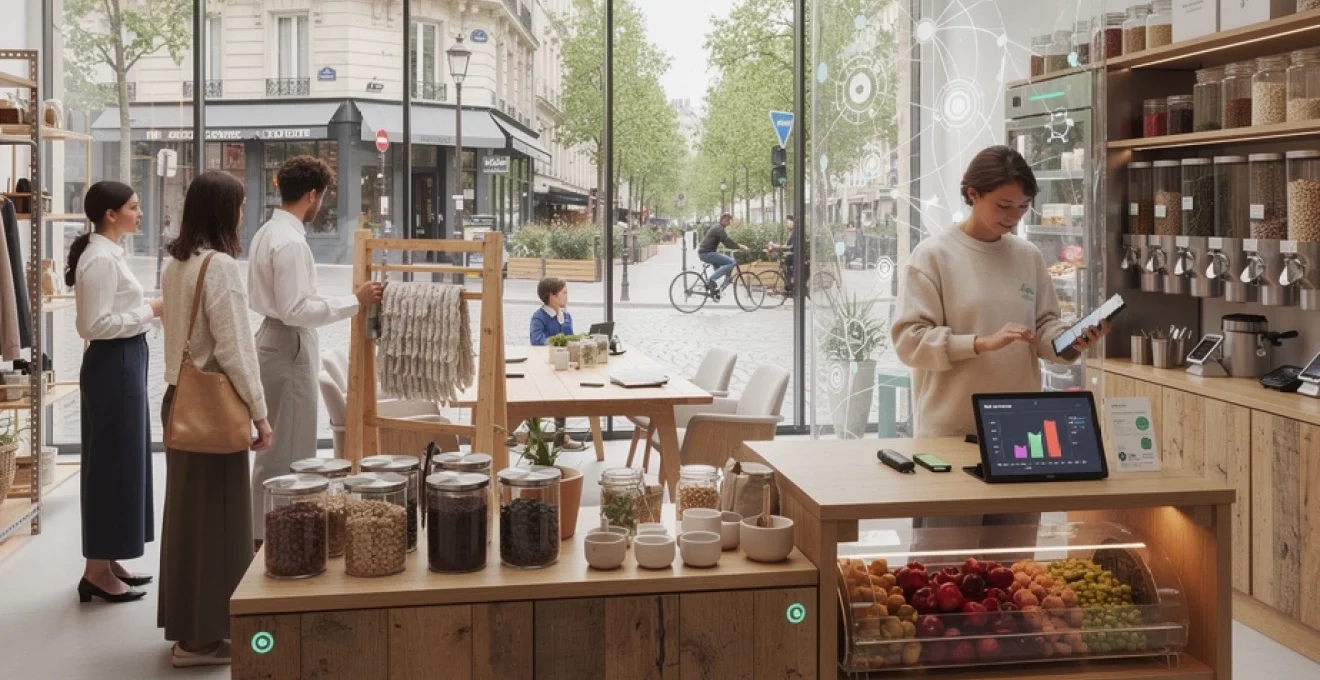
Paris is experiencing a remarkable transformation in its retail landscape, with sustainable concept stores emerging as the new benchmark for conscious commerce. These innovative retail spaces are revolutionising how consumers interact with brands whilst addressing pressing environmental challenges. From the historic Marais district to the trendy Saint-Germain area, forward-thinking retailers are implementing circular economy principles and cutting-edge sustainability technologies that extend far beyond mere greenwashing.
The shift represents more than a fleeting trend; it embodies a fundamental reimagining of retail operations. Major department stores like Galeries Lafayette have allocated permanent spaces to circular fashion initiatives, whilst luxury conglomerates including LVMH are developing comprehensive sustainability frameworks that reduce operational costs by up to 30%. This transformation is attracting environmentally conscious consumers who increasingly prioritise sustainable shopping experiences over traditional retail encounters.
Circular economy integration in parisian retail architecture
The implementation of circular economy principles within Parisian retail architecture represents a sophisticated approach to sustainable commerce that goes beyond surface-level environmental initiatives. Modern concept stores are incorporating regenerative design strategies that transform waste into valuable resources, creating closed-loop systems that eliminate traditional linear consumption patterns. This architectural revolution is reshaping how retail spaces function as living ecosystems rather than mere product distribution centres.
Zero-waste material sourcing for store interior design
Contemporary Parisian concept stores are pioneering zero-waste material sourcing strategies that eliminate construction waste whilst creating distinctive shopping environments. Retailers are utilising reclaimed wood from decommissioned Haussmannian buildings, transforming discarded materials into elegant fixtures and furniture pieces. This approach reduces material costs by approximately 40% whilst creating unique aesthetic experiences that resonate with environmentally conscious consumers.
The sourcing process involves partnerships with local demolition companies and urban waste management organisations to identify high-quality materials suitable for retail applications. Store designers are developing innovative techniques to repurpose everything from vintage Parisian subway tiles to industrial machinery components, creating distinctive retail atmospheres that tell compelling sustainability stories.
Closed-loop supply chain management systems
Advanced closed-loop supply chain management systems are enabling Parisian concept stores to achieve unprecedented levels of resource efficiency and waste elimination. These systems utilise sophisticated tracking technologies to monitor product lifecycles from initial manufacturing through customer use to eventual recycling or upcycling processes. Retailers are implementing blockchain-based tracking systems that provide complete transparency regarding product origins and environmental impacts.
The integration of closed-loop systems extends to packaging materials, with stores developing reusable container programmes that eliminate single-use packaging entirely. Customers participate in container return initiatives that offer incentives through loyalty programmes, creating collaborative sustainability ecosystems that benefit both retailers and consumers whilst reducing environmental footprints significantly.
Biodegradable packaging solutions and customer engagement
Innovative biodegradable packaging solutions are transforming customer engagement strategies within sustainable concept stores throughout Paris. Retailers are developing packaging materials derived from agricultural waste, including wheat husks and corn starch, that decompose completely within 90 days under standard composting conditions. These materials maintain product protection standards whilst eliminating long-term environmental impacts associated with traditional packaging materials.
Customer engagement initiatives surrounding biodegradable packaging include educational workshops and interactive displays that demonstrate decomposition processes. Stores provide composting facilities where customers can dispose of packaging materials responsibly, creating educational opportunities that enhance environmental awareness whilst building stronger customer relationships through shared sustainability values.
Energy recovery systems through In-Store waste processing
Cutting-edge energy recovery systems are enabling Parisian concept stores to transform waste materials into usable energy sources through innovative in-store processing technologies. These systems utilise advanced anaerobic digestion processes to convert organic waste into biogas, which powers store lighting and heating systems. The implementation of these technologies reduces energy costs by up to 35% whilst demonstrating practical sustainability applications to customers.
The waste processing systems include customer education components where shoppers can observe energy generation processes through transparent viewing panels. This transparency creates compelling educational experiences that demonstrate the practical applications of circular economy principles whilst encouraging customers to adopt similar practices in their personal lives.
Revolutionary sustainable concept
Revolutionary sustainable concept stores transforming paris shopping districts
Across Paris, a new generation of sustainable concept stores is reshaping traditional shopping districts into experimental laboratories for circular retail. Rather than treating sustainability as a marketing add-on, these spaces embed environmental performance into every aspect of their operations, from product selection to building systems. Each neighbourhood, from Le Marais to Bastille, is becoming a micro-hub where residents can test low-impact lifestyles in real time.
What makes these sustainable concept stores particularly powerful is their hyper-local integration. Many collaborate with nearby producers, artisans and waste management partners, creating short supply chains and measurable reductions in transport emissions. In practice, a visit to these addresses becomes both a shopping trip and a live demonstration of how the circular economy can work in dense urban environments.
Nous Anti-Gaspi’s food waste reduction technology in le marais
In Le Marais, Nous Anti-Gaspi has become a benchmark for how retail can tackle food waste at scale while remaining attractive to urban consumers. The store’s model relies on advanced inventory algorithms that predict demand, allowing them to source surplus products from supermarkets, wholesalers and producers before they are discarded. These items, often perfectly edible but cosmetically imperfect or close to their sell-by date, are then sold at discounts of 30–70%.
Behind the scenes, Nous Anti-Gaspi uses real-time stock monitoring to map product flows and avoid overfilling shelves with items that may expire simultaneously. The store integrates dynamic pricing, gradually lowering prices as expiration dates approach to maximise sell-through rates. This data-driven strategy not only prevents tonnes of food from going to waste each year, it also gives brands and suppliers valuable insights into where losses occur in the supply chain.
Customer engagement is central to the concept. Educational signage explains the environmental impact of food waste, including the carbon footprint of each recovered product category. Interactive screens show weekly and monthly waste reduction statistics so that shoppers can see the collective impact of their choices. By turning climate metrics into accessible visuals, Nous Anti-Gaspi makes sustainable grocery shopping feel less like a sacrifice and more like a shared mission.
Episode studio’s circular fashion model in Saint-Germain-des-Prés
Episode Studio, located in the chic Saint-Germain-des-Prés district, showcases a circular fashion model that challenges the logic of disposable wardrobes. Instead of relying on constant newness, the brand curates collections from upcycled garments, vintage finds and small-batch designs made from deadstock fabrics. This hybrid approach allows Episode Studio to reduce textile waste while maintaining a fashion-forward aesthetic that appeals to trend-conscious Parisians.
The store’s interior functions almost like a material library. Product tags include details about the origin of each fabric, whether it comes from surplus luxury stock, recycled fibres or reworked archival pieces. By treating provenance as a design feature rather than a technical detail, Episode Studio educates customers about material lifecycles without overwhelming them with jargon. You can think of it as a fashion gallery where each garment also tells the story of its carbon and resource savings.
Operationally, Episode Studio integrates repair and alteration services directly into its business model. On-site tailors adjust fits, mend worn pieces and even customise vintage items, significantly extending garment lifespans. This service-first approach mirrors a library system more than a conventional store: instead of encouraging constant replacement, it prioritises maintaining and enhancing what you already own. The result is a retail experience that aligns style, sustainability and emotional durability.
Loom’s zero-impact textile manufacturing showcase in bastille
In the Bastille area, Loom has built a reputation as one of Paris’s most transparent and demanding sustainable fashion brands. Its concept store doubles as a zero-impact manufacturing showcase, highlighting each step required to reduce clothing’s environmental footprint. Walls display comparative data on water use, CO2 emissions and durability between Loom basics and conventional fast-fashion equivalents, offering a rare level of honesty in retail.
Loom’s design philosophy emphasises radical simplicity. By limiting the number of references and focusing on essential items—T-shirts, jeans, knitwear—the brand can invest heavily in lifecycle optimisation. Products are designed to withstand hundreds of wash cycles, and the store features testing equipment and fabric samples so visitors can physically compare quality and wear resistance. This hands-on approach helps customers understand why buying fewer, better items often produces the lowest environmental impact.
The Bastille store also acts as a collection point for worn Loom garments. Returned items are sorted into categories for repair, resale, fibre recycling or downcycling into insulation materials. This closed-loop system, combined with full supply chain traceability, allows Loom to track the real-world performance of its zero-impact manufacturing commitments. For visitors, it feels less like a boutique and more like an open-source lab for the future of responsible fashion.
Day by day’s bulk shopping innovation network across arrondissements
Day by Day has quietly built one of the most extensive bulk shopping networks in Paris, with neighbourhood stores across multiple arrondissements. Each boutique allows customers to purchase food staples, cleaning products and personal care items in exactly the quantities they need, using refillable containers. This model addresses both packaging waste and overconsumption, two major sources of environmental pressure in urban lifestyles.
The stores employ precise gravity-fed dispensers and digital scales to ensure that bulk products remain hygienic and easy to use. Clear labelling indicates origin, farming methods and any certifications, making it simple to compare environmental attributes at a glance. For many families, switching to bulk shopping at Day by Day can cut their household packaging waste by more than half over a year, while often lowering total spending.
To help newcomers embrace this system, Day by Day organises regular workshops on topics such as zero-waste pantry planning and sustainable cleaning routines. These community events turn the stores into local hubs for environmental education, rather than simple points of sale. By replicating this model in different districts, the brand demonstrates how sustainable concept stores can scale without losing their neighbourhood identity.
Biomimetic design principles in sustainable retail environments
Biomimetic design—the practice of drawing inspiration from natural systems to solve human challenges—is increasingly influencing how Parisian retailers conceive sustainable interiors. Instead of forcing nature into a decorative role, architects are studying how ecosystems regulate temperature, manage resources and foster resilience, then applying those mechanisms to store layouts and materials. The result is retail spaces that consume less energy, adapt to changing conditions and provide a healthier environment for visitors.
For instance, some concept stores use natural ventilation strategies modelled on termite mounds, which keep internal temperatures stable without excessive reliance on air conditioning. Others deploy modular shelving systems inspired by plant growth, allowing fixtures to be expanded or pruned back as product assortments evolve, reducing the need for complete refits. Much like a forest where every element serves multiple functions, biomimetic stores strive to make lighting, furniture and partitions work together to minimise waste and maximise comfort.
Living walls, indoor gardens and daylight-optimised façades are not just aesthetic choices; they support better air quality, natural humidity control and psychological well-being. Studies have shown that biophilic spaces can increase dwell time and customer satisfaction, suggesting that these designs offer both environmental and commercial benefits. By positioning nature as a teacher rather than a backdrop, Parisian retailers are proving that biomimicry can be a powerful tool for sustainable retail innovation.
Carbon footprint measurement technologies for concept store operations
As sustainable concept stores multiply, the need to accurately measure and manage their carbon footprint has become urgent. Many Parisian retailers are moving beyond annual sustainability reports toward continuous monitoring systems that track emissions in near real time. This shift allows store managers to respond quickly to inefficiencies, test new initiatives and quantify the results of their circular economy strategies.
Emerging tools combine energy data, logistics information and sales records to build a detailed picture of emissions across store operations. When integrated into user-friendly dashboards, these systems turn complex carbon accounting into actionable insights for non-specialists. Think of it as a fitness tracker for a store’s environmental performance: by seeing daily metrics, teams stay motivated to improve.
Real-time energy consumption monitoring via IoT sensors
Internet of Things (IoT) sensors are at the heart of many new carbon measurement initiatives in Parisian concept stores. These small devices are installed on lighting circuits, HVAC systems, refrigeration units and even individual display areas to record energy consumption minute by minute. Data is transmitted to central platforms where it can be analysed for patterns, inefficiencies and anomalies.
With this granular visibility, store managers can identify surprisingly simple actions that yield significant savings, such as adjusting lighting schedules or recalibrating thermostats outside opening hours. Some retailers integrate AI-based anomaly detection to spot unusual spikes in consumption, which may indicate faulty equipment or poor usage habits. This level of transparency replaces guesswork with evidence, enabling continuous improvement rather than one-off sustainability campaigns.
For staff, dashboards displaying live energy use help build a shared sense of responsibility. When teams can see in real time how closing doors, switching off display screens or optimising ventilation affects overall consumption, behavioural change becomes much easier. Over time, these systems can cut energy-related emissions by 10–25%, depending on the starting point and the ambition of implemented actions.
Lifecycle assessment integration for product display systems
Beyond operational energy, progressive concept stores are starting to assess the lifecycle impact of their physical infrastructure, including shelving, mannequins and lighting rigs. Lifecycle assessment (LCA) tools evaluate the environmental footprint of these elements from raw material extraction to end-of-life disposal. This approach helps retailers avoid the paradox of promoting sustainable products on displays that are themselves environmentally costly.
Some Parisian stores now specify fixtures made from recycled metals, FSC-certified wood or bio-based composites, comparing LCA results before making purchasing decisions. By quantifying impacts such as embodied carbon and resource depletion, they can prioritise designs that combine durability with low environmental cost. In doing so, they treat store fit-outs like long-term investments rather than disposable marketing sets.
To make these choices visible to customers, retailers sometimes include QR codes or discreet labels that summarise the sustainability credentials of major design elements. This transparency transforms the entire store into an educational tool, showing that responsible retail extends well beyond the products on the shelves. For designers and architects, it also creates a powerful incentive to innovate more efficient, modular and repairable display systems.
Supply chain carbon tracking through blockchain technology
Carbon emissions do not stop at the store entrance, which is why many Parisian sustainable retailers are experimenting with blockchain-based tools to trace supply chain impacts. By registering each stage of a product’s journey—from raw materials to manufacturing, transport and distribution—on a decentralised ledger, they can provide verifiable data on associated emissions. This level of traceability is particularly valuable in fashion and food, where globalised supply chains can be opaque.
Blockchain technology allows multiple stakeholders, including factories, logistics providers and brands, to upload authenticated information without a single party controlling the narrative. Smart contracts can even automate certain sustainability checks, flagging shipments that do not meet predefined environmental criteria. For consumers, this translates into scannable product passports that reveal not only where an item was made, but also its estimated carbon footprint.
While such systems are still in early stages, pilot projects in Paris show promising results in terms of trust and accountability. Retailers adopting these tools often report improved collaboration with suppliers, as all parties gain clearer visibility into where emissions hotspots occur. Over time, this shared data can inform more strategic decisions, such as consolidating shipments, favouring low-carbon transport modes or supporting factories that invest in renewable energy.
Customer behaviour analytics for sustainability impact measurement
Understanding how customers interact with sustainable offerings is essential for scaling positive impact. Parisian concept stores are increasingly using customer behaviour analytics to measure not just sales, but the environmental implications of purchasing patterns. By correlating data from point-of-sale systems, loyalty programmes and even in-store sensors, they can identify which sustainable products and services generate the most engagement.
For example, analytics may reveal that refill stations drive strong repeat visits among a specific demographic or that repair services are underused because they are poorly signposted. Armed with these insights, retailers can adjust store layouts, pricing strategies or communication campaigns to make low-impact choices more visible and attractive. In this way, sustainability becomes a design challenge rather than a moral lecture.
Some concept stores go a step further by displaying aggregate impact metrics—such as plastic avoided, garments repaired or kilograms of CO2 saved—on digital screens at the exit. This feedback loop helps customers understand the cumulative effect of their actions and encourages them to return. Much like a game that shows your progress level, these impact dashboards can transform everyday shopping into a participatory sustainability experience.
Regenerative business models adopted by parisian sustainable retailers
While many brands aim to be “less bad,” a growing number of Parisian concept stores are embracing regenerative business models that seek to restore ecosystems and communities rather than merely reducing harm. This shift involves rethinking profit structures, ownership models and value creation so that environmental and social gains are built into the core of the business. Instead of treating sustainability as a cost centre, regenerative retailers view it as their primary driver of innovation and resilience.
Some of these businesses integrate revenue-sharing schemes with local producers, ensuring that value remains within regional economies and supports fair working conditions. Others dedicate a portion of profits to rewilding projects, urban greening initiatives or climate adaptation funds, directly linking commercial success to environmental restoration. You might think of them as “impact cooperatives” disguised as stylish boutiques, where every transaction contributes to a broader regenerative mission.
Service-based models are also expanding. Rental, repair and subscription services for clothing, childrenswear and household items are gaining traction in districts like the Marais and Canal Saint-Martin. By monetising access rather than ownership, these retailers dramatically increase product utilisation rates and reduce the need for constant manufacturing. In parallel, educational programmes—workshops, talks, circular design residencies—generate additional revenue streams while empowering customers to adopt more regenerative lifestyles.
Green building certification standards driving paris concept store development
The architectural evolution of Parisian concept stores is increasingly guided by recognised green building certifications. Labels such as LEED, BREEAM and France’s own HQE framework provide structured criteria for energy performance, water use, materials selection and indoor environmental quality. By aligning new projects and major renovations with these standards, retailers can benchmark their progress and attract tenants, investors and customers who value verified sustainability credentials.
Luxury groups and multi-brand retailers are at the forefront of this movement, working closely with landlords to embed eco-design principles into leases and construction briefs. This often includes commitments to high-efficiency insulation, low-impact materials, optimised glazing and advanced building management systems. Although these measures may require more planning time, they typically reduce operating expenses over the store’s lifetime and enhance the overall shopping experience.
An emerging trend is the simplification and popularisation of technical indicators for a broader audience. Inspired by concepts such as the “nutri-score” on food packaging, some stakeholders advocate for clear, accessible environmental ratings displayed at store entrances. By condensing complex certification data into a set of 8–12 key performance indicators—covering energy intensity, lighting efficiency and biodiversity contributions—retailers can make sustainability performance tangible for everyday visitors. In doing so, they help shift expectations of what a modern Parisian store should be: not just visually compelling, but measurably responsible.