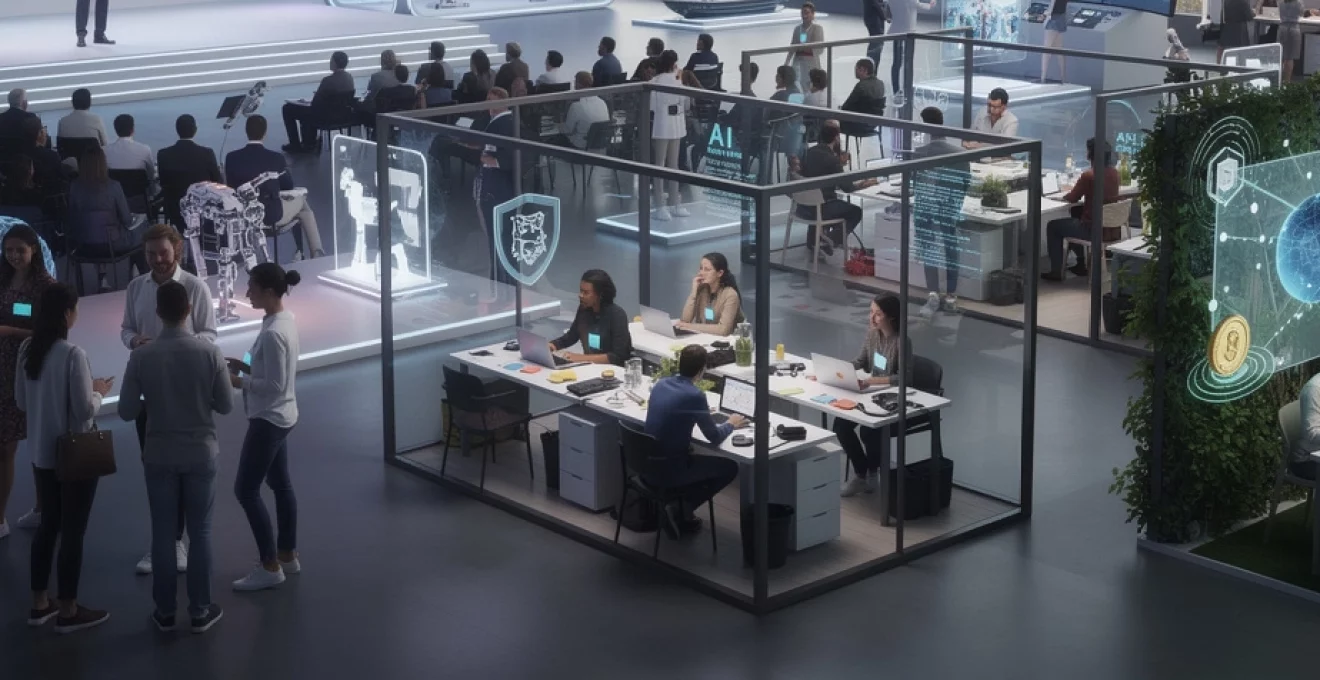
France has emerged as one of Europe’s most dynamic innovation ecosystems, with Paris alone hosting over 180 French startups at major international exhibitions. The country’s commitment to technological advancement extends far beyond its capital, with regional hubs in Lyon, Toulouse, and Aix-Marseille creating specialised clusters in cybersecurity, aerospace, and maritime technologies. Government initiatives like La French Tech have catalysed entrepreneurial activity across the nation, whilst world-class engineering institutions continue producing exceptional talent. From massive international gatherings that attract 180,000 attendees to intimate networking sessions for underrepresented founders, French tech events offer unparalleled opportunities for entrepreneurs, investors, and innovators seeking to shape the future of technology.
Vivatech paris: europe’s largest digital transformation conference
VivaTech stands as the undisputed flagship technology event in France, transforming Paris into a global innovation hub each June. With 180,000 attendees, 14,000 startups, 4,000 partners, and 3,600 investors converging annually, this four-day extravaganza represents the epicentre of European tech discourse. The scale alone is remarkable, but what truly distinguishes VivaTech is its ability to bridge the gap between ambitious early-stage ventures and established multinational corporations. The event operates on a fundamentally different premise than purely technical conferences—its core mission centres on visibility, ecosystem positioning, and facilitating business relationships that drive innovation forward. You’ll find that value extraction at VivaTech requires strategic preparation, with pre-scheduled meetings, carefully selected side events, and targeted demonstrations delivering far greater returns than passive stage attendance.
The exhibition floor pulses with energy as cutting-edge technologies compete for attention alongside billion-dollar corporations showcasing their latest innovation initiatives. Unlike developer-focused gatherings, VivaTech embraces a deliberately broad approach, creating intersections between industries that might never otherwise collaborate. This cross-pollination effect has sparked partnerships between traditional automotive manufacturers and mobility startups, financial institutions and fintech disruptors, healthcare systems and digital health innovators. The diversity of participants means you’re equally likely to encounter a government minister discussing digital sovereignty as you are to meet a bootstrapped founder demonstrating their minimum viable product.
Keynote presentations from global tech leaders and unicorn founders
The main stages at VivaTech feature an impressive roster of speakers who shape global technology trends. These keynotes transcend typical conference presentations, offering insights into strategic decision-making at the highest levels of tech leadership. You’ll hear firsthand accounts of scaling challenges from founders who’ve navigated the treacherous journey from seed funding to unicorn valuation, alongside perspectives from corporate innovation chiefs managing billion-euro transformation programmes. The content balances inspirational storytelling with practical wisdom, though experienced attendees recognise that the real conversations happen in the corridors and private meeting rooms rather than in the auditoriums. Recent editions have featured discussions on artificial intelligence governance, the future of sustainable technology, and the evolving relationship between startups and incumbent enterprises across regulated industries.
La french tech pavilion: showcasing deep tech and AI startups
The French Tech pavilion serves as the national showcase for France’s most promising technological ventures, with particular emphasis on deep tech and artificial intelligence companies. This curated space highlights startups developing solutions in quantum computing, advanced materials, biotechnology, and machine learning applications that address genuine industrial challenges. The 80 companies selected for the French Tech 2030 programme exemplify this focus, having collectively invested €130 million in research and development whilst filing 353 patents. These aren’t consumer-facing apps or incremental improvements—you’re witnessing fundamental technological innovations with potential to reshape entire industries. The pavilion functions as both a statement of national technological ambition and a practical marketplace where investors and corporate partners can identify collaboration opportunities with ventures backed by rigorous technical validation.
Corporate innovation labs: partnerships between CAC 40 companies and scale-ups
VivaTech has become the premier venue for French multinational corporations to demonstrate their commitment to innovation whilst scouting for partnership opportunities with high-growth ventures. The CAC 40 companies maintain substantial presences, operating innovation labs that function as controlled environments for testing collaborative models. These aren’t merely marketing exercises—corporations arrive with specific challenges, budgets, and decision-makers empowered to initiate partnerships. You’ll find procurement teams evaluating
solutions from French Tech 2030 laureates in AI, cybersecurity, quantum technology, and robotics, aligning their procurement roadmaps with France’s broader ambition for technological sovereignty. For startups and scale-ups, this creates rare access to decision-makers who can unlock seven-figure contracts and long-term industrial partnerships. To make the most of these labs, you should arrive with a clear value proposition, proof-of-concept results, and a concise understanding of how your technology integrates into complex enterprise environments. Think of these spaces less as exhibition booths and more as live deal rooms where pilots, joint ventures, and co-innovation projects are negotiated in real time.
Networking opportunities with venture capital firms and business angels
Beyond the exhibition halls and keynote stages, VivaTech is one of the most efficient environments in Europe for concentrated investor networking. With more than 3,600 investors present, including top-tier venture capital firms, corporate VCs, and active business angels, the event compresses months of outreach into a few intense days. You will find curated matchmaking sessions, investor office hours, and private breakfasts where founders can pitch in a more focused setting than the noisy exhibition floor. Many of the best conversations happen at side events across Paris—private dinners, rooftop meetups, and unofficial gatherings where investors are more relaxed and open to longer discussions.
To turn these encounters into tangible fundraising progress, founders should treat VivaTech like a strategic campaign rather than a spontaneous networking opportunity. That means researching attending funds in advance, prioritising those that match your stage and sector, and scheduling meetings at least four to six weeks before the event. A concise one-page teaser, a clear ask, and a realistic funding timeline will help you stand out in an environment where investors hear dozens of pitches each day. As with most high-profile tech events in France, the real ROI comes from follow-up: taking detailed notes, sending tailored recaps, and converting initial conversations into structured due-diligence processes once everyone has left Paris Expo Porte de Versailles.
Station F startup programmes: the world’s largest incubator ecosystem
If VivaTech is where the French tech ecosystem showcases itself to the world, Station F is where much of that innovation is quietly built day to day. Located in a former railway depot in central Paris, Station F houses more than 1,000 startups and dozens of themed programmes under one roof, making it the world’s largest startup campus. Rather than a single accelerator, it operates as an ecosystem of incubators, corporate programmes, and public initiatives, each targeting specific verticals or founder profiles. For entrepreneurs, Station F combines affordable infrastructure with dense networks of mentors, investors, and peers who have already navigated the challenges of scaling in France and abroad.
What makes Station F particularly powerful is its ability to connect early-stage founders with both grassroots communities and institutional partners. You might spend the morning in a hands-on product workshop with other founders and the afternoon pitching to a global brand within the same building. The campus regularly hosts events, demo days, and office hours that mirror the intensity of a tech conference, but in a more focused and recurring format. For international founders exploring French market entry, Station F often serves as a soft landing zone, providing immediate immersion into the realities of the French tech ecosystem rather than a glossy, one-off snapshot.
Founders programme: accelerating pre-seed and seed stage ventures
The Founders Programme is Station F’s flagship track for early-stage startups at pre-seed and seed level. It targets teams that have moved beyond the idea phase and are now focused on product-market fit, acquisition channels, and the first repeatable revenues. Rather than relying on a rigid curriculum, the programme combines structured resources—such as legal clinics, fundraising workshops, and growth marketing sessions—with a strong emphasis on peer learning. Founders share playbooks on everything from navigating French labour law to optimising B2B sales cycles in regulated sectors like healthtech or fintech.
For many entrepreneurs, the most valuable aspect of the Founders Programme is access to decision-ready mentors and investors who understand the nuances of the French and European markets. You can expect regular office hours with experienced operators, pitch feedback sessions, and introductions to funds that actively invest in Station F alumni. To extract maximum value, it helps to arrive with clear quarterly objectives: Do you want to validate pricing, secure your first enterprise pilot, or prepare for a seed round? Treat the programme as a 12–18 month runway optimisation exercise where every workshop and connection should move at least one metric forward.
Fighters programme: supporting underrepresented founders in tech
The Fighters Programme embodies one of the core principles behind La French Tech: innovation should be accessible to talented founders regardless of background or resources. This track is designed specifically for entrepreneurs from underrepresented or disadvantaged backgrounds—whether due to geography, education, or socio-economic context—who often lack access to traditional startup networks and investors. Station F provides them with free or highly subsidised desk space, tailored mentoring, and practical training on topics like fundraising, pitch storytelling, and legal structuring.
What sets the Fighters Programme apart is its focus on levelling the playing field rather than lowering the bar. Selection remains competitive, and the expectation is that accepted founders will build ambitious, scalable businesses. By combining financial relief with intense community support, the programme allows teams to focus on building products and customers instead of worrying about basic operational costs. For investors and partners interested in diversity and inclusion in French tech, Fighters cohorts offer a concentrated pool of high-potential startups that might otherwise remain invisible in mainstream deal flow.
Future 40 initiative: connecting high-growth startups with enterprise clients
While many incubator programmes focus on very early-stage ventures, Station F’s Future 40 initiative shines a light on scale-ups already demonstrating strong traction and rapid growth. Each year, a curated list of 40 startups is selected based on metrics like revenue growth, international expansion, and technological differentiation. This initiative is less about basic mentoring and more about strategic exposure—connecting these companies with large enterprise clients, public institutions, and international partners looking for proven solutions rather than prototypes.
For selected startups, being part of Future 40 acts as a powerful credibility signal in both French and global markets. Enterprise buyers and institutional partners often use the list as a shortcut to identify reliable vendors in areas such as AI, cybersecurity, fintech, and climate tech. If your company is targeting long sales cycles or regulated industries, Future 40 can dramatically shorten the trust-building phase that usually precedes large contracts. The initiative also aligns closely with programmes like French Tech 2030 and French Tech Next40/120, creating a pipeline from promising early-stage ventures to nationally recognised technology champions.
LVMH luxury lab and other corporate accelerator partnerships
Station F is also home to a range of corporate-backed programmes that blend the agility of startups with the scale and brand power of global groups. One of the most prominent examples is the LVMH Luxury Lab, which focuses on startups innovating in retail, customer experience, supply chain, and sustainable materials for the luxury sector. Selected teams work closely with LVMH maisons to test their solutions in real-world environments—from in-store experiences to logistics and after-sales services—often leading to commercial pilots or strategic investments.
Beyond LVMH, Station F hosts numerous other corporate accelerator partnerships spanning fintech, gaming, cybersecurity, and healthtech. For startups, these programmes offer rare access to distribution channels, datasets, and industry expertise that would be impossible to replicate alone. The key is to approach them with a clear partnership strategy: Are you aiming for a pilot, a long-term commercial agreement, or a co-developed product? By aligning expectations early and understanding each partner’s innovation roadmap, you can avoid the common pitfall of “innovation theatre” and instead build collaborations that move both your startup and the corporate partner forward.
Paris blockchain week summit: decentralised technology and web3 innovation
Paris Blockchain Week Summit has rapidly evolved into one of Europe’s most influential Web3 conferences, attracting protocol teams, institutional investors, crypto-native funds, and policymakers from around the globe. Unlike hackathon-centric events aimed primarily at developers, this summit focuses on the business, regulatory, and infrastructure dimensions of decentralised technologies. You will encounter high-level discussions on token economics, custody solutions, compliance frameworks, and institutional adoption, often framed through the lens of European regulation and Paris’s ambition to become a leading crypto-financial centre.
The event is as much about ecosystem positioning as it is about technology. Founders use Paris Blockchain Week to announce major partnerships, raise new funds, or signal strategic shifts in areas such as layer-2 scaling or real-world asset tokenisation. Side events play an outsized role: private roundtables hosted by law firms, breakfast briefings organised by exchanges, and evening meetups where protocol teams and regulators exchange views away from the main stages. If you are building or investing in Web3 products, attending the summit with a clear objective—fundraising, regulatory insight, or B2B partnerships—will help you navigate a packed agenda without burning out.
Defi protocol development: smart contract architecture and tokenomics
Decentralised finance (DeFi) remains one of the most dynamic yet complex segments covered at Paris Blockchain Week. Panels and workshops go far beyond introductory explanations, diving into topics like composable smart contract architecture, risk management for liquidity pools, and the design of sustainable tokenomics models. You will hear candid post-mortems from teams that have experienced both rapid growth and painful exploits, offering lessons on security audits, oracle design, and on-chain governance mechanisms. For builders, these sessions function like advanced masterclasses in designing robust DeFi systems that can withstand real-world stress tests rather than idealised academic scenarios.
Tokenomics, in particular, is treated less as a marketing lever and more as a form of economic engineering. Discussions explore how to align incentives between liquidity providers, protocol users, and governance token holders over the long term, rather than just during initial yield-farming campaigns. If you are designing or reviewing a token model, attending these sessions can help you spot weaknesses in emission schedules, fee structures, or governance distribution that might not be obvious at first glance. Think of it as having a room full of game theorists, security researchers, and market makers dissecting your assumptions before the market does.
NFT marketplace evolution: from art to utility tokens
While the initial NFT boom was driven largely by digital art and collectibles, Paris Blockchain Week highlights how the space is maturing into broader utility-driven applications. Marketplace operators, brands, and infrastructure providers present case studies on tokenised memberships, in-game assets, event ticketing, and digital identity credentials. The conversation has shifted from speculative floor prices to questions like: How do we design NFT experiences that people actually want to use daily? How can brands leverage NFTs to deepen loyalty rather than just launch one-off drops?
For startups, this evolution opens new opportunities at the intersection of Web3 and traditional industries such as entertainment, sports, fashion, and real estate. You will find sessions detailing how to integrate NFT infrastructure into existing apps, manage custodial versus non-custodial wallets for mainstream users, and comply with consumer protection regulations. A useful way to think about modern NFTs is as programmable access keys: they control who can enter a community, unlock a service, or prove participation in an event. At Paris Blockchain Week, you can see concrete examples of this shift, from token-gated experiences at side events to pilots with major European brands.
Regulatory compliance framework: MiCA standards and french AMF guidelines
One of the defining features of Paris Blockchain Week is its strong regulatory focus, reflecting Europe’s move towards comprehensive crypto legislation. The conference dedicates significant space to explaining the implications of the EU’s Markets in Crypto-Assets (MiCA) regulation and how it interacts with guidelines from France’s Autorité des Marchés Financiers (AMF). Legal experts, policymakers, and compliance officers dissect topics such as licensing requirements for exchanges, stablecoin reserve obligations, and disclosure standards for token issuers. For founders and investors, these sessions are invaluable in understanding how to structure products that can scale across European markets without constantly navigating legal grey zones.
Rather than treating regulation as a barrier, many discussions frame compliance as a competitive advantage. Web3 companies that invest early in robust KYC/AML processes, transparent governance, and clear risk disclosures are often better positioned to win institutional clients and banking relationships. If your goal is to serve regulated entities or operate in multiple EU jurisdictions, spending time in these regulatory tracks can save you from costly structural changes later on. In a sense, Paris Blockchain Week functions as both a crystal ball and a manual: it shows you where European crypto policy is heading and what concrete steps you need to take today.
AI paris summit: machine learning and neural network applications
The AI Paris Summit (often coupled with Big Data Paris) has become a key gathering for organisations deploying machine learning and neural networks at scale. Unlike research-heavy academic conferences, AI Paris is firmly oriented towards applied AI in production environments—exactly where most companies struggle. CIOs, data leaders, and AI engineers come together to compare tools, architectures, and governance frameworks for real-world use cases spanning predictive maintenance, recommendation systems, fraud detection, and medical imaging. If you are looking for deep technical research, dotAI or NeurIPS might be a better fit; if you want to understand how large French and European enterprises actually run AI in production, AI Paris is unmatched.
Sessions often zoom in on practical questions: How do you industrialise MLOps workflows? Which data governance models satisfy both innovation speed and GDPR constraints? How do you quantify ROI for AI projects beyond vague “efficiency gains”? Vendors showcase platforms for data labelling, feature stores, model monitoring, and generative AI deployment, while customer case studies reveal what really worked and what quietly failed. Think of AI Paris as a giant architectural review board: you can benchmark your stack against peers, challenge your assumptions, and return with a clear roadmap for the next 12–24 months of your AI strategy.
French tech tour: regional innovation hubs beyond the capital
While Paris absorbs much of the international spotlight, the French tech ecosystem is intentionally distributed across regional hubs that specialise in distinct technology domains. The French Tech Tour and related initiatives encourage investors, corporates, and international partners to look beyond the périphérique and engage with ecosystems in cities like Lyon, Toulouse, and Aix-Marseille. These hubs combine local industrial strengths—such as aerospace, maritime logistics, or medical research—with emerging deep tech startups, creating clusters that are both globally competitive and deeply rooted in regional expertise.
For founders and investors, exploring these hubs offers two major advantages: access to specialised talent and proximity to industrial partners. An AI startup focused on predictive maintenance for aircraft engines, for example, will find more relevant partners and mentors in Toulouse’s Aerospace Valley than in a generic urban coworking space. By attending regional French tech events and delegations, you can tap into networks that are less saturated than Paris yet equally ambitious in terms of global impact.
Aix-marseille french tech: IoT and maritime technology clusters
The Aix-Marseille region has leveraged its position as a major Mediterranean port to build strong clusters in Internet of Things (IoT), logistics, and maritime technologies. Startups here work on everything from port optimisation and smart containers to underwater robotics and environmental monitoring of coastal ecosystems. The presence of large logistics operators, shipping companies, and port authorities creates a living laboratory where solutions can be tested at scale. Events organised by the local French Tech community bring together engineers, maritime experts, and public authorities to explore topics such as smart ports, decarbonised shipping corridors, and real-time tracking of global supply chains.
For IoT founders, Aix-Marseille offers both technical depth and industrial relevance. You can prototype sensor networks in real port environments, collaborate with research institutions on edge computing or 5G connectivity, and access European funding dedicated to green maritime innovation. If your product targets infrastructure, logistics, or environmental monitoring, engaging with this hub can accelerate your path from pilot to commercial deployment. It is a powerful reminder that French tech innovation is not confined to software—it often intersects with heavy industry and physical infrastructure in ways that few other ecosystems can replicate.
Lyon french tech: cybersecurity and healthtech ecosystems
Lyon has quietly become a heavyweight in both cybersecurity and healthtech, thanks to a combination of historical strengths in healthcare and a growing base of security-focused research labs and companies. On the health side, the city benefits from major hospitals, pharmaceutical groups, and biotechs that collaborate with digital health startups on clinical data platforms, AI-assisted diagnostics, and remote patient monitoring solutions. This creates an environment where regulatory, clinical, and technical expertise are all within a short metro ride, making Lyon an ideal testbed for complex healthtech products.
In parallel, Lyon’s cybersecurity ecosystem addresses the rising need to protect critical infrastructure, hospital systems, and industrial networks. Meetups and conferences in the region often bring healthtech and cybersecurity communities together to address shared challenges such as data privacy, ransomware resilience, and secure-by-design architectures. If your startup sits at the intersection of health, data, and security, tapping into Lyon’s French Tech network can provide both domain-specific mentors and early customers. It’s a bit like running a clinical trial and a penetration test in the same city—challenging, but incredibly efficient.
Toulouse aerospace valley: SpaceTech and aviation innovation
Toulouse’s reputation as the heart of European aerospace is well deserved: it hosts major players like Airbus, CNES (the French space agency), and a dense network of suppliers and engineering schools. The Aerospace Valley cluster extends this legacy into the startup world, supporting ventures in satellite technology, launch services, avionics, and advanced materials. Events and demo days here are unique in that you might see a nanosatellite deployment plan presented right after a pitch for AI-based flight route optimisation. The common thread is a focus on highly technical, capital-intensive projects with long development cycles and global markets.
For founders in SpaceTech or aviation, Toulouse offers unparalleled access to domain expertise, test facilities, and potential anchor customers. You can collaborate with research labs on propulsion systems, work with air traffic management authorities on regulatory sandboxes, or integrate your solution into existing aerospace supply chains. Investors interested in deep tech and dual-use technologies increasingly view Aerospace Valley as a mandatory stop on any French tech tour. The region exemplifies how France’s industrial heritage is being reimagined through startups that are as comfortable in clean rooms and test ranges as they are in pitch competitions.
Futur.e.s in paris: sustainable technology and GreenTech solutions
Futur.e.s in Paris (often associated with broader sustainability initiatives like ChangeNOW) places environmental and social impact at the centre of technological innovation. Rather than focusing solely on software scalability or fundraising milestones, this event asks a more fundamental question: how can technology help build a more sustainable and equitable society? Startups, researchers, NGOs, and corporates come together to showcase solutions in climate tech, circular economy, biodiversity protection, and inclusive digital access. The atmosphere is less about glossy product launches and more about thoughtful dialogue, measurable impact, and cross-sector collaboration.
For founders building GreenTech or impact-driven ventures, Futur.e.s offers both visibility and constructive scrutiny. Investors attending these events increasingly look for rigorous impact metrics, transparent governance, and credible plans for long-term environmental benefits. It’s a place where you can validate not only your business model but also your theory of change—how exactly your solution reduces emissions, preserves resources, or improves social outcomes. If you are serious about aligning your startup with Europe’s climate objectives, this is where you will find peers, partners, and critics who share that ambition.
Carbon footprint reduction technologies: CleanTech startup showcases
One of the core pillars of Futur.e.s is the showcase of technologies directly aimed at reducing carbon footprints across industries. Startups present solutions for industrial decarbonisation, building efficiency, low-carbon mobility, and carbon accounting, often backed by rigorous lifecycle analyses. You might see AI-powered platforms that optimise energy consumption in factories, hardware innovations for heat recovery, or software that helps SMEs track and reduce emissions in their supply chains. The emphasis is on quantifiable impact: how many tonnes of CO₂ equivalent can be avoided or captured, at what cost, and at what scale?
For corporates under pressure to meet ESG targets, these showcases function as an accelerated scouting mechanism. Instead of spending months mapping the CleanTech landscape, sustainability teams can meet dozens of relevant startups in a single day, compare approaches, and initiate pilots. As a founder, arriving with clear metrics—such as energy savings per unit produced or payback period on CAPEX investments—will significantly increase your chances of converting interest into contracts. It’s not enough to be “green” in narrative; Futur.e.s rewards those who can turn climate ambition into operational reality.
Circular economy platforms: waste management and recycling innovation
Another major theme at Futur.e.s is the circular economy, with startups tackling everything from industrial waste tracking to consumer product reuse. Platforms for materials marketplaces, reverse logistics, and product-as-a-service models illustrate how digital tools can enable new business models that keep resources in circulation longer. You will find ventures working on intelligent sorting technologies, traceability systems based on IoT or blockchain, and platforms connecting waste producers with recyclers or upcyclers. The underlying idea is simple yet powerful: waste becomes a design flaw and a missed revenue opportunity rather than an unavoidable side effect.
For cities and large industrial players, these innovations help align economic efficiency with environmental responsibility. Implementing a circular economy platform can reduce landfill costs, secure secondary raw materials, and improve compliance with emerging European regulations on extended producer responsibility. If your startup operates in this space, Futur.e.s gives you the chance to engage directly with municipalities, waste management companies, and CSR teams that control large, complex flows of materials. It’s where theoretical circularity diagrams meet the messy realities of collection routes, contamination rates, and consumer behaviour.
Energy transition strategies: smart grid and renewable integration
The final cornerstone of Futur.e.s is the energy transition, particularly the integration of renewables into existing grids and the emergence of decentralised energy systems. Startups and utilities present projects on smart grids, demand-response platforms, energy communities, and storage technologies that smooth the intermittency of solar and wind. Discussions often address both technical and regulatory barriers: How do you price flexibility services fairly? What data standards are needed for interoperable grid management? How can local authorities incentivise citizens to participate in energy communities without creating new inequalities?
For entrepreneurs in energytech, these conversations are crucial. You are not just selling software or hardware; you are proposing changes to critical infrastructure that affect millions of people and must operate safely for decades. Futur.e.s offers access to grid operators, regulators, and financiers who can help you understand the constraints and opportunities of this transformation. In many ways, the event encapsulates the broader promise of French tech: combining deep engineering, ambitious entrepreneurship, and public policy to tackle some of the most complex challenges of our time.