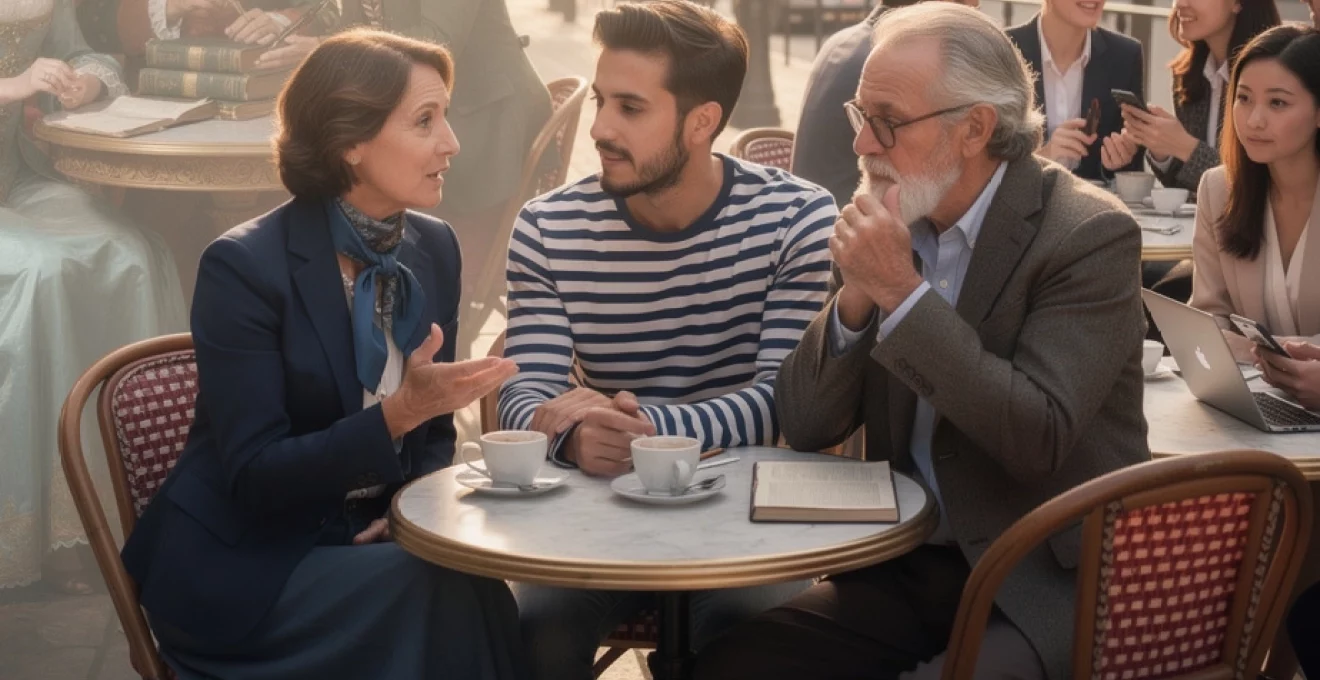
France stands apart in the global cultural landscape as a nation where the art of conversation holds extraordinary significance in shaping social relationships, professional interactions, and cultural identity. From the intimate exchanges shared over lengthy meals to the passionate debates that unfold in neighbourhood cafés, French society has cultivated a sophisticated conversational culture that serves as both a social lubricant and an intellectual proving ground. This deep-rooted emphasis on verbal exchange reflects centuries of historical development, philosophical tradition, and cultural refinement that continues to influence how French people connect, argue, and build meaningful relationships in contemporary society.
Understanding the centrality of conversation in French culture requires recognising that dialogue serves multiple functions beyond mere information exchange. L’art de la conversation operates as a vehicle for intellectual stimulation, social bonding, cultural transmission, and personal validation. Whether navigating the subtle hierarchies of workplace interactions or engaging in spirited political discussions among friends, French conversational practices reveal intricate codes of behaviour that foreign visitors and expatriates must master to achieve genuine social integration.
Historical roots of french conversational culture through salon traditions
The foundations of French conversational excellence trace their origins to the aristocratic salons of the 17th century, where intellectual discourse became both an art form and a social necessity. These gathering spaces transformed casual conversation into a refined cultural practice that would fundamentally shape French social behaviour for generations to come.
Madame de rambouillet’s literary salons and linguistic refinement
Catherine de Vivonne, Marquise de Rambouillet, revolutionised French social interaction by establishing the first truly influential literary salon in early 17th-century Paris. Her chambre bleue became the epicentre of linguistic innovation, where participants engaged in sophisticated wordplay, literary criticism, and philosophical debate. The salon’s emphasis on wit, elegance, and intellectual agility established conversational standards that permeated French society beyond aristocratic circles.
These early salons introduced the concept of préciosité, a cultural movement that elevated language refinement to unprecedented heights. Participants competed to demonstrate verbal dexterity through elaborate compliments, clever repartee, and nuanced expressions that showcased both intelligence and cultural sophistication. This tradition of linguistic excellence became embedded in French educational systems and social expectations, creating a culture where conversational skill signalled social status and intellectual capacity.
Enlightenment discourse practices in parisian café society
The 18th-century Enlightenment transformed French conversational culture by democratising intellectual discourse through the emergence of coffeehouse society. Philosophers like Voltaire, Diderot, and Rousseau frequented establishments where ideas circulated freely among diverse social groups, breaking down traditional barriers between aristocratic salons and popular culture. These spaces fostered critical thinking, rational debate, and the free exchange of revolutionary ideas that would reshape European intellectual traditions.
Parisian cafés became laboratories for developing argumentative techniques that remain characteristic of French conversation today. The emphasis on logical reasoning, evidence-based discussion, and respectful disagreement emerged from these Enlightenment gatherings, where participants learned to separate personal relationships from intellectual positions. This cultural development explains why contemporary French people can engage in passionate debates without damaging friendships, viewing disagreement as intellectual stimulation rather than personal conflict.
Post-revolutionary republican ideals and democratic dialogue
The French Revolution fundamentally altered conversational culture by introducing egalitarian principles into social discourse. Revolutionary assemblies and public forums established new norms for citizen participation in political dialogue, emphasising the importance of eloquence, persuasion, and civic engagement. These democratic ideals transformed conversation from an aristocratic privilege into a republican responsibility, creating expectations that all citizens should develop competence in public speaking and reasoned debate.
Post-revolutionary France witnessed the emergence of cercles républicains and political clubs where ordinary citizens practiced the arts of persuasion and collective decision-making. These institutions reinforced the notion that effective communication serves democratic functions, encouraging French people to develop sophisticated argumentative skills for civic participation. Modern French political discourse retains these republican traditions, explaining the prevalence of philosophical depth and rhetorical complexity in everyday conversations.
Belle époque intellectual exchange in montmartre establishments
By the late 19th and early 20th centuries, this conversational heritage found new expression in the bohemian neighbourhoods of Paris, particularly Montmartre. Artists, writers, and musicians gathered in cabarets, brasseries, and cafés like Le Chat Noir or La Closerie des Lilas, where social life revolved around spirited discussion as much as around artistic production. Conversation functioned as a crucible in which new aesthetic movements—Impressionism, Symbolism, early Modernism—were debated, contested, and refined long before they reached galleries or publishing houses.
These Belle Époque establishments blurred the boundaries between entertainment and intellectual exploration. Satirical songs, improvised monologues, and sharp-tongued critiques were embedded in a broader culture of verbal play and public debate. The informal, often irreverent tone of Montmartre conversation contributed to a distinct French belief that ideas should circulate beyond formal institutions, reinforcing the notion that cafés, bars, and bistros are legitimate spaces for serious reflection, political discussion, and the everyday practice of l’art de la conversation.
Structural elements of french conversational methodology
If salons and cafés provided the historical setting, they also helped define the structural “rules” that still shape French conversation today. French people do not simply talk; they often follow an implicit methodology that combines rhetorical technique, register management, and a finely tuned sensitivity to non-verbal signals. Understanding these patterns is essential if you want to participate fully in French social life and avoid misreading disagreement, silence, or irony.
From the outside, French dialogue can seem like a rapid-fire game where everyone speaks at once and opinions clash. In reality, there is usually an underlying order: how arguments are built, how turns are taken, and how respect is shown or withheld are all encoded in predictable ways. Once you recognise this structure, you can move from being a polite observer to becoming an active partner in French conversations, whether you are at a family dinner, a business meeting, or a neighbourhood apéritif.
Art de la conversation: rhetorical techniques and verbal dexterity
The French conversational style places high value on the ability to argue clearly and elegantly. From secondary school onwards, students learn to construct a structured argument (introduction, développement, conclusion) and to nuance their ideas with connectors such as cependant, en revanche, and pourtant. This training explains why French speakers often treat even casual topics—film, food, public transport—as invitations to develop a mini-essay aloud. For many, a “good conversation” is one where everyone has had the chance to demonstrate both knowledge and rhetorical finesse.
At the same time, verbal dexterity in French is not only about logic; it also depends on wit. Irony, understatements, and clever turns of phrase are prized, particularly in urban, educated milieus. For newcomers, this can feel like entering a fencing match without having mastered the moves. One useful strategy is to focus first on clarity—using simple structures like je pense que… or à mon avis…—and then gradually integrate more nuanced connectors and references. Think of it like learning jazz: you start with the basic melody before attempting improvisation.
Code-switching between formal and informal register systems
Another core element of French conversational methodology is the constant navigation between levels of formality. The tu/vous distinction is the most well-known example, but French also has clear boundaries between elevated, standard, and colloquial registers. Choosing the wrong pronoun or level of vocabulary can instantly change the perceived relationship between speakers. For instance, switching to tu without invitation in a workplace context may be seen as presumptuous, while persisting with vous among peers can suggest distance or lack of warmth.
French speakers often engage in subtle code-switching even within the same interaction. A manager might begin a meeting using vous and relatively formal language, then slide into tu and colloquialisms over lunch with the same colleagues. For expatriates, a good rule of thumb is to start more formal and wait for your interlocutor to signal a shift, often explicitly with on peut se tutoyer ? or implicitly by adopting a more relaxed tone. Over time, you will notice that mastering register in French conversation is less about memorising rules and more about reading context and mirroring the other person’s style.
Non-verbal communication patterns in french social interaction
Because France is considered a relatively “high-context” culture, meaning and intention are not carried by words alone. Eye contact, posture, hand gestures, and physical distance all provide additional information about how a message should be interpreted. Direct eye contact, for example, is typically understood as a sign of attention and respect rather than aggression. Avoiding someone’s gaze while they speak may be interpreted as disinterest or discomfort, even if your words are polite.
Gestures and facial expressions also play a specific role. A raised eyebrow, a slight shrug, or the characteristic bof sound can communicate scepticism or ambiguity more efficiently than a long explanation. Touch, on the other hand, tends to be reserved for people with whom you have some familiarity, despite the ritual of the bise. As a general guide, imagine non-verbal signals as the subtitles of a French conversation: you can technically follow the plot without them, but you will miss much of the humour, nuance, and emotional colour if you ignore what is happening beyond the words.
Turn-taking protocols and interruption dynamics
To many visitors, French conversations seem marked by frequent interruptions and overlapping speech. Yet what might appear as rudeness in a low-context culture is often a sign of engagement in France. Cutting in briefly to challenge a point, complete a sentence, or offer an example can indicate that you are following closely and eager to contribute. That said, there is an unspoken distinction between enthusiastic interjection and monopolising the floor; constantly talking over others without leaving them space tends to be frowned upon.
Turn-taking in French social life often resembles a lively dance rather than a strict queue. People may signal their intention to speak with small verbal markers like juste, attends, or non mais, then quickly make their point before yielding again. If you are less confident in French, you can claim your space with simple phrases such as je peux ajouter quelque chose ? or si je peux me permettre…. Over time, you will sense that the goal is not to speak the longest, but to contribute something relevant, well-formulated, and ideally a little original.
Contemporary french social spaces and conversational hierarchies
While the historical salon has largely disappeared, its spirit survives in the way contemporary French social spaces structure interaction. From the family dining table to the company cantine, each setting comes with its own conversational expectations and hierarchies. Seating arrangements, who speaks first, and which topics are considered appropriate all reflect subtle but persistent social norms that can affect how integrated you feel.
In many families, for example, meals are still seen as key moments for discussion rather than mere refuelling. Children are encouraged to express opinions, but adults often set the rhythm and topics of conversation. In professional environments, hierarchy continues to matter: senior figures may talk more, initiate debates, and close conversations, while younger or junior participants are expected to show deference through attentive listening and carefully phrased interventions. Recognising these patterns helps you adapt your level of assertiveness so that you do not appear either excessively submissive or inappropriately bold.
Digital transformation of french conversational practices
The rise of digital communication has not diminished the importance of conversation in French social life; instead, it has transplanted many of its rules and rituals into new spaces. WhatsApp groups, SMS exchanges, and social media platforms now host a significant share of everyday dialogue, but written messages still carry expectations of style, humour, and subtlety. While the contexts have changed, the underlying French appreciation for well-crafted expression and spirited exchange remains recognisable.
At the same time, digital tools have introduced new forms of hierarchy and inclusion. Being added to a private group chat, invited to comment on a colleague’s LinkedIn post, or tagged in an Instagram Story can all signal degrees of closeness or professional recognition. For expatriates, understanding these online gestures is just as important as interpreting a bise or a shift from vous to tu in face-to-face interactions. The digital sphere is now an extension of the same conversational culture rooted in cafés and salons.
Whatsapp and sms language evolution in french social networks
On messaging apps and SMS, French speakers often adopt a hybrid language that mixes standard spelling with abbreviations and oral forms. Expressions like coucou, ça va ?, or mdr (mort de rire) appear alongside more carefully composed messages, depending on the relationship and context. Punctuation carries emotional weight: multiple exclamation marks can signal enthusiasm, while a short, perfectly punctuated reply may come across as distant or formal. For many French people, texting is an extension of spoken conversation, not a separate mode of communication.
Interestingly, the same concern for nuance and register seen in offline conversation persists in digital form. You will notice different tones between a family WhatsApp group, a chat with close friends, and a semi-professional group of colleagues organising after-work drinks. As a newcomer, you can learn a lot by observing how others write: do they use emojis sparingly or frequently? Do they drop accents or keep them? Mirroring this style—without forcing slang you do not fully understand—is a practical way to integrate and avoid misunderstandings in French digital conversations.
Linkedin professional networking etiquette among french business leaders
In the professional sphere, LinkedIn has become a key arena for French conversation, especially among executives, consultants, and academics. Yet even here, national preferences are visible. Long-form posts that develop a clear argument, draw on data, and offer a personal perspective tend to perform well, reflecting the broader French taste for reasoned discourse. Comments often include constructive disagreement, phrased diplomatically but directly, as professionals use the platform to showcase their capacity for critical thinking.
Networking etiquette on French LinkedIn also follows specific patterns. Cold messages that are overly informal or obviously transactional may be ignored, whereas a brief, respectful note explaining a shared interest or connection has a higher chance of success. When you engage with a French leader’s content, adding a thoughtful comment—rather than a simple “great post”—demonstrates that you value the exchange of ideas, not just the opportunity for visibility. In that sense, even digital networking is still rooted in the same conversational ideals that drove debate in Enlightenment cafés.
Instagram stories and casual french communication patterns
On more visual platforms like Instagram, conversation takes a lighter, more playful form, yet words still matter. French users often pair images or Stories with witty captions, cultural references, or understated jokes that require shared background knowledge to fully appreciate. Private replies to Stories—through quick reactions or short messages—have become a new way of maintaining low-intensity contact, similar to a brief greeting in the street or a passing comment at the bakery.
For younger generations in particular, Instagram and similar platforms serve as a continuous conversational thread that complements offline interaction. A friend might tease you online about your football team’s defeat, then continue the discussion in person the next day. The alternation between humour, irony, and sincerity that characterises traditional French conversation is alive and well in these digital exchanges, even if the medium has shifted from café tables to smartphone screens.
Regional variations in french conversational customs across metropolitan areas
Although national norms exist, conversational styles in France also show notable regional differences. The stereotype of the reserved Parisian and the exuberant southerner contains a grain of truth, shaped by local history, climate, and social habits. Understanding these variations can help you adjust expectations when travelling within the country and avoid assuming that one interaction style represents all of “French culture.”
In the north and in large cities, interaction may initially feel more formal and brisk. People might be less inclined to small talk with strangers, but conversations among friends can quickly become deep and analytical. In the south, especially along the Mediterranean coast, everyday exchanges—at markets, in cafés, on terraces—are often more expansive and emotional. Here you may find it easier to start conversations, but that does not necessarily mean intimacy develops faster. Across regions, however, the underlying appreciation for debate, story-telling, and well-turned phrases remains a shared national thread.
Cross-cultural communication challenges for expatriates in french society
For expatriates, integrating into French social life often means navigating a complex web of expectations about how to speak, disagree, and show interest. Misunderstandings rarely stem only from vocabulary or grammar; more often, they arise from different cultural assumptions about what “good conversation” looks like. Recognising these gaps is the first step toward bridging them. Rather than seeing French style as cold or combative, you can start to view it as a distinct conversational code—one that becomes rewarding once you learn how it works.
Many newcomers, for example, are surprised when a French colleague openly challenges their idea in a meeting but is perfectly friendly at coffee break. Others feel unsettled when personal questions are scarce at the beginning of a relationship, interpreting this as disinterest rather than respect for privacy. By reframing these experiences through the lens of French conversational culture, you can reduce frustration and build more resilient, mutually satisfying relationships.
Anglo-saxon direct communication versus french diplomatic discourse
Speakers from Anglo-Saxon cultures such as the UK, the US, or Australia often regard themselves as “direct,” expecting clarity and efficiency in professional and social dialogue. Yet French directness operates differently: while people do not hesitate to criticise ideas, they tend to wrap evaluations in more elaborate phrasing, sometimes using irony instead of straightforward statements. This can lead to confusion. An English-speaking manager might think they have been clear, while French colleagues perceive the message as abrupt or lacking nuance.
Conversely, when French interlocutors engage in extended critique of a proposal, Anglo-Saxon professionals may interpret this as hostility or obstruction. In reality, probing weaknesses and debating alternatives is often a way of showing involvement and taking the matter seriously. A useful strategy is to adopt a slightly more explicit style than the French norm—signposting your intentions clearly (je critique l’idée, pas la personne)—while also accepting that disagreement is part of the process, not necessarily a sign of conflict.
German precision-based dialogue adaptation in franco-german business relations
In Franco-German business relations, another contrast emerges. German communication is frequently associated with precision, structure, and a preference for thorough preparation before discussion. French partners, by comparison, may appear more comfortable with ambiguity and improvisation, using meetings as spaces to explore possibilities through conversation rather than to ratify pre-agreed decisions. This difference in expectations can create tension if not acknowledged.
Successful Franco-German teams often blend strengths from both sides. Germans may appreciate the creative potential of open-ended debate once they understand its function, while French professionals can learn to provide clearer summaries and action points after discussion. If you come from a precision-oriented culture, it can help to treat French conversational meandering like the “draft” phase of a document, where ideas circulate freely before they are edited into a more concrete plan.
Mediterranean expressiveness integration in southern french conversational norms
In southern France, particularly in regions influenced by Mediterranean culture such as Provence and Occitanie, conversation tends to be more animated and expressive. Volume may be higher, gestures broader, and interruptions more frequent, especially in family settings or among friends. For visitors from more reserved cultures, this intensity can be misread as anger or conflict, when it often simply reflects enthusiasm and involvement.
At the same time, the Mediterranean influence encourages a strong culture of hospitality and everyday sociability: exchanging a few words with neighbours, shopkeepers, or strangers in a queue is more common than in some northern regions. If you relocate to the south, embracing these frequent micro-conversations—at the bakery, market, or café—can be a powerful way to build social networks. Think of each brief exchange as a small investment in belonging, even if the topics seem trivial at first.
Asian hierarchical communication protocols within french academic institutions
Students and professionals from many Asian cultures, where hierarchy and face-saving are central to communication, may face specific challenges in French academic and workplace settings. In universities, for example, professors often expect students to question arguments, express disagreement, and participate actively in debate. For someone raised in a system where contradicting a teacher is seen as disrespectful, this can feel risky or inappropriate, even when explicitly encouraged.
Within French institutions, however, respectful challenge is usually interpreted as engagement rather than insubordination. One way to navigate this tension is to use softening phrases—je ne suis pas tout à fait d’accord, je me demande si…—that allow you to introduce a different point of view without appearing confrontational. Over time, you may even find that this style of interaction increases your academic or professional credibility, as it signals that you are not just absorbing information but actively contributing to the shared conversation that lies at the heart of French social life.