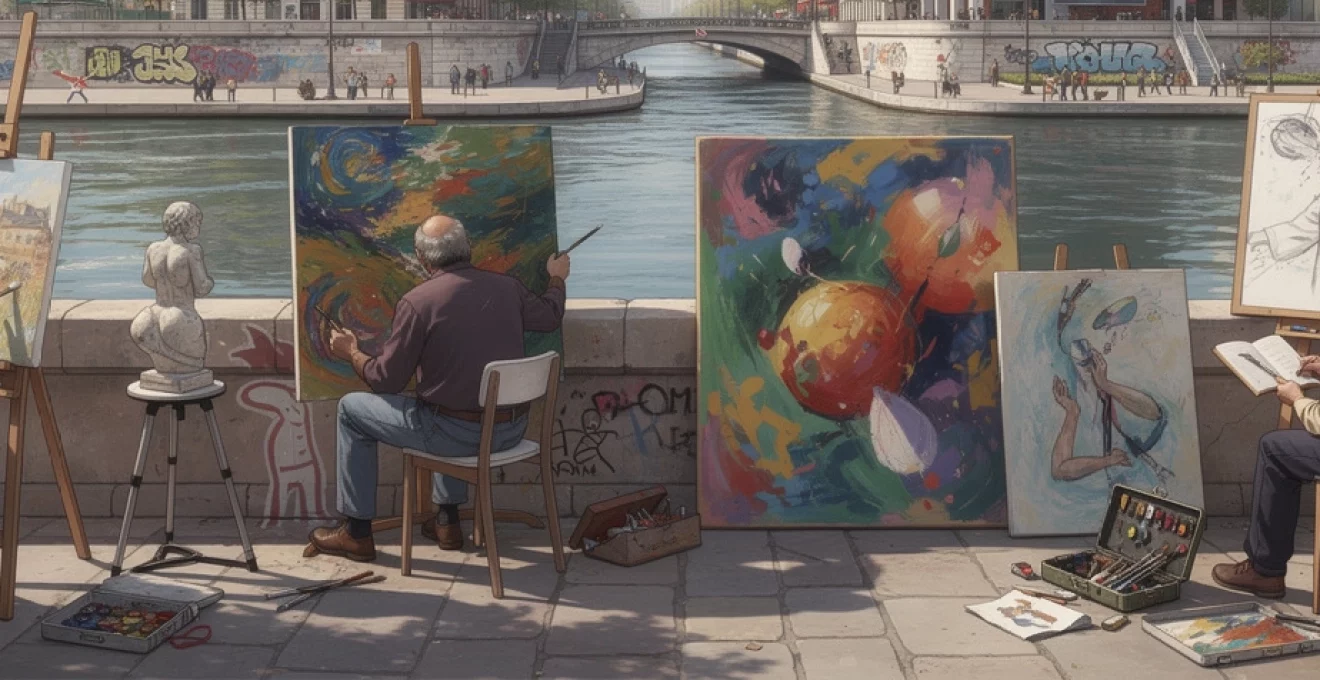
Paris has maintained its position as a global artistic beacon for over two centuries, drawing creative minds from every corner of the world with an irresistible combination of historical legacy, architectural beauty, and cultural vibrancy. The city’s unique luminosity, described by countless observers as otherworldly, stems from its distinctive limestone buildings that create what locals call the “Parisian light” – a soft, diffused glow that has captivated painters since the Impressionist era. Beyond its visual appeal, Paris offers an unparalleled ecosystem of artistic institutions, residency programmes, and creative networks that continue to nurture both emerging talents and established masters. From the cobblestone streets of Montmartre to the contemporary galleries of the Marais, the French capital remains a living laboratory where artistic movements are born, evolve, and transform the global cultural landscape.
Historical artistic movements that established paris as europe’s cultural epicentre
The artistic supremacy of Paris didn’t emerge overnight but developed through centuries of revolutionary movements that fundamentally changed how we understand and create art. The city’s transformation under Baron Haussmann in the 19th century created not just new boulevards and buildings, but entirely new ways of seeing and depicting urban life. This urban renewal coincided with artists’ growing desire for independence from traditional academic constraints, leading to some of the most significant artistic breakthroughs in history.
Impressionism’s birth in montmartre and the batignolles quarter
The Impressionist movement emerged from the very fabric of Paris itself, with the 1874 exhibition at 35 Boulevard des Capucines marking a pivotal moment in art history. When Claude Monet, Pissarro, Degas, and Renoir staged their independent exhibition, they weren’t merely rebelling against the Académie des Beaux-Arts – they were responding to the changing nature of Parisian life itself. The newly constructed Grands Boulevards provided both the subject matter and the viewing conditions that made Impressionism possible.
Monet’s fascination with Saint-Lazare station exemplifies this connection between urban transformation and artistic innovation. His bold request to the station master to generate maximum steam for his paintings demonstrates the collaborative spirit between Parisian life and art. The Batignolles district, where many Impressionists lived and worked, offered the perfect balance of urban energy and artistic community that fostered their revolutionary techniques.
Post-impressionist revolutionary techniques from Pont-Aven school influences
Following the Impressionist breakthrough, Paris became the launching pad for Post-Impressionist innovations that would reshape modern art. Artists like Paul Gauguin, who spent time in Brittany’s Pont-Aven, brought their experimental techniques back to Parisian studios and galleries. This cross-pollination between provincial experimentation and metropolitan exhibition created a dynamic cycle of artistic evolution that positioned Paris as the ultimate arbiter of artistic merit.
The Post-Impressionist movement demonstrated Paris’s ability to absorb, refine, and disseminate artistic innovations from across France and beyond. The city’s network of galleries, critics, and collectors provided the infrastructure necessary to transform regional experiments into international movements. This pattern of provincial innovation and Parisian validation became a template that continues to influence contemporary art markets today.
Fauvism and expressionist developments in Bateau-Lavoir studios
The legendary Bateau-Lavoir studios in Montmartre became the crucible for some of the most radical artistic experiments of the early 20th century. Artists like Henri Matisse and André Derain developed Fauvism’s bold colour palette in these cramped, poorly heated spaces that nevertheless sparked revolutionary artistic breakthroughs. The communal nature of these studios created an atmosphere of constant experimentation and mutual influence that would be difficult to replicate elsewhere.
These Montmartre studios also witnessed the birth of Cubism, with Picasso’s Les Demoiselles d’Avignon marking another seismic shift in artistic representation. The concentration of talent in such a small geographic area created an intensity of creative exchange that transformed not just individual artists but entire artistic movements. This model of artistic community would later inspire artist quarters and creative districts worldwide.
Surrealist manifestos and andré
Surrealist manifestos and andré breton’s parisian literary salons
When we turn from the Bateau-Lavoir to the cafés of the Left Bank, we see how Paris also became the nerve centre of literary and philosophical experimentation. André Breton, often called the “Pope of Surrealism”, used Parisian cafés, bookshops, and small galleries as stages for his revolutionary ideas. In 1924, the first Manifeste du surréalisme was drafted in Paris, redefining art and literature as tools to access the unconscious rather than to imitate reality. These manifestos, circulated through Paris’s dense network of reviews and salons, turned the city into a laboratory for dreams, chance encounters, and automatic writing.
Breton’s salons – part reading group, part performance, part political cell – attracted a circle that included Salvador Dalí, Max Ernst, Man Ray, and many others who made Paris their base. Here, painters debated poets, photographers challenged philosophers, and new alliances formed overnight, often over a single phrase or image. The Surrealists roamed the arcades, backstreets, and riverbanks of Paris as if they were walking through a collective subconscious, treating the city like a living text to be decoded. Their Paris was not only a backdrop but a co-author, and that collaborative relationship between place and imagination still attracts artists who come to the city seeking similar collisions between reality and fantasy.
Contemporary urban architecture and spatial design elements attracting modern creatives
If the historic avant-gardes established Paris as a cultural capital, contemporary architecture and urban design continue to make it a magnet for artists and designers today. The city has mastered a delicate balance: preserving its Haussmannian heritage while embracing bold, experimental structures that speak to the 21st century. This layered urban fabric offers endless visual cues, from razor-straight boulevards to industrial museums and repurposed rail lines. For many creatives, working in Paris feels like inhabiting a three-dimensional sketchbook, where every street corner suggests a new composition, installation, or narrative.
Urban planners in Paris have also prioritised public space in ways that directly influence creative practice. Projects such as the pedestrianisation of riverbanks and the transformation of disused infrastructure into cultural corridors give artists fresh arenas for intervention. These spaces are not only aesthetically compelling; they provide practical platforms for site-specific performances, outdoor exhibitions, and ephemeral works. In a global context where many cities are becoming visually homogenised, Paris’s urban design remains distinctive, offering what you might call an “open-air studio” to anyone willing to look closely.
Haussmannian boulevard systems creating visual perspective lines
Baron Haussmann’s 19th-century redesign gave Paris its iconic grid of boulevards, radiating from key monuments and squares. For visual artists, these boulevards act like ready-made perspective studies: long, vanishing lines bordered by uniform façades in pale limestone, punctuated by the dark silhouettes of trees and street lamps. Painters and photographers often describe walking along Boulevard Saint-Germain or Boulevard Haussmann as akin to moving through a carefully storyboarded film sequence. The rhythm of balconies, cornices, and rooftops becomes a kind of architectural metronome, stabilising even the busiest street scene.
These grand axes also shape how artists conceptualise movement and time in their work. Think of them as visual conveyor belts: people, cars, and light all streaming along the same carefully drawn lines. Contemporary photographers and filmmakers exploit this built-in geometry to frame urban narratives, from street fashion editorials to experimental video art. For an artist arriving from a less structured city, Paris’s boulevards can feel like pre-drafted canvases, where the composition is already half-solved before the first sketch. This marriage of order and spontaneity – straight lines filled with unpredictable life – is a key reason why Paris continues to inspire visual storytellers.
Centre pompidou’s industrial aesthetic influencing installation art
When the Centre Pompidou opened in 1977, its radical “inside-out” design shocked many Parisians. Today, its exposed pipes, colour-coded ducts, and structural skeleton have become an emblem of contemporary Paris. For installation artists and architects, the building is more than a museum; it is a manifesto in steel and glass, proving that infrastructure itself can be aesthetic. The Pompidou’s industrial aesthetic has encouraged generations of artists to reconsider the relationship between artwork, display systems, and the surrounding architecture.
Inside, vast, flexible gallery spaces allow for ambitious large-scale installations that would be impossible in more traditional settings. Curators frequently invite artists to respond directly to the building’s structure, blurring the line between exhibition and environment. This has helped establish Paris as a city where installation art, multimedia works, and digital art can be shown at their full scale and complexity. For younger practitioners in particular, the Pompidou acts like a giant toolbox, suggesting new ways to integrate sound, light, and technology into their work. It’s no coincidence that many artists cite their first visit to the Pompidou as the moment they realised just how expansive contemporary practice could be.
Seine riverbank typography and street art integration zones
The Seine is more than a postcard view; it is a living corridor of artistic expression. Over the past decade, the pedestrian-friendly banks – particularly around the Rive Gauche and Rive Droite quays – have become informal galleries where graphic designers, muralists, and typographers experiment with scale and context. Large-scale lettering painted onto quay walls, stencilled poetry on steps, and discreet murals beneath bridges all turn the riverbanks into a constantly evolving visual essay. For artists interested in urban calligraphy or experimental typography, the Seine offers a rare chance to see text integrated directly into the everyday flow of the city.
In addition, designated street art zones along canals and underpasses create legal frameworks where muralists and graffiti artists can work without fear of erasure. These zones, often developed in partnership with the city and local associations, encourage collaboration between international street artists and Paris-based collectives. The result is a visual dialogue that changes month to month, like a palimpsest of global styles layered over the city’s historic stone. For visitors and residents alike, a simple walk along the river can become a crash course in contemporary visual languages – a reminder that in Paris, art is not confined to museum walls.
Marais district’s medieval-modern architectural juxtaposition techniques
Nowhere is Paris’s architectural dialogue between past and present more evident than in the Marais. Here, medieval lanes and Renaissance hôtels particuliers coexist with sleek galleries, concept stores, and contemporary design studios. For artists, this juxtaposition is fertile ground: the worn stone archways and irregular courtyards provide textural counterpoints to white-cube interiors. Exhibitions in the Marais often play with this contrast, using minimalist installations to frame and re-interpret centuries-old details like carved lintels or vaulted cellars.
This layered environment also encourages experimental curatorial approaches. You might enter a 17th-century townhouse to find a video installation projected across a cracked stucco wall, or a sound piece echoing through a centuries-old stairwell. Such experiences remind us that context can transform content, just as a frame changes a painting. For creatives working in architecture, spatial design, or exhibition-making, the Marais functions as a real-world case study in adaptive reuse and narrative space. It demonstrates how you can honour historical fabric while still pushing aggressively forward – a lesson that many artists carry into their own practices after time spent in Paris.
Institutional infrastructure supporting international artist residencies and exhibitions
Alongside its inspiring streetscapes, Paris offers a dense ecosystem of institutions that actively support international artists. Residencies, academies, and museums here don’t simply showcase finished work; they provide space, time, and resources for experimentation. For many creatives, this is what turns a short visit into a long-term relationship with the city. When you know there are organisations ready to mentor, fund, and exhibit your work, Paris becomes less of a dream destination and more of a practical base for building a sustainable artistic career.
Over the past decade, international demand for residencies in Paris has grown significantly, with application numbers at major institutions rising year on year. This reflects not only the city’s prestige but also a broader global shift toward project-based, cross-border careers in the arts. Parisian institutions have responded by refining their selection processes, diversifying their cohorts, and forging partnerships with organisations from North America, Asia, Africa, and the Middle East. The result is a cosmopolitan community in which artists can test ideas across cultures in real time.
Cité internationale des arts fellowship programme structure
The Cité Internationale des Arts, located in the Marais and near the Île Saint-Louis, is one of the largest artist residency complexes in the world. Hosting more than 1,000 artists each year from over 90 countries, it operates like a vertical village of studios, rehearsal rooms, and common spaces. Its fellowship programmes combine private workspaces with shared resources such as printmaking workshops, sound studios, and exhibition halls. For many residents, the ability to step out of their studio and into a courtyard conversation with a choreographer or composer is as valuable as the physical space itself.
The structure of the Cité’s fellowships emphasises both autonomy and integration. Artists usually receive a dedicated studio-apartment for periods ranging from a few months to a year, often supported by funding from their home countries or partner foundations. Regular open-studio events, talks, and internal exhibitions encourage residents to share works-in-progress rather than simply presenting polished outcomes. For someone considering a move to Paris, securing a place at the Cité can be a strategic way to build networks, test how their practice resonates in a new context, and gain visibility among curators and critics who frequently visit the complex.
Villa medici academy’s cross-cultural exchange methodologies
While the Villa Medici itself is in Rome, its historical and ongoing links to Paris are crucial for understanding how French institutions think about artistic exchange. The French Academy in Rome traditionally welcomed laureates of the prestigious Prix de Rome, many of whom trained in Paris before departing. Today, the Villa Medici’s programmes still operate in close dialogue with French cultural policy, making it part of a broader network that connects Paris-based institutions with international research and production. In this sense, Paris doesn’t see itself as an isolated capital but as one node in a constellation of creative centres.
The methodologies developed through the Academy – long-term residencies, interdisciplinary cohorts, and structured mentorship – have directly influenced how Parisian programmes are designed. Many Paris-based residencies now adopt similar models, pairing studio time with critical seminars, public presentations, and collaborative projects. For artists, this approach can feel like an extended, practice-led laboratory, where theoretical input and hands-on experimentation are interwoven. If you are looking to situate your work within European discourses while maintaining strong ties to your home context, this Franco-Italian framework offers a compelling blueprint.
Palais de tokyo contemporary art production facilities
The Palais de Tokyo, overlooking the Seine near Trocadéro, is one of Europe’s largest sites devoted to contemporary art. Unlike a traditional museum, it often functions as a production facility as much as an exhibition space. Artists invited to show here typically develop site-specific works with the support of in-house technical teams, curators, and fabricators. For large-scale sculpture, immersive installations, or experimental performance, having access to this infrastructure can be transformative. It’s a bit like moving from a home studio to a fully equipped film set, with specialists on hand to help realise ambitious ideas.
The Palais de Tokyo also offers residency programmes, commissioning opportunities, and mentorship schemes for emerging artists and curators. These initiatives are designed to integrate international voices into the heart of Paris’s contemporary art scene, rather than relegating them to peripheral spaces. If you’re considering exhibiting in Paris, keeping an eye on open calls and curated programmes here can be a strategic move. Even when your work is not on the walls, the institution’s public talks, performances, and late-night openings make it an ongoing classroom for anyone interested in the latest developments in global contemporary art.
FIAC and art basel paris international market access opportunities
For artists and galleries concerned with the commercial side of the art world, Paris’s major fairs are crucial gateways. The historical FIAC (Foire Internationale d’Art Contemporain), now integrated into the Art Basel ecosystem as Art Basel Paris, has further cemented the city’s role in the global market. Each October, tens of thousands of collectors, curators, and journalists converge on venues like the Grand Palais to survey the latest offerings. For an artist, being represented by a gallery at Art Basel Paris can mean instant international visibility and access to top-tier buyers.
What makes these fairs especially important is their ecosystem effect. Satellite fairs, pop-up exhibitions, and off-site projects multiply across the city during fair week, giving emerging artists chances to piggyback on the influx of visitors. Galleries from Seoul, São Paulo, Cape Town, and beyond use Paris as a neutral meeting point to test new markets and build relationships with European institutions. For you as an artist or arts professional, planning your visit to coincide with Art Basel Paris can be a smart way to compress months of networking into a few focused days. It’s also a practical reminder that in Paris, cultural prestige and market access often go hand in hand.
Light quality and atmospheric conditions enhancing visual art creation
Artists have long spoken about the “Parisian light” as if it were a medium in its own right. This is not mere romanticism: the city’s pale limestone façades, reflective zinc roofs, and relatively temperate climate create a unique luminosity. Light here tends to be soft and diffused rather than harsh, making subtle tonal variations easier to perceive and capture. For painters, photographers, and filmmakers, working in Paris often means discovering new gradations of grey, cream, and blue that simply don’t appear in the same way elsewhere. It’s a bit like switching from a standard-definition screen to high-definition; the underlying reality hasn’t changed, but your perception of detail is sharper.
Seasonal shifts in Paris also offer a rich palette of atmospheres. Winter days may be short, but the low sun and frequent overcast skies produce delicate, even illumination that many artists find ideal for studio work or portrait photography. In summer, late sunsets and long golden hours bathe the city in warm, cinematic tones, perfect for plein air painting along the Seine or in the Jardin du Luxembourg. The city’s layout amplifies these effects: wide boulevards capture and reflect light across their surfaces, while narrow medieval streets in areas like the Latin Quarter create dramatic chiaroscuro. If you’re planning a project in Paris, thinking about how light changes over the day and across the seasons can be as important as choosing your location.
Cultural cross-pollination networks within parisian creative districts
One of Paris’s greatest strengths is the way it concentrates diverse creative communities into walkable districts. Neighbourhoods like Belleville, Pigalle, the 11th arrondissement, and the northern edges of the Marais host dense networks of studios, co-working spaces, rehearsal rooms, and small galleries. In these districts, you’re rarely more than a few minutes’ walk from another artist-run space or café where musicians, writers, architects, and designers gather. This density encourages what we might call “creative osmosis”: ideas and methods seep from one discipline to another almost without planning. A conversation that starts about set design in a theatre bar can easily drift into questions of urban planning or sound art.
International artists, in particular, benefit from this cross-pollination. Many collaborative projects begin informally, perhaps at an opening or residency potluck, and evolve into longer-term initiatives that span multiple cities. Paris’s position as a hub for students and practitioners from Africa, the Middle East, Asia, and the Americas means that these networks are truly global in scope. If you’re new to the city, one practical tip is to anchor yourself in a specific district – by renting a studio, joining a shared workspace, or attending regular events – rather than trying to be everywhere at once. Over time, your local connections will naturally branch out into a wider web, mirroring the way ideas themselves travel across the metropolis.
Economic ecosystem supporting emerging and established international artists
Behind the visible glamour of museums and fairs, Paris sustains a complex economic ecosystem that helps both emerging and established artists build viable careers. Public funding plays a significant role: national and municipal grants, commissions for public art, and support for festivals and biennials all inject resources into the cultural sector. At the same time, a robust private market – from blue-chip galleries around Avenue Matignon to experimental spaces in the 18th and 20th arrondissements – offers multiple entry points for artists at different stages. This layered system can feel intricate, but it also means there isn’t just one path to success.
For those starting out, smaller galleries, artist-run spaces, and municipal art centres often provide the first opportunities to exhibit and sell work. Many of these organisations operate on hybrid models, combining sales income with public subsidies or membership schemes, which allows them to take risks on lesser-known artists. Established practitioners, by contrast, may work with major galleries that can position them at international fairs, negotiate museum acquisitions, and arrange institutional exhibitions. For both groups, Paris’s network of curators, critics, and cultural entrepreneurs functions like an invisible scaffolding, connecting creative labour to audiences and patrons around the world.
Of course, the economic reality of living and working in Paris presents challenges, especially when it comes to studio rents and housing costs. To address this, the city and various non-profit organisations have developed initiatives such as subsidised studio complexes, co-operative workspaces, and time-limited occupation of vacant buildings. As an artist, approaching Paris with a clear strategy – researching residency options, potential funding sources, and neighbourhoods that align with your budget – can make the difference between a short, expensive stay and a sustainable, long-term engagement. In many ways, the city functions like a demanding but generous patron: it asks for commitment and resilience, but in return it offers unparalleled exposure, community, and inspiration to those who choose to make it part of their creative journey.