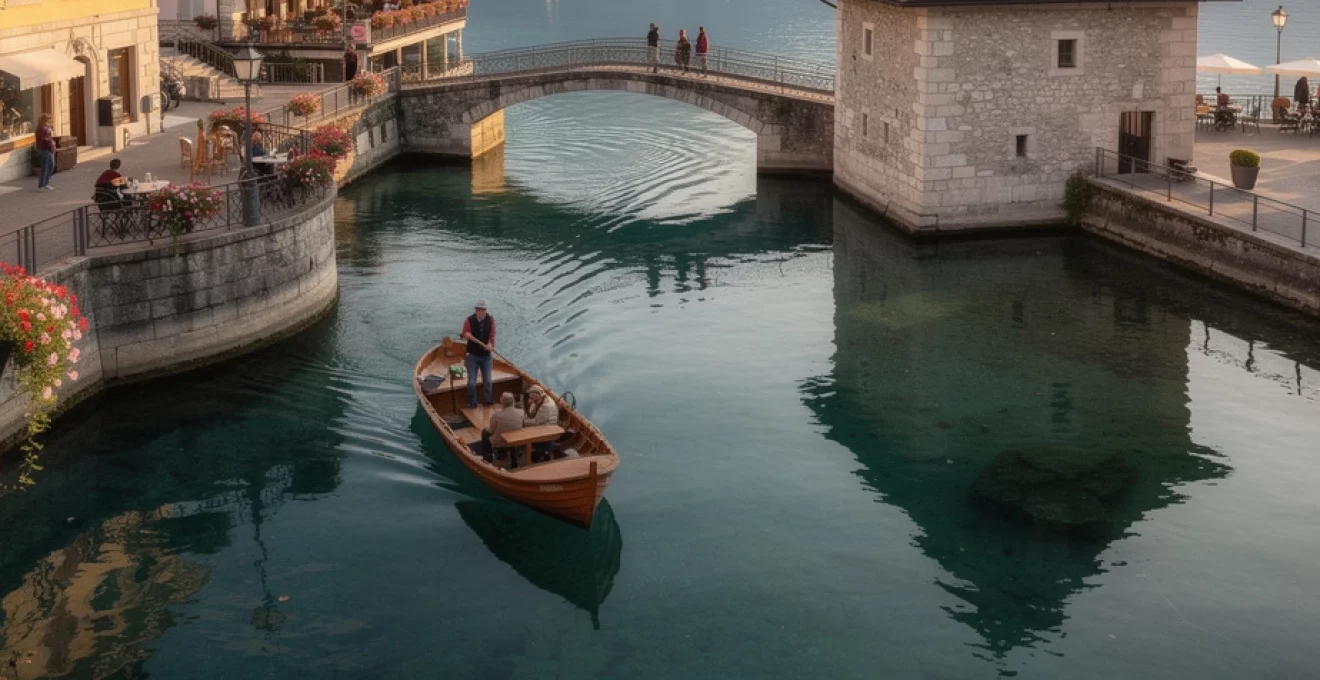
Nestled in the heart of France’s Haute-Savoie region, Annecy has earned a romantic sobriquet that captures the imagination of travellers worldwide: the “Venice of the Alps.” This alpine gem, with its crystalline lake and labyrinthine canal system, presents an enchanting paradox—a medieval mountain town where water flows through cobblestone streets, creating scenes reminiscent of Italy’s famous lagoon city, yet surrounded by snow-capped peaks rather than the Adriatic Sea. The comparison is more than mere marketing hyperbole; it reflects centuries of urban development shaped by waterways, a commitment to architectural preservation, and a unique geographical position that has made Annecy one of Europe’s most photographed destinations. Understanding why this French alpine town bears such a prestigious comparison requires exploring its medieval origins, distinctive hydraulic geography, and the cultural forces that have cemented its identity as a water-bound jewel in the mountains.
Historical origins of annecy’s venetian comparison
The foundations for Annecy’s eventual comparison to Venice were laid centuries before anyone coined the phrase “Venice of the Alps.” The town’s relationship with water began as a practical necessity, evolving over time into the defining characteristic that would shape its identity and international reputation.
Medieval canal system development along the thiou river
The medieval development of Annecy’s canal system represents a masterclass in hydraulic urban planning. Unlike Venice, where canals served primarily as transportation arteries through a lagoon settlement, Annecy’s waterways emerged from the natural flow of the Thiou River, which connects Lake Annecy to the broader Rhône watershed. Medieval engineers recognized the strategic and economic value of this natural watercourse, gradually channelling and dividing it to create multiple branches that could power mills, facilitate trade, and provide fresh water throughout the growing settlement. These early hydraulic interventions established the pattern of water-centred development that would define the town’s character for centuries to come.
By the 13th century, the canal system had become sufficiently complex to support a thriving artisanal economy. Tanners, dyers, and millers established workshops along the water channels, relying on the consistent flow and exceptional purity of the alpine-fed water for their crafts. This industrial heritage left an indelible mark on the urban fabric, with buildings constructed directly over or alongside the canals—a configuration that inadvertently created the picturesque waterside scenes that now draw millions of visitors annually.
12th century urban planning and waterway architecture
The 12th century witnessed critical developments in Annecy’s urban structure that would establish its distinctive character. During this period, the town’s layout began to reflect a sophisticated understanding of hydraulic engineering, with water management integrated into the very foundations of urban planning. The construction of channels and weirs to control water flow demonstrated technical expertise that rivalled contemporary developments elsewhere in medieval Europe. What distinguished Annecy’s approach was the integration of these functional waterways into the residential and commercial fabric of the town, rather than relegating them to industrial peripheries.
Architectural innovations during this era included the construction of buildings with foundations directly in the water channels, creating the distinctive canal-side structures that now characterize the Vieille Ville (Old Town). These weren’t merely practical constructions but reflected aesthetic sensibilities that valued proximity to flowing water. Stone bridges with Gothic arches began connecting different quarters of the town, establishing crossing points that would become landmarks in their own right. The visual effect—cobblestone streets intersecting with flowing canals beneath medieval bridges—created an urban landscape that, while serving practical purposes, possessed an undeniable romantic quality.
The role of the counts of geneva in shaping annecy’s aquatic infrastructure
The Counts of Geneva played a pivotal role in transforming Annecy from a modest lakeside settlement into a fortified town with sophisticated water infrastructure. When religious disputes expelled them from Geneva in the 12th century, they established Annecy as their new seat of power, initiating construction of the Château d’Annecy on the hillside overlooking the town and lake. This political transition brought investment, architectural ambition, and administrative organization that accelerated urban development.
Under the patronage of these noble families,
urban projects focused on controlling and exploiting water became a priority. Defensive moats were enhanced, canals were redirected to feed cisterns and fountains, and new channels were dug to supply the nascent bourgeois houses and religious institutions. The Counts understood that mastery of water meant both security and prosperity, and they encouraged the creation of mills, workshops, and markets along the Thiou. Over time, this deliberate policy turned Annecy into a showcase of medieval hydraulic design, where political power, commercial activity, and everyday life all revolved around the controlled presence of water.
As Annecy expanded under their rule and later under the House of Savoy, the town’s aquatic infrastructure was continually refined. Flood risks had to be mitigated, especially during spring thaws from the surrounding Alps, and intricate systems of sluices and weirs were developed to regulate water levels. These technical adjustments, though invisible to most modern visitors, allowed the canals to remain both functional and aesthetically pleasing. They also contributed to the impression of a city that seems to float between lake and mountains—an image that would later fuel the comparison with Venice. In a sense, the Counts of Geneva did for Annecy what the doges did for Venice: they built a political capital whose identity was inseparable from the water that sustained it.
Evolution from fortified lake settlement to romantic destination
Initially, Annecy’s strategic position at the outlet of Lake Annecy made it above all a fortified lake settlement. Ramparts, watchtowers, and the imposing Château d’Annecy underscored its role as a defensive stronghold on key trade routes between France, Switzerland, and Italy. The canals and river branches were part of this defensive system, acting as natural barriers that hindered potential invaders while feeding moats and ditches. Water, at this stage, was more a shield and a source of power than an object of contemplation. Yet even then, chroniclers noted the charm of the setting, where clear alpine waters contrasted with stone fortifications.
From the 18th and especially the 19th century onward, as warfare receded from the town’s immediate horizon, Annecy began to reinvent itself as a place of leisure and contemplation. The Romantic movement, with its fascination for dramatic landscapes and medieval ruins, played a key role in this transformation. Travellers and writers started to celebrate the picturesque bridges, flower-decked balconies, and reflections of pastel façades in the canals. The very infrastructure once designed for defence and industry became the backdrop for promenade culture, lakeside gardens, and open-air cafés. By the time early tourists began to circulate the phrase “Venice of the Alps,” Annecy had already shifted from military outpost to romantic destination, its fortified past softened by flower boxes and waterside terraces.
Annecy’s distinctive canal network and hydraulic geography
To understand why Annecy is called the Venice of the Alps, we also need to look closely at its unique hydraulic geography. Rather than being built in a lagoon like Venice, Annecy is anchored on solid ground at the northern tip of a glacial lake, with canals carefully carved into its urban fabric. This gives the town a different spatial logic: watercourses thread through dense streets and under arcades, then open out dramatically toward the lake and surrounding mountains. The interplay between confined canals and wide-open alpine vistas is precisely what gives Annecy its distinct personality as a water city.
The thiou river: europe’s shortest river flowing through urban centre
At the heart of Annecy’s canal system lies the Thiou River, often cited as one of the shortest rivers in Europe at roughly 3.5 kilometres. Emerging from Lake Annecy, the Thiou acts as both an outlet and a lifeline, channelling water toward the Fier and ultimately the Rhône. For a river of such modest length, its historical role has been outsized. It powered mills, regulated lake levels, and provided the clean, cold water that supported local industries. In urban terms, the Thiou functions almost like a spine for the old town, from which smaller channels and canals branch off into different districts.
Walking along the Thiou today, you can still sense this dual identity of utility and charm. Wooden balconies overhang the water, stone arches frame tranquil eddies, and a network of small bridges connects the two banks in an intricate pattern. Unlike many European cities where industrial waterways were later covered or diverted, Annecy preserved its relationship with the Thiou in the open air. This visible continuity between river and cityscape contributes strongly to the “Venice of the Alps” image. You are constantly reminded, as you stroll, that Annecy grew by adapting itself to a river’s course rather than forcing the water underground.
Canal du vassé and canal Saint-Dominique interconnected waterways
Complementing the Thiou are Annecy’s secondary canals, notably the Canal du Vassé and the Canal Saint-Dominique. The Canal du Vassé borders the famous Pâquier lawn and Jardin de l’Europe, shaded by rows of plane trees that form a picturesque tunnel over the water. Lined with traditional wooden boats in summer, it is one of the most photographed spots in town and a key visual anchor of the “Venice of the Alps” identity. The canal’s still surface reflects bridges, foliage, and mountain peaks, creating scenes that feel almost like paintings. For visitors, renting a small boat here is an accessible way to experience Annecy’s canals from the water rather than the pavement.
The lesser-known Canal Saint-Dominique threads more discreetly through the old town, lending an intimate character to the streets that cross it. Historically, these interconnected waterways allowed controlled circulation of water for both domestic and artisanal uses. Today, they function more as aesthetic and climatic assets, cooling the town in summer and offering ever-changing views in every season. When you navigate Annecy’s historic centre, you quickly realise how seamlessly these canals are woven into daily life. Much like in Venice, you are never far from a bridge, a water’s-edge terrace, or a reflection dancing on the surface—yet here the backdrop is unmistakably alpine.
Lake annecy’s alpine glacial origins and crystal-clear water quality
While Venice owes its existence to a shallow coastal lagoon, Annecy’s identity is rooted in a deep alpine lake of glacial origin. Formed at the end of the last Ice Age, Lake Annecy sits at an altitude of around 447 metres and is fed by mountain streams and springs. Its waters are renowned for their purity; since the 1960s, strict environmental protection policies and modern wastewater treatment have transformed it into one of the cleanest lakes in Europe. Regular monitoring confirms high water quality, which underpins both the local ecosystem and Annecy’s image as a pristine “Venice of the Alps.”
This clarity has a direct visual impact on how visitors experience the town. From lakeside promenades or the Pont des Amours, you can often see several metres down into turquoise water, where fish and submerged rocks are clearly visible. The transparency of the lake amplifies reflections of the surrounding mountains and sky, creating an almost surreal palette of blues and greens. In summer, swimming, paddle-boarding, and sailing turn the lake into a playground, while in winter, the calm surface mirrors snow-dusted peaks. Venice offers its own brand of poetry, but it cannot match this combination of mountain scenery and crystalline water—one of the key reasons Annecy’s nickname resonates so strongly.
Pont des amours and pont perrière: iconic crossing points
Among Annecy’s many bridges, two stand out as emblematic: the Pont des Amours and the Pont Perrière. The Pont des Amours, an elegant iron bridge dating from the Belle Époque, spans the Canal du Vassé at the point where it meets the lake. On one side you have sweeping views over Lake Annecy and the encircling peaks; on the other, you look back toward the canals and rooftops of the old town. Legend has it that couples who kiss on the bridge will stay together for life, adding a layer of romantic mythology that naturally invites comparison with Venetian bridges like the Ponte degli Incurabili or even the Bridge of Sighs.
The Pont Perrière, by contrast, is a robust stone bridge that crosses the Thiou in the heart of the Vieille Ville. Flanked by historic houses with arcades and colourful shutters, it offers a direct view of the Palais de l’Isle, seemingly moored in the middle of the canal. This composition—bridge, canal, and island-building—has become one of the most iconic images of Annecy. Photographers often frame the scene at dusk, when lights from cafés reflect in the water, and it is easy to understand why people draw parallels with views along Venice’s smaller rii. As you wander between these two bridges, you move through the full spectrum of Annecy’s water-bound identity, from lakeside panorama to intimate medieval canal.
Architectural parallels between annecy and venice
Beyond canals and bridges, architecture plays a central role in explaining why Annecy is likened to Venice. Both cities evolved during similar historical periods, incorporating Gothic, Renaissance, and Baroque influences into dense urban fabrics shaped by water. While Annecy’s buildings are more modest in scale and distinctly Savoyard in detail, they share with Venetian palazzi a concern for façades, arcades, and balconies that engage with the waterways. Strolling through the Vieille Ville, you often have the impression of walking through a smaller, alpine version of a Venetian sestiere, where each corner reveals another play of light and colour on stone and water.
Palais de l’isle: the 12th century prison on an island formation
If one building encapsulates Annecy’s “Venice of the Alps” identity, it is undoubtedly the Palais de l’Isle. Dating back to the 12th century and built on a natural rocky islet in the middle of the Thiou, the structure resembles a stone ship anchored in the canal. Over the centuries, it has served as a lordly residence, courthouse, mint, and prison, reflecting the shifting political and judicial functions of the town. Its distinctive triangular footprint and steep roofs make it instantly recognisable, and it is one of the most photographed monuments in France.
From an architectural perspective, the Palais de l’Isle illustrates how Annecy’s builders embraced water as a structural and symbolic element. The building is accessed by small bridges and appears to grow directly out of the riverbed, much like certain Venetian palazzi whose foundations sink into lagoon mud. Inside, visitors can explore former cells, dungeons, and courtrooms, gaining insight into the town’s administrative history. Today, the site also houses exhibitions about Annecy’s architecture and urban development. Standing on the nearby quays and looking at the palace reflected in the canal, you can immediately see why so many travel writers reach for Venetian analogies.
Pastel-coloured façades along quai de l’île and quai de l’évêché
Annecy’s romantic reputation also owes much to the pastel façades lining the Quai de l’Île and Quai de l’Évêché. Soft yellows, terracotta reds, dusty pinks, and warm ochres create a chromatic harmony that recalls the faded colours of Venetian houses along smaller canals. These buildings are often adorned with wooden shutters, wrought-iron balconies, and flower boxes that spill over with geraniums in summer. The result is a vivid yet harmonious streetscape where every façade contributes to the overall composition.
What makes these quays particularly striking is their intimate relationship with the water. Many ground floors open directly onto the canal, housing cafés, restaurants, and boutiques whose terraces extend to the very edge of the quay. As in Venice, façades become theatrical backdrops to everyday life: laundry hangs from windows, conversations flow across balconies, and the clink of glasses echoes over the water. When evening light bathes the pastel walls and their reflections shimmer in the Thiou, the resemblance to a small Venetian rio is undeniable, even though the silhouettes of alpine peaks just beyond the rooftops remind you that you are firmly in the Alps.
Renaissance and baroque influences in vieille ville architecture
While Annecy’s core remains medieval, the Vieille Ville also bears clear marks of Renaissance and Baroque influences, parallel to developments in Venice and other Italian cities. After the Counts of Geneva and later the Dukes of Savoy consolidated their power, they undertook urban projects that reflected contemporary tastes: arcaded streets, more regular façades, and richly decorated religious buildings. Rue Sainte-Claire, with its long line of arcades dating back to the 17th century, exemplifies this evolution. Originally designed to protect merchants and passers-by from the elements, these covered walkways now host boutiques and cafés, much like the arcades around Venetian campi.
Religious architecture adds further layers to this stylistic dialogue. The Church of Saint-François-de-Sales, facing the canals near the Palais de l’Isle, showcases Baroque tendencies with its white façade and curved pediments, echoing Italian models adapted to Savoyard sensibilities. Nearby, the Cathedral of Saint-Pierre and the Church of Notre-Dame-de-Liesse combine Gothic foundations with later Baroque and Renaissance additions. For visitors interested in architectural history, Annecy offers a compact, walkable catalogue of styles that resonate with, but do not imitate, Venetian precedents. This blend reinforces the impression of a city that is at once distinctly alpine and subtly Italianate.
Ecological and hydrological distinctions from venetian lagoon systems
Despite the poetic nickname, Annecy’s water system differs fundamentally from Venice’s lagoon environment. Venice is built on a series of low-lying islands in a brackish, tidal lagoon, where the constant movement of saltwater and the threat of acqua alta shape both daily life and long-term urban planning. Annecy, by contrast, sits on solid ground beside a freshwater lake at the foot of the Alps, with no tidal influence. Its canals are fed by gravity and controlled by sluices and weirs rather than by the rhythms of the sea. This distinction has major implications for ecology, engineering, and even tourist experience.
Ecologically, Lake Annecy supports a freshwater ecosystem with species such as trout, perch, and the local féra, as well as reed beds and submerged vegetation that benefit from the high water quality. The absence of industrial ports, large ships, and heavy pollution has helped maintain this delicate balance. Venice’s lagoon, on the other hand, faces constant pressure from ship traffic, erosion, and rising sea levels, leading to large-scale engineering projects like the MOSE barriers. When we call Annecy the “Venice of the Alps,” we are therefore speaking in metaphorical terms; the hydrological realities are closer to those of a mountain lake than a coastal lagoon.
For visitors, these differences translate into distinct experiences. In Annecy, you can safely swim in the lake in summer, drink water from public fountains, and enjoy clear views to the lakebed in many areas—something unthinkable in most parts of the Venetian lagoon. The town has also implemented strict environmental regulations, including protected zones and limits on motorboat traffic, to preserve the lake’s clarity. This commitment to sustainability is increasingly part of Annecy’s brand: a water city that combines the charm of canals with the purity of an alpine environment. If Venice is a fragile jewel floating on the sea, Annecy might be compared to a crystal set in a mountain ring—both dazzling, but shaped by very different forces.
Tourism marketing and cultural branding strategies
The phrase “Venice of the Alps” did not emerge in a vacuum. It is the product of evolving tourism narratives and branding strategies that sought to position Annecy within a wider European imagination. Over time, local authorities, writers, and tourism boards recognised that comparing Annecy to Venice immediately evoked romance, canals, and architectural charm. At the same time, they were careful to highlight what makes the town unique: its alpine setting, clean lake, and accessible outdoor activities. The result is a nuanced marketing message that balances comparison and distinction, inviting visitors to discover a kind of Venice reimagined in the mountains.
19th century romantic movement and alpine tourism development
The 19th century was crucial in shaping Annecy’s touristic identity. As the Romantic movement swept across Europe, travellers seeking sublime landscapes and picturesque ruins turned their attention to the Alps. Railways and improved road networks made formerly remote regions more accessible, and guidebooks began to describe Annecy as a charming stop between Geneva, Chamonix, and the Italian lakes. Writers emphasised the contrast between the town’s medieval streets, its tranquil canals, and the dramatic peaks rising just beyond—a combination that felt almost too perfect to be real.
In this context, comparing Annecy to Venice served a strategic purpose. It allowed early promoters to anchor a relatively unknown town in the mental map of cultivated travellers by invoking a famous reference point. At the same time, they played up the differences: unlike crowded Venetian canals, Annecy offered fresh mountain air, opportunities for bathing in the lake, and hiking in the surrounding forests. Travel narratives from the period often oscillate between admiration for the town’s “little Venetian” corners and delight in its distinctly alpine character. This duality lies at the root of the enduring “Venice of the Alps” label.
Post-war french tourism campaigns positioning annecy as “venise des alpes”
After the Second World War, tourism in France entered a new phase, with national and regional agencies actively promoting domestic travel. The rise of paid holidays and car ownership meant that more French families could plan vacations beyond their home regions. Annecy, already popular with Swiss and Italian visitors, became a target for these campaigns. Posters, postcards, and brochures highlighted images of the Palais de l’Isle, pastel quays, and the Pont des Amours, often accompanied by the now-familiar slogan “Venise des Alpes.”
This framing had several advantages. It evoked romance and cultural refinement, suggested a rich historical heritage, and differentiated Annecy from more conventional mountain resorts focused solely on skiing. At the same time, post-war urban projects, such as the development of lakeside parks and pedestrianisation of parts of the Vieille Ville, reinforced the town’s image as a place for leisurely strolls and waterside café culture. By the late 20th century, the “Venice of the Alps” brand was firmly embedded not only in promotional materials but also in the way visitors spoke about their experiences, sharing photographs and anecdotes that mirrored official imagery.
Contemporary destination marketing by lake annecy tourisme
Today, Lake Annecy Tourisme and local partners continue to use the “Venice of the Alps” label, but in a more nuanced and sustainable way. Modern travellers are often wary of clichés, so marketing materials tend to present the nickname as an entry point rather than a full definition. Official websites and campaigns emphasise diverse experiences: exploring the canals, cruising on the lake in restored wooden boats, cycling the greenway, or visiting nearby mountain villages. The message is clear: Annecy may remind you of Venice at first glance, but it offers much more, especially if you slow down and explore beyond the most photographed spots.
There is also a growing emphasis on responsible tourism. Information campaigns encourage visitors to respect the fragile lake ecosystem, use public transport or bicycles where possible, and visit in shoulder seasons to reduce pressure on the old town in peak summer. In this sense, the “Venice of the Alps” label is gradually being reinterpreted through the lens of 21st-century values. Rather than just evoking romance and beauty, it now also suggests a model of a water city that strives to live in balance with its environment. As you plan your own trip, you can see this as an invitation: come for the canals and pastel façades, stay for the hikes, the local gastronomy, and the lake that remains remarkably clear thanks to collective effort.
Photographic and cinematic representations reinforcing the venice comparison
In the digital age, images circulate faster and more widely than ever before, and Annecy’s resemblance to Venice is constantly reinforced through photography and film. Social media platforms are filled with shots of the Palais de l’Isle at blue hour, reflections of pastel façades in the Thiou, or couples standing on the Pont des Amours with the lake and mountains behind them. These compositions follow visual tropes long established in postcards and travel posters, creating a feedback loop: visitors come expecting a “Venice of the Alps,” seek out specific viewpoints that match this idea, and then share images that perpetuate the comparison.
Cinematically, Annecy and its lake have appeared in documentaries, travel shows, and feature films that highlight the contrast between intimate canals and expansive alpine scenery. Directors often use the old town as a setting for romantic encounters, market scenes, or nocturnal strolls, relying on its cobblestones, arcades, and waterways to convey a timeless European charm. Festivals and events, such as the Annecy International Animation Film Festival, further amplify the town’s visual profile by attracting creative professionals who capture and reinterpret its landscapes. For many viewers who have not yet visited, their first encounter with Annecy is thus mediated through images that emphasise its Venetian qualities.
Ultimately, the power of the “Venice of the Alps” nickname lies as much in imagination as in geography. Photographs, films, and promotional materials invite us to project our own ideas of romance, history, and beauty onto this compact alpine city. When you finally arrive and stand on a bridge overlooking the canals, you may find that the reality is both exactly as pictured and surprisingly different. The water is clearer, the air fresher, and the mountains closer than in most images. In that moment, you understand that Annecy is not simply a copy of Venice, but a place where the poetry of water has taken on a distinctly alpine form—familiar enough to feel instantly evocative, yet unique enough to reward deeper exploration.