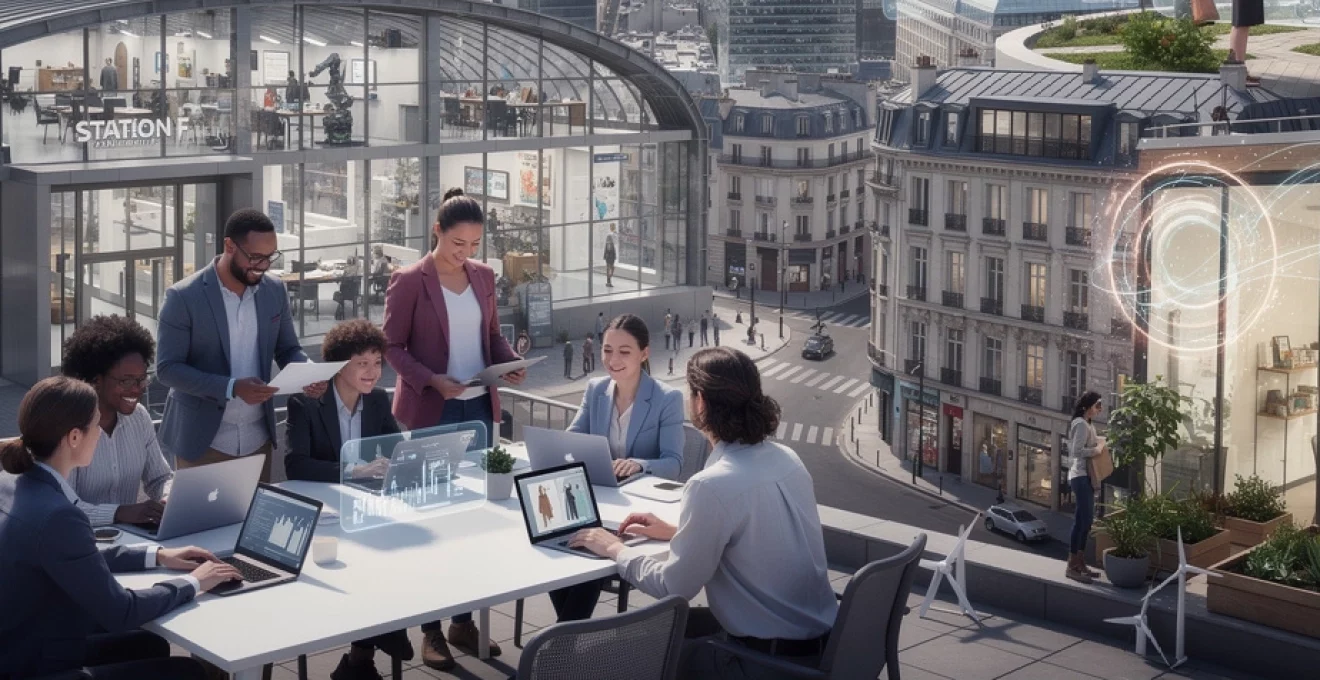
Paris has transformed itself into one of Europe’s most dynamic innovation ecosystems, establishing multiple specialised districts that attract entrepreneurs, researchers, and global corporations. The French capital’s strategic approach to innovation clustering has created distinct zones of excellence, each fostering unique technological advances and business models. From the massive startup campus at Station F to the research-intensive Paris-Saclay cluster, these innovation districts represent a comprehensive ecosystem that supports companies at every stage of development.
The city’s innovation districts benefit from France’s generous research tax credit system, which covers 30% of R&D expenses up to €100 million, making Paris an attractive destination for international companies seeking to establish European innovation hubs. With over €3.8 billion invested in Paris startups during 2024 alone, these districts have become magnets for venture capital and corporate innovation programmes. The concentration of talent, infrastructure, and financial resources within these zones creates powerful network effects that accelerate innovation and entrepreneurship across multiple sectors.
Station F: europe’s largest startup campus and innovation hub
Station F stands as the crown jewel of Paris’s startup ecosystem, occupying a massive 34,000 square metre facility that houses over 1,000 startups under one roof. This converted railway station represents the largest startup campus in the world, creating an unprecedented concentration of entrepreneurial energy in the heart of Paris. The campus serves as more than just office space; it functions as a comprehensive ecosystem that provides startups with access to mentorship, funding opportunities, and collaborative networks that span multiple industries and geographic markets.
The facility’s design promotes serendipitous encounters between entrepreneurs, with open-plan workspaces, shared facilities, and regular networking events that facilitate knowledge transfer and partnership formation. Station F hosts over 30 different startup programmes, ranging from early-stage incubation to corporate acceleration initiatives. This diversity ensures that entrepreneurs at various stages of development can find appropriate resources and support within the same physical location, creating opportunities for peer learning and collaboration across different maturity levels.
Xavier niel’s vision for digital entrepreneurship at halle freyssinet
The transformation of the historic Halle Freyssinet into Station F reflects a broader vision for democratising entrepreneurship and creating a European counterweight to Silicon Valley’s dominance in startup culture. Xavier Niel’s investment of over €250 million in the project demonstrates the scale of commitment required to create world-class innovation infrastructure. The campus design emphasises accessibility and inclusivity, offering subsidised workspace for early-stage entrepreneurs and providing programmes specifically designed to support underrepresented founders.
The architectural renovation preserves the building’s industrial heritage while incorporating modern technology infrastructure, including high-speed internet connectivity and flexible workspace configurations that can adapt to changing startup needs. This blend of historical character and cutting-edge functionality creates an inspiring environment that reflects Paris’s unique position as a city that embraces both tradition and innovation.
Corporate accelerator programmes: microsoft, facebook and zendesk partnerships
Station F’s corporate partnership model represents a sophisticated approach to bridging the gap between large enterprises and startup innovation. Microsoft’s presence at Station F through its dedicated AI accelerator programme provides startups with access to Azure cloud credits, technical mentorship, and potential customer relationships within Microsoft’s global ecosystem. This partnership model allows corporations to scout emerging technologies while providing startups with the resources and credibility needed to scale their solutions.
Facebook’s startup garage at Station F focuses on companies developing consumer-facing applications and social technologies, offering guidance on user acquisition, product development, and platform integration. Zendesk’s customer experience accelerator targets startups working on customer service innovations, providing access to Zendesk’s software platform and customer base for pilot programmes. These corporate programmes create symbiotic relationships where established companies gain access to innovation while startups receive strategic guidance and market validation.
Venture capital ecosystem: founders program and investment pipeline
The concentration of startups at Station F has attracted a corresponding ecosystem of venture capital firms and angel investors who maintain regular presence at the campus. The Founders Program, Station F’s flagship incubation initiative, provides selected startups with €200,000 in funding alongside mentorship from successful entrepreneurs and industry experts. This programme has supported over 200 startups since its inception, with participants raising more than €500 million in follow-on funding.
The campus hosts regular investor demo days
The campus hosts regular investor demo days, office hours with leading funds, and informal meetups that help founders refine their fundraising strategy and connect with the right investors at the right time. As a result, Station F has become a key node in Paris’s venture capital ecosystem, creating a highly visible pipeline of innovation for both local and international funds. For entrepreneurs, this density of capital and expertise reduces the friction often associated with early fundraising and accelerates the path from prototype to market.
International expansion strategy through global network initiatives
While Station F is physically anchored in Paris, its strategy has always been decisively global. The campus maintains partnerships with international startup hubs in North America, Asia, and other European capitals, enabling soft-landing programmes and exchange initiatives for founders looking to test new markets. For startups, this means that scaling beyond France is not an afterthought but an integrated part of the growth journey from the earliest stages of incubation.
Global network initiatives at Station F often combine market-entry coaching, local regulatory guidance, and introductions to potential partners or early customers overseas. In practice, this approach turns Station F into a launchpad rather than a simple coworking space: you can validate your product in Paris and, through curated programmes, access ecosystems such as Berlin, London, San Francisco, or Singapore. For international startups entering Europe, the reverse flow works just as well, with Station F and its partners acting as a gateway into the French and European markets, supported by tools like the French Tech Visa and generous R&D tax incentives.
Paris-saclay innovation cluster: research-driven technology transfer
Located to the south of Paris, the Paris-Saclay innovation cluster has emerged as one of Europe’s leading research-driven districts, often compared to a “French Silicon Valley” built around science and engineering. Concentrating top universities, grandes écoles, and national research organisations within a compact area, Paris-Saclay is designed to turn frontier research into market-ready technologies. The cluster benefits from major public investments in transportation, laboratories, and collaborative spaces, all aimed at accelerating technology transfer and deep tech entrepreneurship.
Paris-Saclay brings together academic excellence and industrial R&D in fields such as artificial intelligence, quantum technologies, photonics, and bioengineering. Close links between labs and companies make it easier for researchers to spin out startups, license patents, or co-create solutions with corporate partners. If Station F is the beating heart of Paris’s startup scene, Paris-Saclay is its brain, where breakthrough ideas are forged before reaching the broader innovation ecosystem.
École polytechnique and CentraleSupélec deep tech commercialisation
At the core of Paris-Saclay’s innovation capacity stand institutions like École Polytechnique and CentraleSupélec, which have a long tradition of training world-class engineers and scientists. Over the past decade, both schools have invested heavily in entrepreneurship centres, incubators, and seed funds specifically tailored to deep tech commercialisation. This shift means that research projects in robotics, energy storage, advanced materials, or cybersecurity are now systematically assessed for their market potential, often leading to startup creation.
Dedicated structures such as the X-Entrepreneurship & Innovation Centre and CentraleSupélec’s incubators play a pivotal role in guiding researchers through intellectual property management, business model design, and early fundraising. Think of these centres as “translation engines” that convert complex scientific results into understandable, fundable ventures. For companies seeking deep tech innovation in Paris, collaborating with these schools offers direct access to highly skilled teams, cutting-edge prototypes, and a steady pipeline of spin-offs ready for industrial partnerships.
Cea-list artificial intelligence and robotics research facilities
CEA-List, one of the technology research institutes of the French Alternative Energies and Atomic Energy Commission (CEA), is another cornerstone of the Paris-Saclay innovation district. Specialised in smart digital systems, CEA-List focuses on artificial intelligence, advanced robotics, cybersecurity, and human–machine interaction. Its facilities provide industrial-grade platforms where companies can test algorithms, embedded systems, and collaborative robots in near-real-world conditions.
For businesses, partnering with CEA-List offers a chance to de-risk ambitious R&D projects by leveraging validated tools, datasets, and co-development frameworks. Instead of building everything in-house, firms can co-design AI and robotics solutions alongside researchers who are at the forefront of their fields. This is particularly attractive for SMEs that may lack internal R&D teams but still need cutting-edge capabilities to remain competitive in global value chains. In many cases, collaborations at CEA-List lead directly to patents, licensing agreements, or joint ventures located in the wider Paris-Saclay area.
Systemx institute for digital systems engineering excellence
The Institute for Technological Research SystemX completes this high-tech landscape by specialising in digital systems engineering. SystemX runs multi-partner projects that bring together industrial groups, SMEs, and academic labs to tackle complex challenges in mobility, energy, cybersecurity, and industry 4.0. Rather than focusing on isolated components, the institute looks at entire systems—how connected vehicles interact with smart infrastructure, or how energy networks can be made more resilient and data-driven, for example.
Participation in SystemX projects gives companies access not only to advanced simulation and modelling tools, but also to a community of stakeholders who share data, risks, and results. For a firm entering the Paris innovation ecosystem, joining a SystemX consortium can be a powerful way to understand regulatory landscapes, test new business models, and position itself within emerging standards. In a sense, SystemX acts like a wind tunnel for digital transformation: you can safely experiment with future scenarios before launching large-scale deployments.
Venture capital presence: partech partners and alven capital investments
To turn deep tech ideas into scalable businesses, Paris-Saclay relies on a growing venture capital presence. Funds such as Partech Partners and Alven Capital maintain strong links with the cluster, backing startups that emerge from local labs as well as more mature companies that choose to locate their R&D teams there. Both investors have built portfolios that span SaaS, AI, fintech, and industrial tech, offering not only capital but also strategic support and international connections.
In recent years, several Paris-Saclay-born startups have raised sizeable rounds from these and other funds, reinforcing the cluster’s reputation as a source of high-value innovation. For founders, the proximity of investors who understand long R&D cycles and complex regulatory pathways is crucial—especially in sectors like healthcare or autonomous systems where time-to-market can be lengthy. From your perspective as an entrepreneur or corporate innovator, this alignment between research institutions and specialised VC funds means that promising projects are less likely to stall for lack of suitable financing.
La défense business district: corporate innovation and fintech development
La Défense, Europe’s largest business district, has long been synonymous with corporate headquarters and financial services. Over the past decade, however, it has been quietly transforming into a major hub for corporate innovation and fintech development within the Greater Paris ecosystem. Global companies based in La Défense increasingly run their own accelerators, intrapreneurship programmes, and open innovation schemes aimed at partnering with startups and scaleups.
The district hosts specialised incubators such as Le Swave, dedicated to fintech and insurtech, which connect young companies with banks, insurance groups, and regulators. This proximity allows startups to pilot their solutions in real environments, from digital banking interfaces to risk-scoring algorithms and regtech tools. For corporates, the arrangement is equally attractive: instead of building every digital tool internally, they can co-create with agile partners and rapidly integrate new services into their existing infrastructure. As financial services become more data-driven and regulated, this dense collaboration between incumbents and innovators is turning La Défense into a strategic node for Europe’s digital finance landscape.
Sentier digital quarter: fashion-tech and e-commerce convergence
The Sentier district, historically known as Paris’s textile and garment neighbourhood, has reinvented itself as a digital quarter where fashion-tech, e-commerce, and creative industries intersect. Former warehouses and wholesale spaces now host startups working on online marketplaces, direct-to-consumer brands, logistics optimisation, and retail analytics. This mix of heritage and innovation makes Sentier a natural home for companies that blend technology with design, storytelling, and customer experience.
In practice, this means you will find SaaS platforms helping retailers manage omnichannel operations side by side with AI-driven tools that forecast trends or optimise inventory. The presence of fashion houses, digital agencies, and content creators in the same streets fosters rapid experimentation with new retail formats, from pop-up experiences to livestream shopping. If you think of Paris-Saclay as the lab and Station F as the campus, Sentier is the showroom where digital-native brands and tools meet real consumers and test scalable e-commerce strategies.
Clichy-batignolles sustainable innovation ecosystem
Clichy-Batignolles, located in the north-west of Paris, has become a flagship district for sustainable urban innovation. Built around the Martin Luther King Park and the new Paris courthouse, the neighbourhood was designed as a low-carbon, mixed-use area that integrates housing, offices, and public spaces. For startups and corporates focused on green technologies, it operates as a real-world testbed where energy systems, mobility services, and circular economy solutions can be piloted at district scale.
The area’s development aligns with Paris’s broader climate goals, including the ambition to reach carbon neutrality by 2050. By bringing together property developers, utility companies, urban planners, and entrepreneurs, Clichy-Batignolles demonstrates how innovation districts can function as “living labs” for sustainable cities. For anyone interested in climate tech or urban resilience, this neighbourhood offers concrete examples of how regulatory frameworks, public investment, and private innovation can reinforce one another.
Smart grid technologies and energy management solutions
One of the most distinctive features of Clichy-Batignolles is its smart grid infrastructure, which integrates renewable energy generation, district heating, and advanced monitoring systems. Buildings are connected to a high-efficiency district heating network that relies in part on geothermal energy, while rooftop solar panels contribute to local electricity production. Sensors and data platforms monitor consumption in real time, allowing operators to balance supply and demand more efficiently and reduce peak loads.
For energy-tech startups, this environment offers a unique sandbox to test algorithms for demand response, predictive maintenance, or user engagement. Instead of simulating behaviour in a lab, you can deploy solutions in real buildings, gather feedback from residents and facility managers, and iterate quickly. Over time, the lessons learned in Clichy-Batignolles can be replicated across other Paris neighbourhoods and international projects, turning the district into a reference point for smart grid deployment in dense urban settings.
Green building standards and environmental tech startups
Clichy-Batignolles also showcases ambitious green building standards, with many constructions meeting or exceeding low-energy and passive-house criteria. High-performance insulation, bioclimatic design, and natural ventilation strategies help cut energy consumption while improving indoor comfort. Water management systems, including rainwater harvesting and permeable surfaces, reduce runoff and support urban biodiversity, particularly around the central park.
This emphasis on sustainable construction creates strong demand for environmental tech startups specialising in building performance analytics, smart materials, and IoT-based monitoring. For example, companies developing digital twins of buildings or AI tools for energy optimisation find in Clichy-Batignolles an ideal early adopter base. The district thus acts as a bridge between policy ambitions—such as Paris’s bioclimatic urban planning rules—and concrete, market-ready solutions that can be scaled across the real estate sector.
Circular economy business model innovation
Beyond energy and buildings, Clichy-Batignolles is fertile ground for circular economy initiatives that rethink how resources are used, reused, and shared. Local authorities and community organisations support projects focused on repair, reuse, and short supply chains, such as neighbourhood repair cafés, shared logistics hubs, and sustainable packaging pilots. These initiatives often involve close collaboration between residents, startups, and municipal services.
For entrepreneurs, the district’s compact size and engaged population make it easier to experiment with new circular business models, from product-as-a-service offers to urban composting and waste valorisation. Think of it as a micro-city where you can test whether a circular service actually fits into people’s daily routines, before deploying it at metropolitan scale. In this way, Clichy-Batignolles contributes to Paris’s broader reputation as a leader in green innovation and climate-conscious urban development.
Cross-district collaboration networks and knowledge transfer mechanisms
What truly sets Paris apart as an innovation powerhouse is not just the strength of each individual district, but the connections between them. Programmes such as the Quartiers Métropolitains d’Innovation, operated by Paris&Co and the Greater Paris Metropolis, encourage municipalities and innovators to collaborate on pilot projects that span mobility, energy, digital services, and social inclusion. These “open-air laboratories” turn parts of the metropolis into shared experimentation zones where solutions tested in one district can be adapted and scaled in another.
Knowledge transfer mechanisms include joint labs between universities and corporates, cross-acceleration programmes, and metropolitan-wide events like VivaTech and ChangeNOW, which bring together actors from Station F, Paris-Saclay, La Défense, Sentier, and Clichy-Batignolles. For you as an innovator or investor, this means that entering one Paris innovation district rarely limits you to a single neighbourhood. Instead, you plug into a distributed network in which AI developed in Paris-Saclay can power fintech tools in La Défense, while sustainability solutions piloted in Clichy-Batignolles inform urban projects supported by the Quartiers Métropolitains d’Innovation across the Greater Paris area.