The Loire Valley stands as one of Europe’s most magnificent showcases of architectural grandeur, where over 300 châteaux dot the landscape like jewels across the “Garden of France”. This UNESCO World Heritage region stretches along 280 kilometres of the Loire River, presenting visitors with an extraordinary concentration of Renaissance palaces, medieval fortresses, and classical estates that chronicle nearly a millennium of French history. From François I’s Italian-inspired innovations at Chambord to the romantic waterside elegance of Chenonceau, these architectural marvels represent the pinnacle of European palace design and continue to captivate millions of visitors annually.
Renaissance architecture and construction techniques across loire valley châteaux
The Loire Valley’s châteaux showcase an unparalleled evolution of architectural styles, with Renaissance design principles fundamentally transforming medieval fortress construction throughout the 15th and 16th centuries. This architectural revolution merged Italian Renaissance ideals with distinctly French building traditions, creating a unique synthesis that defines the region’s most celebrated monuments. The transformation from defensive structures to pleasure palaces reflects broader cultural shifts during the French Renaissance, when châteaux evolved from military necessities into symbols of artistic sophistication and royal power.
Construction techniques employed across Loire Valley châteaux demonstrate remarkable innovation in structural engineering and decorative artistry. Master builders incorporated advanced mathematical principles to achieve unprecedented scales and proportions, whilst craftsmen perfected intricate stonework that continues to astound modern observers. The extensive use of local tuffeau limestone provided both structural integrity and distinctive aesthetic qualities, allowing for detailed carving and elaborate ornamentation that characterises the region’s most celebrated monuments.
François i’s Italian-Inspired architectural innovations at chambord castle
Chambord represents the apotheosis of French Renaissance architecture, incorporating revolutionary design elements that Leonardo da Vinci may have influenced during his residence at nearby Clos Lucé. The château’s iconic double-helix staircase exemplifies this Italian influence, creating an architectural marvel where two independent spiral staircases intertwine without meeting. This engineering masterpiece allows visitors to ascend and descend simultaneously whilst maintaining visual contact, demonstrating the sophisticated mathematical principles underlying Renaissance design philosophy.
The castle’s distinctive roofline, featuring 440 rooms, 77 staircases, and 282 chimneys, creates a skyline reminiscent of Italian palazzo architecture adapted to French climatic conditions. François I’s builders employed innovative construction methods to support this massive structure, utilising advanced foundation techniques and load-bearing systems that enabled the creation of vast ceremonial spaces. The integration of classical proportions with French building traditions established architectural precedents that influenced château design throughout the Loire Valley and beyond.
Medieval fortification elements in château d’angers and fortress design
Château d’Angers preserves exceptional examples of 13th-century military architecture, demonstrating sophisticated defensive strategies through its massive curtain walls and cylindrical towers. The fortress’s seventeen towers, constructed from dark schist stone contrasting with lighter limestone details, illustrate advanced understanding of siege warfare and artillery defence. These fortifications incorporated innovative features such as machicolations, arrow slits positioned for maximum defensive coverage, and complex gate systems designed to channel and control attacking forces.
The castle’s defensive architecture reflects the evolution from wooden motte-and-bailey structures to stone fortifications capable of withstanding prolonged sieges. Engineers implemented sophisticated water management systems, including underground cisterns and drainage networks that ensured garrison survival during extended conflicts. The integration of residential quarters within defensive structures demonstrates the dual functionality that characterised medieval château design, balancing military necessity with aristocratic comfort.
Classical french baroque features at château de blois royal apartments
Blois exemplifies the architectural evolution from Renaissance innovation to Baroque grandeur, particularly evident in the royal apartments commissioned by successive French monarchs. The château’s famous spiral staircase, adorned with salamander motifs celebrating François I, demonstrates the transition from purely functional architecture to decorative statement-making. The integration of classical orders, elaborate sculptural programmes, and sophisticated spatial arrangements reflects the influence of Italian baroque principles adapted to French court requirements.
The palace’s successive building campaigns created a remarkable architectural timeline, with each wing representing distinct stylistic periods whilst maintaining overall compositional harmony. Baroque elements include elaborate ceiling decorations, complex geometrical floor patterns, and sophisticated lighting systems designed
to dramatize court ceremony and highlight the king’s presence. When you walk through the royal apartments today, details such as richly painted beams, heraldic emblems, and ornate chimney pieces reveal how architecture, interior design, and political messaging were closely intertwined. For visitors interested in the evolution of Loire Valley castles, Blois functions almost like an open textbook, where you can compare medieval, Renaissance, and classical French Baroque features within a single complex.
Gothic revival restoration methods at château de saumur
Château de Saumur offers an excellent case study in Gothic Revival restoration, illustrating how 19th-century architects reinterpreted medieval forms through the lens of Romanticism. Originally a medieval fortress overlooking the Loire, Saumur was heavily altered over the centuries, then restored under the direction of architect Charles Joly-Leterme following Viollet-le-Duc’s principles. Rather than simply repairing damaged elements, restorers often reconstructed what they believed the “ideal” medieval castle should look like, adding stylised crenellations, pointed turrets, and high-pitched roofs to dramatise the silhouette.
These restoration choices raise intriguing questions about authenticity in Loire Valley château architecture. Are we seeing the original Middle Ages, or a 19th-century dream of them? At Saumur, careful stone replacement techniques, consolidation of weakened walls, and the use of traditional lime mortars were combined with new structural supports, discreetly integrated to meet modern safety standards. When you visit today, you can observe the contrast between original tuffeau stonework and later Gothic Revival additions, making Saumur an ideal stop if you are interested in how conservation practices have shaped the castles we admire.
Strategic château touring routes and regional navigation systems
Planning how to move between Loire Valley castles is almost as important as choosing which châteaux to visit. The region’s castles are distributed along several key corridors following the Loire and its tributaries, and efficient touring routes can help you see more without feeling rushed. Modern navigation systems, regional train lines, and well-marked cycling paths make it easier than ever to create multi-day itineraries that balance architectural highlights, wine tasting, and garden visits. With a bit of planning, you can link world-famous sites like Chambord and Chenonceau with lesser-known gems that see far fewer crowds.
Whether you travel by car, bicycle, or public transport, it helps to think in clusters: the Blois–Cheverny–Chambord axis, the Amboise–Chenonceau–Chaumont triangle, and the Tours–Villandry–Azay-le-Rideau loop. Each cluster can form the basis of a day or two of exploration, minimising backtracking and time on the road. Digital tools such as GPS apps work well here, but traditional paper maps and the official Loire tourism maps still provide a valuable overview, especially if you want to adjust your route spontaneously. By aligning your movements with the main valleys and signed tourist routes, you can turn logistics into a pleasant part of the experience rather than a source of stress.
Loire à vélo cycling network integration with castle access points
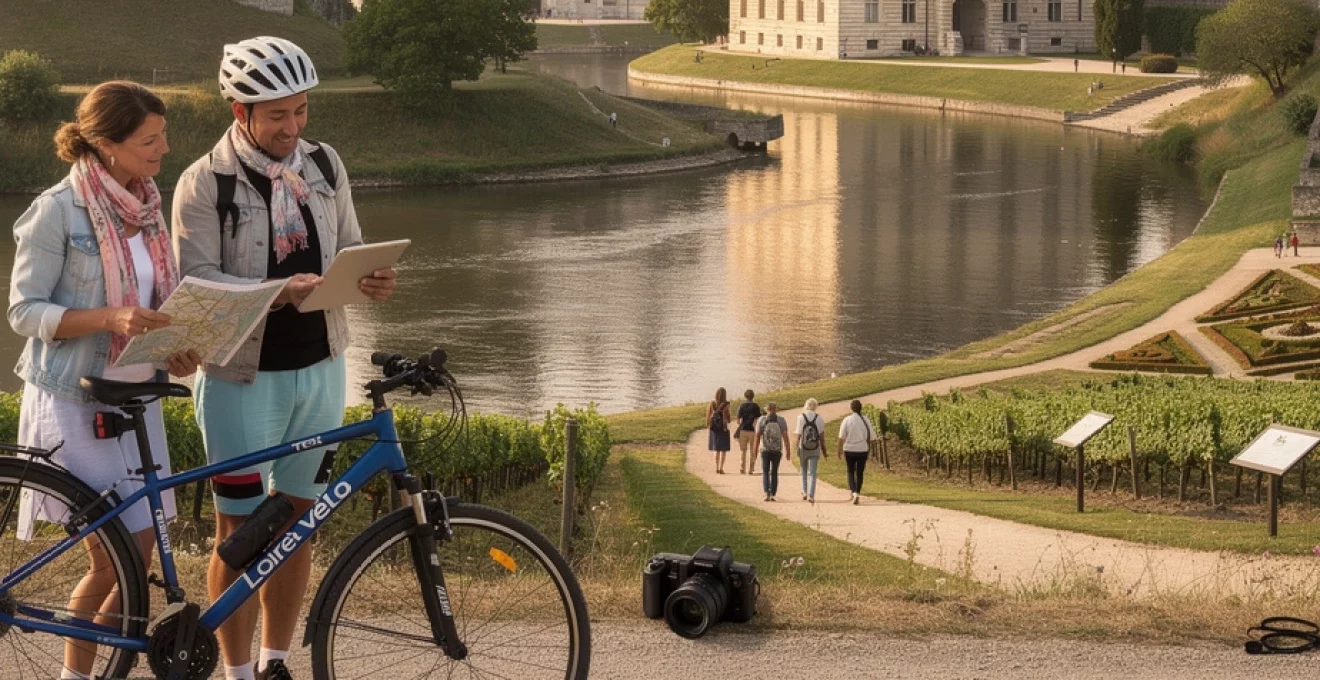
The Loire à Vélo network is one of Europe’s premier long-distance cycling routes, covering roughly 800 km from Cuffy near Nevers to Saint-Brevin-les-Pins on the Atlantic coast. For château enthusiasts, its greatest asset is how frequently it runs within easy reach of major sites, often with dedicated “castle access” spurs or signposted connections. In practice, this means you can base yourself in a riverside town such as Tours, Amboise, or Blois, then use well-maintained cycle paths to reach nearby châteaux without ever needing to ride on busy national roads.
Many castles, including Chambord, Chaumont-sur-Loire, and Villandry, now provide secure bike parking, water points, and sometimes even repair stations near their entrances. Some train services along the valley, especially the summer Interloire line between Orléans and Le Croisic, accept bicycles free of charge, allowing you to combine rail and cycling in flexible itineraries. If you are not a seasoned cyclist, consider short segments of 10–20 km between two towns or a station and a castle rather than attempting long, fully loaded touring days. Think of the Loire à Vélo as a movable balcony overlooking the Loire Valley castles: you can step on or off where it suits your level and schedule.
Seasonal visitor management at chenonceau and villandry gardens
Two of the most visited Loire Valley castles—Château de Chenonceau and Château de Villandry—have developed sophisticated seasonal visitor management strategies to cope with high demand. At Chenonceau, timed entry slots and extended summer opening hours help spread visitor flows across the day, reducing bottlenecks in the famous gallery spanning the River Cher. During peak months (typically July and August), you will benefit from booking online in advance and aiming for early morning or late afternoon visits to avoid the most crowded periods. Shoulder seasons such as May–June and September offer a more relaxed experience while still providing lush garden displays.
Villandry, renowned for its Renaissance parterres and kitchen gardens, adapts its visitor management to the horticultural calendar. Garden maintenance, replanting schedules, and flowering peaks all influence when different sections of the property are at their best. As a visitor, this means your experience of the castle and its gardens will change significantly between spring and autumn. To make the most of your time, it helps to check official websites for current opening times, any special evening illuminations, and temporary closures of specific garden areas. Accepting that these iconic Loire Valley castles attract large crowds during school holidays, and planning around that reality, will allow you to appreciate their beauty rather than fight the flow.
UNESCO world heritage site cluster planning in touraine region
The central Loire Valley between Sully-sur-Loire and Chalonnes-sur-Loire is recognised by UNESCO as a World Heritage cultural landscape, and the Touraine section around Tours forms one of its most accessible clusters. Within a radius of roughly 40–50 km, you can reach Chenonceau, Amboise, Villandry, Azay-le-Rideau, Langeais, and several smaller estates, all linked by the Loire and Cher rivers. This dense concentration of heritage sites makes Touraine an ideal base if you want to experience the “classic” Loire Valley castles without constant hotel changes. You can think of it as an open-air museum, where medieval towns, vineyards, and royal residences sit side by side.
UNESCO designation has encouraged coordinated planning between local authorities, château managers, and tourism offices. As a result, information panels, signposted scenic routes, and multilingual visitor materials are generally of a high standard. For travellers, this means it is easier to build thematic days—focusing on Renaissance architecture, gardens, or wine—without needing to research every detail from scratch. When designing your itinerary, aim to balance headline sites with quieter stops in historic towns such as Loches or Chinon, where the pace is slower and you can appreciate how the Loire Valley’s living landscape surrounds its castles.
Private château accommodation booking systems and exclusive access
One of the most memorable ways to experience the Loire Valley is to stay overnight in a private château, many of which now operate as boutique hotels, guesthouses, or exclusive-use rentals. Booking these properties typically involves specialised platforms or direct contact via the château’s own website, rather than mass-market hotel aggregators. Lead times for peak season can be several months, especially for smaller estates with only a handful of rooms, so early planning is essential if sleeping in a château is a priority for your trip. Prices vary widely, from surprisingly affordable B&B-style stays to high-end, fully staffed experiences.
Many private châteaux offer value beyond the room itself: access to otherwise closed wings, private parkland, or candlelit dinners in historic dining rooms. Some even arrange after-hours tours of their own property or nearby castles, giving you exclusive access once day visitors have left. When comparing options, look carefully at what is included—breakfast, use of gardens, pool or spa facilities, and the possibility of wine tastings or cooking classes. A night or two in a château can turn a standard sightseeing trip into an immersive journey through Loire Valley history, especially if you pair it with visits to better-known royal estates nearby.
Historical dynasties and noble lineages of loire valley estates
The Loire Valley’s castles are inseparable from the dynasties and noble families who built, expanded, and sometimes lost them. From the Plantagenets and Valois to the Bourbons and powerful aristocratic houses such as the Guise and the d’Amboise, each lineage left architectural and political traces across the region. Castles like Amboise, Blois, and Chinon served at various times as royal residences, prisons, and centres of power during crucial episodes of French history, including the Hundred Years’ War and the Wars of Religion. As you move from château to château, you are essentially following the shifting geography of royal favour and noble influence.
Understanding these lineages can enrich your visit far beyond simple aesthetics. For example, Chenonceau’s nickname, the “Château des Dames”, reflects how women such as Diane de Poitiers and Catherine de’ Medici shaped its destiny, while the Dukes of Anjou turned Angers into a symbol of their territorial authority. In Chinon, the Plantagenet kings of England ruled vast swathes of Western France, and it was here that Joan of Arc famously met Charles VII in 1429. If you enjoy connecting places with people, consider bringing or downloading a concise historical guide that outlines who lived where and when; walking through these rooms becomes more compelling once you can place the portraits and coats of arms in context.
Viticultural terroir and wine estate integration within castle grounds
The Loire Valley is not only a land of castles but also one of Europe’s most diverse wine regions, where viticultural terroir is often tightly integrated with historic estates. Many châteaux you visit will either overlook vineyards, host working wineries on their grounds, or be closely associated with nearby appellations. This makes it easy—and tempting—to combine cultural visits with tastings of Sauvignon Blanc, Chenin Blanc, Cabernet Franc, or Melon de Bourgogne, depending on where you are along the river. The cool climate and varied soils produce wines with fresh acidity and relatively modest alcohol levels, ideal for daytime exploration and food pairing.
Several Loire Valley castles actively promote this connection between architecture and wine. At properties such as Château Moncontour near Vouvray or estates around Chinon and Saumur, historic cellars carved into the soft tuffeau stone double as atmospheric tasting rooms. Visiting these sites offers a tangible demonstration of how geology, climate, and human craftsmanship combine to shape both the built and natural landscapes. For travellers keen to understand the region in depth, scheduling one or two vineyard visits per day of château touring provides a balanced rhythm: history in the morning, wine in the afternoon, and local cuisine to tie it all together.
Sancerre AOC vineyard management at château de tracy
At the eastern edge of the broader Loire Valley, near the town of Pouilly-sur-Loire, Château de Tracy is closely linked with the Sancerre and Pouilly-Fumé area, famous for its expressive Sauvignon Blanc. Vineyard management here focuses on expressing the nuances of flint, limestone, and clay-limestone soils, which lend characteristic minerality and smokiness to the wines. Modern viticultural practices—such as careful canopy management, reduced chemical inputs, and selective harvesting—are combined with long experience, as wine production at Tracy dates back centuries. For visitors, guided tours often include a walk among the vines, where you can see how row orientation and planting density respond to the slope and exposure.
In the cellar, gentle pressing and temperature-controlled fermentation help preserve the grape’s aromatic freshness, while ageing on fine lees adds texture without overwhelming oak influence. When you taste these wines in the château’s historic surroundings, it becomes clear how much local terroir shapes their character. If you are planning a Loire itinerary that stretches beyond the central château cluster, adding a day around Sancerre and Pouilly-Fumé offers a rewarding contrast: fewer palaces, more vineyards, but the same deep interweaving of land, history, and craftsmanship.
Muscadet production techniques in pays nantais castle estates
Further west, near Nantes and the estuary of the Loire, the Pays Nantais region is synonymous with Muscadet, produced primarily from the Melon de Bourgogne grape. Here, historic manor houses and smaller châteaux punctuate rolling vineyards that benefit from the moderating influence of the nearby Atlantic. Muscadet’s signature style—light, dry, and saline—owes much to the traditional technique of ageing “sur lie”, where wine rests on its fine lees for several months to enhance mouthfeel and complexity. Many estates continue to use underground concrete or stainless-steel tanks for this purpose, reflecting a balance between tradition and practical modern winemaking.
Visiting castle-linked estates in this part of the Loire Valley gives you an insight into how wine production has adapted to contemporary tastes while retaining its maritime character. You may notice that some producers now bottle single-commune or single-plot Muscadet, echoing the terroir-driven approach seen in more famous appellations. Pairing a tasting with fresh Atlantic oysters or local seafood brings the experience full circle, underscoring why Muscadet has been the region’s classic accompaniment to shellfish for generations. If your château tour takes you as far as the western Loire, a stop in the Pays Nantais adds a refreshing, ocean-influenced note to your journey.
Chinon red wine cellaring methods in troglodyte cave systems
Around Chinon, the landscape reveals a striking feature: cliffs and hillsides riddled with openings leading into ancient troglodyte caves. Originally quarries for the soft tuffeau stone used to build many Loire Valley castles, these underground galleries now serve as ideal cellars for ageing Cabernet Franc. Their naturally cool, stable temperatures and high humidity create perfect conditions for slow, even maturation, protecting wines from heat spikes and vibration. Some producers line the walls with barrels, while others age wines in tanks or bottles, depending on their stylistic goals.
Several Chinon estates offer guided visits that take you directly into these cave systems, where you can see rows of barrels receding into the darkness and feel the drop in temperature as you step inside. The sensory contrast between sunlit vineyards and cool, earth-scented tunnels helps explain why this region’s red wines can show both freshness and depth. For travellers, it is an unforgettable way to connect the invisible infrastructure of wine ageing with the visible architecture of nearby towns and châteaux. When you later encounter tuffeau stone in castle façades, you will recognise it not just as a building material but as the rock that shelters the valley’s wines.
Vouvray sweet wine traditions at château moncontour
On the north bank of the Loire near Tours, the Vouvray appellation is renowned for its Chenin Blanc, capable of producing everything from bone-dry sparkling wines to opulent, honeyed sweet wines. Château Moncontour, perched above the river, encapsulates this diversity and the long-standing sweet wine traditions of the region. In favourable years, autumn mists encourage noble rot (botrytis cinerea) or late concentration of grapes on the vine, resulting in richly flavoured berries that yield complex, age-worthy wines. Harvesting is often done by hand in multiple passes, with pickers selecting only the ripest clusters each time.
Sweet Vouvray is typically fermented and aged slowly, sometimes in old oak barrels that impart subtle oxidative notes without dominant wood flavours. These wines can age gracefully for decades, developing layers of dried fruit, spice, and beeswax while retaining vibrant acidity. At Moncontour, museum exhibits and cellar tours help explain how these techniques evolved over centuries, often influenced by changing tastes at court and in export markets. Tasting such wines in a château setting makes it easier to imagine them gracing banquets in the very halls you have just visited, closing the loop between viticulture, architecture, and the social life of the Loire Valley.
Garden design mastery and horticultural heritage preservation
Beyond stone and wine, the Loire Valley castles are equally celebrated for their gardens, which showcase centuries of horticultural experimentation and artistry. From meticulously clipped boxwood parterres to wild, romantic landscapes, these gardens reflect changing tastes and scientific advances in botany and hydraulics. Their layouts often encode symbolic meanings, whether religious, political, or personal to the families who commissioned them. For modern visitors, they provide not only visual pleasure but also insight into how elites once displayed power and intellect through control of nature.
Preserving this living heritage poses unique challenges that differ from architectural conservation. Plants grow, age, and die; climate conditions shift; and diseases such as box blight threaten entire design schemes. Garden teams must constantly balance historical accuracy with ecological resilience and visitor safety. As you stroll through rose tunnels at Chenonceau or vegetable beds at Villandry, you are seeing the result of countless daily decisions about plant selection, pruning, and soil management. Understanding a few core principles of Renaissance and classical garden design will deepen your appreciation of what might otherwise appear as mere decoration.
André le nôtre’s geometric parterre layouts at château de villandry
Château de Villandry is perhaps the Loire Valley’s most striking example of formal geometric garden design, strongly influenced by the principles associated with André Le Nôtre, the mastermind behind Versailles. Although Le Nôtre himself did not work at Villandry, the early 20th-century owners, Joachim Carvallo and Ann Coleman, reimagined the grounds in a spirit that echoes his love of symmetry, axial perspectives, and carefully proportioned parterres. From the château’s upper terraces, you can admire an intricate patchwork of boxwood-bordered beds representing love, music, and religious symbols, as if looking at a vast embroidered carpet.
Maintaining these designs requires precise geometric alignment and rigorous pruning schedules. Gardeners use strings, stakes, and careful measurement to ensure that hedges remain straight and angles crisp, much like architects drawing a plan at full scale on the ground. Seasonal plantings of tulips, cabbages, or annual flowers fill the parterres with changing colours while respecting the underlying structure. For visitors, Villandry offers a clear demonstration of how mathematical thinking and aesthetic sensibility merge in Loire Valley castle gardens, turning open land into a three-dimensional work of art.
Renaissance kitchen garden reconstruction methodologies
Renaissance kitchen gardens, or potagers, were more than functional spaces; they were carefully organised plots that reflected ideas about order, health, and the ideal relationship between humans and nature. At sites like Villandry and other Loire estates that have reintroduced historical vegetable gardens, reconstruction efforts draw on period treatises, archival plans, and archaeological evidence. Garden designers study old engravings and written descriptions to determine which crops were grown, how beds were arranged, and what companion planting techniques might have been used. The result is not a museum fossil but a working garden that continues to feed residents, staff, and sometimes on-site restaurants.
For travellers, these reconstructed potagers offer a tangible connection to everyday life in and around the castles. You can see heritage varieties of cabbages, beans, and herbs growing in neatly edged beds, often framed by low boxwood or brick paths that make maintenance easier. Modern organic practices, such as crop rotation and composting, dovetail well with Renaissance principles that valued soil fertility and plant diversity. If you are interested in gardening at home, pay attention to how these spaces combine utility and beauty; many ideas, from raised beds to symmetric layouts, can be adapted on a smaller scale in your own garden.
Topiary maintenance protocols and boxwood disease management
Topiary—shaping shrubs into architectural forms—is a defining feature of many Loire Valley castle gardens, yet it is also one of the most labour-intensive and vulnerable elements. Most traditional topiary uses boxwood (Buxus sempervirens), a slow-growing shrub that responds well to frequent clipping. Maintaining clean lines and coherent shapes requires several rounds of pruning per year, often done by hand with shears to avoid tearing the leaves. Garden teams must coordinate this work with visitor flows, scheduling major interventions outside peak hours whenever possible to preserve the tranquil atmosphere.
In recent years, diseases such as box blight and pests like the box tree moth have posed serious threats to historic parterres across Europe, including the Loire. As a result, many châteaux have had to develop disease management strategies that balance heritage conservation with environmental responsibility. These can include increased monitoring, selective replacement with resistant varieties, or in some cases substitution with alternative species that mimic the look of boxwood. When you admire the crisp patterns at a site like Villandry or Chaumont-sur-Loire, you are seeing the outcome of ongoing scientific collaboration between horticulturists, pathologists, and conservationists working to safeguard these iconic designs for future generations.
Water feature engineering in catherine de’ medici’s garden designs
Water has always played a central role in Loire Valley castle gardens, and few patrons understood its theatrical potential better than Catherine de’ Medici. At estates associated with her, including Chenonceau, hydraulic engineering underpinned fountains, reflecting pools, and ornamental canals that amplified the castles’ visual impact. In the 16th century, creating such features required complex systems of gravity-fed channels, reservoirs, and sometimes early pumping technologies to lift water from nearby rivers. Garden engineers had to calculate gradients with remarkable precision to ensure a steady flow without erosion or stagnation.
Today, many of these historical systems have been modernised, but their principles remain the same. As you walk around Chenonceau’s terraces or look out over its river-spanning gallery, consider the hidden infrastructure that keeps basins filled and jets playing. Maintaining water clarity and mechanical reliability, while complying with contemporary environmental regulations, is an ongoing challenge for garden teams. These hydraulic networks are the circulatory systems of Loire Valley castle gardens: mostly invisible, but essential to the life and spectacle of the landscape.
Conservation technologies and château restoration methodologies
Preserving the Loire Valley’s castles and their surroundings is a continuous process that relies increasingly on advanced technologies and interdisciplinary collaboration. Historic masonry, fragile frescoes, timber roof structures, and delicate stained glass all demand specialised care, especially as climate patterns shift and visitor numbers rise. Conservation teams combine traditional craftsmanship—stone carving, carpentry, and lime plastering—with modern diagnostic tools such as laser scanning, thermal imaging, and 3D modelling. These techniques help identify structural weaknesses, map moisture infiltration, and document original surfaces before any intervention begins.
At many major Loire Valley châteaux, ongoing or recent projects showcase how these methodologies are applied in practice. Drone surveys allow engineers to inspect roofs and chimneys without erecting vast scaffolds, while high-precision digital models support both restoration planning and virtual tours for remote visitors. Inside, careful environmental monitoring controls temperature and humidity to protect artworks and furnishings. For travellers, visible scaffolding or temporarily closed rooms can be a minor inconvenience, but they are also a reminder that these monuments are living works in progress. By supporting on-site foundations or choosing guided tours that highlight conservation, you contribute directly to the long-term survival of the castles and landscapes that make the Loire Valley unique.