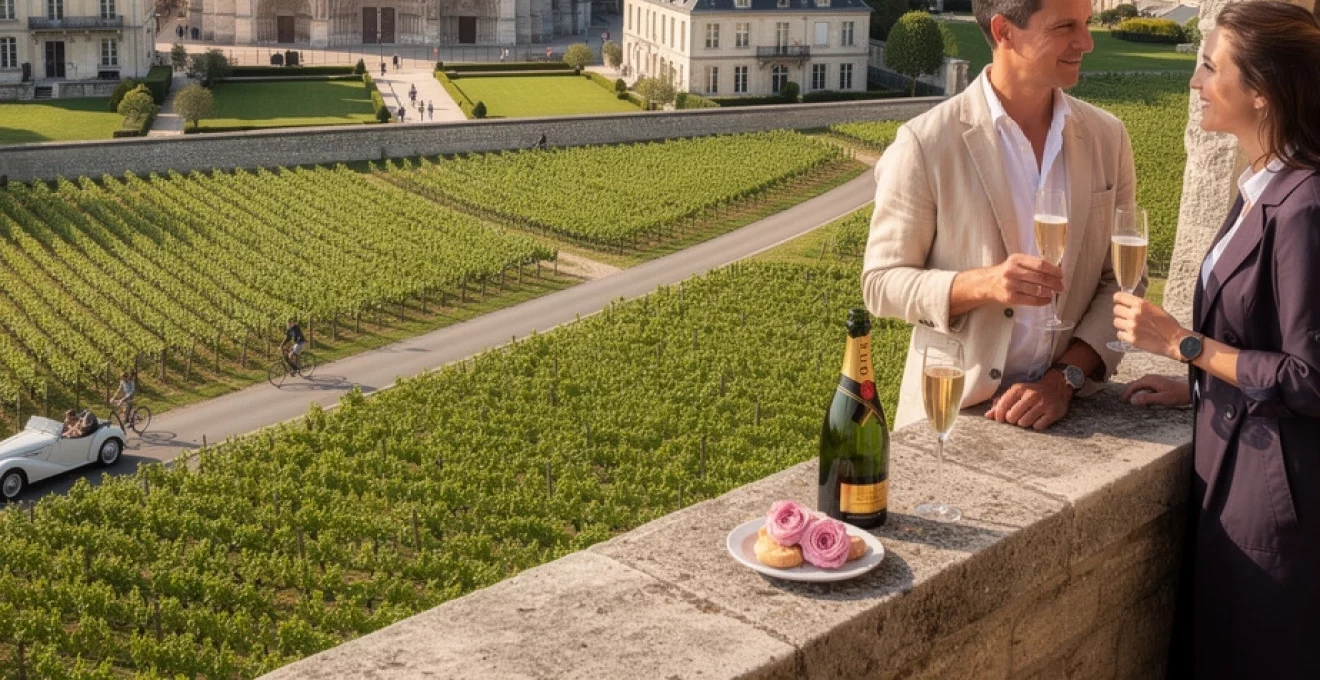
Nestled in northeastern France, Reims stands as the undisputed capital of Champagne country, where centuries of royal heritage converge with the world’s most celebrated sparkling wine. This historic city, once the coronation site for French monarchs, now welcomes visitors seeking to immerse themselves in Gothic architecture, underground chalk cellars, and the intricate art of méthode champenoise. Beyond the city limits, the Route Touristique du Champagne weaves through sun-drenched vineyards, charming villages, and prestigious estates that have shaped global wine culture. Whether you’re drawn to the cultural grandeur of Notre-Dame Cathedral or the sensory pleasures of a well-aged vintage, Reims offers an experience where history, craftsmanship, and French savoir-vivre intertwine seamlessly.
Reims cathedral: gothic architecture and coronation heritage of french monarchs
The skyline of Reims is dominated by one of France’s most magnificent architectural achievements, a testament to medieval craftsmanship that has withstood wars, revolutions, and the passage of eight centuries. The cathedral’s significance extends far beyond its aesthetic beauty, representing a pivotal institution in French national identity and royal legitimacy.
Notre-dame de reims: UNESCO world heritage status and architectural mastery
Constructed between 1211 and 1275, Notre-Dame de Reims exemplifies the pinnacle of French Gothic architecture. The cathedral’s façade stretches an impressive 149 meters in length and reaches 38 meters in height at the nave, creating an overwhelming sense of verticality that draws the eye heavenward. UNESCO recognized this architectural masterpiece in 1991, acknowledging not only its aesthetic significance but also its role in shaping European cultural heritage. The cathedral features approximately 2,303 statues, making it one of the most densely decorated religious structures in Christendom. The famous “Smiling Angel” sculpture has become an iconic symbol of the cathedral, representing a more humanized approach to religious art that emerged during the 13th century. Remarkably, the building survived World War I bombardments that caused significant damage, requiring extensive restoration efforts that continued through much of the 20th century.
Marc chagall’s stained glass windows and interior artistic elements
While the cathedral’s medieval stained glass suffered irreparable damage during wartime conflicts, the post-war restoration presented opportunities for contemporary artistic contributions. In 1974, renowned artist Marc Chagall designed three replacement windows for the apsidal chapel, creating a striking dialogue between medieval architecture and 20th-century artistic vision. These windows depict biblical scenes in Chagall’s distinctive style, using luminous blues and golds that transform natural light into an ethereal spiritual experience. The juxtaposition of contemporary artistry within a Gothic framework demonstrates how living heritage sites can evolve while maintaining their historical essence. Beyond Chagall’s contributions, the cathedral houses numerous artistic treasures, including the 15th-century astronomical clock and the elaborate rose window that dominates the western façade, measuring 12 meters in diameter.
The sainte ampoule and historical coronation ceremonies from clovis to charles X
For nearly a millennium, Reims Cathedral served as the sacred stage for French royal coronations, a tradition initiated when Clovis I was baptized here in 496 CE. The Sainte Ampoule, a holy ampulla believed to contain oil delivered by a dove from heaven, was used to anoint French monarchs during their coronation ceremonies. Between 1027 and 1825, twenty-five kings received their crowns within these hallowed walls, from Henry I to Charles X, the last monarch to be crowned in France. The coronation ceremony itself was an elaborate affair lasting several hours, combining religious sacraments with political theatre designed to legitimize royal authority through divine sanction. Joan of Arc famously escorted Charles VII to Reims in 1429 for his coronation, a pivotal moment that shifted the momentum of the Hundred Years’ War. This convergence of spiritual authority and political power established Reims as a symbolic center of French national identity, a reputation that persists today.</p
Although the original ampulla was destroyed during the French Revolution, fragments of the sacred oil were preserved and later incorporated into a new vessel, underscoring how deeply the coronation ritual was woven into the fabric of the French monarchy. Today, visitors can explore this legacy through interpretive exhibits and artefacts that evoke the splendour of these ceremonies and their long-lasting impact on French political culture.
Palais du tau: treasury collections and royal coronation artefacts
Adjacent to the cathedral, the Palais du Tau served as the archbishop’s residence and the ceremonial lodging for French kings on the eve of their coronation in Reims. Now a museum and part of the same UNESCO World Heritage ensemble, the palace houses an exceptional treasury of liturgical objects, royal regalia, and statuary removed during cathedral restorations. Here, you can trace the coronation route from private chapel to cathedral nave, visualising the choreography of power that unfolded over centuries. The building itself blends Gothic foundations with classical and Baroque modifications, reflecting evolving tastes from the Middle Ages to the Ancien Régime.
Inside, you will find remarkable pieces such as the chalices used during coronation masses, richly embroidered vestments, and fragments of the original cathedral statuary damaged during wartime. One of the most striking rooms is the banquet hall, where post-coronation feasts once brought together nobles, clergy, and foreign envoys under elaborate vaulted ceilings. Detailed models and audiovisual displays help contextualise how the palace functioned as a backstage for royal theatre, making it easier to appreciate the scale of logistics and symbolism behind each ceremony. For travellers interested in French history, the Palais du Tau offers a concise yet powerful immersion into the ritual world that made Reims synonymous with kingship.
Prestige champagne houses: veuve clicquot, taittinger, and pommery cellars
Beyond its royal heritage, Reims is equally renowned as a gateway to some of the world’s most prestigious Champagne houses. Beneath the city, a maze of crayères—ancient chalk quarries repurposed as cellars—provides ideal aging conditions for millions of bottles. Visiting these estates is more than a tasting opportunity; it is a chance to witness how centuries-old techniques meet modern technology to create Champagne that is shipped across the globe. Many houses offer guided tours in English, so you can follow the journey from grape to glass while standing in the very tunnels where the wines quietly evolve.
Veuve clicquot ponsardin: crayères chalk cellars and méthode champenoise tours
Founded in 1772 and propelled to international fame by the visionary Madame Clicquot, Veuve Clicquot Ponsardin is one of Reims’ most iconic Champagne producers. The estate’s guided tours typically begin with an introduction to the house’s history and Madame Clicquot’s pioneering role in refining the méthode champenoise, including innovations in riddling that helped clarify wines. You then descend into the chalk cellars, where constant temperatures of around 10–12°C and natural humidity provide perfect conditions for slow, steady maturation. The sensation of walking through these silent, cathedral-like galleries—lined with thousands of bottles resting on wooden racks—is unforgettable.
During the visit, you will learn how base wines from different crus and vintages are blended to create Veuve Clicquot’s signature Brut Carte Jaune, as well as more complex cuvées like Extra Brut Extra Old and vintage bottlings. Guides often explain technical steps such as tirage, aging on lees, riddling, disgorgement, and dosage, turning abstract winemaking vocabulary into tangible processes you can see and touch. Tours usually conclude with a seated tasting, where guests compare different styles and discover how factors like grape variety, aging time, and dosage shape aroma and texture. For travellers keen on understanding Champagne production in depth, Veuve Clicquot’s tours offer a structured, educational experience without losing sight of the pleasure in each glass.
Taittinger champagne house: saint-nicaise abbey cellars and chardonnay blending techniques
Taittinger distinguishes itself through its strong emphasis on Chardonnay, a grape that lends elegance, finesse, and longevity to Champagne blends. The house’s cellars are built within the remains of the 13th-century Saint-Nicaise Abbey, where monks originally excavated chalk for construction and storage. Today, these underground galleries extend more than 18 metres below ground and hold countless bottles of Taittinger cuvées aging slowly in the cool darkness. As you descend the spiral staircase, carved niches, faint inscriptions, and remnants of monastic architecture create a powerful sense of continuity between medieval spirituality and modern oenology.
Guided visits highlight how Taittinger uses a high proportion of Chardonnay in emblematic labels such as Brut Réserve and the prestige cuvée Comtes de Champagne Blanc de Blancs. You will see how reserve wines from different years are stored and later blended to maintain consistency in non-vintage Champagnes, much like a perfumer balancing notes to recreate a signature scent. The explanation of blending techniques is particularly enlightening if you are curious about how winemakers craft a house style that remains recognisable despite vintage variations. A tasting at the end of the tour allows you to experience firsthand the creamy texture, citrus precision, and mineral backbone that define Taittinger’s Chardonnay-driven approach.
Pommery estate: 18-kilometre underground galleries and contemporary art installations
Pommery offers one of the most visually striking Champagne experiences in Reims, combining historic cellars with bold contemporary art. The estate’s 19th-century Anglo-Norman architecture stands out among local maisons, but it is underground where the true spectacle begins. Visitors descend a dramatic staircase into a network of galleries spanning approximately 18 kilometres, some of which were carved as far back as the Roman era. Along these tunnels, you will encounter large-scale art installations that transform the cellars into a subterranean gallery, merging the worlds of wine and visual creativity.
This approach creates a unique dialogue between tradition and modernity: ancient chalk walls become canvases, while the quiet rhythm of bottle aging contrasts with dynamic sculptures and light projections. Pommery’s tours typically cover the estate’s history, including the role of Louise Pommery in developing the first commercially successful Brut Champagne in the 1870s—an innovation that anticipated contemporary tastes for drier styles. Tasting sessions often feature cuvées such as Brut Royal or seasonal special editions, allowing you to compare how different blends express the house’s crisp, lively signature. If you enjoy pairing cultural discovery with wine tourism, Pommery’s fusion of cellar tour and art exhibition is an ideal stop on your Champagne route.
Ruinart maison: premier champagne house founded 1729 and blanc de blancs specialisation
Recognised as the oldest established Champagne house, founded in 1729, Ruinart occupies a special place in the region’s history. Its cellars—also classified as a UNESCO World Heritage site—are among the deepest in Reims, descending around 40 metres into the chalk. These vast crayères form almost sculptural spaces, with soaring ceilings and smooth white walls that reflect soft light, giving the impression of being inside an underground cathedral. Temperature and humidity remain remarkably stable here, offering near-perfect conditions for slow maturation and contributing to the purity and precision of Ruinart’s wines.
Ruinart is particularly renowned for its Blanc de Blancs, crafted exclusively from Chardonnay grapes sourced from premier and grand cru vineyards. During the tour, guides explain how Chardonnay from different zones—such as the Côte des Blancs and Montagne de Reims—brings complementary elements of citrus, florality, and chalky minerality to the final blend. Tastings usually focus on comparing Blanc de Blancs with other house cuvées, illustrating how grape composition and time on lees influence aroma spectrum and mouthfeel. Because production volumes are more limited than some larger houses, visiting Ruinart offers a slightly more intimate, contemplative experience. For enthusiasts interested in Chardonnay-driven Champagne and the role of chalk cellars in shaping style, Ruinart is an essential stop.
Route touristique du champagne: montagne de reims and vallée de la marne vineyards
Leaving the city behind, the Route Touristique du Champagne invites you to explore the region’s vineyards at a slower pace. This 220-kilometre network of signposted routes connects Reims with Épernay, the Vallée de la Marne, and the historic hillsides recognised by UNESCO in 2015. Driving or cycling through these landscapes, you move from grand maisons to family-run domaines, from forested plateaus to sunlit slopes planted with Pinot Noir, Pinot Meunier, and Chardonnay. The scenery is as much a highlight as the wines: patchwork hillsides, church spires, and stone villages compose a quintessentially French tableau.
Montagne de reims regional natural park: pinot noir terroir and grand cru villages
Between Reims and Épernay rises the Montagne de Reims, a forested plateau encircled by some of Champagne’s most prestigious vineyards. Much of this area is protected as a Regional Natural Park, where biodiversity initiatives coexist with viticulture. On the northern and eastern slopes, villages such as Verzenay, Verzy, Mailly-Champagne, and Bouzy hold grand cru status, producing Pinot Noir grapes that form the backbone of many powerful, structured Champagnes. As you travel along the ridge, observation points and viewpoints offer sweeping panoramas over the sea of vines—particularly impressive in late summer and early autumn.
The Montagne de Reims is also known for its so-called “faux de Verzy,” a rare beech variety with twisted trunks that adds a touch of mystery to forest walks. Combining vineyard visits with short hikes or picnic stops is an excellent way to break up a day of tasting. Many independent growers here welcome visitors by appointment, offering tours of their press houses and cellars followed by tastings of single-village cuvées. This is where you can truly appreciate how Pinot Noir from different slopes expresses variations in ripeness, structure, and spice. For travellers seeking a deeper connection with Champagne terroir, the Montagne de Reims provides both scenic and educational rewards.
Épernay and avenue de champagne: moët & chandon, perrier-jouët, and de castellane
South of Reims, Épernay brands itself the “Capital of Champagne,” and its Avenue de Champagne lives up to that title. Lined with ornate mansions and landscaped gardens, this grand boulevard shelters some of the region’s most famous houses, including Moët & Chandon, Perrier-Jouët, and De Castellane. Beneath your feet, an estimated 110 kilometres of cellars store hundreds of millions of bottles, making the avenue a veritable underground city of wine. Strolling along the boulevard, you can admire 19th-century façades, visit visitor centres, and arrange guided tastings, all within walking distance of one another.
Moët & Chandon offers large-scale tours that trace the house’s history, including its connection with Napoleon Bonaparte, and showcase extensive cellars where the celebrated Dom Pérignon prestige cuvée matures. Perrier-Jouët, by contrast, emphasises Art Nouveau aesthetics, with its iconic anemone-adorned bottles echoed in elegant interior design and curated tasting experiences. De Castellane stands out thanks to its distinctive neo-Gothic tower, which you can climb for panoramic views over Épernay and the surrounding vineyards. Whether you dedicate an entire day to Épernay or combine it with excursions to nearby villages, the Avenue de Champagne is a must-see for anyone following the Champagne wine route.
Hautvillers abbey: dom pérignon’s winemaking legacy and benedictine viticultural innovations
Perched above the Marne Valley, the village of Hautvillers is inseparable from the legend of Dom Pérignon, the Benedictine monk often (though somewhat mythically) credited with “inventing” Champagne. While the famous exclamation “Come quickly, I am tasting the stars!” is apocryphal, Dom Pérignon’s real contributions were substantial. As cellar master at the Abbey of Saint-Pierre d’Hautvillers in the late 17th and early 18th centuries, he worked to improve grape selection, blending practices, and pressing techniques, all of which laid foundations for the refined sparkling wines we enjoy today. His tomb inside the village church remains a place of quiet pilgrimage for wine enthusiasts.
Wandering through Hautvillers, you will encounter wrought-iron signs above doorways depicting trades or family emblems, adding charm to the sloping streets. Several small producers open their doors for tastings, offering a contrast to the grandeur of the larger houses. From viewpoints at the edge of the village, the Marne Valley unfolds in a patchwork of vineyards that shimmer in changing light. Visiting Hautvillers provides context for how monastic discipline and observation gradually evolved into codified winemaking techniques, much as careful note-taking becomes scientific method. It is an ideal stop for travellers who want to connect Champagne’s present-day prestige with its more humble, spiritual origins.
Champagne appellation d’origine contrôlée: terroir classification and production regulations
Behind every glass of Champagne lies a strict system of rules that safeguards quality, authenticity, and regional identity. The Champagne Appellation d’Origine Contrôlée (AOC), officially established in 1936, defines where and how Champagne can be produced. Only wines made from authorised grape varieties—primarily Pinot Noir, Pinot Meunier, and Chardonnay—grown within the delimited region and produced according to specific methods may bear the name “Champagne.” This framework ensures that when you follow the Champagne route in Reims and beyond, you are tasting wines that genuinely reflect their place of origin rather than imitations.
Échelle des crus: grand cru and premier cru village rankings
One of the most distinctive aspects of Champagne’s classification system is the historical Échelle des Crus, or “ladder of growths,” which ranks entire villages rather than individual vineyards. Traditionally, villages rated at 100% on this scale were designated as grand cru, while those between 90% and 99% were classified as premier cru. Famous grand cru villages include Aÿ, Avize, Le Mesnil-sur-Oger, and Bouzy, each known for producing grapes of exceptional quality and character. Although the pricing system originally associated with the Échelle des Crus has evolved, these designations still carry strong prestige and marketing power.
For visitors, understanding these terms adds an extra layer of insight when reading labels or discussing wines with producers. A Champagne labelled “grand cru” must be made entirely from grapes grown in grand cru villages, offering a kind of shorthand for top-tier terroir. Premier cru bottlings, meanwhile, often represent excellent value, combining high-quality fruit with slightly more approachable pricing. Think of the system like star ratings for hotels: not the only indicator of quality, but a helpful starting point. When tasting along the Champagne route, asking growers about their village classifications can open up interesting conversations about soil, microclimate, and stylistic choices.
Traditional méthode champenoise: secondary fermentation and riddling processes
The magic of Champagne’s bubbles comes from the traditional méthode champenoise, also known as the traditional method. After the initial fermentation and blending, winemakers add a mixture of yeast and sugar—called liqueur de tirage—to the still wine before bottling it with a temporary cap. Inside the sealed bottle, yeast consumes the sugar, producing alcohol and carbon dioxide that becomes trapped, dissolving into the wine and creating natural effervescence. This secondary fermentation usually takes several weeks, but the bottles then remain on their lees (dead yeast cells) for a minimum of 15 months for non-vintage and 36 months for vintage Champagne, often much longer for prestige cuvées.
During aging, lees contact imparts complex aromas of brioche, toasted nuts, and pastry, much like bread dough slowly developing flavour as it proves. To remove the sediment without losing the bubbles, producers use remuage or riddling: bottles are gradually tilted and rotated so the lees collect in the neck. Traditionally done by hand on wooden pupitres, this process is now often mechanised using gyropalettes, especially for large houses. Once the sediment has gathered, the neck is frozen, the cap removed, and internal pressure expels the plug of ice and lees—a step called disgorgement. A small dose of wine and sugar, the liqueur d’expédition, is then added to adjust sweetness levels before the final cork and wire cage are applied. Seeing these stages in person during a cellar tour transforms technical jargon into a vivid, memorable sequence.
Dosage levels: brut nature, extra brut, and demi-sec classifications
After disgorgement, the level of sugar in the liqueur d’expédition determines the Champagne’s final sweetness, known as dosage. Understanding these categories can help you choose styles that match your palate and food pairings. At the driest end of the spectrum, Brut Nature (or Pas Dosé) contains 0–3 grams of sugar per litre and no added dosage, resulting in a lean, mineral-driven profile. Extra Brut ranges from 0–6 grams and offers a similarly crisp character with a hint more roundness. Classic Brut, the most common style on the market, allows up to 12 grams of sugar per litre, striking a balance between freshness and approachability.
Slightly sweeter categories include Extra Dry (ironically sweeter than Brut), Sec, and Demi-Sec, the latter containing 32–50 grams of sugar per litre. Demi-Sec and Sec Champagnes pair beautifully with desserts or spicy dishes, where a touch of sweetness can offset heat or richness. When reading labels or ordering tastings along the Champagne route, do not hesitate to ask for guidance based on your preferences—most producers are happy to suggest styles that suit both novice and experienced drinkers. Think of dosage as seasoning in a dish: the right amount accentuates flavours without dominating them, and different palates will prefer different balances.
Gastronomic reims: michelin-starred dining and regional biscuit rose specialities
No sparkling escape to Reims is complete without exploring its gastronomic scene, which ranges from casual bistros to Michelin-starred temples of haute cuisine. The city and its surrounds are home to prestigious addresses such as L’Assiette Champenoise (three Michelin stars) and Le Foch (one star), where chefs craft menus that highlight regional ingredients and, naturally, pair them with carefully selected Champagnes. Expect dishes featuring local game, freshwater fish, and seasonal produce, often prepared with sauces or reductions that echo the wine’s acidity and complexity. Booking ahead is strongly recommended, especially on weekends and during harvest season.
For a more relaxed experience, brasseries and wine bars across Reims offer tasting menus or small plates designed to complement different cuvées by the glass. This is an excellent way to experiment with pairings: try Blanc de Blancs with seafood, Pinot Noir–driven blends with roasted meats, or demi-sec Champagnes with fruit-based desserts. As you eat your way through the city, keep an eye out for biscuit rose de Reims, the iconic pink biscuit traditionally dipped into a glass of Champagne. Created in the 17th century, these crunchy, vanilla-scented treats are baked twice to achieve their distinctive texture and rosy hue.
Local pâtisseries and speciality shops sell biscuit rose in decorative tins, making them an ideal edible souvenir. You can enjoy them on their own, crumble them into desserts like tiramisu, or pair them with a flute of Brut or Demi-Sec for a classic regional combination. Other regional delicacies include andouillette de Troyes (for adventurous palates), Chaource and Langres cheeses, and aromatic mustards from nearby towns. Together, these flavours create a culinary landscape that mirrors Champagne itself: diverse, nuanced, and rooted in local tradition.
Practical logistics: champagne tourism itineraries and sustainable vineyard visits
Planning a Champagne-focused escape to Reims is relatively straightforward thanks to the region’s excellent transport links and visitor infrastructure. High-speed TGV trains connect Paris to Reims in about 45 minutes, making day trips feasible, while staying two to four nights allows you to explore both the city and the wider Champagne route at a comfortable pace. Many travellers choose to base themselves in Reims or Épernay and join guided small-group tours that handle driving, appointments, and tastings—an appealing option if you intend to sample multiple cuvées. Alternatively, renting a car offers more flexibility to venture off the beaten path and visit smaller producers by appointment.
When building your itinerary, it can be helpful to alternate visits to large maisons with stops at family-run domaines to experience the full spectrum of Champagne production. A typical two-day plan might combine Reims Cathedral and a grand house like Veuve Clicquot or Taittinger on day one, followed by a drive through the Montagne de Reims and Vallée de la Marne with tastings at independent growers on day two. For longer stays, consider adding Épernay, Hautvillers, and sections of the Vallée de la Marne Ouest or Côte des Blancs. Always book cellar tours and tastings in advance, particularly during peak periods such as harvest (usually September) and around major holidays.
As Champagne tourism grows, sustainability has become a key focus for many estates and regional bodies. Over 60% of vineyard area in Champagne is now engaged in some form of environmental certification, such as Viticulture Durable en Champagne (VDC) or High Environmental Value (HVE). Practices include reduced pesticide use, cover cropping to prevent erosion, rainwater management, and initiatives to cut carbon emissions in packaging and transport. When choosing which producers to visit, you may wish to prioritise those that highlight sustainable viticulture or organic and biodynamic methods, especially if you are interested in the future of wine in the face of climate change.
From a visitor’s perspective, travelling responsibly in Champagne can be as simple as using public transport where possible, joining shared tours, and respecting local communities by keeping noise and litter to a minimum. Spreading your visits among both famous houses and smaller growers also helps distribute economic benefits more evenly across the region. Above all, allowing enough time in your schedule to move at a relaxed pace—lingering over a tasting, walking through vineyards, or pausing at a viewpoint—will make your sparkling escape to Reims and the Champagne route not only memorable, but meaningful.