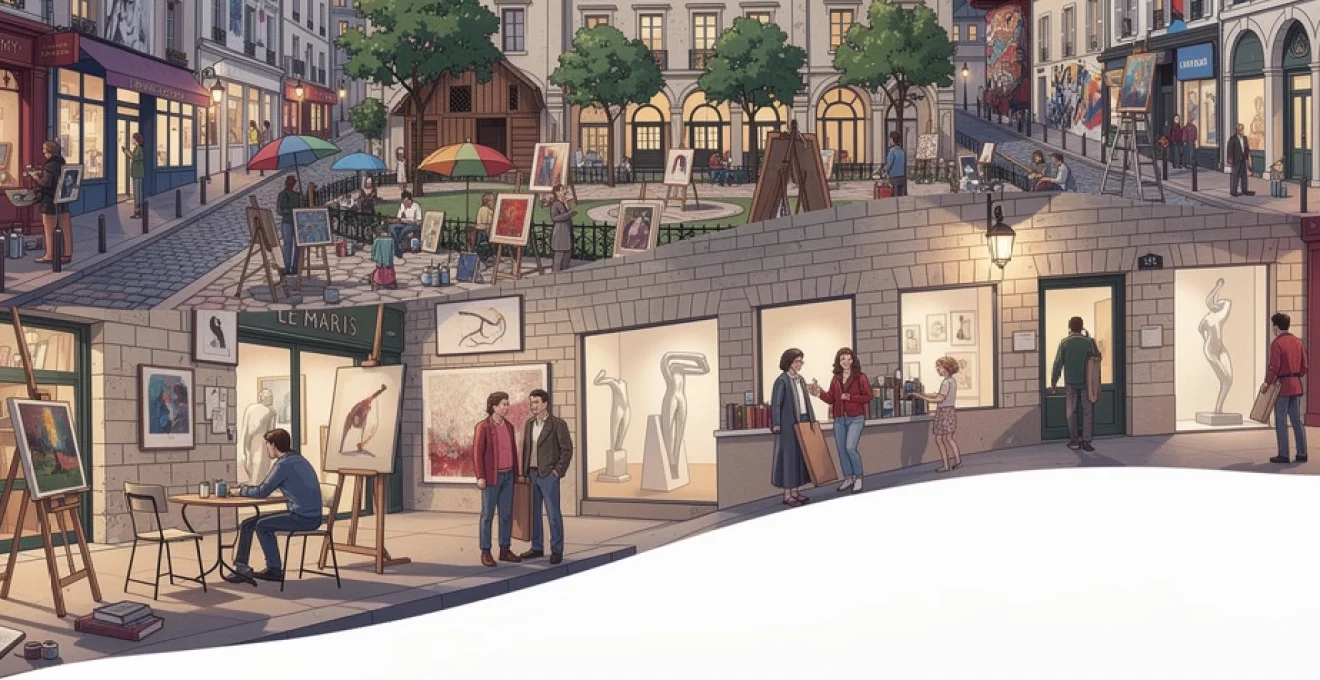
Paris stands as one of the world’s most influential artistic capitals, where creativity flows through cobblestone streets and modern galleries alike. The city’s artistic landscape spans centuries, from the traditional ateliers of Montmartre to the contemporary spaces emerging in industrial quarters. Each district tells a unique story of artistic evolution, cultural transformation, and creative community building. Understanding these diverse creative enclaves reveals how Paris maintains its position as a global art hub whilst continuously reinventing itself for new generations of artists and art lovers.
The artistic geography of Paris extends far beyond the famous museums and monuments. Hidden galleries, independent studios, and alternative spaces create a complex network of cultural production that spans both banks of the Seine. From the scholarly atmosphere of the Latin Quarter to the emerging creative corridors along Canal Saint-Martin, each neighbourhood contributes distinct flavours to the city’s artistic identity. These districts represent more than mere geographical boundaries—they embody different approaches to art-making, community building, and cultural expression that continue to shape contemporary Parisian artistic life.
Left bank artistic heritage: latin quarter’s bohemian legacy and contemporary gallery scene
The Latin Quarter’s artistic reputation extends back centuries, establishing itself as the intellectual and creative heart of Paris. This historic district continues to nurture artistic endeavours whilst balancing its scholarly traditions with contemporary creative enterprises. The interplay between ancient academic institutions and modern artistic spaces creates a unique environment where traditional craftsmanship meets innovative expression.
Academic influence permeates every aspect of the quarter’s artistic landscape, from the prestigious art schools to the independent galleries that showcase emerging talent. The neighbourhood’s narrow streets harbour countless studios, workshops, and creative spaces that maintain the area’s reputation as a breeding ground for artistic innovation. Book lovers and art enthusiasts find themselves naturally drawn to this district, where literary cafés neighbour contemporary galleries and traditional bookbinders work alongside digital artists.
École des Beaux-Arts influence on rue bonaparte’s artist studios
The prestigious École des Beaux-Arts continues to exert significant influence over the artistic character of Rue Bonaparte and surrounding streets. Students and faculty from this renowned institution have created a vibrant ecosystem of studios, galleries, and creative workshops throughout the area. The school’s emphasis on classical techniques alongside contemporary practices shapes the artistic output of the entire neighbourhood, creating a distinctive blend of traditional craftsmanship and modern innovation.
Private studios clustered around Rue Bonaparte reflect the school’s pedagogical approach, where master-apprentice relationships foster artistic development. These spaces often double as informal galleries, hosting exhibitions and artist talks that blur the lines between education and professional practice. Young artists benefit tremendously from this proximity to established practitioners and academic resources, creating natural mentorship networks that sustain the quarter’s artistic vitality.
Shakespeare and company’s literary circle impact on visual arts development
Shakespeare and Company bookshop has historically served as more than just a literary gathering place—it functions as a cultural catalyst that influences visual arts development throughout the Latin Quarter. The bookshop’s tradition of hosting readings, discussions, and cultural events creates cross-pollination between literary and visual arts communities. Writers, painters, photographers, and multimedia artists regularly intersect in this iconic space, fostering collaborative projects and interdisciplinary artistic exploration.
The shop’s influence extends beyond its physical walls, inspiring numerous galleries and creative spaces to adopt similar models of cultural programming. This approach emphasises community building and artistic dialogue, encouraging experimental work that crosses traditional medium boundaries. Contemporary artists frequently cite the bookshop’s open, inclusive atmosphere as foundational to their artistic development and professional networks within the Parisian art scene.
Galerie maeght and place furstenberg contemporary exhibition spaces
Place Furstenberg represents one of Paris’s most concentrated gallery districts, anchored by prestigious establishments like Galerie Maeght. These galleries have maintained strong relationships with both established and emerging artists, creating exhibition programmes that balance commercial viability with artistic innovation. The intimate scale of Place Furstenberg allows visitors to experience multiple exhibitions within a short walking distance, creating natural curatorial conversations between different spaces.
Contemporary exhibition spaces in this area have evolved beyond traditional gallery models, incorporating educational programmes, artist residencies, and public art initiatives. These venues recognise that modern art consumption requires more
more than white-walled rooms; they function as cultural platforms. Curated talks, book launches, and themed group shows invite visitors to engage with works in context rather than in isolation. For visitors trying to understand how Paris art districts operate today, Place Furstenberg offers a compact case study in how heritage addresses and contemporary gallery practice can coexist and mutually reinforce each other.
For collectors, this micro-district provides an efficient way to compare different curatorial approaches and price points within the same afternoon. For artists, proximity to institutions like Galerie Maeght can mean increased visibility and access to international networks. If you’re planning a Latin Quarter gallery walk, it is worth timing your visit for evening vernissages, when several spaces open new exhibitions on the same night and the square becomes a hub of conversation, networking, and informal portfolio reviews.
Panthéon quarter’s independent artist collectives and workspace networks
Moving uphill toward the Panthéon, the atmosphere shifts from polished gallery storefronts to more discreet doors leading to shared studios and collectives. Former educational buildings, repurposed warehouses, and upper-floor apartments now host independent artist-run spaces that prioritise experimentation over commercial pressure. These collectives often organise open-studio weekends, where visitors can see works in progress and discuss techniques directly with the creators.
The Panthéon quarter has become a laboratory for collaborative working models. Shared darkrooms, printmaking workshops, and digital fabrication labs are pooled resources, reducing costs while increasing technical possibilities for emerging artists. You might find, for example, a photographer renting time in a communal studio next to a sculptor using the same space for casting small-scale works. This networked infrastructure mirrors a co-working space but with a stronger emphasis on artistic risk-taking and peer critique.
Independent spaces here also engage with the intellectual legacy of the surrounding universities. Curators frequently collaborate with researchers in history, philosophy, or the sciences, producing exhibitions that merge rigorous scholarship with visual experimentation. For visitors, this means the Panthéon area is particularly rewarding if you are interested in concept-driven contemporary art or cross-disciplinary projects that go beyond traditional painting and sculpture.
Montmartre district analysis: traditional atelier culture versus modern creative enterprises
Montmartre retains a powerful mythos as the hilltop village where Picasso, Modigliani, and countless others transformed modern art. Yet the contemporary reality is a nuanced mix of tourist-focused spectacle and quietly thriving creative businesses. Understanding this contrast helps you navigate past surface-level attractions toward the ateliers and initiatives that still sustain serious artistic practice.
On one hand, traditional portrait painters and souvenir shops around Place du Tertre cater to the millions of visitors who climb the hill each year. On the other, design studios, small production houses, and contemporary galleries operate in side streets and courtyards, using Montmartre’s reputation while consciously updating its creative economy. The district essentially functions as a living case study in how an art neighbourhood can embrace its historical narrative without becoming a museum piece.
Place du tertre portrait artists and tourist art market dynamics
Place du Tertre remains Montmartre’s most visible artistic stage, where easels line the cobblestones and portraitists compete for the attention of passing visitors. The square operates under a regulated system of pitches allocated by the city, with long waiting lists and strict rules about working hours and space. This formal structure ensures continuity of the “open-air studio” tradition, while also revealing how highly coveted a place in the tourist art market can be.
From an economic perspective, Place du Tertre illustrates how art districts can sustain entire micro-economies based on quick-turnaround commissions. Many artists specialise in rapid charcoal or pastel portraits, delivering work within 10–20 minutes. Prices and negotiation styles vary, so it helps to walk the square first, observe different techniques, and ask politely about pricing before you sit down. If you are looking for an original but affordable Paris souvenir, commissioning a portrait here can be more meaningful than buying a mass-produced print.
Critics sometimes dismiss this scene as “tourist art,” yet for many practitioners it provides a dependable income that subsidises more experimental work done in private studios. Think of Place du Tertre as the public-facing shopfront of a much larger creative ecosystem. Behind the square, in upper-floor apartments and shared workshops, the same artists may be preparing works for local salons, online sales, or group exhibitions across the city.
Bateau-lavoir historical significance in cubist movement development
Just a short walk from the square, the Bateau-Lavoir on Place Émile-Goudeau represents one of Montmartre’s most important historical anchors. The original building, nicknamed for its resemblance to a washing barge, housed the studios of Picasso, Braque, Gris, and Modigliani in the early 20th century. It was here that Picasso painted Les Demoiselles d’Avignon in 1907, a work widely acknowledged as a foundational moment in the birth of Cubism.
Although a fire in the 1970s destroyed much of the original structure, the rebuilt site still hosts working studios and small exhibition spaces. For today’s visitors, the Bateau-Lavoir offers a more introspective counterpoint to the bustle of Place du Tertre. Rather than an open-air market, you encounter quiet stairwells, nameplates on studio doors, and occasional public events that connect contemporary practitioners to the location’s extraordinary artistic lineage.
The site’s enduring appeal lies in how it compresses art history and present-day practice into a single courtyard. Standing here, you can easily imagine the intense debates that once shaped early modernism, while simultaneously observing how younger artists negotiate issues of rent, visibility, and creative autonomy in 21st-century Paris. If you are mapping out a self-guided Montmartre art walk, including a stop at the Bateau-Lavoir helps contextualise the district beyond postcard clichés.
Moulin rouge cultural quarter’s performance art integration
Descending toward Boulevard de Clichy, the Montmartre district segues into the nightlife corridor anchored by the Moulin Rouge. This area, historically associated with cabaret, burlesque, and music halls, contributes a different dimension to Parisian art districts: performance as visual spectacle. The iconic red windmill, neon façades, and elaborate poster designs demonstrate how graphic art, costume design, and choreography intersect in a single entertainment ecosystem.
For visual artists, the Moulin Rouge quarter functions as both inspiration and employment network. Costume designers, set painters, lighting technicians, and illustrators work behind the scenes to support nightly shows that attract a global audience. Increasingly, performance venues in this area collaborate with contemporary artists on limited-run scenography, immersive installations, or reimagined poster campaigns, blurring the boundaries between commercial entertainment and experimental performance art.
Visitors interested in the crossover between stage and studio can look for smaller venues and bars that host cabaret-inspired performance nights, often featuring live drawing sessions or projected visuals by local video artists. In many ways, this quarter embodies how Montmartre’s historical bohemian energy has migrated from painting and poetry into multidisciplinary performance, while still retaining its reputation as a playground for creative risk-taking after dark.
Sacré-cœur periphery’s contemporary street art and mural installations
Around the base of the Sacré-Cœur Basilica, especially along Rue de Clignancourt and in the backstreets leading toward the 18th arrondissement’s northern edge, street art has become an increasingly visible layer of the district’s identity. Legal mural programmes and semi-authorised interventions coexist with spontaneous graffiti, creating a varied outdoor gallery that contrasts sharply with the church’s white domes above.
Local associations and the city government have commissioned large-scale murals on blank building façades, often inviting well-known French and international street artists to contribute. These works bring contemporary visual language into a neighbourhood otherwise dominated by historic imagery, offering a counter-narrative to the postcard view of Montmartre. For example, you might find a geometric abstract mural just a few minutes’ walk from a century-old cabaret sign, a visual analogy for the area’s layered artistic timelines.
If you are interested in exploring this dimension of Montmartre, consider following one of the independent street art maps or joining a guided walk that explains the difference between commissioned murals, tagged surfaces, and more politically charged interventions. This periphery demonstrates how the district continues to adapt, integrating newer art forms that speak to current social issues and global visual trends while still acknowledging its past.
Le marais cultural evolution: jewish quarter heritage to contemporary design hub
Le Marais offers one of Paris’s most striking examples of how an art district can evolve while preserving strong historical roots. Once characterised by aristocratic hôtels particuliers and later by a thriving Jewish community, the neighbourhood has, over the past four decades, transformed into a dense cluster of galleries, design boutiques, and creative agencies. Rather than replacing earlier layers, this evolution has added new cultural functions alongside existing ones.
For visitors, Le Marais can feel like an open-air catalogue of Paris art districts in miniature: heritage synagogues stand near cutting-edge design studios, while centuries-old courtyards host contemporary painting, photography, and installation art. The result is a district where you can move from heritage preservation to avant-garde experimentation within a few blocks, making it an ideal area for those who want to experience both historical context and contemporary practice in a single afternoon.
Rue des rosiers traditional craft workshops and artisan heritage
Rue des Rosiers, at the heart of the historic Jewish quarter, still preserves traces of the artisan economy that once defined this part of Le Marais. While many storefronts now serve food—particularly the famous falafel counters—upper floors and adjoining streets hide workshops for goldsmiths, leatherworkers, framers, and restorers. These craftspeople maintain skills passed down through generations, often supplying galleries and collectors throughout Paris.
In recent years, some of these traditional workshops have begun opening their doors during special events such as the Journées Européennes des Métiers d’Art (European Artistic Craft Days). This gives you a rare chance to see how gilding, bookbinding, or bespoke framing is still practiced within the district. Watching a framer assemble a conservation-grade frame for a 19th-century print, for example, illustrates the hidden infrastructure that allows the Paris art market to function.
Rue des Rosiers thus plays a quiet but crucial role in connecting past and present within Le Marais. Even if you come mainly for its culinary reputation, paying attention to workshop signs and nameplates can reveal an underlying network of artisans who ensure that both historical and contemporary artworks are preserved, presented, and circulated with the care they deserve.
Place des vosges gallery district and luxury art market positioning
Place des Vosges, with its perfectly symmetrical arcades and brick façades, has long attracted high-end galleries and dealers. Many specialise in Old Masters, modern classics, or blue-chip contemporary artists, positioning the square as one of Paris’s prime addresses for the luxury art market. Rents are high, but so is the visibility: collectors know that a single circuit of the arcades can introduce them to several museum-quality exhibitions.
Galleries here often maintain international client lists and participate in major fairs such as FIAC (now Paris+ par Art Basel) and TEFAF. Their spaces function as both showrooms and discreet meeting points for private sales. Window displays tend to be carefully curated, offering a glimpse of works that might also circulate to London, New York, or Hong Kong. For visitors who are more curious than acquisitive, Place des Vosges provides a valuable education in how pricing, provenance, and brand reputation shape the high-end segment of the Paris art scene.
At the same time, smaller galleries in the surrounding streets present younger or mid-career artists at more accessible price points. This proximity allows you to see, almost side by side, how different tiers of the art market operate. If you are considering your first acquisition, do not hesitate to ask staff about edition sizes, artist CVs, and payment plans; many spaces are more approachable than their imposing addresses might suggest.
Hôtel de soubise archives integration with modern creative spaces
The Hôtel de Soubise, home to part of the French National Archives, anchors another important cultural cluster within Le Marais. Its ornate courtyards and exhibition galleries present historical documents, maps, and artefacts that shed light on France’s political and social evolution. For contemporary artists and designers, this institution serves as a rich resource, providing source material for works that engage with memory, bureaucracy, and the politics of record-keeping.
Several nearby creative spaces actively reference the archives in their programming. Graphic designers might develop typefaces inspired by 18th-century manuscripts preserved inside, while installation artists create works that reinterpret administrative forms or censored letters. Occasional collaborative exhibitions explicitly connect archival material with commissioned contemporary pieces, encouraging visitors to consider how today’s digital documents will become tomorrow’s heritage.
This dialogue between archives and art exemplifies one of Le Marais’s core strengths: its capacity to function as both a guardian of history and a catalyst for new cultural production. If you are drawn to conceptually driven art or data-inspired design, spending time around Hôtel de Soubise can reveal how deeply the Paris art scene is woven into broader questions of memory and governance.
Saint-paul metro area’s design studios and fashion atelier concentration
Around the Saint-Paul metro station, the tone of Le Marais shifts again, this time toward contemporary design and fashion. Side streets such as Rue Saint-Paul, Rue Charlemagne, and Rue de Sévigné host a dense mix of graphic design agencies, interior design studios, and small fashion ateliers. Many operate on a hybrid model, combining consulting work for brands with their own product lines or capsule collections.
For the broader Paris art districts ecosystem, this concentration of design practices plays an important bridging role. Photographers collaborate with fashion houses on lookbooks, illustrators develop branding for concept stores, and set designers create ephemeral installations for seasonal window displays. Walking through the area, you will often encounter pop-up exhibitions, sample sales, or events that blur the line between shop, gallery, and studio.
If you are interested in applied arts or the intersection of visual culture and commerce, this part of Le Marais is particularly insightful. It demonstrates how the city’s creative economy extends beyond traditional gallery models into branded spaces and experiential retail. For aspiring designers, it also offers a realistic picture of how small studios survive: by diversifying projects, cultivating long-term clients, and leveraging the neighbourhood’s constant foot traffic.
Canal Saint-Martin creative corridor: industrial heritage transformation into artist quarters
North-east of Le Marais, the Canal Saint-Martin area showcases how former industrial zones can be repurposed into vibrant creative quarters. Once dominated by warehouses, workshops, and modest housing for workers, the district has gradually attracted artists, designers, and cultural entrepreneurs drawn by relatively lower rents and generous floor plans. Lock bridges and tree-lined quays now frame a relaxed yet energetic environment, particularly attractive to younger creatives.
Many of the ground-floor spaces along Quai de Valmy and Quai de Jemmapes now house hybrid venues that combine studios, galleries, cafés, and concept stores. A design collective might occupy a former metal workshop, installing a street-facing gallery to showcase furniture prototypes while using the back rooms for fabrication and team meetings. This multifunctional usage mirrors broader urban trends: cultural production, retail, and hospitality converge in single addresses, offering both visibility and financial resilience.
Institutions such as Point Éphémère and the nearby CENTQUATRE-Paris play anchor roles in this corridor, providing rehearsal spaces, residencies, and exhibition platforms for emerging artists across disciplines. Their programming often includes street art, performance, video, and socially engaged projects, aligning closely with the area’s informal, experimental character. For visitors, attending an event at one of these centres is one of the most direct ways to experience how a contemporary Paris art district operates beyond the traditional gallery scene.
Belleville alternative art scene: street art culture and independent gallery networks
Further east, straddling the 19th and 20th arrondissements, Belleville has become synonymous with Paris’s alternative art scene. Historically a working-class and immigrant neighbourhood, it offers a very different visual and social landscape from the polished streets of Saint-Germain or Le Marais. Here, murals climb entire building façades, and small artist-run spaces coexist with community centres, cafés, and long-established local businesses.
Street art is perhaps the most visible expression of Belleville’s creative energy. Guided walks frequently trace routes up Rue Denoyez, around the Parc de Belleville, and through side streets where both recognised names and anonymous writers leave their marks. These interventions range from politically charged stencils to intricate paste-ups and large-scale commissioned works. The result is a constantly shifting outdoor gallery that encourages repeat visits, as pieces are painted over, adapted, or replaced.
Alongside this, a loosely connected network of independent galleries and project spaces has taken root. Many operate on shoestring budgets, prioritising curatorial freedom and community engagement over commercial gain. Exhibitions might focus on diasporic narratives, queer perspectives, or experimental media rarely seen in more established institutional settings. Openings in Belleville tend to be informal and welcoming; it is not unusual to find artists, curators, and neighbours sharing drinks on the pavement while discussing the work inside.
For anyone curious about where emerging trends in the Paris art scene are incubated, Belleville is essential. It functions as an early-warning radar for new aesthetics and debates, much like an independent music venue signals tomorrow’s headliners. Visiting this district requires a bit more walking and openness to improvisation, but the reward is a direct encounter with the city’s most politically and socially engaged artistic practices.
Saint-germain-des-prés gallery quarter: established art market and auction house dynamics
Returning to the Left Bank, Saint-Germain-des-Prés remains one of Paris’s most established gallery quarters, where literary café culture intersects with a mature, international art market. Streets such as Rue de Seine, Rue des Beaux-Arts, and Rue Jacob host a dense concentration of galleries dealing in everything from post-war abstraction to cutting-edge photography. Many have operated here for decades, building deep relationships with collectors, museums, and artists.
The commercial dynamics of this quarter are closely tied to major auction houses and art fairs. Galleries often time their key exhibitions to coincide with sale weeks at Christie’s and Sotheby’s or with events like Paris Photo, when international buyers are in town. Secondary-market activity—resale of works by already established artists—plays a significant role here, with dealers advising clients on portfolio building, deaccession strategies, and long-term value. This makes Saint-Germain particularly instructive if you want to understand how art functions as both cultural capital and financial asset.
At the same time, smaller and mid-sized galleries in the neighbourhood actively support living artists through solo shows, artist talks, and catalogue publications. Many specialise in specific movements or regions—Concrete art, Japanese photography, Latin American conceptualism—offering a level of expertise that can be invaluable to serious collectors and informed enthusiasts alike. Staff are generally knowledgeable and, when approached respectfully, happy to explain context, pricing structures, and editioning for prints or multiples.
For visitors planning a gallery tour, it can be useful to think of Saint-Germain-des-Prés as a curated maze. Start along Rue de Seine, where you can move from one doorway to the next, and allow yourself to be drawn in by whatever catches your eye—minimalist canvases, vintage gelatin silver prints, or sculptural installations. In doing so, you will experience not only the artworks themselves but also the subtle choreography of how one of Paris’s most influential art districts presents, promotes, and negotiates culture on a global stage.