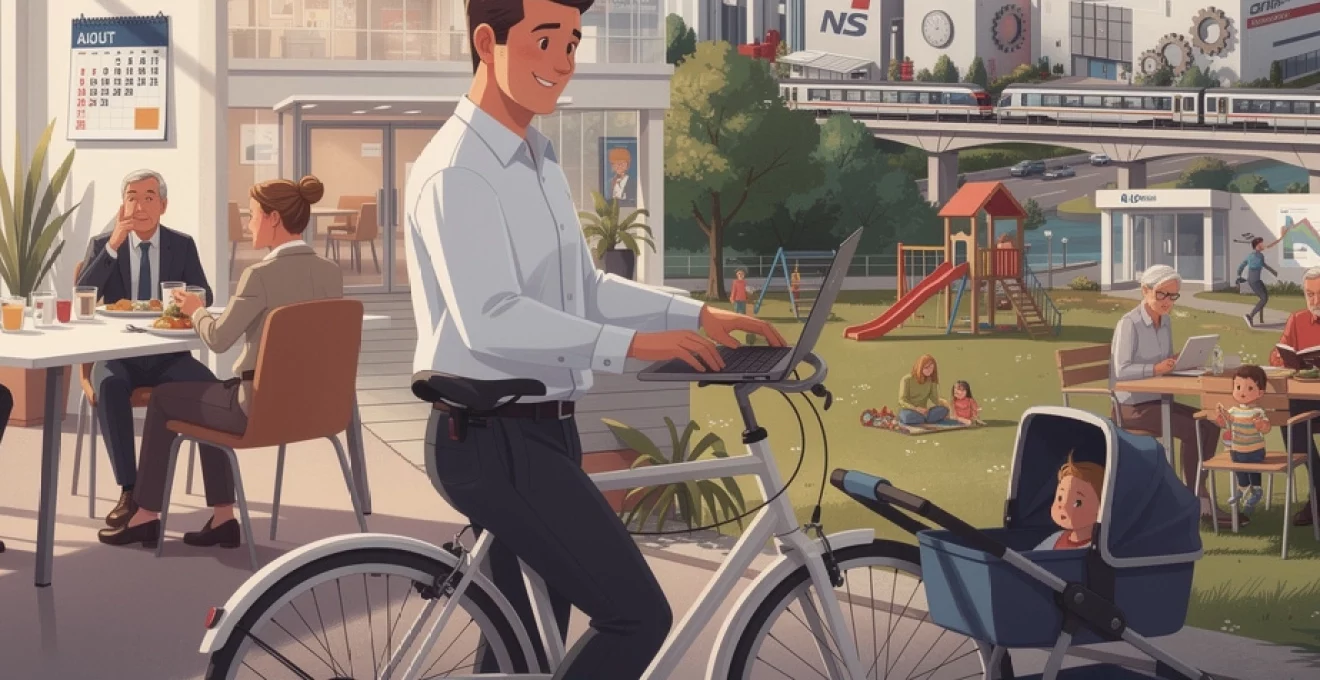
When you picture France, perhaps images of leisurely café lunches, extended August holidays, and a certain joie de vivre come to mind. These aren’t merely romantic stereotypes—they represent a deeply embedded cultural philosophy that prioritises quality of life alongside professional accomplishment. France has constructed an intricate social and legislative framework that explicitly protects workers’ time, health, and personal fulfilment in ways that continue to baffle and fascinate observers from more work-centric cultures. The French approach challenges the assumption that relentless productivity and extended working hours are prerequisites for economic success, instead demonstrating that a well-rested, properly supported workforce can drive innovation and prosperity whilst maintaining robust personal lives. This distinctive equilibrium between professional demands and personal time has become not just a cultural characteristic, but a defining pillar of French identity.
Legislative framework: the 35-hour working week and RTT system
France’s commitment to work-life balance isn’t simply a matter of cultural preference—it’s enshrined in law. The legislative architecture supporting this philosophy represents one of the most comprehensive attempts by any developed nation to formally limit working time and protect employees’ personal hours. Understanding this framework helps explain why the French approach to work differs so fundamentally from that of countries like the United Kingdom or the United States, where statutory working time limits remain far more flexible or non-existent.
The aubry laws and mandatory working time reduction
The cornerstone of France’s working time legislation arrived in 2000 with the implementation of the Aubry Laws, named after then-Minister of Labour Martine Aubry. These regulations established the 35-hour working week as the legal standard for full-time employment, reducing it from the previous 39-hour norm. The primary motivation wasn’t purely altruistic—policymakers hoped that by limiting individual working hours, companies would be compelled to hire additional staff, thereby reducing unemployment during a period of economic restructuring. The legislation applied specifically to blue-collar workers and non-managerial staff, creating a clear demarcation in how different employment categories experience working time.
Critics initially predicted economic catastrophe, arguing that French businesses would become uncompetitive against international rivals unburdened by such constraints. Yet these dire forecasts largely failed to materialise. Instead, the reforms forced organisations to examine productivity more critically, eliminate inefficiencies, and focus on output quality rather than time spent at desks. The 35-hour week became a cultural touchstone, a point of national pride that symbolised France’s determination to resist what many French citizens viewed as the dehumanising aspects of Anglo-American capitalism.
RTT (réduction du temps de travail) compensation mechanisms
Whilst the 35-hour week applies to certain worker categories, reality proves more nuanced for managers and white-collar professionals—the cadres. These employees typically work considerably longer hours, with 2016 statistics indicating an average of 43.2 hours weekly for managerial staff. However, French law doesn’t simply abandon these workers to unlimited schedules. Instead, the RTT system provides compensation through additional paid days off calculated based on hours worked beyond the 35-hour threshold.
The RTT mechanism functions as a bank of accumulated time. When a cadre works beyond standard hours, they accrue RTT days that can be taken as additional leave throughout the year. In 2013, the average RTT allotment stood at nine days annually, effectively extending the already generous holiday provisions. This system acknowledges the practical reality that certain roles demand flexibility and extended commitment during critical periods, whilst ensuring that this additional effort translates into tangible rest and recovery time rather than simply disappearing into an employer’s expectations.
Annual leave entitlements: five weeks minimum under french labour code
Beyond weekly working time restrictions, French labour law guarantees all full-time employees a minimum of five weeks of paid annual leave—25 working days. This represents one of the most generous statutory holiday provisions in the developed world. By comparison, the United Kingdom mandates 28 days (including bank holidays), whilst the United States has no federal requirement for paid holiday whatsoever, leaving such matters to employer discretion.
In practice, many French workers enjoy even more generous allocations. Senior employees, those with longer tenure
In practice, many French workers enjoy even more generous allocations. Senior employees, those with longer tenure, and workers covered by advantageous conventions collectives often receive additional days. When you add public holidays and RTT days into the equation, it’s not unusual for a French employee to have the equivalent of seven to eight weeks off per year. This legal foundation sends a powerful signal: time away from work is not an indulgence, but a fundamental component of a sustainable professional life.
Right to disconnect laws: digital workplace boundaries since 2017
The legislative push for work-life balance did not stop at working hours and paid leave. In 2017, France introduced the so‑called “right to disconnect” (droit à la déconnexion), requiring companies with more than 50 employees to negotiate clear rules around after-hours communication. The aim is simple yet radical in our always-on digital culture: protect workers from the creeping expectation that they must be permanently reachable by email, messaging apps, or phone. Employers are encouraged to define time slots when employees are not expected to respond and to put systems in place that discourage out‑of‑hours contact.
Some organisations have gone further by technically restricting access to email servers in the evening or during weekends, ensuring that “emergency” messages are the rare exception rather than the norm. For international teams used to late‑night pings and constant connectivity, this can feel almost shocking at first. Yet the French view is that digital boundaries are as important as physical ones, helping to prevent burnout, protect family time, and reinforce the message that productivity should be concentrated within defined working hours. In effect, the right to disconnect is the legal counterpart to the cultural idea that, once you leave the office, you truly leave work behind.
Corporate culture and workplace practices in french organisations
Legislation alone cannot explain why work-life balance is such a pillar of the French lifestyle. The daily rhythms and unwritten codes of French corporate culture reinforce and extend the protections set out in law. From how lunch is handled to when meetings are scheduled, workplace practices are designed to respect personal time and create a clearer separation between professional and private spheres. For foreigners used to back‑to‑back meetings and desk lunches, these norms can feel almost like an alternate universe—one where time is structured differently and recovery is part of the job.
Lunch break protocols: the two-hour déjeuner tradition
One of the most visible manifestations of the French work-life philosophy is the midday break. While the legal minimum lunch break can be far shorter, in many companies a 60‑ to 120‑minute déjeuner remains the norm. Rather than hastily eating at their desks, employees are expected to step away from their screens, often heading to a nearby restaurant, a company canteen, or even home if they live close by. Lunch is seen as both a social ritual and a pause that allows the mind to reset before the afternoon’s work.
This long lunch tradition has concrete implications for work-life balance. It breaks the day into two distinct segments, preventing the kind of eight‑hour stretch of uninterrupted screen time that is common in more work‑centric cultures. It also supports healthier eating habits and fosters stronger relationships among colleagues, which in turn can improve collaboration and reduce workplace stress. You might ask: doesn’t such a lengthy break hurt productivity? In practice, many French employees simply work with greater focus during the morning and late afternoon, proving that total hours at the desk and effective output are not the same thing.
Email etiquette: out-of-office enforcement at orange and michelin
French corporations have become laboratories for experimenting with digital boundaries. Large employers such as Orange and Michelin have implemented strict out-of-office email policies that put the right to disconnect into practice. Some teams configure their servers so that emails sent outside agreed working hours are held back and delivered the next working day. Others automatically notify senders that a recipient is off duty and will not respond until they return, subtly shifting expectations around instant replies.
At Orange, for example, managers are actively trained not to send non‑urgent emails late at night or on weekends, with internal guidelines treating such behaviour as poor leadership rather than dedication. Michelin has tested systems that automatically delete emails received during an employee’s holiday, asking the sender to contact a colleague instead. These initiatives may seem extreme to those accustomed to 24/7 responsiveness, but they underline a central French belief: technology should serve human wellbeing, not erode it. By institutionalising healthy email etiquette, companies help employees maintain a psychological boundary between work and home, reducing the cognitive load that comes with constant low‑level monitoring of inboxes.
Meeting schedules: avoiding pre-9am and post-6pm appointments
Another, often overlooked, aspect of French workplace practice is the timing of meetings. In many sectors, scheduling regular meetings before 9am or after 6pm is strongly discouraged, if not informally taboo. Early‑morning or late‑evening calls with overseas offices are treated as exceptions that must be justified and rotated fairly among team members. The underlying principle is that employees should be able to organise their mornings and evenings around family obligations, commuting, and personal activities without constant professional intrusion.
This approach contrasts with cultures where 7am conference calls or 8pm debriefs are routine, especially in global companies. By keeping most meetings within a clearly defined daytime window, French organisations create predictable schedules that support childcare arrangements, evening hobbies, and social life. The effect is a less chaotic rhythm of work, where productivity is concentrated and personal time is not constantly encroached upon by “just one more” meeting. For anyone trying to design a better work-life balance in their own organisation, examining when meetings are allowed to happen can be a surprisingly powerful lever.
August shutdown period: national business closure conventions
No discussion of French work culture would be complete without mentioning August. Throughout the month, and especially in its middle weeks, large parts of the country effectively slow down or even pause. Factories schedule maintenance shutdowns, many small shops close their doors, and offices operate with skeleton staff as employees take their annual leave. In Paris, entire neighbourhoods can feel noticeably quieter, with closed shutters and “fermé pour congés” signs reminding you that, for the French, holidays are a collective experience, not an individual exception.
From a business perspective, the August shutdown may appear inefficient. Yet there is a pragmatic logic behind aligning holidays in this way. Clients, suppliers, and colleagues share the same expectations, reducing frustration about delayed responses or stalled projects. It also creates a cultural permission slip to genuinely switch off, knowing that most of your professional ecosystem is doing the same. Rather than constantly juggling overlapping leave periods, companies build their annual planning around this slower month, focusing on strategic reflection, maintenance, or training at the fringes of the holiday season.
Economic productivity metrics despite reduced working hours
Given these strong protections for personal time, you might reasonably wonder: does France pay an economic price for working less? International data suggests the answer is more complex than the stereotypical image of the leisurely French worker implies. Despite shorter average working hours and extensive holidays, France consistently ranks among the world’s most productive economies when measured per hour worked. This apparent paradox is central to understanding why work-life balance is seen not as a luxury, but as part of an effective economic model.
OECD productivity rankings: france’s GDP per hour worked
According to recent OECD data, France’s GDP per hour worked places it among the top performers in Europe, often outstripping countries where employees spend significantly more time on the job. In 2023, French labour productivity hovered around the high‑50s to low‑60s in US dollars of GDP per hour worked, putting it ahead of the United Kingdom and close to Germany. This suggests that, on average, each hour of French labour generates substantial economic value despite—or arguably because of—the limited number of hours worked overall.
Economists point to several reasons for this strong productivity-per-hour metric. A well‑educated workforce, robust infrastructure, and high rates of capital investment all play a role, but so does the cultural emphasis on focused work during working hours. When employees come to the office rested and with protected time for recovery, they are better able to concentrate, solve complex problems, and avoid the diminishing returns that come with chronic overwork. The French case challenges the assumption that longer hours inevitably lead to higher output; instead, it supports the growing body of research suggesting that beyond a certain threshold, additional hours can actually reduce overall productivity.
Sectoral analysis: manufacturing efficiency in lyon and toulouse industrial zones
The picture becomes even clearer when we look at specific sectors. In manufacturing hubs such as Lyon and Toulouse, where industries like chemicals, pharmaceuticals, aerospace, and precision engineering cluster, French firms compete on quality and efficiency rather than sheer volume of hours. Airbus facilities around Toulouse, for instance, have to coordinate with global supply chains while operating within French labour regulations that cap working time and mandate significant leave. Yet the region has become synonymous with high‑tech manufacturing and complex project management.
Similarly, the industrial zones around Lyon host some of Europe’s most advanced chemical and biotech plants, which rely on high automation and skilled labour rather than extended shifts to maintain competitiveness. Here, work-life balance is not seen as an obstacle but as a factor in attracting and retaining scarce technical talent. For engineers and technicians, knowing that they can build a demanding career while still having time for family, culture, and leisure makes these regions particularly attractive. The result is a virtuous circle: companies invest in efficiency and innovation, which supports high productivity per hour, making generous work-life policies economically sustainable.
Innovation output: french patent applications and R&D investment rates
Another way to gauge whether a country’s work-life model supports economic vitality is to look at innovation. France consistently ranks among the top European nations for patent applications, particularly in sectors such as transport, pharmaceuticals, and green technologies. Data from the European Patent Office regularly places French applicants within the top five globally, reflecting a robust innovation ecosystem underpinned by both public and private R&D investment.
French R&D spending, hovering around 2.2–2.3% of GDP in recent years, may lag slightly behind Germany but still indicates a strong commitment to long‑term innovation. Crucially, many French researchers and engineers operate within the same legislative framework of protected hours and generous leave. This suggests that creativity and scientific output do not require a culture of constant overwork; on the contrary, mental space and time away from the lab or office can foster the kind of lateral thinking that leads to breakthroughs. For businesses and policymakers elsewhere, the French example raises an important question: could protecting personal time actually be a competitive advantage in knowledge‑intensive industries?
Healthcare system integration and preventative wellness policies
Work-life balance in France is not only a matter of time; it is closely linked to health. The French healthcare system, regularly ranked among the best in the world, integrates occupational health and preventative care in ways that reinforce the country’s broader philosophy around work. By treating worker wellbeing as both a public good and an economic asset, France creates structural support for sustainable careers. This alignment between healthcare and labour policy makes it easier for individuals to maintain their physical and mental health over the long term.
Occupational health monitoring: médecine du travail requirements
Every employee in France is covered by médecine du travail, a dedicated occupational health service that operates alongside the general healthcare system. Employers are legally required to provide access to occupational doctors, who carry out regular check‑ups, assess workplace risks, and advise on adaptations when health issues arise. New employees typically undergo an initial medical visit, followed by periodic reviews depending on their exposure to particular risks or job demands.
This proactive monitoring serves several functions. It enables early detection of work‑related health problems, helps tailor roles to individual capacities, and provides an official channel for discussing workload, stress, or ergonomic concerns. Rather than waiting for severe burnout or injury to emerge, the system encourages ongoing dialogue between worker, employer, and health professional. For you as an employee, this means that your health is formally recognised as part of your professional profile, not an afterthought to be managed in your spare time.
Burnout prevention: recognised professional disease classification
In recent years, France has taken significant steps to acknowledge the reality of psychological strain at work. Burnout (épuisement professionnel) has progressively gained recognition within the framework of occupational illness, with some severe cases now eligible for classification as a professional disease. This recognition matters because it opens the door to specific compensation, workplace adaptations, and, in certain circumstances, employer responsibility.
By naming burnout as a work‑related condition rather than a purely individual failing, French institutions send a clear message: chronic overwork and psychological pressure are structural risks to be managed, not badges of honour. Companies are increasingly expected to monitor psychosocial risks, introduce stress‑reduction measures, and train managers to identify warning signs. While no system is perfect, this formal recognition supports a culture where seeking help is more acceptable and where preventing burnout is seen as part of good management practice.
Mental health support: CPAM reimbursement for psychological services
Complementing these occupational mechanisms, the French national health insurance system (CPAM) has expanded its coverage of mental health services. Pilot programmes launched in recent years allow patients, including employees under stress, to obtain partial reimbursement for sessions with qualified psychologists upon medical referral. This is a significant shift in a country where, historically, psychotherapy was often paid entirely out of pocket.
For workers juggling professional responsibilities and personal life, easier access to psychological support can be transformative. It lowers financial barriers to care and normalises the idea that mental health is as legitimate a concern as physical injury. When combined with work-time protections and the right to disconnect, this reinforces a holistic vision of work-life balance: not just fewer hours, but a healthier, more sustainable way of engaging with work over the course of a career.
Social infrastructure supporting work-life integration
Behind the legal framework and corporate practices lies a dense network of social infrastructure that makes French work-life balance practically achievable. Childcare, transport, and cultural facilities are designed to be accessible and affordable, allowing people to weave their professional and personal lives together with less friction. Without this infrastructure, statutory rights would be harder to exercise; with it, the French lifestyle becomes something you can experience in everyday routines, not just in theory.
Childcare networks: crèches collectives and assistantes maternelles systems
One of the key pillars of this infrastructure is childcare. France operates a mixed system of public and private options, with crèches collectives (group nurseries) and assistantes maternelles (licensed childminders) forming the backbone of early childhood care. Municipalities often subsidise crèche places according to household income, making high‑quality childcare more affordable than in many comparable countries. Parents can also benefit from tax credits and financial support to employ childminders, who are subject to training and regulation.
This extensive childcare network has two major implications for work-life balance. First, it enables both parents to participate in the labour market without facing prohibitive costs or unreliable arrangements. Second, because opening hours are often aligned with standard working days and commuting patterns, parents can coordinate drop‑off and pick‑up with relatively predictable schedules. For families, this means that the choice between career and children is less stark; for employers, it widens the talent pool and supports gender equality in the workplace.
Public transport efficiency: SNCF commuting patterns and TER regional services
Public transport is another essential ingredient in the French approach to integrating work and life. The national rail operator SNCF, along with regional TER services and urban networks of metros, trams, and buses, connects residential suburbs with employment centres across the country. In many metropolitan areas, a significant share of workers rely on public transport for their daily commute, often benefitting from employer subsidies for travel passes.
When trains and trams run frequently and reliably, commuting time can become more predictable and, crucially, less stressful. Even though some regions—especially around Paris—struggle with congestion and delays, the overall system still offers a level of accessibility that many countries envy. Being able to read, rest, or simply decompress on the train rather than fighting through traffic makes it easier to arrive at work mentally prepared and to return home without carrying as much residual stress. You can think of transport as the hinge between work and personal life; in France, considerable effort goes into making that hinge as smooth as possible.
Cultural access: subsidised museums, theatres and cinéma pass initiatives
Work-life balance is not just about having time off; it is also about what you can do with that time. France invests heavily in cultural infrastructure, from national museums and regional theatres to local libraries and cinemas. Subsidised ticket schemes, such as reduced‑price cinema passes or cultural vouchers for young people, lower the cost of participation and encourage regular engagement with the arts. Many cities organise free or low‑cost festivals, open‑air concerts, and exhibitions, turning leisure into an accessible part of everyday life rather than an occasional luxury.
This cultural abundance shapes how people use their evenings, weekends, and holidays. Instead of defaulting to more work or purely domestic routines, many French residents spend their time exploring exhibitions, attending performances, or simply enjoying public spaces designed for social life. The result is a richer, more varied set of non‑work identities: you are not just your job title, but also a concert‑goer, amateur painter, or cinema enthusiast. This diversification of identity is one of the subtler yet most powerful pillars of the French work-life model.
Regional variations: paris versus provincial lifestyle dynamics
Of course, the French experience of work-life balance is far from uniform. Where you live—Paris, a mid‑sized regional city, or a rural area—can dramatically shape how these national principles translate into daily life. While the legislative framework is the same across the country, commuting patterns, housing costs, and local cultures vary widely. Understanding these regional dynamics helps explain why some French people feel their balance is under pressure, even within a system designed to protect it.
Île-de-france commuting challenges and stress indicators
In the Île-de-France region surrounding Paris, long commutes and high living costs can strain even the best legal protections. Many workers spend an hour or more each way on crowded RER trains or congested ring roads, turning the theoretical 35‑hour week into far more time spent away from home. Surveys regularly show that Parisians report higher levels of stress and fatigue than residents of smaller cities, with commuting often cited as a key factor.
Strikes and infrastructure works, while part of the broader French tradition of labour negotiation, can add further unpredictability to the daily journey. For some, the solution has been to move closer to work despite higher housing costs; for others, the pandemic‑driven rise of remote work has offered a new way to reclaim time. Yet even in this challenging environment, many Parisian employers are experimenting with flexible hours, telework days, and satellite offices in the suburbs to reduce commuting burdens and support more humane daily rhythms.
Quality of life rankings: nantes, bordeaux and lyon attractiveness studies
Outside the capital, a different picture often emerges. Cities like Nantes, Bordeaux, and Lyon frequently top French quality‑of‑life and work‑attractiveness rankings, thanks to shorter commutes, vibrant cultural scenes, and strong local economies. Studies by national newspapers and research institutes regularly highlight these cities as ideal locations for balancing career and lifestyle, attracting both domestic migrants and international talent.
Nantes, with its dynamic digital and creative sectors, offers a blend of urban amenities and proximity to the Atlantic coast. Bordeaux combines a booming tech and services economy with renowned wine country and a sunny climate. Lyon, France’s second metropolitan area, boasts major industries in biotech, chemicals, and gastronomy, alongside access to the Alps. In each of these cities, the national framework of reduced working hours and generous leave intersects with manageable living costs and easier daily logistics, making the French promise of work-life balance feel particularly tangible.
Remote work adoption in brittany and occitanie rural areas
The rise of remote work has added a new layer of complexity—and opportunity—to regional dynamics. In regions such as Brittany and Occitanie, many professionals now split their time between occasional trips to major urban centres and home offices in smaller towns or even rural villages. Reliable broadband, improved regional rail links, and supportive local policies have made it increasingly feasible to pursue high‑skilled careers from locations once considered too remote.
This trend has the potential to rebalance work and life in profound ways. Imagine starting your day with a walk along the Breton coast or in the Occitan countryside before logging on for meetings with colleagues in Paris or abroad. For some, this hybrid arrangement offers the best of both worlds: access to national and international job markets combined with the slower pace and stronger community ties of provincial life. While challenges remain—notably around digital infrastructure and maintaining clear boundaries when home becomes the workplace—the French framework of limited hours, the right to disconnect, and strong social infrastructure continues to provide a solid foundation for rethinking what a healthy working life can look like in the 21st century.