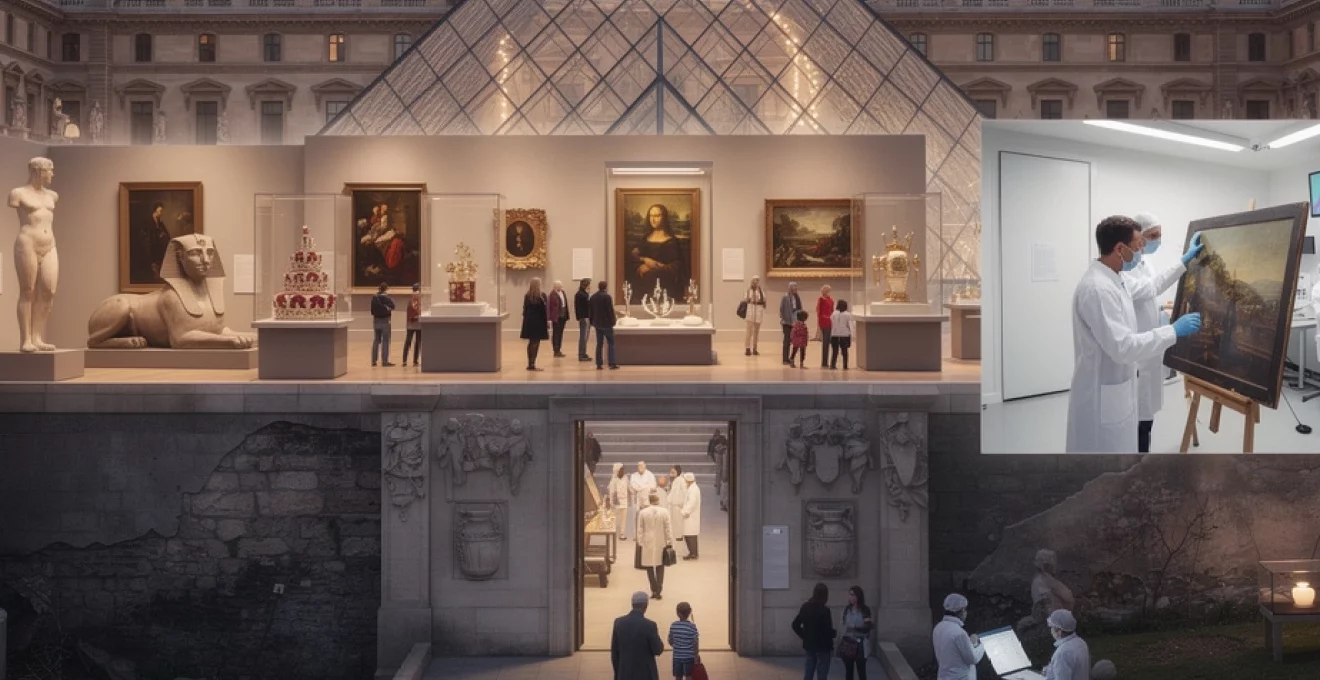
Standing majestically along the banks of the Seine River, the Louvre Museum represents humanity’s greatest commitment to preserving and celebrating artistic achievement. This extraordinary institution houses over 380,000 objects spanning millennia of human creativity, from ancient civilisations to contemporary masterpieces. With approximately 10 million visitors annually, the Louvre transcends its role as merely a museum to become a cultural pilgrimage site where art lovers encounter works that have shaped civilisation itself. The museum’s transformation from a 12th-century fortress to the world’s most visited art museum exemplifies France’s dedication to making cultural treasures accessible to global audiences.
Architectural magnificence and historical significance of the louvre palace complex
The architectural evolution of the Louvre spans eight centuries, creating a remarkable tapestry of French building traditions. This magnificent complex demonstrates how successive generations of architects and rulers contributed to what has become one of Europe’s most significant architectural achievements. The building’s current form represents multiple architectural periods, from medieval fortifications to contemporary interventions that continue to shape visitor experiences today.
Medieval fortress origins under philippe auguste’s 12th century construction
The original Louvre fortress, constructed between 1190 and 1202, served as a defensive stronghold protecting Paris’s western approaches. King Philippe Auguste commissioned this formidable structure featuring a central keep rising 98 feet above ground level, surrounded by defensive walls and a substantial moat. Archaeological excavations beneath the current museum reveal portions of these medieval foundations, including the circular keep’s base and fragments of the original defensive walls. The fortress design reflected 12th-century military architecture principles, emphasising both defensive capabilities and symbolic royal authority over the expanding Parisian territories.
Renaissance transformation during françois i’s architectural renaissance programme
François I’s reign marked a revolutionary transformation of the medieval fortress into a Renaissance palace worthy of European royal courts. Beginning in 1546, the king commissioned Pierre Lescot to redesign substantial portions of the structure, introducing Italian Renaissance architectural elements that would influence French palace design for centuries. This ambitious reconstruction programme replaced medieval defensive features with elegant residential quarters, grand reception halls, and extensive art galleries designed to showcase the royal collections. The Renaissance transformation established the Louvre’s dual identity as both royal residence and repository for artistic treasures.
Pierre lescot’s classical façade design and sculptural integration
Pierre Lescot’s architectural vision introduced classical proportions and sophisticated decorative elements that defined the Louvre’s aesthetic character. His design for the western façade incorporated Corinthian columns, triangular pediments, and elaborate sculptural programmes created by Jean Goujon. These sculptural reliefs depicted mythological scenes and royal emblems, establishing a visual language that celebrated both classical antiquity and French royal power. Lescot’s innovative use of natural light through strategically positioned windows transformed interior spaces, creating galleries that would later prove ideal for displaying artistic masterpieces.
Glass pyramid innovation by I.M. pei’s contemporary architectural vision
The controversial yet ultimately celebrated glass pyramid, completed in 1989, demonstrates how contemporary architecture can enhance rather than compromise historical structures. I.M. Pei’s design addresses practical challenges of accommodating millions of annual visitors whilst creating a striking visual dialogue between past and present. The pyramid’s transparent materials allow natural light to flood the underground reception areas, creating an ethereal atmosphere that prepares visitors for their artistic journey. This architectural intervention proves that thoughtful contemporary additions can strengthen rather than diminish historical buildings, providing modern functionality without sacrificing cultural authenticity.
Masterpiece collections and curatorial excellence across civilisations
The Louvre’s curatorial approach reflects centuries of scholarly dedication to preserving and presenting humanity’s greatest artistic achievements. Eight distinct departments organise the museum’s vast holdings, each representing specialised expertise in different cultural traditions and historical periods. This systematic organisation enables visitors to explore artistic development across civilisations whilst allowing scholars to conduct comparative research across cultural boundaries.
Leonardo da vinci’s mona lisa and italian renaissance paintings department
Leonardo da Vinci’s enigmatic portrait continues to captivate millions of visitors annually, representing the pinnacle of Renaissance artistic achievement. The painting’s revolutionary techniques, including sfumato and atmospheric perspective, demonstrate da
continually refined his mastery of light and shadow. Within the Italian Renaissance paintings department, works by Raphael, Titian, and Veronese provide essential context, allowing visitors to compare how different masters approached portraiture, religious themes, and mythological narratives. By presenting the Mona Lisa alongside this broader visual culture, the Louvre enables us to see Leonardo not as an isolated genius, but as part of a vibrant artistic network that reshaped European painting.
Curators in this department carefully manage visitor flow around the Mona Lisa, balancing conservation needs with public demand to see the world’s most famous painting. Sophisticated queuing systems, controlled lighting, and protective glazing ensure the work remains accessible whilst safeguarding it from environmental fluctuations and physical risk. For art lovers planning a visit, arriving early in the morning or later in the day can offer a more contemplative experience of this iconic masterpiece. The department’s interpretive panels and digital tools further deepen understanding, explaining technical analyses that reveal Leonardo’s underdrawings and minute corrections beneath the visible surface.
Ancient egyptian antiquities including the seated scribe and sphinx collections
The Louvre’s Egyptian antiquities department, one of the most comprehensive outside Egypt, spans over 4,000 years of civilisation along the Nile. Among its most celebrated works is the Seated Scribe, a remarkably lifelike limestone sculpture from the Old Kingdom whose inlaid eyes seem to follow the viewer with uncanny realism. Nearby, monumental sphinxes and colossal statues evoke the grandeur of temple complexes, offering a striking contrast between intimate funerary objects and large-scale royal imagery. Together, these pieces reveal how ancient Egyptians combined artistic sophistication with strong religious and political symbolism.
Carefully curated thematic galleries guide visitors through daily life, writing systems, and beliefs about the afterlife, making this collection particularly rewarding for those curious about ancient cultures. You can trace the evolution of hieroglyphic script, examine intricately painted sarcophagi, and observe how styles changed under foreign dynasties such as the Ptolemies. For modern viewers, the department’s explanatory labels and multimedia supports function like a time machine, translating a distant civilisation into relatable human stories. In this way, the Louvre reinforces its role as a timeless artistic treasure that connects us to the very origins of written history and monumental art.
Greek and roman classical sculptures featuring venus de milo
The Greek, Etruscan, and Roman antiquities department is home to some of the Louvre’s most recognisable masterpieces, foremost among them the Venus de Milo. This Hellenistic sculpture of Aphrodite, dating from around 130–100 BCE, embodies the classical ideals of proportion, balance, and serene beauty that continue to influence art and design today. Its missing arms have become almost as famous as the statue itself, inviting viewers to imagine its original pose and context. Around this celebrated work, galleries of marble athletes, philosophers, and deities illustrate how ancient sculptors captured both physical perfection and psychological depth.
Complementing these freestanding sculptures, the museum displays exquisite Roman copies of lost Greek bronzes, intricate reliefs, and everyday objects that reveal how classical art permeated domestic life. Did you ever consider how much modern public monuments owe to these ancient prototypes? From city plazas to courthouse façades, echoes of the Louvre’s classical sculptures reverberate through contemporary urban landscapes. By presenting the Winged Victory of Samothrace at the top of the Daru staircase and the Venus de Milo within stately galleries, the Louvre turns each visit into a walk through the visual foundations of Western art.
French neoclassical paintings by jacques-louis david and eugène delacroix
The Louvre’s French paintings collection offers a powerful journey through national identity, politics, and aesthetics, with Neoclassicism and Romanticism occupying a central place. Works by Jacques-Louis David, such as The Coronation of Napoleon and The Oath of the Horatii, use crisp lines, restrained colour, and classical references to convey moral seriousness and political authority. These monumental canvases function almost like visual manifestos, reflecting revolutionary ideals and imperial ambition. Standing before them, we witness how painting became a tool of persuasion and statecraft in late 18th- and early 19th-century France.
In striking contrast, Eugène Delacroix’s Romantic masterpieces, including Liberty Leading the People, explode with dynamic brushwork and emotional intensity. Here, colour becomes a vehicle for passion, and historical scenes acquire a raw immediacy that still resonates with viewers today. By placing Neoclassical and Romantic works in dialogue, the Louvre helps us understand how artists responded differently to the same turbulent political events. This juxtaposition is like listening to two powerful but opposing voices in a national conversation: one calls for order and reason, the other for freedom and emotional truth. For anyone interested in how art reflects social change, these galleries are indispensable.
Decorative arts galleries showcasing crown jewels and napoleonic artefacts
The decorative arts department showcases the everyday splendour of courts and elites, transforming objects of use into works of art. Visitors can wander through the lavishly restored apartments of Napoleon III, where gilded mouldings, crystal chandeliers, and richly upholstered furniture recreate the atmosphere of Second Empire Paris. These interiors highlight how architecture, furniture design, and textile arts combined to express power and prestige. Elsewhere in the galleries, finely worked tapestries, porcelain, and goldsmiths’ pieces reveal the technical virtuosity of French artisans across centuries.
Perhaps the most dazzling highlight is the display of the French Crown Jewels and Napoleonic regalia, whose gemstones and intricate settings symbolise both national history and personal ambition. Observing these objects up close, you can see how even the smallest detail—an engraved handle, an enamelled surface, a carefully chosen gemstone—was designed to communicate status and taste. For contemporary designers and craftspeople, these collections serve as a living reference library of materials, techniques, and styles. In demonstrating that beauty can infuse functional objects, the Louvre’s decorative arts galleries expand our understanding of what constitutes a “masterpiece” beyond painting and sculpture alone.
Advanced conservation techniques and preventive preservation methods
Behind the Louvre’s public galleries lies an immense network of laboratories, storage areas, and specialist workshops dedicated to conservation. Preserving a collection of more than 380,000 objects is a continuous challenge that demands both scientific rigor and artistic sensitivity. Much like a hospital for artworks, the museum’s technical departments monitor the “health” of paintings, sculptures, and delicate artefacts, intervening only when necessary. In recent decades, the Louvre has become a global leader in preventive conservation, focusing not only on restoring damaged works but also on preventing deterioration before it occurs.
Climate-controlled environment systems for painting conservation
One of the most important tools in the Louvre’s preservation strategy is its sophisticated climate-control system. Paintings, especially those on wooden panels or fragile canvases, are extremely sensitive to fluctuations in temperature and humidity. Rapid changes can cause paint layers to crack, varnish to yellow, or supports to warp, much like how a wooden door swells and shrinks with the seasons. To avoid these risks, the museum maintains stable conditions, typically around 20°C with relative humidity near 50%, tailored to the needs of specific collections.
Advanced sensors continuously monitor environmental data in galleries, storage spaces, and display cases, sending alerts if conditions stray outside safe parameters. For major works like the Mona Lisa, special microclimate vitrines create an extra layer of protection against external changes and the body heat of large crowds. For visitors, these systems are almost invisible, yet they are essential to ensuring that artworks remain vibrant for future generations. If you manage a smaller collection at home, even simple measures—like avoiding direct sunlight and extreme temperature shifts—can echo the Louvre’s approach on a modest scale.
Digital imaging technology for artwork documentation and analysis
Digital imaging has revolutionised how conservators and art historians study and document artworks at the Louvre. High-resolution photography, infrared reflectography, and multispectral imaging allow specialists to see beneath the surface of paintings, revealing underdrawings, corrections, and previous restorations. It is rather like reading the palimpsest of an artist’s thoughts, layer by layer, without ever touching the original work. These images are meticulously archived, creating a visual record that can be compared over time to detect even subtle changes in condition.
Digital tools also enhance collaboration and public engagement. Scholars around the world can examine detailed images online, facilitating international research projects without the risks of frequent transport. For visitors, interactive screens and virtual tours make it possible to zoom in on tiny details that might be easy to miss in the gallery. Have you ever wanted to study a brushstroke from just a few millimetres away? Through digital imaging, the Louvre makes such close observation accessible while keeping the actual artworks safely at a distance.
X-ray fluorescence spectroscopy in pigment authentication studies
X-ray fluorescence (XRF) spectroscopy is one of the cutting-edge analytical methods used in the Louvre’s laboratories to study pigments and materials. By directing X-rays at a tiny area of an artwork and measuring the resulting emission, conservators can determine the chemical elements present in paints, metalwork, or ceramics. This technique is non-invasive, meaning it does not require removing samples, which is crucial for preserving fragile masterpieces. The resulting data help specialists identify original materials, later additions, and even past restoration campaigns.
Such analysis plays a key role in authentication, dating, and understanding historical artistic practices. For example, if a supposed Renaissance painting contains pigments that were only invented in the 19th century, XRF results might raise serious questions about its attribution. In this sense, the museum’s scientists function like detectives, piecing together clues to reconstruct an artwork’s biography. The use of XRF also supports ethical decision-making in restoration, ensuring that new interventions are compatible with the original materials and fully reversible whenever possible.
Restoration laboratory protocols for canvas and panel paintings
Restoring a painting at the Louvre is a carefully staged process governed by strict protocols, peer review, and international guidelines. Before any treatment begins, conservators carry out extensive examination, including microscopic analysis, imaging, and historical research into previous interventions. The goal is always to stabilise and reveal, never to overwrite, the artist’s original intent. Every step—from cleaning varnish layers to consolidating flaking paint—is documented in detail, ensuring full transparency for future experts.
Ethical considerations are central to this work: interventions must be reversible, distinguishable upon close inspection, and based on the least invasive methods available. High-profile restoration projects, such as those of large Italian altarpieces or French historical canvases, sometimes spark public debate, highlighting how strongly people feel about cultural heritage. To foster trust, the Louvre increasingly shares before-and-after images and explanatory materials, helping visitors understand why certain choices were made. This open, science-led approach is one reason the museum remains a benchmark for conservation best practice worldwide.
Cultural impact and international artistic influence throughout history
Since opening to the public in 1793, the Louvre has shaped the global perception of what a museum can be. Its transition from royal palace to “museum of the nation” during the French Revolution set a precedent for democratising access to art. Artists from across Europe in the 19th century flocked to its galleries to copy Old Masters, treating the Louvre as an academy in itself. Many leading painters—from Ingres and Manet to later modernists—developed their styles in dialogue with the works they studied there, proving that great museums are not mausoleums but engines of creative renewal.
The Louvre’s influence extends far beyond France’s borders through loans, travelling exhibitions, and institutional partnerships. Projects such as the Louvre Abu Dhabi exemplify how the museum exports not only artworks but also curatorial expertise and a philosophy of cross-cultural dialogue. For emerging artists, architects, and scholars, engaging with the Louvre’s collections often becomes a formative experience that informs their own practice. Have you noticed how many national museums around the world echo its layout, lighting, and storytelling techniques? This is no coincidence; the Louvre has become a reference model for presenting diverse cultures side by side while respecting their specific histories.
Educational programmes and academic research initiatives
Education lies at the heart of the Louvre’s mission, ensuring that its artistic treasures remain relevant to contemporary audiences. The museum offers a wide range of programmes for different age groups, from interactive workshops for children to in-depth guided tours for university students and professionals. Family trails, audio guides, and themed visits—such as introductions to Islamic art or focus tours on women artists—help visitors navigate the vast collections in a meaningful way. By framing masterpieces within accessible narratives, the Louvre transforms potentially overwhelming galleries into dynamic learning spaces.
On the academic front, the Louvre collaborates closely with universities, research institutes, and international foundations. Its staff publish scholarly catalogues, organise symposia, and participate in major research projects on topics ranging from ancient metallurgy to digital museology. The museum’s study rooms for prints, drawings, and decorative arts provide scholars with direct access to works that are not always on public display, supporting original research and new attributions. For those unable to travel to Paris, online resources and digitised collections open up unprecedented opportunities for remote study. In combining public education with high-level research, the Louvre exemplifies how a museum can function simultaneously as a classroom, a laboratory, and a library of world culture.
Tourism statistics and economic contribution to french cultural heritage
The Louvre is not only a cultural icon but also a major driver of tourism and economic activity in France. In record years, the museum has welcomed over 10 million visitors, making it the most visited art museum in the world. Even when global events temporarily affect travel patterns, the Louvre remains a central attraction for both domestic and international tourists. Its draw helps sustain a vast ecosystem of hotels, restaurants, bookshops, and cultural venues in Paris, particularly in the surrounding 1st arrondissement. In this way, the museum’s appeal directly supports employment and investment in the wider region.
Economic studies regularly highlight the Louvre’s significant contribution to France’s cultural and creative industries. Ticket sales, special exhibitions, licensing agreements, and partnerships with other institutions generate substantial revenue that can be reinvested in conservation, education, and new projects. Moreover, the symbolic value of the Louvre—as a global ambassador for French culture—enhances the country’s soft power and attractiveness for business, study, and tourism. When you plan a cultural trip to Paris, it is almost impossible not to include the Louvre on your itinerary, and that enduring magnetism is part of what makes it a timeless artistic treasure.