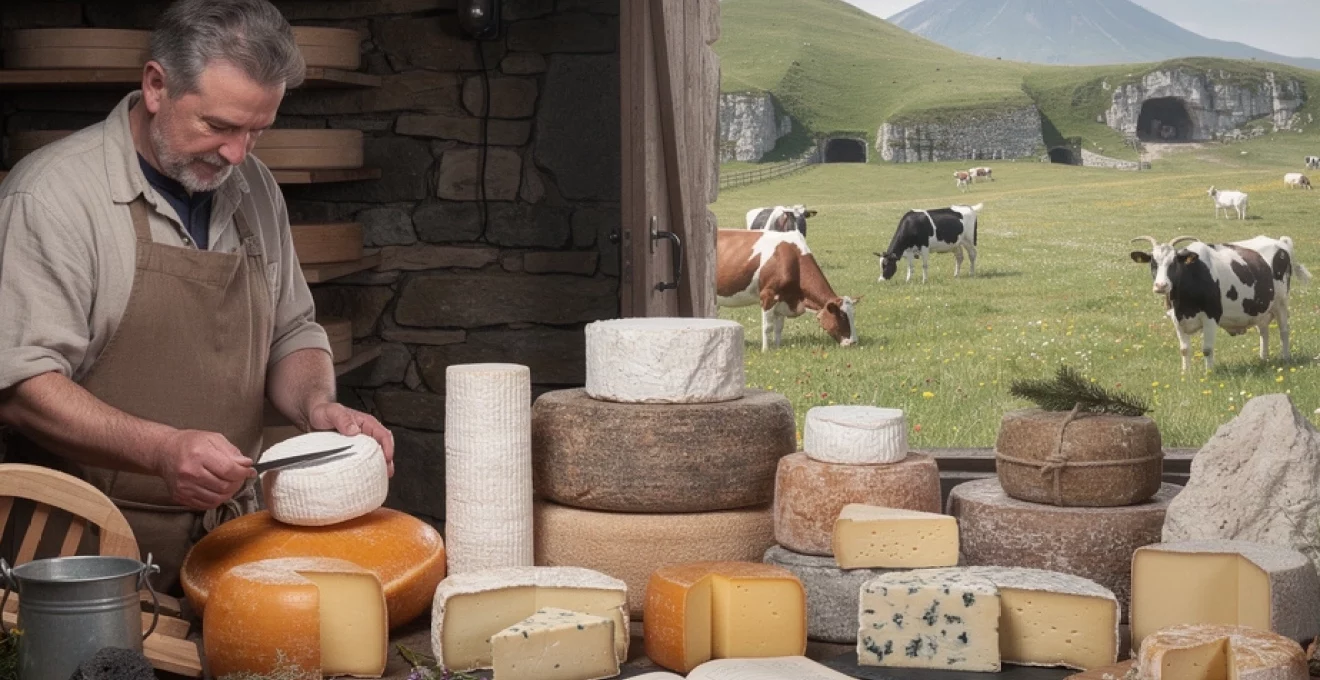
French cheese represents far more than a culinary tradition—it embodies centuries of geographical knowledge, agricultural wisdom, and cultural identity. Each fromage tells a story written in the language of limestone caves, alpine meadows, and sea-swept pastures. The concept of terroir, that uniquely French understanding of how place shapes flavour, finds its most eloquent expression in the nation’s extraordinary diversity of regional cheeses. From the pungent washed rinds of Burgundy to the delicate chèvres of the Loire Valley, these cheeses serve as edible archives of France’s geographical and cultural landscape. Understanding why regional cheeses so profoundly define French terroir requires examining the intricate interplay between legal frameworks, geological conditions, microbial ecosystems, traditional practices, and the communities that sustain them.
Appellation d’origine contrôlée: legal framework protecting french cheese heritage
The Appellation d’Origine Contrôlée system stands as one of France’s most significant contributions to global food culture, creating a legal architecture that protects the authenticity and regional character of agricultural products. This framework doesn’t simply certify quality—it enshrines the relationship between product and place, ensuring that cheeses bearing protected names genuinely reflect their terroir of origin. The AOC designation transforms cheese from commodity into cultural heritage, legally recognising that certain flavours cannot be replicated outside their native environment.
INAO certification standards for geographical indication status
The Institut National de l’Origine et de la Qualité (INAO) serves as the guardian of France’s terroir-based food traditions, administering a certification process of remarkable rigour. To achieve geographical indication status, cheese producers must demonstrate not only historical continuity but also an inseparable connection between their product’s characteristics and its regional origin. INAO evaluators conduct exhaustive chemical analyses and sensory evaluations, examining flavour profiles, texture variations, and aromatic compounds to verify that a cheese’s distinctive qualities genuinely stem from local environmental factors. This scientific scrutiny complements traditional knowledge, creating a certification system that respects heritage whilst maintaining contemporary standards.
Cahier des charges: production specifications governing terroir expression
Each AOC cheese operates under a cahier des charges—a detailed specification document that reads like a constitution for terroir preservation. These documents mandate everything from permissible livestock breeds and fodder sources to milking schedules and ageing durations. For Comté, the specifications dictate that cows must graze on specific grasslands for minimum periods, that no silage can be fed, and that milk must be collected within twenty-four hours of milking. Such exacting requirements might seem restrictive, yet they serve a crucial purpose: preserving the environmental fingerprint that makes each cheese unmistakably itself. The cahier des charges transforms centuries of accumulated regional wisdom into enforceable standards.
Protected designation of origin versus protected geographical indication classifications
Within the European Union’s broader framework, France employs two principal classifications: Protected Designation of Origin (PDO) and Protected Geographical Indication (PGI). PDO status, the more stringent category, requires that all production stages—from milk sourcing through final ageing—occur within the designated region using traditional methods. PGI status offers slightly more flexibility, typically requiring only that certain production phases or ingredients originate locally. Most prestigious French cheeses carry PDO status, reflecting the nation’s conviction that authentic terroir expression demands complete geographical fidelity. This distinction matters profoundly: it’s the difference between a cheese merely associated with a region and one that could exist nowhere else.
Historical evolution from roquefort’s 1925 decree to modern AOC systems
The story of France’s origin protection system begins in the limestone caves of Roquefort-sur-Soulzon. In 1925, Roquefort became the first cheese—indeed, the first food product of any kind—to receive legal protection against imitation. This landmark decree emerged from centuries of disputes over counterfeit cheeses, recognising that Roquefort’s unique character derived inseparably from its specific terroir. The success of this initial protection inspired systematic expansion: by 1935, the AO
system had been formalised, leading to the creation of the INAO and a progressively expanding list of protected cheeses. Over the following decades, classics such as Camembert de Normandie, Comté, Beaufort and Reblochon entered the AOC register, each bringing its own definition of regional authenticity. With the advent of the European Union’s PDO/PGI framework in the 1990s, these protections were harmonised across member states, ensuring that French regional cheeses remained shielded from misuse of their names on a continental scale. Today, more than 50 French cheeses benefit from PDO status, and the Roquefort decree is widely regarded as the foundational moment that transformed terroir from a poetic concept into enforceable law.
Geological substrata and microclimatic conditions shaping regional cheese characteristics
If law provides the framework for terroir, geology and climate provide its raw material. Beneath every wheel and wedge lies a specific combination of rock types, soil structures and microclimates that influence everything from the botanical diversity of pastures to the mineral composition of milk. Regional cheeses are therefore not just products of dairy technology; they are crystallisations of deep time, shaped by tectonic shifts, glacial erosion and marine deposits. Understanding how limestone plateaus, volcanic highlands, alpine slopes and maritime plains imprint themselves on cheese helps us read French terroir almost like a geological map you can taste.
Limestone plateaus of jura: mineral composition in comté production
The Jura massif, home to Comté, is defined by vast limestone plateaus formed from ancient marine sediments. These calcareous soils are naturally rich in calcium and magnesium, minerals that directly influence the structure and behaviour of casein proteins in milk. Cows grazing on these high pastures ingest a complex mix of herbs and grasses that thrive on thin, well-drained soils, resulting in milk with a pronounced sweetness and nuttiness. In the final cheese, this geological inheritance manifests as Comté’s firm yet supple paste, its crystalline crunch, and its layered aromas of hazelnut, butter and cellar.
Microclimatic conditions in the Jura further refine this expression of terroir. Cold winters and mild summers slow the maturation process, allowing large wheels—often exceeding 35 kilos—to develop complexity over many months or even years. Traditional fruitières (village dairies) collect milk from small catchment areas, ensuring that each batch reflects a tightly defined slice of the plateau’s geology and climate. When you taste a mature Comté, you are effectively tasting a condensed year of Jura weather and a cross-section of its limestone geology, translated through the medium of raw milk.
Volcanic soils of auvergne: terroir influence on cantal and Saint-Nectaire
In Auvergne, an ancient volcanic landscape shapes cheeses with a very different personality. The Massif Central’s basaltic and volcanic ash soils retain moisture and are enriched with trace elements such as iron and manganese, supporting lush, aromatic grasslands even at relatively high altitudes. Cantal, one of France’s oldest cheeses, draws its robust, slightly earthy character from these high pastures, where the volcanic substrata encourage dense, protein-rich forage. The result is a cheese whose firm, friable texture and long, lactic finish echo the rugged slopes and windswept plateaus of its origin.
Saint-Nectaire, traditionally produced on the volcanic plateaus of the Monts Dore, offers a more delicate but equally terroir-driven experience. The cheese’s supple paste and washed, often mottled rind reflect both the mineral-rich pastures and the humid, temperate mountain climate. Cellars carved into volcanic rock maintain stable temperatures and high humidity, ideal for encouraging the growth of indigenous rind flora. The subtle aromas of cellar stone, damp hay and wild mushroom that define Saint-Nectaire can thus be traced back to the porous, volcanic bedrock and the microclimate it helps regulate.
Alpine pasture biodiversity: botanical diversity in beaufort and reblochon
Move east towards the Alps and terroir takes the form of breathtaking verticality. Steep slopes, sharp altitude gradients and short growing seasons combine to create meadows of extraordinary botanical diversity. In the Savoie and Haute-Savoie, where Beaufort and Reblochon originate, summer pastures can host more than a hundred plant species—grasses, wild flowers, alpine herbs—within a single hectare. This floral richness is far from decorative; it infuses the milk with a complex matrix of aromatic compounds that later re-emerge as nuanced flavours.
Beaufort, often called the “Prince of Gruyères,” is a direct translation of this high-altitude biodiversity. Produced from the milk of cows grazing above 1,500 metres in some cases, its firm, elastic paste carries notes of alpine flowers, toasted hazelnuts and warm butter. Reblochon, from lower but still steep alpine slopes, offers a creamier, more buttery profile with hints of fresh nuts and cellar. In both cases, the cheeses are seasonal diaries of transhumance: as herds move up and down the mountain according to the calendar, the changing mix of plants in their diet leaves a traceable imprint on the taste of the cheese.
Atlantic maritime climate: salt-laden grasses affecting normandy camembert
On the opposite side of France, the Atlantic exerts a gentler but no less decisive influence on terroir. Normandy’s coastal plains and bocage landscapes are defined by mild temperatures, frequent rainfall and salt-laden winds. Pastures here remain green for much of the year, supporting dense, protein-rich grasses interspersed with clover and wild herbs. Sea spray deposits microscopic salt particles on the vegetation, subtly seasoning the diet of the region’s cows and, in turn, the milk used for Camembert de Normandie.
This maritime climate also shapes the cheese’s maturation environment. Traditional ageing rooms benefit from naturally high humidity and relatively stable temperatures, ideal for the development of Penicillium camemberti and other surface flora. The result is a cheese whose creamy texture, mushroomy rind and gentle, barnyardy aromas could only arise from this mosaic of hedgerows, meadows and sea air. When you cut into a perfectly ripened Camembert de Normandie, you are not just enjoying a soft cheese—you are tasting a distilled version of Normandy’s Atlantic terroir.
Indigenous bacterial strains and fungal cultures from regional ecosystems
While soil and climate set the stage, microbes perform the play. Indigenous bacterial strains and fungal cultures are the invisible artisans of French cheese terroir, transforming raw milk into a myriad of textures and flavours. These microbial communities are highly localised, often tied to specific caves, cellars or even individual wooden boards used for ageing. Unlike industrial starter cultures designed for uniformity, native microbes embrace variability, making each batch of cheese a living reflection of its microbial ecosystem. In many ways, understanding French cheese terroir today means understanding its microbiology.
Penicillium roqueforti: cave-specific moulds in Roquefort-sur-Soulzon
Roquefort offers perhaps the most iconic example of place-specific microbes. The blue-green veins that define Roquefort cheese are created by Penicillium roqueforti, a mould historically harvested from the natural caves of the Combalou plateau. These caves, laced with vertical fissures known as fleurines, maintain a unique combination of temperature (around 10°C) and humidity (near 95%), conditions under which the native mould thrives. For centuries, producers collected mouldy rye bread from these caves, dried and powdered it, and used it to inoculate their cheeses—a direct transfer of cave flora into the curds.
Modern microbiological techniques have isolated and stabilised strains of P. roqueforti, yet many producers still rely on cultures that originate from local caves to preserve their terroir signature. These strains influence not only the intensity of blueing but also the spectrum of aromas, from sharp, metallic tangs to sweeter, almost caramelised notes. The mould’s enzymatic activity breaks down fats and proteins in ways that are specific to each strain and cave environment. In other words, even within the legally defined boundaries of Roquefort, micro-terroirs exist at the microbial level.
Geotrichum candidum: surface ripening cultures in loire valley chèvres
In the Loire Valley, terroir expresses itself through the delicate bloom of Geotrichum candidum on the surface of goat cheeses. This yeast-like fungus forms a thin, wrinkled rind often described as “toad skin,” which plays a crucial role in both flavour development and texture. Naturally present in many traditional dairies and ageing rooms, G. candidum raises the pH at the cheese surface, softening the paste from the outside in and moderating the sharper lactic acidity of fresh goat’s milk. The result is a subtle transition from chalky core to creamy under-rind—a tactile map of microbial activity.
Different valleys and farms along the Loire host slightly different populations of G. candidum and companion microbes, leading to variations in aroma and rind appearance even among cheeses with the same AOC status. Some present more yeasty, brioche-like notes; others lean towards cellary, mushroomy aromas. For you as a taster, these nuances are a reminder that “Loire Valley chèvre” is not a single product but a family of cheeses shaped by countless tiny microbial decisions made in response to local conditions.
Brevibacterium linens: terroir-derived bacteria in époisses washed rinds
Few cheeses demonstrate the power of bacteria as dramatically as Époisses de Bourgogne. Its striking orange rind and pungent aroma are the work of Brevibacterium linens, a salt- and moisture-loving bacterium encouraged by regular washings in brine and marc de Bourgogne (a local grape spirit). Naturally present on human skin and in many damp environments, B. linens colonises the surface of Époisses during ageing, gradually outcompeting moulds and creating a sticky, orange-red rind rich in sulfurous and meaty compounds.
What makes Époisses a terroir cheese rather than just a bacterial showcase is the way local conditions shape these microbial communities. The composition of the washing brine, the porosity of the cellar walls, the ambient flora in Burgundy’s humid caves—all influence which strains of B. linens dominate and how they express themselves. That is why artisanal Époisses often displays a more complex spectrum of aromas—smoked ham, fermenting fruit, damp earth—than industrial versions washed with standardised cultures. In washed-rind cheeses, as in blue or bloomy rinds, terroir operates at the scale of single cells.
Heritage livestock breeds as living vessels of terroir expression
Terroir is often described in terms of land and microbes, but it also lives in the animals themselves. Heritage livestock breeds are not interchangeable milk machines; they are the product of centuries of adaptation to specific landscapes, climates and farming systems. Their physiology, grazing behaviour and milk composition all influence how regional cheeses taste and age. In many French AOC specifications, the authorised breeds are as tightly regulated as the pastures they graze, underscoring the idea that breeds are living vessels of terroir, carrying its signature in every litre of milk.
Montbéliarde cattle: genetic adaptation to Franche-Comté terrain
In the Franche-Comté region, Montbéliarde cows are central to the identity of cheeses such as Comté and Morbier. This hardy, red-and-white breed evolved on the region’s rolling limestone plateaus, where long winters and steep slopes demand both resilience and efficient feed conversion. Montbéliardes are known for producing milk with a high ratio of casein to fat, ideal for cooked, pressed cheeses that require elasticity and long ageing potential. Their milk is also rich in beta-carotene from pasture grasses, lending a natural golden hue to the finished cheese.
The cahier des charges for Comté specifies that only Montbéliarde and Simmental Française cows are permitted, and that they must be predominantly grass-fed. This insistence on breed and diet is not merely nostalgic; it is a recognition that swapping in a high-yield Holstein herd would change the very nature of the cheese. When you taste the nutty depth and satisfying chew of an aged Comté, you are tasting not only Jura limestone and alpine flowers, but also generations of selective breeding for exactly this kind of milk.
Alpine goat populations: transhumance practices in savoie cheese production
Goats have long been the “climbers” of French pastoralism, adept at exploiting steep, marginal terrains where cattle would struggle. In Savoie and other alpine regions, traditional goat breeds participate in seasonal transhumance, moving with their herders from valley barns to high summer pastures. This mobility exposes them to a constantly shifting palette of shrubs, herbs and grasses, resulting in milk with a dynamic flavour profile that changes over the course of the season. Early-summer cheeses may taste fresh and floral; late-summer batches can be more concentrated, with hints of resin and dried herbs.
These alpine goat populations are not generic; they include breeds such as the Chèvre des Savoie and the Alpine Française, selected over time for sure-footedness, hardy constitutions and the ability to thrive on sparse forage. Their milk, naturally higher in certain fatty acids and aromatic precursors, lends itself to small-format cheeses with quick maturation. If you have ever noticed how a mountain goat cheese can evoke pine needles, wild thyme or even the faint smoke of shepherds’ huts, you have experienced how transhumance and breed work together as vectors of terroir.
Lacaune sheep: breed-specific milk composition for roquefort
Roquefort would not exist without the Lacaune sheep, a breed native to the rugged Causses plateaus of southern France. Over centuries, Lacaune flocks have adapted to sparse, limestone-based pastures and a climate marked by hot summers and cold, dry winters. Their milk is unusually rich in fat and protein—on average around 7% fat and 5.5% protein—making it particularly well suited to blue-veined cheeses that require a robust curd capable of withstanding piercing and long ageing. This composition also supports the luxuriant, almost melting texture that defines a great Roquefort.
The AOC regulations for Roquefort stipulate that the cheese must be made exclusively from raw Lacaune milk collected during a defined milking season, reinforcing the intimate link between breed, landscape and final product. Industrial attempts to replicate Roquefort-style cheeses using cow’s milk or non-Lacaune sheep milk invariably fall short, lacking the same depth of flavour and creamy yet friable texture. The lesson is simple: in Roquefort, terroir is as much on four legs as it is underfoot.
Normandy cattle breeds: fat content variations in Pont-l’Évêque and livarot
Normandy’s lush pastures support another emblematic breed: the Norman cow, distinguished by its brindled coat and distinctive “spectacles” around the eyes. Traditionally used for both milk and meat, Norman cattle produce milk with a high fat content and a favourable balance of saturated and unsaturated fats, ideal for rich, soft cheeses such as Pont-l’Évêque and Livarot. The elevated fat content translates into voluptuous textures and a mouth-coating creaminess, while the breed’s ability to thrive on grass-based diets enhances the aromatic complexity of the milk.
In AOC areas for these cheeses, regulations often require that a significant proportion of the herd be composed of Norman cattle and that grazing form the backbone of their feed. This insistence recognises that a Holstein-dominated herd, selected primarily for volume rather than composition, would dilute the sensory identity of Normandy’s traditional cheeses. When you savour the buttery centre and earthy rind of a well-aged Livarot, you are tasting, in part, the genetic legacy of Norman cows and their long relationship with the region’s rainy, temperate climate.
Traditional affinage techniques reflecting regional cave environments
If milking and curd-making constitute the birth of cheese, affinage—maturation—is its education. Traditional affinage techniques are finely tuned to the environmental conditions of specific regions, especially their caves, cellars and mountain chalets. These spaces are not neutral storage areas; they are active participants in shaping rind development, moisture loss, and flavour concentration. Wooden shelving, stone walls, natural fissures and even the orientation of vents translate the local climate into a distinctive ageing environment. In France, regional cheeses and their cellars have evolved together, each adapting to the other over generations.
Natural cave maturation: fleurines fissures in roquefort ageing chambers
The ageing chambers of Roquefort-sur-Soulzon are perhaps the most famous cheese caves in the world, and for good reason. Carved into the collapsed Combalou plateau, these multi-level caves are intersected by vertical fissures known as fleurines, which act as natural ventilation shafts. Cool air from higher elevations descends through these cracks, creating a self-regulating system that maintains almost constant temperature and humidity without mechanical intervention. This microclimate is perfectly suited to the growth of Penicillium roqueforti and the slow, even maturation of Roquefort cheeses.
Affineurs (maturers) in Roquefort have learned to read the caves much like winemakers read a vineyard. They adjust the placement of shelves, the density of cheeses and the timing of piercings to harmonise with subtle variations in airflow and moisture. The result is a spectrum of flavour expressions within a single AOC: some wheels develop more intense blueing and sharper profiles; others lean towards creamy, buttery richness. While modern technology could, in theory, replicate temperature and humidity, the complex interplay of air currents, rock porosity and native cave flora remains unique to Roquefort’s natural cavities.
Hâloir ventilation systems: controlled humidity in normandy cheese cellars
In Normandy, affinage has historically relied on hâloirs—ventilated rooms or small buildings designed to manage the high humidity of the region’s maritime climate. These spaces, often with slatted walls or adjustable shutters, allow affineurs to fine-tune airflow and moisture around cheeses such as Camembert, Pont-l’Évêque and Livarot. Too much draught and the cheeses dry out prematurely; too little and unwanted moulds may flourish. The hâloir thus acts like a lung for the cellar, breathing in and out according to seasonal changes.
Traditional wooden shelving and clay or stone floors contribute additional layers of terroir expression. Over time, these materials become inoculated with local microbial communities that seed each new batch of cheeses. When you bite into a Camembert with a thin, supple rind and a perfectly oozing centre, you are tasting not only the milk and the mould but the cumulative memory of decades—sometimes centuries—of affinage practice embedded in the walls and boards of Normandy’s hâloirs.
Spruce bark wrapping: mountain resin properties in mont d’or production
In the Jura and neighbouring mountain regions, Mont d’Or (or Vacherin Mont d’Or) showcases a different dialogue between cheese and environment. Produced in winter when cows descend from high pastures and milk volume drops, this soft, spoonable cheese is traditionally encircled with a band of spruce bark. This practice is not purely functional—though it does help the fragile cheese hold its shape—it is also a vector of flavour. The spruce bark, sourced from local forests, imparts subtle resinous, woody notes that mingle with the cheese’s rich, lactic interior.
Affinage for Mont d’Or takes place in cool, humid cellars where the aroma of spruce mingles with the scents of yeast and washed rind flora. Regular brushing and turning encourage an even, slightly sticky rind, while the bark band moderates moisture loss and shapes the paste. The result is a cheese that tastes unmistakably of its mountain origin: think of it as a forest in winter, distilled into a wooden box. Without the specific resin profile of local spruce and the climatic conditions of the Jura, Mont d’Or would lose much of what makes it unique.
Socioeconomic integration of fromage fermier within rural french communities
Beyond geology, microbes and animals, regional cheeses are embedded in the social and economic fabric of rural France. Fromages fermiers—farmhouse cheeses made on the same farm where the animals are raised—play a vital role in sustaining small-scale agriculture, preserving landscapes and maintaining local identities. In many areas, cheese production has prevented rural depopulation by providing added value to milk and creating skilled jobs in dairying and affinage. To understand French terroir, we must therefore look not only at the land but at the cooperative models, seasonal rhythms and artisanal networks that keep these traditions alive.
Coopérative laitière models: collective terroir preservation in pays basque
In the Pays Basque, as in many mountainous regions, cooperative dairies (coopératives laitières) have been instrumental in preserving both terroir and livelihoods. Individual sheep or cow farmers, often with small herds, pool their milk in village-based facilities where trained cheesemakers and affineurs transform it into appellation cheeses such as Ossau-Iraty. This model spreads investment costs, ensures consistent quality and gives small farmers access to broader markets, all while keeping production tied to a clearly defined geographic area.
These cooperatives are more than economic structures; they are guardians of collective terroir knowledge. Decisions about grazing practices, feed policies and ageing styles are often made democratically, reflecting a shared commitment to regional identity. When you buy a wheel of cooperative-produced Ossau-Iraty, you are supporting a network of farms that might otherwise be vulnerable to industrial consolidation or abandonment. In this way, cooperative models help ensure that terroir remains a living, community-based reality rather than a marketing slogan.
Seasonal transhumance calendars: alpine pasture management for summer production
Across the Alps, Jura and Pyrenees, the ancient practice of transhumance—seasonal movement of herds between lowland winter quarters and high summer pastures—continues to structure cheese production. Detailed transhumance calendars determine when animals ascend to and descend from the high meadows, balancing pasture regeneration with optimal milk quality. Summer milk from rich alpine grass and flowers is often reserved for prestigious cheeses such as Beaufort d’Alpage or certain Tommes de Montagne, while winter milk may go to different styles or shorter-aged products.
This seasonal choreography has profound implications for terroir-based eating. If you seek the fullest expression of alpine terroir in cheese, you will look for labels indicating “d’estive” or “d’alpage,” signalling milk from high-summer pastures and often small, chalet-based production. These practices also play a key environmental role: managed grazing reduces wildfire risk, maintains open landscapes for biodiversity and supports mountain tourism. Thus, transhumance is simultaneously an agricultural, cultural and ecological system—a reminder that terroir is as much about time and movement as it is about fixed place.
Artisanal fromagerie networks: economic sustainability in depopulated regions
Finally, artisanal fromageries—small-scale dairies and affineurs—form dense networks that can revitalise regions facing demographic decline. In parts of central and eastern France, young cheesemakers have taken over abandoned farms or converted disused buildings into production sites, often focusing on fromage fermier or short supply chains. By selling directly at markets, through subscription boxes or to specialist cheese shops, they capture more value per litre of milk and create compelling stories that resonate with consumers seeking authentic regional products.
These networks also foster innovation within the bounds of terroir. While respecting AOC rules where they apply, artisans experiment with ageing techniques, mixed-milk cheeses or revived historical recipes, enriching the local cheese landscape and attracting gastronomic tourism. For rural communities, the presence of active fromageries can mean new jobs, repopulated schools and maintained infrastructure. For you as a cheese lover, it means that when you taste a regional French cheese, you are not only enjoying a complex expression of land, microbes and animals—you are participating in an economic and cultural ecosystem that keeps those landscapes inhabited and those traditions alive.