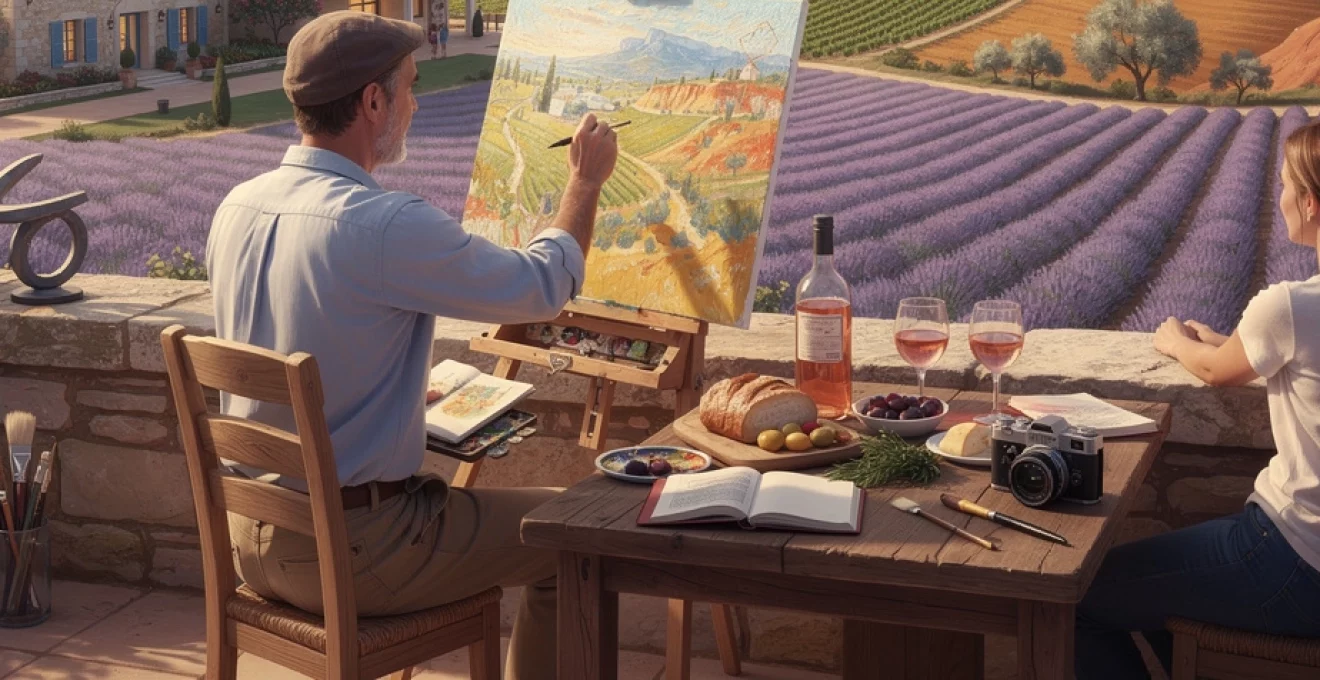
The southern French region of Provence has captivated creative souls for centuries, drawing painters, writers, and visionaries into its luminous embrace. From the cobalt Mediterranean coastline to the rolling lavender fields of the Luberon, this enchanting landscape possesses an almost mystical ability to unlock artistic potential. The region’s unique combination of crystalline light, vibrant colours, and profound cultural heritage creates an atmosphere where creativity flourishes naturally. Artists ranging from Vincent van Gogh to contemporary painters continue to discover that Provence offers something indefinable – a quality that transforms ordinary observation into extraordinary artistic expression. The magnetic pull of this Mediterranean paradise extends beyond mere visual beauty, encompassing a way of life that celebrates contemplation, craftsmanship, and the profound connection between human creativity and natural splendour.
Provence’s distinctive mediterranean light and chromatic palette
The legendary Provençal light forms the cornerstone of the region’s artistic magnetism. This distinctive illumination results from a unique geographical position where Mediterranean humidity meets Alpine clarity, creating atmospheric conditions unlike anywhere else in Europe. The interplay between sea breezes and continental air masses produces exceptionally clear visibility that can extend up to 150 kilometres on optimal days. Artists consistently report that colours appear more saturated and shadows more defined under these conditions, enabling them to perceive subtle tonal variations that might remain invisible elsewhere.
The chromatic palette of Provence shifts dramatically throughout the day, offering artists an ever-changing canvas of inspiration. Morning light carries cool undertones that gradually warm as the sun climbs higher, reaching peak intensity during the famous golden hour periods. The region’s diverse geological formations contribute additional colour complexity – from the red ochre cliffs near Roussillon to the white limestone of the Alpilles, creating natural colour harmonies that have influenced artistic movements for generations.
Golden hour luminosity in the luberon valley
The Luberon Valley experiences particularly spectacular golden hour phenomena due to its east-west orientation and protective mountain ranges. During sunrise and sunset, the valley becomes a natural amphitheatre where light bounces between limestone cliffs and rolling hillsides. Artists working in this region discover that ordinary subjects transform into extraordinary compositions when bathed in this warm, honeyed illumination. The extended duration of golden hour light – often lasting up to two hours during summer months – provides painters with generous windows of optimal working conditions.
Mistral wind effects on atmospheric clarity
The famous Mistral wind plays a crucial role in creating Provence’s renowned atmospheric clarity. This powerful northwestern wind can reach speeds of up to 130 kilometres per hour, effectively clearing the air of dust, pollution, and humidity. Artists often describe the post-Mistral atmosphere as having an almost crystalline quality, where distant mountains appear startlingly close and colours achieve unprecedented vibrancy. The wind’s cleansing effect creates ideal conditions for plein air painting, allowing artists to capture precise details and subtle colour relationships that would be impossible under hazier conditions.
Seasonal colour transformations in lavender fields
Provence’s lavender fields provide artists with a masterclass in seasonal colour progression. The transformation begins in early spring with tender green shoots emerging from winter dormancy, progressing through various shades of silver-green as the plants mature. Peak blooming season reveals the iconic purple hues that have become synonymous with Provençal imagery – ranging from pale lilac to deep violet depending on variety and growing conditions. Post-harvest fields offer equally compelling subjects, with their geometric patterns of cut stems creating fascinating textural studies against golden stubble.
Ochre quarries of roussillon and natural pigment inspiration
The ochre deposits near Roussillon have provided artists with natural pigments for centuries, creating a direct connection between landscape and artistic materials. These quarries reveal an extraordinary spectrum of earth tones – from pale yellow through burnt orange to deep russet red. The geological formations themselves serve as three-dimensional colour studies, demonstrating how natural weathering processes create complex tonal variations. Contemporary artists continue to source pigments from these deposits, maintaining traditional connections between place and practice that span generations of creative expression.
Post-impressionist movement origins in arles
Vincent van gogh’s 300 paintings and drawings period
When Vincent van Gogh arrived in Arles in 1888, he entered what many art historians consider his most productive and transformative phase. In just over 15 months between Arles and his subsequent stay at the Saint-Paul-de-Mausole asylum near Saint-Rémy-de-Provence, he produced around 300 paintings and drawings. This extraordinary output, fuelled by Provence’s intense light and colour, marked a decisive shift from his darker Dutch palette to the luminous yellows, blues, and greens that define his mature style.
It was here that van Gogh painted works such as Café Terrace at Night, Starry Night Over the Rhône, and the iconic series of Sunflowers. The clarity of the Provençal sky allowed him to study contrasting tones with scientific precision while still responding emotionally to the landscape. For contemporary visitors, walking the streets of Arles or the gardens of Saint-Paul-de-Mausole reveals how closely his compositions mirror real viewpoints, proving that this “dreamlike” vision was deeply rooted in observable reality.
At Saint-Paul-de-Mausole, where he voluntarily admitted himself in 1889, van Gogh found a paradoxical combination of confinement and freedom. His room overlooked olive groves and cypress trees, motifs that would dominate masterpieces such as The Starry Night and his olive tree series. Even as he battled hallucinations and depression, the calm rhythms of Provençal nature – the swaying cypresses, the changing skies, the fields in bloom – offered a stabilising structure for daily work. For many artists today, this period serves as a reminder that consistent creative practice, anchored in a specific place, can transform inner turmoil into enduring art.
Paul cézanne’s mont Sainte-Victoire obsession
If van Gogh embodied emotional intensity in Provence, Paul Cézanne represents analytical devotion to place. Born in Aix-en-Provence in 1839, Cézanne spent decades returning to the same motif: Mont Sainte-Victoire, the limestone ridge rising just east of the city. He painted and drew the mountain more than 80 times, from multiple viewpoints and in changing weather, using the Provençal landscape as a laboratory for what would become the foundations of modern art. For Cézanne, Provence was not a backdrop but a geometric problem to be solved, plane by plane and colour by colour.
Why did one mountain hold him so firmly? In Provence, he found a landscape reduced to what he called “cylinders, spheres, and cones,” stripped of excess detail by the fierce Mediterranean light. Mont Sainte-Victoire, the pine forests, and the tiled roofs of nearby villages allowed him to break down nature into structural units without losing its living presence. Standing today on the trails near Le Tholonet or at the Bibémus quarries, you can still recognise the angular profiles and colour blocks that populate his canvases, as if reality has been quietly rearranged to match Cézanne’s vision.
For contemporary painters and photographers, Cézanne’s approach in Provence offers a valuable lesson: the more you return to a single motif, the more its hidden complexity reveals itself. Instead of chasing new scenery every day, you might choose one vista, one village square, or even one olive tree to document across seasons and light conditions. Like Cézanne, you can use Provence’s stable forms and variable atmosphere to explore structure, perception, and the subtle boundary between representation and abstraction.
Henri matisse’s fauve colour revolution in collioure
Although often associated with Nice and Vence, Henri Matisse’s colour revolution began in earnest in Collioure, a small Mediterranean port on the edge of historical Provence. In the summer of 1905, Matisse and André Derain worked side by side there, captivated by the intense light and bold contrasts of sea, sky, and terracotta roofs. Their shockingly vivid canvases, shown later that year in Paris, led a critic to call them “les fauves” – the wild beasts – and Fauvism was born. Collioure’s chromatic extremes turned Matisse away from naturalistic colour and toward expressive harmonies that would define his career.
Provence’s light acted on Matisse like a prism, pushing him to use colour not as description but as emotion. The turquoise Mediterranean, orange fishing boats, and violet shadows cast by whitewashed walls gave him permission to exaggerate reality in the service of feeling. He discovered that a patch of pure red or saturated blue could convey warmth, joy, or serenity more directly than careful modelling. In this sense, the Provence coast became a kind of open-air colour theory studio, where visual experiments could be tested instantly against the landscape.
For anyone exploring modern painting techniques today, studying Matisse’s Provençal work is like reading a manual on how to liberate colour from strict realism. When you stand on a sun-drenched harbour or a hillside terrace in Provence, ask yourself: what if you painted not what you see, but what the scene makes you feel? Swapping literal hues for expressive ones – a green sky, a pink road, an ultramarine shadow – echoes Matisse’s leap in Collioure and can transform your own creative language.
Pablo picasso’s les demoiselles d’avignon cubist genesis
Pablo Picasso’s radical Les Demoiselles d’Avignon was painted in Paris, but its title nods to Avignon, the historic Papal city on the Rhône that forms a cultural bridge between northern France and Mediterranean Provence. While the “Avignon” of the painting likely references a Barcelona street, Picasso’s long relationship with the southern coast – from Antibes to Vallauris and Mougins – was deeply rooted in the same Provençal light and limestone clarity that shaped Cézanne. He openly declared Cézanne his “one and only master,” and it was through studying Cézanne’s Provençal landscapes that he found the structural principles that would lead to Cubism.
In Provence, Picasso encountered a landscape already semi-abstracted by Cézanne’s vision: villages reduced to stacked blocks, trees to twisting volumes, mountains to fragmented planes. Translating this into figures and interiors, he shattered traditional perspective in works like Les Demoiselles d’Avignon, suggesting multiple vantage points at once. The dry, sculptural quality of the Provençal terrain – rocks, cliffs, and sun-bleached architecture – reinforced his interest in solidity and volume, even as he fractured forms across the canvas. Here, the land itself seemed to invite deconstruction.
For present-day creators, the “Cubist Provence” offers a different kind of inspiration from the postcard lavender fields. You might explore how a single street in Aix or an alley in Arles breaks down into planes of light and shadow, or how the façade of a Roman amphitheatre can be reimagined as overlapping geometries. Just as Picasso translated Cézanne’s Provençal structures into a new visual language, you can use the region’s clear forms and sharp edges as raw material for collage, abstract sculpture, or experimental photography.
Literary sanctuary traditions from daudet to contemporary writers
Provence has not only painted masterpieces into existence; it has also nurtured a long tradition of literary sanctuaries. From 19th-century storytellers to 21st-century memoirists, writers have sought out the region’s stone villages, wind-swept hills, and quiet farmhouses as places to work and reflect. The same luminous skies that transformed van Gogh’s canvases have illuminated the notebooks of authors who came seeking solitude, clarity, or simply a slower pace of life. In Provence, the boundaries between daily routine and creative practice blur, creating an atmosphere in which stories seem to rise naturally from the landscape.
For many writers, Provence functions like a living character rather than a mere setting. Olive groves, mistral-bent cypresses, and village fountains appear again and again in novels and memoirs, often symbolising resilience, memory, or the tension between tradition and change. This ongoing literary relationship also helps explain why modern visitors feel an uncanny sense of déjà vu when they arrive: they are stepping into pages written by Alphonse Daudet, Jean Giono, Marcel Pagnol, Peter Mayle, and countless contemporary authors inspired by Provence’s gentle rhythms. If you have ever felt that a place was “already a story” before you began to write, Provence is that feeling made tangible.
Alphonse daudet’s windmill of fontvieille chronicles
In the late 19th century, Alphonse Daudet transformed the hills around Fontvieille, near Arles, into a literary landmark with his beloved collection Lettres de mon moulin (Letters from My Windmill). These short stories, framed as dispatches written from a modest windmill in the Alpilles, introduced readers across France – and eventually the world – to the humour, warmth, and occasional melancholy of Provençal life. Daudet captured everything from local legends to everyday village scenes, preserving a way of life that industrialisation threatened to erase.
Visiting the “Moulins d’Alphonse Daudet” today, you can still sense how the combination of isolation and community fed his imagination. The hills are quiet, but below lie bustling markets, church bells, and the earthy rituals of wine harvests and olive pressing. Daudet’s genius was to translate these sensory impressions – the scent of thyme on the wind, the creak of the mill’s wooden beams, the sun on white stone – into vivid, conversational prose. For modern writers, his Fontvieille chronicles offer a model for how to turn close observation of a particular region into stories with universal resonance.
If you are drawn to creative non-fiction or travel writing, you might follow Daudet’s example by choosing a single vantage point – a café terrace, a farmhouse, or even a bus stop – and documenting the flow of Provençal life around it. Over days or weeks, the same setting will reveal dozens of different micro-stories, reminding you that, in Provence, narrative material is as abundant as the light itself.
Jean giono’s manosque pantheistic philosophy
Further north, in the town of Manosque, Jean Giono developed a profoundly different vision of Provence. Writing in the early to mid-20th century, Giono portrayed the region not as a charming backdrop but as a powerful, almost mystical entity in its own right. His novels and essays – such as Hill and Joy of Man’s Desiring – are steeped in what many critics call a pantheistic philosophy, where humans, animals, plants, and even rocks share a common vitality. For Giono, the Provençal countryside was a kind of living cathedral, and to walk its paths was to engage in a spiritual conversation with the land.
This perspective offers a different way for writers and artists to approach Provence today. Rather than focusing solely on picturesque details, you might ask: how does this place change the people who live here? How do drought, wind, and seasonal cycles shape local character and belief? Giono’s Manosque becomes a laboratory for thinking about sustainability and our relationship with the environment, well before such themes became mainstream. In an era of climate anxiety, his work reminds us that deep attachment to a specific landscape can foster both poetic insight and ecological consciousness.
Travelling through the Valensole plateau or the foothills near Manosque, you may feel what Giono described: an impression that the earth itself is breathing. Incorporating this sense of reciprocity into your writing – where the land influences the plot as much as any human decision – can lead to richer, more layered stories rooted in Provençal soil.
Peter mayle’s ménerbes expatriate renaissance
In the late 1980s, British writer Peter Mayle sparked a new wave of global fascination with Provence through his memoir A Year in Provence. Based in the Luberon village of Ménerbes, Mayle chronicled the pleasures and frustrations of restoring a farmhouse, navigating local bureaucracy, and adjusting to the unhurried rhythms of rural French life. His humorous, affectionate portraits of neighbours, builders, and wine growers turned Provence into a dream destination for English-speaking readers, inspiring countless relocations, long stays, and creative sabbaticals.
Mayle’s success illustrates how Provence functions as a canvas for reinvention. For many expatriate writers and artists, moving to a Luberon village or a stone house near Gordes is less about escape and more about recalibration – trading noise for quiet, haste for contemplation. The daily rituals he describes, from market shopping to long lunches under plane trees, may seem simple, yet they provide a scaffolding for steady creative work. It is no coincidence that numerous contemporary authors now base themselves in the region, using the same mix of beauty and routine that Mayle celebrated to sustain long-term projects.
If you have ever dreamed of taking a “creative year” abroad, Provence offers practical advantages beyond its romance: high-speed rail links, reliable internet in most villages, and a growing ecosystem of co-working hubs and residencies. Following Mayle’s example, you could turn your own adjustment period – miscommunications, cultural surprises, small triumphs – into narrative material, transforming personal transition into a story that resonates with readers facing similar crossroads.
Marcel pagnol’s aubagne cinematic literature
South of Aix, near the limestone ridges of the Garlaban, Marcel Pagnol fused literature and cinema in ways that still shape how many people imagine Provence. Born in Aubagne in 1895, Pagnol wrote plays, novels, and screenplays that brought the voices, accents, and landscapes of his childhood to life. Works such as Jean de Florette, Manon des Sources, and the autobiographical La Gloire de mon père and Le Château de ma mère depict villagers, shepherds, and schoolteachers with warmth and complexity, set against hillsides of scrub, thyme, and stone.
Pagnol was among the first major French writers to understand Provence as inherently cinematic. He used the stark contrasts of light and shadow, the vast skies, and the echoing valleys as narrative tools, heightening drama and underscoring emotional beats. Later film adaptations of his novels cemented a visual vocabulary of Provence – the dusty paths, the stone farmhouses, the communal fountains – that still influences tourism campaigns and visitors’ expectations today. In a sense, he choreographed how we see the region, long before many of us arrived.
For modern storytellers working across media, Pagnol’s legacy suggests fruitful ways to adapt Provençal experiences for screen, podcast, or digital storytelling. How might the sound of cicadas, the swell of mistral wind, or the echo of church bells at dusk become integral elements of your narrative design? By thinking as Pagnol did – with one foot in prose and the other in cinema – you can create immersive, multisensory stories firmly anchored in the landscapes around Aubagne and beyond.
Archaeological heritage and ancient roman architectural influence
Beyond its modern artistic fame, Provence rests on a deep archaeological foundation that continues to inspire architects, designers, and history-minded creators. The region was an early Roman stronghold, and traces of that empire’s ambition appear everywhere: aqueducts spanning valleys, amphitheatres rising above town centres, and triumphal arches carved with scenes of conquest. Walking through Arles, Nîmes, or Orange, you move through an open-air textbook of Roman engineering, where stone and proportion reflect a 2,000-year-old dialogue between function and beauty.
This ancient infrastructure shapes not only the visual identity of Provence but also its cultural rhythms. Roman arenas that once hosted gladiatorial games now stage concerts, photography festivals, and theatre performances, blending past and present in a way few regions can match. The scale and durability of these structures – built to outlast generations – offer a stark contrast to modern, disposable design. For contemporary creatives, studying the arches, vaults, and circulation patterns of Roman Provence can inform everything from urban planning and sustainable architecture to set design and historical fiction.
If you are interested in architectural sketching or urban photography, Provence’s Roman heritage provides a wealth of subjects and compositional challenges. Try capturing the interplay between an ancient stone façade and a contemporary café terrace, or between a colonnade and the shifting Provençal light. These juxtapositions serve as visual analogies for the region itself, where layers of history are not hidden in museums but woven into daily life. Understanding this archaeological depth can enrich any creative project rooted in Provence, whether you are designing a building, writing a novel, or curating an exhibition.
Modern creative residency programmes and contemporary art centres
While the ghosts of van Gogh and Cézanne still hover over Provence, the region is far from a static museum piece. Over the past two decades, a network of creative residencies, foundations, and contemporary art centres has transformed it into a dynamic laboratory for new work. From converted farmhouses in the Alpilles to cutting-edge venues like LUMA Arles, artists, writers, designers, and musicians now come not only to follow in historical footsteps but also to push their own practices forward in a supportive environment. Provence has become a place where heritage and innovation meet on equal terms.
These residency programmes typically combine studio space, accommodation, and curated encounters with local culture, offering structured time away from daily obligations. Participants might spend mornings painting in olive groves, afternoons attending critiques or workshops, and evenings sharing meals with peers from around the world. This blend of solitude and community mirrors the experiences of earlier artists who formed circles in places like Vence or Nice, but with contemporary resources such as digital labs, printmaking studios, and recording facilities. Many residencies also emphasise sustainability and site-specific practice, encouraging projects that respond sensitively to the Provençal environment.
If you are considering a creative residency in Provence, it helps to think practically as well as romantically. Clarify your goals: do you want to produce a specific body of work, experiment with new media, or simply reconnect with your craft? Research application deadlines a year in advance, and prepare a concise portfolio that shows both your current direction and how a Provençal setting could extend it. Once in residence, resist the urge to over-schedule excursions; some of the most transformative breakthroughs happen on quiet days in the studio, when the distant sound of cicadas and the changing light through a stone window frame are all the stimulus you need.
Sensory stimulation through provençal gastronomy and viticulture terroir
Provence’s influence on creativity is not purely visual or intellectual; it is profoundly sensory, and nowhere is this clearer than in its food and wine culture. Local gastronomy is built around ingredients that mirror the landscape: olives, almonds, figs, tomatoes, garlic, and an array of herbs collectively known as herbes de Provence. Each market stall, café terrace, and vineyard offers a palette of flavours and aromas that can be as inspiring as any view of Mont Sainte-Victoire. For many artists and writers, a meal here is less a distraction from work than an extension of it – another way of engaging with place.
The concept of terroir – the idea that soil, climate, and human tradition give food and wine their character – is particularly strong in Provence. Rosé from the Côtes de Provence, for example, often reflects the region’s limestone-rich soils and maritime breezes, resulting in wines that are pale, mineral, and refreshing, like liquid translations of a summer afternoon. Olive oils vary dramatically from one valley to the next, echoing differences in altitude and tree varietals. Paying attention to these nuances can sharpen your observational skills overall: as you learn to distinguish between two neighbouring appellations, you also train yourself to notice subtle shifts in light, colour, and mood.
For creators seeking practical ways to tap into Provence’s sensory richness, integrating food rituals into your daily routine can be surprisingly powerful. You might keep a notebook specifically for market mornings, jotting down colour combinations from fruit displays or snippets of conversation overheard at a cheese stall. Sketching a café table – the curve of a wine glass, the pattern of sunlight on a carafe, the label on a bottle – can become a quick exercise in composition. Even if you are not a food writer or culinary artist, letting Provençal gastronomy inform your metaphors, textures, and narrative pacing can add depth and immediacy to your work.
Ultimately, Provence inspires artists, writers, and dreamers because it engages every sense at once. The region’s light, history, architecture, residencies, and cuisine do not operate in isolation; they form an interconnected ecosystem of stimuli. Whether you come for a week or a year, you will find that the more you slow down and pay attention – to the colour of an evening sky, the sound of a fountain, the taste of a local olive – the more this Mediterranean landscape reveals its quiet, inexhaustible capacity to kindle creativity.