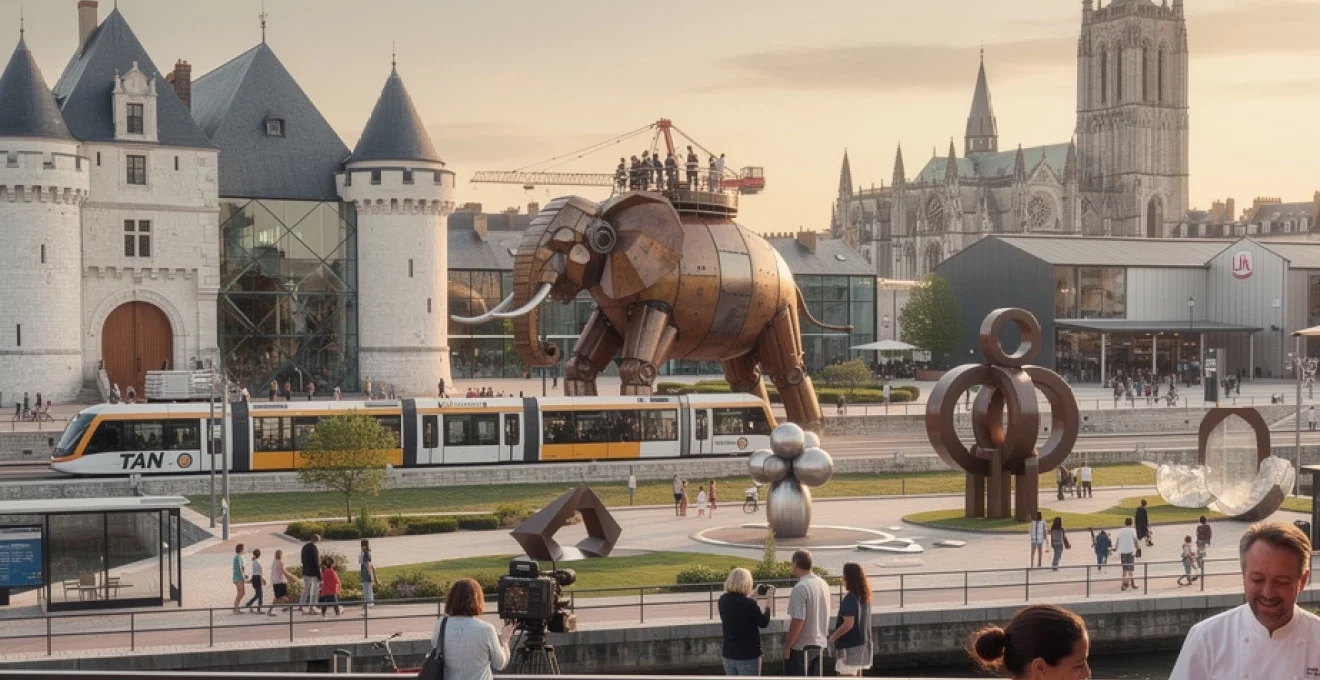
Once overshadowed by France’s traditional tourism magnets like Paris, Nice, and Lyon, Nantes has emerged as an unexpected cultural powerhouse that savvy travellers are increasingly discovering. This former capital of Brittany, now nestled in the Loire-Atlantique region, has transformed its industrial heritage into a compelling blend of contemporary art, gastronomic excellence, and innovative urban planning. The city’s authentic character, combined with its strategic positioning just two hours from Paris by high-speed rail, positions Nantes as France’s most compelling alternative cultural destination.
What sets Nantes apart from other French cities isn’t just its affordable accessibility or its lack of overwhelming tourist crowds. Rather, it’s the city’s bold commitment to reinventing itself as a creative hub whilst preserving its maritime heritage and Breton cultural identity. From mechanical elephants roaming former shipyards to Michelin-starred restaurants championing local produce, Nantes exemplifies how thoughtful tourism development can create authentic experiences that benefit both visitors and residents.
Nantes’ strategic tourism infrastructure development and UNESCO world heritage recognition
Nantes has strategically positioned itself within France’s tourism landscape through comprehensive infrastructure investments that extend far beyond traditional hospitality offerings. The city’s approach focuses on integrating cultural assets with modern transport networks, creating seamless visitor experiences that encourage extended stays and regional exploration. This methodology has attracted recognition from international tourism bodies, with several districts and cultural sites gaining prestigious heritage status.
The city’s tourism infrastructure development follows a distinctive model that prioritises sustainable cultural tourism over mass market approaches. Local authorities have invested heavily in creating interconnected cultural districts, each offering unique thematic experiences while maintaining authentic neighbourhood character. This strategy ensures that tourism development enhances rather than overwhelms local communities, creating a sustainable foundation for long-term growth.
Les machines de l’île: industrial heritage transformation into immersive cultural attractions
The transformation of Nantes’ former naval shipyards into Les Machines de l’Île represents one of Europe’s most successful examples of industrial heritage conversion into world-class cultural attractions. This extraordinary project, inspired by Jules Verne’s mechanical universe and Leonardo da Vinci’s invented machines, has created an entirely new category of cultural tourism experience that attracts over 650,000 visitors annually.
Le Grand Éléphant, the project’s centrepiece, stands nearly 40 feet tall and carries up to 49 passengers on spectacular journeys through the former shipyard. The mechanical elephant’s sophisticated engineering combines artistry with functionality, creating an experience that appeals equally to engineering enthusiasts and art lovers. Beyond the elephant, the site features the Marine Worlds Carousel, where visitors can ride giant sea creatures in a three-level aquatic fantasy that showcases the project’s commitment to immersive storytelling.
The economic impact of Les Machines de l’Île extends throughout Nantes’ tourism ecosystem, generating an estimated €45 million in annual economic activity. The attraction has catalysed development across the Île de Nantes district, attracting complementary cultural venues, restaurants, and creative businesses that enhance the overall visitor experience whilst creating sustainable employment opportunities for local residents.
Château des ducs de bretagne museum complex: medieval architecture integration with contemporary exhibition design
The Château des Ducs de Bretagne serves as Nantes’ historical anchor, seamlessly blending 15th-century architecture with cutting-edge museum design to create one of France’s most innovative heritage experiences. The fortress, which once housed the Dukes of Brittany, now contains a comprehensive museum that chronicles Nantes’ evolution from medieval duchy capital to contemporary cultural centre through state-of-the-art interactive exhibitions.
The museum’s approach to historical interpretation sets new standards for heritage tourism in France. Rather than presenting static displays, the complex uses multimedia installations, reconstructed period environments, and hands-on exhibits to engage visitors with Nantes’ complex history, including its role in the Atlantic slave trade. This honest confrontation with difficult historical periods demonstrates the city’s commitment to authentic cultural dialogue rather than sanitised tourist narratives.
Visitor access to the château’s ramparts provides spectacular views across Nantes whilst the internal courtyards host regular cultural events that connect historical spaces with contemporary creative expression
These programmed events, from open-air concerts to night-time projection shows, ensure that the château is not frozen in time but instead remains a living part of Nantes’ cultural fabric. For visitors, this integration of medieval architecture with contemporary exhibition design transforms the château from a simple photo stop into a full‑day cultural hub that anchors any Nantes city break.
Loire valley wine route accessibility: muscadet sur lie regional appellations and tasting circuit development
While many travellers associate the Loire Valley wine route with châteaux near Tours or Blois, Nantes is in fact the gateway to one of France’s most distinctive wine regions: Muscadet country. Just south and east of the city, the vineyard-cloaked hills of the Sèvre-et-Maine appellation are easily accessible by car, regional train, or organised tours, making wine tourism in Nantes both convenient and sustainable. For visitors looking to combine urban culture with vineyard experiences, this proximity creates a powerful incentive to extend their stay beyond a single night.
The region’s signature style, Muscadet sur lie, offers a compelling story for wine-focused travellers. Aged on its lees to gain texture and complexity, this crisp white wine pairs perfectly with the seafood of the nearby Atlantic coast, particularly oysters from the Vendée and Brittany. Several local estates have invested in visitor facilities, creating dedicated tasting rooms, vineyard trails, and cellar tours that can be comfortably explored in half-day or full-day circuits from Nantes. Many of these domaines now provide information in English, making the wine route far more accessible to international guests than even a decade ago.
Nantes’ tourism board has actively supported the development of structured wine circuits linking the city with surrounding appellations, including Muscadet Sèvre-et-Maine, Gros Plant du Pays Nantais, and Coteaux d’Ancenis. These circuits are increasingly integrated with cycling routes along the Loire à Vélo, allowing visitors to move between vineyards, riverbanks, and historic villages without relying exclusively on cars. This multimodal approach not only reduces environmental impact but also positions Nantes as a model for slow tourism that balances gastronomy, landscape, and heritage.
From a strategic standpoint, the city’s collaboration with wine producers reinforces Nantes’ identity as more than an industrial port turned creative hub. It becomes a starting point for the wider Loire Valley wine route, encouraging travellers to base themselves in Nantes and radiate outward for tastings and terroir-driven experiences. For you as a visitor, this means you can enjoy a Michelin-starred dinner in the city, then spend the next day sampling Muscadet sur lie directly at the source, all without complicated logistics.
Nantes métropole public transport network: TAN tramway system enhancing tourist mobility
Underpinning Nantes’ rise as a city break destination is a remarkably efficient public transport network operated by TAN (Transports de l’Agglomération Nantaise). The tramway system, one of the first modern networks reintroduced in France in the 1980s, now spans three main lines that connect key tourism districts, the train station, and outlying neighbourhoods. For travellers arriving by TGV or plane, this means you can be at your hotel, the Château des Ducs de Bretagne, or Les Machines de l’Île within minutes, often without needing a taxi.
For tourism planners, the TAN network is more than a mobility solution; it is a strategic tool that shapes how visitors experience the city. Tram stops are carefully integrated into major cultural zones, from the botanical gardens and Musée d’Arts to the Île de Nantes creative district. Combined tickets such as the Pass Nantes bundle unlimited public transport with entry to dozens of attractions, removing friction from itinerary planning. As a result, visitors are more likely to explore lesser-known neighbourhoods, dispersing tourism flows and reducing pressure on the historic core.
The network’s multimodal design further enhances Nantes’ appeal as a sustainable tourism destination. Trams, Chronobus rapid lines, river shuttles on the Loire, and an extensive bike-share system work together as a cohesive whole rather than competing services. This integration allows you to, for example, take a tram to the riverfront, board a Navibus to Trentemoult, and return via a scenic bike ride, all on a single ticket. Compared with car-dependent destinations, Nantes offers a low-stress, low-carbon way to see more in less time.
From an urban planning perspective, the success of the TAN system has encouraged city officials to continue investing in pedestrianisation and high-quality public spaces. Squares like Place Graslin and the streets around the château are designed first for people, with traffic calmed or removed to create safer, more pleasant environments. This people-centred infrastructure makes it easier for Nantes to host outdoor festivals, street theatre, and public art installations, which in turn strengthens its reputation as one of France’s most liveable and visitable cities.
Cultural tourism ecosystem: festival programming and creative industries integration
Nantes’ cultural tourism strategy goes well beyond isolated attractions, relying instead on a dense ecosystem where festivals, creative industries, and public institutions collaborate year-round. Rather than concentrating all activity into a short summer season, the city curates a rolling calendar of events that keep hotel occupancy and visitor interest high in shoulder months. This deliberate programming has helped Nantes shift from being “on the way” to Brittany or the Loire castles to being a primary destination in its own right.
At the heart of this ecosystem is a willingness to treat the entire urban area as a canvas. Former shipyards become stages for mechanical creatures, riverbanks host large-scale art installations, and even industrial relics are repurposed into concert venues and design studios. For visitors, the result is an experience that often feels more like stepping into a living laboratory of urban creativity than ticking items off a traditional sightseeing list. It’s this city‑wide integration of culture and everyday life that makes Nantes stand out in the increasingly competitive field of European city breaks.
Le voyage à nantes contemporary art trail: urban space transformation through permanent installations
Le Voyage à Nantes is perhaps the city’s most visible expression of its creative ambition. Launched as a summer event and now extended through permanent installations, this contemporary art trail links more than 100 artworks, heritage sites, and cultural venues via a simple green line painted on the ground. Follow that line, and you’re effectively taking a curated tour of Nantes’ most compelling spaces, from the quays of the Loire to hidden courtyards in the old town.
The impact on urban space is profound. Sculptures, playful interventions, and architectural artworks transform everyday locations into points of curiosity: a once-overlooked square becomes a meeting point, a riverside path turns into an open-air gallery, a former warehouse evolves into a cultural landmark. For travellers, this means that wandering without a strict agenda still yields meaningful discoveries, an increasingly prized quality in experiential tourism. It also encourages repeat visits, as new works are added and temporary pieces rotate each season.
From a tourism development standpoint, Le Voyage à Nantes is a masterclass in low-cost, high-impact placemaking. Instead of building entirely new attractions on the outskirts, the city overlays its existing fabric with artistic narratives that invite you to slow down and look twice. The art trail also supports local and international artists through commissions and residencies, tying Nantes into broader contemporary art networks. For anyone seeking a French city where art is integrated into the streets rather than confined to galleries, this is a compelling reason to prioritise Nantes on your itinerary.
Stereolux digital arts centre: electronic music festival circuit and international artist residencies
Located on the Île de Nantes, Stereolux is a flagship venue for digital arts and contemporary music that plays a key role in attracting younger, culturally engaged visitors. Housed within La Fabrique, a large creative complex, Stereolux hosts everything from electronic music nights and audiovisual performances to digital art exhibitions and workshops. It functions as both a performance hall and an incubator, supporting emerging talent and cutting-edge experimentation.
For international travellers, Stereolux offers a window into Europe’s thriving electronic music festival circuit without the overwhelming scale of mega-events. Its programming often features renowned DJs, producers, and visual artists alongside local acts, making it an excellent place to experience how Nantes connects to global creative trends. If you’re planning a weekend in Nantes, checking Stereolux’s calendar can turn a standard city break into an immersive cultural getaway, especially if you align your visit with one of its flagship festivals or themed weekends.
Beyond the events themselves, Stereolux anchors a broader digital arts ecosystem through residencies, co-productions, and partnerships with universities and tech firms. This mix of culture and innovation reinforces Nantes’ branding as a creative city where art, technology, and urban life intersect. From a tourism perspective, venues like Stereolux diversify the city’s appeal, ensuring that Nantes is not only known for medieval fortresses and mechanical elephants, but also for forward-looking culture that resonates with digital natives and professionals in the creative industries.
Royal de luxe street theatre productions: Large-Scale puppet performances impact on tourism revenue
Few spectacles have done more to cement Nantes’ reputation for imaginative public art than the performances of Royal de Luxe, the internationally acclaimed street theatre company based in the city. Their giant marionettes — towering figures that roam the streets accompanied by teams of puppeteers — have become something of a legend in contemporary performance. When a new show is announced in Nantes, hotel bookings spike and hundreds of thousands of visitors flock to the city to witness the event.
Economic impact studies following major Royal de Luxe performances have highlighted their powerful role in boosting tourism revenue. For example, previous multi-day events have generated tens of millions of euros in direct and indirect spending, from accommodation and dining to retail and transport. But the value extends beyond raw numbers: media coverage of these surreal parades circulates worldwide, positioning Nantes as a place where the boundary between daily life and fantasy is intentionally blurred. This global visibility supports the city’s long-term tourism strategy, attracting travellers who seek creative, once‑in‑a‑lifetime experiences.
For visitors, catching a Royal de Luxe show is akin to attending a city‑wide festival. Streets become pedestrian zones, balconies turn into private box seats, and residents mingle with tourists in a shared sense of wonder. Even if your travel dates do not coincide with a performance, the company’s legacy is evident in Nantes’ broader embrace of outdoor performance and public participation. It’s no coincidence that many travellers report feeling like they’ve stepped into a storybook when they explore the city: that sense of narrative is precisely what Royal de Luxe has helped cultivate over decades.
Lieu unique cultural centre: former LU biscuit factory conversion into Multi-Disciplinary arts hub
Le Lieu Unique, often simply called LU, is another emblematic example of Nantes’ knack for reimagining its industrial past. Housed in the former LU biscuit factory, whose iconic twin towers once symbolised Nantes’ manufacturing prowess, the venue has been reborn as a multi-disciplinary arts centre that fuses performance, visual art, debate, and everyday social life. Walking inside, you’ll find exhibition spaces, a theatre, a bar, a restaurant, a bookshop, and even a hammam, all under one roof.
The programming at LU is deliberately eclectic, ranging from contemporary dance and experimental theatre to philosophy talks and literary festivals. This diversity ensures that almost any visitor can find something of interest, while locals see the venue as an extension of their living room. For tourists, dropping into LU for a drink or a show offers a particularly authentic glimpse into Nantes’ cultural heartbeat. It’s one of those rare spaces where you truly feel you’re sharing the city with residents rather than observing from the sidelines.
From a tourism development perspective, LU is a textbook case of how to preserve industrial architecture while giving it a thoroughly contemporary purpose. Instead of turning the factory into a static museum of biscuits, Nantes chose to maintain the memory of LU through architecture and branding while filling the building with new cultural content. The result strengthens the city’s image as adaptive and creative, and provides yet another compelling reason to choose Nantes for a long weekend focused on art and culture.
Gastronomic tourism positioning: local culinary heritage and Michelin-Starred restaurant scene
Nantes’ emergence as a rising star in French tourism is closely tied to its evolving gastronomic identity. Situated between the Atlantic coast and the fertile Loire Valley, the city benefits from an exceptional pantry: Atlantic seafood, Loire vegetables and fruit, high-quality dairy, and the aforementioned Muscadet wines. Chefs in Nantes have seized this opportunity, blending Breton and Loire traditions with contemporary techniques to create a food scene that increasingly draws culinary travellers away from Paris and Lyon.
At the fine-dining end of the spectrum, Michelin-starred restaurants such as L’Atlantide 1874 or other high‑end tables showcase a refined interpretation of local products. Menus often feature line-caught fish, shellfish, and vegetables sourced from nearby producers, paired with natural or biodynamic wines from Muscadet and beyond. Yet what makes Nantes particularly attractive for gastronomic tourism is the breadth of its offering: from bustling covered markets and bistronomy addresses to wine bars serving inventive small plates, there is a strong sense that good food is woven into everyday life rather than confined to special occasions.
For visitors planning a food-focused weekend, a simple structure works well. Start with Marché de Talensac to get a feel for the region’s produce, then book lunch or dinner at a creative bistro or Michelin-starred restaurant to see those ingredients elevated on the plate. Between meals, you can explore bakeries specialising in gâteau nantais, sample salted butter caramels with a Breton twist, or visit riverside guinguettes in summer for grilled fish and relaxed outdoor dining. Compared with France’s more famous gastronomic hubs, Nantes remains relatively affordable, making high-level cuisine more accessible to a wider range of travellers.
On a strategic level, the city and region have increasingly positioned Nantes as a gateway to the larger Atlantic Loire gastronomy corridor. Collaborative campaigns highlight links between city restaurants, coastal oyster farms, inland cider producers, and vineyard estates, encouraging multi-stop itineraries centred on food and drink. For you as a traveller, this means that choosing Nantes as a base doesn’t limit your culinary exploration; it amplifies it, placing you within easy reach of seafood ports, wine villages, and rural producers that might otherwise be difficult to access in a single trip.
Loire-atlantique regional tourism synergies: atlantic coast integration and Multi-Destination itineraries
One of Nantes’ greatest strengths as a tourism hub is its strategic location within the Loire-Atlantique department, offering easy access to both inland heritage and the Atlantic coast. Rather than promoting itself in isolation, the city increasingly collaborates with neighbouring destinations to create seamless multi-day itineraries. This regional approach encourages longer stays and higher visitor spending while giving travellers a richer, more varied experience of western France.
Within 60 to 90 minutes’ travel, you can move from the urban creativity of Nantes to the charming port towns of the Côte d’Amour, the wild marshlands of the Brière Regional Natural Park, or the historic winemaking villages along the Loire. Coastal resorts such as La Baule, Le Croisic, and Pornic offer classic seaside experiences with beaches, promenades, and seafood restaurants, making them ideal day trips or overnight add-ons. Inland, smaller towns like Clisson or Ancenis combine picturesque architecture with vineyard landscapes, broadening the appeal beyond the city itself.
Regional transport connections make these synergies more than just marketing slogans. Frequent TER regional trains, improved road infrastructure, and coordinated tourist passes allow visitors to move easily between Nantes and surrounding destinations without complex planning. Many local tourism offices now work together on joint promotions, maps, and thematic routes, such as “from estuary to ocean” or “castles and vineyards of the Loire-Atlantique.” For travellers, this translates into clear, ready-made options: a three-day city break, a five-day city-and-coast combination, or a week-long loop linking Nantes with the Loire Valley and the Atlantic shore.
Importantly, this regional integration also supports more balanced and sustainable tourism development. By actively promoting secondary destinations, Nantes helps distribute visitor flows and economic benefits across the Loire-Atlantique, reducing pressure on a single city centre. For you, this means that a “Nantes trip” can feel surprisingly diverse: one morning you may be following the green line art trail, and the next you’re cycling along salt marshes at the ocean’s edge. It’s this breadth of accessible experiences that increasingly convinces travellers to choose Nantes over more congested French hotspots.
Digital tourism marketing strategies: social media engagement and visitor experience technology implementation
Nantes’ rise on the international tourism radar is not accidental; it’s supported by a savvy digital marketing strategy that leverages social media, user-generated content, and on-the-ground technology. Instead of relying solely on traditional brochures and trade fairs, local tourism bodies actively cultivate an online narrative of Nantes as a creative, liveable, and slightly offbeat city. Instagram-friendly attractions like Le Grand Éléphant, riverside rings by Daniel Buren, and the Passage Pommeraye arcade are frequently highlighted, encouraging visitors to share their own images and stories.
This social media engagement is backed by practical digital tools designed to enhance the visitor experience once you arrive. Official apps and mobile-friendly websites provide interactive maps of the Le Voyage à Nantes trail, real-time public transport updates, and suggestions based on interests such as art, food, or family activities. QR codes at major landmarks link to multilingual content, allowing independent travellers to access deeper layers of history and interpretation without needing a guided tour. For many visitors, this self-directed, tech-assisted exploration feels more flexible and personalised than traditional group excursions.
Nantes also experiments with emerging technologies to keep its tourism offer fresh. Augmented reality features, for instance, can overlay historical images onto current streetscapes, helping you visualise the city’s evolution from fortified port to creative metropolis. Digital ticketing for the Pass Nantes and major attractions reduces queuing and facilitates last-minute planning, while data insights from these systems help the city understand visitor flows and adjust programming. It’s a virtuous circle: better data leads to smarter decisions, which in turn result in more satisfying experiences that guests are happy to share online.
In a travel landscape where destination choices are heavily influenced by what we see on our screens, Nantes’ combination of distinctive visual identity and user-friendly digital infrastructure is a major competitive advantage. The city doesn’t simply promote a list of sights; it invites potential visitors into an evolving story of reinvention, creativity, and quality of life. For travellers seeking a French city that feels both historic and forward-thinking — and that’s easy to navigate with nothing more than a smartphone and curiosity — Nantes is increasingly hard to ignore.