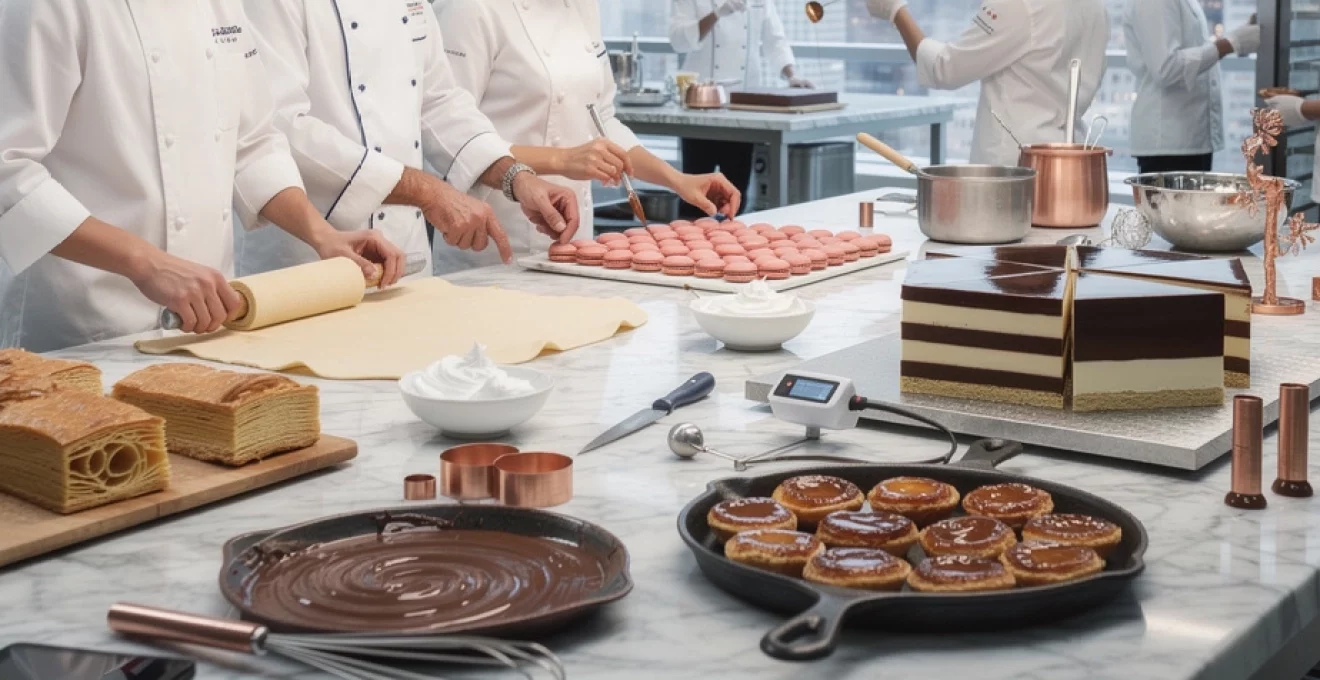
# Why French Pastry Techniques Are Admired Worldwide
French pâtisserie stands as the pinnacle of culinary craftsmanship, a discipline where precision, artistry, and scientific understanding converge to create edible masterpieces. The meticulous techniques developed over centuries in France have established the benchmark against which all other pastry traditions are measured. From the perfectly laminated layers of a croissant to the delicate shells of macarons, French pastry methods demand an unwavering commitment to excellence that has captivated professionals and enthusiasts across the globe. This reputation isn’t merely historical reverence—it reflects a living tradition of technical mastery, rigorous training systems, and an almost scientific approach to understanding how ingredients behave under specific conditions.
What distinguishes French pastry from other baking traditions is its foundation in codified techniques rather than approximation. Every fold, temperature, and timing is calculated with purpose. The French approach treats pastry as both craft and science, requiring practitioners to understand not just what to do, but why each step matters. This depth of knowledge transforms simple ingredients—flour, butter, eggs, sugar—into creations that demonstrate exceptional technical skill and aesthetic beauty.
The rigorous foundation of classical french pâtisserie training
The journey to becoming a French pâtissier begins with a structured educational pathway that has remained remarkably consistent for generations. This systematic approach to training ensures that foundational skills are not merely learned but truly mastered before practitioners advance to more complex techniques. The emphasis on proper training creates a workforce of pastry professionals who share a common technical vocabulary and understand the principles underlying every technique they employ.
Apprenticeship system and the CAP pâtissier qualification
At the heart of French pastry education lies the Certificat d’Aptitude Professionnelle (CAP) Pâtissier, a nationally recognised qualification that represents the essential baseline of professional competency. Students typically begin this two-year programme at age fifteen, alternating between classroom instruction and hands-on apprenticeships in working pâtisseries. This dual approach ensures that theoretical knowledge is immediately applied in real-world conditions, where timing, temperature, and precision aren’t academic concepts but daily necessities.
The apprenticeship model creates a direct lineage of skill transmission. Young pâtissiers work alongside experienced professionals, observing how master craftspeople adapt techniques to varying conditions—adjusting for humidity, ingredient variations, or equipment differences. This experiential learning cannot be replicated in classroom settings alone. According to recent statistics from the French Ministry of Labour, approximately 28,000 students are enrolled in CAP Pâtisserie programmes across France annually, with completion rates exceeding 82%. These graduates form the foundation of France’s pastry industry, whether they continue to advanced qualifications or enter the workforce directly.
Mastering the five mother doughs: pâte feuilletée, pâte à choux, pâte brisée, pâte sucrée, and pâte sablée
French pastry education revolves around mastering the five fundamental dough types, each with distinct characteristics and applications. Pâte feuilletée (puff pastry) represents perhaps the most technically demanding, requiring precise lamination to create hundreds of delicate layers. Pâte à choux produces the airy shells for éclairs and profiteroles through a unique cooking method that gelatinises starch before baking. The three tart doughs—pâte brisée (shortcrust), pâte sucrée (sweet pastry), and pâte sablée (sandy pastry)—differ in butter content, mixing method, and sugar levels, each suited to specific applications.
Understanding these mother doughs means comprehending how gluten development affects texture, how fat interferes with gluten formation to create tenderness, and how sugar ratios influence browning and crispness. A pâtissier must know that overworking pâte sablée develops gluten and destroys its characteristic crumbly texture, whilst insufficient mixing of pâte à choux results in collapsed
collapsed structures.
This rigorous focus on dough fundamentals gives French pastry its consistency: no matter which region of France you visit, a tart shell or éclair base will share the same technical DNA. For anyone studying why French pastry techniques are admired worldwide, these mother doughs function like grammar in a language. Once you understand their rules, you can “speak” pastry fluently—adapting recipes, troubleshooting textures, and innovating new creations without losing structural integrity. It is this shared technical foundation that allows French pâtissiers to push boundaries while maintaining reliability and finesse.
Temperature control and precision in laminated dough production
Laminated doughs such as pâte feuilletée and croissant dough epitomise the technical precision of classical French pastry. Success depends on exact temperature control, both of the dough and the butter block, to ensure that distinct layers remain separate rather than merging into a greasy mass. In professional French pastry kitchens, dough temperature is checked with thermometers as routinely as ovens are preheated, because a variation of just a few degrees can radically alter the final crumb.
During lamination, the butter must be plastic—firm yet malleable—typically around 14–16°C, while the dough remains slightly cooler. If the butter is too soft, it will squeeze out during rolling; if too hard, it will shatter and create uneven layers. This is why croissant production in France often takes place in temperature-controlled rooms or during the coolest hours of the night. The French pastry technique of resting between “tours” (folds) is not merely tradition; it allows gluten to relax and the butter to re-solidify, producing the uniform honeycomb structure that defines an excellent croissant or mille-feuille.
Professional bakers also adapt lamination schedules to ambient conditions, adjusting proofing times and yeast quantities in response to seasonal changes. This ability to respond to humidity and temperature in real time is one of the reasons French laminated pastries maintain their quality year-round. For home bakers trying to reproduce authentic French croissants, understanding this interplay of time and temperature is often the missing link between a dense, bready result and the feather-light layers seen in Parisian boulangeries.
The role of meilleur ouvrier de france (MOF) in preserving standards
The title of Meilleur Ouvrier de France (MOF)—literally “Best Craftsworker of France”—represents the pinnacle of recognition in French craftsmanship, including pastry. Awarded only every few years and after notoriously demanding exams, the MOF distinction signals not just technical brilliance but also an ability to innovate while honouring tradition. Candidates are judged on flavour, texture, presentation, organisation, and even hygiene, often under intense time pressure that mirrors the realities of a high-level pastry kitchen.
MOF pastry chefs play a crucial role in preserving and transmitting rigorous French pastry standards worldwide. Many lead prestigious houses, teach in renowned pastry schools, or consult for international brands seeking to elevate their offerings to French levels of excellence. Their influence ensures that techniques such as classic entremets construction, sugar sculpture, and advanced chocolate work are not diluted as they spread globally. When you see an MOF tricolour collar in a pastry lab, you are witnessing a living guarantee that centuries of savoir-faire are being carried forward with uncompromising discipline.
Interestingly, the MOF system also encourages constant evolution in French pâtisserie. Because candidates must present original creations alongside classic references, the competition becomes a laboratory for new textures, flavour pairings, and visual concepts. In this way, the very mechanism that safeguards tradition also fuels innovation—one of the key reasons French pastry continues to lead the global conversation rather than simply resting on its heritage.
Advanced techniques that define french pastry excellence
Beyond foundational doughs, what truly sets French pastry techniques apart are the advanced methods that require both scientific understanding and artistic finesse. From tempering chocolate to constructing multi-layered entremets, these skills demand years of practice and an almost obsessive attention to detail. They also explain why French pastry schools and workshops attract professionals from every continent: mastering these techniques can transform a competent baker into a world-class pâtissier.
Tempering chocolate: the tablage and seeding methods
Tempering chocolate is one of the most emblematic French pastry techniques, combining chemistry with craftsmanship. Properly tempered chocolate has a glossy sheen, a clean snap, and a smooth melt-in-the-mouth texture—qualities that are essential for moulded bonbons, chocolate decorations, and enrobing. Achieving this requires controlling the crystal structure of cocoa butter, encouraging the formation of stable form V crystals while eliminating unstable forms that cause bloom and dullness.
Two principal methods dominate professional practice in France: tablage and seeding. In tablage, melted chocolate is poured onto a marble slab and worked with spatulas, cooling it while constantly moving it to distribute stable crystals evenly. The chocolate is then returned to the warmer melted portion to reach the precise working temperature, typically around 31–32°C for dark chocolate. Seeding, by contrast, involves adding finely chopped tempered chocolate or “pistoles” to melted chocolate, using the solid pieces as a source of stable crystals. Both methods require accurate thermometry and constant agitation—skills that are drilled repeatedly in French pastry training.
Why does this matter for anyone studying global pastry standards? Because properly tempered chocolate is non-negotiable in high-end pâtisserie. A single misstep in temperature can cause streaks, graininess, or fat bloom, undermining both flavour and visual impact. Understanding the science of crystallisation allows French-trained chocolatiers to produce consistent results at scale, whether they are crafting minimalist chocolate bars or intricate garnishes for modern entremets. For home bakers, adopting even a simplified seeding method can dramatically improve the quality of chocolate decorations and coatings.
Sugar work mastery: pulling, blowing, and casting techniques
While less visible to the casual bakery customer, sugar work remains one of the most demanding disciplines in French pastry. Techniques such as pulling, blowing, and casting sugar require precise temperature control, perfect timing, and heat tolerance—skills typically honed in advanced pastry programmes and MOF-level training. Pulled sugar, for example, begins with a cooked sugar syrup brought to specific stages (often around 155–160°C), then cooled slightly and repeatedly folded to incorporate air. The result is a pearlescent, satin-like mass that can be shaped into ribbons, flowers, or showpieces.
Blown sugar takes this artistry further, as chefs use pumps to inflate small portions of sugar into delicate spheres or figurines, much like glassblowing on a miniature scale. Every movement must be calculated: too much pressure and the piece bursts; too little and the form collapses. Cast sugar, on the other hand, involves pouring cooked sugar into moulds to create structural elements or transparent bases. In all three approaches, the window for manipulation is extremely narrow; sugar passes from workable to brittle within minutes as it cools. This is why you often see French sugar artists working over heat lamps or in warm rooms, constantly reheating pieces to keep them pliable.
Even though modern pastry emphasises more natural, less ornamental styles, sugar work continues to symbolise the heights of French pastry technique. International competitions such as the Coupe du Monde de la Pâtisserie still feature towering sugar sculptures that push structural and aesthetic boundaries. For professionals, mastering sugar work is like a musician learning advanced classical repertoire: even if it is not performed daily, it sharpens technical control and deepens understanding of how sugar behaves at different temperatures and concentrations.
Crème pâtissière variations and mousseline applications
Crème pâtissière—classic pastry cream—is another cornerstone of French pastry admired worldwide for its versatility. At its simplest, it is a cooked mixture of milk, egg yolks, sugar, and starch, flavoured with vanilla or other aromatics. Yet within French pastry labs, this seemingly basic preparation becomes a modular component from which dozens of creams are derived: crème légère (lightened with whipped cream), crème diplomate (stabilised with gelatine and cream), and crème mousseline (enriched with butter) are just a few examples.
Crème mousseline, in particular, showcases the sophistication of French technique. Used in classics like the Paris-Brest or fraisier, it combines pastry cream with softened butter, whipped to a light, almost aerated texture. Temperature alignment is crucial: if the butter and pastry cream are not at similar temperatures, the emulsion can break, leading to a grainy or greasy mouthfeel. When executed correctly, however, mousseline offers unparalleled richness and stability, holding its shape in piped decorations while remaining silky on the palate.
For anyone seeking to adopt authentic French pastry methods at home or in a professional setting, understanding these variations is transformative. Rather than relying on generic “custard” or whipped cream fillings, you can choose the precise cream that best suits each application—whether you need a sliceable filling for a tart, a pipeable cream for choux, or a light mousse-like texture for layered desserts. This modular approach to creams is one reason French pastry recipes seem endlessly varied yet technically coherent.
Entremets construction: layering, glazing, and mirror finishes
Entremets—multi-layered mousse cakes—are perhaps the most internationally recognised symbol of contemporary French pastry. Far from being simple cakes, they are carefully engineered compositions of textures and flavours: sponges, croustillant bases, creams, mousses, gels, and glazes harmonised into a single slice. Constructing an entremets requires not just creativity but also a deep understanding of structure. Each layer must set at the right firmness, adhere properly to adjacent components, and cut cleanly without collapsing.
Mirror glazes, with their flawless reflective surfaces, highlight the precision underlying modern French entremets. Achieving that “mirror” effect depends on the correct balance of chocolate or cocoa powder, sugar, water, gelatine, and sometimes condensed milk, all poured at a very specific temperature—usually around 30–35°C—over a perfectly frozen cake. Pour too hot and the glaze will be thin and translucent; too cool and it will set in uneven waves. Like painting a car, you only get one smooth pass: after that, any correction will leave marks. This is where French training in timing and mise en place becomes indispensable.
From a practical standpoint, entremets techniques also illustrate the efficiency of French pastry production. Components are often prepared in stages, frozen, and assembled using moulds and inserts, allowing pâtissiers to produce complex desserts for service with remarkable consistency. For pastry enthusiasts, learning to build even a simplified entremets at home opens a window into the layered logic of French pastry—an edible architecture that explains why these techniques are studied and imitated across the world.
Iconic french pastries showcasing technical precision
Certain pastries have become global icons not just because they taste extraordinary, but because they embody the precision and discipline of French pastry technique. When we talk about why French pastry is considered the gold standard, we often point to these creations as case studies: each one is a practical exam in dough handling, fermentation, emulsions, or caramelisation. Understanding what makes them work can drastically improve your own baking, whether you run a bakery or simply love weekend projects.
Croissant architecture: 27-layer lamination and honeycomb structure
The French butter croissant is a masterclass in laminated dough engineering. A traditional croissant lamination aims for 27 layers of dough and butter, achieved through a series of single and double folds. These precise folds trap thin films of butter between sheets of dough; during baking, the water in the butter turns to steam, expanding and lifting each layer. The result, when executed correctly, is a well-defined honeycomb crumb with large, uniform alveoli (air pockets) and a shattering exterior crust.
What makes croissant production so demanding is the need to balance gluten strength, fermentation, and lamination. Over-fermenting the dough before lamination can cause excessive gas, leading to irregular holes and ruptured layers. Under-developing gluten, on the other hand, prevents the dough from stretching thinly enough to form distinct strata. Professional French bakers therefore stage fermentation carefully—often using a poolish or pre-ferment for flavour, followed by a controlled bulk rise and long, cold proof after shaping. Witnessing a perfectly baked croissant, you are essentially looking at the visible record of a series of correctly timed and executed steps.
For anyone trying to replicate authentic French croissants, focusing on the internal architecture is more instructive than fixating on exterior colour alone. When you cut a croissant in half, do you see a regular honeycomb pattern or dense, bread-like layers? Answering that question honestly—and adjusting your lamination or proofing accordingly—is exactly how French professionals refine their technique over years of practice.
Macaron production: italian versus french meringue methods
Macarons are another emblem of French pastry precision, famously unforgiving yet endlessly alluring. At their core, they are almond meringue shells sandwiched with ganache, buttercream, or jam, but every stage of production is technically sensitive. Two principal methods dominate professional practice: the French meringue method, in which sugar is gradually whisked into raw egg whites, and the Italian meringue method, where hot sugar syrup is poured into semi-whipped whites to create a more stable foam.
The Italian meringue method, favoured by many French pastry houses, offers increased stability and consistency, particularly useful for large-scale production or humid environments. Because the egg whites are partially cooked by the syrup, the resulting meringue is less prone to deflation, and the shells tend to be smoother with more pronounced “feet.” The French meringue method is simpler and requires less equipment, making it popular with home bakers, but it demands greater attention to macaronage—the folding stage where almond flour and icing sugar are incorporated. Over-mixing or under-mixing by just a few strokes can mark the difference between perfect macarons and cracked, hollow, or flat ones.
Why are macarons such a compelling symbol of French pastry excellence? Because they distil core skills—meringue handling, folding technique, piping precision, and baking curve control—into a single bite-sized test. When you can produce consistent batches of macarons, you have internalised many of the microscopic judgements that define French pastry technique: how batter should flow like “lava,” how long to rest shells for a skin to form, and how to adjust oven temperature to prevent browning while achieving even rise. It is no surprise that macaron masterclasses are among the most sought-after French pastry workshops worldwide.
Mille-feuille assembly and caramelised puff pastry technique
The mille-feuille, or Napoleon, is often translated as “thousand leaves”—a poetic reference to its many layers of crisp puff pastry. Technically, it showcases two pillars of French pastry: perfectly laminated pâte feuilletée and controlled assembly of cream and layers. To achieve the distinctive, sharply defined strata, pastry chefs bake the puff sheets between trays or under weights, preventing excessive puffing and ensuring a flat, even surface for stacking.
Many modern French pâtissiers enhance texture and flavour by caramelising the top layer of puff pastry with sugar, either sprinkled before baking or brûléed afterwards. This adds a thin, glassy crunch and a subtle bitterness that balances the richness of the cream. The filling—traditionally crème pâtissière or crème diplomate—must be firm enough to support the layers yet supple enough to yield under a fork without squeezing out. Assembly is often done in stages, with resting periods in the refrigerator to allow the cream to set and the layers to stabilise.
Cutting a mille-feuille cleanly is another test of technique. Professionals will often partially freeze the assembled cake or use serrated knives and gentle sawing motions to avoid crushing the layers. If you have ever tried to slice one at home and ended up with cream oozing out the sides, you have experienced first-hand why mille-feuille is considered a benchmark pastry. Its apparent simplicity hides a demanding combination of dough work, baking control, and precise handling.
Tarte tatin: caramelisation chemistry and upside-down baking
Tarte Tatin, the famous upside-down caramelised apple tart, illustrates the French mastery of sugar and fruit. At first glance, it seems rustic: apples, sugar, butter, and pastry. Yet achieving the deep, even caramelisation and tender fruit that define a great Tatin requires understanding the chemistry of sugar and the water content of apples. The fruit is typically cooked in caramel on the stovetop first, allowing moisture to evaporate and sugars to concentrate before the pastry lid is added and the tart is finished in the oven.
Choosing the right apple variety is as important as managing the caramel. In France, firmer, slightly acidic apples such as Reine des Reinettes or Golden Delicious are favoured, as they hold shape while absorbing caramel. During cooking, the balance between Maillard reactions and caramelisation must be controlled: too little heat and the result is pale and overly sweet; too much and the caramel turns bitter. The pastry—often pâte brisée or pâte feuilletée—acts as a lid, trapping steam and juices, which later soak into the crust during inversion.
Flipping the tart is the final moment of truth. In one swift motion, the pan is inverted onto a plate, releasing the caramelised apples and revealing the glossy surface. This dramatic technique encapsulates the French willingness to embrace controlled risk in pursuit of flavour. When executed with confidence, a Tarte Tatin demonstrates not only technical knowledge of caramelisation but also the kind of assured handling that comes from repetition—one of the reasons it remains a staple in both bistros and fine-dining restaurants.
Influential french pâtissiers shaping global standards
The global admiration for French pastry techniques is not only about methods and recipes; it is also about the chefs who champion and evolve them. Over the past few decades, a new generation of French pâtissiers has turned pastry into a cultural export akin to fashion or perfume. Names like Pierre Hermé, Cédric Grolet, Claire Heitzler, and Christophe Michalak are now recognised far beyond France, thanks to international boutiques, media appearances, and social networks.
Pierre Hermé, often dubbed the “Picasso of pastry,” revolutionised the macaron by introducing bold, layered flavour combinations and seasonal collections, much like a haute couture house. His work demonstrates how classical French techniques can serve as a platform for endless creativity. Cédric Grolet, famous for his hyper-realistic fruit entremets, pushes structural and aesthetic limits, using precise moulding, glazing, and texturing to create desserts that blur the line between pastry and sculpture. Both chefs rely on the same rigorously trained teams and classical foundations that underpin more traditional pastries.
At the same time, many influential French pastry chefs have championed lighter, more ingredient-focused desserts in response to evolving consumer tastes. Jessica Préalpato, for instance, has promoted the concept of “desseralité”—desserts closer to their natural ingredients, with less added sugar and fat. This shift shows how French pastry can adapt to nutrition and sustainability concerns without sacrificing technical sophistication. By sharing their philosophies through cookbooks, masterclasses, and international collaborations, these chefs ensure that French techniques continue to shape pastry innovation from Tokyo to New York.
It is also worth noting the impact of televised competitions and online platforms in amplifying French pastry culture. Shows focused on pastry challenges, MOF exams, or bakery contests give viewers worldwide a glimpse into the discipline and artistry of French training. When you watch contestants temper chocolate under time pressure or construct towering sugar pieces, you are seeing the same standards that govern professional kitchens. This visibility inspires aspiring bakers everywhere to seek out French-style training, further reinforcing its global influence.
French pastry education institutions and their worldwide impact
Behind many celebrated pâtissiers stand the institutions that trained them. French pastry schools and culinary institutes have become international reference points, attracting students who want to learn authentic techniques at the source. Establishments such as Le Cordon Bleu, École Ferrandi, École Lenôtre, and the École Nationale Supérieure de la Pâtisserie offer programmes that range from intensive diplomas to multi-year professional courses, all grounded in classical French methods.
What distinguishes these institutions is their structured progression from fundamentals to highly specialised techniques. Students may begin by mastering basic doughs, creams, and tarts before advancing to chocolate work, sugar art, and modern entremets. Assessments often mirror real-world conditions: timed practical exams, production planning, and service simulations prepare graduates for the pressures of professional pastry kitchens. Many schools also maintain close ties with industry, placing students in apprenticeships at renowned patisseries and hotels where they can apply classroom knowledge in demanding environments.
The global impact of French pastry education is evident in the proliferation of satellite campuses and partnerships abroad. Le Cordon Bleu, for example, operates schools in cities from London to Sydney to Tokyo, each teaching core French techniques adapted to local ingredients and markets. Graduates carry these methods back to their home countries, where they open bakeries, teach, or develop products for large food companies. As a result, terms like “pâte à choux,” “ganache,” and “sablé” have entered the international culinary vocabulary, even in places far from France.
For serious amateurs and career changers, shorter workshops and online courses now offer access to French pastry training without relocation. Many MOF chefs and prestigious schools have launched digital platforms featuring step-by-step videos, live Q&A sessions, and detailed recipes. This democratisation of knowledge means that you no longer need to live in Paris to learn how to make a professional-level croissant or mirror-glazed entremets. Yet the underlying curriculum still reflects the same priorities: technical precision, ingredient quality, and an understanding of why each step matters.
Scientific principles underpinning french pastry methods
One of the reasons French pastry techniques are admired worldwide is their deep alignment with food science, even when early pâtissiers explained their methods intuitively rather than chemically. Modern training increasingly makes these scientific principles explicit, enabling chefs to troubleshoot, innovate, and adapt recipes more effectively. When you grasp the “why” behind the “how,” you can move beyond rote replication to genuine mastery.
Gluten development, for instance, is central to understanding the textures of French doughs. In laminated doughs and bread-like pastries, controlled gluten networks provide elasticity and structure, allowing for expansion without tearing. In tart shells like pâte sablée, by contrast, gluten formation is deliberately minimised through techniques such as the sablage method (rubbing fat into flour) and limited mixing. This is why overworking sablée leads to toughness instead of the desired crumbly, cookie-like texture. Thinking of gluten as a network of elastic bands—sometimes desirable, sometimes not—helps explain why French recipes are so specific about mixing times and methods.
Emulsions are another key scientific concept underpinning French creams, ganaches, and sauces. Whether you are making crème anglaise, chocolate ganache, or crème mousseline, you are essentially persuading fat and water, which naturally repel each other, to coexist in a stable mixture. Temperature control is crucial: too cold and fats solidify before they can disperse; too hot and proteins coagulate, causing curdling. Professional French pastry chefs treat a broken ganache or split buttercream not as a disaster but as a signal that the emulsion has failed—and often know how to repair it by adjusting temperature or adding a small amount of liquid to re-homogenise the mixture.
Fermentation science also plays a major role in viennoiserie and certain regional pastries. Yeast activity is influenced by temperature, sugar concentration, and salt levels, all of which are carefully calibrated in French formulas. Long, cold ferments are used to develop flavour complexity through the slow production of organic acids and aromatic compounds, much like ageing a wine or cheese. Recognising dough as a living system allows bakers to adjust proofing based on ambient conditions rather than following times blindly—a practical example of applied microbiology in the pastry lab.
Finally, sugar chemistry underlies everything from caramel and nougat to meringues and mirror glazes. The various “stages” of cooked sugar—thread, soft ball, hard crack—correspond to specific temperature ranges and resulting textures. French pastry training teaches chefs to associate each use case with the right stage: soft ball for Italian meringue, hard crack for pulled sugar, amber caramel for sauces and Tarte Tatin. Understanding sugar’s hygroscopic nature (its tendency to attract moisture) also explains why macarons can become sticky in humid environments or why crisp tuiles soften if not stored properly. In essence, French pastry is a continuous negotiation with water, heat, and time.
When you look at French pastry through this scientific lens, its global prestige becomes easier to understand. It is not simply a collection of beautiful desserts, but a codified system built on reproducible principles. Whether you are perfecting croissant lamination, stabilising a citrus curd, or troubleshooting a batch of macarons, the same underlying physics and chemistry apply. This fusion of artistry and science is what allows French techniques to travel, adapt, and inspire—making them a benchmark for pastry professionals and passionate home bakers around the world.