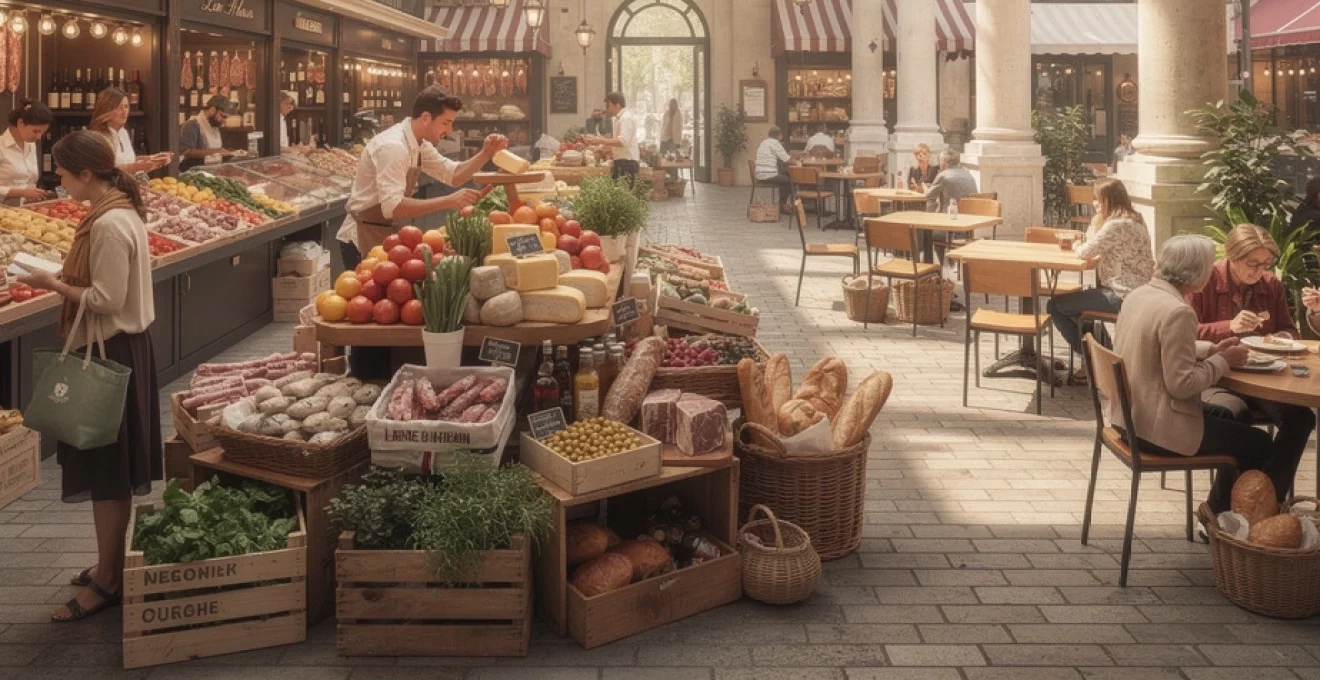
Walking through a French food market on a Saturday morning reveals far more than commerce—it unveils the beating heart of urban community life. From the animated conversations between vendors and regulars to the multigenerational gatherings around seasonal produce displays, these markets function as sophisticated social infrastructure that transcends mere shopping. The aromatic blend of fresh bread, ripe cheese, and just-picked herbs mingles with the sound of friendly banter, creating an atmosphere that has remained fundamentally unchanged for centuries despite the digital revolution transforming retail everywhere else.
French food markets represent one of the few remaining spaces where social capital formation occurs organically through daily interaction. Unlike the transactional anonymity of supermarkets or the isolated convenience of online shopping, these markets facilitate meaningful human connection whilst fulfilling the practical need for fresh provisions. With over 10,000 food markets operating across France and approximately 38,500 businesses participating in this distribution network, the market system constitutes a parallel economy rooted in relationships rather than efficiency metrics.
Architectural design and spatial configuration of french market halls
The physical structure of French market spaces profoundly influences their capacity to function as social gathering points. Unlike supermarkets designed to maximise throughput and minimise dwell time, traditional market halls and open-air market layouts encourage lingering, conversation, and serendipitous encounters. The architecture itself communicates values about community, craftsmanship, and the importance of food in daily life.
Les halles de lyon paul bocuse: Multi-Level vendor arrangement and traffic flow
This iconic covered market in Lyon exemplifies how thoughtful spatial design facilitates both commerce and socialisation. The two-storey structure houses approximately sixty vendors arranged to create natural circulation patterns that prevent bottlenecks whilst encouraging browsing. Wide aisles accommodate not just shopping but also standing conversations, whilst elevated walkways provide viewing platforms where visitors can observe the theatrical marketplace below. The architectural decision to incorporate communal eating areas adjacent to prepared food vendors transforms a simple market into a destination where you might spend hours rather than minutes.
The acoustic properties of the vaulted ceiling amplify the ambient sounds of market activity—the rhythmic chopping of vegetables, the calls of fishmongers, the hum of dozens of simultaneous conversations—creating an immersive sensory experience. This auditory landscape becomes part of the market’s identity, a soundscape as distinctive as any visual element. Research suggests that such multi-sensory environments create stronger memories and emotional connections, explaining why regular market-goers often describe their visits with such affection.
Marché forville cannes: Open-Air layout and social congregation zones
Operating since the 1930s, Marché Forville demonstrates how open-air configurations foster different social dynamics than covered halls. The absence of walls creates visual permeability, allowing passersby to be drawn into the market’s orbit spontaneously. Vendors arrange their stalls facing inward around a central plaza, creating what urban designers call “positive outdoor space”—an area defined by activity rather than barriers.
The market’s layout includes deliberate “congregation zones” where the aisles widen, benches appear, and the flow of foot traffic naturally slows. These spaces become informal gathering points where acquaintances encounter each other unexpectedly, transforming routine shopping into social occasions. The morning light filtering through canvas awnings creates a distinctive atmosphere that changes throughout the morning, with early shoppers experiencing a quieter, more intimate environment than those arriving mid-morning when the market reaches peak animation.
Marché des enfants rouges paris: historical covered structure and communal seating areas
As Paris’s oldest covered market, dating to 1628, Marché des Enfants Rouges represents the archetype of market-as-social-hub. The historical structure features communal seating areas deliberately positioned at the market’s centre, sending an unmistakable message: this space exists for gathering, not just transactions. You’ll find office workers sharing tables with retirees, tourists seated beside neighbourhood regulars, all united by the simple act of eating market-fresh food in a shared space.
The architectural choice to preserve the original timber-frame construction maintains a tangible connection to centuries of market tradition. This historical continuity matters psychologically; vendors and customers alike participate in a
continuum that stretches from the pre-industrial city to contemporary Paris. When you sit at one of these long, shared tables, you are not just eating; you are participating in a ritual of urban conviviality that has unfolded in the same footprint for nearly four centuries. The compact scale of the hall, combined with the density of food stalls and communal seating, forces proximity in the best possible way, turning strangers into temporary table companions and conversations into part of the meal itself.
Acoustic properties and sensory atmospherics in market environments
Beyond their visible architecture, French food markets are carefully choreographed sensory environments. The combination of hard surfaces—stone floors, metal structures, tiled counters—and semi-open layouts produces a distinctive acoustic profile: sounds bounce and blend into a warm background hum rather than sharp, isolated noises. This “market murmur” functions almost like a protective audio curtain, allowing private conversations to unfold in public while still feeling part of a shared social experience.
Smell is equally central. The proximity of cheese mongers to bakers, fishmongers to greengrocers, and coffee stands to spice stalls creates layered olfactory “zones” that guide you intuitively through the space. In urban design terms, this is the opposite of sterile, air-conditioned retail environments; it is closer to walking through a richly scored film set, where every turn offers a new sensory cue. This multisensory atmosphere is why food markets in France remain powerful social magnets: people come not only to buy ingredients but to inhabit a space that feels intensely alive.
Vendor-customer relational dynamics and social capital formation
If the architecture of French markets provides the stage, the vendor-customer relationship supplies the script. Markets operate as dense networks of weak and strong ties where repeated interactions accumulate into significant social capital. Unlike anonymous supermarket aisles, where you might never speak to the same person twice, a weekly visit to your local marché places you in front of the same primeur, cheesemaker, or butcher again and again. Over time, these patterns of recognition, small talk, and mutual assistance turn a commercial space into a web of micro-relationships that stabilise neighbourhood life.
Repeated transactional encounters and trust-building mechanisms
Trust in French food markets is not abstract; it is built one tomato, one slice of cheese, one recommendation at a time. Regulars often give vendors considerable discretion in choosing produce—asking, for example, for “peaches for this evening” or “strawberries for tomorrow or the day after.” This temporal calibration of ripeness is a subtle but powerful trust-building mechanism: when the fruit is perfect at the agreed moment, the vendor’s competence and goodwill are confirmed.
Sociologists would describe this as a shift from price-based to relationship-based exchange. You are not only buying what you see on the stall; you are buying the vendor’s expertise and their investment in your future satisfaction. Over months and years, this repeated positive reinforcement turns vendors into informal advisors on your household’s food choices. In effect, your local market stall becomes part of your extended social support system, contributing to a sense of security that no online grocery interface can replicate.
Linguistic exchange patterns: dialect, negotiation, and local vernacular
Language is another key ingredient in the social life of French markets. Simple phrases—“Bonjour Madame, qu’est-ce que vous me conseillez aujourd’hui ?”—open the door to miniature consultations about seasonality, price, and preparation. These exchanges are rarely purely transactional; they are peppered with local idioms, affectionate nicknames, and region-specific terms for produce that anchor the market firmly in its territory. For newcomers, this local vernacular can feel like a gentle initiation into community life.
Negotiation, where it occurs, is typically subtle and wrapped in politeness: a raised eyebrow at a price, a joking comment about the size of a portion, or the classic question, “Et si je vous en prends deux, vous me faites un petit prix ?” This performative aspect of bargaining is less about saving a few centimes and more about affirming a relationship where both parties recognise each other as human beings, not just buyer and seller. In this way, the everyday language of the market continually renews social bonds.
Maraîchers and producteurs: direct producer-consumer relationships
One of the reasons French food markets are perceived as authentic social spaces is the visible presence of maraîchers (market gardeners) and producteurs who sell directly to consumers. In many urban markets, you will find signs stating “Producteur – Vente directe”, signalling that the person behind the stall is also the person who planted, harvested, or raised the goods on display. This short-circuiting of supply chains fosters a unique intimacy around food: you can ask exactly where the apples were grown or how the goats are treated, and you will receive an answer grounded in lived experience.
These direct relationships also redistribute power within the urban food system. Rather than being faceless suppliers to large retail chains, producers become visible actors in city life, with their own stories, constraints, and aspirations. For city-dwellers increasingly concerned with sustainability and food ethics, this face-to-face contact is invaluable. It transforms abstract concepts like “local food systems” into something very concrete: a handshake, a conversation, a weekly rendezvous at the same corner of the market hall.
Gift economy practices and reciprocity norms in market transactions
Look closely at any bustling French market and you will notice small gestures that fall outside strict commercial logic: an extra handful of cherries slipped into a bag, a free bunch of parsley added “pour le pot-au-feu,” a slice of sausage offered to the child waiting patiently beside a parent. These practices participate in what anthropologists call a “gift economy,” where small acts of generosity establish reciprocity and loyalty over time.
From a social perspective, such gestures humanise the marketplace. They signal that the relationship is not purely utilitarian; there is room for kindness and recognition. You, as a customer, respond in kind—by returning to the same stall, recommending it to friends, or bringing a little box of chocolates at Christmas. These loops of giving and receiving weave a dense fabric of mutual obligation that helps explain why physical markets retain such resilience, even in an era of hyper-efficient digital commerce.
Temporal rhythms and weekly market cycles as social anchors
French food markets also structure time. In many cities, the weekly market day functions as a temporal landmark as significant as Sunday mass once was. Rather than being open 24/7, most markets operate in concentrated bursts: early morning to early afternoon, one to three times per week. This rhythm creates anticipation, routine, and a sense of collective synchronicity. When market day arrives, you know that neighbours, friends, and acquaintances will likely be out too, converging on the same urban space.
Market days as synchronised community gathering points
Because market days are fixed and widely advertised—often on town-entry signs or municipal websites—they serve as synchronised social appointments for the entire community. Residents plan their week around them: a Thursday morning market in a small town, or a Saturday marché in a big-city neighbourhood, becomes a predictable node in the social calendar. You might not arrange to meet anyone explicitly, yet you “run into” the same people with remarkable regularity.
This regular convergence has powerful implications for urban cohesion. It creates what urban theorists call “repeated unplanned encounters,” which are essential for building the low-intensity familiarity that underpins trust in public space. In other words, seeing the same faces at the vegetable stall every Tuesday—even if you do not know their names—quietly reassures you that you live in a stable, shared environment. Markets thus operate as informal weekly assemblies, reinforcing a collective sense of “us” without any formal organisation.
Morning rush demographics versus midday social shoppers
Within a single market day, different time slots attract different demographics and behaviours. Early morning—often from 8:00 to 10:00—is the domain of purposeful shoppers: restaurant owners sourcing ingredients, retirees arriving with caddies, busy parents grabbing produce before work. The pace is brisk, conversations are efficient, and the focus leans towards practicality. If you want to study the logistical backbone of the food system, this is the hour to observe.
From late morning to early afternoon, the mood shifts. The pace slows, the aisles become more congested, and the café terraces surrounding the market fill up. Here you find groups of friends lingering over coffee, families sampling olives and cheeses, and tourists absorbing the atmosphere. Shopping morphs into strolling, and the market becomes more explicitly a social hub. For urban planners interested in how public spaces support different types of social interaction over the course of a day, French food markets offer a textbook example.
Seasonal product availability and culinary calendar coordination
Beyond weekly cycles, markets in France also choreograph the seasons. The sudden appearance of gariguette strawberries in late spring, the summer arrival of melons and tomatoes, the autumnal display of wild mushrooms and game—all mark transitions in the culinary calendar. For many city-dwellers, these seasonal cues are more tangible than the dates on a calendar; they are how you “feel” the passing of the year.
This alignment between market offerings and seasonal recipes creates a kind of collective menu planning. When you see mountains of apricots, you are reminded to make jam; when black truffles appear, you start thinking of festive meals. Vendors actively participate in this coordination by suggesting dishes appropriate to the season and the weather. In doing so, they help maintain a shared food culture, even in large, anonymous cities where other forms of tradition may be fading.
Culinary knowledge transfer and gastronomic education networks
French food markets are not just places where food is exchanged; they are also classrooms, laboratories, and storytelling venues. Much of the country’s celebrated gastronomic culture is transmitted not in formal cooking schools but in the casual, ongoing conversations that occur between stalls and shopping bags. If you listen carefully, you will hear impromptu masterclasses in everything from how to prepare artichokes to choosing the right cheese for a specific wine.
Recipe sharing and cooking technique demonstrations at vendor stalls
Ask a French market vendor what to do with an unfamiliar vegetable, and you will rarely receive a one-word answer. Instead, you will be given a recipe outline, cooking times, seasoning tips, and sometimes even a quick demonstration of how to peel or trim it. These exchanges turn each stall into a micro cooking school, where practical culinary knowledge is passed on in highly contextual, personalised ways.
For home cooks, this advice is invaluable. It lowers the barrier to experimenting with new ingredients and strengthens the link between raw produce and finished dishes. Over time, markets thus help sustain a population of confident, informed cooks—people who understand not only what they are eating but how and why it is prepared in a particular way. In a world where many have outsourced cooking to delivery apps, this kind of informal education keeps culinary skills embedded in everyday life.
Terroir discussions: AOC products and regional provenance storytelling
Another distinctive feature of French food markets is the constant discourse around terroir—the idea that geographical origin, soil, climate, and human know-how combine to produce unique flavours. Vendors selling AOC or AOP products—whether it is Comté, Roquefort, or a specific olive oil—frequently engage in mini-lectures about where their goods come from and what makes them special. Labels and signage reinforce these narratives, but it is the spoken stories that really bring them to life.
These terroir conversations do more than market products; they educate urban consumers about rural landscapes and the people who work them. As you hear about alpine pastures or Atlantic salt marshes, you begin to map an invisible geography of taste onto the products before you. This narrative dimension of market shopping is a major reason why food markets in French cities feel so different from generic retail: every purchase can be an entry point into a story about place, tradition, and craft.
Intergenerational food culture transmission in market settings
Watch any French market for a while and you will see many shoppers with children or grandchildren in tow. These visits are rarely just about convenience; they are opportunities for intergenerational transmission of food culture. Grandparents explain how to choose a ripe melon, parents negotiate with children over which cheese to buy, teenagers taste their first oyster under a watchful adult eye. Through these rituals, young people learn not only to recognise quality ingredients but also to navigate social etiquette: greeting vendors, waiting in line, saying thank you.
In this sense, markets function as informal civic academies, teaching the next generation how to be both consumers and citizens. They learn that food does not simply appear on supermarket shelves; it comes from identifiable people who deserve respect and fair compensation. They also absorb unspoken rules about sharing space, respecting elders, and participating in community life. Few other urban institutions pack so much tacit education into such a seemingly mundane activity.
Marché biologique: organic certification discourse and consumer education
In many French cities, dedicated organic markets—marchés biologiques—have emerged as specialised forums for discussing environmental impact, animal welfare, and sustainable agriculture. At places like the Sunday organic market on Boulevard Raspail in Paris, conversations routinely go beyond taste and price to encompass pesticide use, soil health, and certification standards. Shoppers ask detailed questions about the difference between AB (Agriculture Biologique) certification and other labels, and vendors are typically well-prepared to answer.
This discourse transforms the act of buying vegetables into an ongoing civic seminar about the food system. For urbanites who may feel disconnected from rural realities, the organic market offers a rare chance to interrogate production methods face to face. The result is a more informed public, better able to align their purchasing habits with their environmental and ethical values. Once again, the market functions as both economic infrastructure and social classroom.
Multi-ethnic integration and cross-cultural food exchange
Modern French cities are profoundly multicultural, and their food markets provide some of the most visible evidence of this diversity. Stalls selling olives from Morocco stand alongside traditional French cheese counters; vendors speaking Arabic, Portuguese, Chinese, or Wolof coexist with those using regional French dialects. This daily coexistence around food—arguably the most intimate of cultural expressions—creates conditions where cross-cultural understanding can grow organically.
Maghrebi vendors at marché barbès: north african culinary presence
Nowhere is this more apparent than at markets like Marché Barbès in northern Paris, where Maghrebi vendors and products play a central role. Here you will find towering mounds of coriander, crates of dates, preserved lemons, and harissa paste, as well as butchers specialising in halal meat. The visual and olfactory atmosphere is distinct from more traditional bourgeois markets, yet the social logic is the same: greetings exchanged, recipes recommended, gossip traded.
For long-time residents of North African origin, such markets offer comfort and continuity—a way to access familiar ingredients and social codes in the heart of the French metropolis. For others, they function as gateways into new culinary worlds. Buying a handful of spices or asking how to prepare couscous becomes a low-stakes act of cultural curiosity. Over time, these everyday transactions help normalise diversity, making the multi-ethnic character of the city feel not exceptional but entirely routine.
Asian product stalls in quartier belleville and cultural hybridisation
In neighbourhoods like Belleville, the presence of Asian grocery stalls and prepared-food stands adds another layer to the market mosaic. Here you might see bok choy piled next to leeks, bunches of Thai basil alongside conventional parsley, or steamed dumplings sold a few metres from a classic French rotisserie. This juxtaposition encourages what cultural theorists call hybridisation: the blending of culinary traditions as people experiment with combining “foreign” ingredients with local recipes.
From a social perspective, these Asian stalls expand the range of conversations and relationships that can occur in the market. A French customer might ask a vendor how to use fresh lemongrass, while an immigrant family discovers local cheeses at the neighbouring stand. Markets thus become laboratories of integration, where difference is not merely tolerated but actively incorporated into daily routines. In a time when debates about immigration can be polarising, these quiet culinary exchanges provide a powerful counter-narrative of coexistence.
Halal and kosher provisions: religious dietary accommodation in urban markets
The availability of halal and kosher options in many French city markets is another example of how these spaces adapt to diverse social needs. Dedicated butchers and specialty stalls ensure that observant Muslims and Jews can adhere to religious dietary laws without leaving the mainstream commercial circuit. This inclusivity is significant: it signals that the public marketplace belongs to everyone, regardless of faith.
At the same time, the visibility of halal and kosher provisioning can spark curiosity among other shoppers, leading to conversations about rituals, fasting periods, or festival foods. A non-Muslim customer buying lamb before Eid might learn about the celebration, just as someone purchasing matzo near Passover discovers a bit about Jewish tradition. In this way, religious dietary accommodation becomes a vehicle for mutual understanding, again underscoring the role of food markets as living classrooms of urban pluralism.
Digital disruption resistance and analogue social infrastructure preservation
In an era dominated by e-commerce, food delivery apps, and contactless payment, French food markets look, at first glance, stubbornly old-fashioned. Yet their analogue character is precisely what makes them so valuable as social infrastructure. While supermarkets roll out self-checkout machines and online platforms promise “frictionless” shopping, markets preserve a space where friction—conversation, waiting, negotiating, deciding—is not a bug but a feature. This resistance to digital disruption is less about nostalgia than about protecting a rare type of urban experience.
Anti-e-commerce sentiment and tactile product selection preferences
Many regular market-goers explicitly reject the idea of delegating their fresh food purchases to algorithms or warehouse pickers. For them, choosing a peach is not just about ticking a box labelled “ripe” or “firm”; it is about smelling, weighing, and sometimes even tasting before deciding. This tactile engagement with food reinforces a sense of agency and connection to what we eat. Have you ever tried to specify “strawberries for Saturday, not too ripe, but not too hard” in an online order form? The market vendor understands that nuance instantly.
This preference for tactile selection goes hand in hand with a critique—sometimes spoken, sometimes implicit—of hyper-optimised supply chains that prioritise shelf life and uniformity over flavour and diversity. By continuing to shop in person, market customers vote with their feet for a different food paradigm, one where human judgement and face-to-face interaction still matter. In doing so, they help keep alive an alternative model of urban commerce that values relationship and experience as much as efficiency.
Cash-based transactions and financial accessibility for marginalised groups
Another way in which French food markets resist full digitalisation is their continued reliance on cash. While more stalls now accept cards or mobile payments, coins and notes remain widely used. This has important social implications. For older residents uncomfortable with digital banking, recent immigrants without full access to the financial system, or low-income households who budget day by day, cash-based transactions keep the market accessible.
In a city where many services increasingly require bank cards, smartphones, or apps, the ability to participate fully in the market economy with just a handful of euros in one’s pocket is a form of inclusion often taken for granted. This financial simplicity lowers the threshold for participation: you do not need an account, a subscription, or a login—just the willingness to say “Bonjour” and engage. Thus, markets quietly counteract some of the exclusionary tendencies of digitised urban life.
Social media documentation practices: instagram culture at marché d’aligre
Paradoxically, the very analogue character of French markets has made them highly photogenic in the digital age. At Marché d’Aligre in Paris, for example, it is common to see shoppers and visitors taking photos of colourful produce displays, cheese boards, or steaming plates at nearby bistros. Instagram stories and posts tagged with the market’s name circulate widely, turning individual visits into shared digital narratives.
This social media documentation performs two seemingly opposite functions. On the one hand, it promotes markets to new audiences, contributing to their economic vitality and cultural prestige. On the other, it underscores what cannot be digitised: the smell of roasting chicken, the texture of a sun-warmed tomato, the murmur of overlapping conversations. In capturing and sharing images of these experiences, users implicitly affirm their value. Far from replacing the market, digital platforms here act as amplifiers of its unique, irreplaceable role in French urban life.