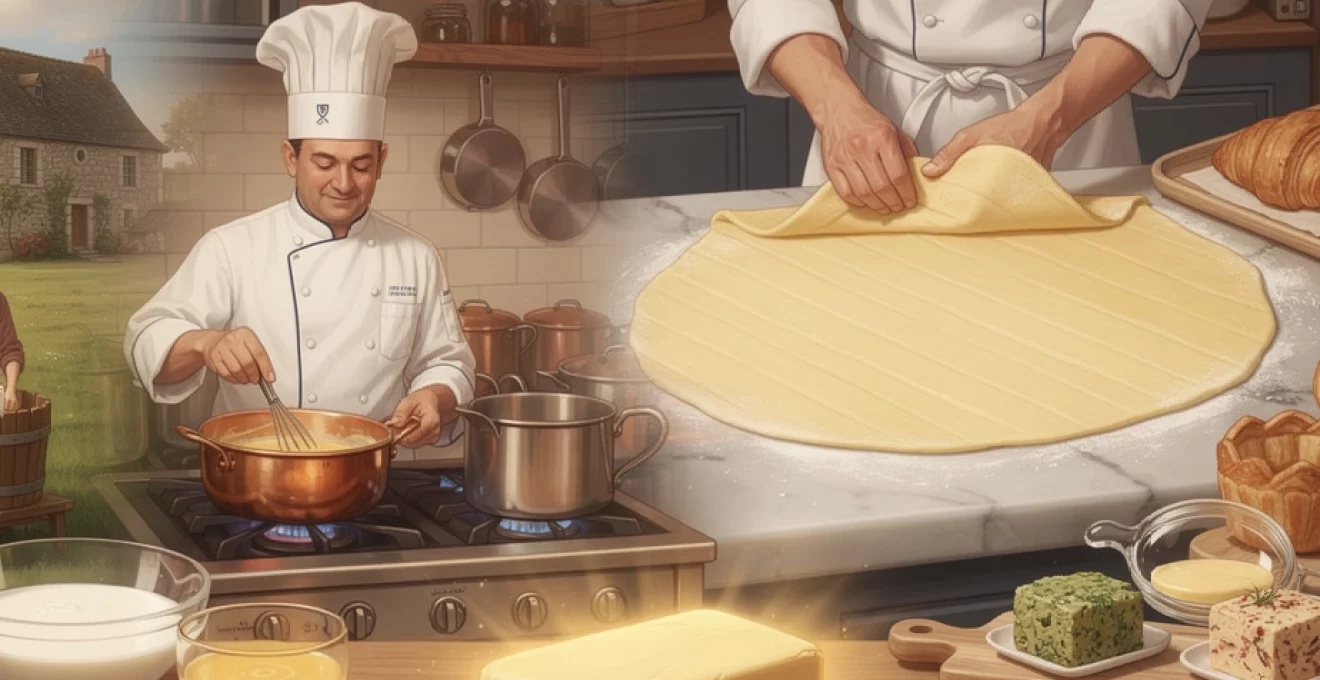
French cuisine’s reputation for excellence stems from centuries of culinary refinement, yet no single ingredient embodies this pursuit of perfection quite like butter. From the flaky layers of croissants to the velvety finish of a classic beurre blanc, butter serves as both foundation and finale in countless French preparations. The relationship between French cooking and butter transcends mere culinary preference—it represents a fundamental understanding of how fat creates texture, carries flavour, and transforms simple ingredients into extraordinary experiences.
This golden dairy product has shaped French gastronomy for over a millennium, establishing techniques and traditions that continue to influence professional kitchens worldwide. The precision with which French chefs manipulate butter’s various forms—from cold lamination in pastry work to the delicate emulsification of warm sauces—demonstrates a mastery that distinguishes French cuisine from other culinary traditions.
Historical evolution of butter in french culinary traditions
Medieval normandy and the birth of french butter culture
The foundations of France’s butter-centric cuisine emerged during the medieval period, particularly in the northern regions where cattle thrived in lush pastures. Norman monasteries pioneered early butter-making techniques, developing methods that would eventually spread throughout France. These religious communities possessed both the resources and patience necessary for perfecting the churning process, creating butter that surpassed anything previously produced in the region.
Medieval French butter production differed significantly from contemporary methods, relying on seasonal availability and natural fermentation processes. The lack of refrigeration meant that butter often developed complex, cultured flavours through natural bacterial action—a characteristic that modern artisanal producers now deliberately recreate. This historical accident became a defining feature of French butter, distinguishing it from the sweet cream varieties favoured in other European regions.
Escoffier’s codification of classical Butter-Based mother sauces
Auguste Escoffier’s systematisation of French cuisine in the late 19th century elevated butter from a simple cooking fat to a sophisticated culinary medium. His codification of the five mother sauces established butter as essential in hollandaise and its derivatives, whilst his techniques for mounting sauces with cold butter became standard practice in professional kitchens. Escoffier understood that butter’s unique properties—its ability to create stable emulsions, provide richness without heaviness, and enhance flavour perception—made it irreplaceable in haute cuisine.
The chef’s influence extended beyond sauce-making to encompass the entire spectrum of French cookery. His techniques for clarifying butter, creating compound butters, and utilising butter in pastry work established protocols that remain virtually unchanged in contemporary French kitchens. This standardisation ensured that butter’s role in French cuisine became both systematic and sophisticated, elevating it from peasant cooking staple to haute cuisine essential.
Regional terroir influence on isigny and échiré butter production
France’s diverse regional terroir creates distinct butter varieties that reflect local environmental conditions and traditional practices. Isigny-sur-Mer’s proximity to the English Channel infuses the region’s pastures with salt-laden air, producing butter with subtle mineral notes that complement both sweet and savoury preparations. The area’s specific soil composition, rich in trace minerals, directly influences the flavour profile of local dairy products.
Échiré butter, produced in the Deux-Sèvres department, represents another pinnacle of terroir-driven production. The region’s limestone-rich soils and temperate climate create ideal conditions for producing cream with exceptional butterfat content. Traditional wooden churning methods, still employed by select producers, contribute to the butter’s distinctive texture and flavour development. These regional variations demonstrate how geographical factors continue to influence French butter production, maintaining diversity within a unified culinary tradition.
Post-war industrialisation impact on traditional french butter methods
The post-World War II period brought significant changes to French butter production, as industrialisation threatened traditional methods whilst simultaneously making quality butter more accessible. Large-scale production introduced standardisation and consistency, yet potentially diminished the unique characteristics that defined regional varieties. This tension between efficiency and tradition continues to influence contemporary French butter production.
However, the rise of industrial production also sparked a counter-movement towards artisanal methods. Small
However, the rise of industrial production also sparked a counter-movement towards artisanal methods. Small dairies and cooperatives doubled down on traditional fermentation, slow churning, and local milk sourcing, positioning their butter as a premium alternative to standardized blocks. The creation and reinforcement of quality labels such as AOP (Appellation d’Origine Protégée) and Label Rouge helped protect regional identities and traditional butter-making skills. Today, French butter culture sits at this intersection: industrial butter provides everyday affordability, while artisanal producers preserve techniques that give French recipes their unmistakable depth and character.
Technical properties of french butter in professional cookery
Fat crystal structure and plasticity in pâte brisée formation
From a technical standpoint, what makes French butter so powerful in recipes like pâte brisée is its fat crystal structure. Butterfat is composed of different types of triglycerides that solidify at slightly different temperatures, creating a network of crystals that can be either brittle or plastic. High-quality French butter is designed to be more plastic at typical working temperatures, meaning it can be pressed and rolled without shattering or melting too quickly. This plasticity allows you to coat flour particles efficiently, limiting gluten development and yielding a tender, short crumb in savoury tarts and quiches.
Think of the process like laminating tiny sheets of fat between grains of flour: if the butter is too hard, it breaks into irregular shards; if it is too soft, it smears and disappears. French butter, particularly those with around 82–84% fat, strike the ideal balance for pâte brisée and other classic French pastry doughs. Professional kitchens often work with “dry” butters formulated specifically for pastry, which maintain structure at slightly higher temperatures. For home cooks, choosing a French or European-style butter with at least 82% fat can dramatically improve the flakiness and consistency of your tart shells.
Water content ratios in european vs american butter standards
One of the most important technical differences between French butter and many foreign counterparts lies in water content. In France and across much of Europe, the legal minimum for butterfat is typically 82%, whereas standard American butter often hovers around 80% fat. Those two percentage points might seem trivial, but in professional cookery they can mean the difference between a crisp, laminated dough and one that bakes up denser and flatter. Less water means less steam and less risk of gluten overdevelopment, both crucial factors in delicate pastry.
For bakers adapting French recipes abroad, this water–fat ratio is more than a detail—it’s a variable that affects how dough behaves. Using a butter with higher water content can introduce extra moisture into pastry, which may require small adjustments in flour or baking time. Conversely, when you switch to French butter, you may notice doughs come together more quickly and feel slightly richer. If you have ever wondered why your “authentic” croissant recipe doesn’t look like those in Paris, checking your butter’s fat content is a good starting point.
Clarification techniques for beurre noisette and ghee applications
Clarifying butter removes water and milk solids, transforming it into a purer fat with a higher smoke point and concentrated flavour. In French cuisine, two clarified preparations stand out: beurre noisette (hazelnut brown butter) and beurre clarifié, which is similar in use to ghee. Beurre noisette is created by gently heating butter until the milk solids sink, toast, and colour the fat golden brown, releasing nutty, toasted aromas that French chefs use to elevate everything from fish to financiers. The key is temperature control: too low and flavours remain flat, too high and the solids burn, turning bitter.
Classic clarified butter used for sautéing or sauce work is heated more gently and strained before the solids colour, leaving a clear, pale yellow fat. This clarified butter behaves much like ghee in Indian cuisine, offering stability at higher temperatures and a clean, buttery note without the risk of scorching. For modern cooks, mastering both styles opens up a range of French recipes that rely on precise fat behaviour, from pan-roasted sole finished with beurre noisette to airy crêpes cooked in clarified butter. Once you grasp that you are essentially editing out water and solids to control flavour and heat tolerance, the process becomes far less intimidating.
Emulsification science behind hollandaise and béarnaise stability
Hollandaise and béarnaise are iconic examples of why butter sits at the heart of so many French sauces. At their core, these sauces are emulsions: tiny droplets of butterfat suspended in a continuous phase of water and egg yolk. Egg yolks provide lecithin and other emulsifiers that act like tiny bridges, helping fat and water coexist in a smooth, glossy sauce. Temperature control is critical; if the mixture overheats, the proteins in the yolk coagulate too quickly, causing the emulsion to break and the butter to separate.
You can imagine a stable hollandaise like a well-organised crowd, with yolk molecules keeping the butter droplets from crashing into each other and clumping. In practice, this means adding warm clarified butter slowly to a foamed yolk base while whisking constantly, maintaining a gentle heat. Béarnaise follows the same principle, with an aromatic reduction of vinegar, shallots, and tarragon providing the water phase. Understanding this basic emulsification science allows both professional chefs and home cooks to troubleshoot: if your sauce begins to thin or separate, a spoonful of warm water or an extra whisked yolk can often bring it back from the brink.
Foundational french butter techniques and applications
Beurre manié thickening methods in classical sauce construction
Beurre manié is one of those deceptively simple techniques that quietly underpins a huge number of French recipes. It is nothing more than equal parts softened butter and flour kneaded together into a smooth paste, but its usefulness lies in how gently and evenly it thickens liquids. Because each flour particle is coated in butter, it disperses without clumping when whisked into hot stock or sauce. This allows chefs to adjust consistency at the last moment, without the raw flour taste that can result from hurried roux-based thickeners.
In practice, you might use beurre manié to give body to a red wine jus, a blanquette de veau, or even a simple pan sauce for chicken. A small knob whisked in off the heat produces a silkier texture and a subtle gloss, while larger quantities can turn a broth into a velvety sauce. For home cooks, keeping a small portion of beurre manié in the fridge is an easy way to correct a sauce that has turned out thinner than expected. It is a clear example of how French cuisine uses butter not only for flavour, but as a precise structural tool.
Lamination processes in croissant and puff pastry production
Few techniques showcase French butter’s importance better than lamination, the process of folding butter into dough to create hundreds of ultra-thin layers. In croissant and puff pastry production, a rectangle of cold, plastic butter is encased in dough and repeatedly rolled and folded—typically in three or four “turns”. With each turn, the number of layers grows exponentially, like folding a piece of paper until it becomes impossibly thick. During baking, the water in both the dough and butter turns to steam, forcing those layers apart and creating the signature honeycomb structure and flake.
The success of this process depends on the butter’s plasticity and melting point. Professional French bakers often specify “dry” butter formulated for lamination, which holds its shape longer and can be rolled thinner without cracking. If the butter melts too quickly, it leaks into the dough, and the layers fuse instead of separating. When you bite into a shatteringly crisp croissant in Paris, you are experiencing the result of this meticulous choreography between dough and butter. For anyone attempting laminated doughs at home, choosing a French or European-style butter and working in a cool environment are two of the most effective ways to replicate that texture.
Compound butter preparations: maître d’hôtel to café de paris
Compound butters—plain butter mixed with herbs, spices, or aromatics—are another expression of French culinary efficiency and elegance. Beurre Maître d’Hôtel, for instance, combines softened butter with chopped parsley, lemon juice, and a touch of seasoning. Sliced over grilled steak or fish, it melts into an instant sauce, adding acidity and freshness alongside richness. Other classic variations incorporate garlic, anchovies, citrus zest, or even finely chopped nuts, each tailored to a specific dish.
Perhaps the most famous is beurre Café de Paris, a complex mixture traditionally served with grilled meats. Though its exact formula varies by house and is often guarded, it typically includes mustard, herbs, capers, curry powder, and other aromatics folded into butter. The principle remains consistent: butter acts as a carrier for a concentrated mix of flavours, releasing them gradually as it melts. For modern cooks, compound butters are a practical way to bring French-style finesse to simple preparations—an herbed butter for roast chicken, a seaweed butter for shellfish, or a citrus butter for seasonal vegetables.
Mounting techniques for beurre blanc and pan sauce finishing
Monter au beurre, or mounting with butter, is a finishing technique that gives many French sauces their luxurious mouthfeel and sheen. In the case of beurre blanc, a Loire Valley classic, cold butter is whisked into a warm reduction of white wine and vinegar. The butter emulsifies into the liquid, creating a pale, velvety sauce that clings lightly to fish or vegetables. Temperature is again crucial: if the mixture is too hot, the butter will separate; too cool, and it will not fully emulsify. The result, when done correctly, is a light yet rich sauce that highlights rather than overwhelms delicate ingredients.
Pan sauces follow a similar logic. After searing meat or fish, the fond left in the pan is deglazed with wine, stock, or vinegar, then reduced and seasoned. Off the heat, small cubes of cold butter are whisked in to thicken slightly and round off any sharp edges of acidity. You can think of this butter mounting as the final brushstroke on a painting—it does not change the essence of what is on the plate, but it refines and unifies the flavours. Once you start finishing sauces this way, it becomes clear why French recipes so often specify “finish with a knob of butter.”
Regional french butter variations and culinary applications
Just as French wines express their terroir, so too do regional butters, each with distinct flavours and preferred uses. In Brittany, for example, salted butter (beurre salé or demi-sel) reigns supreme, historically linked to the region’s access to sea salt and exemption from the old salt tax. This butter finds its way into iconic specialities like kouign-amann and buttery crêpes, where its salinity balances sweetness and deep caramelisation. In Normandy, rich pastures yield cream-heavy butters often used in sauces for seafood, chicken, and apples, reinforcing the region’s reputation for dairy excellence.
Further south, butters from Charentes-Poitou or Échiré are prized for their silky texture and subtle, cultured tang, making them favourites for viennoiseries and high-end pastry work. Regional preferences also extend to everyday habits: in some western regions, breakfast tartines are almost unthinkable without a generous layer of salted butter beneath the jam, while in others, unsalted butter remains the default for both cooking and table use. For anyone exploring French recipes, paying attention to these regional butter styles can enhance authenticity—using Breton salted butter in caramel, for instance, or a Normandy butter in cream-based sauces to echo local tradition.
Contemporary french gastronomy and butter innovation
Modern French gastronomy has not abandoned butter; instead, it has reframed and refined its use. Contemporary chefs, influenced by lighter dining preferences and global techniques, often deploy butter more strategically than their predecessors. Rather than saturating every component, they highlight butter where it has the most impact—finishing a sauce, glazing seasonal vegetables, or enriching a purée. At the same time, artisanal butter producers have embraced innovation, offering butters infused with seaweed, smoked salt, citrus zest, or spices designed specifically for pairing with seafood, meat, or bread.
There is also a growing conversation around sustainability and animal welfare in French dairy production. Some high-end restaurants now source butter from small farms practicing regenerative agriculture or using heritage breeds of cattle, emphasizing traceability much as they do with wine or meat. Parallel to this, plant-based “butter-style” fats and hybrid approaches (such as sauces that combine olive oil and a small quantity of butter) have entered the repertoire of chefs responding to vegan or lactose-intolerant guests. While these alternatives cannot replicate every technical property of traditional French butter, they push chefs to think more critically about where butter is essential in a recipe, and where its role can be reimagined.
Nutritional and cultural significance in french dietary patterns
From a nutritional standpoint, butter occupies a nuanced place in French dietary patterns. It is calorie-dense and high in saturated fat, yet in typical French eating habits it is consumed in modest quantities, integrated into meals rather than eaten in isolation throughout the day. This balance aligns with the so-called “French paradox”: a cuisine rich in butter, cream, and cheese coexisting with comparatively lower rates of cardiovascular disease and obesity than some countries with similar or lower fat consumption. Portion control, slower meals, and an emphasis on overall dietary diversity help explain why butter can remain at the heart of so many French recipes without dominating the diet.
Culturally, butter symbolises both comfort and craftsmanship. A simple tartine de beurre, a ham-and-butter baguette, or potatoes mashed with salted butter all speak to everyday French home cooking, while a meticulously laminated croissant or glossy sauce in a fine-dining restaurant showcases technical excellence. For many French people, the choice of butter—brand, region, salted or unsalted—is as personal as their choice of coffee or bread. When you cook French recipes at home, being mindful of how, when, and why you use butter brings you closer to this culinary culture. You are not just adding fat; you are participating in a tradition that treats butter as both a flavour and a tool, woven into the fabric of daily life.