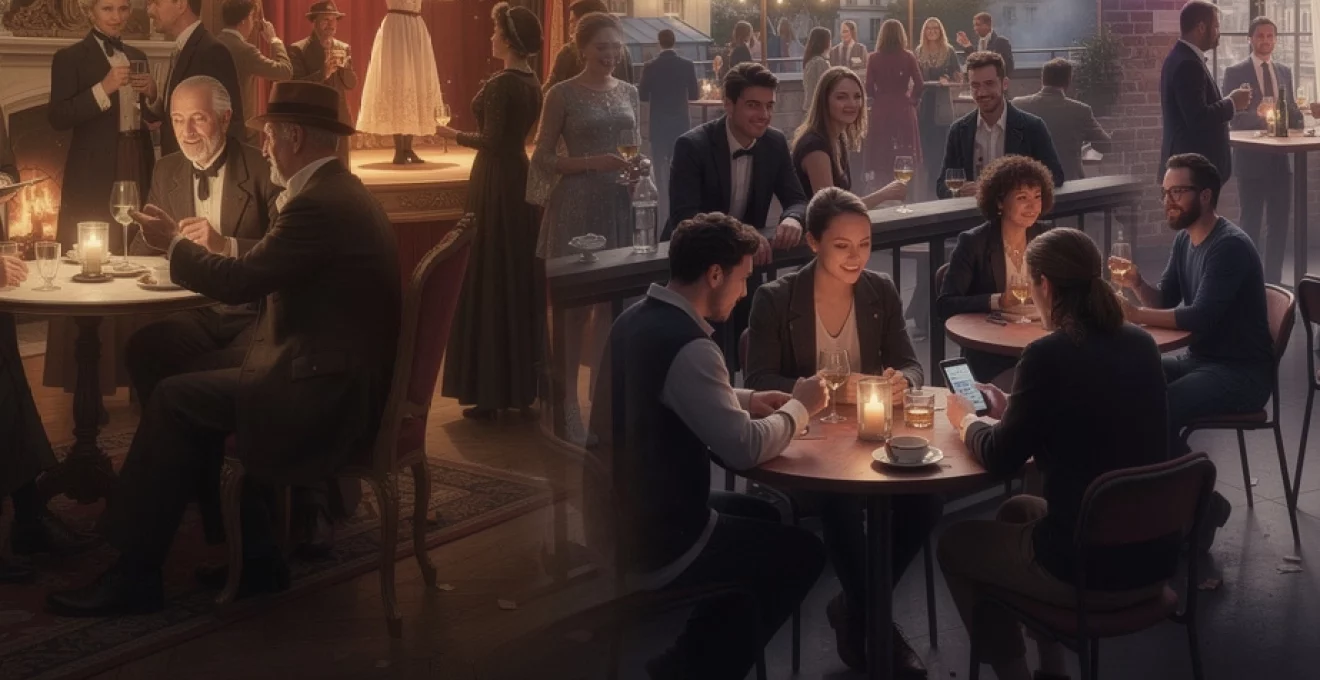
Paris stands as one of the world’s most socially dynamic capitals, where gatherings and celebrations form the very backbone of urban culture. From intimate salon conversations to grand networking events, the French capital has perfected the art of bringing people together in ways that transcend mere entertainment. The city’s unique approach to socialisation creates connections that extend far beyond momentary encounters, building lasting networks that influence everything from career opportunities to personal relationships. This intricate web of social interaction reveals why Parisian parties aren’t simply leisure activities—they represent an essential infrastructure for navigating both professional and personal life in one of Europe’s most influential cities.
Historical evolution of parisian social gatherings from salon culture to modern networking events
The transformation of Parisian social gatherings spans centuries of cultural evolution, beginning with the influential salon tradition that shaped intellectual discourse across Europe. These sophisticated gatherings established patterns of social interaction that continue to influence contemporary Parisian party culture, creating frameworks for meaningful conversation and relationship building that persist today.
Literary salons of madame de staël and their influence on contemporary party dynamics
The literary salons of the 18th and 19th centuries established fundamental principles that continue to guide Parisian social gatherings. These intimate intellectual circles emphasised quality conversation over mere socialising, creating environments where ideas flourished alongside personal connections. Participants engaged in structured yet spontaneous dialogue that moved seamlessly between literature, politics, and personal philosophy. Modern Parisian gatherings retain this emphasis on substantive conversation, with hosts carefully curating guest lists to ensure dynamic intellectual exchange.
Contemporary event organisers draw directly from salon traditions when designing networking events and cultural gatherings. The careful attention to seating arrangements, the strategic mixing of personalities, and the creation of conversational catalysts all echo historical salon practices. This historical foundation explains why Parisian parties often feel more intellectually stimulating than their counterparts in other major cities.
Post-haussmann urban planning impact on private entertainment venues
Baron Haussmann’s comprehensive urban redesign fundamentally transformed how Parisians gather and celebrate. The creation of wide boulevards and standardised apartment buildings established new spatial relationships that directly influenced private entertainment possibilities. These architectural changes didn’t merely alter the physical landscape—they reshaped social behaviours and gathering patterns throughout the city.
The uniform height regulations and grand apartment layouts created ideal spaces for hosting sophisticated gatherings. High ceilings, large reception rooms, and interconnected spaces became standard features that facilitate flowing conversation and elegant entertainment. Modern party hosts still benefit from these 19th-century design principles, which provide natural frameworks for successful social events.
Belle époque cabaret culture and its legacy in modern parisian nightlife
The vibrant cabaret culture of the Belle Époque established Paris as a global entertainment capital whilst creating social traditions that persist in contemporary nightlife. These venues pioneered the integration of artistic performance with social networking, demonstrating how cultural experiences could enhance personal and professional connections. The Moulin Rouge and similar establishments created models for immersive entertainment that combined spectacle with intimate social interaction.
Today’s Parisian nightlife venues continue this tradition by offering curated cultural experiences alongside socialising opportunities. From jazz clubs in Saint-Germain to underground venues in Belleville, modern establishments maintain the Belle Époque emphasis on artistic programming that enhances social connections. This cultural foundation explains why Parisian parties often incorporate artistic elements that elevate them beyond simple social gatherings.
Resistance networks during WWII and their role in shaping underground social movements
The clandestine networks that operated during the Nazi occupation created lasting impacts on how Parisians approach exclusive social gatherings. These resistance circles established communication protocols, trust-building mechanisms, and community support systems that influenced post-war social organisation. The emphasis on discretion, selective membership, and mutual support became embedded in Parisian social culture.
Modern exclusive events and private gatherings still reflect these wartime lessons about community building and selective networking. The careful vetting of participants, the emphasis on personal recommendations, and the creation of supportive professional networks all echo resistance organisation principles. This historical context explains the sophisticated approach Parisians take to building and maintaining social circles.
Architectural infrastructure supporting parisian entertainment culture
The physical fabric of Paris quietly underpins its reputation for unforgettable parties and vibrant social life. Urban design, building typologies, and even interior layouts all help determine how people gather, mingle, and connect. When we look beyond the clichés of “romantic Paris” and examine the city as a living system, it becomes clear that architecture provides the stage set on which Parisian social life unfolds.
From Haussmannian apartments to converted industrial lofts, different neighbourhoods offer distinct spatial experiences that shape how Parisians host, attend, and remember social events. Understanding this architectural infrastructure helps explain why parties in Paris feel so specific: they are calibrated to the spaces that contain them, from intimate living rooms to expansive rooftop terraces.
Haussmannian apartment layouts and their optimisation for social gatherings
Haussmannian apartments are almost tailor-made for entertaining, and this is no historical accident. Designed in the mid-19th century for a bourgeois class that valued receptions and soirées, these apartments typically include a clear separation between reception rooms and private quarters. Double living rooms, long enfilades, and large dining spaces create natural circulation paths that allow guests to move fluidly, forming and reforming conversation clusters throughout the evening.
High ceilings, tall windows, and generous proportions also enhance the sensory experience of a Parisian party. Sound carries but does not overwhelm, and the interplay of streetlights, chandeliers, and candlelight contributes to an atmosphere that feels simultaneously grand and intimate. For hosts today, these features provide practical advantages: multiple rooms allow for “zoned” events, such as a quiet corner for discussion, a main space for mingling, and perhaps a music or dance area further away from the entrance.
Many contemporary Parisians adapt Haussmannian layouts to modern social expectations without losing their original strengths. Removing non-structural partitions to create semi-open kitchens, for instance, transforms cooking into part of the social performance. Guests drift between the salon and the kitchen island, blurring the lines between domestic work and conviviality. This spatial logic continues the long Parisian tradition of hosting gatherings where food, conversation, and culture are inseparable.
Rooftop terraces in belleville and montmartre: spatial dynamics for outdoor events
In districts like Belleville and Montmartre, rooftop terraces have become key assets in the Parisian social ecosystem. These elevated spaces offer more than just impressive views of the city’s skyline; they create a unique setting where proximity and openness coexist. Guests are physically close, yet visually oriented toward long vistas, which tends to relax social tension and encourage longer, more reflective conversations.
Outdoor parties on these rooftops leverage a core element of Parisian lifestyle: the pleasure of being outside while still feeling embedded in the city. The spatial dynamics differ from indoor gatherings. People naturally gather near parapets and railings to admire the view, forming small groups that can easily merge as new guests arrive. This constant reconfiguration supports chance encounters and cross-pollination between friendship circles, an essential ingredient of Parisian social life.
Because noise travels differently in open air, rooftop hosts often favour more conversational formats over high-volume dance parties. Acoustic choices—acoustic sets, small speakers, or even no amplified music at all—encourage formats reminiscent of historical salons, but in an informal, contemporary context. In this way, a terrace in Belleville can function as a modern, democratic version of a 19th-century salon, where artists, freelancers, and professionals mix freely under the open sky.
Industrial loft conversions in république and their appeal for creative communities
Around République and in nearby areas like the Canal Saint-Martin, former workshops and warehouses have been converted into lofts that now serve as hubs for creative communities. These expansive, often minimalist spaces contrast sharply with traditional Haussmannian apartments. Open plans, exposed structures, and high ceilings offer a blank canvas for experimental event formats that might not fit within the constraints of more classical interiors.
Because industrial lofts lack rigid compartmentalisation, they invite flexible layouts for performances, installations, or collaborative activities. A single evening might combine a temporary exhibition, a DJ set, and a panel conversation, with guests drifting between each zone as if they were moving through a pop-up cultural centre. This adaptability appeals strongly to designers, artists, tech entrepreneurs, and other professionals whose work thrives on interdisciplinary exchange.
Loft parties in République often blur the line between social events and professional showcases. A product launch might double as a gallery opening; a birthday celebration might also function as informal networking. In this sense, industrial conversions support a new chapter in Parisian party culture where the boundaries between leisure, work, and creative experimentation are deliberately porous—much like an open-plan office that periodically transforms into a lively after-hours venue.
Historic venues like pavillon de l’arsenal and their modern event hosting capabilities
Historic institutions such as the Pavillon de l’Arsenal exemplify how Paris merges heritage with contemporary event culture. Originally focused on urbanism and architecture, the venue now frequently hosts exhibitions, conferences, and evening receptions that attract architects, planners, and culturally engaged residents. Its flexible exhibition halls and carefully managed acoustics allow it to switch from daytime educational space to nighttime social hub with ease.
The appeal of such venues lies partly in their symbolic value. Attending an event in a historic building integrates guests into a larger narrative of Parisian history, reinforcing a sense of belonging to a community that values culture and civic life. This backdrop adds gravitas to networking events, making even a simple cocktail reception feel like a meaningful part of the city’s ongoing story.
From a practical perspective, these venues are equipped with modern lighting, sound, and accessibility features tailored to contemporary expectations. Organisers can project visuals onto historic walls, use modular furniture to create networking zones, and rely on professional staff familiar with large-scale cultural events. The result is a hybrid space where tradition and innovation support a style of socialising that is both rooted and forward-looking.
Cultural capital theory and social stratification through parisian party networks
While Parisian parties are often portrayed as spontaneous expressions of joy, they also play a strategic role in how cultural capital is produced, exchanged, and displayed. Drawing on sociologist Pierre Bourdieu’s theory of cultural capital, we can see parties as arenas where taste, knowledge, and social connections are actively performed. Knowing which events to attend, how to behave, and who to talk to becomes a form of currency in itself.
In practice, Parisian social life is layered. Student house parties in the 11th arrondissement, gallery openings in the Marais, fashion after-parties near Opéra, and informal wine tastings in the Latin Quarter each attract specific social groups. Access is often mediated by subtle markers—education, occupation, dress codes, or shared cultural references. These markers help maintain social stratification even in settings that feel informal. Have you ever noticed how quickly a conversation at a Paris party turns to books, exhibitions, or travel? This is cultural capital in action, gently signalling belonging to certain circles.
At the same time, parties in Paris can also enable social mobility. Someone invited as a friend-of-a-friend to a rooftop gathering might meet a future collaborator, employer, or mentor. Like a well-connected co-working space after dark, the right event can compress years of slow networking into a single evening. However, this potential is not evenly distributed; those already equipped with strong social skills, linguistic fluency, and cultural codes are better positioned to leverage party networks.
Digital culture has complicated these dynamics but not erased them. Public events advertised on social media coexist with closed WhatsApp groups and invite-only dinners. The visible layer of Paris nightlife—bars, clubs, festivals—sits atop a more discreet structure of private salons, professional gatherings, and members-only clubs. Parties thus function as both bridges and filters in Parisian society, reinforcing certain hierarchies while still leaving room for serendipitous connections that can change the course of a life or career.
Economic ecosystem of parisian event planning and hospitality services
Behind every memorable party in Paris lies an intricate economic ecosystem. Event planners, caterers, bartenders, DJs, florists, photographers, and venue managers together support a sector that generates significant revenue for the city. According to industry estimates, France’s broader events market represented several billion euros in turnover in the early 2020s, with Paris accounting for a substantial share thanks to its concentration of corporate, cultural, and private events.
For many small businesses and freelancers, Parisian social life is not just a pleasure but a livelihood. A single weekend might involve a wedding reception near the Seine, a tech start-up launch in République, and a fashion brand’s pop-up in the Marais—all relying on overlapping networks of suppliers. This dense web of professionals ensures that even relatively modest gatherings can access high-quality services, from curated wine lists to bespoke playlists.
Hospitality services in Paris also reflect the city’s strong traditions around food and drink. Independent wine merchants, artisanal bakeries, and specialist cheese shops often collaborate informally with hosts to create distinctive experiences. In this sense, a Parisian party acts like a micro-economy, temporarily activating local businesses and showcasing regional products. The neighbourhood café that supplies glassware and charcuterie boards for a private event, for example, strengthens its relationship with residents while diversifying its income streams.
Of course, this ecosystem is not without challenges. Rising rents and regulatory constraints can make it difficult for new venues and small operators to enter the market. Noise ordinances, licensing requirements, and safety regulations require careful navigation. Yet these constraints have also encouraged innovation: shared event spaces, hybrid cultural venues, and short-term pop-up concepts help keep the scene dynamic. For hosts, understanding this economic landscape—knowing where to source, whom to hire, and how to budget—has become part of the art of organising a successful Parisian gathering.
Digital communication platforms transforming parisian social event organisation
Digital tools have fundamentally reshaped how Parisians discover, organise, and document parties. What once depended on word of mouth or printed invitations now unfolds across multiple platforms, each with its own logic. If historical salons relied on carefully curated guest lists and handwritten notes, today’s hosts juggle Facebook Events, WhatsApp groups, Instagram Stories, and event management platforms to coordinate complex social calendars.
This shift has increased both the speed and the scale of social coordination. With a few taps, a host can invite dozens or hundreds of people, adjust logistical details in real time, and measure interest before the event even begins. At the same time, digital platforms leave traces—RSVP counts, engagement metrics, photo archives—that turn ephemeral evenings into part of a long-term personal or professional narrative. The result is a hybrid social environment where offline parties and online networks continuously reinforce one another.
Facebook events algorithm and its impact on guest list curation
Facebook Events remains a central tool for organising larger gatherings in Paris, from public concerts to semi-private house parties. The platform’s algorithm determines which events appear in users’ feeds, which means visibility is partly a function of digital engagement. When guests click “Interested” or “Going,” they not only communicate their intentions but also increase the event’s reach among their own networks. In this way, guest list curation is no longer just a social decision; it is also shaped by algorithmic logic.
Organisers have learned to work with these dynamics. Posting engaging visuals, clear descriptions, and timely updates encourages interaction that keeps the event visible. Some hosts even segment their invitations, creating smaller, more targeted guest lists to preserve a sense of intimacy while still leveraging platform tools for logistics. You might think of Facebook Events as the modern equivalent of a circulating salon rumour: the more people talk about it, the more likely it is to draw the “right” mix of guests.
However, reliance on algorithms can also introduce biases. People with highly active social media profiles may receive more invitations, while others remain at the margins despite living in the same neighbourhood or sharing similar interests. For anyone seeking to build inclusive Parisian social circles, it becomes important to look beyond the most visible events and cultivate spaces that are not purely driven by algorithmic amplification.
Instagram stories integration for real-time party documentation
Instagram Stories has turned party documentation into a real-time performance. As soon as a Parisian event begins, it often starts appearing in vertical video snippets and photos, complete with location tags and music overlays. This live documentation serves several purposes: it allows absent friends to feel part of the evening, it enhances the host’s social visibility, and it creates a digital memory that can be revisited later.
For organisers, Stories function almost like a live press release, showcasing the atmosphere, the décor, and the guest mix. In creative and professional circles, this visibility can be strategic—demonstrating curatorial taste, confirming relationships with key figures, or promoting a brand. Yet there is also a subtle etiquette at play. Many Parisian guests balance the desire to share with respect for privacy, avoiding intrusive filming or explicitly asking before posting images of others.
This tension between exposure and discretion is particularly pronounced at exclusive events. Some parties explicitly ban phone use to preserve a sense of intimacy, echoing the discretion of historical salons and resistance circles. Others embrace Instagram as part of the experience, designing “Instagrammable” corners with considered lighting and backdrops. Like a modern-day illustrated chronicle, Stories transform Parisian nights into narratives that extend far beyond the walls of the venue.
Whatsapp group dynamics in exclusive invitation management
At the more private end of the spectrum, WhatsApp groups have become the backbone of exclusive party organisation in Paris. Small, tightly curated chats act like contemporary secret societies, where invitations, updates, and last-minute changes circulate among trusted contacts. Membership in these groups often reflects deeper layers of social trust and shared history, much like the inner circles of earlier salon culture or resistance networks.
Because WhatsApp allows quick coordination, hosts can adapt in real time to changing circumstances: adjusting the start time, sharing door codes, or providing directions to a new bar once the original venue closes. This flexibility supports the Parisian habit of extending an evening across multiple locations—starting on a terrace, continuing in an apartment, and finishing in a club. Have you ever noticed how one message—“On bouge ?”—can suddenly shift the entire geography of a night out?
Yet WhatsApp also introduces challenges. Information overload, overlapping groups, and the fear of missing out can lead to social fatigue. Managing boundaries—deciding which groups to mute, which invitations to decline, and how to say no politely—has become an essential social skill. In this sense, digital coordination mirrors the complexity of physical Parisian social life: abundant opportunities, but limited time and energy to seize them all.
Eventbrite analytics for measuring social engagement metrics
For more formal or larger-scale events, platforms like Eventbrite offer tools that turn Parisian parties into measurable phenomena. Organisers can track ticket sales, no-show rates, and attendee demographics, gaining data-driven insights into what works and what doesn’t. This analytical layer is particularly valuable for cultural institutions, start-ups, and brands seeking to build communities through recurring events.
Eventbrite’s analytics can reveal patterns that might otherwise remain anecdotal. Do Thursday evenings attract more professionals from the tech sector? Are free events drawing a broader demographic than paid ones? Such information helps refine programming, pricing, and communication strategies, ensuring that future events better match the expectations of Parisian audiences. It is a bit like adjusting a recipe by carefully tasting and noting each iteration until the balance feels right.
For attendees, the use of such platforms also brings advantages: clear information, easy registration, and digital tickets stored on smartphones. But it also means that participation leaves a trace in databases, contributing to broader profiles of consumer and cultural behaviour. As Parisian nightlife becomes more data-informed, the challenge will be to preserve spontaneity and human warmth within systems increasingly optimised by analytics.
Seasonal cultural calendar integration with parisian social scheduling patterns
Parisian party culture is deeply intertwined with the city’s seasonal rhythms. Rather than existing apart from the cultural calendar, social life weaves through it like a thread, tying personal gatherings to public events. From La Nuit Blanche in autumn to open-air cinema in summer, the year is punctuated by moments that naturally lend themselves to extended evenings, impromptu parties, and carefully planned celebrations.
In winter, indoor gatherings dominate. Apartment dinners, wine tastings, and small concerts in intimate venues offer warmth and connection against a backdrop of early nightfall. The festive season from late November to early January is particularly dense: work-related year-end events overlap with family celebrations and friendly reunions, prompting careful scheduling to avoid conflicts. Many Parisians use this time to consolidate their networks, reconnecting with contacts they may have seen less frequently during the busy year.
Spring and early summer bring a noticeable shift outward. Terraces fill, picnics return to parks like the Luxembourg Gardens and the Buttes-Chaumont, and riverbanks become natural stages for informal gatherings. Major cultural events—such as music festivals, temporary exhibitions, and fashion weeks—generate their own ecosystems of satellite parties. Planning a social life in Paris often means aligning one’s calendar with these anchor events, using them as opportunities to meet new people or deepen existing relationships.
August remains a special month, when many residents leave the city and those who stay experience a quieter, more spacious Paris. Parties do not disappear; they simply change character, often becoming more relaxed and improvised. Then, in September, the famous rentrée marks a surge of activity as cultural institutions reopen their full programmes and professionals return from holiday. New exhibitions, conferences, and festivals provide countless pretexts for receptions and after-parties. In this cyclical pattern, we see why parties in Paris are more than distractions: they are the social infrastructure that helps individuals and communities navigate the city’s changing tempo, reconnecting at key moments and sustaining the dense web of relationships that defines Parisian life.