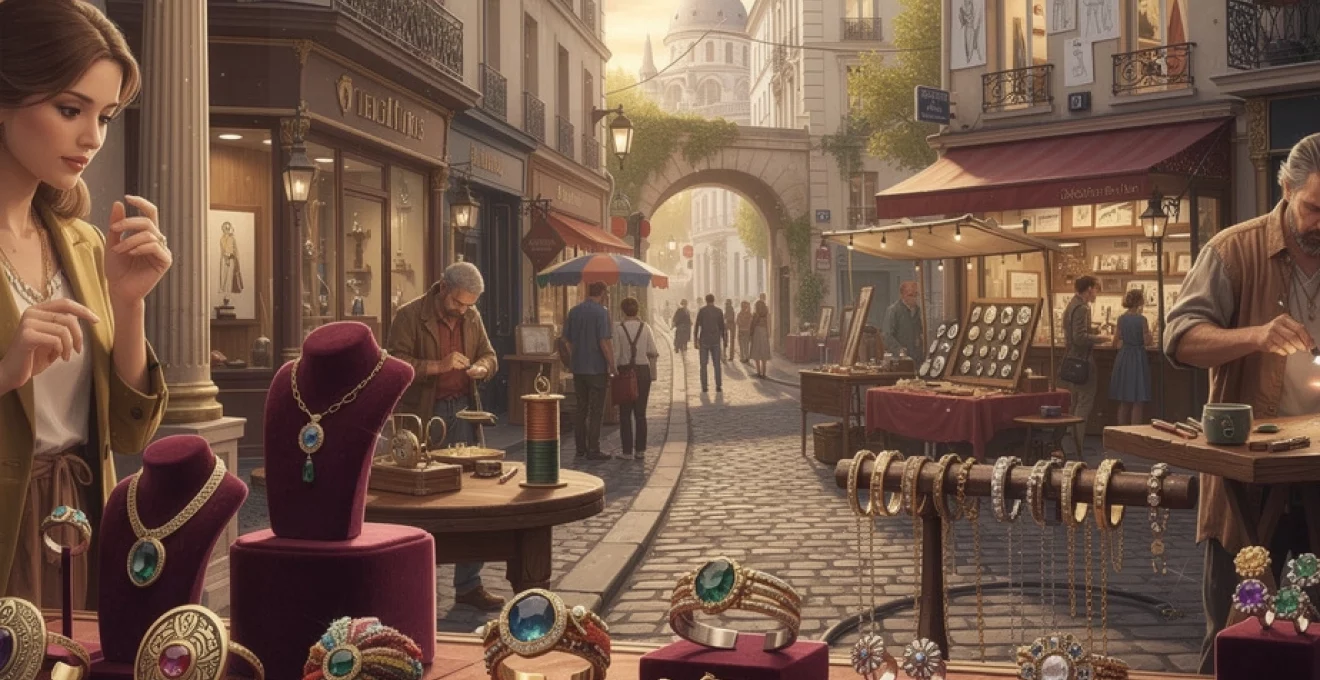
Paris stands as an unrivaled destination for artisan jewelry, where centuries-old goldsmithing traditions merge seamlessly with contemporary design innovation. The French capital’s cobblestone streets hide countless ateliers where master craftspeople transform precious metals and stones into wearable art. From the prestigious maisons of Place Vendôme to the bohemian workshops of Montmartre, each arrondissement offers unique treasures waiting to be discovered by discerning collectors and jewelry enthusiasts.
The city’s reputation for exceptional craftsmanship stems from its deep-rooted commitment to savoir-faire – the traditional French concept of expertise passed down through generations. Modern Parisian jewelers like Nadia Azoug of Monsieur Paris exemplify this approach, combining ancestral techniques with contemporary aesthetics in their Marais workshop. This dedication to handcrafted excellence has positioned Paris as the global epicenter for artisan jewelry, attracting both established collectors and emerging connoisseurs seeking authentic, investment-worthy pieces.
Historical quartiers and their signature artisan jewellery traditions
Paris’s historical districts serve as living museums of jewelry craftsmanship, each quarter preserving unique traditions while fostering contemporary innovation. These neighborhoods have cultivated distinct identities over centuries, creating specialized ecosystems where artisans perfect their craft within supportive creative communities.
Place vendôme high jewellery maisons and their contemporary artisan collections
Place Vendôme represents the pinnacle of Parisian jewelry excellence, where legendary maisons have operated since the 18th century. Mellerio dits Meller, established in 1613, continues to create bespoke pieces using time-honored techniques perfected over four centuries. The octagonal plaza houses workshops where master craftspeople employ traditional methods like sertissage (stone setting) and ciselure (chasing) to create contemporary interpretations of classical designs.
Beyond the established houses, emerging artisans have begun establishing satellite workshops in the surrounding streets, offering accessible luxury without compromising on craftsmanship quality. These newer ateliers often specialize in recycled precious metals and ethically sourced gemstones, responding to modern consumers’ environmental consciousness while maintaining the district’s reputation for excellence.
Le marais medieval goldsmithing heritage along rue des rosiers
The Marais district preserves Paris’s most authentic goldsmithing traditions, with workshops nestled in medieval buildings that have housed jewelry makers for over 500 years. Rue des Rosiers and its surrounding lanes contain family-run ateliers where traditional techniques like granulation and filigree work continue unchanged from their Renaissance origins.
Monsieur Paris exemplifies this quarter’s commitment to handcrafted excellence, operating from a workshop where every piece undergoes meticulous hand-finishing. The district’s narrow streets create an intimate atmosphere where artisans collaborate closely, sharing techniques and maintaining quality standards that have made Marais jewelry synonymous with authenticity. Contemporary designers here often incorporate ancient motifs into modern settings, creating pieces that bridge historical and contemporary aesthetics.
Saint-germain-des-prés bohemian jewellery ateliers near école des Beaux-Arts
Saint-Germain-des-Prés attracts avant-garde jewelry designers whose proximity to École des Beaux-Arts influences their artistic approach. This intellectual quarter fosters experimental techniques and unconventional material combinations, producing pieces that challenge traditional jewelry boundaries. Ateliers here often function as galleries, displaying work that blurs lines between wearable art and sculptural objects.
The area’s café culture creates opportunities for informal collaboration between designers, metalworkers, and gemologists. This cross-pollination of ideas results in innovative pieces that reflect the quarter’s bohemian spirit while maintaining impeccable craftsmanship standards. Many workshops offer bespoke services, working directly with clients to create personalized pieces that capture individual stories and aesthetic preferences.
Montmartre artist quarter independent metalworking studios
Montmartre’s artistic heritage attracts independent metalworkers who
Montmartre’s artistic heritage attracts independent metalworkers who transform traditional techniques into bold, expressive artisan jewelry. Many of these studios are hidden in narrow stairways and courtyard passages, where jewellers work at small benches surrounded by sketches, wax models, and trays of stones. You’ll find everything from raw, textured silver pieces that echo the quartier’s cobblestones to intricate goldwork inspired by the Sacré-Cœur’s mosaics. Because rents here are still more accessible than in central districts, emerging artisans can experiment with small-batch collections rather than mass production.
Visiting Montmartre for artisan jewelry feels a bit like stepping into an open-air artist residency. Studios often double as showrooms, and it’s common to see a jeweller filing, soldering, or setting stones right in front of you. Many accept custom commissions, from reworking heirloom rings into contemporary designs to creating one-of-a-kind wedding bands that reflect the couple’s story. If you value direct contact with the maker and pieces that carry the imprint of the hand, this hillside village within Paris is one of the most rewarding places to explore.
Premium covered markets and artisan jewellery galleries
Alongside its historic quartiers, Paris is home to covered markets and gallery-style passages where artisan jewelry is curated like fine art. These spaces bring together antique specialists, contemporary designers, and restoration experts under one roof, making them ideal if you want to compare different eras and styles in a single afternoon. You can move from a 19th-century Victorian brooch to a minimalist recycled-gold ring in just a few steps. For collectors, these markets offer a balance between discovery and reassurance, since many vendors are long established and highly specialized.
Because these venues attract both locals and visitors who care about craftsmanship, you’ll often find jewelers who take the time to explain their process, stones, and alloys in detail. This educational dimension is invaluable when you’re choosing artisan jewelry in Paris as an investment or as a meaningful gift. Think of these covered markets as curated ecosystems: each stall or boutique has its niche, but together they present a panoramic view of what French jewelry can be today.
Marché aux puces Saint-Ouen antique jewellery specialists and estate pieces
The Marché aux Puces de Saint-Ouen, just north of Paris, is one of the world’s largest flea markets and a treasure trove for antique jewelry. Within its maze of covered markets—Paul Bert Serpette, Vernaison, Biron—you’ll find dealers who specialise exclusively in estate pieces, from Belle Époque tiaras to Art Deco engagement rings. Many vendors have backgrounds in gemology or art history and can provide provenance details, hallmark interpretations, and restoration histories. If you’re searching for antique artisan jewelry with character and documented origins, this is where to start.
Navigating Saint-Ouen can feel overwhelming at first, so it helps to focus on two or three alleys known for fine jewelry and take your time. Ask to see loupe magnification of hallmarks and stone settings, and don’t hesitate to inquire about previous repairs—transparent dealers will be happy to explain. Prices can be negotiable, but for truly rare pieces you’re paying as much for expertise and authenticity as for gold and stones. Much like hunting for a first-edition book, the joy here lies in both the chase and the story that comes with the object you finally choose.
Marché des enfants rouges handcrafted contemporary jewellery vendors
In the Haut Marais, the Marché des Enfants Rouges is best known as Paris’s oldest covered food market, but its surrounding streets host pop-up stands and boutiques dedicated to contemporary artisan jewelry. On weekends in particular, you’ll find young designers presenting small collections of handcrafted rings, earrings, and necklaces in silver, vermeil, and 18k gold. Many combine French metalworking techniques with influences from their home regions—North Africa, Japan, Latin America—resulting in hybrid styles that feel distinctly cosmopolitan.
Because these vendors work in short runs, the jewelry you find here is often limited edition or even one-of-a-kind. This makes it an excellent place for discovering affordable artisan jewelry in Paris that still respects high standards of craftsmanship. If you’re unsure how to style a sculptural ear cuff or an asymmetrical ring, most creators will happily suggest combinations or show you how they wear the pieces themselves. Think of this area as an open studio where you can directly support emerging talent before it reaches bigger galleries.
Village Saint-Paul courtyard artisan workshops and bespoke services
Hidden between the Seine and the Marais’s busier streets, Village Saint-Paul is a cluster of interconnected courtyards lined with galleries and workshops. Several artisan jewelers have chosen this tranquil enclave for their studios, attracted by its slower rhythm and loyal local clientele. Behind discreet doors, goldsmiths hammer, solder, and set stones at traditional benches, often visible from the street through large workshop windows. This intimate setting is ideal if you’re drawn to bespoke jewelry services in Paris rather than off-the-shelf designs.
Many Village Saint-Paul ateliers specialise in custom creations and transformations of existing pieces. You might bring a vintage diamond inherited from a relative and work with the jeweller to design a modern ring or pendant that suits your current style. Consultations usually begin with sketches and metal samples, followed by stone selection and fitting, much like commissioning a tailored suit. Because these workshops rely on reputation and word of mouth, they tend to prioritise long-term relationships and meticulous aftercare over fast sales.
Passage des panoramas historic jewellery boutiques and restoration experts
Passage des Panoramas, one of Paris’s oldest covered passages, offers a different angle on artisan jewelry: specialised restoration and conservation. Tucked between stamp dealers and vintage postcard shops, you’ll find jewellers who focus on repairing antique pieces and recreating missing elements with historical accuracy. Their work requires mastery of traditional techniques such as hand engraving, fine soldering of delicate chains, and re-cutting of antique stones to match existing settings. If you own a piece that’s too sentimental to leave to a generic repair shop, this passage is an invaluable resource.
These restoration experts often collaborate with auction houses and antique dealers, so their perspective on value extends beyond simple carat weight. They can advise you on whether an heirloom ring should be preserved as-is, sympathetically restored, or subtly updated for everyday wear. Watching them at work is like observing a conservator in a museum: every decision balances aesthetic fidelity, structural stability, and respect for the piece’s history. For collectors interested in investment-grade artisan jewelry in Paris, understanding the role of careful restoration is part of making informed choices.
Renowned independent ateliers and their signature techniques
Beyond major maisons and markets, a handful of independent Parisian ateliers have built global reputations through distinctive techniques and strong creative identities. Their studios and boutiques function as laboratories where design, craftsmanship, and storytelling intersect. When you invest in artisan jewelry from these designers, you’re not just buying a ring or necklace—you’re buying into a specific philosophy of how jewelry should be made and worn. Paying attention to their methods can help you refine your own taste and recognise quality in less famous names.
Each of the following designers illustrates a different facet of contemporary French savoir-faire, from saturated gemstone palettes to mixed-media experimentation. As you explore their work, notice how they use texture, colour, and proportion as a language. Just as you might learn to distinguish grape varieties in a wine tasting, learning these signatures trains your eye and makes choosing artisan jewelry in Paris more intuitive and rewarding.
Marie-hélène de taillac precious stone setting and colour combinations
Marie-Hélène de Taillac is renowned for her luminous use of coloured gemstones, often sourced directly from workshops in Jaipur, India. Her pieces showcase stones such as tourmaline, aquamarine, citrine, and amethyst in unexpected combinations, set in pared-back 22k or 18k gold that lets colour take centre stage. Rather than relying on heavy metalwork, she favours delicate prong or bezel settings that create the impression of jewels floating against the skin. The result is jewelry that feels as light as a silk scarf yet visually as rich as a stained-glass window.
For collectors, the appeal lies in her eye for subtle variations of hue and saturation. Two supposedly “blue” stones may read more like dawn and dusk when placed side by side, and that nuance is intentional. If you’re building a capsule jewelry wardrobe, one of her multicolour bracelets or necklaces can play the role of a wardrobe anchor, tying together different outfits without feeling overly formal. Her work is a masterclass in how thoughtful colour theory can elevate even the simplest silhouette into a distinctive signature piece.
Sylvie corbelin hand-engraved medallions and ancient techniques
Sylvie Corbelin’s creations fuse antique aesthetics with a distinctly contemporary sensibility, particularly in her hand-engraved medallions and talismanic pieces. Drawing on techniques used by 18th- and 19th-century jewellers, she collaborates with skilled engravers to carve intricate symbols, portraits, and celestial motifs into gold surfaces. These are often paired with old-cut diamonds or coloured gemstones that enhance the sense of timelessness. Wearing one of her medallions feels akin to carrying a pocket-sized illuminated manuscript around your neck.
What sets Corbelin apart is her dedication to narrative detail. Each piece is saturated with references—to mythology, astronomy, or personal iconography discussed with the client. If you’re searching for meaningful artisan jewelry in Paris that can be passed down as a family relic, her work offers both aesthetic beauty and rich storytelling. When you visit, be prepared to spend time discussing your tastes and symbols that resonate with you; the more precise you are, the more the final piece will feel like a wearable chapter of your own history.
Gigi clozeau resin and gold wire wrapping methodology
Gigi Clozeau has become synonymous with joyful, everyday jewelry built around fine chains dotted with tiny resin beads. The brand’s signature technique involves encasing pigment-rich resin around 18k gold wire, creating a strand of vivid “pearls” that are both lightweight and surprisingly durable. This process demands precision: each bead must be perfectly formed, cured, and spaced to ensure the necklace or bracelet drapes fluidly. The finished effect is reminiscent of a string of confetti frozen mid-air.
For many wearers, the appeal lies in how easily these pieces layer with both minimalist and more opulent jewelry. You might pair a coral-pink strand with a classic diamond solitaire, softening its formality, or stack several colours to echo the palette of your wardrobe. Because the designs are understated, they’re ideal for those who want a touch of artisan jewelry in Paris that can be worn in any setting—from office to beach to evening drinks—without ever feeling overdone.
Médecine douce sculptural metalwork and contemporary design approach
Médecine Douce focuses on sculptural metalwork that bridges the gap between fine jewelry and design object. Their collections often feature fluid, architectural lines in gold-plated brass, silver, and vermeil, with an emphasis on volume and negative space. Instead of relying heavily on gemstones, they use curves, planes, and polished versus matte finishes to catch the light. Think of their rings and cuffs as miniature pieces of contemporary sculpture that happen to rest on your hand or wrist.
This design-led approach particularly resonates if you’re drawn to clean, modern interiors and minimalist fashion. A single bold cuff or oversized hoop can transform a simple outfit much like a statement chair can define a room. Most pieces remain accessible in price, making them a smart entry point if you want to explore Parisian artisan jewelry before committing to higher-ticket gold and diamond pieces. When trying them on, pay attention to comfort: well-executed sculptural jewelry should feel surprisingly natural once it’s in place.
Aurélie bidermann textile integration and mixed-media jewellery
Aurélie Bidermann is known for integrating textiles and unconventional materials—such as braided threads, cotton cords, and even woven raffia—into metal frameworks. Her bracelets may combine chunky gold-plated chains with colourful threads, while earrings can juxtapose polished metal with organic forms reminiscent of shells or leaves. This mixed-media approach softens the perceived formality of gold and brings a playful, bohemian energy to each piece. It’s a reminder that luxury doesn’t have to be rigid or overly serious.
If you enjoy the idea of jewelry that feels like a travel souvenir from a sun-drenched holiday, Bidermann’s pieces will likely appeal. Many designs are deliberately tactile, inviting touch in a way that purely metal-based jewelry does not. The combination of materials also offers versatility: a single bracelet can work with both linen summer dresses and structured winter coats. When you’re selecting a mixed-media piece, consider how much wear the textile element will see and ask about care instructions so that your jewel ages gracefully rather than prematurely.
Specialised craft schools and emerging artisan showcases
Behind every great Parisian jeweller stands a foundation of rigorous training, often acquired at specialised craft schools. Institutions such as the École Boulle, Institut de Bijouterie de Paris, and private jeweller schools in the Marais and near Bastille teach everything from traditional stone setting to CAD-based design. Admission is competitive, and programs can last several years, combining bench work, drawing, metal theory, and professional internships. For aspiring artisans, these schools function much like conservatories do for musicians: demanding, immersive, and essential for mastering technique.
How does this matter to you as a buyer of artisan jewelry in Paris? Many schools hold annual exhibitions and graduate shows where you can discover emerging designers before they launch their own brands. These events, often open to the public, allow you to see experimental pieces at accessible prices while meeting the creators in person. It’s the equivalent of attending a student fashion show and spotting tomorrow’s couture star. Keep an eye on school websites and local cultural calendars; visiting during these showcases can add a unique dimension to your jewelry-focused trip.
Authentication methods and investment-grade artisan pieces
When you’re considering artisan jewelry in Paris as more than just a souvenir—perhaps as a long-term investment or heirloom—authentication becomes crucial. Unlike mass-produced pieces, artisan creations may not always come with elaborate certificates, but reputable ateliers provide detailed invoices, hallmarking, and sometimes gemological reports. French law requires precious metal items above certain weights to carry official hallmarks, indicating both metal fineness (such as 750 for 18k gold) and the maker’s mark. Learning to recognize these tiny stamps is a bit like reading a secret language etched into the metal.
How can you be sure a piece is truly investment-grade? Look for a combination of factors: documented materials, high-level craftsmanship, and a designer or maison with a strong, consistent reputation. For pieces featuring diamonds or rare coloured stones, ask whether a certificate from a recognized lab (GIA, HRD, or its European equivalents) is available. Finally, consider long-term service: does the atelier offer resizing, polishing, or re-setting if needed in the future? A jeweller willing to maintain your piece over time is more likely to have confidence in its structural integrity.
Seasonal artisan markets and limited-edition collection access
Beyond permanent boutiques and workshops, Paris hosts seasonal markets and pop-up events where artisan jewelers present limited-edition collections. Around the winter holidays and spring design festivals, you’ll find curated fairs in venues such as le Carreau du Temple, the Cité de la Mode, and various town halls across arrondissements. These events function like concentrated snapshots of the contemporary artisan jewelry scene in Paris: dozens of designers, each with a table, display, and sometimes live demonstrations of their techniques. For time-pressed visitors, it’s an efficient way to discover multiple brands in a single visit.
Because many of the pieces presented are small-run or exclusive to the event, seasonal markets are ideal if you’re looking for something truly unique. Designers often test new ideas here before rolling them out more widely, so you may encounter prototypes or colourways that never make it to online shops. To make the most of these markets, arrive early, bring photos of outfits or existing jewelry you want to complement, and don’t hesitate to ask about custom variations. After all, the great advantage of buying artisan jewelry in Paris is precisely this: you’re dealing with creators who can adapt, personalise, and refine their work for you in real time.