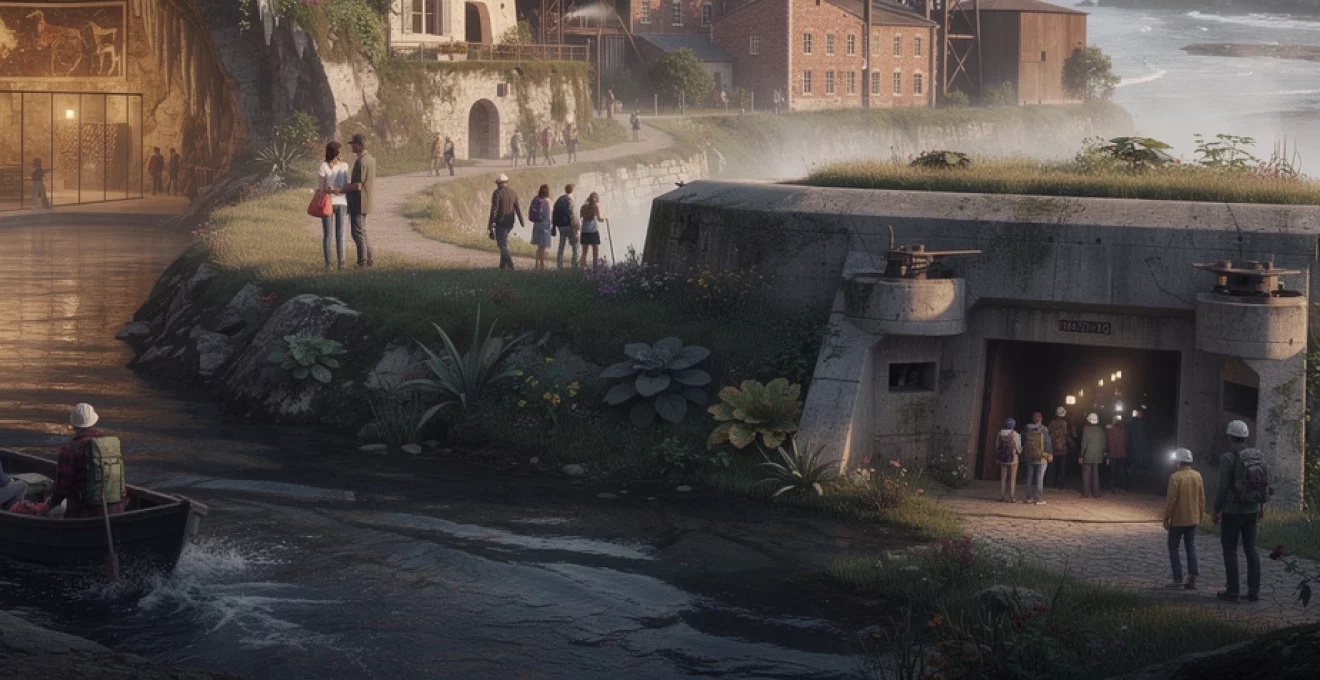
France harbours some of Europe’s most extraordinary hidden treasures, far removed from the typical tourist circuit of Paris landmarks and Riviera beaches. These remarkable destinations showcase the country’s diverse geological heritage, industrial archaeology, and centuries of human ingenuity carved into landscapes both natural and man-made. From subterranean networks that predate recorded history to abandoned industrial complexes transformed into cultural spaces, France offers adventurous travellers access to sites that challenge conventional notions of tourism. The nation’s unusual attractions span millennia of human occupation, revealing stories etched in stone, preserved in underground chambers, and embedded within landscapes shaped by both natural forces and human determination.
Underground cave networks and subterranean archaeological sites
France’s limestone geology has created an extensive network of underground marvels that extend far beyond well-known tourist caves. These subterranean environments offer glimpses into prehistoric life, geological processes spanning millions of years, and the ingenious ways humans have utilised underground spaces throughout history. The country’s cave systems represent some of Europe’s most significant archaeological and paleontological discoveries, providing researchers with invaluable insights into ancient climates, extinct species, and early human civilisation.
Gouffre de padirac’s limestone cavern system in lot department
Located in the Lot department, the Gouffre de Padirac presents one of France’s most spectacular underground river systems. This massive chasm plunges 103 metres into the earth before opening into a vast network of galleries and underground waterways. Visitors descend via lift or staircase to explore chambers adorned with towering stalactites and stalagmites, some reaching heights of over 20 metres. The underground river journey by boat reveals geological formations sculpted over millions of years, creating cathedral-like spaces that demonstrate the raw power of water erosion on limestone bedrock.
Grotte de lascaux IV’s palaeolithic art preservation centre
The Lascaux cave system in the Dordogne represents one of humanity’s earliest artistic achievements, containing Palaeolithic paintings dating back approximately 17,000 years. The modern Lascaux IV facility provides visitors with an extraordinary replica experience that protects the original cave whilst showcasing prehistoric art of unparalleled quality. Advanced 3D scanning technology has recreated every nuance of the original cave paintings, allowing visitors to witness the sophisticated artistic techniques employed by Cro-Magnon artists who created these masterpieces using natural pigments and the cave’s contours to enhance their three-dimensional effects.
Carrières de paris catacombs network beneath montparnasse
Beneath Paris lies an extensive network of abandoned limestone quarries transformed into the world’s largest ossuary, containing the remains of over six million Parisians. The Paris Catacombs extend for hundreds of kilometres beneath the city, though only a small section remains accessible to the public. These tunnels originated as Roman-era stone quarries that provided building materials for ancient Lutetia, later serving as storage spaces, mushroom farms, and refuge areas during various conflicts. The carefully arranged bone displays create haunting artistic arrangements that reflect 18th-century attitudes towards mortality and public health concerns about overflowing cemeteries.
Aven armand’s stalagmite forest in causse méjean
Situated on the Causse Méjean plateau in the Lozère department, Aven Armand showcases one of Europe’s most impressive stalagmite formations. This vast underground chamber contains over 400 stalagmites, including the famous “Virgin of the Forest,” which towers 30 metres high. The cave’s discovery in 1897 revealed a pristine underground ecosystem that had remained undisturbed for millennia. The funicular railway descent provides visitors with dramatic views of calcite formations that took hundreds of thousands of years to develop, creating a natural sculpture garden of extraordinary beauty and scientific importance.
Abandoned industrial heritage sites and Post-Industrial landscapes
France’s industrial transformation has left behind a fascinating legacy of abandoned sites that now serve as cultural spaces, museums, and artistic venues. These post-industrial landscapes tell the story of France’s economic evolution whilst providing unique environments for contemporary cultural expression. The conversion
the Friche Belle de Mai in Marseille, the mining complexes of northern France, and former heavy industrial sites around Paris and Lyon illustrates how disused factories, mines, and shipyards can be reimagined as cultural hubs and heritage attractions. For travellers interested in unusual places to visit in France, these sites provide a compelling mix of industrial archaeology, contemporary art, and social history that goes far beyond traditional museums.
Friche belle de mai cultural quarter in marseille’s former tobacco factory
On the edge of central Marseille, the Friche Belle de Mai occupies a sprawling former tobacco factory that has been transformed into one of France’s most dynamic cultural laboratories. Once employing thousands of workers, the complex now houses theatres, artist studios, concert venues, skateparks, and exhibition spaces spread over more than 45,000 square metres. The site retains its raw industrial character – brick façades, steel beams, and towering chimneys – while hosting cutting-edge festivals, street art events, and community gardens that attract over 450,000 visitors annually.
Exploring the Friche feels a little like wandering through an open-air gallery fused with a social experiment. Rooftop terraces offer panoramic views over Marseille’s dense urban fabric and the distant Mediterranean, especially striking at sunset. Practical visitors will appreciate that the site is easily accessible by tram from the city centre, and that many events are free or low-cost, making it an ideal stop if you are seeking unusual things to do in Marseille on a budget.
Zollverein coal mine industrial complex remnants in Nord-Pas-de-Calais
While the original Zollverein Coal Mine Industrial Complex is located in Essen, Germany, northern France possesses its own network of UNESCO-listed mining landscapes that echo the same industrial heritage. In the Nord-Pas-de-Calais region, former collieries at sites such as Loos-en-Gohelle and Lewarde preserve headframes, slag heaps, and pithead buildings that once formed the backbone of France’s coal industry. These landscapes have been partially renaturalised, with terrils (slag heaps) now covered in vegetation and serving as unlikely viewpoints over the otherwise flat plains of the region.
The Lewarde Mining History Centre, for instance, occupies a former pit and uses preserved galleries and machinery to illustrate miners’ working conditions from the 18th to the 20th century. Walking tours often compare the French sites with other major European coal complexes like Zollverein, helping visitors understand how industrialisation created a shared cultural landscape across borders. If you are driving between Lille and Lens, detouring to climb one of the conical slag heaps provides a surprisingly scenic introduction to this post-industrial environment.
Île seguin’s renault factory archaeological remains
In the western suburbs of Paris, the Île Seguin in the Seine River was once synonymous with the Renault car empire. For much of the 20th century, this island housed cutting-edge assembly lines producing millions of vehicles in a dense industrial micro-city of steel, glass, and concrete. Following the closure and demolition of the main factory buildings in the early 2000s, the island has been gradually redeveloped as a cultural and ecological district, with only scattered traces of its former function remaining.
Visitors today encounter landscaped promenades, contemporary art spaces, and foundations that incorporate fragments of the old industrial infrastructure. Interpretive panels and occasional archaeological remnants – such as preserved foundations, cranes, and service tunnels – allow you to imagine the deafening noise and constant movement that once dominated the island. For those interested in urban regeneration, Île Seguin offers a textbook example of how a heavy industrial site within the Paris region can be reimagined as a mixed-use cultural landscape without erasing its historical memory.
Saint-étienne’s puits couriot mining museum infrastructure
Saint-Étienne, long associated with mining and metalworking, has embraced its industrial past through the Puits Couriot / Parc-Musée de la Mine. This former coal mine, located a short walk from the city centre, preserves headframes, compressor rooms, lamp rooms, and underground galleries that reveal how deeply coal extraction shaped local life. Guided tours typically lead visitors into reconstructed tunnels where original equipment, soundscapes, and lighting recreate the cramped, dangerous conditions miners faced daily.
Above ground, the surrounding park has transformed the once-polluted industrial site into green space, while exhibition halls explore themes such as labour struggles, technical innovation, and environmental impact. The juxtaposition of rusting machinery with contemporary design – Saint-Étienne is also a UNESCO City of Design – makes this one of the most unusual places in France to witness how a city can simultaneously honour and critically reflect upon its industrial heritage. If you are travelling between Lyon and Clermont-Ferrand, a half-day stop in Saint-Étienne provides both historical insight and a welcome break from motorway driving.
Micro-climate botanical enclaves and endemic flora sanctuaries
France’s varied topography and exposure to different air masses have created a mosaic of micro-climates where unexpected plant communities flourish. These botanical enclaves, often tucked into sheltered valleys, coastal inlets, or thermal basins, shelter rare or endemic species that would normally be associated with entirely different regions of the world. For travellers passionate about unusual landscapes and biodiversity, visiting these sites can feel like stepping into a different latitude without leaving the country.
Along the Mediterranean coast, gardens such as the Jardin Exotique d’Èze or the terraced collections surrounding Menton benefit from a warm, protected micro-climate that allows subtropical plants – from succulents to citrus – to thrive outdoors year-round. In contrast, high-altitude botanical gardens in the Alps, like the Jardin Alpin du Lautaret, focus on alpine flora adapted to extreme cold, thin soils, and intense sunlight. What unites these very different sites is their role as living laboratories for botanists and conservationists working to understand how climate change is reshaping plant distributions.
Perhaps the most striking micro-climate sanctuary is the Bambouseraie en Cévennes near Anduze, where giant bamboos form towering green corridors more reminiscent of East Asia than southern France. Established in the mid-19th century, this exotic garden exploits a humid river valley and specific soil conditions to cultivate over 1,000 varieties of bamboo, camellias, and Japanese maples. Walking through its shaded pathways on a hot summer day offers a tangible reminder that climate is as much about local geography as it is about global weather patterns.
Fortified troglodyte villages and cliff-dwelling settlements
Beneath the comfortable surface of modern France lies a parallel world carved into cliffs, hillsides, and soft limestone plateaux. Troglodyte settlements – a term derived from the Greek for “cave-dweller” – have been used continuously from prehistoric times through the Middle Ages and, in some cases, into the 20th century. These rock-cut dwellings, chapels, and storage spaces make some of the most unusual places to discover in France, revealing how communities adapted architecture to geology rather than imposing structures on the landscape.
Rocamadour’s vertical sanctuary architecture on alzou canyon cliffs
Perched dramatically on the cliffs of the Alzou canyon in the Lot department, Rocamadour appears to defy gravity. The village’s sanctuaries, chapels, and houses seem stacked one atop another, clinging to the rock face in a vertical cascade that has drawn pilgrims for nearly a thousand years. Accessed via steep staircases and switchback paths, the site was built around a shrine to the Black Madonna and became an important stop on the pilgrimage route to Santiago de Compostela.
From an architectural perspective, Rocamadour showcases how medieval builders integrated structures directly into the limestone cliff, using natural caves as foundations or apses for chapels. Many façades still bear traces of rock-cut interior spaces, storage niches, and defensive elements that allowed the community to shelter from attack. Standing at the base of the Grand Escalier, which links the lower town to the religious complex, you can appreciate how the village functions almost like a vertical fortress, its troglodyte origins still clearly visible beneath later additions.
Les Eyzies-de-Tayac’s prehistoric rock shelter complex
Often called the “world capital of prehistory,” Les Eyzies-de-Tayac-Sireuil in the Dordogne region is surrounded by a dense concentration of rock shelters, caves, and cliff dwellings. Here, the Vézère River has carved into soft limestone, creating overhangs that provided ideal shelter for Palaeolithic hunter-gatherers. Sites such as Abri de Cro-Magnon, Laugerie-Basse, and the Font-de-Gaume cave demonstrate a remarkable continuity of occupation, from the earliest modern humans in Europe to medieval farmers who reused the same rock faces for dwellings and barns.
Today, a walk through the village itself reveals houses built directly under enormous limestone cornices, with upper storeys sometimes integrated into former rock shelters. Museums and interpretive trails explain how these natural formations were progressively modified with low walls, carved staircases, and smoke-blackened ceilings, turning simple overhangs into complex multi-room homes. For visitors interested in unusual places to see in France with deep time depth, Les Eyzies offers the rare chance to move in a few minutes from 20,000-year-old art to 19th-century rural troglodyte architecture.
Saumur’s tuffeau stone troglodyte wine cellars
Along the Loire around Saumur, the soft, pale tuffeau stone that defines the region’s châteaux also hides an extensive underground world. For centuries, quarrying this limestone created labyrinths of galleries which, once extraction ceased, were repurposed as wine cellars, mushroom farms, and even entire subterranean hamlets. The constant temperature and high humidity of these spaces make them ideal for ageing the region’s sparkling wines and storing agricultural produce.
Numerous producers now offer guided visits that combine cellar tours with explanations of troglodyte life. You may descend via narrow staircases to find row upon row of bottles stretching into the darkness, punctuated by carved pillars and arches that still bear the tool marks of quarrymen. In some cases, former cave dwellings–complete with carved fireplaces, niches for oil lamps, and ventilation shafts–have been restored to illustrate how families lived partially underground well into the 19th century. Tasting a glass of Saumur Brut in such a setting brings the region’s geology, architecture, and gastronomy together in a single sensory experience.
Chinon’s loire valley cave dwelling network
Further west along the Loire, Chinon extends the theme of cliffside habitation with an intricate network of cave dwellings honeycombing the slopes above the Vienne River. The fortress of Chinon itself crowns a long limestone ridge, beneath which dozens of troglodyte houses, workshops, and storage rooms were carved over many centuries. Some of these spaces have been converted into atmospheric restaurants and guesthouses, allowing visitors to sleep or dine within historic rock-cut interiors.
Wandering through the upper streets of Chinon, you will notice façades that appear almost ordinary until you realise that their rear walls are solid rock. Small doors and windows cut directly into the cliff often conceal multi-level cave systems extending deep into the hillside. Local tours occasionally include visits to abandoned troglodyte farms just outside town, where presses, cisterns, and animal stalls bear silent witness to a way of life that only disappeared in the last hundred years. For anyone compiling a list of unusual places to stay in France, Chinon’s troglodyte guest rooms offer a memorable alternative to standard hotels.
Isolated tidal islands and maritime geological formations
France’s extensive coastline, stretching from the North Sea to the Mediterranean, is dotted with tidal islands and striking rock formations that reveal the constant battle between land and sea. Some of these islands can only be reached on foot at low tide, their accessibility governed by lunar cycles and local currents, lending them an air of mystery and isolation. Others, sculpted by relentless waves, stand as natural monuments that have inspired legends, paintings, and maritime folklore for centuries.
In Brittany, the granite chaos of the Côte de Granit Rose and the wind-lashed islands of the Iroise Sea showcase some of the most unusual coastal landscapes in France. Here, lighthouses such as Kéréon or La Vieille rise from submerged reefs, while small chapels and former customs officers’ houses perch improbably on rocky outcrops surrounded by foaming seas. Visiting requires careful planning: ferry schedules, tide tables, and weather forecasts become essential tools if you want to explore safely beyond the main harbours.
Further south, along the Atlantic coast near La Rochelle and in the Gulf of Morbihan, islands such as Île d’Aix or Gavrinis offer a different kind of maritime singularity. Île d’Aix is car-free, accessible only by boat, with a compact network of paths, Napoleonic fortifications, and quiet beaches that make it feel frozen in time. Gavrinis, by contrast, hides one of Europe’s most remarkable Neolithic passage graves beneath its modest grassy surface, its pecked stone art accessible only via small group tours that respect both archaeological fragility and the strong local tides.
Secret military installations and declassified defence infrastructure
Scattered across France, from wooded hillsides to discreet coastal inlets, lie remnants of once-secret military complexes now partially opened to the public. These fortifications, bunkers, and command centres provide an unusual lens through which to view the 20th century, particularly the world wars and the Cold War. Visiting them feels a little like stepping onto the set of a historical thriller, except that the rusted doors, armoured cupolas, and miles of cable trays are entirely real.
Maginot line’s ouvrage du hackenberg fortress system
Near Thionville in the Moselle department, the Ouvrage du Hackenberg is one of the largest and best-preserved fortresses of the Maginot Line. This colossal underground complex, carved into a hillside, consists of kilometres of galleries linking combat blocks, barracks, ammunition stores, and power plants. During guided tours, visitors board a small electric train that once transported soldiers and shells, travelling through damp tunnels where original ventilation systems and generators remain intact.
Designed in the 1930s to deter a German invasion, Hackenberg illustrates both the engineering ambition and strategic limitations of the Maginot Line. Gun turrets capable of retracting into armoured pits, observation posts camouflaged as rural houses, and complex filtration systems to counter gas attacks make the site a technical marvel. At the same time, interpretive displays and guides explain how rapid manoeuvre warfare in 1940 rendered these static defences largely ineffective, turning Hackenberg into a powerful symbol of misplaced military doctrine.
Mont verdun’s underground command bunker complex
On a wooded hill northwest of Lyon, the Mont Verdun air defence base long formed a crucial node in France’s Cold War command-and-control network. Much of the installation remains active and off-limits, but declassified sections and public information reveal a labyrinth of underground bunkers, operations rooms, and communication centres dug deep into the massif. These subterranean spaces were designed to withstand nuclear attack, with blast doors, autonomous power supplies, and complex life-support systems.
While regular visits are restricted for security reasons, occasional open days and exhibitions organised in partnership with local authorities offer glimpses into this hidden world. Scale models, photographs, and veterans’ testimonies help visitors imagine the constant vigilance required to monitor airspace during periods of heightened tension. For those fascinated by Cold War history, the very existence of such installations underlines how landscapes that appear entirely rural can conceal sophisticated military infrastructure just beneath the surface.
Fort de douaumont’s artillery casemate network
Overlooking the battlefield of Verdun in northeastern France, Fort de Douaumont is one of the most somber and unusual military sites in the country. Originally built in the late 19th century as part of the Séré de Rivières defensive system, the fort was heavily modernised with reinforced concrete and armoured turrets. During the First World War, it became a key objective in the Battle of Verdun, changing hands several times and suffering devastating artillery bombardment.
Today, visitors can explore its dimly lit corridors, artillery casemates, and observation posts, many of which still bear the scars of shellfire and collapse. Inside, ossuaries and memorial plaques commemorate the thousands of soldiers who fought and died in appalling conditions, sometimes trapped for days in underground galleries filled with smoke, gas, and debris. Walking through these spaces is less about military hardware and more about confronting the human cost of industrial warfare, making Fort de Douaumont a powerful, if unsettling, stop on any itinerary exploring unusual historical sites in France.
Base Sous-Marine de lorient’s U-Boat concrete shelters
On the Atlantic coast of Brittany, the vast submarine pens of Lorient stand as some of the most imposing Second World War relics in France. Constructed by Nazi Germany between 1941 and 1943, these reinforced concrete shelters housed U-boat fleets targeting Allied shipping in the Atlantic. With roofs up to seven metres thick, criss-crossed by steel beams and filled with anti-bombing gravel, the structures were effectively indestructible by the aerial weapons of the time.
After the war, the base remained in military use before being partially abandoned and progressively redeveloped as a maritime heritage and sailing hub. Visitors can now tour sections of the pens, where the sheer scale of the interior docks, workshops, and submarine bays is immediately striking. Exhibitions explain the strategic role of the Lorient base, the experiences of local civilians during occupation, and the technical aspects of U-boat maintenance. Standing inside these cavernous shelters, with their dripping walls and echoing footsteps, you experience one of the most unusual and haunting industrial-era monuments anywhere on the French coast.