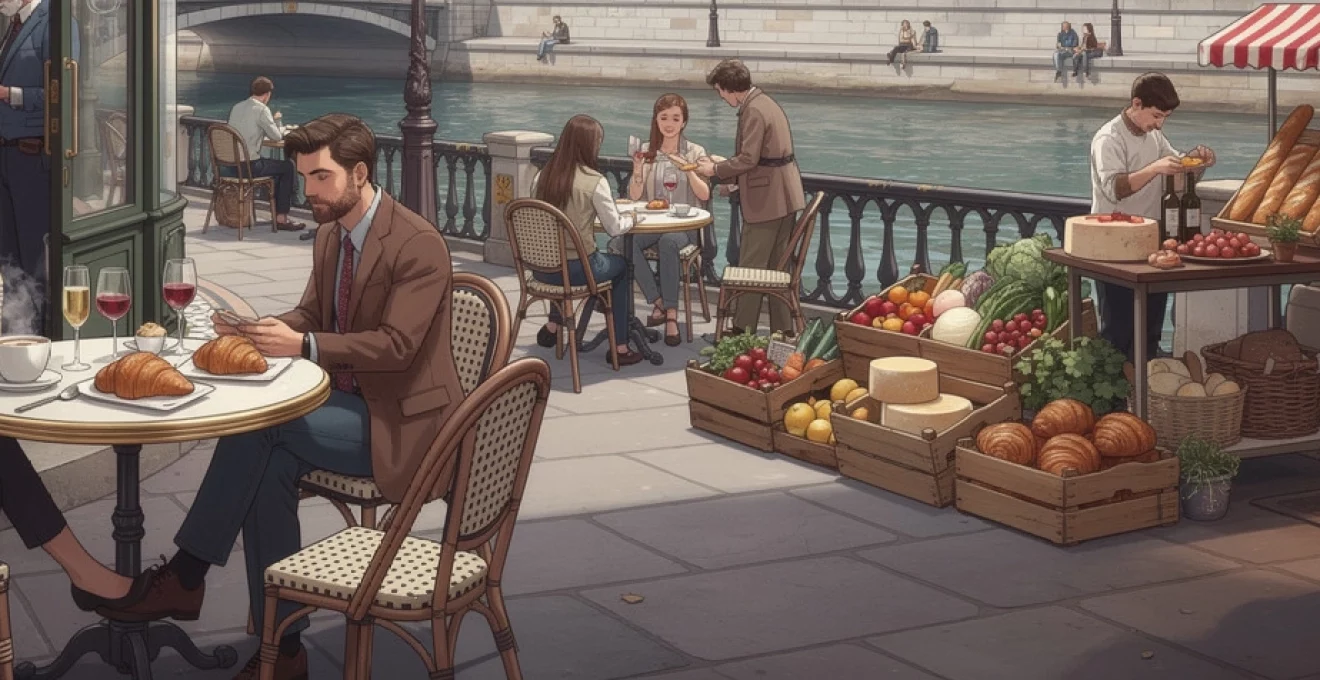
Paris reveals its true essence not through its grand monuments, but through the intimate rhythms of daily life that unfold across its cobblestone streets and sun-dappled boulevards. The city’s allure lies in the exquisite art of transforming ordinary moments into extraordinary experiences, where a morning croissant becomes a ritual of devotion and an evening stroll along the Seine transforms into a meditation on beauty. These daily pleasures form the very fabric of Parisian existence, creating a lifestyle philosophy that prioritises quality over quantity, mindfulness over haste, and genuine human connection over superficial interaction.
The Parisian approach to daily life serves as a masterclass in joie de vivre, demonstrating how cultural traditions and urban rhythms can harmoniously blend to create a living environment that nurtures both individual well-being and community spirit. From the sophisticated café culture that anchors neighbourhood social life to the contemplative practice of flânerie along historic streets, Paris offers a blueprint for elevated urban living that extends far beyond its geographical boundaries.
Quintessential café culture and bistro rituals in parisian arrondissements
The café represents the beating heart of Parisian social life, functioning as an extension of the home where relationships are cultivated and ideas exchanged over perfectly prepared beverages. These establishments serve as democratic spaces where conversations flow as freely as the wine, creating an atmosphere where time seems to slow and human connection takes precedence over productivity. The ritual of café visiting extends beyond mere consumption, embodying a philosophy of presence and community engagement that defines the Parisian character.
The true essence of Parisian café culture lies not in the consumption of coffee, but in the sacred act of pause – a deliberate interruption of daily momentum that allows for reflection, observation, and genuine human interaction.
Each arrondissement maintains its distinct café personality, from the intellectual discussions that permeate Left Bank establishments to the bohemian energy of Montmartre’s village-like coffee houses. The practice of café hopping becomes a form of cultural anthropology, revealing the nuanced differences between neighbourhoods whilst maintaining the universal constants of quality, atmosphere, and unhurried service that define authentic Parisian hospitality.
Morning café au lait traditions at café de flore and les deux magots
The legendary establishments of Café de Flore and Les Deux Magots continue to serve as temples of morning meditation, where the ritual of café au lait consumption transcends mere sustenance. These historic venues attract locals and intellectuals who understand that the morning coffee ceremony serves as both personal reflection time and community gathering space. The baristas here practice their craft with reverence, understanding that each cup represents a moment of communion between tradition and innovation.
Regular patrons develop relationships with their preferred morning spots, establishing unspoken territorial agreements over favoured tables and preferred service routines. The morning rush takes on a distinctly different character here, where efficiency means providing space for contemplation rather than hurried consumption. The café au lait itself becomes a canvas for appreciation, with its perfect foam art and temperature balance representing the culmination of generations of refinement in coffee preparation techniques.
Afternoon apéritif sessions along boulevard Saint-Germain
The transition from afternoon to evening along Boulevard Saint-Germain marks one of Paris’s most sophisticated daily rituals, where the apéritif culture transforms sidewalk cafés into stages for social theatre. This golden hour period witnesses the convergence of business professionals, artists, and neighbourhood residents who gather to celebrate the day’s conclusion through carefully curated wine and conversation pairings. The apéritif represents more than alcoholic consumption; it embodies a philosophical approach to time management that prioritises relationship building over task completion.
The beverage selection during apéritif hour reflects both personal taste and cultural knowledge, with choices ranging from traditional kir to contemporary natural wines. Conversations during this period tend toward deeper subjects, as the unhurried pace allows for exploration of ideas that might be dismissed in more rushed environments. The café terraces become observation decks for human behaviour, where the art of people-watching reaches its highest expression through skilled practitioners who understand the subtle differences between observation and intrusion.
Late-night brasserie culture in montp
Late-night brasserie culture in montparnasse and pigalle districts
As daylight recedes, the centre of gravity in Parisian daily life shifts towards the luminous signs of traditional brasseries, particularly in Montparnasse and Pigalle. These historic dining rooms, with their mirrored walls, red banquettes and white tablecloths, become sanctuaries for unhurried conversation long after most restaurants elsewhere have closed. Here, a late plate of steak-frites or a simple croque-monsieur at midnight is not an indulgence but a continuation of the day’s social narrative.
In Montparnasse, legendary brasseries that once hosted artists and writers still welcome a mix of locals, night-shift workers and theatre-goers, all united by the desire to stretch the evening just a little further. Pigalle’s brasseries, by contrast, hum with a slightly more electric energy, reflecting the neighbourhood’s blend of music venues and cabarets. In both districts, the true pleasure lies in the freedom from the clock: you are invited to linger, refill your glass, and let time dissolve into the soft clatter of cutlery and the low murmur of other diners.
Zinc counter philosophy and standing coffee etiquette
Not all Parisian café rituals revolve around long sessions on the terrace; some of the city’s most characteristic daily pleasures take place in a matter of minutes at the zinc counter. Ordering a quick espresso au comptoir is both a practical habit and a micro-ceremony, observed by office workers, tradespeople and retirees alike. For a slightly lower price than table service, you gain immediate access to the barista’s domain, where the exchange is brisk yet surprisingly human.
Standing at the counter, you are part of a fleeting community defined by shared rhythm rather than conversation. A nodded greeting, a brief comment on the weather, a folded newspaper left behind for the next person – these details create a sense of continuity in urban life. The etiquette is simple yet precise: you order, you drink, you pay, you free the space, all with an economy of gesture that mirrors the short, intense shot of coffee itself. It is efficiency without haste, a pause that proves even the quickest moments can be savoured.
Artisanal food markets and gastronomic exploration practices
Beyond its cafés and brasseries, Paris expresses its passion for daily pleasure most vividly through its open-air food markets and specialist shops. These markets transform routine grocery shopping into an exercise in aesthetics, seasonality and social connection. Rather than filling a trolley in a fluorescent supermarket, many Parisians prefer to build relationships with vendors, ask questions about provenance, and let the colours and scents of the stalls guide their weekly menus.
For visitors, exploring these markets offers an intimate glimpse into how the Parisian lifestyle balances indulgence with discernment. You begin to understand that gastronomy here is not reserved for special occasions; it is woven into errands, small decisions and everyday conversations. Each market has its own personality and rituals, from historic covered spaces to neighbourhood streets that come alive only on certain days of the week.
marché des enfants rouges seasonal produce rituals
In the Haut Marais, Marché des Enfants Rouges – Paris’s oldest covered market, founded in the 17th century – epitomises the ritualistic nature of food shopping in the city. Locals weave between stalls piled with seasonal produce, fresh herbs and artisanal products, often greeting their preferred greengrocer or fishmonger by name. The rhythm is unhurried yet purposeful; shoppers are not merely stocking up, they are composing the week’s pleasures plate by plate.
Because the offering changes with the seasons, regulars learn to anticipate the first asparagus of spring, the tomatoes of late summer, and the fragrant mushrooms of autumn. You might notice how Parisians often plan their meals backwards from what looks best that day, rather than forcing a fixed menu. If you are staying in an apartment, arriving early, asking the stallholders for cooking suggestions, and buying just enough for a day or two can help you experience this same flexible, pleasure-first approach.
Rue mouffetard cheese tasting and fromagerie discoveries
On the Left Bank, Rue Mouffetard descends like a gourmet river through the 5th arrondissement, lined with bakeries, butchers and, most importantly, fromageries. Cheese in Paris is not a mere accompaniment; it is a subject of study, conversation and daily delight. Stepping into a traditional fromagerie along this street means entering a world organised not just by type, but by region, texture, aroma and maturity.
Here, the pleasure lies in the dialogue as much as the dégustation. You are encouraged to describe what you enjoy – creamy, sharp, nutty, mild – and the cheesemonger responds as a sommelier would, offering samples and explanations. Many Parisians will select just a small piece of two or three cheeses for the next day’s meals, ensuring optimum freshness. If you feel overwhelmed by choice, ask for a mini cheese board for two people; it is an easy way to convert curiosity into a structured tasting experience.
marché saint-germain organic ingredient sourcing
In the chic 6th arrondissement, Marché Saint-Germain showcases another aspect of Parisian food culture: the growing emphasis on organic and sustainably sourced ingredients. Under its elegant arcades, you will find stalls dedicated to bio produce, free-range meats and artisanal pantry staples, frequented by residents who view food choices as extensions of their values. Here, the daily pleasure of eating well is inseparable from a broader consciousness about health and the environment.
Many shoppers arrive with specific producers in mind, timing their visits to coincide with the presence of favourite stalls. Labels indicating origin, farming methods and certifications are read with the same attention some people reserve for book covers. If you are exploring this market, consider buying a small selection of organic vegetables, a loaf of naturally leavened bread and a bottle of independent winemaker’s wine. Preparing even a simple supper with these ingredients reveals why Parisians often say that quality transforms the most modest meal into a celebration.
boulangerie queue culture and fresh croissant procurement
Perhaps no daily ritual captures the Parisian relationship with pleasure as perfectly as queuing for bread and pastries at the neighbourhood boulangerie. At peak hours, lines often spill onto the pavement, yet impatience is rare; everyone knows that good dough takes time, both in the making and in the purchasing. The brief wait becomes a social microcosm, where neighbours nod hello and regulars might share recommendations about which loaf is best that day.
Securing a still-warm baguette or a perfectly laminated croissant is less about indulgence than about continuity. Many families repeat this ritual almost every day, buying just enough for the next few meals because freshness is non-negotiable. If you wish to experience this slice of daily life, look for a bakery where the queue includes locals of all ages and where the shelves are not overloaded. Arriving early, ordering in simple French – “Une tradition, s’il vous plaît” – and taking the time to eat your croissant slowly, ideally seated with a coffee rather than on the move, will bring you closer to the Parisian tempo.
Seine riverbank contemplation and urban sanctuary practices
While Paris vibrates with cafés and markets, some of its most profound daily pleasures are found in quiet encounters with the Seine. The river functions as the city’s collective breathing space, offering a linear park of stone quays and leafy banks where residents retreat to read, picnic, talk or simply stare at the water. At almost any hour, you will see individuals and small groups using the riverside as an informal living room, far from the pressures of schedules.
From the renovated paths of the Rive Droite to the more intimate nooks of the Île Saint-Louis, these spaces encourage a slower form of urban living. Office workers might eat lunch on the steps near Pont Neuf, students gather in the evening near the Pont des Arts, and solitary walkers find solace beneath weeping willows on the Left Bank. The act of sitting by the Seine, letting your gaze follow the current, becomes a kind of accessible meditation, reminding you that even in a dense metropolis, room for contemplation exists within a few minutes’ walk.
Neighbourhood flânerie and architectural discovery methodologies
Another defining pleasure of Parisian life is the art of flânerie: purposeful wandering without a fixed destination. Rather than treating walking as merely a way to move from point A to point B, Parisians often use it as a means of mental reset and aesthetic discovery. Each neighbourhood offers a different texture of experience, from grand boulevards to labyrinthine alleys, and learning to read these streetscapes turns every stroll into an informal architecture lesson.
As you allow yourself to drift through the city, you begin to notice how building heights, balconies, doorways and street furniture shape the mood of each arrondissement. This kind of exploration does not require specialized knowledge; it simply asks that you slow your pace and pay attention. Over time, your internal map of Paris fills not only with landmarks but with favourite corners, secret shortcuts and visual details that make the city feel personally yours.
haussmannian boulevard navigation techniques
The wide, tree-lined boulevards designed under Baron Haussmann in the 19th century are more than just traffic arteries; they are outdoor salons for daily life. Learning to navigate them as a Parisian means understanding their rhythm of light, shade and movement. The uniform façades, wrought-iron balconies and carved stone details encourage you to lift your gaze above the shopfronts, tracing the elegant continuity from one corner to the next.
One practical technique is to choose a starting point – say, Place de la Madeleine or Place de la République – and follow a single boulevard for several blocks, observing how the street life changes as you move. Notice where cafés cluster, where bookstores appear, and where the trees open up to reveal unexpected vistas. By treating the boulevard as both a route and a reading exercise, you cultivate the Parisian habit of using daily commutes as opportunities for visual pleasure rather than mere transit.
hidden passages and galeries vivienne exploration
In contrast to the grand boulevards, Paris’s covered passages offer a more intimate, almost secretive walking experience. Passages such as Galerie Vivienne, Passage Jouffroy and Passage des Panoramas thread between buildings, sheltering tiny shops, antique bookstores and tea rooms under glass roofs. These 19th-century arcades once functioned as early shopping malls; today, they provide a haven from rain, noise and crowds, cherished by those who know them.
Exploring these passages is like leafing through a well-illustrated book: each doorway reveals a new vignette of Parisian life. To make the most of them, we recommend plotting a loose itinerary that connects several passages in one walk, then allowing yourself to deviate whenever a window display or staircase catches your eye. The pleasure lies not only in the architecture – patterned tiles, cast-iron frames, filtered light – but also in the sense of stepping sideways in time, away from the busy streets into a slower, more reflective dimension of the city.
marais district cobblestone wandering protocols
The Marais, with its narrow lanes and preserved pre-Haussmann buildings, invites a different style of flânerie. Here, the streetscape shifts every few metres: from medieval façades to discreet hôtels particuliers, from contemporary galleries to centuries-old synagogues. Walking on its cobblestones requires a slightly slower pace, which conveniently aligns with the local culture of browsing, lingering and observing.
To enjoy the Marais as Parisians do, it helps to abandon strict itineraries and instead follow sensory cues – the sound of laughter from a courtyard, the glow of a bookshop window, the aroma of falafel in the Jewish quarter. Consider setting a simple rule for yourself, such as turning left at every second corner or entering any courtyard that has an open gate. These playful protocols transform a simple walk into an exploratory game, revealing how daily pleasures in Paris often arise when we allow ourselves to get a little lost.
montmartre village atmosphere immersion strategies
In Montmartre, perched on its hill in the 18th arrondissement, the city takes on the feel of a provincial village. Steep staircases, vine-draped façades and tiny squares where locals play pétanque all contribute to an atmosphere that encourages lingering rather than rushing. Although famous sights like Sacré-Cœur draw crowds, a few streets away you will find a quieter Montmartre where Parisians still buy their bread, chat with neighbours and enjoy a glass of wine on modest terraces.
Immersing yourself in this village ambience means adjusting your expectations: instead of checking off landmarks, focus on routines. Try visiting early on a weekday, when shopkeepers are setting up and schoolchildren are on their way to class. Sit on a bench at Place des Abbesses, watch the carousel turn, and then wander up side streets such as Rue Gabrielle or Rue des Trois Frères. By aligning your tempo with that of the locals, you will discover that the real attraction of Montmartre is not its postcard views, but its enduring sense of everyday community.
Cultural institution integration and intellectual stimulation routines
For many Parisians, daily pleasure is as much intellectual as it is sensory. The city’s dense network of museums, cinemas, theatres and bookstores functions less as a tourist checklist and more as an extension of home and office. Rather than reserving culture for rare outings, residents often integrate it into their weekly schedule: a quick exhibition after work, a debate at a literary café, a film at a neighbourhood cinema showing original-language versions.
This habit reflects a broader belief that cultivating the mind is an ongoing practice, not an occasional luxury. You will notice how museum membership cards sit in wallets alongside transport passes, and how independent bookshops attract steady evening crowds browsing new releases. If you wish to follow this rhythm, consider choosing one or two institutions – perhaps a favourite small museum or a local arthouse cinema – and returning to them repeatedly during your stay. Over time, they become anchors in your personal map of Paris, places where you can reliably find both inspiration and a sense of belonging.
Green space utilisation and jardin meditation practices
Amid the stone and bustle, Paris’s parks and gardens provide essential counterpoints of softness and calm. They are not merely decorative; they are working spaces for rest, reflection and gentle socialising. From manicured formal gardens to wilder, undulating parks, each offers its own style of daily pleasure, governed by unwritten rules of use that Parisians intuitively respect.
Spending time in these green spaces reveals how the Parisian lifestyle embraces idleness without guilt. People come to read, to nap, to talk, to simply sit and observe the play of light on leaves and fountains. By treating these gardens as open-air living rooms rather than tourist attractions, you can tap into the same restorative energy that locals rely on to balance the intensity of urban life.
luxembourg gardens chair positioning and reading rituals
In the Jardin du Luxembourg, one of the city’s most beloved parks, pleasure begins with a deceptively simple act: choosing your chair. The famous green metal chairs can be moved, which means each visitor composes a personal arrangement in relation to sun, shade, fountain and pathway. Parisians take this choice seriously, adjusting position as the light shifts, always seeking the angle that best suits reading, conversation or quiet contemplation.
Books and newspapers are omnipresent here; the garden functions as an outdoor library where solitude and sociability coexist. You might see students revising for exams, retirees absorbed in novels, and office workers snatching a chapter during lunch. To adopt this ritual yourself, bring something to read, select a chair facing a view that pleases you – the central basin, the orchard, the Medici Fountain – and give yourself permission to stay longer than you think you should. In doing so, you participate in a shared understanding that time spent in stillness is not wasted but invested.
tuileries garden sculpture appreciation walks
Between the Louvre and Place de la Concorde, the Tuileries Garden invites a more ambulatory form of pleasure: the sculpture walk. Here, classical statues mingle with contemporary works, turning simple paths into open-air galleries. Parisians strolling through often slow down unconsciously, pausing to examine a particular figure from different angles or to watch how children interact with abstract pieces.
One effective way to experience this garden is to choose a single axis – for instance, from the Louvre’s glass pyramid towards the obelisk – and walk it slowly, using the sculptures as natural points for micro-pauses. Ask yourself what mood each piece conveys, how it relates to the surrounding trees, sky and gravel. This deliberate approach transforms what could be a hurried shortcut into a mindful exercise, demonstrating how even routine crossings of the city can double as moments of aesthetic enrichment.
parc des buttes-chaumont sunset observation points
In the northeast of the city, Parc des Buttes-Chaumont offers a more dramatic landscape of cliffs, bridges and sloping lawns, beloved for evening gatherings and, in particular, sunsets. Unlike the formal symmetry of central gardens, this park encourages a sense of exploration: paths twist upwards towards viewpoints, then drop down to lakeside paths where joggers and families share the same space. As the day ends, locals instinctively gravitate towards certain overlooks that catch the last light on Paris’s rooftops.
Finding your own favourite observation point here can become a cherished ritual if you are staying nearby. Arrive an hour before sunset, wander without a fixed route, and notice where people naturally congregate with blankets and bottles of wine. When you stop, allow yourself to do very little: watch the sky change colour, listen to the overlapping conversations, and feel how the city’s intensity softens. In these moments, you experience perhaps the deepest daily pleasure Paris has to offer – the sense that life, in all its complexity, can pause long enough for you to simply be present within it.