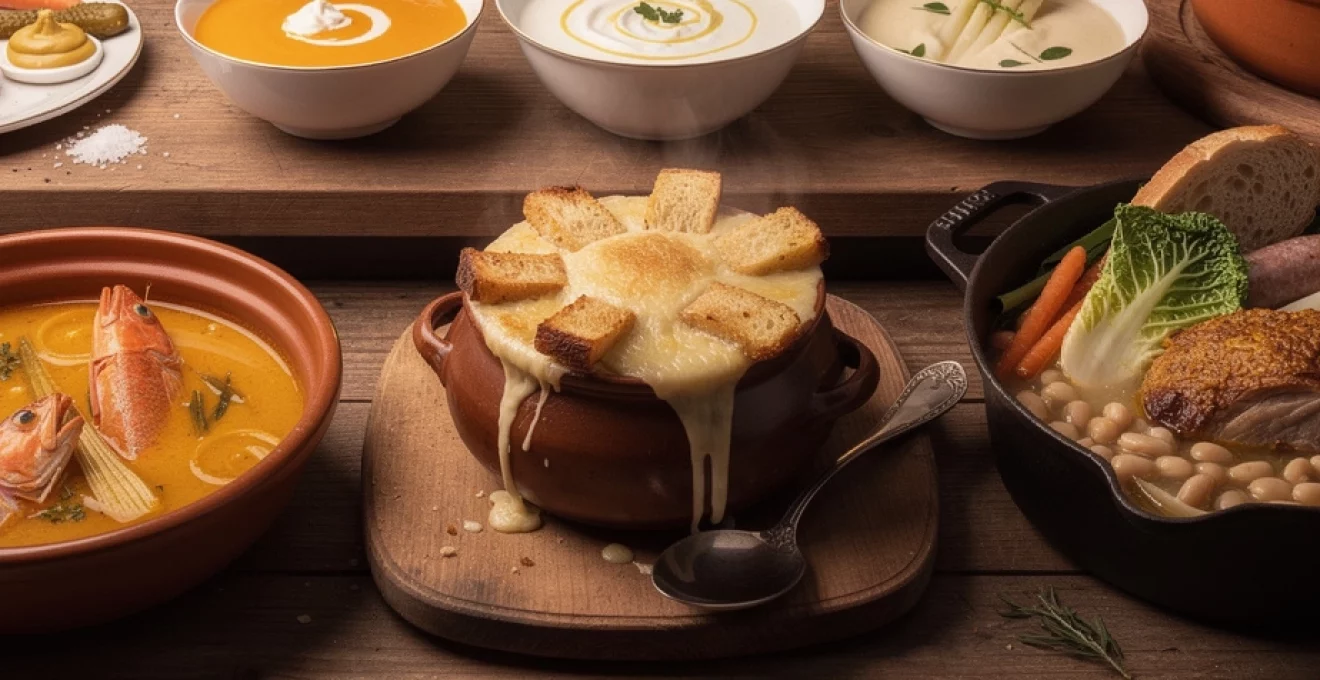
When winter’s chill settles across France, kitchens fill with aromatic steam rising from simmering pots of traditional soups that have nourished generations. These time-honoured recipes represent more than sustenance—they embody regional identities, culinary techniques perfected over centuries, and the French philosophy of transforming humble ingredients into extraordinary dishes. From the caramelised depths of Parisian onion gratinée to the Mediterranean complexity of bouillabaisse, French soups showcase the nation’s diverse terroir and unmatched culinary heritage. Each spoonful carries the warmth of tradition, whether you’re savouring the robust garbure of the Southwest or the refined elegance of a cream-enriched velouté from Burgundy.
The beauty of French soup-making lies in its precise technique combined with generous patience—qualities that define French gastronomy. These dishes demand respect for ingredients, proper preparation methods, and an understanding that true flavour development cannot be rushed. As temperatures drop and evenings lengthen, mastering these classic soups provides both physical warmth and a connection to France’s rich culinary tapestry.
Classic french onion soup: mastering the gratinée technique
French onion soup stands as one of the most iconic representations of Parisian bistro cuisine, dating back to the 18th century when resourceful Les Halles market workers transformed simple onions into a restorative late-night meal. The gratinée technique—crowning the soup with cheese-topped bread and broiling until golden—elevates this humble dish into something magnificent. Understanding the methodology behind proper caramelisation, stock selection, and cheese application separates an adequate version from an exceptional one that captures the soul of traditional French cooking.
Selecting vidalia and yellow onion varieties for deep caramelisation
The foundation of superior onion soup rests entirely on onion selection and caramelisation. Yellow onions remain the traditional choice, offering the ideal balance between sweetness and savoury depth when slowly cooked. Their higher sulphur content creates more complex flavour compounds during the Maillard reaction. Vidalia onions, though sweeter, can complement yellow varieties in a 1:3 ratio, adding subtle sweetness without overwhelming the soup’s characteristic savoury character. This combination requires patient cooking over medium-low heat for 45-60 minutes, stirring regularly as the onions transform from translucent to deep mahogany.
The caramelisation process cannot be rushed—attempting to increase heat only burns the onions rather than developing the rich, sweet complexity that defines authentic gratinée. Professional chefs recommend adding a pinch of salt early in the process to draw out moisture, facilitating even caramelisation. When the onions reach a deep amber colour and reduced to roughly one-third their original volume, they’re ready for deglazing.
Deglazing with cognac and dry white wine for umami depth
Deglazing represents a critical moment in French onion soup preparation, where alcohol lifts the flavourful fond (caramelised bits) from the pan bottom whilst adding layers of complexity. Traditional recipes call for cognac or brandy, added after caramelisation and ignited to burn off harsh alcohol whilst leaving behind rich, fruity undertones. Approximately 60ml of cognac per kilogram of onions provides sufficient depth without overpowering the dish. Following the cognac, 250ml of dry white wine—preferably a crisp Chablis or Muscadet—further deglazes the pan and introduces bright acidity that balances the onions’ sweetness.
This dual deglazing technique, though sometimes overlooked in simplified recipes, creates the sophisticated flavour profile that distinguishes restaurant-quality soup from home versions. The wine reduces by half before adding stock, concentrating its flavours and ensuring no raw alcohol taste remains. This careful layering of flavours exemplifies the French approach to building depth through technique rather than excessive ingredients.
Gruyère vs comté: choosing the right alpine cheese for gratinée
The gratinée crown makes or
comté lovers apart is the way each cheese melts and flavours the crust. Both Gruyère and Comté belong to the family of cooked pressed Alpine cheeses, but Gruyère tends to be slightly nuttier and saltier, while Comté often brings buttery, hazelnut notes that pair beautifully with the sweet onions. For an authentic Parisian-style onion soup, many chefs favour Gruyère for its reliable melt and slight stretch under the grill, whereas bistros in eastern France often opt for a well-aged Comté. Whichever you choose, grate it finely to ensure even melting and apply a generous layer—think of the cheese as a protective blanket that seals in steam and finishes the soup at the last moment.
The gratinée technique requires placing ovenproof bowls on a baking tray, topping the hot soup with toasted baguette slices, then covering them completely with cheese. Position the bowls under a fiercely hot grill or salamander until the top becomes blistered, bubbling, and richly golden. You are aiming for a contrast in texture: a thin crisp top giving way to molten cheese and tender bread soaked with broth beneath. Allow the bowls to rest for a minute before serving; this short pause lets the cheese set slightly, preventing burns while still providing that luxurious, stringy pull we associate with classic French onion soup.
Achieving the perfect baguette croûton texture
The croûtons in a traditional French onion soup are not simply pieces of bread; they function as a structural and textural element that must withstand both heat and liquid. A day-old baguette works best because its slightly dried crumb absorbs broth without immediately disintegrating. Slice the baguette into 1–1.5cm thick rounds and toast them in the oven at 180°C until fully dried and lightly coloured, turning once to ensure even crispness. For additional flavour, you can rub each slice with a cut clove of garlic and brush lightly with melted butter or duck fat.
Getting the balance right between crunch and absorption is key to avoiding a soggy, collapsing cap of bread. Think of the croûton as a sponge encased in armour: the exterior should be crisp enough to resist the broth at first contact, while the interior gradually softens, absorbing the stock and onions. Some chefs like to pre-melt a thin layer of cheese on the croûtons before floating them on the soup, which creates a barrier that slows down saturation. When you ladle the soup into bowls, ensure it is piping hot; the residual heat will soften the bread from below while the grill crisps the cheese from above, delivering that quintessential gratinée experience in every spoonful.
Provençal fish soup: bouillabaisse from marseille harbour
Bouillabaisse, the legendary fish soup from Marseille, began as a humble fisherman’s stew prepared with unsold rockfish that had little commercial value. Over time, this rustic dish evolved into a symbol of Provençal cuisine, celebrated in both family kitchens and Michelin-starred restaurants along the Mediterranean coast. What defines an authentic bouillabaisse is not just the list of ingredients but a set of precise techniques, from fish selection and layering to the creation of a saffron-scented broth and the essential accompaniment of rouille. When done correctly, the result is a complex, aromatic soup that captures the very essence of the sea.
In 2023, Marseille tourism boards reported that bouillabaisse remains one of the top-requested regional dishes among international visitors, reflecting its enduring global appeal. For home cooks, reproducing traditional bouillabaisse can seem intimidating, but breaking the recipe into clear stages makes the process manageable. You will work in layers: building a powerful court-bouillon, adding carefully chosen fish, and finishing with garlic-enriched garnishes. Like a well-orchestrated symphony, each component plays its part to create a harmonious whole that warms winter evenings with Mediterranean sunshine.
Sourcing mediterranean rascasse and rouget for authentic flavour
The soul of bouillabaisse lies in the variety and freshness of the fish. Traditionally, fishermen along the Mediterranean used rockfish such as rascasse (scorpionfish), vive (weever), and congre (conger eel), combined with fleshy fish like rouget (red mullet) and sometimes John Dory or monkfish. These species bring gelatin, collagen, and deep marine flavour that thicken the broth naturally, much like how bones enrich a well-made stock. If you do not have access to Mediterranean waters, seek out firm, non-oily white fish with bones and heads intact; your fishmonger can often supply inexpensive trimmings that are perfect for soup.
When shopping, prioritise whole fish with bright eyes, firm flesh, and a clean sea smell—signs of freshness that directly affect the quality of your bouillabaisse. You can ask the fishmonger to fillet larger fish and reserve heads and bones for the stock, which ensures maximum extraction of flavour. Avoid strongly oily species such as mackerel or salmon, which can overpower the delicate balance of aromatics and saffron. By choosing at least three different types of fish, you create complexity and richness in your traditional French fish soup that a single species simply cannot provide.
Preparing saffron-infused court-bouillon with fennel
The court-bouillon is the aromatic backbone of bouillabaisse, acting like a canvas on which the flavours of fish and shellfish are painted. You begin by sweating onions, leeks, and fennel in olive oil until tender, then adding garlic, tomatoes, and a bouquet garni featuring thyme, bay, and orange zest. Fish heads, bones, and small rockfish are added and covered with water or light fish stock, then simmered gently for 30–40 minutes. Vigorous boiling is avoided to prevent bitterness and cloudiness, much like when preparing a refined consommé.
Saffron, one of the world’s most prized spices, delivers the characteristic golden hue and floral, slightly metallic notes that distinguish bouillabaisse from simpler fish soups. For a family-sized pot, a generous pinch (about 0.2–0.3g) of high-quality saffron threads is infused in a small amount of hot broth, then added back to the pot near the end of cooking to preserve its perfume. Think of saffron as the perfume of the sea: too little and its presence is barely noticed; too much and it dominates everything else. Once the broth has extracted maximum flavour, it is traditionally passed through a fine sieve or food mill, pressing firmly on the solids to capture every drop of essence before the fillets and shellfish are briefly poached in the strained liquid.
Crafting traditional rouille with piment d’espelette
No discussion of bouillabaisse is complete without mentioning rouille, the fiery, garlicky emulsion served on toast and often stirred into the soup at the table. Traditional rouille starts with a base of mashed potato or soaked bread, to which you add raw garlic, egg yolk, and a generous drizzle of extra-virgin olive oil, emulsifying the mixture much like a mayonnaise. Piment d’Espelette, a mildly spicy chilli from the Basque region with protected designation of origin status, offers gentle heat and fruity complexity without overpowering the seafood. Its moderate Scoville rating makes it ideal for diners who appreciate warmth but prefer to avoid aggressive spice levels.
To make a stable rouille, add the olive oil in a slow, steady stream while whisking vigorously, just as you would with classic aioli. The texture should be thick enough to hold its shape on a spoon yet soft enough to spread easily on toasted bread. If the sauce becomes too thick, a teaspoon of warm fish broth can help loosen it without diluting flavour. You can prepare rouille a few hours in advance and refrigerate it, allowing the flavours to meld. When you finally sit down to eat, each guest can decide how much rouille to add to their bowl, customising the intensity of garlic and spice in their Provençal fish soup.
Serving protocol with toasted pain de campagne
Serving bouillabaisse follows a time-honoured ritual in Marseille, where presentation is almost as important as preparation. Traditionally, the rich, saffron-coloured broth is brought to the table first and ladled into warmed bowls, followed by a platter of poached fish and shellfish arranged separately. Diners can either combine the two on their plates or enjoy the fish as a second course. Alongside, you present toasted slices of pain de campagne—a rustic country loaf—with a bowl of rouille for spreading or stirring.
The bread should be sliced about 1cm thick and toasted until crisp, providing a solid base for the rouille that will then be dipped into the steaming soup. Some hosts like to rub the warm toast with a clove of garlic for extra aroma, echoing the flavours of the rouille and reinforcing the Mediterranean identity of the dish. This interactive style of service turns bouillabaisse into a convivial winter meal, encouraging guests to build their own combinations of broth, fish, bread, and sauce. In a way, it becomes less a simple French fish soup and more a full dining experience that lingers long after the bowls are empty.
Burgundian garbure: slow-cooked cabbage and duck confit potage
Garbure is a hearty peasant soup originating from Gascony and the Pyrenean foothills, though variations have spread across southwestern and central France, including Burgundy. More a meal in a bowl than a starter, this slow-cooked potage combines cabbage, root vegetables, beans, and preserved meats such as duck confit. Historically, garbure sustained farm workers through cold winters, and its generous use of preserved ingredients made it ideal for regions without easy year-round access to fresh meat. Today, it is cherished as a rustic yet sophisticated example of traditional French comfort food.
Compared to lighter winter soups, garbure has the soul of a stew: it simmers gently for hours, allowing flavours to meld and textures to soften. You can think of it as the French cousin of minestrone or Portuguese caldo verde, but with a distinctly southwestern accent thanks to duck, goose fat, and sometimes cured ham. As interest in nose-to-tail and sustainable eating continues to grow, garbure has gained renewed popularity in bistros and at home, where cooks value its ability to transform inexpensive ingredients into something deeply satisfying. It is particularly well suited to batch cooking and freezing, making it a practical choice for busy winter weeks.
Incorporating toulouse sausage and preserved goose fat
The flavour foundation of a classic garbure rests on two key ingredients: Toulouse sausage and goose or duck fat. Toulouse sausage is a coarse, lightly seasoned pork sausage from the southwest, typically containing just pork, salt, and pepper, sometimes with a hint of garlic. Its robust texture stands up to long simmering, releasing savoury juices into the broth without falling apart. If you cannot find authentic Toulouse sausage, choose a high-quality, unsmoked fresh pork sausage with minimal added spices, avoiding heavily seasoned or smoked varieties that can dominate the pot.
Goose or duck fat plays a role similar to butter or olive oil in other cuisines, but brings a distinctive depth and silkiness to the soup. You begin by gently frying lardons and sausage slices in a spoonful of this fat, creating a rich base in which to sweat onions, leeks, and carrots. The rendered fat coats the vegetables, helping them caramelise slightly and develop sweetness, much like the early stages of a cassoulet. While these fats are energy-dense, they are used sparingly, and a modest amount goes a long way towards creating the luxurious mouthfeel that makes garbure such a beloved winter dish.
Selecting savoy cabbage and haricot tarbais beans
Not all cabbages are created equal when it comes to garbure. Savoy cabbage, with its crinkled leaves and tender texture, is the preferred choice because it softens beautifully without dissolving into mush. Its mild flavour absorbs the smoky, meaty notes from the sausage and duck while still contributing a gentle vegetal sweetness. Cut the cabbage into thick ribbons or wedges, remembering that it will shrink significantly during the long simmer. Adding it in stages—some at the beginning for body and some later for texture—can provide a pleasant contrast in the final bowl.
Haricot Tarbais beans, grown in the foothills of the Pyrenees and protected by an IGP label, are prized for their thin skins and creamy interiors. They hold their shape admirably during extended cooking, making them ideal for rustic French soups and stews. If Haricot Tarbais are unavailable, substitute with high-quality cannellini or Great Northern beans, soaking them overnight to ensure even cooking. Beans do more than add protein and fibre; they also gently thicken the broth, giving garbure its characteristic velvety consistency without the need for flour or roux. For optimal results, simmer the beans separately until just tender, then finish cooking them in the garbure so they can absorb the soup’s complex flavours.
Layering technique with stale sourdough bread
A traditional serving method for garbure involves layering slices of stale bread—often sourdough—at the bottom of deep bowls or even in the pot itself. This technique echoes medieval bread trenchers and transforms yesterday’s loaf into a hearty, flavour-soaked base. The bread absorbs the broth and fat, becoming almost custard-like while retaining enough structure to be lifted with a spoon. Think of it as a built-in accompaniment, eliminating the need for a separate side of bread.
To employ this layering technique, arrange thick slices of stale sourdough in a casserole dish, ladle over hot garbure, and allow it to rest for several minutes before serving. The residual heat will soften the bread, melding it into the soup. If you prefer a slightly crisp contrast, you can toast the bread before layering, much as you would for onion soup croûtons. This simple ritual underscores one of the great strengths of French country cooking: its ability to minimise waste while maximising comfort, turning humble leftovers into a central feature of the meal.
Velouté-based french soups: cream enrichment methods
While rustic potages and broths dominate many regional tables, France is equally renowned for its refined velouté-style soups. These are smooth, blended preparations thickened with a light roux, starch, or puréed vegetables and finished with cream, butter, or egg yolk. Velouté-based French soups exemplify the country’s talent for elevating simple produce—carrots, leeks, asparagus—into silk-smooth, restaurant-worthy dishes. The goal is a texture akin to pouring cream: neither watery nor gluey, but delicately coating the back of a spoon.
Mastering cream enrichment is less about adding large quantities of dairy and more about timing and technique. Add cream too early and vigorous boiling can cause it to split; add it too late and it may not fully integrate, leaving a greasy mouthfeel. Instead, you typically blend the cooked vegetables with a portion of the cooking liquid, return the purée to the pot, and simmer gently before stirring in cream off the heat. This approach preserves both the bright colour of the vegetables and the fresh lactic sweetness of the cream, resulting in elegant French winter soups that feel indulgent without being heavy.
Preparing potage crécy with vichy carrots and crème fraîche
Potage Crécy, named after the town of Crécy-en-Ponthieu once famous for its carrots, is a classic French carrot soup with a distinctive sweetness and vivid orange hue. Many modern chefs recommend using Vichy carrots—young, tender carrots cooked in lightly salted, mineral-rich water associated with the spa town of Vichy—for their superior flavour and smooth texture. To make this soup, sliced carrots are gently sweated with onions or leeks in butter until fragrant, then covered with light chicken or vegetable stock and simmered until completely tender. A small amount of rice or potato can be added as a natural thickener, avoiding an overly floury taste.
Once the vegetables are soft, the mixture is blended until perfectly smooth, often passed through a fine sieve for an ultra-silky finish. Instead of heavy cream, many cooks prefer crème fraîche for enrichment; its slight tang balances the carrots’ natural sweetness and adds complexity. Stir a generous spoonful into the hot soup just before serving, swirling extra on top as a garnish if desired. Potage Crécy can be served with a sprinkle of toasted cumin seeds or chopped chervil, enhancing its aroma and transforming it from a simple carrot soup into a refined centrepiece for a winter dinner.
Crafting vichyssoise with leeks and yukon gold potatoes
Vichyssoise is often associated with chilled summer service, but this leek and potato velouté is equally satisfying served warm on a frosty evening. The classic formula pairs the white and pale green parts of leeks with floury potatoes such as Yukon Gold, which have enough starch to create a creamy consistency without becoming gluey. After washing the leeks thoroughly to remove grit, you sweat them gently in butter until soft but not browned, preserving their delicate sweetness. Cubed potatoes are then added with stock—traditionally chicken, though vegetable stock works well for a vegetarian version—and simmered until everything is tender.
The mixture is blended until completely smooth, then cooled slightly before cream is incorporated to avoid curdling. Straining through a fine sieve is optional but recommended if you are aiming for restaurant-level refinement in your traditional French winter soup. When serving vichyssoise warm, season carefully with salt, white pepper, and a hint of freshly grated nutmeg, which complements the sweetness of the leeks. A garnish of finely chopped chives or a drizzle of chive oil provides fresh colour and a mild oniony lift. Whether served hot or cold, the key to an exceptional vichyssoise lies in restraint: clean flavours, perfect texture, and no heavy-handed seasoning.
Creating velouté d’asperges with white asparagus from landes
Velouté d’asperges showcases one of France’s most prized seasonal vegetables: white asparagus, particularly those grown in the Landes region of southwestern France. Unlike green asparagus, white spears are cultivated underground to prevent chlorophyll development, resulting in a delicate, slightly nutty flavour and a tender yet firm texture. Because they can be fibrous near the base, careful peeling and trimming are essential before they meet the pot. The trimmings can be simmered with aromatic vegetables to create a flavourful stock, reflecting the French commitment to using every part of the ingredient.
To prepare this elegant velouté, asparagus pieces are gently sweated with shallots in butter, then covered with light stock and simmered until just tender. Overcooking can dull both flavour and colour, so keep a close eye on the pot. The mixture is blended and often passed through a chinois to achieve a perfectly smooth texture, after which cream is added off the heat, along with a small knob of cold butter whisked in for extra sheen. Seasoning is kept minimal—usually just salt, white pepper, and perhaps a squeeze of lemon—to allow the asparagus to shine. Served in small portions as a starter, this velouté offers a luxurious yet subtle expression of French soup-making, ideal for sophisticated winter menus.
Pot-au-feu: the national beef and root vegetable broth
Often described as the national dish of France, pot-au-feu is more than a soup; it is a ritual around which families gather on cold Sundays. At its core, pot-au-feu is a slow-simmered beef and vegetable broth that extracts flavour from modest cuts of meat and marrow bones, yielding a clear, aromatic consommé and tender pieces of beef served alongside. Historically, a pot of broth would be kept simmering at the hearth, replenished with fresh ingredients over several days, providing constant nourishment throughout winter. Today, home cooks typically prepare it in a single long session, repurposing leftovers into hash, salads, or gratins.
What sets pot-au-feu apart from ordinary beef soup is the care taken in selecting cuts, regulating temperature, and clarifying the broth. The aim is a crystal-clear consommé with a rich yet clean taste, free from excess fat or impurities. Root vegetables such as carrots, leeks, turnips, and celeriac contribute sweetness and complexity, while aromatic herbs and spices—bay, thyme, cloves, and peppercorns—add subtle depth. If onion soup is the emblem of Parisian bistros, pot-au-feu is the embodiment of French home cooking, offering comfort, thrift, and hospitality in a single steaming tureen.
Selecting charolais beef cuts: plate, shank and oxtail
The choice of beef is crucial for an authentic pot-au-feu. French cooks often favour Charolais, a breed known for its balance of flavour and tenderness, though any good-quality, grass-fed beef will yield excellent results. Rather than using prime steaks, you select collagen-rich cuts that benefit from long, gentle cooking: plat de côtes (beef plate or short ribs), jarret (shin or shank), and oxtail. These pieces contain connective tissue that gradually breaks down into gelatin, giving the broth a silky mouthfeel and making the meat succulent rather than dry.
A typical pot might combine two or three different cuts, along with marrow bones, to create a layered flavour profile. The meat is often blanched briefly in boiling water and rinsed to remove surface impurities before the main cooking begins, which helps achieve a clearer broth. Once skimmed, the beef is added to cold water and brought slowly to a bare simmer, never a rolling boil, to prevent the proteins from emulsifying into the liquid. This patient approach, much like simmering a fine stock in classical French cuisine, is one of the secrets behind a successful pot-au-feu.
Clarifying bouillon with egg whites for crystal-clear consommé
While many home cooks are content with a well-skimmed broth, the classical method for achieving a truly clear consommé involves clarification with egg whites. This restaurant technique may sound intimidating, but the principle is simple: beaten egg whites bind with suspended particles in the broth, forming a raft that traps impurities as it rises to the surface. To apply this method, you cool a portion of the degreased broth, whisk in egg whites (and sometimes crushed shells for added calcium), then gently heat the mixture, stirring at first to prevent the eggs from sticking to the bottom.
As the liquid approaches a simmer, you stop stirring and allow the raft to form and rise. Tiny bubbles and impurities collect in this floating mass while the liquid beneath becomes progressively clearer, like a lens being polished. After about 30–45 minutes of very gentle simmering, you carefully ladle or siphon off the clarified consommé through a fine sieve lined with cloth. The result is a golden, translucent broth with concentrated beef flavour and a refined appearance, suitable not only for traditional pot-au-feu service but also for more formal dinners where presentation matters.
Serving with cornichons, dijon mustard and fleur de sel
The traditional accompaniments to pot-au-feu are as important as the soup itself, transforming a simple bowl of beef and vegetables into a full, interactive meal. The clarified broth is typically served first, sometimes with a few slices of carrot or leek and perhaps a sprinkling of chopped parsley. The meat and root vegetables are presented on a warm platter, inviting diners to help themselves. On the side, small dishes of cornichons (tangy pickles), coarse salt or fleur de sel, and pungent Dijon mustard provide contrast and brightness.
This ritual of seasoning at the table allows each person to tailor the flavours to their own taste. A dab of mustard or a crunchy bite of cornichon cuts through the richness of the beef, while a pinch of fleur de sel applied at the last moment enhances its natural savour. Some families also serve bone marrow, scooped from the simmered bones and spread on toasted bread—a luxurious treat that epitomises winter comfort food. Leftover broth can be used over the following days as a base for other French soups, sauces, or risottos, extending the pleasure of pot-au-feu well beyond the initial meal.
Alsatian baeckeoffe: terracotta-baked meat and potato stew
Originating from Alsace in eastern France, Baeckeoffe sits at the crossroads of French and German culinary traditions, combining marinated meats, onions, and potatoes baked slowly in a sealed terracotta dish. The name translates roughly to “baker’s oven,” reflecting the historical practice of assembling the dish at home, then delivering it to the village baker to cook in the residual heat of the bread oven. Although often classified as a stew rather than a soup, Baeckeoffe produces an abundance of richly flavoured juices that are ladled into bowls much like a hearty potage, making it a fitting inclusion in a winter soup repertoire.
Typically, Baeckeoffe features a trio of meats—pork shoulder, lamb, and beef—marinated overnight in Alsace white wine such as Riesling or Sylvaner with onions, garlic, and herbs. Layers of thinly sliced potatoes and onions alternate with the marinated meat in the casserole, which is then sealed with a rope of bread dough around the lid to trap steam. Over several hours of slow baking, the ingredients meld into a tender, aromatic whole, with the wine reducing to a concentrated, almost velvety broth. The result is a dish that embodies the virtues of traditional French winter soups and stews: economy, comfort, and deep respect for local ingredients.
When served, the baked dough seal is cracked open at the table, releasing a cloud of perfumed steam—an almost theatrical moment that never fails to impress guests. The cook can choose to plate Baeckeoffe in shallow bowls, ensuring each portion includes meat, potatoes, and plenty of cooking juices. A simple green salad and a glass of the same white wine used in the marinade complete the meal, cutting through the richness and refreshing the palate. For those seeking to explore beyond the more famous bouillabaisse or onion soup, Baeckeoffe offers a rewarding glimpse into Alsatian home cooking, proving once again that in France, the most comforting winter dishes are often those that have quietly simmered or baked for hours, waiting patiently to warm the evening.