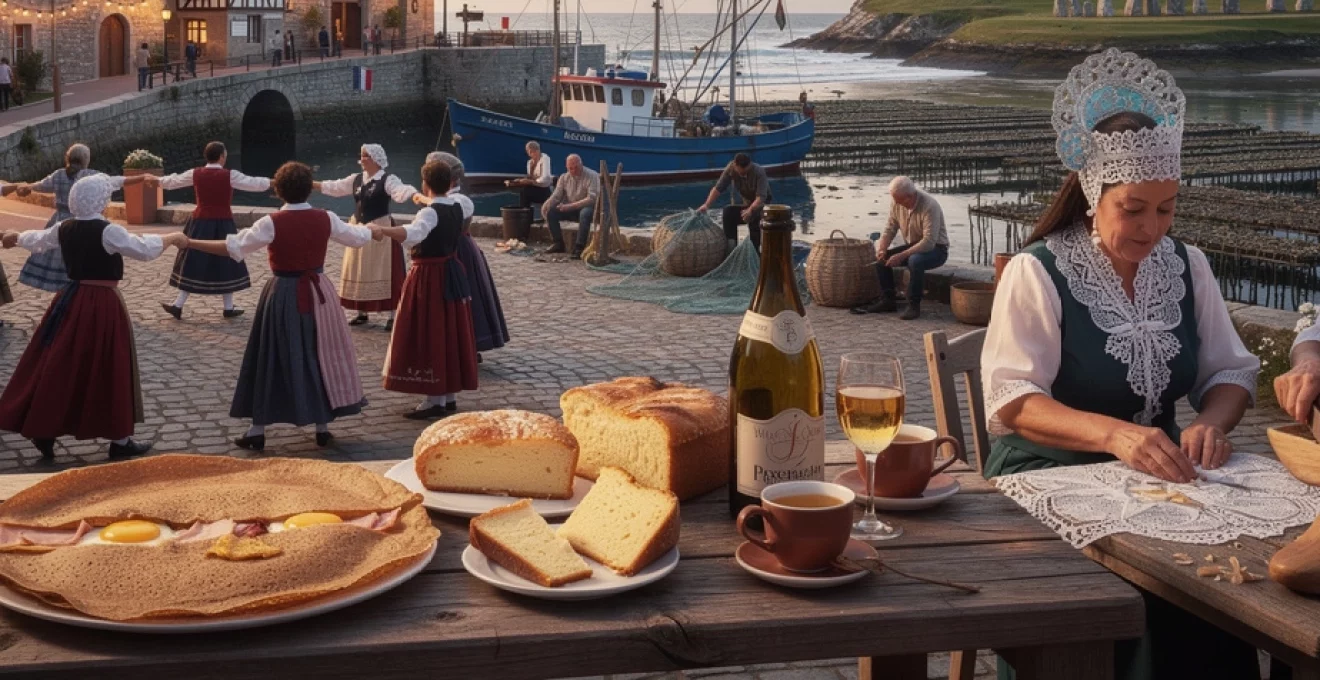
Brittany stands apart from the rest of France with a cultural identity as distinctive as its rugged coastline. This Celtic nation, with its own language, traditions, and fierce independence, offers travellers an opportunity to step into a world where ancient customs are not merely preserved in museums but actively celebrated in daily life. From the haunting melodies of traditional fest-noz celebrations to the towering megaliths that predate Stonehenge by millennia, Brittany pulses with a living heritage that has survived centuries of cultural pressures. The region’s commitment to maintaining its identity manifests in everything from street signage in the Breton language to artisans who still craft wooden clogs using techniques passed down through generations. Understanding where to find these authentic experiences transforms a typical French holiday into an immersive journey through one of Europe’s most enduring cultural landscapes.
Traditional Fest-Noz celebrations in finistère and morbihan
The fest-noz, literally “night festival” in Breton, represents the beating heart of Brittany’s living cultural tradition. These gatherings, recognised by UNESCO as intangible cultural heritage since 2012, transform village squares and community halls into swirling vortices of traditional dance and music. Unlike performance-based folk events found elsewhere in Europe, fest-noz celebrations remain fundamentally participatory. Attendees don’t simply watch—they join the dance circles, link arms with strangers, and become part of a tradition stretching back centuries. The departments of Finistère and Morbihan host the most frequent and authentic fest-noz events, particularly during summer months when nearly every weekend brings multiple celebrations across the region.
What strikes first-time attendees most powerfully is the intergenerational nature of these gatherings. Grandparents dance alongside teenagers, and children barely tall enough to see over the crowd hold hands in the circles. This isn’t cultural tourism—it’s community life made visible. The music, driven by bagpipes, accordions, and the distinctive Breton bombarde, creates hypnotic rhythms that seem to bypass the brain and speak directly to the feet. Even those who’ve never danced before find themselves swept up in the collective movement, guided by the patient hands of experienced dancers who welcome newcomers into the circles without judgement or interruption.
Bagadoù brass bands and bombarde performances at quimper’s festival de cornouaille
The Festival de Cornouaille in Quimper, held annually in late July, showcases the pinnacle of Breton musical tradition through performances by bagadoù—the region’s distinctive pipe bands. These ensembles differ significantly from Scottish bagpipe bands, incorporating the piercing bombarde (a double-reed instrument similar to an oboe) alongside the more familiar biniou bagpipes and a percussion section that drives dancers into tireless motion. The competition between different bagadoù represents serious business in Brittany, with bands training year-round to perfect their synchronisation and sound quality. When you witness a championship-level performance, the wall of sound produced by thirty or forty musicians playing in perfect unison creates an almost physical sensation, vibrating through the cobblestones beneath your feet and resonating in your chest cavity.
Quimper’s festival extends beyond competition performances to include workshops where visitors can try their hand at these traditional instruments. The bombarde, whilst appearing deceptively simple with its conical bore and seven finger holes, demands considerable breath control and embouchure technique. Most novices manage little more than a few squeaky notes, which makes the effortless virtuosity of master players all the more impressive. The festival also features instrument makers who craft these tools according to centuries-old specifications, demonstrating how Breton musical culture maintains continuity with its medieval origins whilst adapting to contemporary contexts.
An dro and hanter dro circle dances in Pont-Aven’s village squares
Pont-Aven, famous for attracting impressionist painters including Paul Gauguin, transforms on summer evenings when an dro and <em
em>hanter dro circle dances take over the village squares. Unlike solo or couple dances, these communal chains bring together dozens of participants, all stepping in unison to the hypnotic rhythm of traditional music. Dancers link little fingers or forearms, forming long serpentine lines that weave through the square, sometimes spiralling inward before unfurling again like a living Celtic knot. The basic steps of an dro and hanter dro are simple enough for beginners to pick up within a few minutes, which makes Pont-Aven an ideal place to experience fest-noz culture for the first time.
Arrive early in the evening and you will often find local associations offering short initiation sessions, demonstrating the characteristic sideways steps and subtle weight shifts of each dance. Think of it as learning the grammar of a language before attempting full conversation—once you understand the pattern, you can join any circle with confidence. Musicians typically play on a small raised platform, sometimes accompanied by singers performing kan ha diskan (call-and-response singing) over the melody. If you are unsure where to put your feet, simply watch the dancers two or three places ahead of you in the circle; the movement flows along the chain like a wave, carrying you along until the steps become instinctive.
Kan ha diskan call-and-response singing traditions in vannes
In the historic town of Vannes, fest-noz evenings often highlight the vocal tradition of kan ha diskan, literally “sing and counter-sing”. This style, which once accompanied work in the fields or gatherings in farmhouses, now energises dance floors with nothing more than the human voice as an instrument. Typically, two singers stand facing each other, one launching a phrase and the other overlapping with the response, creating a continuous stream of sound without a single breath of silence. The rhythm is built into the phrasing itself, providing a percussive backbone for dancers tracing out gavotte and fisel steps on the wooden floor.
Hearing kan ha diskan live in Vannes is like listening to a centuries-old recording brought suddenly into the present. You may not understand the Breton lyrics, but the phrasing, drive and subtle ornamentation communicate emotion beyond words. Many fest-noz organisers in the Morbihan region now pair traditional singers with younger musicians, creating hybrid sets where voice, accordion and guitar intertwine. If you are keen to delve deeper, look out for daytime workshops during cultural festivals, where you can learn the basics of breathing and phrasing. Even as a listener, however, you will quickly sense how this vocal art keeps the Breton language alive in the most physical way possible—through breath, rhythm and dance.
Plinn dance competitions at lorient’s festival interceltique
Lorient’s Festival Interceltique, held every August, brings together Celtic cultures from across Europe, but one of its most authentically Breton moments is the plinn dance competitions. Originating in central Brittany, plinn is a vigorous dance marked by a distinctive bouncing motion that seems to rise from the ground itself. In competition settings, couples and groups are judged on precision, posture and the subtle elasticity of their steps, all performed to powerful kan ha diskan or driving bombard-and-biniou duos. For spectators, it can feel a little like watching a regional version of tango or flamenco championships—rooted in everyday culture, yet honed to a high level of artistry.
If you are visiting Lorient during the festival, plan to attend both the formal competitions and the open-air fest-noz sessions that follow. The contrast is revealing: where contestants focus on exact timing and stylised carriage, the late-night dances prioritise shared energy and endurance, with locals and visitors forming circles that can last for hours. Not sure if you have the stamina for a full evening of plinn? Pace yourself by alternating between dancing and watching from the sidelines, where food and drink stalls offer everything from buckwheat galettes to local cider. By the end of the night, you will understand why dance in Brittany is less a performance than a communal ritual—a way of reaffirming identity with every step.
Architectural heritage sites preserving breton identity
Beyond music and dance, Brittany’s architectural heritage offers tangible evidence of a culture shaped by faith, seafaring and stubborn independence. From fortified hilltop towns to isolated parish complexes, these sites preserve stories that written records only hint at. Walking through them, you experience Breton culture much as a medieval pilgrim or 19th-century sailor might have done: through stone, wood and the play of Atlantic light on weathered façades. Many of the most striking examples sit well away from the main tourist routes, rewarding travellers willing to take a detour inland from the celebrated coasts.
Architecture in Brittany is more than a backdrop for holiday photos; it’s a three-dimensional archive of the region’s social and spiritual history. Why did small villages build such elaborate church complexes? How did isolated rural communities afford enormous granite calvaries? The answers lie in a mixture of maritime wealth, local pride and a worldview where the sacred was woven into everyday life. As you explore, take time not just to admire façades but to read information panels, visit small local museums, and, if possible, join a guided tour led by a Breton-speaking guide. These layers of context turn stone into story.
Enclos paroissiaux church complexes in Saint-Thégonnec and guimiliau
The enclos paroissial—parish close—is one of the most distinctive expressions of Breton religious architecture, and the finest examples are found in the villages of Saint-Thégonnec and Guimiliau in the Léon region. Each complex typically includes a church, an elaborate entrance arch, a calvary (stone crucifixion group), and an ossuary, all enclosed by low walls that create a clearly defined sacred space. These were not humble rural chapels; they were statements of collective wealth and devotion, funded largely by profits from linen and maritime trade between the 16th and 18th centuries. Arriving at Saint-Thégonnec, you pass under the triumphal arch as generations of villagers did for baptisms, weddings and processions.
Inside the churches, richly carved wooden altarpieces sit beneath vaulted ceilings, their gilded figures lit by narrow windows that filter the grey Breton light into soft gold. The ossuaries—chapels once used to store bones when graveyards became overcrowded—often display sculpted skulls and hourglasses, reminders of the medieval preoccupation with mortality. In Guimiliau, the monumental calvary reads like a stone comic-strip of the Passion, its dozens of characters frozen mid-gesture. To fully appreciate these complexes, allow at least an hour at each site and consider bringing binoculars to examine high relief carvings. Many information boards now include Breton as well as French, underlining how architectural heritage and language revival go hand in hand.
Granite calvaries and ossuaries of the léon region
Scattered across the Léon region of northern Finistère, granite calvaries and ossuaries form a network of open-air sculptures that rival more famous European monuments in complexity. Often rising several metres high, these calvaries depict Biblical scenes with an intensity that reflects both Counter-Reformation zeal and local craftsmanship. Look closely at the faces and you may notice distinctly Breton features—thick eyebrows, strong noses, even traces of regional dress—suggesting that carvers used neighbours as models. The roughness of the granite, softened by centuries of wind and rain, gives these figures a weathered humanity that polished marble can rarely match.
Ossuaries, meanwhile, offer a stark counterpoint to the exuberance of the calvaries. These small buildings, usually located within or just outside the parish close, served as repositories for bones moved from overcrowded graves. Their façades often feature carved skeletons, angels and Latin inscriptions warning of life’s brevity, echoing the Breton saying: “Ar vuhez zo berr”—life is short. Visiting several sites in one day—Saint-Thégonnec, Guimiliau, Lampaul-Guimiliau, for example—allows you to compare styles and spot recurring motifs. A self-guided driving route through Léon’s parish closes can be one of the most rewarding cultural day trips in Brittany, especially if you combine it with a visit to a local café where Breton is still spoken at neighbouring tables.
Half-timbered medieval houses in dinan’s rue du jerzual
Dinan, perched above the River Rance in Côtes-d’Armor, preserves one of the most extensive ensembles of medieval half-timbered houses in Brittany. Nowhere is this more evident than along the steep Rue du Jerzual, which snakes down from the upper town to the riverside port. Lined with overhanging façades, crooked beams and tiny workshops, this street feels less like a museum and more like a film set brought to life. Yet unlike reconstructed historic quarters elsewhere in Europe, Dinan’s houses are largely original, their 15th- and 16th-century frames carefully restored rather than rebuilt.
Walking down Rue du Jerzual, you can easily imagine merchants hauling goods between riverboats and the market square, or artisans leaning from their upper windows to watch processions passing below. Many of the former workshops now host contemporary artisans—leatherworkers, glass-blowers, painters—who consciously see themselves as part of a long local tradition of craftsmanship. Stop to chat if the door is open; you will often find that makers are happy to explain their techniques and materials. The climb back up can be steep, so give yourself time and use the ascent as an excuse to pause and study architectural details: carved corner posts, engraved dates, or discreet plaques explaining a building’s history.
Standing stone alignments at carnac’s megalithic complex
No exploration of Breton identity would be complete without a visit to the megalithic alignments at Carnac in Morbihan, one of the densest prehistoric sites in Europe. More than 3,000 standing stones—some over four metres high—stretch across several kilometres, arranged in parallel rows whose original purpose remains the subject of debate. Were they ritual avenues, astronomical markers, or vast communal cemeteries? Archaeologists are still piecing together answers, but for visitors the impact is immediate: stepping into these fields feels like walking into an open-air cathedral raised not by masons but by Neolithic farmers some 6,000 to 7,000 years ago.
To make sense of the site, start at the Maison des Mégalithes visitor centre, where exhibitions explain the latest research and offer scale models of the alignments. Guided tours—often available in English during high season—allow you to access fenced areas and hear interpretations that go beyond the usual myths. If you can, visit at two different times of day: early morning, when mist hangs between the stones and the atmosphere borders on the otherworldly, and late afternoon, when low sun throws long shadows that emphasise the alignments’ geometry. Combined with nearby tumuli and dolmens, Carnac’s complex reminds you that Breton culture reaches back far beyond the Celts, into a deep time that continues to shape the region’s imagination.
Gastronomic experiences rooted in breton terroir
Brittany’s culture is perhaps most immediately accessible through its food and drink, which distil centuries of maritime trade, small-scale farming and unabashed love of butter into dishes that are both comforting and distinctive. From street-side crêperies to farmhouse cider houses, gastronomy here remains closely tied to local terroir: buckwheat grown in windy fields, apples from mossy orchards, sea salt harvested from Atlantic marshes. Eating in Brittany is not just about satisfying hunger; it’s about tasting a landscape where land and sea constantly negotiate with each other.
As you travel, you will notice how certain specialities appear everywhere—galettes, crêpes, cider—while others are strongly associated with specific towns or micro-regions. Seeking out these local variations is one of the best ways to experience authentic Breton culture. Do you try kouign-amann in every bakery you pass, comparing textures and levels of caramelisation? Or do you dedicate an afternoon to visiting traditional cider producers, learning how choices in apple varieties affect flavour just as grape selection does in wine? Either way, the region rewards curiosity.
Galette de sarrasin buckwheat crêpes in Saint-Malo crêperies
In the walled corsair city of Saint-Malo, the aroma of sizzling buckwheat batter drifts down narrow streets from dozens of crêperies. The galette de sarrasin—a savoury crêpe made from buckwheat flour, water and salt—is Brittany’s most iconic dish, and Saint-Malo offers some of the finest examples. Traditionally cooked on a large cast-iron billig (griddle) and flipped with a wooden spatula, galettes can be filled with anything from the classic “complète” (ham, egg, cheese) to more elaborate combinations featuring local scallops, seaweed butter or smoked sausage. The slightly nutty flavour of buckwheat, crisp at the edges and tender in the middle, pairs beautifully with a bowl of dry cider.
For an authentic experience, look for crêperies that still prepare their batter using slow-fermented buckwheat, often indicated on menus as “pâte au levain”. This natural fermentation, which can take up to 24 hours, enhances both flavour and digestibility, much like a good sourdough bread. Seating is often close-packed, and you may find yourself shoulder to shoulder with local families and visiting hikers comparing their favourite coastal walks. Don’t be shy about asking for recommendations; Malouins are usually happy to debate the relative merits of different fillings. And remember that in Brittany, dessert crêpes made with wheat flour (crêpes de froment) are a separate course, not an afterthought—save room for one with salted butter caramel.
Kouign-amann caramelised pastries from douarnenez bakeries
If one pastry encapsulates Breton indulgence, it is the kouign-amann from Douarnenez in Finistère. Often described—accurately—as “a laminated cake made of 50% dough, 25% butter and 25% sugar”, this caramelised spiral was invented in the 19th century, allegedly during a flour shortage when a local baker substituted extra butter and sugar. Today, Douarnenez’s bakeries guard their recipes jealously, but the essentials remain the same: layers of yeasted dough folded repeatedly with salted butter and sugar, then baked until the exterior forms a caramelised, almost crunchy crust while the interior stays tender and flaky.
Tasting kouign-amann fresh from a Douarnenez oven is a revelation compared to the sometimes heavy versions found elsewhere. The balance of salt and sweetness, crispness and softness, makes each bite surprisingly nuanced for such a simple ingredient list. To maximise your chances of getting one still warm, visit in the morning or ask the bakery when the next batch will come out. Many shops now offer individual-sized portions, which are easier to manage (and justify) than a full cake, especially if you are also tempted by other local specialities like far breton. Just be warned: once you have tasted the real thing in its hometown, supermarket imitations elsewhere will never quite satisfy you again.
Cider houses and cidre breton AOC tasting routes in cornouaille
While Normandy may be better known internationally for cider, Brittany’s Cornouaille region produces some of France’s most characterful apple brews, many now protected by the AOC Cidre de Cornouaille designation. Rolling orchards around towns like Quimper and Fouesnant host family-run cider houses (cidreries) where apples are still harvested, pressed and fermented using methods that would be recognisable a century ago. Visiting one of these estates offers a deeper understanding of how terroir shapes flavour: coastal breezes, soil type and even local yeast strains all play a role in the final product.
Several signposted cider routes in Cornouaille allow you to combine tastings with scenic drives or bike rides between farms. At each stop, producers typically explain the difference between brut (dry), doux (sweet) and demi-sec (medium) ciders, and may also offer pommeau (an apple-based aperitif) or lambig (apple brandy). Tasting flights usually cost only a few euros, and purchases support local agriculture directly. As with wine, responsible consumption is key—consider appointing a designated driver or planning a route you can do largely by bicycle or on foot. Pairings can be as simple as a slice of farmhouse cheese or as elaborate as a full crêperie meal in a nearby village.
Far breton custard tarts and gâteau breton butter cakes
Alongside showstoppers like kouign-amann, Breton home baking remains anchored in two deceptively modest desserts: far breton and gâteau breton. Far breton is a dense, custard-like tart made from eggs, milk, flour and sugar, often enriched with prunes soaked in rum. Originating as a simple farmhouse dish, it was traditionally baked in large slabs and cut into squares, its slightly browned top giving way to a creamy interior. You will find it in bakeries across the region, but some of the best versions appear in unassuming village shops where recipes have barely changed in generations.
Gâteau breton, by contrast, is a rich, sandy-textured butter cake, cross-hatched on top and sometimes flavoured with vanilla or plum jam. Originally designed to keep well on long sea voyages, it remains a favourite souvenir thanks to its ability to travel without losing quality. When choosing one, pay attention to ingredient lists—shorter is better—and weight; a good gâteau breton feels reassuringly heavy in the hand. Both desserts pair beautifully with coffee or cider and offer an everyday taste of Breton culture that you can easily recreate at home using widely available recipes. In a sense, they are edible memory devices, allowing you to bring a piece of Brittany back to your own kitchen long after your trip ends.
Linguistic immersion through breton language revival
The Breton language, brezhoneg, lies at the core of the region’s distinct identity, even for residents who no longer speak it fluently. A Celtic tongue more closely related to Welsh and Cornish than to French, Breton once dominated rural life across much of western Brittany. By the mid-20th century, however, state education policies and social pressures had pushed it to the brink of extinction. The last few decades have seen a remarkable grassroots revival, driven by families, teachers, musicians and activists determined that their heritage should not vanish. For visitors, this revival offers a unique opportunity: where else in France can you encounter road signs, radio shows and school playgrounds alive with a non-Romance language?
Immersing yourself in Breton does not require fluency; even learning a few phrases can transform the way locals respond to you. A simple “Demat” (hello) or “Trugarez” (thank you) often earns a smile and a story about a grandparent who spoke nothing else. You will notice how language and culture intertwine in place names—Plou- for parishes, Ker- for villages—or in festival banners that proudly proclaim “Breizh” rather than “Bretagne”. Treat Breton not as a museum piece but as a living code that still shapes humour, music and worldview.
Diwan bilingual schools network across Côtes-d’Armor
One of the most visible pillars of the language revival is the Diwan school network, founded in 1977 to provide immersive Breton-language education. These independent, non-denominational schools now operate across Brittany, with a strong presence in Côtes-d’Armor. Classes are taught primarily in Breton from nursery level, with French introduced gradually later on, creating genuinely bilingual speakers. Visiting families sometimes encounter Diwan pupils at festivals or in town squares, their easy code-switching between Breton and French illustrating how far the revival has progressed.
While schools themselves are not tourist sites, public events and fundraisers organised by Diwan associations offer windows into everyday Breton-language life. Look for posters advertising lotos (bingo nights), concerts or fest-noz in support of local schools; these gatherings are open to all, and you will often hear announcements and jokes delivered in Breton first, French second. If you are curious about the pedagogy behind immersion programmes, many Diwan websites provide detailed explanations and even downloadable learning materials. For travellers considering a longer stay in Brittany with children, these schools can also be a practical gateway into the community.
Breton signage and place names in breizh-speaking communities
One of the easiest ways to gauge the vitality of Breton in a given area is to look at its signage. In many western communes—particularly in Finistère and Morbihan—bilingual French-Breton road signs greet you at town entrances, with traditional names displayed alongside their French counterparts. More recently, some municipalities have extended this practice to street labels, public buildings and even bus stops, transforming the visual landscape into a daily language lesson. For visitors, this can be both practical and poetic: you start to decode recurring elements like “traon” (valley) or “menez” (mountain), realising that place names often describe features long erased by modern maps.
In certain communities, especially on the islands and in rural heartlands like the Monts d’Arrée, you may even notice shop signs or menus written first in Breton. Don’t be intimidated—French translations are usually close at hand—and treat this as an invitation rather than a barrier. A useful exercise is to keep a small notebook where you jot down words that appear repeatedly on signs, then look them up in a pocket dictionary or online resource back at your accommodation. Over a week or two, you will find that you can “read” more and more of the landscape, turning car journeys and village strolls into informal language classes.
Radio kerne and arvorig FM broadcasts in native tongue
For an immersive yet low-effort introduction to contemporary Breton, tune into local radio stations such as Radio Kerne and Arvorig FM, which broadcast largely or entirely in the language. Available across much of Finistère and online worldwide, these stations mix music, news, talk shows and children’s programmes, offering a snapshot of how Breton functions in everyday contexts. Listening while you drive between coastal villages or prepare dinner in a holiday rental can be surprisingly effective; even if you cannot follow the content in detail, you will begin to recognise recurring phrases, rhythms and intonations.
Radio schedules often include segments on local history, agriculture or maritime life, making them a valuable cultural resource as well as a linguistic one. Think of them as audio guidebooks curated by locals, free from tourist clichés. If a topic catches your interest, you can later search station websites for podcasts or show notes, many of which provide summaries in French. For those who enjoy language learning, this combination of passive listening and occasional active research can be as engaging as any formal course, and far more closely tied to the places you are actually visiting.
Maritime traditions at working fishing ports
Brittany’s relationship with the sea is not a romantic backdrop but a fundamental fact of life that has shaped everything from diet to superstition. Working fishing ports along the north and south coasts offer some of the most authentic windows into this maritime culture, far removed from postcard-perfect marinas. Here, the smell of diesel and iodine mingles with cries of gulls and the clatter of crates being unloaded at dawn. Visiting these ports respectfully—as curious observers rather than intrusive photographers—allows you to witness routines that have changed little in decades, even as boats and regulations have modernised.
The rhythm of a fishing town is cyclical: boats head out before sunrise, markets flare into activity mid-morning, and afternoons slow as crews rest for the next tide. Planning your visit around these cycles can make the difference between seeing empty quays and encountering a bustling auction in full swing. Whenever possible, seek out local guides or interpretation centres that explain how specific fisheries operate; understanding, for example, the difference between oyster farming and wild shellfish harvesting will deepen your appreciation of the seafood on your plate that evening.
Cancale oyster farming and parcs à huîtres cultivation methods
On the Emerald Coast near the border with Normandy, Cancale has built its reputation on oysters since at least Roman times. Today, its bay is criss-crossed by neat grids of parcs à huîtres—oyster beds that emerge dramatically at low tide, tended by tractors and flat-bottomed boats. Rather than relying on wild stocks, most producers now cultivate oysters using carefully managed methods: spat (baby oysters) are attached to collectors, grown in mesh bags on iron tables, and regularly turned to ensure even shaping. The process, which takes two to three years from spat to plate, requires constant attention to water quality, tides and weather.
The best way to understand Cancale’s oyster culture is to walk along the harbour at low tide, watching farmers at work and reading explanatory panels that line the seafront. A small but informative museum, the Musée de l’huître, details the evolution of cultivation techniques and the strict health regulations that protect consumers. Then, of course, comes the tasting: on the quayside, stalls sell freshly opened oysters by the dozen, often at lower prices than in restaurants. You can eat them standing by the sea wall, returning your shells to a designated area where they will later be recycled for use in new beds—a neat illustration of the bay’s circular economy.
Concarneau’s ville close fortified harbour and thoniers tuna boats
Further south in Finistère, Concarneau combines a picturesque fortified old town—the Ville Close—with an active fishing harbour that was once France’s leading tuna port. While the traditional wooden thoniers (tuna boats) have largely given way to steel-hulled vessels, you can still see a few preserved examples and museum exhibits that evoke the days when fleets headed to distant Atlantic waters for months at a time. The contrast between the stone ramparts, where tourists stroll in search of crêperies, and the industrial quays, where crews unload their catch, encapsulates the tension between heritage and modernity that defines so much of Brittany.
To bridge the gap between these two worlds, visit the Musée de la Pêche (Fishing Museum), located partly onshore and partly aboard an old trawler moored in the harbour. Exhibitions cover everything from traditional nets and navigation instruments to contemporary sustainability challenges. Afterwards, walk along the quay at the end of the afternoon, when boats often return; watching crew members hose down decks or mend nets brings the static displays to life. If you dine in Concarneau that evening, you will likely find tuna on menus in various forms—grilled, confit, or as rillettes—a direct link between the day’s work and your plate.
Traditional rigging demonstrations at brest’s fête maritime internationale
Every four years, Brest hosts one of the world’s largest gatherings of traditional sailing vessels during the Fête Maritime Internationale. For a week, the harbour fills with tall ships, classic yachts, fishing smacks and workboats from across the globe, their masts forming a temporary forest of spars and rigging. Among the most captivating activities are demonstrations of traditional rigging and sail-handling techniques, often carried out by crews in period-appropriate clothing. Watching half a dozen sailors climb aloft to loose a square sail, or haul together on a heavy hemp line while chanting rhythmically, gives you a visceral sense of how labour-intensive seafaring once was.
Even outside festival years, Brest’s maritime culture is evident in its shipbuilding yards and maritime museums, but during the Fête the city becomes a living theatre of nautical heritage. Visitors can often step aboard certain vessels, chatting with crew members about restoration projects or life at sea. If you have ever struggled to fold a simple camping tent, seeing a full-rigged ship’s canvas stowed neatly by hand will feel like watching textile origami on an enormous scale. For families, workshops on knot-tying and model boat building provide hands-on ways to engage children with maritime traditions that might otherwise seem abstract.
Artisan craft workshops maintaining ancestral techniques
In an era of mass production, Brittany’s artisans play a crucial role in keeping ancestral techniques alive, adapting them to contemporary tastes without losing their essence. From pottery decorated with traditional motifs to lace-like embroidery for towering headdresses, these crafts embody a patience and precision that mirrors the region’s slow, tidal rhythms. Visiting workshops and studios not only supports local economies but also offers insight into how cultural identity is literally woven, carved or painted into everyday objects.
Many towns now feature clearly marked artisan trails, encouraging visitors to step beyond main shopping streets into side alleys and courtyards where makers work. Don’t be surprised if a demonstration that was meant to last five minutes turns into a half-hour conversation; craftspeople are often eager to explain the stories behind their designs, whether drawn from Celtic mythology or coastal landscapes. The objects you bring home from these encounters—whether a simple mug or a hand-embroidered scarf—carry with them a depth of meaning that far exceeds their practical function.
Faïencerie henriot pottery studios in quimper’s old town
Quimper has been synonymous with faïence—tin-glazed earthenware—since the 17th century, and the Faïencerie Henriot remains one of the oldest and most renowned producers. Its characteristic style features Breton men and women in traditional dress, framed by floral borders in blues, yellows and greens, painted by hand on each piece. Visiting the factory and adjoining showroom in Quimper’s old town allows you to follow the entire process from raw clay to finished plate: moulding, first firing, glazing, freehand decoration and final firing. Watching painters at work is especially mesmerising; with just a few confident brushstrokes, they conjure figures that seem ready to step off the ceramic surface.
Guided tours, available in multiple languages during high season, explain how patterns have evolved over time while retaining recognisable elements that link modern pieces to their 18th-century forebears. You will also see limited-edition collaborations with contemporary artists, proof that this is a living tradition rather than a static one. If you decide to purchase something, consider practical items—bowls, jugs, everyday plates—rather than purely decorative pieces. That way, each breakfast or cup of tea becomes a small daily reminder of your immersion in Breton culture.
Bigouden coiffe headdress embroidery in Pont-l’Abbé ateliers
In the Bigouden region of south-west Finistère, traditional women’s headdresses—coiffes—once reached heights of up to 30 centimetres, their starched lace towers balanced precariously yet gracefully on wearers’ heads. While such elaborate versions are now reserved mostly for festivals and ceremonies, the embroidery techniques that adorned them continue to thrive in workshops around Pont-l’Abbé. Using fine white thread on equally delicate fabric, embroiderers create geometric and floral patterns whose density and complexity once signalled the wearer’s village and social status.
Several ateliers in Pont-l’Abbé open their doors to visitors, showcasing both antique coiffes and contemporary interpretations on table linens, clothing and accessories. Watching an embroiderer at work, you realise that each tiny stitch contributes to a pattern only fully visible from a distance—much like the way individual cultural practices build a larger collective identity. If you are interested in trying your hand, look out for short initiation sessions where you can learn basic stitches and gain an appreciation for the patience required. Even if you leave with nothing more than a small sample, you will have touched a craft that has adorned Breton celebrations for more than a century.
Sabotier wooden clog carving in scaër’s rural workshops
Before rubber boots became ubiquitous, wooden clogs—sabots—were the footwear of choice for Breton farmers and fishermen, prized for their durability and insulation against damp ground. In the rural town of Scaër in Finistère, a handful of sabotiers still carve clogs by hand from blocks of alder, poplar or willow, using specialised axes and gouges to hollow out the interior. The process is surprisingly physical: woodchips fly as the rough shape emerges, then finer tools refine the fit and finish. Standing in a workshop fragrant with fresh shavings, you gain a new respect for what might seem, at first glance, a simple object.
Some workshops now offer demonstrations or short courses where visitors can observe each stage, from log selection to final polishing. While few people today wear wooden clogs daily, they remain part of traditional dance costumes and are often adapted into contemporary designs with rubber soles or painted decorations. Purchasing a pair or a miniature clog as a souvenir supports a craft that would otherwise risk disappearing within a generation. More broadly, it reminds you that authentic Breton culture is not only found in grand festivals and famous landmarks, but also in the quiet persistence of artisans who keep ancestral knowledge alive through their hands.