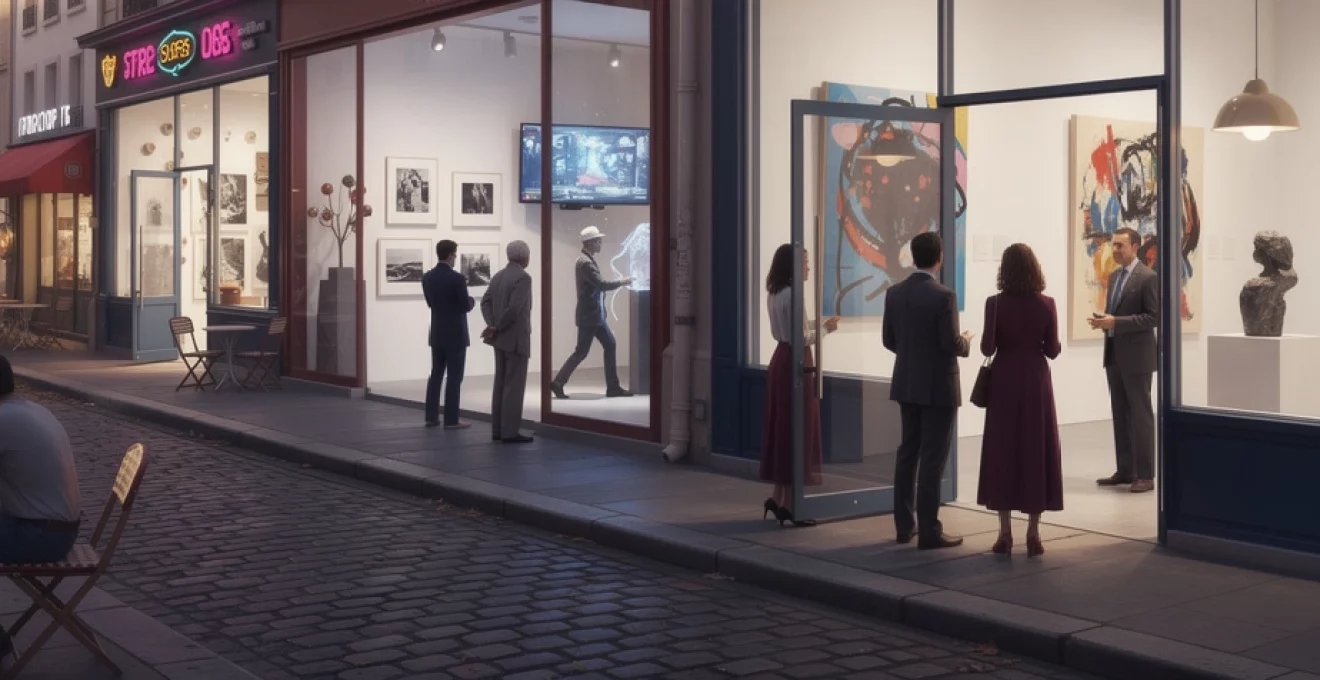
Saint-Germain-des-Prés stands as Paris’s most prestigious artistic enclave, where centuries of creative heritage blend seamlessly with cutting-edge contemporary expression. This Left Bank district, once home to Existentialist philosophers and post-war avant-garde movements, continues to shape the global art landscape through its exceptional concentration of galleries. The neighbourhood’s cobblestone streets harbour more contemporary art spaces than any other district in Paris, making it an essential destination for collectors, curators, and art enthusiasts seeking to understand the current pulse of international creativity.
From established blue-chip galleries representing internationally renowned artists to experimental project spaces showcasing emerging talent, Saint-Germain-des-Prés offers an unparalleled diversity of contemporary artistic voices. The district’s unique position between the Louvre and the École des Beaux-Arts creates a natural ecosystem where traditional French artistic education meets global contemporary practice, fostering a dynamic environment that continues to influence art markets worldwide.
Established Blue-Chip galleries in Saint-Germain-des-Prés
The established gallery scene in Saint-Germain-des-Prés represents the pinnacle of contemporary art dealing, with several internationally recognised institutions maintaining prestigious spaces throughout the district. These galleries have spent decades building relationships with museum directors, private collectors, and art fair organisers worldwide, establishing themselves as crucial intermediaries in the global art market.
Galerie lelong & co contemporary art programme
Founded in 1981, Galerie Lelong & Co has established itself as one of Europe’s most influential contemporary art dealers, representing a carefully curated roster of international artists whose work spans multiple generations and artistic movements. The gallery’s Saint-Germain location serves as the flagship for their global operations, which include spaces in New York and Zürich.
The gallery’s contemporary programme focuses particularly on artists exploring themes of social justice, environmental consciousness, and cultural identity. Recent exhibitions have featured works by prominent Latin American conceptual artists, African diaspora painters, and European installation artists whose practices challenge conventional gallery presentation formats. Their commitment to representing underrepresented voices in the art world has positioned them as leaders in promoting diversity within blue-chip gallery representation.
Galerie Lelong’s curatorial approach emphasises long-term artist development rather than market speculation, with many artists remaining with the gallery for decades. This stability allows for comprehensive solo presentations that can span entire careers, providing collectors and institutions with rare opportunities to acquire significant works from different periods of an artist’s development.
Galerie daniel templon’s international artist roster
Since 1966, Galerie Daniel Templon has maintained its position as one of Paris’s most internationally connected contemporary art spaces, representing artists whose work regularly appears in major biennials and museum exhibitions worldwide. The gallery’s Saint-Germain location showcases rotating exhibitions that reflect current trends in global contemporary practice while maintaining strong connections to French artistic traditions.
Templon’s artist roster includes painters, sculptors, and multimedia artists whose work addresses contemporary political and social issues through various experimental approaches. The gallery has been particularly successful in introducing European audiences to American pop art sensibilities while simultaneously promoting European artists in international markets. Their exhibition programme regularly features thematic group shows that explore current philosophical and aesthetic debates.
The gallery’s influence extends beyond traditional art dealing through their publishing programme, which produces comprehensive catalogues and artist monographs that contribute significantly to contemporary art scholarship. These publications often feature essays by leading art historians and critics, establishing important academic frameworks for understanding emerging artistic movements.
Galerie karsten greve’s european masters collection
Galerie Karsten Greve specialises in presenting work by established European contemporary masters alongside carefully selected emerging artists whose practices demonstrate exceptional technical and conceptual sophistication. The gallery’s approach combines museum-quality presentations with commercial accessibility, making significant contemporary works available to both institutional and private collectors.
Their exhibition programme frequently features retrospective presentations of work by artists who have shaped European contemporary art over the past five decades. These shows often include rarely seen early works alongside recent productions, providing comprehensive overviews of artistic development that are typically only available in museum contexts. The gallery’s commitment to scholarly presentation ensures that each exhibition contributes meaningfully to art historical
discourse, with detailed wall texts, archival documentation, and carefully researched exhibition catalogues accompanying major shows. Visitors interested in the evolution of European minimalism, post-war abstraction, or sculpture will find here a level of contextualisation that rivals major public museums while still allowing for intimate encounters with individual works. For collectors, Galerie Karsten Greve offers access to historically important pieces with clear provenance, making it a key stop for anyone mapping the landscape of blue-chip contemporary art in Saint-Germain-des-Prés.
Galerie marian goodman’s conceptual art exhibitions
Galerie Marian Goodman brought a distinctly international perspective to the Left Bank when it opened its Paris space, building on the gallery’s longstanding reputation in New York and London. Known for representing many of the most influential conceptual artists of the late 20th and early 21st centuries, the gallery has played a central role in shaping how contemporary art is collected, exhibited, and discussed. In Saint-Germain-des-Prés, its exhibitions often foreground time-based media, large-scale installations, and research-driven practices that challenge conventional notions of what a “painting” or “sculpture” can be.
The gallery’s programme frequently features artists whose work engages with politics, memory, and the structures of power that shape our everyday lives. Rather than prioritising purely aesthetic considerations, Marian Goodman tends to present projects that unfold like visual essays, where film, photography, and archival materials interact in complex ways. For visitors, this means exhibitions that may feel closer to walking through a thought experiment than a traditional commercial show, offering a deeper understanding of how conceptual art continues to evolve.
Because many of its represented artists appear regularly in institutions such as the Tate, MoMA, or the Centre Pompidou, the Saint-Germain space operates as a crucial bridge between the museum world and the private gallery scene. If you are planning a contemporary art itinerary in Paris that includes both major museums and independent galleries, scheduling a stop at Marian Goodman allows you to see ambitious projects in a more intimate setting. The gallery’s emphasis on rigorous curatorial frameworks and international collaboration makes it indispensable for anyone seriously interested in conceptual contemporary art.
Emerging contemporary art spaces and project galleries
Beyond the blue-chip institutions, Saint-Germain-des-Prés also nurtures a vibrant ecosystem of emerging contemporary art spaces and project galleries. These more agile venues often take greater curatorial risks, supporting early-career artists, experimental media, and installation formats that may not yet have found their place in the major fairs. For visitors, this is where you are most likely to encounter new names and unexpected practices that expand your understanding of contemporary art in Paris.
Many of these galleries operate almost like laboratories, testing new exhibition models, collaborative curating, and cross-disciplinary projects that blend performance, sound, and digital media. While their physical footprints may be smaller than those of established dealers, their impact on the wider art scene is significant: they often provide the first professional platform for artists who later join larger international galleries. If you are looking for the next generation of talent or want to experience contemporary art in its most experimental forms, these project spaces in Saint-Germain-des-Prés are essential stops.
Galerie papillon’s experimental installation works
Galerie Papillon has built its reputation on supporting artists whose practices push the boundaries of traditional mediums, particularly through installation art and site-specific interventions. Rather than focusing solely on painting or sculpture, the gallery encourages artists to reimagine the exhibition space itself as a material, transforming rooms into immersive environments. For visitors, this means that a single show can feel like stepping into a carefully constructed world where light, sound, and spatial perception are all part of the artwork.
The gallery’s curatorial strategy often foregrounds humour, poetry, and subtle social critique, inviting you to question how objects behave in space and how we navigate them. One exhibition might feature fragile, ephemeral materials that appear on the verge of collapse; another might use everyday objects in uncanny ways that shift your perception, much like a clever stage set. This focus on experimental installation makes Galerie Papillon a key destination for those interested in cutting-edge contemporary art experiences that go beyond traditional wall-hung works.
Collectors visiting the gallery will find that many of the works require careful consideration of site and context, a challenge that can be extremely rewarding. Acquiring an installation or modular piece often involves dialogue with the artist about how it can be adapted to domestic or institutional spaces, turning the act of collecting into a collaborative process. If you are curious about how to integrate large-scale or conceptual installations into a collection, Galerie Papillon offers both inspiration and practical guidance.
Galerie poggi’s multimedia art presentations
Galerie Poggi (formerly Galerie Jérôme Poggi) stands out in Saint-Germain-des-Prés for its strong commitment to multimedia practices and research-based art. Its exhibitions often merge photography, video, drawing, and sculpture into cohesive narratives, reflecting how contemporary artists no longer confine themselves to a single medium. As you move through a typical show, you might encounter archival documents next to abstract images, sound pieces complementing sculptural forms, or digital works that extend the exhibition into the online realm.
The gallery’s programme frequently engages with history, science, and philosophy, making it an ideal stop for visitors who appreciate intellectually rigorous contemporary art. Many artists represented by Galerie Poggi develop long-term projects that investigate topics such as memory, ecology, or the politics of representation, using multimedia strategies to layer meanings. This approach can feel similar to reading a complex novel rather than a short story: you are invited to spend time, move back and forth between pieces, and gradually assemble your own interpretation.
Because multimedia art can sometimes seem intimidating, the gallery places emphasis on accessible mediation, offering clear wall texts and often organising artist talks or guided visits. If you are new to video art or digital installations, this is a welcoming place to explore these forms in depth. The team’s experience with institutional collaborations also makes Galerie Poggi an important partner for museums and foundations looking to commission ambitious multimedia projects.
Galerie frank elbaz photography specialists
Galerie Frank Elbaz plays an important role in the Paris contemporary art ecosystem by maintaining a strong focus on photography while also supporting painting, sculpture, and conceptual practices. For visitors interested in how contemporary photography intersects with other media, this gallery offers an illuminating cross-section of approaches, from documentary-inspired series to staged images and experimental printing techniques. The exhibitions often highlight how photography has become a central language of contemporary art rather than a separate category.
Many of the gallery’s represented artists use the camera not simply as a recording tool, but as a means to question truth, memory, and the construction of images in a media-saturated world. You might encounter works that blur the line between photography and painting, or photo-based installations that occupy the room like sculptures. This hybrid approach reflects broader trends in global contemporary practice, where photography frequently acts as a bridge between traditional disciplines and newer digital forms.
For collectors, Galerie Frank Elbaz offers expert guidance on building a photography-focused contemporary art collection, from editioned prints to unique works and photo-based installations. Understanding questions of edition size, archival quality, and provenance is crucial in this field, and the gallery’s longstanding experience helps demystify these aspects. If you are considering investing in contemporary photography in Paris, including works that cross into conceptual art, adding this gallery to your Saint-Germain-des-Prés itinerary is highly recommended.
Galerie sultana’s performance art documentation
Galerie Sultana distinguishes itself through its dedication to performance-related practices and the often complex question of how ephemeral events can be collected, archived, and exhibited. Rather than treating performance as an unrepeatable moment, the gallery works closely with artists to develop forms of documentation—videos, photographs, scripts, scores, and objects—that retain the intensity of the live act. Visiting an exhibition here can feel like entering the afterlife of a performance, where traces and remains are reactivated in the gallery space.
This focus on performance documentation reflects a broader shift in the contemporary art world, where live practices have gained new institutional visibility but still present practical challenges for collectors and museums. How do you own a performance? What does it mean to preserve an artwork that was originally designed to be temporary? At Galerie Sultana, these questions become part of the exhibition narrative, encouraging you to think about art as a process rather than a fixed object.
For those interested in collecting performance-based work, the gallery offers rare expertise in negotiating editions, rights, and reactivation protocols. Acquiring a performance often involves securing the right to restage or present it under specific conditions, almost like acquiring a musical score rather than a single recording. If you are drawn to the energy of live contemporary art but unsure how it translates into a collection, Galerie Sultana provides a thoughtful introduction within the intimate setting of Saint-Germain-des-Prés.
Specialty contemporary art dealers and private collections
Alongside public-facing galleries, Saint-Germain-des-Prés is home to a network of specialty contemporary art dealers and discreet private collections that further enrich the area’s ecosystem. Often operating on an appointment-only basis, these spaces cater to dedicated collectors seeking highly specific types of work—such as design-art, post-war abstraction, or crossovers between decorative arts and contemporary sculpture. While they may not always be visible from the street, they play a crucial role in shaping the district’s reputation as a refined and intellectually engaged art hub.
Many of these dealers have backgrounds as curators, art historians, or auction specialists, bringing deep market knowledge to their advisory services. They can help you navigate questions such as: how do you balance established names with emerging artists in a collection, or how do you build a focused ensemble around a theme like “conceptual photography” or “contemporary ceramics”? In this sense, visiting a private dealer in Saint-Germain-des-Prés can feel less like shopping and more like entering a personalised research library of artworks.
Some of the most interesting specialty spaces in the area operate at the crossroads of contemporary art and design, showcasing limited-edition furniture by architects alongside sculptural works and experimental objects. This reflects a wider international trend where the boundaries between fine art, collectible design, and craft are increasingly porous. If you are planning a contemporary art tour of Saint-Germain-des-Prés, it is worth setting aside time to book at least one appointment with a private dealer, especially if you are interested in deepening or refining an existing collection.
Saint-germain-des-prés gallery district navigation routes
Navigating the dense gallery landscape of Saint-Germain-des-Prés can feel overwhelming at first glance, but with a bit of planning you can transform your visit into a coherent, enjoyable itinerary. The district’s relatively compact size makes it ideal for walking, allowing you to move from major contemporary art galleries to smaller project spaces in just a few minutes. Think of the area as a series of overlapping circuits centred around key streets such as Rue de Seine, Rue des Beaux-Arts, Rue Bonaparte, and the quays along the Seine.
One effective strategy is to structure your day around thematic routes—for example, a “blue-chip and museum-level” path in the morning, followed by an “experimental and emerging” circuit in the afternoon. You might begin with established galleries such as Lelong & Co, Templon, Karsten Greve, and Marian Goodman, then gradually work your way toward more intimate spaces like Papillon, Poggi, or a photography-focused stop at Frank Elbaz. This approach mirrors how curators plan biennials: moving from broad historical overviews to more focused, experimental propositions.
To help you visualise a potential day in the district, here is a simple orientation table you can adapt to your own interests and pace:
| Time of Day | Suggested Focus | Gallery Area |
|---|---|---|
| Morning | Blue-chip and museum-level exhibitions | Rue de Seine / Rue des Beaux-Arts |
| Early Afternoon | Conceptual and multimedia practices | Near École des Beaux-Arts / Quai Malaquais |
| Late Afternoon | Emerging art and project spaces | Side streets off Boulevard Saint-Germain |
When planning your route, remember that most contemporary art galleries in Saint-Germain-des-Prés are open from late morning to early evening, typically Tuesday to Saturday. It is wise to check the opening hours and current exhibitions in advance, as smaller project spaces may close for installation periods between shows. You can think of the gallery district like a constantly changing stage set: while the architecture remains the same, the “scenes” inside are regularly renewed, so even repeat visitors will always find something new.
Seasonal contemporary art events and vernissages schedule
The rhythm of contemporary art in Saint-Germain-des-Prés is punctuated by a series of seasonal events, vernissages, and coordinated openings that bring extra energy to the district. If you time your visit to coincide with these key moments, you will experience the neighbourhood at its most vibrant, with extended opening hours, artists present in the galleries, and a palpable sense of discovery in the air. Many of these events align with the broader Paris art calendar, creating synergies with fairs and museum exhibitions across the city.
Autumn is typically the most intense season, anchored by the major Paris art fairs that draw collectors, curators, and journalists from around the world. During this period, Saint-Germain galleries often synchronise their strongest exhibitions, unveiling ambitious solo shows or carefully curated group exhibitions. Spring brings its own wave of activity, with lighter, sometimes more experimental programming and numerous student-related events linked to the nearby École des Beaux-Arts. For you as a visitor, these periods offer the highest concentration of high-quality contemporary art within a short walking radius.
Vernissage evenings—usually held on Thursday nights—are another key feature of the local scene. On these occasions, galleries open new exhibitions with informal gatherings where you can meet artists, curators, and fellow enthusiasts, often with a glass of wine in hand. While these openings can be crowded, they provide a unique opportunity to sense how the community responds to new work, almost like attending a premiere in the theatre. If you prefer a quieter viewing experience, you might instead visit the same shows during daytime hours and treat vernissages as social events rather than viewing sessions.
Because exact dates change from year to year, the best strategy is to consult the galleries’ websites or sign up for their newsletters a few weeks before your planned trip. Many institutions in Saint-Germain-des-Prés coordinate their calendars, making it possible to attend multiple vernissages in a single evening by simply walking from one street to the next. Whether you are building a collection, researching for a curatorial project, or simply exploring contemporary art out of curiosity, aligning your schedule with these seasonal peaks will ensure that your experience of the district is as rich and rewarding as possible.