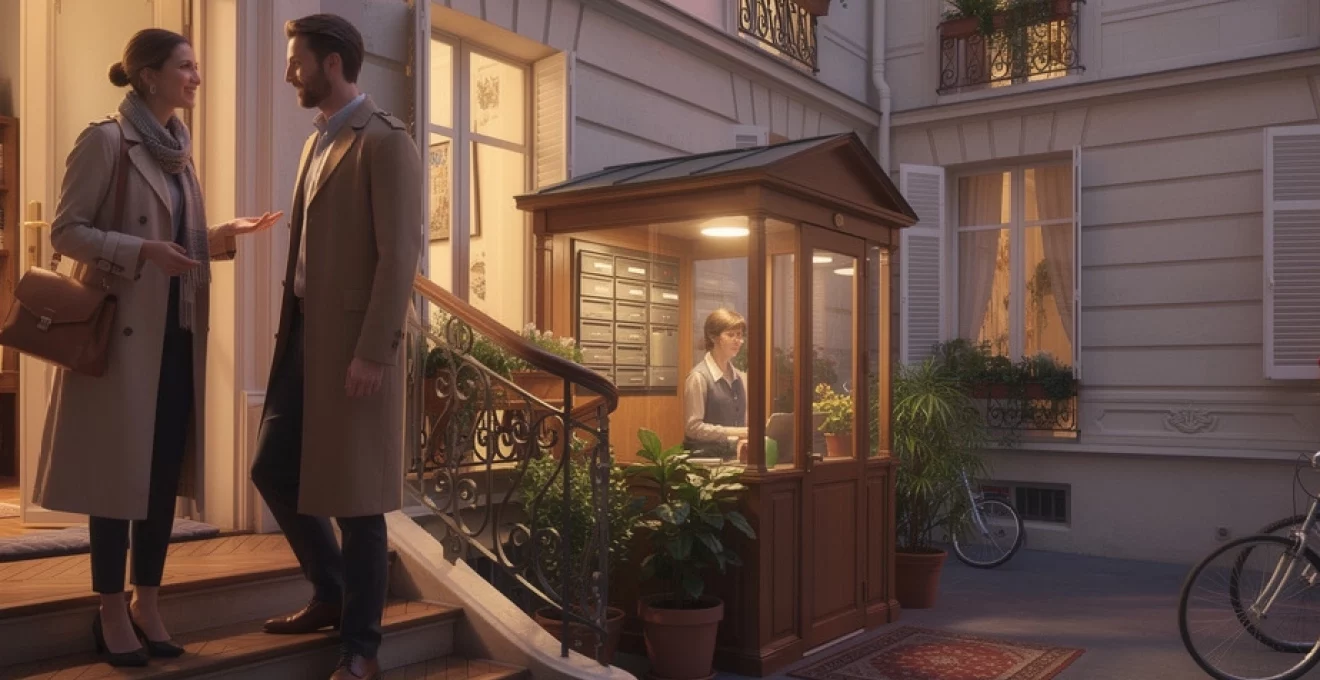
Living in a Parisian apartment building requires mastering an intricate ballet of social codes that extends far beyond simply paying your rent on time. The relationship between neighbors in Paris operates on an entirely different wavelength than what you might encounter in London, New York, or Berlin. This isn’t merely about being polite or friendly—it’s about understanding a centuries-old system of cohabitation that balances privacy with community, individual expression with collective responsibility.
The Parisian approach to neighborly relations reflects the city’s broader cultural values: a profound respect for personal boundaries coupled with an expectation of social grace. Whether you’re considering a move to the French capital or simply curious about how urban living works differently across cultures, understanding these dynamics offers fascinating insights into what makes Paris uniquely Parisian. From the moment you step into the building’s entrance hall to the late-night sounds that drift through century-old walls, every interaction carries meaning.
Navigating the unwritten social codes of parisian apartment buildings
The social architecture of a Parisian immeuble functions like an invisible framework that shapes daily interactions. Unlike apartment buildings in many other cities where residents might pass each other with barely a nod, Parisian buildings operate under a more nuanced system. You’re expected to acknowledge your neighbors, but not to become overly familiar. This delicate equilibrium can perplex newcomers who mistake French reserve for unfriendliness or, conversely, who attempt American-style neighborliness and find themselves politely rebuffed.
Understanding these codes begins with recognizing that Parisian apartment buildings often house the same families for generations. The woman on the third floor might have grown up in that very apartment; her children might attend the same school she did. This continuity creates a micro-community with its own history, hierarchies, and expectations. When you move into such a building, you’re not just renting square meters—you’re entering an established social ecosystem that predates you and will continue long after you leave.
The protocol of stairwell encounters and greeting etiquette
The stairwell greeting represents one of the most fundamental yet frequently misunderstood aspects of Parisian neighbor relations. When encountering a neighbor in the stairwell, hallway, or elevator, a simple “Bonjour” or “Bonsoir” is not optional—it’s obligatory. However, this greeting should be delivered with a specific tone: polite and clear, but not effusive. Making eye contact briefly is appropriate, but sustained eye contact might be interpreted as intrusive or confrontational.
What distinguishes Parisian stairwell etiquette is its context-dependency. If you encounter the same neighbor multiple times in a single day, subsequent greetings can be abbreviated to a simple nod or petit sourire. However, never ignore someone you’ve already greeted earlier—this would suggest either that you’ve forgotten them (insulting) or that you’re deliberately snubbing them (worse). The goal is to strike a balance between acknowledgment and discretion, recognizing each person’s presence without demanding their attention.
Respecting quiet hours: the sacred 22h00-07h00 window
Perhaps no aspect of Parisian cohabitation carries more weight than the strict observance of quiet hours. Between 22h00 (10 PM) and 07h00 (7 AM), apartment dwellers are expected to maintain a noise level that doesn’t disturb neighbors. This isn’t merely a suggestion—it’s backed by local regulations and can result in formal complaints, mediation proceedings, or even legal action if violated persistently.
The French concept of tranquillité extends beyond simple silence. It encompasses respect for the shared auditory environment. During quiet hours, you should avoid vacuuming, playing musical instruments, running washing machines, or hosting gatherings that generate sustained noise. Even activities you might consider quiet—such as moving furniture or hanging pictures—should be reserved for acceptable hours. Many Parisians will plan renovations or furniture assembly around the 14h00-16h00 window when neighbors might be out or more tolerant of disruption.
Mastering the art of the gardienne relationship
The gardienne
is far more than a glorified mail collector. In many traditional Parisian buildings, she is the quiet axis around which daily life turns: she receives parcels, monitors comings and goings, manages cleaning schedules, and often acts as a first filter for information from the syndic (property manager). For newcomers, mastering this relationship can make the difference between feeling like a tolerated transient and being accepted as a proper Parisian neighbor.
Basic rules apply. Always greet your gardienne by name, with a clear “Bonjour, Madame X,” and acknowledge her work when the hall gleams a little more than usual. Around Christmas, a small envelope with cash—often the equivalent of one or two days’ rent—is customary and more efficient than any formal complaint when you need help solving minor building issues. If you are planning disruptive works or expecting large deliveries, inform her ahead of time; she can warn neighbors, manage access to the courtyard, and in many cases will become your best ally in avoiding conflict. Treat her with the same formal respect you would show a civil servant, because in the micro-state of the building, that is exactly what she is.
Proper conduct during assemblées générales de copropriété
The annual Assemblée Générale de Copropriété (AG) is where the building’s real politics unfold. Even if you are a tenant rather than an owner, understanding what happens in this meeting helps you decode later hallway tensions. Owners gather, often in the lobby or a nearby meeting room, to vote on budgets, building works, insurance, and regulations—everything from façade repainting to the fate of the bike rack. The atmosphere can range from sleepy bureaucracy to near-operatic drama, depending on the stakes and the personalities involved.
Proper conduct follows an unspoken script. Arrive on time, sign the attendance sheet, and listen before you speak; interrupting or talking over older co-owners is badly received, even if you are technically in the right. When presenting a request—say, installing a new extractor fan or enclosing a balcony—come prepared with quotes, references to building rules, and an awareness of costs to others. If you are a tenant attending as a proxy for your landlord, remember that you are representing someone else’s interests; consulting them beforehand and debriefing afterward is both courteous and strategically wise. Above all, remember that today’s adversary in the AG is still tomorrow’s neighbor in the stairwell.
Architectural acoustics and noise management in haussmannian buildings
To understand Parisian neighbor relations, you have to understand Parisian walls and floors. Most Haussmannian and pre-1900 apartment buildings were not designed with modern sound insulation in mind. Thin partitions, hollow doors, and original parquet laid directly on joists mean that everyday noise travels in unexpected ways. The result is a kind of enforced intimacy: you may know your neighbor’s routine, musical tastes, and even their preferred brand of vacuum cleaner without ever having set foot in their apartment.
This acoustic transparency explains why the Parisian obsession with tranquillité is so strong. It also means that being a good Parisian neighbor is as much about understanding the physics of your building as it is about mastering its social codes. By learning how sound moves through your immeuble ancien, you can anticipate potential conflicts and adopt small habits that make a disproportionate difference to collective comfort.
Understanding parquet flooring sound transmission in pre-1900 constructions
Original parquet floors are one of the great aesthetic joys of Parisian apartments—and one of their main acoustic challenges. Unlike modern floating floors with underlay, Haussmannian parquet often rests directly on wooden joists above the downstairs ceiling. Every heel strike, dropped object, or shifting chair leg can transform into a low thud or sharp crack one or two floors below. Add the fact that many residents still wear shoes indoors, and you start to understand why footsteps are a common source of complaint.
Mitigating this requires both awareness and a few practical adjustments. Area rugs with dense underlay in high-traffic zones (hallways, living rooms, children’s rooms) can significantly reduce impact noise. Felt pads under chair and table legs are inexpensive yet dramatically soften the sound of furniture movement—particularly important in dining rooms above bedrooms. If you enjoy at-home workouts or have children who love to run, try to schedule the noisiest activities outside the 22h00–07h00 window and, ideally, away from the room that sits over your neighbor’s bedroom. Think of your parquet as a shared instrument: beautiful when handled gently, unbearable when played without restraint.
The bruit de voisinage legal framework and décibel thresholds
Behind the cultural norm of quiet lies a clear legal framework: bruit de voisinage (neighborhood noise) is regulated at both national and municipal levels. French law distinguishes between bruits de comportement (everyday behavior noise) and bruits d’activités (business or construction noise). In residential settings, a noise can be considered illegal if it is “anormalement répétitif, intensif ou durable”—abnormally repetitive, intense, or lasting—regardless of the exact decibel level. In practice, however, acoustic experts use measurable thresholds: a variation of more than 5 dB during the day or 3 dB at night, compared to background noise, can be deemed excessive.
What does that mean for you in real life? Occasional laughter, a dropped pan, or a weekend lunch with friends are tolerated as part of normal city living. Regular late-night parties, amplified music, or daily drilling at 7 AM are not. If you are hosting an event, warn your direct neighbors and keep windows closed after 22h00—sound escapes courtyards and lightwells like an echo chamber. Should you be on the receiving end of chronic noise, the Parisian protocol favors escalation in stages: a polite conversation, a written note, involvement of the syndic or gardienne, and only then, if necessary, a formal complaint to the police (main courante) or a mediator. Jumping straight to legal threats is rarely appreciated and can poison long-term relations.
Soundproofing techniques for shared walls in immeubles anciens
If you plan to stay long-term in a Parisian apartment, investing in basic soundproofing is one of the smartest decisions you can make—for your own comfort and for neighborly peace. Full acoustic renovations can be costly and complex, but even modest interventions help. On shared walls, adding a layer of plasterboard (placo phonique) on resilient channels with mineral wool behind can reduce airborne noise transmission significantly. For ceilings, a suspended structure with acoustic hangers may be necessary, but even a simpler “false ceiling” can dampen impact sounds.
On the floor side, if replacing parquet is on the agenda, insist on acoustic underlay compliant with current French norms (ΔLw rating), and discuss this with both your contractor and the syndic before work begins. Seal gaps around pipes, electrical outlets, and skirting boards, as these small openings often act like sound leaks. Finally, remember that furniture placement matters: placing bookcases, wardrobes, or even heavy curtains along shared walls can act as an informal buffer. Soundproofing in Paris is like wearing a well-cut coat in winter—not legally mandatory, but everyone is grateful when you have one.
The parisian courtyard ecosystem: shared space dynamics
Many Parisian buildings revolve around an internal courtyard, the cour intérieure, which functions as both a lightwell and a shared living space. Laundry rooms, bike racks, recycling bins, and sometimes even tiny gardens coexist in a few dozen square meters glimpsed from dozens of windows. The courtyard is a vertical village square where smells, sounds, and habits intersect; what you do there is visible and audible to almost everyone in the building.
This density makes the courtyard a sensitive zone for neighbor relations. Hanging laundry, storing bulky items, taking phone calls, or having a cigarette may all be technically allowed yet socially regulated. Understanding the unwritten rules of the courtyard ecosystem will help you navigate this semi-public space without becoming “le voisin problématique” everyone complains about during the next AG.
Bicycle storage protocols in cours intérieures
With Paris investing heavily in cycling infrastructure—daily bike trips have more than doubled in the last decade—bicycles have become a permanent feature of many courtyards. Yet space is finite, and stacking bikes chaotically against walls or blocking access doors is a fast track to conflict. Most règlements de copropriété specify where bikes can be stored: designated racks, hooks in cellars, or a clearly marked area of the courtyard. Ignoring these rules is seen not just as disorganized but as disrespectful of collective space.
As a rule of thumb, store your bicycle in the narrowest configuration possible, lock it to an existing rack rather than a random pipe, and avoid bringing muddy wheels across freshly cleaned tiles. If your building does not yet have adequate bike storage, raising the topic at the AG with concrete proposals and quotes is often appreciated—especially if you show concern for preserving façade aesthetics and circulation space. And however tempting it may be, never chain your bike to the ornamental cast-iron banister in the entry hall; that detail alone can spark a multi-year debate.
Window box gardening regulations and façade aesthetics
Flower-filled window boxes are part of Paris’s postcard charm, but they are not purely decorative; they are also regulated by safety and aesthetic considerations. The règlement de copropriété or city bylaws often specify that planters must be secured inside the railing rather than perched on the outside ledge, to avoid the risk of a pot falling onto the sidewalk or into the courtyard. In some protected districts, there may even be restrictions on visible materials and colors to maintain façade uniformity.
From a neighborly perspective, the key is to think vertically. When you water your geraniums, where does the runoff go? If it drips onto your downstairs neighbor’s freshly cleaned windows or laundry, expect a knock at the door. Using saucers under pots, watering in the early morning rather than during peak courtyard activity, and trimming any exuberant plants that encroach on a neighbor’s view are all part of responsible Parisian window gardening. You are effectively curating a micro-garden for an audience of dozens; the goal is to delight, not to annoy.
Managing cigarette smoke etiquette on balconies and terrasses
Balconies and tiny terrasses are prized in Paris, but they also concentrate one of the most frequent friction points between neighbors: cigarette smoke. Legally, smoking on your private outdoor space is permitted, yet in practice, smoke rarely respects property boundaries. On still evenings, it can drift upwards and sideways into open windows, bedrooms, or children’s rooms, triggering tensions that are as much about lifestyle differences as about health concerns.
Good etiquette starts with awareness. If you smoke, try to step to the outer edge of your balcony, away from the interior lightwell; smoke rises, but air currents in courtyards can push it straight back into neighbors’ windows. Short, infrequent breaks are usually tolerated; chain-smoking late into the night with loud conversation is not. If you are bothered by a neighbor’s smoke, a calm, non-accusatory conversation—framing the issue around specific times or rooms affected—often leads to compromises such as closing windows during certain hours or choosing a different smoking spot. In a city where outdoor space is rare, a bit of mutual flexibility goes a long way.
Domestic rituals that define parisian neighbourliness
Beyond regulations and architecture, what truly defines a good Parisian neighbor are the small, recurrent gestures that stitch daily life together. Parisian neighborliness is rarely grand or demonstrative; it is discreet, ritualized, and often framed by a certain ironic distance. You are unlikely to be invited to a backyard barbecue with everyone in the building, but you may well exchange home-baked cake at New Year’s, feed a cat for a weekend, or keep a spare set of keys for the person across the hall.
Several domestic rituals stand out. Garbage routines—respecting recycling bins, not overfilling containers, taking down bulky items on the proper day—signal your integration into the collective rhythm. Lending and borrowing is another: a screwdriver, a ladder, a hand to carry a washing machine up the stairs. The Parisian code expects you to offer help when it is clearly needed, but not to insist; to accept assistance gracefully, but not to overuse it. A short handwritten note slipped under a door to thank a neighbor for watering plants or signing for a parcel is often remembered long after the favor itself.
Digital age neighbour relations: WhatsApp groups and collaborative platforms
While the clichés of Parisian life tend to focus on stone staircases and brass mailboxes, neighbor relations have quietly migrated online as well. Many copropriétés now maintain WhatsApp groups, email lists, or use collaborative platforms to coordinate building life. These digital spaces can make communication more fluid—sharing information about plumber visits, lost packages, or suspicious activity—but they also import all the challenges of online etiquette into the microcosm of the building.
Used well, a building WhatsApp group functions like an efficient digital notice board. Residents can quickly flag a broken entry door, propose a group order for heating oil, or poll others about preferred dates for façade works. However, the same principles that govern physical neighborliness apply: keep messages concise, relevant to everyone, and within reasonable hours. Sending political memes at midnight or using the group to publicly shame a noisy neighbor is considered as bad form as shouting across the courtyard.
In parallel, citywide platforms for sharing tools, organizing babysitting swaps, or lending out seldom-used items have taken root in Paris. Participating in these networks can deepen your connection to the neighborhood beyond your own building, turning anonymous urban blocks into communities of mutual aid. Still, it is wise to maintain the Parisian balance between openness and privacy: share your drill, not your entire life story. In a city that has always prized both independence and interdependence, the digital layer is simply the latest expression of an old art—the subtle art of being a good Parisian neighbor.