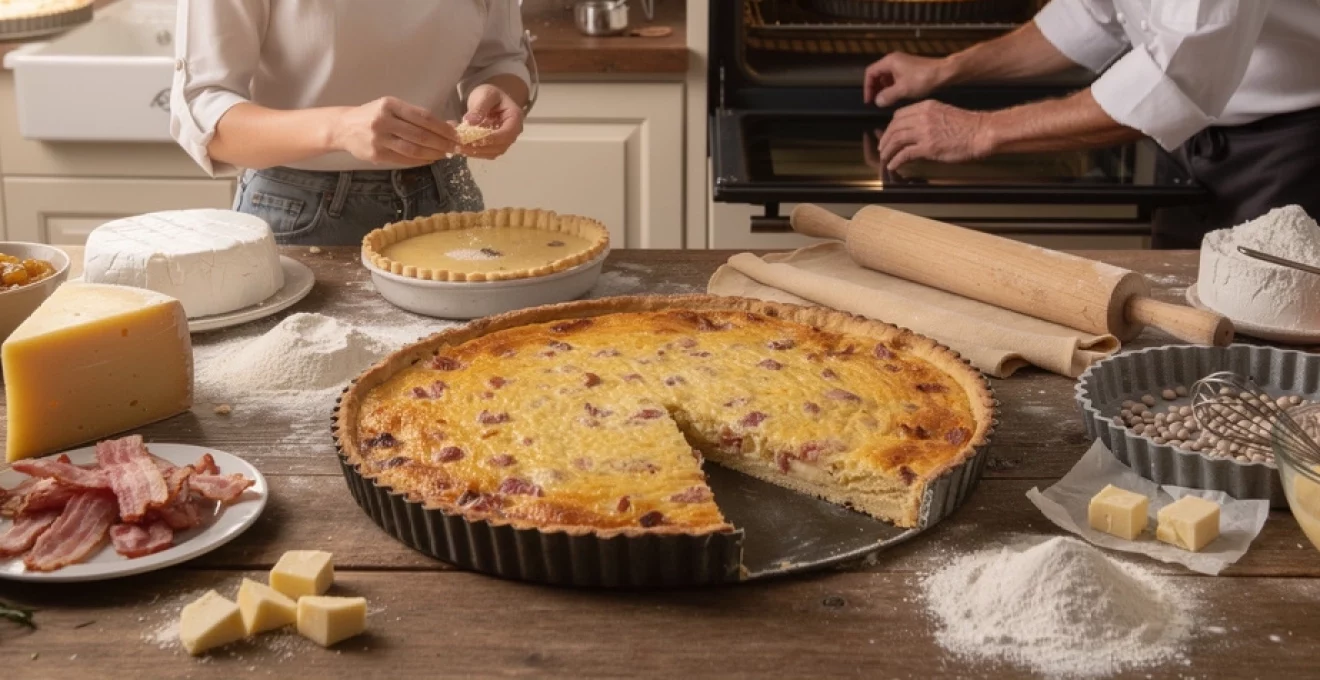
The art of French quiche-making represents one of gastronomy’s most elegant demonstrations of culinary precision. This beloved savoury tart has transcended its humble origins in the Lorraine region to become a cornerstone of sophisticated home cooking. Yet beneath its seemingly simple exterior lies a complex interplay of techniques, ingredients, and timing that separates exceptional quiches from their disappointing mass-produced counterparts. Understanding these fundamental principles transforms what many consider a basic dish into a masterpiece of French culinary tradition.
From the delicate balance of custard ratios to the scientific precision required for perfect pastry, creating an authentic French quiche demands both technical knowledge and intuitive understanding. The difference between a mediocre quiche and an extraordinary one often lies in mastering seemingly minor details that professional chefs have refined over generations.
Traditional french quiche techniques and regional variations
French regional cuisine offers remarkable diversity in quiche preparation, each area contributing distinctive techniques and flavour profiles that reflect local ingredients and culinary heritage. These variations demonstrate how traditional recipes evolve while maintaining their essential character and quality standards.
Quiche lorraine: mastering the original bacon and gruyère formula
The authentic Quiche Lorraine represents the gold standard of French quiche-making, though historical purists argue against the inclusion of cheese in truly traditional versions. Modern interpretations typically incorporate lardons fumés (smoked bacon lardons) and Gruyère cheese, creating a harmonious balance between smoky, salty, and creamy elements. The key lies in achieving the proper bacon-to-custard ratio, ensuring the meat provides flavour enhancement without overwhelming the delicate egg base.
Professional chefs recommend using dry-cured bacon cut into uniform 1cm pieces, gently rendered to remove excess fat while preserving texture. The bacon should achieve a light golden colour without becoming crisp, as overcooking creates an unpleasant contrast with the silky custard. Temperature control during this process proves crucial, maintaining medium heat to allow gradual fat rendering.
Quiche alsacienne: incorporating munster cheese and onion confit methods
Alsace region’s distinctive quiche combines the pungent character of Munster cheese with slowly caramelised onions, creating complex flavour layers that exemplify French provincial cooking. The onion confit requires patient preparation, cooking thinly sliced onions over low heat for 45-60 minutes until they achieve deep amber colouration and concentrated sweetness.
Munster cheese integration demands careful consideration of its strong aroma and creamy texture. Professional techniques involve incorporating the cheese in two stages: mixing half into the custard base for even distribution, then reserving the remainder for surface garnish. This approach prevents the cheese from overwhelming other flavours while ensuring consistent distribution throughout the tart.
Provençal quiche: mediterranean herb integration and goat cheese selection
Southern French quiche variations showcase Mediterranean ingredients, particularly herbs de Provence and fresh goat cheese. The herb integration requires understanding which varieties withstand baking temperatures without losing their essential oils. Thyme, rosemary, and oregano maintain their potency during cooking, while basil and parsley benefit from last-minute addition.
Goat cheese selection significantly impacts the final result. Fresh chèvre provides tangy brightness and creamy texture, while aged varieties contribute more complex, assertive flavours. Professional chefs often combine both types, using fresh goat cheese in the custard base and crumbled aged cheese as surface decoration.
Normandy apple quiche: balancing sweet calvados reduction techniques
Normandy’s apple quiche demonstrates French cuisine’s masterful integration of sweet and savoury elements. This sophisticated variation requires careful apple preparation and Calvados reduction to prevent excessive moisture from compromising the custard structure. Apples must be pre-cooked to remove moisture content while maintaining their shape and texture.
The Calvados reduction technique involves simmering the apple brandy with a touch of cream and thyme until it achieves syrupy consistency. This concentrated flavour base integrates into the custard, providing depth without overwhelming the
other ingredients. When executed correctly, this Normandy-style quiche delivers a subtle sweetness that enhances rather than competes with the savoury custard, making it a sophisticated choice for those who enjoy exploring regional French quiche variations.
Pâte brisée mastery: creating the foundation pastry
A flawless French quiche begins with impeccably made pâte brisée, the classic shortcrust that provides structure and contrast to the velvety custard. While many home cooks focus primarily on fillings, professionals know that a perfectly baked, shatteringly crisp base distinguishes a restaurant-quality quiche from an average one. The goal is a pastry that stays thin, tender, and dry from first slice to last, even when the custard is luxuriously rich. Achieving this requires precise flour choice, disciplined butter handling, and proper blind baking technique.
Flour selection: T55 versus plain flour impact on texture
French bakers traditionally favour T55 flour for pâte brisée, a low-ash, medium-protein flour that balances tenderness with enough structure to hold the custard. When you use T55 for a classic French quiche, the crust tends to bake up slightly more elastic and less crumbly than one made with standard all-purpose flour. This subtle difference helps prevent cracking and improves slicing, especially for deep-dish quiches served at room temperature. If T55 is unavailable, choose a plain flour with around 9–10% protein content and avoid strong bread flours that toughen the crust.
For those seeking a particularly delicate pastry shell, substituting 10–15% of the wheat flour with finely ground rice flour or cornstarch can reduce gluten development and increase friability. However, such modifications demand careful handling, as the dough becomes more fragile during rolling and lining. You may wonder whether these nuanced flour choices truly matter for home baking; in blind tastings, experienced tasters consistently describe T55-based crusts as “cleaner” and “less doughy” in the mouth, an advantage that becomes more apparent as the quiche cools.
Butter temperature control and fraisage technique application
The temperature and handling of butter play a decisive role in the final pastry texture. For pâte brisée, butter should be cold but malleable, generally around 8–12°C, firm enough to resist melting under your fingers yet soft enough to be worked quickly into the flour. Cutting the butter into small cubes and chilling them for at least 20 minutes before mixing helps maintain this ideal state. As you rub or pulse the butter into the flour, aim for a mixture that resembles coarse sand with a few visible pea-sized pieces; these discreet pockets of fat are what create delicate layers in the baked crust.
Professional chefs often finish the dough using the classic fraisage technique, gently smearing small portions of dough with the heel of the hand on the work surface. This controlled smearing aligns the fat and flour into thin layers without overworking the gluten, yielding a crust that is simultaneously cohesive and tender. Think of it as laminating the dough on a miniature scale, a refined alternative to rough puff methods used in some quiche recipes. Once the dough just comes together, it should be pressed into a flat disc, wrapped tightly, and rested in the refrigerator for at least 30–60 minutes to relax gluten and fully hydrate the flour.
Blind baking methods: preventing soggy bottom syndrome
Blind baking is the most effective defence against the notorious “soggy bottom” that can ruin an otherwise perfect French quiche. The objective is to fully set and partially brown the pastry shell before introducing any liquid custard, creating a protective barrier that resists moisture. For a standard 23cm tart ring, a two-stage baking process works best: an initial 15–20 minutes at 190–200°C with weights, followed by 5–10 minutes unweighted to dry and colour the base.
To enhance crispness, many professionals brush the hot, partially baked shell with lightly beaten egg white and return it to the oven for a brief 3–5 minutes. This creates a thin protein film that seals micro-cracks and increases resistance to the custard’s moisture, particularly useful for high-cream or cheese-rich fillings. Using a preheated baking stone or heavy steel under the tart tin further improves heat transfer to the base, promoting rapid setting. Once you adopt this disciplined blind baking process, you will notice that your quiche slices cleanly and the pastry remains crisp even several hours after baking.
Docking and ceramic bean weighting protocols
Docking—the practice of pricking the pastry base with a fork—serves to release trapped air and prevent excessive puffing during blind baking. For quiche, where an even, thin base is essential, docking should be thorough but controlled: small, evenly spaced pricks across the surface, avoiding any tears near the sides that could later leak custard. Over-docking can weaken the structure, so aim for a pattern that resembles a fine grid rather than random punctures.
Ceramic baking beans or metal pie weights remain the most reliable tools for keeping the pastry in place, though dried pulses also work in a home kitchen. Line the chilled pastry case with baking parchment or foil, pressing it firmly into the corners and up the sides, then fill it to the brim with weights to support the walls and prevent slippage. After the first baking phase, the weights are removed to allow the base to crisp and colour. Curious why this step matters so much? In professional kitchens, skipping full-weight blind baking almost guarantees shrinkage, warped sides, and unevenly baked crust that undermines even the most refined custard.
Custard base chemistry: achieving silky texture through precision
The custard filling is the heart of any French quiche, and its texture depends on a precise balance of fat, protein, and gentle heat. At its core, quiche custard is a savoury crème custard, similar in principle to crème brûlée but baked in a shallow shell rather than individual ramekins. The challenge lies in achieving a set yet trembling centre, free of graininess or weeping whey. Understanding the chemistry behind egg coagulation and dairy selection allows you to fine-tune your recipe for consistently silky results.
Egg-to-cream ratios: double cream versus crème fraîche applications
A classic French quiche relies on a relatively high ratio of egg to dairy, often around one large egg (or equivalent in yolks) for every 80–100ml of liquid. For a deep 23cm quiche, many professionals work with approximately 4 whole eggs plus 2 yolks to 350–400ml of cream, yielding a rich, gently wobbling custard that slices cleanly. Double cream provides luxurious mouthfeel and a stable emulsion, thanks to its higher fat content, which protects proteins from over-coagulation. However, an all-double-cream base can feel heavy, particularly for lunchtime service or warm-weather entertaining.
Crème fraîche introduces a subtle tang and slightly firmer set due to its higher solids content and mild acidity. Many modern French quiche recipes use a blend—often half double cream and half crème fraîche—to achieve a balance between richness and lightness. If you prefer a more everyday quiche, incorporating up to one-third whole milk can reduce density while maintaining a pleasing texture, provided you do not dilute the egg content excessively. Think of the egg-to-cream ratio as the quiche’s “architecture”: too little egg and the filling slumps and tastes bland; too much egg and it veers towards a firm omelette.
Nutmeg and white pepper seasoning calibration
Traditional French quiche seasoning is remarkably restrained, often limited to salt, freshly grated nutmeg, and finely ground white pepper. Nutmeg, when used sparingly, enhances the dairy’s natural sweetness and gives the custard a subtle warmth that many people associate with classic Quiche Lorraine. The key is calibration: for a standard 23cm quiche, a mere 2–3 light scrapings from a whole nutmeg, or roughly 1/8 teaspoon, is sufficient. Anything more risks overwhelming the delicate egg flavour and creating an unwelcome resemblance to dessert custard.
White pepper offers fragrant heat without visible specks, preserving the custard’s elegant pale appearance. Its flavour is more floral and immediate than black pepper, which can taste harsh in a gentle egg base. Season the cream mixture generously but thoughtfully, tasting before adding the eggs if possible. You might ask whether additional herbs or spices have a place in a perfect French quiche; outside regional variants such as Provençal versions with herbs de Provence, keeping the seasoning palette minimal allows the primary ingredients—smoky lardons, aged cheese, or tender vegetables—to shine.
Temperature gradient control during baking process
Managing oven temperature is critical to ensuring the quiche custard sets evenly from edge to centre without curdling. Professional kitchens often bake quiches at a slightly higher initial temperature, around 190–200°C, for the first 10–12 minutes to encourage rapid edge setting and proper pastry expansion. The heat is then reduced to 160–170°C to allow the centre to set gently, preserving a smooth, creamy texture. This two-stage baking approach creates a favourable temperature gradient, with the edges slightly firmer but not rubbery.
Placing the quiche on a preheated baking stone or heavy tray further stabilises this gradient by delivering strong bottom heat, preventing under-baked centres and pale bases. Rotating the tart halfway through baking compensates for typical domestic oven hot spots, a simple step that markedly improves consistency. An internal custard temperature of around 80–82°C at the centre, measured with a probe thermometer, usually indicates an ideal “set but still trembling” state. If you rely solely on visual cues, look for a gently puffed surface with a 3–4cm central area that still shivers slightly when the tin is nudged.
Protein coagulation science and curdling prevention methods
At a molecular level, quiche custard sets when egg proteins denature and form a delicate network that traps liquid and fat. This process begins around 62–65°C and accelerates as the temperature rises, but if the custard exceeds roughly 85°C, the proteins contract too much, squeezing out moisture and creating a curdled, watery texture. Preventing this requires both measured oven temperatures and a well-emulsified custard mixture. Thorough but gentle whisking helps distribute the proteins evenly, avoiding dense pockets of egg that can overcook.
Adding salt and dairy before incorporating eggs provides a more forgiving environment, as fat and dissolved salts slightly raise the coagulation temperature and buffer against sudden changes. Over-whisking, however, can introduce excess air, leading to an overly puffy quiche that collapses and develops a spongy mouthfeel. Think of the ideal custard as a well-inflated air mattress rather than a stiff board; it should support toppings while yielding softly under the fork. If you notice fine bubbles forming on the surface before baking, rap the tin gently on the counter to release them, reducing the risk of foamy, uneven texture.
Professional filling distribution and layering strategies
How you arrange fillings within the pastry shell has a marked impact on both texture and presentation. Professional chefs rarely scatter ingredients randomly; instead, they consider density, moisture content, and visual appeal when layering. Heavier elements such as lardons, sautéed mushrooms, or potato slices are typically placed first on the base, creating a stable foundation. Medium-density items like softened leeks or wilted spinach follow, with lighter components—herbs, crumbled cheese, or thin vegetable slices—reserved for the upper layers.
To prevent fillings from sinking en masse, many experts add the custard in two stages. First, pour in about two-thirds of the liquid, then gently distribute a portion of the fillings, allowing them to “catch” as the mixture begins to set in the hot oven. After a few minutes, the remaining fillings can be added near the surface, sometimes with an extra drizzle of custard to barely cover them. This technique, used in high-end patisseries, ensures that each slice of quiche displays attractive, evenly suspended pieces rather than a dense, overloaded bottom.
Moisture control remains crucial in professional filling strategy. Vegetables like spinach, mushrooms, or courgettes should be thoroughly pre-cooked and drained, with excess moisture squeezed out or reduced in the pan before they ever meet the custard. Cheese is best added in measured quantities, often half mixed into the filling and half reserved for the top to create a controlled gratin effect. By thinking of the quiche as a layered composition rather than a simple mixture, you achieve not only better structure and flavour distribution but also a visually refined tart that looks as elegant as it tastes.
Oven temperature modulation and timing protocols
Even the most carefully constructed quiche can fail without disciplined oven management. Professional kitchens rely on standardised temperature curves and timing protocols to produce consistent results across multiple batches. As a general rule, once the pastry has been blind baked, the filled quiche is introduced into a relatively hot oven—around 190–200°C—to encourage immediate edge setting and proper oven spring. After 8–12 minutes, when the custard just begins to puff at the perimeter, the temperature is reduced to 160–170°C for the remainder of the baking time.
For a 3cm-deep, 23cm-diameter quiche, total baking time typically ranges from 30 to 40 minutes, depending on the oven’s accuracy and how heavy the filling is. Fan-assisted ovens may require a 10–20°C reduction to avoid over-browning the surface before the centre is ready. It is helpful to think of quiche baking like roasting a delicate piece of fish: firm doneness throughout is not the goal; rather, you aim for a just-set interior that continues to stabilise off the heat. Allowing the quiche to rest for at least 20–30 minutes before slicing enables the custard to finish setting and the flavours to meld, significantly improving both texture and taste.
Positioning in the oven also contributes to success. Baking the quiche on the lower third rack promotes better bottom heat exposure, reducing the risk of under-baked pastry or a pale base. If the surface colours too quickly, a loose foil tent can shield it while the centre finishes cooking. Many professionals keep a simple log of baking times, oven settings, and quiche depth for their particular equipment; by doing the same at home, you quickly develop a reliable protocol tailored to your oven’s quirks.
Troubleshooting common quiche defects and solutions
Even experienced cooks occasionally encounter quiche problems, but most defects can be traced to a handful of common causes. A watery or weeping quiche usually indicates either an overbaked custard, excess moisture in the fillings, or an incorrect dairy ratio with too much low-fat milk. To remedy this, increase pre-cooking and draining of vegetables, return to a higher-fat cream or crème fraîche base, and monitor internal temperature more closely, removing the quiche when it just reaches a gentle wobble. If you find liquid pooling after slicing, it is often a sign the quiche was cut too soon; extending the resting period helps the custard stabilise.
A rubbery or spongy texture typically results from either too high a baking temperature or an egg-heavy mixture. Reducing the oven temperature by 10–20°C and modestly increasing the cream component restores a softer, more custard-like consistency. Cracked or shrunken pastry points to overworked dough, insufficient resting time, or incomplete blind baking with inadequate weight support. In future batches, handle the dough more gently, allow ample chilling, and ensure your parchment and weights press firmly against the sides as well as the base.
Another frequent complaint is a bland or “flat” flavour profile, despite using quality ingredients. This often stems from cautious under-seasoning, particularly when crème fraîche and cheese are involved, as their richness can mute salt and spice perception. Tasting the dairy mixture before adding eggs—adjusting salt, nutmeg, and white pepper at that stage—helps avoid this issue. Finally, if your quiche consistently develops an uneven surface with large bubbles or domes, you are likely introducing too much air during whisking or baking at an excessively high initial temperature. Stir rather than vigorously whip the custard, tap the filled tin gently on the counter to release bubbles, and adopt the two-stage heat strategy to keep the surface smooth and refined.