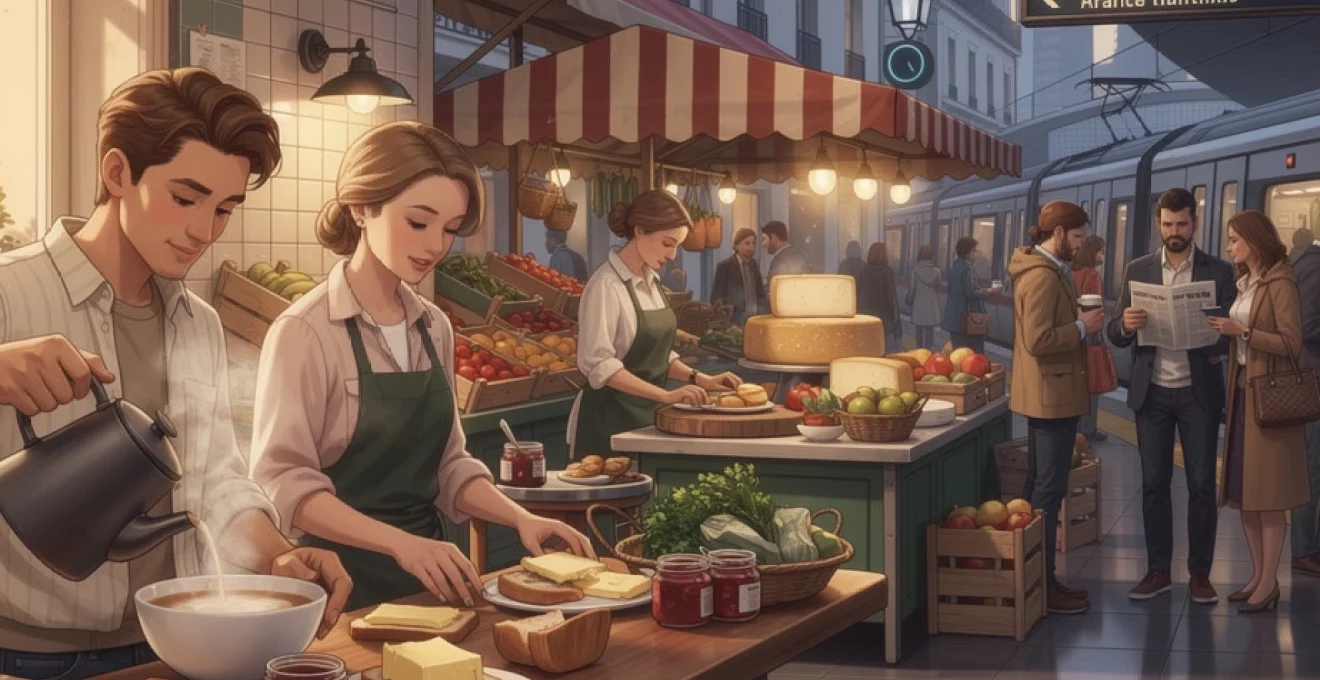
The morning hours in Paris reveal a city that moves with intention and grace. From the first rays of sunlight filtering through Haussmannian windows to the gentle hum of espresso machines in neighbourhood cafés, Parisians have mastered the art of beginning each day with purpose. This sophisticated approach to morning rituals extends far beyond simple habit—it represents a cultural philosophy that values quality over quantity, mindfulness over haste, and authentic connections over superficial interactions.
Understanding how Parisians start their day offers valuable insights into a lifestyle that prioritises wellness, community, and personal satisfaction. Their morning routines encompass everything from carefully curated breakfast rituals to strategic navigation of the city’s bustling markets and transport systems. These practices reflect deeper cultural values about taking time for oneself, maintaining meaningful relationships with local vendors, and finding moments of tranquillity within urban life.
Traditional french breakfast rituals in parisian households
The foundation of a Parisian morning lies in the breakfast ritual, which differs significantly from the rushed, grab-and-go culture found in many other metropolitan areas. French breakfast culture emphasises savouring the moment, creating a peaceful transition from sleep to the day’s activities. This approach treats the first meal as an opportunity for mindfulness and personal care rather than merely fuel consumption.
Parisian households typically dedicate 20 to 30 minutes to breakfast, even on busy weekdays. This time allocation reflects the cultural belief that starting the day properly influences productivity, mood, and overall wellbeing throughout the remaining hours. The setting matters as much as the food itself—many Parisians arrange their breakfast items on proper plates and use ceramic cups rather than disposable containers, creating an atmosphere of respect for the meal.
Café au lait preparation techniques using french press methods
The preparation of café au lait represents one of the most cherished morning traditions in Parisian homes. Using a French press, known locally as a cafetière à piston, allows for precise control over brewing time and coffee strength. The process begins with coarsely ground coffee beans, typically a medium-dark roast that provides robust flavour without overwhelming bitterness.
Water temperature proves crucial in achieving the perfect café au lait—Parisians heat water to approximately 96°C, just below boiling point. The coffee grounds steep for exactly four minutes before pressing, creating a full-bodied base. Equal parts of this strong coffee combine with warm, frothed milk, heated in a small saucepan until it reaches the ideal temperature of 65°C. This methodical approach ensures consistency and allows the drinker to fully appreciate the coffee’s aromatic qualities.
Tartine assembly protocols with beurre président and confiture bonne maman
The tartine represents simplicity elevated to an art form. This open-faced sandwich begins with a slice of day-old baguette, lightly toasted to achieve the perfect balance between crispy exterior and soft interior. The bread selection matters tremendously—Parisians prefer baguettes that are at least six hours old, as the slightly dried texture provides better structural integrity for toppings.
Beurre Président, with its rich, creamy consistency, spreads evenly across the warm bread surface. The butter must reach room temperature beforehand, allowing for smooth application without tearing the bread. Confiture Bonne Maman, particularly apricot or strawberry varieties, complements the butter with its balanced sweetness and natural fruit texture. The ratio typically favours a generous butter layer with a lighter jam application, creating harmony between richness and brightness.
The true pleasure of a tartine lies not in its complexity, but in the quality of each component and the care taken in its preparation.
Croissant selection criteria from boulangeries like du pain et des idées
Selecting the perfect croissant requires understanding the hallmarks of exceptional pastry craftsmanship. At renowned establishments like Du Pain et des Idées, customers look for croissants with a golden-brown exterior that exhibits visible layers, indicating proper lamination technique during preparation. The surface should appear slightly glossy from egg
glaze, without appearing oily or overly dark. When lightly squeezed, the croissant should feel delicate rather than dense, suggesting an airy internal structure. Inside, the crumb reveals irregular honeycomb-style holes and a subtle sheen from quality butter. Parisians often favour croissants that carry a gentle aroma of cultured butter and a slightly nutty note from proper baking, avoiding those that seem uniformly pale or unnaturally uniform in shape. While tourists may prioritise size, locals typically value balance: a croissant that feels light in the hand yet satisfying when paired with a morning café au lait.
Regular patrons of boulangeries like Du Pain et des Idées often time their visits to coincide with the first or second baking batch of the morning, usually between 7:30 and 9:00 a.m. This ensures optimal freshness and texture, when the exterior is still crisp and the interior retains a hint of warmth. Some Parisians will even adjust their commute by a few minutes to stop at their preferred bakery, illustrating how integrated this ritual is in the Parisian morning routine. For at-home enjoyment, croissants are typically reheated gently in a low oven rather than a microwave, preserving their flakiness. This attention to detail reinforces the broader French philosophy of prioritising quality over convenience.
Pain de campagne sourcing from poilâne and local artisan bakeries
Beyond croissants and baguettes, many Parisian households rely on pain de campagne as a versatile breakfast staple. This rustic country bread, often made with a blend of wheat and rye flours and a natural sourdough starter, offers a complex flavour profile and longer shelf life. Iconic bakeries such as Poilâne have built an international reputation on their round, wood-fired loaves, which Parisians purchase in quarters or halves depending on household size. The dense crumb and thick crust make pain de campagne ideal for tartines with salted butter, soft cheese, or even leftover roasted vegetables for those who prefer savoury French breakfast rituals.
Local artisan bakeries across Paris follow similar sourdough traditions, often using stone-ground flours and slow fermentation methods that can stretch over 24 hours. This slow process not only improves flavour and texture but also aligns with growing health-conscious trends, as naturally leavened breads may be easier to digest. Regular customers establish routines, picking up their preferred loaf once or twice a week and storing it wrapped in linen to preserve its crust. Some Parisians will even ask bakers about flour origins or hydration levels, reflecting a deeper engagement with their food. For anyone seeking to recreate a traditional Parisian morning at home, incorporating a high-quality pain de campagne into your breakfast rotation is an accessible first step.
Pre-dawn market culture at marché des enfants rouges and marché saint-germain
As the city slowly awakens, another cornerstone of the Parisian morning routine unfolds in its historic food markets. Before office hours begin, vendors at Marché des Enfants Rouges and Marché Saint-Germain are already arranging seasonal produce, cheeses, and fresh flowers. For many Parisians, a quick stop at the market is less about weekly bulk shopping and more about selecting a few impeccable ingredients for the day ahead. This early-morning ritual supports a lifestyle built around fresh, local produce and reinforces strong ties between residents and their neighbourhood traders.
Markets like these serve as social hubs where news, recipes, and recommendations are exchanged alongside goods. You might notice that conversations with vendors are rarely rushed, even if queues form behind you—this is part of the charm and rhythm of Parisian life. Instead of filling giant trolleys, shoppers often carry a simple canvas bag or wicker basket, choosing just enough fruit, bread, or cheese for the next one or two days. This frequent, small-scale shopping pattern helps reduce waste and ensures that breakfast and lunch ingredients are always at peak freshness. It is a tangible expression of the French preference for daily rituals over weekly stockpiling.
Vendor relationship dynamics with fromagers and primeurs
At the heart of Parisian market culture lies a nuanced relationship between customers and their fromagers (cheesemongers) and primeurs (produce vendors). Regular patrons often greet their preferred sellers by name, exchanging a quick “bonjour” and brief chat before placing their order. Over time, these professionals learn each household’s tastes—whether you prefer a mild Comté for breakfast tartines, or crisp apples for slicing into yogurt. This familiarity allows vendors to make personalised suggestions, such as recommending a particular pear variety that pairs well with your usual morning goat cheese.
These relationships operate almost like informal consultancy sessions rather than simple transactions. Fromagers might advise you on how long to keep a certain cheese at room temperature before serving it with your pain de campagne, while primeurs share tips on storing delicate berries so they last through several breakfasts. In many ways, these experts act as guardians of the French agricultural calendar, guiding customers toward produce that is genuinely in season. For visitors or newcomers to Paris, adopting a similar approach—asking questions, returning to the same stalls, and trusting vendor recommendations—can transform market shopping into an enriching part of your French-style morning routine.
Seasonal produce selection patterns following french agricultural calendars
Unlike in many globalised supermarkets where almost any fruit can be found year-round, Parisian markets tend to follow the French agricultural calendar quite closely. This means that breakfast ingredients change noticeably from month to month. In spring, you are likely to find gariguette strawberries, tender asparagus, and young radishes that appear on breakfast tables alongside fresh bread and soft cheeses. Summer brings an abundance of peaches, nectarines, and cherries, perfect for topping yogurt or enjoying with a simple tartine.
By autumn, figs, pears, and apples take centre stage, often enjoyed raw with a slice of Tomme or Comté as part of a savoury-leaning morning meal. Winter, while more austere, still offers citrus fruits, kiwis, and storage apples that brighten the darker months. For Parisians, eating with the seasons is not a restrictive rule but a source of anticipation and pleasure—much like waiting for the first croissant from a favourite bakery after a holiday. If you are trying to start your day the French way outside of France, you can adopt the same principle by seeking local, seasonal produce in your own region and planning your breakfast around what is truly at its peak.
Queue etiquette and transaction protocols in traditional marchés
Navigating a traditional Parisian market involves a specific etiquette that reflects broader cultural values of respect and order. At busy stalls, customers usually form an implicit queue, often indicated by who arrived first rather than physical barriers. It is customary to greet the vendor with a clear “bonjour, monsieur/madame” before placing your order; skipping this step can be perceived as abrupt. Shoppers typically wait until they are directly addressed before speaking, avoiding shouting over others or touching produce without permission.
Most primeurs prefer to select fruit and vegetables themselves, based on your stated preferences—for example, “pour aujourd’hui” (for today) or “pour la fin de la semaine” (for the end of the week). This allows them to choose items at the right ripeness, especially if you mention that you plan to eat them for breakfast the same day. Payment is efficient yet unhurried, with many vendors still favouring cash, though contactless card use has increased since 2020. Observing and adopting this rhythm of politeness and patience can make your own market visits smoother and more enjoyable, whether in Paris or in your local equivalent.
Commuter behaviour patterns across métro lines 1, 4, and 14
Once breakfast rituals and market stops are complete, the Parisian morning routine often continues underground, across the dense network of Métro lines. Lines 1, 4, and 14 are among the busiest corridors, connecting major residential areas with business districts and tourist hubs. Each line has its own commuter culture, shaped by station architecture, automation levels, and crowd density. For many Parisians, knowing how to navigate these lines efficiently is as essential as knowing which bakery bakes the best croissants.
Line 1, fully automated and running from La Défense to Château de Vincennes, is renowned for its frequency and heavy rush-hour loads. Line 4 cuts through the city north to south, linking key transfer points like Châtelet-Les Halles and Montparnasse-Bienvenüe. Line 14, the most modern and also automated, serves as a rapid backbone between major hubs such as Saint-Lazare, Châtelet, and Bibliothèque François-Mitterrand. Understanding commuter behaviour on these lines—the unspoken rules of where to stand, how to board, and how to maintain personal space—forms a subtle yet significant part of starting the day the French way.
Rush hour navigation strategies during 7:30-9:00 peak times
Between 7:30 and 9:00 a.m., Parisian commuters deploy a range of strategies to make their Métro journeys more bearable. One common tactic is choosing less obvious carriage positions: instead of standing by the stairs where most people enter, seasoned riders walk further down the platform to find slightly emptier cars. On automated lines 1 and 14, where trains arrive as often as every 90 seconds during peak hours, some commuters will even let one crowded train pass to board the next with more comfort. This minor delay can significantly reduce stress at the start of the day.
Another strategy involves timing. Many office workers shift their departure by 10–15 minutes earlier or later to avoid the absolute peak crush, especially at major interchanges. If you were to observe the platforms, you would notice that commuters tend to line up roughly where the doors will open, leaving a narrow corridor for people to exit before boarding—a ritualised dance that keeps traffic flowing. For those adopting a Paris-inspired morning routine in another city, similar principles apply: know your network, adjust your schedule slightly, and remember that a calmer commute can set the tone for a more composed day.
Reading culture analysis: le figaro, le monde, and smartphone usage statistics
Inside Métro carriages, a distinctive reading culture shapes how Parisians spend their morning commute. While printed newspapers like Le Figaro and Le Monde remain visible, particularly among older commuters, digital consumption has grown rapidly in the past decade. According to recent surveys by French media observatories, over 70% of urban commuters now access news primarily via smartphones during transit. This includes not only traditional newspaper apps but also newsletters, podcasts, and long-form articles saved for offline reading.
Yet, the principle remains the same: the commute is treated as mental preparation time rather than an empty gap between home and work. Some Parisians use this window to read literary novels, review work documents, or listen to language-learning lessons through headphones. Have you ever noticed how different your day feels when you start it with reading instead of scrolling aimlessly? Emulating this intentional approach—choosing a specific article, book, or podcast before you leave home—can transform your own commute into a quiet extension of your morning ritual, whether you are in Paris or elsewhere.
Platform waiting behaviour at châtelet-les halles and république stations
Stations such as Châtelet-Les Halles and République, both major interchanges, reveal sophisticated patterns in platform waiting behaviour. At first glance, the crowds may seem chaotic, but closer observation shows that most passengers instinctively position themselves to optimise both boarding and transfers. Regular commuters learn exactly where to stand on the platform so that, upon arrival at their destination station, they can step off the train directly opposite the escalator or connecting corridor they need. This approach is almost like a real-life game of chess, where every move is planned a few steps ahead.
While waiting, Parisians typically maintain a subtle distance from the edge of the platform, especially during busy hours, and yield space for disembarking passengers before attempting to board. Conversations are often hushed, and phone calls kept brief, maintaining a shared sense of calm despite the density. Observing these micro-rituals can help you integrate more smoothly into Parisian commuter life. Simply by watching where locals stand and how they move, you can quickly learn to navigate complex stations like Châtelet-Les Halles with the same quiet efficiency.
Café mobile consumption trends at ratp interchange points
Unlike in some cities where commuters rush through stations clutching oversized takeaway cups, Paris maintains a more restrained approach to mobile coffee consumption. Historically, sipping coffee while walking or standing on the Métro was relatively rare, as café culture centred around sitting at a table. However, in recent years, there has been a gradual increase in small, portable coffees purchased from kiosks at RATP interchange points such as Saint-Lazare, Châtelet, and Gare de Lyon. These are typically expressos or small allongés, rather than large lattes, reflecting French taste for more concentrated coffee.
Many Parisians still prefer to drink their morning coffee either at home or quickly at the bar of a café before entering the station, rather than on the move. This preserves the coffee as a distinct ritual rather than a mere caffeine delivery mechanism. If you are inspired by the French way of starting the day, you might experiment with finishing your coffee mindfully before your commute instead of drinking it in transit. That small shift—treating your beverage as a pause rather than a prop—can make your mornings feel more grounded and intentional.
Workplace coffee culture in business districts
Once Parisians arrive at work, the morning routine continues through a distinctive workplace coffee culture, especially in business districts like La Défense, Bercy, and the area around Opéra. Instead of large, personalised thermos mugs, you are more likely to see colleagues sharing a brief break at the office coffee machine or in a nearby café. Statistics from French labour studies show that short, frequent breaks—often anchored by a quick coffee—are considered essential to productivity and social cohesion. The first office coffee of the day, usually taken between 9:30 and 10:30 a.m., functions almost as a second, socialised breakfast.
Many companies provide automatic machines offering espresso, café crème, or hot chocolate, though discerning employees sometimes pool funds for higher-quality beans or capsules. Conversations at the machine tend to be a mix of work topics and light personal updates, reinforcing team bonds without requiring formal meetings. In some firms, small rituals emerge: a specific colleague is known for making the best ristretto, or a weekly rotation decides who buys pastries from a nearby bakery on Fridays. If you are trying to adopt a French-inspired morning routine at work, you might consider scheduling a short, screen-free coffee pause in your first hour at the office, using it to connect with others and reset your focus.
Outside the office, business districts are dotted with cafés that understand the tempo of corporate life. They offer standing bars where you can drink an espresso in three or four sips, often at a slightly lower price than if you sit at a table. The contrast with takeaway-centric cultures is striking: here, the goal is to step briefly out of work mode, enjoy a concentrated moment of pleasure, and then return sharper and more focused. Over time, these micro-rituals shape not only how Parisians start their day but also how they sustain their energy and social connections until evening.
Weekend morning variations in arrondissements 6, 7, and 16
While weekday mornings in Paris are defined by structure and efficiency, weekends introduce a softer, more leisurely rhythm—especially in residential and upscale areas like the 6th, 7th, and 16th arrondissements. In Saint-Germain-des-Prés (6th), mornings often begin slightly later, with locals heading to iconic cafés for a seated breakfast or brunch rather than a quick tartine at home. You will notice more people reading printed newspapers, sketching, or journaling, turning their morning coffee into a longer creative pause. The streets near the Luxembourg Gardens fill with joggers, families, and older couples taking unhurried strolls before noon.
In the 7th arrondissement, around the Eiffel Tower and Rue Cler, weekend mornings often involve visits to open-air markets or speciality food shops. Residents may pick up fresh flowers, artisanal cheeses, or pastries to enjoy at home with visiting friends or family. The 16th, known for its wide avenues and proximity to the Bois de Boulogne, sees many residents combining a late breakfast with outdoor activities—perhaps a walk in the park followed by coffee and viennoiseries at a neighbourhood café. Here, the French morning routine shifts from individual preparation for work to shared, social rituals that emphasise relaxation and connection.
For anyone seeking to “start the day the French way” beyond Paris, weekends offer the perfect laboratory. Could you dedicate one morning to a slower breakfast, a walk in a nearby park, and a quiet hour in a café with a book instead of a laptop? These variations show that the Parisian morning is not a rigid formula but a flexible framework: during the week, it supports productivity and calm; on weekends, it expands to include exploration, conversation, and rest. By blending both modes—structured weekdays and expansive weekends—you can bring a touch of Parisian balance into your own life, wherever you wake up.