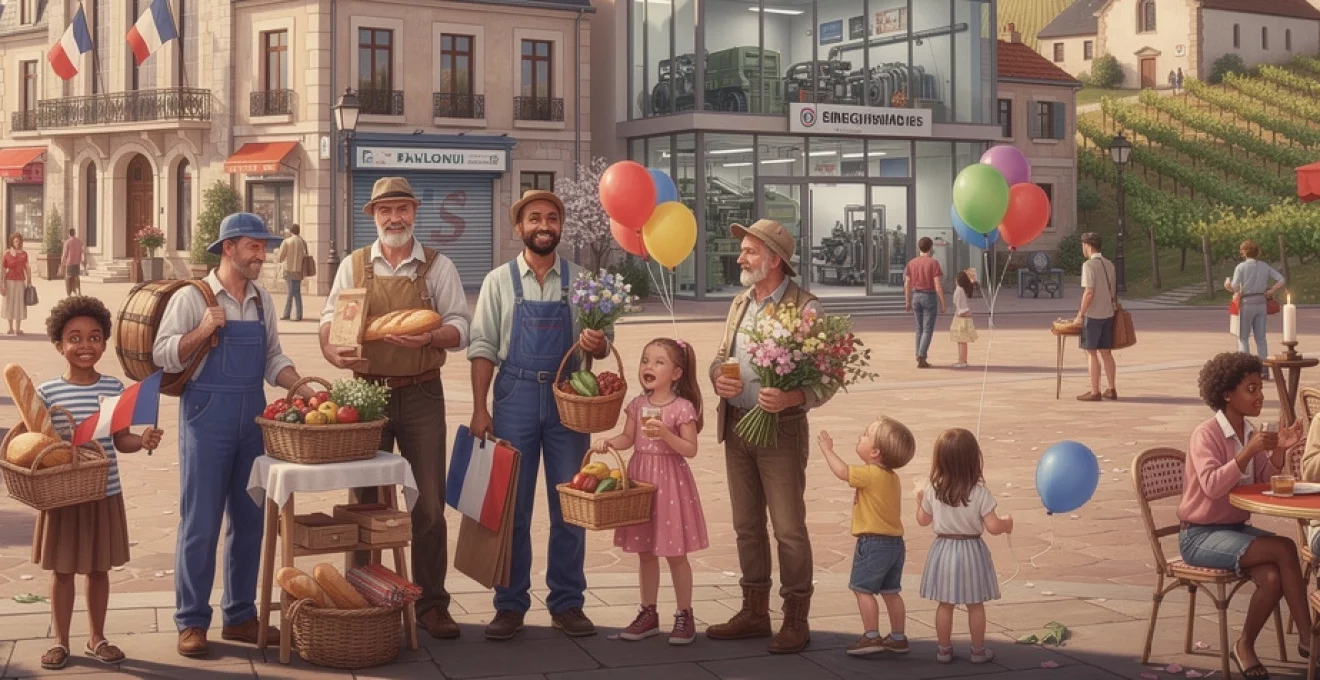
France’s public holidays represent far more than simple days off work; they constitute the rhythmic heartbeat of a nation’s cultural identity, weaving together centuries of religious tradition, republican values, and social cohesion. With eleven official public holidays distributed throughout the year, France maintains one of Europe’s most structured approaches to commemorative celebrations, reflecting a delicate balance between secular governance and deeply rooted Christian heritage. These jours fériés serve as temporal anchors in French society, providing moments for reflection, celebration, and collective memory whilst simultaneously generating significant economic impacts across various sectors. The intricate relationship between French public holidays and national identity reveals itself through complex layers of historical evolution, legislative frameworks, and contemporary cultural practices that continue to shape modern French life.
Historical evolution of french public holiday legislation since the 1905 laïcité laws
The foundation of France’s modern public holiday system emerged from the revolutionary 1905 law establishing the separation of church and state, fundamentally transforming how religious observances were integrated into the national calendar. This landmark legislation, known as the Law of 9 December 1905, didn’t immediately eliminate religious holidays but rather redefined their status within the republican framework. The transition from monarchy to republic required careful navigation between respecting traditional Catholic feast days and establishing secular legitimacy for these observances.
Prior to 1905, France observed numerous Catholic saint days as official holidays, with some regions celebrating over one hundred feast days annually during medieval times. The revolutionary period of 1789-1799 attempted to completely overhaul the calendar system, introducing a ten-day week and eliminating religious observances altogether. However, this radical approach proved unsustainable, and Napoleon’s Concordat of 1801 restored many traditional holidays whilst maintaining state control over religious affairs.
The Third Republic’s approach to public holidays between 1870 and 1940 demonstrated pragmatic compromise, maintaining popular Catholic celebrations whilst introducing secular commemorative days. Labour Day on 1 May gained official recognition in 1947, reflecting post-war social democratic values and workers’ rights movements. Similarly, Victory in Europe Day on 8 May became permanently established in 1981, though it had been observed intermittently since 1945. This gradual evolution illustrates how French public holiday legislation adapted to changing social priorities whilst preserving cultural continuity.
Contemporary public holiday legislation continues to evolve, with recent discussions surrounding the integration of non-Christian celebrations and the economic implications of maintaining extensive holiday schedules. The Code du travail now provides detailed frameworks for holiday observance, compensation, and regional variations, demonstrating the sophisticated legal infrastructure supporting France’s cultural calendar. Regional exceptions, particularly in Alsace-Moselle where Good Friday and St. Stephen’s Day remain official holidays, showcase how historical complexities continue to influence modern holiday legislation.
Religious heritage and secular transformation in contemporary french festivities
The transformation of religious celebrations into secular cultural events represents one of the most fascinating aspects of contemporary French public holidays. Christmas, Easter Monday, Ascension Day, Whit Monday, Assumption of Mary, and All Saints’ Day maintain their religious origins whilst simultaneously functioning as cultural touchstones for broader French society. This dual nature reflects the nation’s capacity to preserve traditional forms whilst adapting their meanings to contemporary contexts.
Catholic saint days integration into republican calendar system
Catholic saint days underwent remarkable transformation following the establishment of the French Republic, evolving from purely religious observances into national cultural celebrations. The Assumption of Mary on 15 August exemplifies this evolution, maintaining its religious significance for practising Catholics whilst serving as a midsummer cultural celebration for the broader population. Traditional processions in regions like Provence continue to attract both religious pilgrims and cultural tourists, demonstrating how sacred and secular meanings can coexist within the same celebration.
All Saints’ Day presents another compelling example of successful integration between Catholic tradition and republican values. The practice of visiting family graves and placing chrysanthemums on tombstones transcends religious boundaries, becoming a national ritual of remembrance that honours both Catholic saints and deceased family members. This fête des morts aspect has gained particular significance in contemporary French culture, providing secular families with meaningful participation opportunities in traditional observances.
Laïcité principles applied to christmas and easter monday observances
The application of laï
cité to Christmas and Easter Monday appears in the way these days are framed in public institutions and the media. Official communications emphasise themes such as family, generosity, solidarity, and winter or spring break rather than explicit Christian doctrine. School calendars, for example, refer to vacances de Noël and vacances de printemps, and public broadcasters increasingly focus on cultural symbols like Christmas markets, festive lights, and chocolate eggs instead of strictly religious ceremonies.
At the same time, laïcité does not erase religious expression in the private sphere. Churches remain full for midnight mass at Christmas and Easter vigils, while many municipalities still install crèches in town halls, though this has sparked recurring legal debates. The Conseil d’État has ruled that nativity scenes can be allowed if they are presented as cultural, artistic, or festive displays rather than as acts of worship, a nuanced interpretation that illustrates how secular principles and Christian heritage continue to coexist in French public space.
Easter Monday offers a particularly telling example: unlike Easter Sunday, which is clearly religious, Monday functions mainly as a family and leisure day, with egg hunts, countryside outings, and shared meals. For many non-religious French citizens, the day has become a kind of springtime mini-holiday, detached from church practice but still anchored in the wider Christian calendar. In this way, laïcité shapes not only what the state recognises, but also how society gradually reinterprets the meaning of these public holidays.
Protestant and jewish community recognition within national holiday framework
Within the formal framework of French public holidays, Protestant and Jewish feasts are not granted the same national status as Catholic-rooted days. Yet this does not mean that these communities are invisible in the holiday system. Since the 1980s, the Code du travail and subsequent circulars have increasingly allowed for negotiated arrangements, enabling employees of minority faiths to request leave for major religious observances such as Yom Kippur, Rosh Hashanah, or important Protestant synods, usually through annual leave or authorised absence.
This approach reflects a compromise between strict laïcité and practical religious accommodation. Rather than multiplying official nationwide holidays, the state recognises the pluralism of French society through flexible labour regulations and local agreements. In public schools, for instance, students of Jewish faith are often permitted to be absent on Yom Kippur without penalty, a de facto recognition that coexists with a uniform national school calendar. You can see here how the French holiday system functions like a rigid framework with flexible joints, allowing certain movements without dismantling the overall structure.
Historically Protestant regions, notably parts of the Cevennes or Alsace, also maintain strong local traditions around Reformation anniversaries or specific commemorative services. While these events do not become public holidays in the legal sense, they contribute to a broader cultural landscape in which non-Catholic Christian memory is publicly expressed. Municipalities may support such events through logistics or communication, demonstrating that national holiday legislation is only one layer of a more complex mosaic of religious and cultural recognition in France.
Islamic and buddhist feast day exclusion from official calendar discourse
By contrast, Islamic and Buddhist feast days remain entirely absent from the official list of French public holidays, despite Islam being the country’s second-largest religion and Buddhism maintaining a longstanding, if smaller, presence. This absence is not accidental; it stems from the historical context in which public holidays were codified, long before large-scale postcolonial immigration diversified the French religious landscape. The result is a calendar that still mirrors the demography of early 20th-century France more than that of today.
In practice, millions of Muslims in France celebrate Aïd al-Fitr and Aïd al-Adha, often negotiating time off with employers or using paid leave days. Some large companies and public administrations issue internal guidelines encouraging managers to be accommodating, yet there is no statutory right equivalent to May Day or All Saints’ Day. For Buddhist communities, major observances such as Vesak are treated similarly, remaining entirely within the private and associative sphere. This raises a key question: can a national holiday calendar remain legitimate if it no longer reflects the religious diversity of its population?
Public debate on this topic resurfaces regularly, especially around proposals to replace one Catholic-rooted public holiday with an Islamic one, or to create “floating religious holidays” that each citizen could use according to their faith. So far, political reluctance and the desire to avoid opening a contentious “calendar reform” has prevailed. The resulting situation illustrates the tension at the heart of French laïcité: while the state proclaims neutrality, the legacy of historical Catholic dominance continues to structure what is “visible” and officially celebrated at the national level.
Economic impact analysis of french public holiday distribution on gdp performance
Beyond their cultural and symbolic significance, French public holidays exert measurable effects on the economy and GDP performance. According to various estimates from the French Treasury and independent economic institutes, a single non-working public holiday can reduce annual GDP by around 0.05 to 0.1 percentage point if not compensated by increased productivity before or after the date. Yet this apparent “loss” is counterbalanced by gains in tourism, leisure consumption, and reduced burnout, making the net impact far more complex than simple output calculations suggest.
The distribution of public holidays across the year is another decisive factor. Concentrations of days off in May or around Christmas can disrupt production chains but also stimulate sectors such as hospitality, transport, and retail. The practice of faire le pont (creating long weekends by taking an extra day off) amplifies these effects, effectively turning certain weeks into semi-vacation periods. From an economic standpoint, French public holidays function like scheduled waves in the business cycle, temporarily slowing industrial activity while boosting services linked to leisure and tourism.
Policymakers therefore face a delicate balancing act: should they prioritise continuous production, or embrace a holiday rhythm that supports quality of life and service-sector dynamism? Empirical research increasingly suggests that regular breaks can enhance long-term productivity by reducing stress and improving worker wellbeing. In this sense, the French model, with its structured public holidays and generous vacation time, can be viewed less as a drag on GDP and more as an investment in sustainable economic performance.
Tourism revenue fluctuations during ascension day and whit monday periods
Ascension Day and Whit Monday, both linked to the Easter cycle, are particularly illustrative of how public holidays shape tourism revenue. Ascension always falls on a Thursday, making it an ideal occasion for faire le pont and creating a four-day weekend. Each year, millions of French residents seize this opportunity to travel to the coast, countryside, or neighbouring countries, resulting in a spike in hotel bookings, campsite occupancy, and short-term rentals. For many rural regions, revenue generated during the Ascension weekend can rival that of peak summer weeks.
Whit Monday, although its legal status briefly changed in the 2000s with the introduction of a “solidarity day,” still functions as a key tourism marker. In years when it is widely observed as a non-working day, tourist sites, amusement parks, and cultural attractions report significant increases in visitor numbers. You can think of these two holidays as “mini summer breaks” strategically placed in late spring, helping to extend the tourism season and smooth revenue across several months instead of concentrating it solely in July and August.
However, these tourism gains are not evenly distributed. Urban business districts may experience lower activity as offices close, while seaside and mountain areas see strong growth. Transport operators also face logistical challenges, as highways and rail lines become congested during departure and return days. For international travellers planning a stay in France, understanding the Ascension and Whit Monday calendar can be a strategic advantage: avoiding peak travel days can mean cheaper tickets and less crowded destinations.
Retail sector performance during may day and victory in europe day closures
May is often perceived in France as a “Swiss cheese month,” riddled with public holidays that interrupt the usual workweek. May Day (Fête du Travail) on 1 May and Victory in Europe Day on 8 May are both fixed-date holidays that frequently fall close to weekends, generating successive bridges. For the retail sector, this translates into a complex pattern of gains and losses. On 1 May, most shops, including supermarkets, are closed as a matter of principle, and even exceptions are rare. The day has a strongly symbolic character, both politically and socially.
In contrast, on and around 8 May, retailers may adopt more flexible strategies. Some large stores choose to open in tourist areas, capitalising on increased foot traffic from visitors enjoying the spring break. Others remain closed in line with local labour agreements. Overall, while sales volumes may dip on the holiday itself, they often rebound before and after as consumers adjust their shopping habits. From a cash-flow perspective, May behaves less like a period of permanent loss and more like a temporary reshuffling of spending patterns.
E-commerce slightly mitigates these fluctuations, as online orders continue to be placed even when physical shops are shut, though deliveries are postponed. Still, for small independent shops with narrow margins, the succession of closures in May can be challenging. Many adapt by launching targeted promotions on the days preceding public holidays or by organising special openings on Sundays where regulations permit. Here again, the French public holiday calendar acts like a tide: it periodically pulls traditional retail activity back, only to push it forward again in the following days.
Manufacturing productivity loss calculations for assumption of mary observance
The Assumption of Mary on 15 August falls in the middle of what is already the main vacation period for French workers, making its economic impact quite specific. In many industrial sectors, factories either slow production significantly or shut down entirely for several weeks in August, scheduling maintenance operations and annual leave. From a short-term perspective, adding a public holiday in the midst of these closures appears to deepen productivity losses. Analysts sometimes estimate that a midweek holiday can reduce monthly industrial output by 2–3% if not compensated elsewhere.
Yet, because August is structurally a low-activity month in manufacturing, the marginal loss attributable to the Assumption itself is smaller than one might think. Production planning usually integrates this date months in advance, redistributing workloads to July or September. In some industries, such as automotive or aeronautics, August shutdowns are treated almost like “reset periods,” allowing companies to perform upgrades and repairs that would be too disruptive during peak production. In this analogy, the Assumption holiday works like a bookmark in the middle of a long chapter, marking a deliberate pause rather than an accidental interruption.
Moreover, the Assumption contributes indirectly to economic activity through the tourism, restaurant, and events sectors, which are at full capacity in mid-August. Pilgrimage sites such as Lourdes or regional Marian sanctuaries attract large crowds, combining spiritual motives with leisure consumption. For policymakers and economists, the key challenge is therefore not to eliminate such holidays, but to understand how their timing interacts with existing seasonal cycles and to design industrial strategies that anticipate rather than endure these pauses.
Agricultural sector adaptations to all saints’ day regional variations
All Saints’ Day on 1 November offers a very different pattern of economic impact, especially in agriculture. Situated at the end of the main harvest season for many crops, it often coincides with a transitional phase in the agricultural calendar. In regions where late harvests are still underway, such as vineyards finishing the vendanges or areas harvesting root vegetables, farmers may need to work through the public holiday to protect crops from weather risks. The law permits such exceptions for perishable goods, but they illustrate how nature’s timetable does not always align with the official calendar.
Other regions, having already completed the bulk of their fieldwork, use All Saints’ Day as a natural pause before winter tasks begin. Livestock farmers may adapt feeding and milking schedules to ensure minimum staffing on the holiday, while taking advantage of the weekend effect if the date falls close to Saturday or Sunday. Local markets and florists, by contrast, experience intense activity in the days preceding 1 November as families purchase chrysanthemums to decorate graves, providing a vital source of income before the quiet winter months.
Regional climatic differences also influence how disruptive All Saints’ Day can be. In the south-west, where autumn remains relatively mild, agricultural work may continue almost uninterrupted, while in northern and eastern regions, early frosts and shorter days make a break more acceptable. Over time, farmers have developed a repertoire of informal strategies to adapt: adjusting planting dates, scheduling machinery maintenance around public holidays, or coordinating seasonal labour contracts to avoid critical tasks on 1 November whenever possible.
Regional variations in public holiday observance across french departments
Despite a common national framework, the observance of public holidays in France varies significantly between regions and departments. The most famous exception is Alsace-Moselle, where historical ties to Germany have preserved two additional public holidays: Good Friday and St. Stephen’s Day on 26 December. In these departments, schools, banks, and many businesses close on these dates, resulting in a denser holiday calendar than in the rest of metropolitan France. This legal particularism, anchored in the local droit local, highlights how political history continues to shape everyday life.
Beyond formal legal differences, there are also strong cultural and economic variations in how public holidays are experienced. In the Paris region, Bastille Day is marked above all by the military parade on the Champs-Élysées and large-scale fireworks, while in small towns firefighters’ balls and local festivities take centre stage. Coastal departments see their population swell dramatically during summer holidays and long weekends, transforming public holidays into peak workload periods rather than days of rest for those working in tourism-related sectors.
Overseas departments and territories add yet another layer of diversity. In Guadeloupe, Martinique, Réunion, or French Guiana, additional local holidays commemorate the abolition of slavery or specific historical events, coexisting with the eleven national dates. Climate and seasonal patterns also alter how holidays are celebrated: All Saints’ Day, for instance, takes on a different atmosphere under tropical skies than in a foggy Breton cemetery. For anyone seeking to understand French culture in depth, paying attention to these regional variations reveals how a single national calendar can be lived in many different ways.
Workplace legislation and employee rights during statutory french holidays
From a legal standpoint, French public holidays are framed primarily by the Code du travail, which defines employee rights and employer obligations. France recognises eleven national jours fériés, but only one – May Day – is universally mandated as both a public holiday and a paid day off for almost all employees, except in sectors where continuous activity is necessary (such as hospitals or public transport). For the other holidays, collective agreements, company policies, and sector-specific rules determine whether the day is non-working and how it is remunerated.
When a public holiday is non-working and falls on a day when the employee would normally work, it is generally paid without requiring the worker to make up the hours, provided they have at least three months’ seniority. If employees are required to work on a public holiday, they may benefit from compensatory rest or enhanced pay, depending on applicable collective agreements. Sundays and public holidays thus form a protected temporal space in French labour law, even though economic pressures have led to more exceptions in retail and hospitality.
The question of bridge days also intersects with workplace legislation. Many companies negotiate “collective bridges,” closing entirely on a Friday or Monday and asking employees either to use a day of paid leave or to recover hours at another time. While some workers welcome the opportunity for long weekends, others may feel pressured to accept arrangements that compress workloads. For international employees or students working part-time in France, understanding these rules can be crucial for planning both income and rest.
Cultural transmission mechanisms through traditional french public holiday rituals
Public holidays are not only legal constructs or economic variables; they are powerful vehicles for cultural transmission. Through rituals repeated year after year – sharing a galette des rois at Epiphany, offering lily-of-the-valley on 1 May, visiting graves on All Saints’ Day, or watching fireworks on Bastille Day – values, narratives, and social ties are passed from one generation to the next. These practices operate like living textbooks of French culture, teaching both explicit historical events and more subtle norms around family, solidarity, and memory.
Schools play a central role in this process. Around major public holidays, teachers often organise lessons on their origins and contemporary meanings, blending history, civics, and literature. Children might create paper poppies or tricolour flags for 11 November, learn songs associated with the Resistance, or discuss the principles of the Republic before 14 July. In doing so, they internalise a shared symbolic repertoire that makes future holiday rituals more meaningful. For newcomers to France, participating in these customs offers a direct pathway into the cultural fabric of the country.
Media and digital platforms amplify and transform these transmission mechanisms. Television specials on Christmas traditions, documentaries about the Great War aired around Armistice Day, or social media posts sharing photos of family gatherings all contribute to maintaining and updating collective representations of public holidays. At the same time, new influences – such as Halloween, Black Friday, or imported Valentine’s Day practices – enter the French calendar informally, sometimes blending with or competing against older traditions. The French system of public holidays therefore remains dynamic: anchored in long history, shaped by law, but constantly reinterpreted through everyday cultural practices.