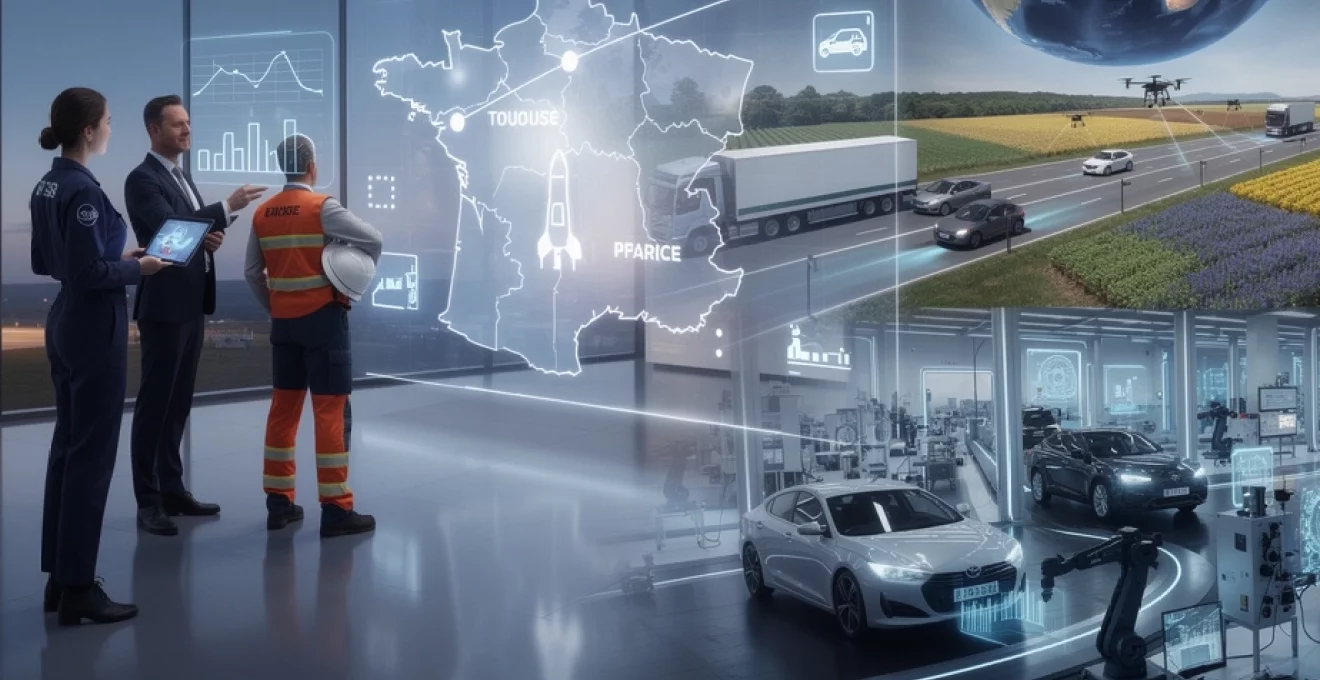
France’s space sector has emerged as a cornerstone of the nation’s economic strategy, generating substantial revenue streams whilst positioning the country as a global leader in aerospace innovation. With over 1,000 companies operating within this dynamic ecosystem, the French space industry contributes significantly to national GDP through advanced manufacturing, cutting-edge research and development, and high-value export activities. The sector’s economic impact extends far beyond traditional aerospace boundaries, creating ripple effects across multiple industries including telecommunications, agriculture, transportation, and environmental monitoring.
This economic powerhouse operates through a sophisticated dual-segment structure, encompassing both upstream activities such as satellite manufacturing and launch services, alongside downstream applications that transform space-derived data into commercial value. The industry’s robust foundation, built upon decades of strategic investment and international collaboration, has created sustainable competitive advantages that continue to drive innovation and economic growth across France’s regional technology hubs.
French space industry revenue streams and economic multiplier effects
The French space industry operates as a complex economic ecosystem where multiple revenue streams converge to create substantial multiplier effects throughout the broader economy. Direct revenues from space activities generate approximately €7 billion in annual trade surplus, whilst supporting over 70,000 direct jobs across the country. These figures represent only the tip of the economic iceberg, as space technology investments create cascading effects that benefit numerous adjacent sectors.
The industry’s economic multiplier effect operates through several key mechanisms. For every euro invested in space technology, studies indicate a return of approximately €3-5 to the broader economy through technology spillovers, job creation in supporting industries, and enhanced competitiveness of French companies in global markets. This multiplier effect proves particularly pronounced in high-technology manufacturing sectors, where space-derived innovations enhance production capabilities and product quality.
Arianespace commercial launch services market dominance
Arianespace maintains its position as Europe’s premier commercial launch service provider, commanding significant market share in the global satellite deployment sector. The company’s revenue model encompasses multiple service tiers, from geostationary satellite launches using Ariane 5 and the upcoming Ariane 6 vehicles, to smaller payload deployments via Vega rockets. Annual launch revenues typically exceed €1 billion, with strong order books extending several years into the future.
The economic significance of Arianespace extends beyond direct launch revenues to encompass the entire European launcher supply chain. The company’s operations support thousands of high-skilled jobs across France, particularly in the Toulouse region and at the Guiana Space Centre. Each successful launch generates additional revenue through insurance services, ground support operations, and mission integration activities that collectively contribute hundreds of millions of euros annually to French economic output.
Thales alenia space satellite manufacturing export performance
Thales Alenia Space represents a cornerstone of French space manufacturing excellence, generating substantial export revenues through its comprehensive satellite production capabilities. The company’s portfolio spans telecommunications satellites, Earth observation platforms, and scientific missions, with annual revenues exceeding €2 billion globally. French manufacturing facilities contribute significantly to these figures through advanced production techniques and cutting-edge technology integration.
Export performance metrics demonstrate the company’s strong international competitiveness, with French-manufactured components and complete satellite systems reaching markets across Europe, Asia, and the Americas. The company’s success in securing international contracts not only generates direct export revenues but also strengthens France’s technological reputation and opens doors for future collaborative projects. This export performance supports thousands of high-value manufacturing jobs whilst contributing to France’s positive trade balance in aerospace products.
CNES R&D investment return on investment metrics
The French Space Agency (CNES) operates with an annual budget exceeding €2.5 billion, strategically allocating resources across research and development programmes that generate substantial economic returns. Investment analysis reveals that CNES R&D expenditure creates measurable economic value through technology transfer, patent generation, and industrial competitiveness enhancement. The agency maintains a portfolio of over 400 patents, representing significant intellectual property assets that benefit the entire French space ecosystem.
Return on investment calculations demonstrate that CNES funding generates substantial economic multiplier effects, with studies indicating that every euro invested in space R&D produces €3-7 in economic benefits over the medium term. These returns materialise through various channels including enhanced industrial capabilities, new product development, improved operational efficiency, and strengthened international competitiveness
These long-term benefits are amplified by the France 2030 investment plan, under which CNES co-manages €1.5 billion dedicated to space innovation. By co-funding demonstrators, nurturing 79+ startups, and derisking breakthrough technologies such as reusable launchers or AI-based data services, the agency effectively crowds in private capital that might otherwise remain on the sidelines. For policymakers and investors, CNES’s ROI metrics make a compelling case: sustained public R&D in space technology is not a cost centre, but a strategic asset underpinning France’s industrial sovereignty.
Airbus defence and space employment generation analysis
Airbus Defence and Space stands among the largest industrial employers within the French space ecosystem, acting as a powerful engine for high-skilled job creation. Its French operations span satellite manufacturing, launcher structures, secure communications, and defence-related space systems, supporting thousands of engineers, technicians, and researchers. Beyond direct employment, Airbus’s extensive supplier network sustains many more jobs in SMEs that specialise in components, software, and advanced materials.
The employment impact of Airbus Defence and Space is particularly visible in regional clusters such as Toulouse and Île-de-France, where the company anchors entire value chains. Each new satellite or launcher programme translates into multi-year employment stability, long apprenticeship pipelines, and continuous upskilling in cutting-edge domains like systems engineering, cyber-security for space assets, and AI-enabled mission control. The result is a robust contribution to France’s knowledge economy, with space technology jobs often paying above-average wages and stimulating local consumption and tax revenues.
Satellite technology applications driving GDP growth sectors
Whilst upstream activities generate impressive export revenues, it is the downstream use of satellite technology that increasingly drives GDP growth across the French economy. Navigation, Earth observation, and telecommunications services are now woven into the daily operations of sectors as diverse as logistics, agriculture, energy, finance, and tourism. Space infrastructure has become a form of invisible yet critical economic plumbing, much like roads or power grids.
By enabling real-time positioning, climate monitoring, broadband connectivity, and geospatial intelligence, satellite systems raise productivity, reduce transaction costs, and support better decision-making in both public and private sectors. As New Space lowers launch costs and expands capacity, the marginal cost of an additional “bit” of satellite data falls, opening the door to new business models and data-driven services. For France, capturing value from these satellite-enabled applications is essential to securing long-term growth and digital competitiveness.
Galileo navigation system economic impact on transportation industry
The Galileo navigation system, to which France is a major contributor, delivers high-precision positioning and timing services that are transforming the transportation industry. Compared with legacy GPS-only solutions, Galileo enhances accuracy and reliability, particularly in dense urban environments and challenging terrains. For French logistics firms, airlines, rail operators, and maritime companies, this translates into lower fuel consumption, fewer delays, and optimised routing.
In road transport, Galileo-enabled telematics support advanced fleet management, dynamic tolling, and usage-based insurance models, all of which can reduce operating costs and emissions. Rail operators rely on precise timing signals to improve signalling systems and increase line capacity without major infrastructure investments. In aviation, Galileo-enhanced navigation supports more efficient flight paths and safer landings, particularly at regional airports. As autonomous and connected vehicles scale up, we can expect Galileo’s economic impact on the French transportation industry to increase further, underpinning innovation from urban mobility services to smart logistics corridors.
Copernicus earth observation programme agricultural productivity enhancement
The Copernicus Earth observation programme provides free and open satellite data that French farmers, agri-tech startups, and cooperatives increasingly use to enhance agricultural productivity. High-resolution imagery and time-series data allow users to monitor crop health, soil moisture, and pest risks at field level, enabling more targeted interventions. Instead of treating every hectare the same, farmers can adjust fertiliser, water, and pesticide inputs with much greater precision.
This shift toward precision agriculture brings both economic and environmental benefits. Farmers can cut input costs, improve yields, and reduce crop losses due to weather extremes or disease, strengthening the competitiveness of French agri-food exports. At the same time, optimised use of fertilisers and irrigation helps reduce greenhouse gas emissions and water consumption. As climate change makes weather patterns more volatile, Copernicus data also supports risk management, allowing insurers and public authorities to better assess droughts, floods, and other agricultural shocks.
Eutelsat telecommunications revenue contribution to digital economy
Eutelsat, one of the world’s leading satellite telecommunications operators, plays a central role in extending digital connectivity across France and beyond. Its fleet of geostationary and, increasingly, low Earth orbit satellites provides broadband, television broadcasting, and secure communications services to households, enterprises, and institutions. In rural and remote French regions where terrestrial infrastructures are costly to deploy, Eutelsat’s services help close the digital divide.
The company’s revenue streams, drawn from video distribution, data connectivity, and government contracts, feed directly into the French digital economy. Satellite broadband enables e-commerce, teleworking, telemedicine, and online education for communities that would otherwise remain underserved. For businesses, resilient satellite links provide redundancy for critical operations and support cross-border activities. As demand for high-throughput satellites and secure connectivity rises, Eutelsat’s investment and export performance further reinforce France’s position in the global digital infrastructure market.
Spot image geospatial intelligence commercial applications
Spot Image, historically linked to CNES and now integrated into Airbus’s Earth observation business, has been a pioneer in commercialising high-resolution satellite imagery. Its geospatial intelligence solutions serve a wide array of customers: urban planners, insurers, energy companies, defence ministries, and international organisations. By turning raw pixels into actionable information, Spot Image and its successors help clients make faster, better-informed decisions.
Commercial applications range from monitoring infrastructure projects and detecting illegal deforestation to assessing disaster damage and tracking maritime activity. For French insurers, for instance, satellite-based risk assessment can streamline claims management after floods or storms, reducing costs and improving customer satisfaction. Urban authorities leverage geospatial intelligence to plan transport networks, manage land use, and track heat islands. As AI and cloud computing mature, the ability to automatically classify land cover, identify anomalies, and forecast trends further increases the economic value of geospatial data services.
Public-private partnership models in french aerospace innovation
Public-private partnerships (PPPs) are a defining feature of France’s aerospace innovation model, enabling risk-sharing and long-term coordination between the state, CNES, ESA, and industry leaders such as ArianeGroup, Thales Alenia Space, Airbus, and a growing cohort of startups. Rather than leaving breakthrough technologies to the market alone, France uses PPPs to co-finance demonstrators, validate technologies, and ensure that critical infrastructure such as launchers and satellite constellations remain under European control. This is particularly important in a sector where initial capital requirements are high and payback periods can be long.
Initiatives under the France 2030 plan illustrate how these PPP models work in practice. The state provides anchor funding and strategic direction, CNES offers technical expertise and programme management, while private firms bring industrial capabilities and commercial focus. New Space startups benefit from incubators such as Connect by CNES and from co-funded projects that derisk their early development. The result is a more dynamic, yet coordinated, innovation ecosystem where reusable mini-launchers, in-orbit servicing, and data-driven services can emerge faster, without compromising sovereignty. For companies looking to engage with this ecosystem, understanding the available PPP instruments—from grants and repayable advances to equity participation—is key to unlocking growth.
Space technology transfer impact on manufacturing and industrial competitiveness
Beyond its direct outputs, the French space sector acts as a powerful vector of technology transfer to the broader manufacturing base. Many of the most advanced techniques developed for launchers, satellites, and ground systems find second lives in automotive, energy, medical devices, and even consumer electronics. Space missions, by nature, demand reliability, miniaturisation, and efficiency under extreme constraints, making them ideal testbeds for innovations that later diffuse across the economy.
This diffusion process boosts France’s industrial competitiveness, enabling firms to produce higher-quality goods, reduce defects, and explore new product segments. As global competition intensifies, access to space-derived technologies can be the difference between leading a market and lagging behind. For SMEs in particular, partnerships with CNES, large primes, or technology transfer offices provide a pragmatic way to access cutting-edge materials, processes, and electronics without having to fund basic research themselves.
Advanced materials development from ariane rocket programme
The Ariane rocket programme has driven decades of innovation in advanced materials, from lightweight composite structures to high-temperature alloys capable of withstanding the stresses of launch. These materials are engineered to optimise the ratio between strength, weight, and cost—a balancing act that mirrors challenges in many terrestrial industries. Innovations first validated on Ariane launchers often migrate into aeronautics, automotive components, and high-performance industrial equipment.
For example, composite materials developed to reduce the mass of upper stages or fairings can be adapted to produce lighter aircraft parts or more efficient pressure vessels. High-performance thermal protection systems originally designed to shield propulsion systems inform new generations of insulation for energy infrastructure. In this sense, Ariane serves as a kind of “materials laboratory in the sky”, where breakthroughs under extreme conditions later help French manufacturers improve product performance, cut fuel consumption, and reduce lifecycle emissions.
Precision manufacturing techniques adoption in automotive sector
Space hardware manufacturing demands micron-level precision and rigorous quality assurance, driving the development of advanced machining, additive manufacturing, and metrology techniques. These capabilities have gradually diffused into the French automotive sector, where competitiveness hinges on producing complex components at scale with minimal defects. Technologies such as 3D printing of metal parts, laser welding, and in-line non-destructive testing all benefit from heritage in launcher and satellite production.
For automotive manufacturers, adopting these space-derived precision techniques leads to lighter engines, more durable components, and faster prototyping cycles. The analogy is clear: just as a satellite cannot be repaired once in orbit, a car manufacturer cannot afford large recall campaigns due to quality issues. By importing space-grade processes and standards into their factories, French automotive firms bolster reliability and reputation in global markets, while reducing waste and energy use on the production line.
Microelectronics innovation spillover effects
Space systems have long pushed the boundaries of microelectronics, requiring radiation-hardened chips, low-power processors, and robust communication modules able to function for years without failure. The research performed by French labs, CNES, and industry partners in these areas generates spillover effects that benefit a wide range of terrestrial applications. Secure telecommunications, IoT devices, medical implants, and industrial automation systems all draw on microelectronic innovations initially developed for satellites or launchers.
As France positions itself in strategic value chains such as semiconductors and edge computing, space technology acts as a differentiating niche. Radiation-tolerant designs, for instance, are increasingly relevant for high-altitude aviation, nuclear facilities, and critical infrastructure. For startups and SMEs in the electronics sector, collaborating with space primes can provide access to demanding use cases that push their products to the next level. Over time, these collaborations strengthen France’s resilience in a domain where global supply chains remain fragile and geopolitically sensitive.
Regional economic development through space technology clusters
The impact of space technology on the French economy is also highly territorial, with several regions emerging as specialised clusters that blend industrial activity, research, and entrepreneurship. These “space technology clusters” act as magnets for talent and investment, creating local ecosystems where universities, labs, and companies co-locate and share resources. The result is a virtuous cycle: as clusters grow, they attract more firms and skilled workers, which in turn boosts innovation and job creation.
From Toulouse’s “Space Valley” to the Guiana Space Centre in Kourou and the Paris-Saclay innovation district, each cluster has its own profile and economic footprint. Together, they support tens of thousands of direct and indirect jobs, drive regional GDP, and foster specialisations ranging from launcher operations to Earth observation analytics. For local authorities, aligning infrastructure, education, and innovation policies with these clusters’ needs is a pragmatic strategy to anchor high-value activities over the long term.
Toulouse space valley employment hub economic analysis
Toulouse is widely recognised as the capital of the European space and aeronautics industry, hosting major players such as Airbus Defence and Space, Thales Alenia Space, CNES’s Toulouse Space Centre, and a dense network of SMEs and startups. This “Toulouse Space Valley” supports a substantial share of France’s 70,000 space-related jobs, with a strong concentration of engineers, software developers, data scientists, and technicians. The presence of renowned academic institutions further reinforces the talent pipeline.
The economic impact of this employment hub extends far beyond direct salaries. Local service industries—from housing and retail to business services—benefit from the spending power of highly qualified workers. Knowledge spillovers between aerospace and digital startups generate new ventures in areas such as Earth observation analytics, in-flight connectivity, and autonomous systems. For young graduates and entrepreneurs, Toulouse offers a unique environment where you can move from lab to startup to major industrial group without leaving the region, accelerating learning and career development.
French guiana kourou spaceport regional development impact
The Guiana Space Centre in Kourou is a strategic asset for Europe’s independent access to space, but it is also a critical driver of regional development in French Guiana. Launch operations generate direct employment in technical, administrative, and support roles, while also stimulating demand for local services such as construction, hospitality, transport, and logistics. Each launch campaign mobilises hundreds of specialists and contractors, injecting significant short-term spending into the local economy.
Over the longer term, the presence of the spaceport has led to improved infrastructure, including roads, ports, and telecommunications, which benefit both residents and businesses. Training programmes and partnerships with local educational institutions aim to integrate more Guianese workers into technical and engineering roles, although challenges remain in fully aligning local skills with highly specialised space activities. Nonetheless, Kourou exemplifies how a strategic space facility, when paired with targeted regional policies, can help diversify an economy historically dependent on a narrow set of sectors.
Paris-saclay innovation district aerospace startup ecosystem
The Paris-Saclay innovation district, located south of Paris, has rapidly emerged as a key ecosystem for aerospace and space-related startups. Bringing together leading engineering schools, research organisations, and corporate R&D centres, Paris-Saclay provides fertile ground for ventures in areas such as satellite data analytics, navigation services, quantum communications, and advanced materials. Proximity to CNES, ESA representations, and major primes in Île-de-France further enhances collaboration opportunities.
Incubators and accelerators within the district support entrepreneurs in maturing technologies from lab prototypes to market-ready solutions, often through public-private funding schemes. For early-stage companies, access to shared facilities, testing infrastructure, and cross-disciplinary talent reduces time to market and development costs. As more investors focus on New Space opportunities, Paris-Saclay’s aerospace startup ecosystem strengthens France’s ability to create homegrown champions in fast-growing niches like in-orbit services, space situational awareness, and AI-powered Earth observation.
Future economic projections for french space technology investment
Looking ahead, the global space economy is projected to reach around $1.8 trillion by 2035, according to the Draghi Report and analyses by McKinsey and the World Economic Forum. This implies annual growth of roughly 9%, driven largely by the United States and China, but offering substantial opportunities for Europe and France as well. The key question is not whether the space market will grow, but how large a share France can capture and in which segments it can build sustainable competitive advantages.
Several trends will shape these future economic outcomes. First, the continued rise of New Space—characterised by reusable launchers, mega-constellations, and data-centric business models—will compress costs and shift value creation downstream toward services and applications. Second, environmental and security concerns will increase demand for Earth observation, climate monitoring, and space situational awareness, areas where France already excels. Third, European regulatory initiatives such as the forthcoming EU Space Act will push for more sustainable and secure operations, potentially giving an edge to actors that adopt high standards early.
For French policymakers and industry leaders, this context calls for consistent, long-horizon investment in both infrastructure and innovation. Maintaining independent access to space through Ariane 6 and its successors, while exploring reusable technologies, will remain non-negotiable for sovereignty. At the same time, supporting a vibrant ecosystem of downstream startups and service providers is essential to translate space capabilities into broad-based economic growth. How can France best align its education system, financing tools, and industrial policy to this objective? By doubling down on clusters, encouraging cross-sector collaborations, and making satellite data more accessible to SMEs, the country can widen the base of beneficiaries.
Ultimately, the impact of space technology on the French economy will be measured not only in export figures or launch counts, but in how deeply space-enabled services permeate everyday life and industrial processes. From precision agriculture that conserves resources to resilient telecommunications underpinning digital sovereignty, space will increasingly serve as a backbone for critical infrastructures. If France continues to leverage its scientific excellence, strong public agencies, and dynamic private sector, it is well positioned to remain a leading space power—and to convert that status into lasting economic resilience and competitiveness.