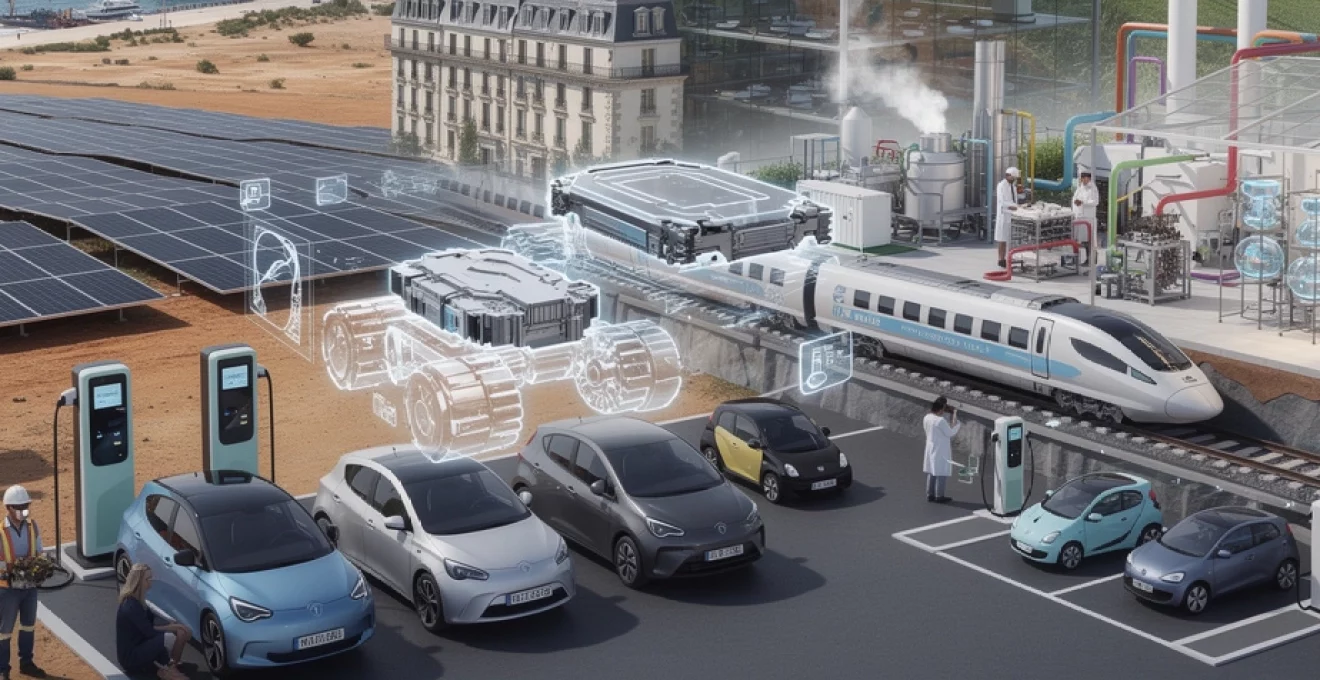
France has emerged as a formidable force in the global green technology landscape, driving innovation across renewable energy, sustainable transportation, and circular economy solutions. The nation’s commitment to ecological transition is exemplified through government initiatives like Greentech Innovation, which supports 297 innovative start-ups across the country, and the comprehensive French Tech ecosystem that champions technological sovereignty. From pioneering carbon capture technologies to revolutionary biotechnology applications, French companies are reshaping how industries approach environmental challenges. These innovations represent not merely technological achievements, but fundamental shifts towards a sustainable economic model that balances industrial growth with environmental stewardship.
French renewable energy manufacturing: solar and wind technology leaders
The French renewable energy sector has established itself as a cornerstone of the country’s green technology revolution, with companies developing cutting-edge solutions that address both domestic and international energy needs. French manufacturers are leveraging advanced engineering capabilities and innovative design approaches to create more efficient, cost-effective renewable energy systems. The sector benefits from substantial government support through programmes like French Tech 2030, which has identified energy transition as a key priority area for technological development.
French companies in the renewable energy space are distinguished by their focus on large-scale deployment and technological integration. Smart grid technologies developed by French firms enable better management of renewable energy sources, whilst advanced materials science contributes to improved efficiency and durability of solar panels and wind turbines. The country’s expertise in nuclear energy has also translated into sophisticated energy storage and grid management solutions that complement renewable sources.
Voltalia’s Utility-Scale solar farm development across Sub-Saharan africa
Voltalia has positioned itself as a leading developer of utility-scale solar installations across Sub-Saharan Africa, bringing French engineering expertise to regions with abundant solar resources. The company’s approach combines advanced photovoltaic technology with comprehensive project management capabilities, enabling the development of solar farms that can generate hundreds of megawatts of clean energy. These projects often incorporate energy storage systems to ensure consistent power delivery even when solar irradiation varies.
The company’s African operations demonstrate how French green tech innovations can address global energy challenges whilst creating sustainable economic opportunities. Voltalia’s projects typically include local workforce training programmes and community development initiatives, ensuring that renewable energy deployment contributes to broader social and economic benefits. Their hybrid renewable energy systems, which combine solar, wind, and storage technologies, represent a sophisticated approach to energy system design that maximises reliability and efficiency.
EDF renewables’ offshore wind turbine manufacturing in Saint-Nazaire
EDF Renewables has established a world-class offshore wind manufacturing facility in Saint-Nazaire, representing a significant milestone in France’s renewable energy industrial strategy. This facility produces large-scale offshore wind turbines designed specifically for marine environments, incorporating advanced materials and engineering solutions that withstand harsh oceanic conditions. The Saint-Nazaire plant serves as a hub for offshore wind development across Europe, with turbines designed for installation in waters ranging from the North Sea to the Mediterranean.
The manufacturing facility utilises automated production processes and digital twin technology to optimise turbine design and performance. Each turbine incorporates sophisticated monitoring systems that enable real-time performance optimisation and predictive maintenance scheduling. The facility’s emphasis on local supply chain development has created a robust ecosystem of component suppliers and service providers, strengthening France’s position in the global offshore wind market.
Neoen’s hornsdale power reserve battery storage systems integration
Neoen has gained international recognition for its innovative approach to large-scale battery storage systems, with the Hornsdale Power Reserve in Australia serving as a flagship demonstration of French energy storage expertise. The project combines Tesla battery technology with Neoen’s sophisticated energy management systems, creating one of the world’s largest lithium-ion battery installations. This system provides grid stabilisation services whilst demonstrating the commercial viability of utility-scale energy storage.
The success of Hornsdale has led to similar projects across multiple continents, with Neoen applying lessons learned to develop increasingly sophisticated storage solutions. Their approach integrates artificial intelligence algorithms for predictive energy management, enabling optimal charging and discharging cycles that maximise both grid benefits and commercial returns. These systems represent a crucial component of renewable energy integration, addressing the intermittency challenges associated with solar and wind power generation.
Engie’s
floating solar panel technology showcases how French industry is pushing the boundaries of renewable energy deployment beyond traditional land-based sites. Engie is developing floating photovoltaic (FPV) systems that can be installed on reservoirs, quarries, and even sheltered marine environments, turning unused water surfaces into clean power plants. By leveraging specialised anchoring systems and corrosion-resistant materials, these floating solar farms maintain stability and performance even in challenging conditions.
One of the key advantages of Engie’s floating solar panel technology is the synergy between water and photovoltaic modules. The natural cooling effect of water can improve solar panel efficiency by several percentage points, making these systems particularly attractive in hot climates where land availability is limited. For coastal and island communities, marine floating solar offers a way to reduce reliance on imported fossil fuels and diesel generators. As you consider the future of renewable energy manufacturing, such hybrid land–sea solutions highlight how flexible infrastructure can accelerate the ecological transition.
Sustainable transportation innovations: electric vehicle infrastructure and smart mobility
France is also at the forefront of sustainable transportation innovations, combining electric vehicles, hydrogen mobility, and smart urban planning into integrated mobility ecosystems. Supported by national initiatives such as “Je choisis la French Tech” and strong automotive and rail industries, French companies are building the EV charging infrastructure, powertrain technologies, and digital platforms needed for large-scale decarbonisation of transport. From city car-sharing schemes to regional hydrogen trains, these solutions are designed to reduce emissions while improving everyday mobility for citizens and businesses.
What makes French green mobility particularly distinctive is the emphasis on systems integration. Vehicle manufacturers, battery experts, grid operators, and software start-ups work together to optimise how vehicles interact with the energy system and the urban environment. This systemic approach enables innovations like vehicle-to-grid (V2G) services, real-time traffic optimisation, and multimodal transport platforms. For organisations looking to decarbonise fleets or invest in smart mobility, the French ecosystem offers a wide range of tested, scalable technologies.
Renault’s ZOE electric vehicle battery management system architecture
The Renault ZOE has become a symbol of France’s electric vehicle transition, and much of its success lies in its advanced battery management system (BMS). The BMS acts as the “brain” of the battery pack, continuously monitoring cell voltage, temperature, and state of charge to optimise performance and safety. By using sophisticated algorithms, Renault’s architecture balances each cell within the pack, extending battery life and maintaining range even after years of daily use.
From an energy efficiency perspective, the ZOE’s BMS architecture is designed to work hand-in-hand with regenerative braking and smart charging strategies. For example, software updates can refine how the car recovers kinetic energy in urban driving or how it schedules charging during off-peak hours. This is where green tech becomes truly intelligent: you are not just driving a zero-emission vehicle, you are also participating in a more flexible and resilient power system. For fleet managers, understanding BMS capabilities is essential to predicting total cost of ownership and planning battery second-life applications.
Alstom’s coradia ilint hydrogen-powered regional train technology
Alstom’s Coradia iLint, although originally developed with German partners, represents a major step forward for hydrogen-powered rail technology in which French engineering plays a central role. Instead of using overhead electric lines or diesel engines, the train is powered by hydrogen fuel cells that generate electricity on board, emitting only water vapour. For non-electrified regional lines, this offers a way to achieve deep decarbonisation without the high cost and disruption of installing new catenary infrastructure.
In practical terms, the Coradia iLint integrates fuel cell stacks, hydrogen storage tanks, and lithium-ion batteries into a single propulsion system controlled by smart energy management software. The train can recover energy during braking, store it in batteries, and then use it when power demand peaks, much like a hybrid car on rails. For transport authorities, the technology offers quieter, cleaner operations and a strong signal of commitment to the hydrogen economy. As hydrogen production from renewable sources grows, these trains can become a cornerstone of low-carbon regional mobility across Europe.
Bolloré group’s autolib electric car sharing platform integration
Although the original Autolib programme in Paris has since ended, the Bolloré Group’s car-sharing experiment remains an important case study in electric mobility services. Autolib combined a large fleet of compact EVs with a dense network of dedicated charging stations and a digital booking platform. The key innovation lay not only in the vehicles themselves but in the integration of user experience, charging infrastructure, and backend fleet management.
For cities and private operators exploring EV car-sharing today, Autolib provides valuable lessons. It showed how user-friendly interfaces, simple pricing, and reliable station availability are just as important as hardware. It also highlighted the need for flexible business models and strong public–private collaboration. When you look at newer mobility platforms and “mobility as a service” (MaaS) offerings, you can still see the influence of Autolib’s integrated approach to smart, shared, electric transport.
Valeo’s 48V mild hybrid powertrain systems for urban mobility
Valeo has emerged as a global leader in 48V mild hybrid systems, which offer a pragmatic bridge between conventional combustion engines and full battery electric vehicles. These 48V powertrains use a belt-driven starter–generator and small lithium-ion battery to support engine torque, enable extended stop–start operation, and recover energy during braking. The result is a significant reduction in fuel consumption and CO2 emissions, particularly in dense urban traffic where vehicles frequently accelerate and decelerate.
For manufacturers and fleet operators, 48V mild hybrids are a cost-effective way to meet tightening emissions standards and low-emission zone regulations. Unlike full hybrids or EVs, they require minimal changes to vehicle architecture and can be integrated into existing platforms relatively quickly. Think of them as a “booster pack” for traditional drivetrains: not a complete reinvention, but a smart technological layer that nudges everyday mobility towards greater sustainability while keeping vehicles affordable for a wide range of users.
Circular economy technologies: waste management and resource recovery systems
Beyond energy and mobility, France is developing advanced circular economy technologies that transform waste into resources and extend the life of materials. Supported by actors such as Ecolab and the Ministry for Ecological Transition, French start-ups and industrial groups are building waste management and resource recovery systems that address everything from plastics recycling to industrial by-product valorisation. Rather than viewing waste as an inevitable output, these companies design processes in which materials circulate across multiple life cycles.
Key focus areas include high-performance recycling for complex materials, digital tracking of products, and innovative business models such as product-as-a-service. You can think of the circular economy as a “feedback loop” added to the traditional linear value chain: materials no longer exit the system as pure waste but re-enter as secondary raw materials. For companies operating in France or partnering with French green tech firms, this shift opens opportunities to reduce environmental impact, secure supplies, and differentiate products through circular design and responsible sourcing.
Carbon capture and storage solutions: industrial decarbonisation technologies
Heavy industry remains one of the hardest sectors to decarbonise, and France is investing heavily in carbon capture, utilisation and storage (CCUS) as a key part of its climate strategy. From steel and cement to refining and waste-to-energy plants, French companies are testing and commercialising technologies that capture CO2 at the source before it enters the atmosphere. These projects often involve large industrial clusters and cross-border collaborations, turning decarbonisation into a shared infrastructure challenge rather than a burden for single sites.
Why is CCUS so important for green tech innovation in France? Even with rapid deployment of renewables and efficiency measures, some industrial processes inherently produce CO2. Carbon capture and storage technologies provide a way to deal with these “residual” emissions while keeping key industries competitive and jobs local. For investors and industrial operators, understanding the maturity, cost, and regulatory context of CCUS is essential to planning long-term decarbonisation pathways.
Air liquide’s cryogenic CO2 capture process for steel manufacturing
Air Liquide is developing a cryogenic CO2 capture process that is particularly promising for high-concentration emissions like those found in steel manufacturing. Instead of relying solely on chemical solvents, this approach cools flue gases to very low temperatures, causing CO2 to condense and separate from other components. The result is a high-purity CO2 stream that can be compressed for transport and storage or used in industrial applications.
For steelmakers facing rising carbon prices and strict climate targets, cryogenic capture offers an alternative or complement to conventional solvent-based technologies. It can be integrated with existing plants and adapted to different furnace configurations. Because the captured CO2 is very pure, it is also well suited for utilisation in chemical processes or synthetic fuels. As you evaluate decarbonisation options in energy-intensive sectors, Air Liquide’s innovations show how process engineering and gas expertise can unlock new pathways.
Totalenergies’ enhanced oil recovery with CO2 sequestration methods
TotalEnergies has long experience with enhanced oil recovery (EOR) using CO2, which involves injecting carbon dioxide into oil reservoirs to increase production while storing part of the CO2 underground. In recent years, the company has been re-orienting this expertise toward permanent CO2 sequestration projects that prioritise storage over additional fossil extraction. This evolution reflects a broader shift in the role of EOR within climate strategies, where the emphasis is gradually moving from oil production to secure geological storage.
From a technological standpoint, these projects require robust modelling of reservoir behaviour, advanced monitoring systems, and strict regulatory oversight to ensure long-term integrity. For policymakers and industrial partners, TotalEnergies’ work offers insights into how existing subsurface skills and infrastructure can be repurposed for climate mitigation. It also raises important strategic questions: how do we balance near-term use of EOR with the need for rapid decarbonisation, and how can we ensure that storage projects are aligned with net-zero trajectories?
Axens’ DMX solvent-based carbon capture technology for cement plants
Axens, in partnership with French research institutions, is developing the DMX solvent-based carbon capture process, particularly targeting hard-to-abate sectors such as cement. Cement production generates CO2 both from fuel combustion and from the calcination of limestone, making it difficult to decarbonise through fuel switching alone. The DMX process uses an innovative solvent that reduces energy consumption for CO2 regeneration compared to conventional amines, which is critical for lowering overall capture costs.
Demonstration projects, such as those at European cement plants, aim to validate energy performance, operational stability, and integration with existing plant layouts. For cement producers and construction companies, these technologies could become essential to align with low-carbon building standards and public procurement requirements that favour low-embodied-carbon materials. When you consider the scale of global cement demand, innovations like DMX are not just incremental improvements; they are potential game changers for industrial decarbonisation.
Veolia’s thermochemical waste-to-energy with carbon storage integration
Veolia is advancing a new generation of waste-to-energy plants that combine thermochemical conversion with carbon capture and storage. Traditional incineration recovers energy from municipal waste but still emits CO2. By adding capture units to flue gases and integrating storage or utilisation pathways, Veolia aims to turn these facilities into low-carbon or even carbon-negative energy sources, especially when a significant fraction of the waste is biogenic.
The approach often includes high-efficiency boilers, advanced flue gas cleaning, and modular capture units that can be retrofitted to existing plants. For cities and regions struggling with landfill reduction targets and rising energy demand, such integrated systems offer a way to address waste management and climate goals simultaneously. It is a good example of how the circular economy and CCUS concepts can intersect: the same infrastructure that handles our waste can also help remove carbon from the atmosphere.
Smart grid and energy efficiency: IoT-enabled building management systems
Smart grids and energy-efficient buildings are another stronghold of French green tech innovation. As more renewable energy comes online, the power system needs to become more flexible and responsive, and buildings—responsible for around 40% of energy use in many countries—are a key part of the solution. French companies are developing IoT-enabled building management systems (BMS) that connect sensors, actuators, and analytics platforms to optimise heating, cooling, lighting, and equipment in real time.
Imagine your office building as a living organism that can “sense” occupancy, weather patterns, and electricity prices, then adjust its metabolism accordingly. That is essentially what advanced BMS platforms do, using algorithms and sometimes artificial intelligence to reduce energy consumption without sacrificing comfort. For property owners and facility managers, the benefits go beyond lower utility bills: they include better air quality, predictive maintenance, and higher asset value. As France pushes forward with regulations on building performance and energy renovation, these digital tools form the backbone of a truly smart and efficient building stock.
Biotechnology and sustainable agriculture: precision farming and bio-based materials
France’s strong agricultural heritage and world-class research institutions have made it a leader in biotechnology and sustainable agriculture. From precision farming tools that optimise inputs to bio-based materials that replace petrochemical products, French companies are redefining how we produce food, feed, and materials. Many of these innovations sit at the crossroads of biology, digital technology, and process engineering, embodying the DeepTech spirit promoted by initiatives like French Tech 2030.
Why does this matter for the broader green tech landscape? Agriculture and food systems account for a large share of global emissions, land use, and biodiversity impacts. By using biotechnology to increase resource efficiency and develop new low-impact materials, French innovators are tackling climate and environmental challenges at their roots. Whether you are a farmer, manufacturer, or investor, these technologies offer practical pathways to build more resilient and sustainable value chains.
Ynsect’s automated insect protein production for animal feed applications
Ynsect has become one of the world’s most prominent players in insect protein production, building highly automated vertical farms that raise mealworms for animal feed and pet food. The company’s facilities use robotics, sensors, and data analytics to monitor insect growth, feed conversion, and environmental conditions, achieving levels of efficiency that would be impossible with traditional livestock. Because insects can be fed on co-products from the agri-food industry, this model also contributes to circularity.
Compared to conventional protein sources like soy or fishmeal, insect protein has a much lower land and water footprint and can significantly reduce pressure on ecosystems. For feed manufacturers and farmers, it offers a way to diversify supply and improve the sustainability profile of their products. Ynsect’s approach is a powerful illustration of how marrying biology with automation can unlock new, climate-friendly protein sources to help feed a growing global population.
Roquette’s plant-based polymer manufacturing from wheat and corn starch
Roquette is a pioneer in plant-based polymers derived from wheat and corn starch, offering bio-based alternatives to fossil-derived plastics and additives. By processing starch into modified polymers, the company supplies materials used in packaging, paper coatings, and even biodegradable plastics. These materials can reduce reliance on petrochemicals and often offer improved end-of-life options, such as compostability or easier recyclability.
From a sustainability perspective, the key is to ensure that plant-based polymers are produced from responsibly sourced biomass and integrated into circular value chains. Roquette’s work with partners across packaging, consumer goods, and industrial sectors aims to do just that, aligning product design with recycling infrastructure and regulatory trends. For companies seeking to reduce the carbon footprint of their products, switching to bio-based materials can be a tangible and market-visible step towards greener offerings.
Limagrain’s CRISPR gene editing for drought-resistant crop development
Limagrain, one of Europe’s largest seed companies, is investing in CRISPR gene editing to develop crop varieties that are more resilient to drought and climate variability. By precisely modifying plant genomes, researchers can accelerate the development of traits such as improved water-use efficiency, deeper root systems, or enhanced disease resistance. In a context of more frequent heatwaves and irregular rainfall, such traits are critical to maintaining yields and farmer incomes.
CRISPR-based breeding is often compared to a finely tuned editing tool, in contrast to the “cut-and-paste” approach of older genetic modification techniques. This precision allows breeders to work faster while staying closer to natural variation found in plant populations. For farmers and food companies, drought-resistant crops can mean greater stability in supply chains and less dependence on irrigation. At the same time, these technologies raise regulatory and societal questions, making transparent communication and robust risk assessment essential.
Carbios’ enzymatic PET plastic recycling process for textile industry
Carbios has developed a groundbreaking enzymatic recycling process for PET plastics, including those used in textiles. Instead of mechanically shredding and melting plastic, Carbios uses specially engineered enzymes that break PET down into its basic chemical building blocks under mild conditions. These monomers can then be purified and repolymerised into virgin-quality PET, creating a true closed loop for bottles and polyester fibres.
For the textile and packaging industries, this technology addresses one of the biggest challenges of the circular economy: how to recycle low-quality or mixed plastics that mechanical processes struggle with. Carbios’ pilot and industrial-scale projects with major brands demonstrate that enzymatic recycling can be integrated into existing value chains and deliver high-quality recycled content. If you are looking for a concrete example of how biotechnology can transform waste into a valuable resource, this French innovation is one of the most promising on the global stage.