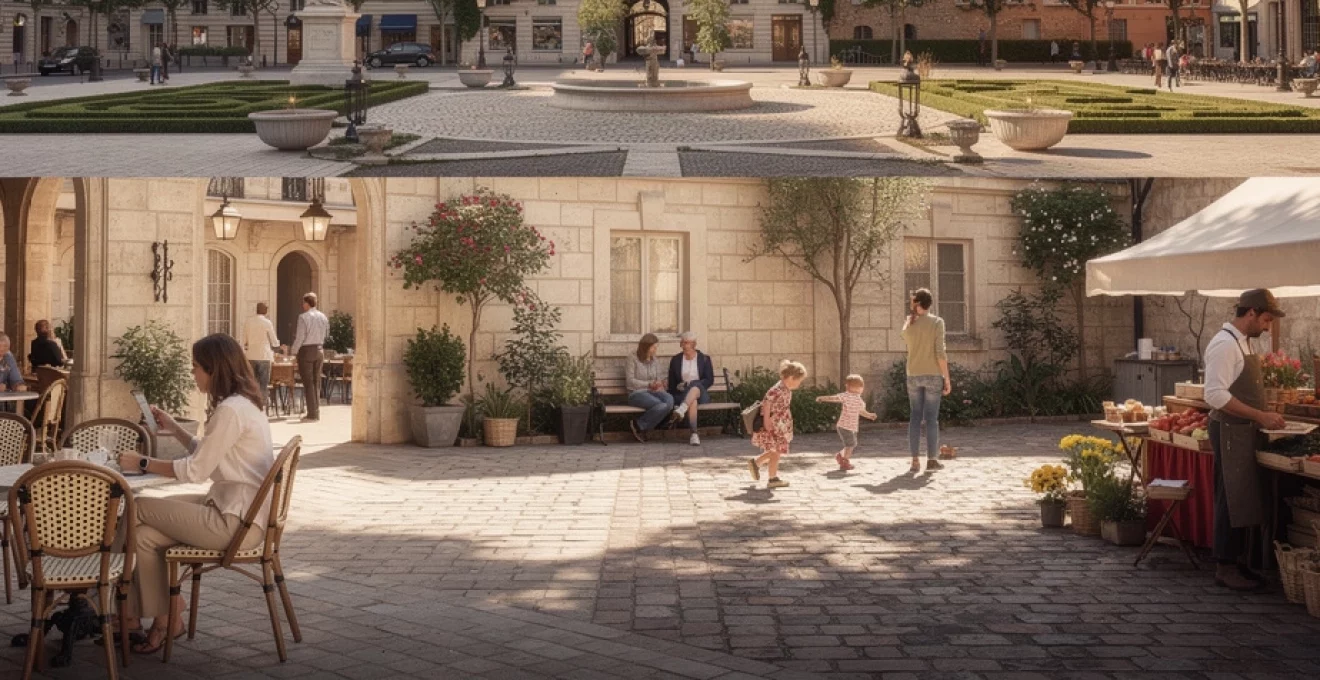
French urban landscapes have long captivated visitors and residents alike with their distinctive blend of architectural elegance and social vitality. From the intimate courtyards of medieval monasteries to the grand boulevards of Haussmann’s Paris, these spaces represent more than mere architectural features—they embody centuries of cultural evolution and social interaction. The relationship between French patios and public squares reflects a sophisticated understanding of how physical space shapes community life, creating environments that serve both practical and symbolic functions in French society.
These outdoor spaces have evolved from ancient Roman forums through medieval market squares to become the sophisticated urban environments we recognise today. Their design principles continue to influence contemporary urban planning, demonstrating the enduring relevance of French spatial concepts in creating liveable cities.
Historical evolution of french urban planning and public space design
The development of French public spaces traces its origins to Roman settlements, where forums served as the beating heart of civic life. Ancient Lutetia, modern-day Paris, featured a grand forum in what is now the 5th arrondissement, complete with temples, basilicas, and commercial spaces. This Roman legacy established fundamental principles of public space design that would influence French urban planning for centuries to come. The concept of a central gathering space surrounded by important civic and commercial buildings became deeply embedded in French urban consciousness.
Medieval France witnessed the organic growth of market squares and church courtyards, spaces that emerged naturally from the needs of growing communities. Unlike their Roman predecessors, these squares developed without rigid geometric planning, adapting to local topography and existing structures. The result was a more intimate scale of public space that fostered close community bonds whilst serving essential commercial and religious functions.
Haussmann’s boulevard system and its impact on parisian public squares
Baron Georges-Eugène Haussmann’s radical transformation of Paris between 1853 and 1870 fundamentally altered the relationship between public and private space in French cities. His vision created wide boulevards that functioned as linear public squares, incorporating tree-lined walkways, café terraces, and architectural unity that gave Paris its distinctive character. The Haussmannian approach prioritised circulation and hygiene whilst creating opportunities for social interaction along major thoroughfares.
This systematic approach to urban design established Paris as a vertical city with mixed-use buildings that brought together residents of different social classes. The integration of commercial ground floors with residential upper levels created a vibrant street life that extended the concept of public space beyond traditional squares into everyday pedestrian areas.
Medieval origins of french market squares and their architectural legacy
Medieval market squares emerged as organic responses to commercial needs, typically positioned at crossroads where trade routes intersected. Places like Place du Tilleuil in Pérouges demonstrate how cobblestone surfaces, half-timbered houses, and stone arcades created functional yet beautiful spaces for commerce and social exchange. These squares featured covered walkways that provided shelter for merchants and shoppers, whilst upper storeys of surrounding buildings jutted out over the square, creating intimate, human-scaled environments.
The multifunctional nature of medieval squares established patterns that persist in contemporary French urban design. These spaces served simultaneously as markets, festival venues, and centres of civic life, demonstrating the French preference for adaptable public spaces that can accommodate diverse community needs throughout different seasons and times of day.
Royal garden influence on 17th century french patio development
The development of formal French gardens under Louis XIV profoundly influenced the design of private courtyards and patios throughout France. André Le Nôtre’s principles of symmetry, perspective, and geometric order found expression not only in grand châteaux but also in the more modest courtyards of urban residences. The art de vivre cultivated at Versailles emphasised the importance of outdoor spaces as extensions of interior living areas, establishing the cultural foundation for contemporary French terrace culture.
Royal patronage of garden arts established France as the European centre of landscape design, with French principles spreading throughout continental Europe. The emphasis on outdoor entertaining and the integration of gardens with architectural design created a template for sophisticated outdoor living that influenced both aristocratic and bourgeois residential development.
Post-revolutionary transformation of aristocratic courtyards into public spaces
The French Revolution marked a dramatic shift in the accessibility
The French Revolution marked a dramatic shift in the accessibility and meaning of outdoor space. Aristocratic courtyards, once enclosed realms reserved for nobles and their guests, were progressively opened, subdivided or repurposed as civic amenities. Former royal properties such as the Tuileries gardens became public promenades, while hôtel particulier courtyards were adapted into shared passages, small squares or collective courtyards for new residents. This reallocation of space translated political ideals into the urban fabric, turning private privilege into shared urban heritage.
Throughout the 19th century, municipal authorities consolidated this transformation by formalising access, adding planting, benches and fountains, and integrating these former aristocratic domains into broader networks of public squares and parks. What had been backdrops for elite sociability now became everyday stages for bourgeois families, workers and children. This shift helped cement the enduring French expectation that the city should offer not only housing and infrastructure, but also generous, high-quality public realms where social life can unfold in the open air.
Architectural typologies and spatial characteristics of french patios
French patios encompass a wide spectrum of architectural typologies, from monumental château forecourts to intimate urban courtyards. Despite their diversity, these spaces share recurring design principles: enclosure that offers protection from noise and wind, carefully choreographed access, and a strong relationship between interior rooms and exterior terraces. In dense urban environments, patios often act as lungs and light wells, ensuring that dwellings receive both daylight and fresh air. In rural or suburban settings, they function as transitional spaces between the domestic interior and the wider landscape, reinforcing the French preference for blurred boundaries between house and garden.
Understanding these typologies allows us to appreciate how French patios contribute to both comfort and culture. They are not simply decorative voids between buildings; they are finely tuned microcosms that reflect social hierarchies, climatic adaptation and changing lifestyles. Whether we look at a grand cour d’honneur or a modest shared courtyard in a provincial town, we find the same underlying ambition: to create an outdoor room that extends the home and supports everyday rituals.
Cour d’honneur design principles in château architecture
The cour d’honneur, or honour courtyard, is one of the most recognisable French patio archetypes. Typically located on the main axis of a château or manor, it forms a ceremonial forecourt framed by wings of buildings and often closed by a gate or low wall. This spatial arrangement creates a sense of theatrical arrival, guiding visitors from the public road through a sequence of increasingly refined spaces before they reach the principal entrance. The geometry is usually rigorous, echoing the symmetry of the façade and reinforcing the idea of order and hierarchy that defined classical French architecture.
In many historic estates, the cour d’honneur also mediated between practical and representational functions. Service buildings such as stables, kitchens or guardhouses lined the sides, while the central space remained clear for carriages, ceremonies and receptions. Paving patterns, gravel beds and clipped box parterres helped manage circulation and drainage while contributing to visual splendour. When we visit places like Vaux-le-Vicomte or smaller regional châteaux today, we can still read these spatial codes, which continue to inspire designers seeking to create dignified yet welcoming entrance courts in contemporary projects.
Hôtel particulier courtyard configurations in lyon and bordeaux
In cities such as Lyon and Bordeaux, the hôtel particulier—a grand urban townhouse—developed its own distinctive courtyard typologies. Because plots were narrower and denser than in rural estates, architects worked vertically and inward, creating courtyards that maximised light and privacy while maintaining a clear separation between street and domestic life. In Bordeaux, for instance, many 18th-century residences feature a restrained stone façade on the street and a more ornate façade opening onto a paved or gravelled courtyard to the rear, often framed by galleries, staircases and service wings.
Lyon’s historic districts, particularly around the Presqu’île and Vieux Lyon, reveal another variant: courtyards connected by traboules, or covered passages, that thread through blocks. These semi-private routes once enabled silk workers and merchants to move quickly between homes, workshops and the river, while inner courtyards provided daylight, ventilation and social space. Today, many of these courtyards have been restored, with planting, café terraces or small artisan workshops bringing new life to formerly hidden spaces. They demonstrate how French patio architecture can adapt to dense, mixed-use contexts while preserving a sense of retreat from the street.
Monastic cloister influences on french residential patio design
Long before the rise of aristocratic châteaux, monastic cloisters established a powerful archetype for enclosed outdoor space. Typically organised as a square or rectangular courtyard surrounded by covered arcades, cloisters offered monks a calm environment for contemplation, circulation and work. The central garden, often planted with medicinal herbs or simple lawns, functioned as both symbolic paradise and microclimate regulator, bringing light and air into adjacent cells, refectories and chapter houses. This model of a protected, introspective patio left a lasting imprint on French spatial imagination.
As domestic architecture evolved, elements of the cloister filtered into residential patio design. Townhouses and rural homes adopted arcaded galleries, peristyles and continuous walkways that allow residents to circulate outdoors while sheltered from rain and sun—a practical solution in varied French climates. The idea of the patio as a quiet, inward-looking refuge also persisted, especially in regions with a strong monastic heritage such as Burgundy or the South-West. When we step into a shaded courtyard apartment in Toulouse or a renovated farmhouse in the Dordogne, we often sense this cloister-like quality of calm enclosure, even if the religious symbolism has long since faded.
Contemporary adaptive reuse of historic patios in marseille’s le panier district
Marseille’s Le Panier district offers a compelling laboratory for the adaptive reuse of historic patios in a dense Mediterranean port city. Once characterised by modest housing blocks, religious institutions and small-scale workshops, the area contained numerous inner courtyards and light wells that had fallen into disrepair by the late 20th century. Recent urban regeneration initiatives have focused on reopening, restoring and reprogramming these spaces, turning them into shared gardens, micro-squares, cultural venues and café terraces that support a more vibrant local life.
Architects and planners working in Le Panier face complex challenges: how to respect fragile heritage fabric, respond to contemporary housing standards and address social diversity, all within limited footprints. Successful projects treat historic patios as flexible platforms rather than static museum pieces. Simple interventions—improved paving, drought-resistant planting, discreet lighting and accessible entrances—allow old courtyards to host concerts, artisan markets or children’s play areas. For visitors and residents, these spaces offer a tangible lesson in how thoughtful reuse can reconcile conservation with everyday use, reinforcing the cultural significance of French patios in modern urban life.
Iconic french public squares and their cultural functions
Across France, a constellation of iconic public squares illustrates how urban form and social practice intertwine. In Paris, the perfectly regular Place des Vosges, with its arcades and uniform façades, embodies the royal ambition to choreograph both architecture and behaviour: arcades shelter cafés and galleries, while the central lawn invites relaxation and play. Place de la Bourse in Bordeaux stages a different scene, where the monumental 18th-century façade is mirrored in the reflective miroir d’eau, turning the square into a dynamic theatre of light, water and people. Both spaces show how squares can simultaneously showcase heritage and frame everyday enjoyment.
Smaller cities and towns also boast emblematic squares with distinctive cultural roles. The amphitheatre-like Place du Capitole in Toulouse, for instance, functions as a civic stage for political gatherings, concerts and public celebrations, its pink-brick architecture amplifying a strong regional identity. In Provence, sun-drenched squares shaded by plane trees, such as those in Aix-en-Provence or Uzès, host markets, pétanque games and terrace cafés, embodying a slower, outdoor-oriented rhythm of life. Each of these places acts as a social condenser, bringing together residents and visitors in rituals that affirm local belonging while welcoming the outside world.
Social rituals and community practices in french public spaces
French patios and public squares are more than aesthetic compositions; they are frameworks for recurring social rituals. From weekday market routines to evening apéritifs on terraces, these spaces structure daily and seasonal rhythms. Urban sociologists often describe such places as the “living rooms” of French cities, where people of different generations and backgrounds cross paths in informal yet meaningful ways. As we examine specific practices—from market days to festivals and café culture—we begin to understand why these spaces are so deeply woven into the French sense of identity and well-being.
In an era when many people spend increasing amounts of time indoors or online, the resilience of these outdoor rituals is striking. They offer face-to-face encounters, sensory richness and a sense of belonging that digital spaces struggle to match. For visitors curious about French culture, paying attention to how people use patios and squares—at what times, in what seasons, and with which unspoken rules—can be as revealing as any museum visit.
Market day traditions in place du tertre and regional town squares
Market days remain one of the most enduring and visible rituals in French squares. In Paris, Place du Tertre in Montmartre famously combines open-air art stalls with café terraces, but its lively atmosphere echoes older traditions of weekly food and craft markets found across the country. In regional towns such as Sarlat, Uzès or Annecy, the central square transforms on market mornings into a dense tapestry of stalls laden with cheese, charcuterie, seasonal produce and local specialities. The square becomes a sensory marketplace where colours, smells and sounds blend into a distinctive urban experience.
These markets are not only about provisioning; they are social events. Neighbours catch up on news, producers exchange recipes with customers, children sample fruits or pastries, and regulars greet each other by name. In many places, cafés on the edges of the square fill with people extending their shopping trip into a leisurely coffee or glass of wine. If you want to understand the cultural significance of a French town square, visiting on market day is often the best strategy: you will see how commerce, conversation and community identity come together in a single, animated setting.
Festival celebrations and seasonal events in public square programming
Throughout the year, French public squares host a rich calendar of festivals and events that reinforce their central role in community life. National celebrations like Bastille Day bring fireworks, concerts and official ceremonies to major squares, while smaller towns organise fêtes votives, Christmas markets or harvest festivals that showcase local traditions. Temporary installations—stages, fairground rides, ice rinks or open-air cinemas—transform familiar spaces into festive arenas, demonstrating the flexibility of French public squares as programmable cultural platforms.
Municipalities increasingly view this event programming as a strategic tool for economic development and social cohesion. Well-curated festivals draw visitors from surrounding regions, support local businesses and foster pride among residents. At the same time, planners must balance lively activity with the needs of nearby residents and heritage conservation. Questions of noise, security and wear on historic paving surfaces require careful management. When done well, however, seasonal events help ensure that squares remain not just picturesque backdrops but living, evolving spaces that reflect contemporary life.
Café culture integration with square design in provence and languedoc
Café terraces are perhaps the most recognisable interface between French patios, public squares and everyday life. In Provence and Languedoc in particular, the design of squares often anticipates and accommodates this café culture. Broad, shaded perimeters allow for rows of tables and chairs that spill into the public realm without obstructing circulation. Trees, fountains and low walls provide microclimatic comfort and informal seating, encouraging people to linger. The effect is a finely balanced choreography where private businesses activate the square while the square, in turn, lends prestige and atmosphere to the cafés.
For many residents, the daily ritual of sitting on a terrace—whether for a quick espresso or a long, convivial lunch—is a way of claiming their place in the city’s social fabric. You might think of the café chair as a personal balcony onto public life: a seat from which to watch passers-by, read the newspaper or chat with friends while remaining firmly anchored in the shared space of the square. Urban designers studying these places often liken them to an “outdoor living room,” where boundaries between private consumption and public sociability are deliberately blurred to enrich urban experience.
Regional variations in french patio and square architecture
Although certain design principles recur across France, regional climates, materials and cultural histories have produced strikingly different patio and square typologies. In the Mediterranean south, for example, patios and plazas are designed to mitigate intense sun and heat, with narrow streets opening onto shaded courtyards, thick masonry walls and light-coloured paving that reflects rather than absorbs warmth. Fountains and basins add evaporative cooling, while plane trees or pergolas provide dappled shade, making outdoor life comfortable well into the summer months.
Further north, in regions such as Brittany or Alsace, wetter and colder climates shape a different approach. Here, enclosed courtyards with arcades, galleries or deep eaves offer protection from rain and wind, and façades often feature half-timbering or coloured plaster that reflects local building traditions. Squares may be slightly smaller and more compact, ensuring a sense of shelter even in harsh weather. Mountain regions like the Alps adopt yet another model, where village squares double as multifunctional spaces for markets, livestock fairs and winter festivities, all framed by steeply pitched roofs and robust stone construction. Taken together, these variations illustrate how the French patio and square are not static formulas, but adaptive responses to place.
Contemporary preservation challenges and urban planning considerations
Today, the cultural significance of French patios and public squares comes with complex preservation and planning challenges. Urban populations are growing, tourism is increasing, and climate change is reshaping how outdoor spaces are used. Municipalities must reconcile the need for densification and new infrastructure with the protection of historic courtyards and squares that give cities their character. In some neighbourhoods, the pressure to convert inner courtyards into additional building volume risks eroding precious open space and natural light, while in heavily visited areas, overuse can damage paving, trees and heritage façades.
Forward-looking urban policies therefore seek a careful balance. Tools such as heritage protection zones, design guidelines and participatory planning help ensure that renovations respect historic typologies while allowing for contemporary comfort—such as accessibility improvements, energy-efficient lighting and resilient planting suited to hotter summers. At the same time, planners are increasingly attentive to social equity, asking who has access to high-quality patios and squares, and how these spaces can support inclusive, intergenerational use rather than exclusive consumption. If we think of French patios and public squares as a shared cultural resource, much like a library or museum, it becomes clear why their thoughtful stewardship is essential for the long-term livability and identity of French cities.