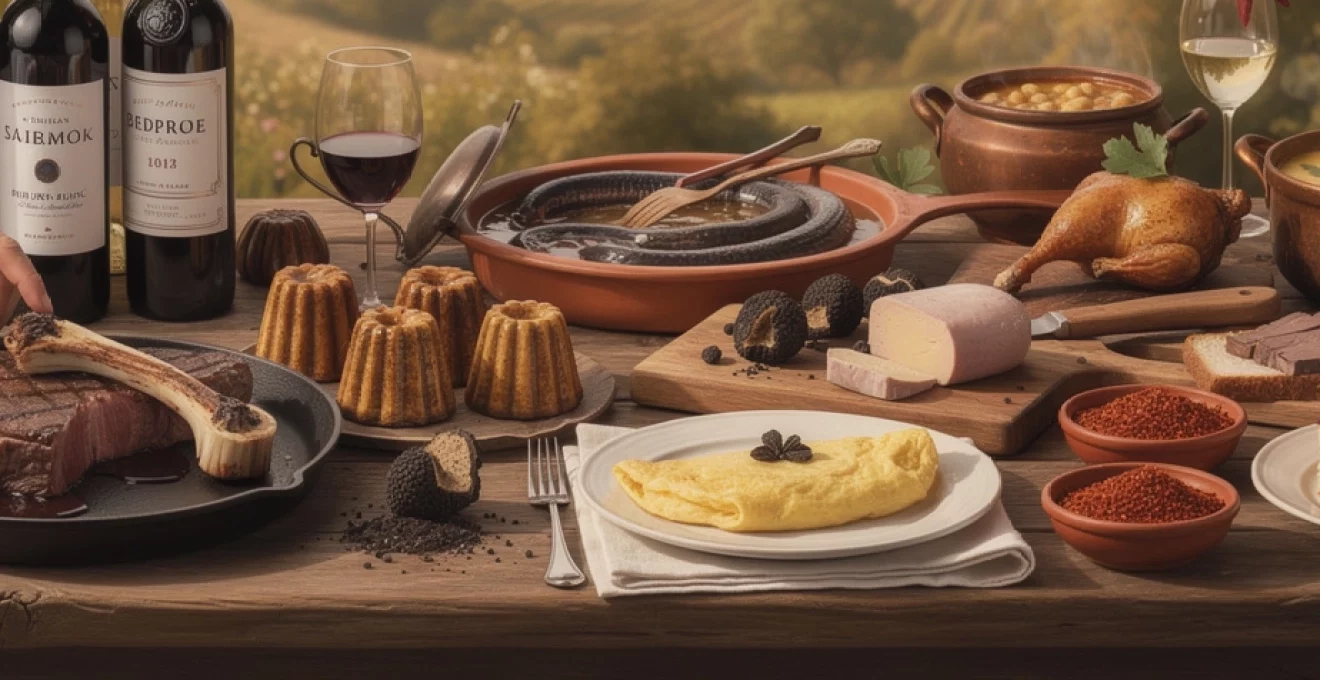
The southwestern corner of France represents one of Europe’s most celebrated gastronomic regions, where centuries-old culinary practices merge seamlessly with exceptional terroir and internationally acclaimed wine production. From the Atlantic coastline to the foothills of the Pyrenees, this expansive territory has developed a distinctive food culture shaped by Roman viticulture, medieval preservation techniques, and Basque maritime traditions. The region’s reputation rests not merely on quality ingredients but on the sophisticated interplay between wine appellations and traditional dishes, where duck fat replaces olive oil, and preservation methods transform humble ingredients into luxury products that command global recognition.
What makes this region particularly fascinating for culinary enthusiasts is the remarkable diversity compressed within relatively compact geographical boundaries. You’ll discover everything from prehistoric lamprey preparations in Bordeaux to salt-cured mountain hams in Bayonne, from black truffle markets in Périgord to pine-smoked charcuterie in the Landes forest. This gastronomic wealth stems from varied microclimates, diverse agricultural practices, and the cultural confluence of French, Spanish, and Basque influences. The result is a cuisine that prioritises preservation, celebrates rich flavours, and demonstrates an almost reverential respect for seasonal rhythms and traditional production methods.
Gastronomic heritage of bordeaux: wine appellations and culinary pairings
Bordeaux’s culinary identity cannot be separated from its viticultural heritage, which dates back approximately 2,000 years to Roman occupation. The city’s position as a major trading port established it as an export hub for wines that would eventually define quality standards worldwide. This commercial success created a sophisticated gastronomic culture where food preparation techniques evolved specifically to complement the region’s diverse wine production. The classification systems developed here influenced agricultural practices across Europe, whilst local dishes were refined through centuries of pairing experimentation with different grape varieties and terroirs.
Pauillac and Saint-Émilion grand cru classification systems
The 1855 Classification of Bordeaux wines established a hierarchical structure that remains influential today, particularly in the Pauillac appellation where prestigious châteaux produce some of the world’s most expensive bottles. This classification system ranked estates from First Growth to Fifth Growth based on market prices and reputation, creating a quality framework that extended beyond wine into associated food production. Pauillac lamb, for instance, developed its Protected Geographical Indication partly due to the region’s wine prestige, with sheep historically grazing between vineyard rows and benefiting from mineral-rich soils.
Saint-Émilion adopted a different approach with its own classification system, established in 1955 and revised approximately every decade. This more dynamic structure allows estates to move between Premier Grand Cru Classé and Grand Cru Classé categories based on current quality assessments. The right bank terroir, predominantly limestone and clay, produces Merlot-dominant wines with softer tannins and earlier drinkability compared to the Cabernet Sauvignon-heavy left bank appellations. These stylistic differences directly influence traditional food pairings, with Saint-Émilion wines complementing duck-based preparations and foie gras, whilst Pauillac wines match better with robust beef dishes.
Entrecôte à la bordelaise: traditional bone marrow sauce preparation
The signature sauce bordelaise exemplifies how wine production shaped culinary techniques in the region. This reduction begins with shallots softened in butter, then deglazed with quality red Bordeaux wine—typically an everyday drinking wine rather than classified growth. The addition of veal or beef stock creates body, whilst thyme and bay leaves provide aromatic complexity. The defining characteristic, however, is the incorporation of poached bone marrow, which adds luxurious richness and silky texture that transforms a simple grilled steak into an elegant dish worthy of the region’s gastronomic reputation.
Traditional preparation requires careful temperature control to prevent the marrow from disintegrating into the sauce. Bone sections are typically soaked in cold salted water for several hours to remove blood residue, then gently poached until the marrow becomes translucent and soft but retains structural integrity. This delicate ingredient is added to the finished sauce just before serving, allowing it to warm through without completely mel
t into the liquid. When prepared for an authentic entrecôte à la bordelaise, the grilled ribeye is typically cooked over vine shoots, which impart a subtle smokiness that mirrors the toasty oak notes in many Médoc wines. The finished sauce is spooned generously over the meat, with extra bone marrow served on top or alongside, creating a dish that showcases both the depth of Bordeaux reds and the region’s mastery of rich, wine-based reductions.
Cannelés de bordeaux: beeswax mould technique and rum custard chemistry
Among Bordeaux’s sweet specialities, cannelés de Bordeaux stand out for their unique texture: a deeply caramelised, almost burnt shell encasing a tender, rum-and-vanilla scented custard. Historically, these pastries emerged from wine production itself. Egg whites were used to clarify wines in the cellars, leaving yolks in abundance; local bakers transformed this “waste” into a rich batter baked in copper moulds lined with beeswax and butter. The result is a pastry that, like many Bordeaux dishes, is inseparable from the wine trade that shaped it.
The beeswax plays a crucial technical role. When brushed inside the moulds, it creates a thin, hydrophobic barrier that allows the custard batter to rise and set without sticking, while promoting intense surface caramelisation. The batter, a loose mixture akin to crêpe batter, rests for 24 to 48 hours. This resting period hydrates the flour and allows gluten to relax, ensuring a silky, custard-like crumb rather than a bready texture. The interaction between proteins, sugars, and high heat triggers the Maillard reaction and caramelisation, developing the cannelé’s characteristic bittersweet crust.
Achieving the ideal contrast between crisp exterior and creamy interior requires careful control of baking temperature. Traditional methods start with very high heat to “shock” the batter, forming the crust quickly, followed by a reduction in oven temperature to cook the centre gently without collapsing. The rum and vanilla are added in modest quantities to avoid curdling the milk proteins; excessive alcohol can interfere with the custard’s ability to set. For pairing, you can enjoy cannelés with a glass of Sauternes or another sweet Bordeaux wine, whose honeyed notes echo the caramel and vanilla in the pastry.
Lamproie à la bordelaise: medieval eel cookery methods
Lamproie à la bordelaise is one of Bordeaux’s most ancient and emblematic preparations, its roots stretching back to medieval and even Roman times. Lamprey, a jawless, eel-like fish, migrates through the Gironde estuary, and has long been prized for its rich, almost gamey flesh. Historically a dish of the elite, it was often served at banquets and on religious feast days. Today, it remains a seasonal speciality, usually available from late winter to early spring, and is still prepared using methods that would be recognisable centuries ago.
The traditional recipe begins with bleeding the live lamprey, collecting its blood to enrich the sauce, much as one might with a classic civet of hare. After being scalded to remove the skin’s mucus, the fish is cut into sections and gently stewed with leeks, onions, quality bacon, thyme, bay leaf, and a generous amount of red Bordeaux wine. The blood is carefully incorporated toward the end of cooking, stabilised with vinegar or wine to prevent coagulation. This creates a thick, velvety sauce that clings to the pieces of lamprey, giving the dish an intensity comparable to a long-simmered meat ragout.
Because of its strong flavour, lamproie à la bordelaise is typically served with simple accompaniments such as steamed potatoes or toasted country bread to absorb the sauce. For wine pairings, powerful left bank reds—often Pauillac or Saint-Julien—stand up to the richness and iron notes of the dish. It is very much a “love it or hate it” preparation, but for those who appreciate historic gastronomy, tasting lamprey cooked in this medieval style offers a direct link to Bordeaux’s maritime and culinary past.
Périgord’s black diamond: truffle cultivation and traditional preservation
Moving east from Bordeaux into the Dordogne and Périgord, the culinary focus shifts from vineyards and estuaries to oak forests and limestone plateaus. Here, the black truffle, or Tuber melanosporum, reigns supreme, earning the nickname “black diamond” for its rarity and value. This part of southwest France has been associated with truffle hunting since at least the 18th century, and today it remains one of Europe’s key production zones. As you explore the culinary traditions of Bordeaux and the Southwest, understanding how truffles are cultivated, harvested, and preserved will deepen your appreciation of many iconic winter dishes.
Tuber melanosporum harvesting in the dordogne valley
The cultivation of black truffles in the Dordogne Valley relies on a symbiotic relationship between the fungus and the roots of specific trees, primarily oaks and hazelnuts. Growers plant inoculated saplings in calcareous, well-drained soils with good sun exposure—a process that demands patience, as it can take 6 to 10 years before a truffle orchard (truffière) yields its first harvest. Annual production in France fluctuates widely depending on rainfall and temperature, with estimates ranging from 30 to 60 tonnes in recent decades, a fraction of historic volumes documented in the 19th century.
Harvesting traditionally involved pigs whose keen sense of smell could detect ripe truffles buried 10–30 centimetres beneath the surface. However, dogs have largely replaced pigs because they are easier to train, less likely to eat the truffles, and more manageable in the field. The ideal harvest window for Tuber melanosporum runs from late November to early March, when the truffles reach full maturity and their aroma peaks. Growers watch for subtle clues—cracking soil, reduced vegetation, and the dog’s behaviour—to pinpoint where to dig.
Once unearthed, truffles are brushed gently and stored in breathable containers at cool temperatures to prevent moisture build-up. Their perfume is volatile and fades quickly, which is why you often see them sold at weekly winter markets in Sarlat, Périgueux, and other Périgord towns. For home cooks, the key is to use them within a few days and to avoid overpowering them with strong flavours. By treating truffles more like a seasoning than a main ingredient, you preserve the delicate interplay of earthiness, undergrowth, and subtle cocoa notes that defines high-quality Tuber melanosporum.
Omelette aux truffes: temperature control and emulsification techniques
One of the purest ways to enjoy black truffle in southwest France is in a simple omelette aux truffes. At first glance, it seems like a basic egg dish, but its success depends on careful temperature control and an understanding of how eggs and fat emulsify. Many traditional cooks begin by storing whole eggs with truffles in a sealed container for 24–48 hours; the porous shells allow the aroma to penetrate, gently perfuming the eggs before cooking even begins. This step explains how such a modest quantity of truffle can flavour an entire omelette.
During cooking, the goal is to achieve a creamy, slightly runny texture—what the French call baveuse. Eggs are whisked just enough to blend white and yolk without incorporating too much air, which would create a dry, spongy result. Butter is melted over low to medium heat until it foams but does not brown; any burnt notes would mask the truffle’s perfume. As the eggs begin to set, finely shaved truffle is folded in, allowing its fat-soluble aromatic compounds to disperse through the butter and egg mixture, creating a subtle but persistent flavour.
Why is gentle heat so important here? If the pan is too hot, the proteins in the egg tighten rapidly, squeezing out moisture and producing a rubbery texture that dulls the truffle’s impact. You’re essentially creating a soft emulsion of fat and partially coagulated protein, similar in some ways to a custard. Served with toasted country bread and a glass of aged Périgord Bergerac or a lighter Bordeaux red, omelette aux truffes showcases the region’s philosophy: simple ingredients elevated through technique and respect for terroir.
Foie gras production methods in Sarlat-la-Canéda
The Périgord Noir around Sarlat-la-Canéda is another stronghold of southwest French gastronomy, particularly renowned for its production of duck and goose foie gras. Despite ongoing ethical debates—and evolving regulations—foie gras remains central to festive meals and restaurant menus across the region. Traditional production begins with duck breeds such as the Mulard, chosen for their ability to develop large, high-quality livers under controlled feeding regimes. For much of the year, the ducks live outdoors, foraging and building baseline health before the finishing phase known as gavage.
During gavage, which typically lasts 10 to 14 days, the ducks are fed energy-dense corn several times daily using a tube. Modern farms increasingly use pneumatic or mechanical systems designed to standardise feed quantities and minimise injury, with veterinary oversight more common than in the past. The process induces hepatic steatosis, enlarging the liver while preserving a smooth texture prized by chefs. Animal welfare remains a central discussion point; some producers are experimenting with alternative feeding techniques and free-range systems to respond to consumer concerns while maintaining product quality.
Once harvested, livers are graded by size, colour, and firmness. Top-quality livers are used for foie gras entier (whole lobes), which can be pan-seared or gently cooked as a terrine. Others are transformed into bloc de foie gras or mousse. In Sarlat’s markets, you’ll see fresh livers, semi-cooked terrines, and canned versions, each with different shelf lives and ideal uses. To make the most of foie gras at home, keep the seasoning simple—salt, pepper, perhaps a splash of Armagnac—and serve it slightly cooler than room temperature with toasted brioche and a glass of Monbazillac or Sauternes.
Confit de canard: duck fat preservation and cassoulet integration
Confit de canard is one of the most emblematic preservation techniques of southwest France, transforming duck legs into a deeply flavoured ingredient that can be stored for months. The process begins with a dry cure: the legs are rubbed with coarse salt, garlic, and sometimes thyme or bay leaves, then left to rest under refrigeration for up to 24 hours. This cure draws out moisture, firms the flesh, and begins to season the meat from within. After rinsing and drying, the legs are slowly poached in rendered duck fat at a low temperature—around 80–90°C—until the meat becomes tender enough to pull away from the bone.
Once cooked, the legs are submerged in duck fat in earthenware pots or jars, creating an anaerobic environment that inhibits bacterial growth. Before modern refrigeration, this method allowed farmers to preserve their winter meat supply well into spring. Today, confit is both a practical and gastronomic choice, providing cooks with ready-to-crisp duck legs that can be quickly finished in a hot oven or skillet. The reserved fat, richly infused with duck flavour, is used to roast potatoes, fry eggs, or enrich stews, making it one of the most versatile ingredients in the southwest pantry.
In dishes like cassoulet—most famously associated with neighbouring Languedoc but widely enjoyed across the southwest—confit de canard plays a starring role. The confit’s concentrated flavour and resilient texture stand up to long, slow baking with white beans, sausages, and pork. If you’re integrating confit into cassoulet at home, a useful tip is to crisp the skin separately before serving, then nestle the duck pieces into the beans just before bringing the dish to the table. For wine pairing, robust reds from Cahors, Bergerac, or a structured Bordeaux blend all complement the dish’s richness and smoky nuances.
Basque country culinary techniques: from bayonne to Saint-Jean-de-Luz
Further south, as you approach the Pyrenees and the Atlantic, the Basque Country introduces new flavours and techniques to the culinary map of Bordeaux and the Southwest. Here, the cuisine reflects a blend of mountain and maritime influences: hearty meat dishes coexist with refined fish preparations, and chilli peppers take the place of black pepper in many recipes. The towns of Bayonne, Espelette, and Saint-Jean-de-Luz form a gastronomic triangle where salt-curing, spice-drying, and slow simmering are elevated to art forms.
Jambon de bayonne: Salt-Curing and adour valley pork selection
Jambon de Bayonne is one of France’s most recognisable cured hams, protected by a PGI (Protected Geographical Indication) that ties it to the Adour river basin. The quality of this Basque ham begins with the selection of pigs raised in the southwest, often on cereal-rich diets that contribute to well-marbled meat. Only specific cuts of hind leg, meeting strict weight and fat-cover criteria, qualify for transformation into jambon de Bayonne. This rigorous selection helps ensure a consistent texture and flavour across producers.
The curing process relies on the region’s natural resources, especially the salt from the Adour basin. Fresh hams are rubbed generously with salt and stored in cool rooms for several weeks, during which the salt penetrates the muscle, drawing out moisture and beginning preservation. After desalting and resting, the hams are transferred to drying rooms where time, airflow, and gradual temperature changes do the rest. This maturation stage can last from 7 to 12 months, sometimes longer for premium hams, developing aromas of nuts, dried fruit, and aged cheese.
In Basque cooking, jambon de Bayonne is usually sliced very thin and served at room temperature to maximise its melt-in-the-mouth quality. You’ll find it paired with local sheep’s cheese, fresh figs, or melon, or incorporated into simple omelettes and piperade. For wine pairings, a fruity southwest rosé or a light, chilled red from Irouléguy works beautifully, cutting through the ham’s richness without overpowering its delicate sweetness.
Piment d’espelette AOP: drying processes and scoville heat classification
No exploration of Basque gastronomy is complete without piment d’Espelette, the mild yet aromatic chilli pepper that has replaced black pepper in many regional recipes. Granted AOP (Appellation d’Origine Protégée) status, it is cultivated in and around the village of Espelette. The peppers are harvested between late summer and early autumn, when they turn a vibrant red. Instead of being consumed fresh in large quantities, they are mostly dried and ground into a powder that offers warmth and flavour rather than searing heat.
The drying process is as much cultural as it is technical. Strings of peppers are hung on house facades and under eaves to dry slowly in the open air, a sight that has become emblematic of Basque villages. Once sufficiently dehydrated, the peppers are finished in controlled drying rooms to standardise moisture content before being ground. The resulting powder has a Scoville rating typically around 1,500 to 3,000 units—gentler than cayenne but more assertive than sweet paprika. This moderate heat allows cooks to use it generously for depth of flavour without overwhelming a dish.
In the kitchen, piment d’Espelette functions much like a signature Basque seasoning. It’s sprinkled over grilled fish, stirred into sauces, and used to finish dishes like axoa or piperade. Think of it as a bridge between pepper and paprika: it provides colour, a touch of smokiness, and a lingering warmth. For home cooks experimenting with Basque recipes, a practical tip is to add the pepper toward the end of cooking to preserve its bright aroma, reserving a final pinch as a table condiment.
Ttoro and axoa: traditional basque fish stew and veal preparations
Basque coastal towns such as Saint-Jean-de-Luz have long relied on the sea, and ttoro is one of the region’s classic fish stews that showcases this maritime heritage. Traditionally prepared by fishermen using the day’s unsold catch, ttoro combines various fish and shellfish—monkfish, hake, mussels, and sometimes crayfish—in a rich broth of tomatoes, onions, garlic, white wine, and piment d’Espelette. The result is a dish that, like a southern cousin to bouillabaisse, balances the sweetness of seafood with the gentle heat and depth of Basque spices.
Inland, axoa offers a meaty counterpart to ttoro. This rustic preparation from the village of Espelette features finely chopped or minced veal sautéed with onions, green peppers, and, of course, piment d’Espelette. Simmered until tender, it yields a dish that is both hearty and aromatic, traditionally served with boiled potatoes or rice. Because the veal is cut into small pieces, the spices and vegetables integrate thoroughly, creating a texture somewhere between a ragout and a stir-fry.
Both dishes illustrate the Basque approach to seasoning: generous but controlled, allowing the primary ingredient—whether fish or veal—to remain at the centre of the plate. For wine pairings, ttoro works well with structured dry whites from the southwest or coastal Spanish regions, while axoa pairs nicely with medium-bodied reds from Irouléguy or even a supple Bordeaux right bank blend. If you’re looking to bring a taste of the Basque Country into your own kitchen, starting with these two recipes gives you an excellent introduction to traditional techniques and flavour profiles.
Gâteau basque: pastry cream versus black cherry filling traditions
Gâteau basque is perhaps the most emblematic dessert of the Basque Country, and yet even locals debate what constitutes the “authentic” filling. At its core, the cake consists of a rich, shortcrust-style dough flavoured with vanilla—or sometimes a hint of rum—enclosing either a pastry cream centre or a layer of black cherry jam. The version with black cherry, made from local griotte cherries, is particularly associated with the town of Cambo-les-Bains, while pastry cream fillings are more common in other parts of the region.
From a technical point of view, the dough behaves more like a cookie than a traditional sponge cake. It relies on a high butter content and minimal mixing to avoid gluten development, resulting in a tender, crumbly texture once baked. For the pastry cream version, cooks must pay close attention to the custard’s stability: it should be thick enough not to leak during baking yet still creamy after cooling. This involves careful tempering of egg yolks with hot milk and cooking to the point of nappe, where the cream coats the back of a spoon.
With the black cherry filling, the challenge lies in achieving the right balance between sweetness and acidity. A jam that is too liquid can cause the cake to sag or split, while one that is overly sugary can mask the subtle aromas of the dough. Many bakers therefore reduce the fruit with minimal added sugar, preserving the cherry’s characteristic tartness. Whether you choose pastry cream or black cherry, serving gâteau basque at room temperature with a cup of coffee or a glass of sweet Jurançon wine offers a fittingly indulgent end to a Basque-inspired meal.
Landes forest gastronomy: Pine-Smoked charcuterie and wild game
North of the Basque Country, the vast Landes forest shapes a different but equally distinctive culinary landscape. Once a marshy wasteland, this area was transformed in the 19th century into one of Europe’s largest man-made pine forests, and the local gastronomy adapted accordingly. Smoke from pine wood and needles became a natural ally in preserving meats, while open spaces and wetlands provided ideal habitats for wild boar, deer, and game birds. When you taste Landes specialities, you often find subtle resinous notes and robust, rustic flavours that speak directly of the forest.
Charcuterie producers in the Landes frequently use pine wood to smoke hams, sausages, and even duck breasts (magrets fumés). Compared to beech or oak, pine imparts a slightly sharper, more aromatic smoke, which must be managed carefully to avoid bitterness. Producers control both the temperature and duration of smoking, sometimes combining cold smoking for flavour with later cooking steps for food safety. The result is cured meats that pair particularly well with earthy mushrooms and potatoes roasted in duck fat, another regional hallmark.
Wild game forms a second pillar of Landes gastronomy. In autumn and winter, menus often feature venison stews, wild boar ragouts, or roasted wood pigeons, prepared with slow-cooking methods that break down tough fibres and concentrate flavour. These dishes typically incorporate forest aromatics such as juniper, bay, and wild thyme, as well as local mushrooms like cèpes. For wine, structured reds from Madiran or Cahors stand up to the intensity of the meat and the smokiness of charcuterie, while fuller-bodied Bordeaux blends also make excellent partners.
Armagnac distillation and prune d’agen processing techniques
Inland from Bordeaux and the Landes, Gascony and the Lot-et-Garonne region introduce two more icons of southwest French gastronomy: Armagnac and pruneaux d’Agen. Both exemplify the region’s historical emphasis on preservation through concentration—of alcohol in the case of brandy, and of sugar and flavour in the case of dried plums. Understanding how Armagnac is distilled and how Agen prunes are processed offers valuable insight into the technical side of the culinary traditions of Bordeaux and the Southwest.
Alambic armagnacais: Single-Distillation copper still methodology
Armagnac is often described as Cognac’s rustic cousin, but from a technical point of view, it is quite distinct. The spirit is typically produced in an alambic armagnacais, a type of continuous copper still designed for single distillation at relatively low strength—usually around 52–60% ABV. This lower distillation proof allows more congeners and aromatic compounds to remain in the spirit, resulting in a fuller-bodied, more characterful brandy straight off the still. Many producers fire their stills only once a year, after the autumn harvest, in a tradition that has changed little over centuries.
In the alambic armagnacais, wine flows continuously through a series of plates, meeting rising alcoholic vapours that strip flavour and alcohol from the liquid. The use of copper is crucial: it catalyses reactions that remove unwanted sulphur compounds, contributing to a cleaner, more elegant distillate. Once collected, the young Armagnac is transferred into local oak barrels, often made from Gascon or Limousin oak, where it will age for years—sometimes decades. During this time, evaporation (the so-called “angels’ share”) gradually reduces alcohol content to around 40–48%, and complex notes of dried fruit, vanilla, and spice develop.
From a food-pairing perspective, Armagnac’s robust profile lends itself well to southwest desserts and cheese. It is often used to flambé prunes, enrich sauces for duck or game, or accompany blue cheeses such as Roquefort. If you’re visiting the region, many small producers offer tastings where you can compare vintages and understand how factors like grape variety, distillation temperature, and barrel selection influence the final spirit.
Floc de gascogne: mutage process and fortification ratios
Alongside Armagnac, Gascony produces Floc de Gascogne, an aromatic fortified wine that showcases another traditional technique: mutage. This process involves blending fresh grape must with Armagnac from the same estate, effectively halting fermentation and preserving the must’s natural sugars. By law, the ratio is typically around two parts grape juice to one part Armagnac, yielding a beverage with an alcohol content of about 16–18% ABV. The name “Floc” comes from the old Occitan word for “bouquet,” a nod to its intensely fruity aroma.
The quality of Floc de Gascogne depends on both components: ripe, flavourful grapes and a well-crafted young Armagnac. White Floc, made from varieties like Colombard, Ugni Blanc, or Gros Manseng, tends to show notes of citrus, white flowers, and stone fruit. Red Floc, produced from Tannat, Cabernet Franc, or Merlot, offers red berry and plum notes with a subtle tannic framework. Because fermentation is stopped early, the drink retains a natural sweetness balanced by the eau-de-vie’s structure.
Served chilled as an aperitif, Floc is often enjoyed with foie gras, cured meats, or fresh fruit-based desserts. In cocktails, it can substitute for vermouth or sweet wine, adding a distinctly Gascon touch. If you’re experimenting at home, remember that Floc is best consumed young—within a couple of years of bottling—to fully appreciate its fresh, grapey character.
Agen prune Drying:Ente plum varietal and dehydration standards
Pruneaux d’Agen owe their reputation to a specific plum variety—the Prune d’Ente—and to carefully controlled drying techniques. The Ente plum, a cross between local and imported varieties, ripens late in the season and contains a high level of natural sugar, making it ideal for dehydration. Harvest typically takes place from late August to early September, when the fruit reaches optimal ripeness and sugar concentration. Only plums that meet strict size and quality standards go on to become AOP-designated Agen prunes.
After washing and sorting, the plums are placed on racks and dried in hot-air tunnels at controlled temperatures, often between 70 and 90°C. The goal is to reduce moisture content to around 21–23%, enough to ensure shelf stability while maintaining a soft, chewy texture. This dehydration process can take 20 to 24 hours, sometimes in stages, with rest periods that help the fruit reabsorb some of its own moisture, creating a more homogeneous consistency. Once dried, the prunes are graded again by size and softness, then either packaged as-is or further processed into prune purée or candied prunes.
Culinarily, pruneaux d’Agen appear in both sweet and savoury dishes. They are stewed with Armagnac for desserts, tucked into roasts of pork or duck, or added to tagines and compotes. Nutritionally, they are rich in fibre and antioxidants, which has boosted their popularity in recent years as a natural health food. When pairing with wine, sweet whites like Monbazillac or late-harvest Jurançon complement the prunes’ caramel and dried-fruit notes, while Armagnac remains the classic partner.
Southwestern french cheese production: from Ossau-Iraty to rocamadour
Cheese might not be the first thing that comes to mind when you think of Bordeaux and the Southwest, yet the region produces several distinctive styles that reflect its varied landscapes. From the sheep-grazed Pyrenean foothills to the limestone plateaus of the Lot, local cheeses offer a snapshot of southwest terroir in every bite. Understanding how these cheeses are made—and how to enjoy them with regional wines—adds another dimension to your exploration of the culinary traditions of Bordeaux and the Southwest.
Ossau-Iraty, an AOP sheep’s milk cheese from the Basque and Béarn regions, is one of the oldest cheeses in France, with roots dating back at least 3,000 years. Made from the milk of Manech and Basco-Béarnaise sheep grazing in mountain pastures, it is pressed and aged for a minimum of 80 days, often much longer. The result is a semi-firm cheese with a supple texture and flavours of nuts, hay, and sometimes caramel. Traditionally, it is enjoyed with black cherry jam and a glass of Irouléguy or a fruity southwest white, a pairing that highlights the contrast between savoury fat and bright fruit.
Further north and east, in the Quercy and Lot regions, small-format goat and cow’s milk cheeses appear, including Rocamadour. This tiny, disk-shaped goat cheese, also AOP-protected, is made from raw or thermised milk and can be eaten at various stages of ripeness—from fresh and lactic to more mature and runny. At around 12–15 days, it offers a delicate balance of tanginess and creaminess, with a thin, slightly wrinkled rind. Served on toasted bread with a drizzle of local honey and a glass of light, dry white wine or a crisp rosé, it exemplifies the elegant simplicity of southwest cheese traditions.
Whether you are assembling a cheese board in Bordeaux or visiting a farm in the Pyrenean foothills, a useful guideline is to match intensity with intensity: robust blue cheeses like Roquefort with sweet wines such as Sauternes or Monbazillac, and milder sheep and goat cheeses with fresher whites or lighter reds. By paying attention to these pairings, you can create your own “tour de terroir” that brings together wine, cheese, and the broader gastronomic heritage of southwest France in a single, memorable meal.