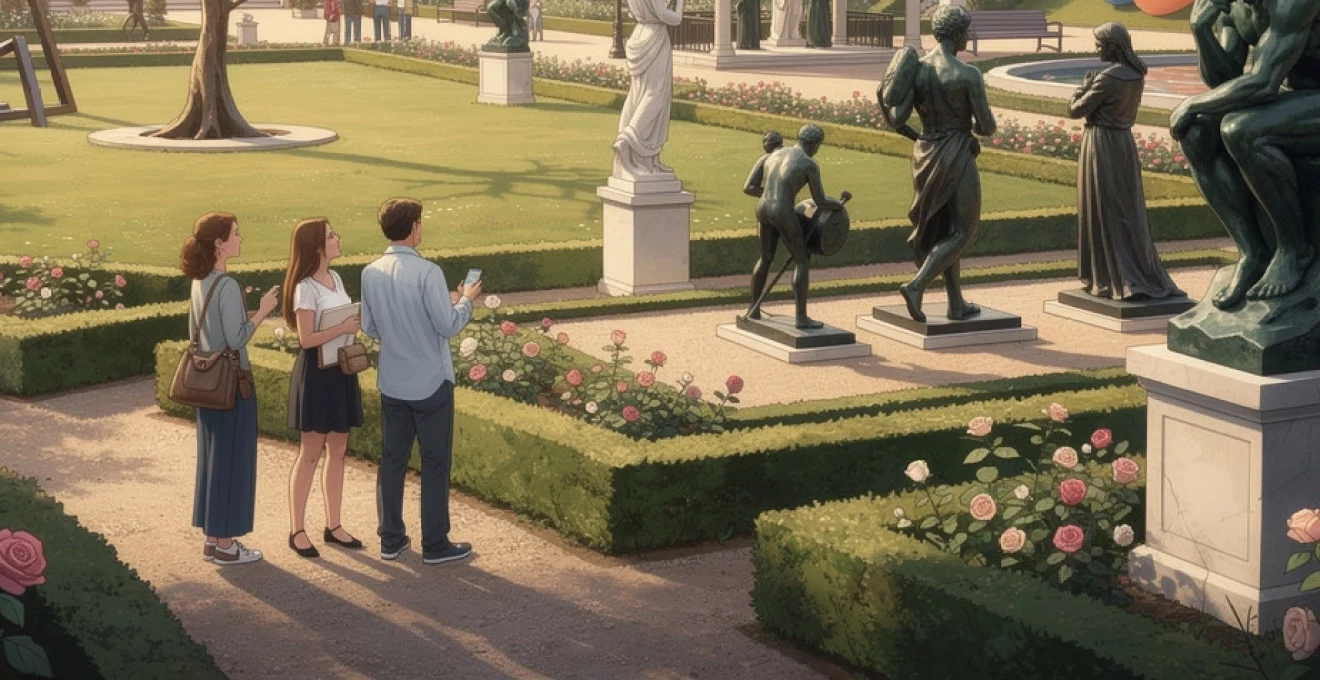
Paris transforms into a magnificent open-air gallery through its exceptional sculpture gardens, where artistic masterpieces blend seamlessly with natural landscapes. These cultural sanctuaries offer visitors an unparalleled opportunity to experience world-class art whilst enjoying the beauty of carefully curated botanical settings. From classical bronze monuments to cutting-edge contemporary installations, the city’s sculpture gardens represent centuries of artistic evolution, providing intimate encounters with works by renowned masters and emerging talents alike.
The unique appeal of Parisian sculpture gardens lies in their ability to present art within living, breathing environments that change with the seasons. Unlike traditional museum spaces, these outdoor galleries allow natural light, weather, and vegetation to interact with sculptural works, creating dynamic viewing experiences that shift throughout the day and across different times of year. This harmonious relationship between art and nature has established Paris as a global leader in open-air cultural experiences.
Jardin des tuileries contemporary sculpture installations
The Jardin des Tuileries stands as Paris’s premier destination for contemporary sculpture, seamlessly blending historical garden design with modern artistic vision. Stretching majestically between the Louvre and Place de la Concorde, this 25-hectare garden showcases an extraordinary collection of sculptures that spans from classical antiquity to the present day. The garden’s formal French design, created by André Le Nôtre in the 17th century, provides an elegant backdrop for over 200 sculptures, creating striking visual dialogues between different artistic periods and styles.
What makes the Tuileries particularly compelling is its commitment to presenting contemporary art within a historically significant setting. The garden’s programming team collaborates with international institutions and galleries to ensure a constantly evolving exhibition programme that challenges visitors’ perceptions whilst respecting the site’s architectural heritage. This approach has transformed the space into a dynamic cultural laboratory where past and present engage in meaningful conversation.
Giuseppe penone’s bronze tree series along place de la concorde
Giuseppe Penone’s monumental bronze trees create one of the most striking contemporary interventions in the Tuileries Garden. These towering sculptures, standing at heights exceeding six metres, explore the relationship between human intervention and natural growth. Penone’s works challenge visitors to reconsider their understanding of nature by presenting bronze castings of actual trees, complete with intricate bark textures and branching patterns that mirror organic forms whilst celebrating industrial craftsmanship.
The positioning of these sculptures along the approach to Place de la Concorde creates a powerful transition zone between the garden’s intimate spaces and the grand urban plaza beyond. The bronze patina develops naturally over time, allowing each piece to acquire unique weathering patterns that enhance their connection to the surrounding living trees. This temporal dimension adds another layer of meaning to Penone’s exploration of time, growth, and artistic permanence.
FIAC hors les murs annual outdoor exhibition programme
The FIAC Hors les Murs programme transforms the Tuileries into an international showcase for contemporary sculpture each autumn. This ambitious initiative brings together galleries from around the world to present large-scale outdoor installations that would be impossible to display in traditional exhibition spaces. The programme typically features 15-20 monumental works, ranging from kinetic sculptures to conceptual installations that interact with the garden’s existing elements.
Recent editions have featured works by internationally acclaimed artists, creating temporary landscapes that attract both art enthusiasts and casual visitors. The programme’s success lies in its ability to democratise contemporary art by placing challenging works in accessible public spaces. These installations often generate important discussions about art’s role in public life whilst introducing new audiences to contemporary artistic practices.
Jean dubuffet’s permanent monumenta sculptures
Jean Dubuffet’s contributions to the Tuileries represent some of the most significant permanent contemporary installations in Paris. His distinctive sculptural language, characterised by bold forms and unconventional materials, creates powerful visual anchors throughout the garden. These works exemplify Dubuffet’s Art Brut philosophy, challenging traditional sculptural conventions whilst maintaining dialogue with the garden’s classical framework.
The scale and positioning of Dubuffet’s sculptures demonstrate careful consideration of viewer experience and garden circulation patterns. Each piece is strategically placed to create surprise encounters whilst respecting the garden’s historical design principles. This thought
ful integration ensures that Dubuffet’s bold, graphic silhouettes never feel intrusive, instead acting like visual exclamation marks within the garden’s refined grammar. As you wander the gravel alleys, these black-and-white forms rise unexpectedly behind clipped hedges or at the end of long vistas, inviting you to pause and reassess your spatial surroundings. For visitors interested in contemporary sculpture in Paris, these works offer an essential case study in how modern art can redefine, rather than disrupt, a historic environment.
Seasonal rotating contemporary art installations
Beyond its permanent sculptures, the Jardin des Tuileries is renowned for its seasonal rotating contemporary art installations, which ensure that no two visits are ever quite the same. Curated in collaboration with leading institutions and galleries, these temporary works often respond directly to the garden’s geometry, water features, and tree-lined avenues. Some artists choose to echo the rigor of the French formal garden, while others introduce playful or disruptive elements that create a productive visual tension.
These open-air exhibitions typically coincide with major events in the Paris art calendar, such as the autumn fairs and summer festivals, drawing an international audience of collectors, curators, and art lovers. For the casual visitor, they offer an accessible way to encounter ambitious contemporary sculpture without the formality of a white-cube gallery. If you are planning an open-air art experience in Paris, it is worth checking the current programme before your trip, as large-scale pieces can dramatically transform the atmosphere of specific areas within the garden.
Musée rodin sculpture garden masterpieces
The sculpture garden of the Musée Rodin is perhaps the most poetic expression of open-air art in Paris, where Auguste Rodin’s masterpieces are staged amid lush plantings and historic architecture. Spread over nearly three hectares surrounding the Hôtel Biron, the grounds combine formal parterres, rose gardens, and shaded avenues that frame more than 30 major works by Rodin and his contemporaries. Unlike many museum courtyards, this garden was conceived from the outset as a living exhibition space, with the sculptor himself overseeing the placement of several key pieces during his lifetime.
Visiting the Musée Rodin garden offers an intimate encounter with bronze and marble sculptures that feels very different from viewing them indoors. Natural light carves deep shadows into Rodin’s expressive surfaces, while changing weather and seasonal foliage continually alter the mood of each work. For anyone interested in sculpture gardens in Paris, this site provides an exemplary model of how landscape architecture and art can be woven together to create a contemplative, immersive environment.
Auguste rodin’s bronze cast collection in period gardens
Rodin’s bronze cast collection is distributed throughout the period gardens in a way that highlights both the power of individual works and their relationships to one another. Pieces such as The Kiss, The Three Shades, and The Walking Man punctuate the lawns and terraces, their dark patinated surfaces standing out against pale gravel and clipped box hedges. This careful positioning allows visitors to experience Rodin’s evolving approach to the human body from multiple angles and distances, much as the artist intended when he worked from live models in his studio.
The garden’s design amplifies key themes in Rodin’s practice, such as fragmentation, movement, and emotional intensity. When you encounter a solitary figure emerging from greenery or a clustered group at a path intersection, it can feel almost like stumbling upon actors frozen mid-scene in a silent drama. Practical details also enhance the experience: interpretive panels and discreet signage help you navigate the collection without interrupting the visual harmony of the setting, making it easy to structure a self-guided tour focused on particular works or periods.
Les bourgeois de calais monument positioning and context
Les Bourgeois de Calais occupies a particularly significant location in the Musée Rodin garden, where its emotional gravitas is heightened by the surrounding open space. Positioned so that visitors can circle freely around the group, the sculpture invites close inspection of each figure’s individual expression of sacrifice and fear. The slightly lowered plinth brings the burghers nearly to eye level, breaking with the heroic conventions of 19th-century public monuments and reinforcing Rodin’s radical decision to depict vulnerability rather than triumph.
In the context of an open-air art experience, this placement encourages you to move slowly and to consider the work from all sides, much like walking through a living historical tableau. The absence of heavy architectural framing means that the silhouettes of the figures stand out against the sky, trees, or façades depending on your vantage point and the time of day. This shifting backdrop subtly reframes the narrative of civic sacrifice, reminding us that questions of courage and duty remain relevant in different eras and political climates.
The thinker replica placement within landscape architecture
The garden’s iconic cast of The Thinker is set on a high pedestal amid carefully composed plantings, underscoring its status as a symbol of introspection and intellectual inquiry. From a distance, the figure appears almost like a human-scale sundial, marking the passage of time as shadows move across the lawn and gravel. As you approach, the surrounding boxwood and trees frame the sculpture in a series of “living picture” views, a technique borrowed from classical garden design to enhance the drama of key focal points.
The placement also reinforces the work’s role within Rodin’s broader project, as The Thinker was originally conceived as part of The Gates of Hell, another monumental bronze that can be seen elsewhere in the garden. By situating the solitary figure at a slight remove from more crowded pathways, the landscape architecture subtly invites a slower, more reflective engagement. It is not uncommon to see visitors mirroring the pose on nearby benches, turning the space into an informal stage where art and daily life echo one another.
Camille claudel works in the rose garden pavilion
The rose garden pavilion provides a more intimate counterpoint to Rodin’s monumental bronzes, housing delicate works by Camille Claudel that reveal another dimension of late 19th-century sculpture. Nestled among fragrant rose beds and climbing vines, the pavilion’s light-filled interior showcases pieces such as The Waltz and The Age of Maturity, whose fluid lines and psychological depth offer a striking contrast to Rodin’s often rugged surfaces. The proximity of Claudel’s works to the garden reinforces the sense that her sculptures grew organically out of lived experience and personal emotion.
For visitors interested in discovering lesser-known voices within Paris sculpture gardens, this pavilion is essential. The scale of Claudel’s works, combined with the human-scale architecture of the space, creates a quiet, almost domestic atmosphere that encourages close, sustained looking. Stepping back out into the rose garden, you may find that your perception of the larger bronzes has shifted, as Claudel’s sensitivity to gesture and intimacy acts like a lens through which you re-evaluate the surrounding masterpieces.
Parc de bagatelle sculptural landscape design
Parc de Bagatelle, set within the Bois de Boulogne, offers a different kind of open-air art experience, where sculpture is integrated into a romantic, almost theatrical landscape. Originally created in the late 18th century as a pleasure garden after a famous bet between Marie-Antoinette and the Comte d’Artois, Bagatelle is now renowned for its rose gardens, follies, and water features. Discreetly placed statues, busts, and ornamental structures are woven into this picturesque setting, transforming leisurely walks into a sequence of carefully choreographed visual episodes.
Unlike the formal rigor of the Tuileries or the concentrated intensity of the Musée Rodin, Bagatelle’s sculptural landscape is all about surprise and discovery. You might turn a corner and encounter a classical figure beside a reflective pond, or find a small decorative sculpture framed by an arch of climbing roses. This integration of art and horticulture creates an atmosphere closer to a stage set than a traditional museum, making Parc de Bagatelle ideal if you are seeking a gentle, romantic introduction to sculpture gardens in Paris away from the city centre crowds.
Fondation cartier pour l’art contemporain outdoor exhibition space
The Fondation Cartier pour l’Art Contemporain, located on Boulevard Raspail, offers one of the most innovative outdoor exhibition spaces in Paris, where architecture, landscape, and contemporary sculpture merge. Designed by Jean Nouvel, the glass-and-steel building appears to dissolve into its surrounding garden, a verdant environment conceived with artist Lothar Baumgarten. This semi-transparent boundary between interior and exterior allows large-scale installations to spill into the grounds, blurring the line between museum gallery and sculpture garden.
Outdoor exhibitions at the Fondation Cartier often feature site-specific works that respond to the building’s reflective surfaces, the density of the plantings, or the play of natural light. For instance, sculptural pieces might be suspended among tree branches, integrated into pathways, or illuminated at night to create a completely different experience after dark. If you are planning a contemporary open-air art itinerary in Paris, the Fondation Cartier is particularly rewarding, as its programme tends to highlight experimental practices, from sound installations to multimedia sculptures that unfold both indoors and out.
Jardin du luxembourg statuary collection and historical monuments
Jardin du Luxembourg, in the 6th arrondissement, combines the elegance of a royal park with one of the most extensive public statuary collections in Paris. Established in the early 17th century around the palace commissioned by Marie de Médicis, the garden now hosts over 100 sculptures, monuments, and decorative works distributed across lawns, terraces, and shaded walks. Here, art and daily life are tightly intertwined: students revise on benches beneath marble queens, children sail toy boats past allegorical figures, and joggers loop around historic monuments almost without noticing their presence.
This coexistence of routine and refinement makes the Luxembourg Gardens a particularly compelling destination for open-air art enthusiasts. The statuary reflects several centuries of French history, from Baroque commissions to 19th-century literary tributes and modern additions. As you explore, you are in effect walking through a three-dimensional timeline of changing tastes, political priorities, and artistic trends, all set within one of the most beloved green spaces in the city.
Marie de médicis commissioned baroque sculpture programme
The original Baroque sculpture programme initiated by Marie de Médicis set the tone for the garden’s enduring relationship with monumental art. Seeking to evoke the grandeur of Italian court culture in Paris, the queen commissioned allegorical figures, mythological subjects, and fountains that articulated themes of power, abundance, and dynastic legitimacy. The most famous remnant of this vision is the Medici Fountain, a theatrical composition of water, stone, and sculpture tucked along the garden’s northern edge.
Standing before the fountain today, you can still sense the Baroque desire to orchestrate emotion through a combination of movement, reflection, and dramatic contrast. The long basin acts like a stage, leading the eye toward the sculpted group framed by a richly decorated architectural backdrop. For visitors interested in how historical patrons used sculpture gardens to project political messages, the Medici legacy at Luxembourg offers a compelling example that can be easily compared with later, more republican monuments elsewhere in the park.
French queens and literary figures monument series
One of the most distinctive features of the Luxembourg Gardens is the ring of statues dedicated to French queens and illustrious women, installed in the 19th century along the central lawns. These marble figures, representing historical rulers such as Anne of Austria and Blanche of Castile, form a kind of open-air portrait gallery that both celebrates and codifies a particular vision of national history. Their dignified poses and neoclassical drapery reflect the era’s desire to forge continuity between the royal past and modern civic identity.
Scattered throughout the park, you will also find monuments to writers and intellectuals, including George Sand and Charles Baudelaire, which extend this commemorative impulse into the literary realm. The result is a sculptural landscape that functions almost like a textbook in three dimensions, prompting you to consider which figures were chosen for public honor and why. As you move from queens to authors, you may find yourself asking how future generations will continue to update or challenge this canon within Paris’s sculpture gardens.
Eugène delacroix memorial and surrounding artistic tributes
The Eugène Delacroix memorial, situated near the rue de Vaugirard entrance, anchors a cluster of artistic tributes that underscore the Luxembourg Gardens’ longstanding ties to the cultural life of Paris. Dedicated to the Romantic painter whose studio once stood nearby, the monument combines a portrait medallion with allegorical figures that symbolize Time and Glory. This blend of likeness and symbolism is characteristic of 19th-century public sculpture, where the goal was not only to depict the individual but also to situate them within a collective narrative of national achievement.
The area surrounding the Delacroix memorial includes additional statues of artists, musicians, and thinkers, creating an informal “hall of fame” in the open air. For art lovers, this part of the garden offers a chance to reflect on how different creative disciplines are commemorated in public space and how these tributes shape our sense of shared heritage. It also illustrates a broader pattern visible across many sculpture gardens in Paris: monuments are rarely isolated objects but rather nodes within a dense web of historical and cultural associations.
Parc andré citroën modern sculptural installations
Parc André Citroën, on the Left Bank in the 15th arrondissement, represents a bold, late-20th-century reinterpretation of the Parisian park, where modern sculptural installations are integral to the overall design. Created on the site of a former car factory and opened in the 1990s, the park is structured around a series of themed gardens, water features, and minimalist lawns framed by striking architectural elements. Within this contemporary framework, sculpture appears both as standalone artwork and as functional design, from abstract forms that double as seating to geometric structures that frame views of the Seine.
For those interested in how Paris continues to innovate in open-air art, Parc André Citroën offers a compelling contrast to the city’s historic sculpture gardens. Here, the emphasis is on clarity of line, industrial materials, and interactive experiences, such as the tethered hot-air balloon that provides aerial views of the park’s sculptural geometry. Exploring the grounds, you may find that the clean, almost cinematic compositions of glass, steel, and stone prompt a different kind of contemplation than the shaded intimacy of older parks—a reminder that the tradition of sculpture in Paris is not static but constantly evolving in dialogue with contemporary urban life.