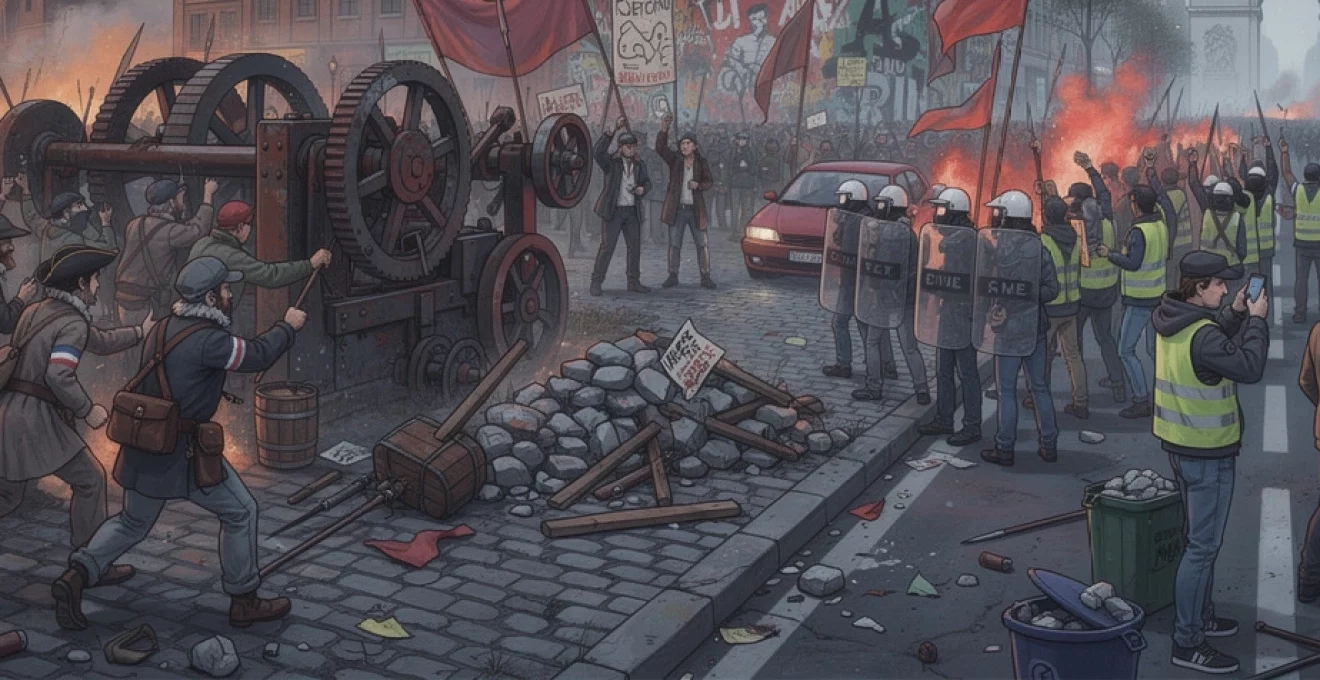
Few nations can claim a relationship with public protest as intricate and enduring as France. The manifestation—a term that elevates the humble demonstration to something approaching civic sacrament—occupies a unique position in French political consciousness. From the cobblestones of revolutionary Paris to the contemporary roundabouts occupied by gilets jaunes, the French have consistently transformed dissent into spectacle, grievance into political theatre. This tradition isn’t merely tolerated; it’s celebrated, enshrined in the collective memory as evidence of democratic vitality and republican virtue. Understanding French protest culture requires examining not just the events themselves, but the philosophical foundations, aesthetic innovations, and social structures that have sustained this remarkable tradition across more than two centuries of political turbulence.
Revolutionary origins: the storming of the bastille and birth of french protest culture
The genesis of French protest culture cannot be separated from the violent rupture of 1789. That year witnessed the transformation of popular discontent from sporadic, localised grievances into coordinated, ideologically-driven mass action. The events that unfolded established not merely a new government, but an entirely new conception of political legitimacy—one that positioned popular mobilisation as the ultimate arbiter of sovereignty. This revolutionary moment created what scholars term a “repertoire of contention,” a toolkit of tactics, symbols, and rhetorical strategies that subsequent generations would adapt and deploy.
14 july 1789: citizen insurrection against monarchical authority
The storming of the Bastille prison on 14 July 1789 represents the paradigmatic moment of popular insurrection in French history. Approximately 1,000 Parisians, armed with weapons seized from the Hôtel des Invalides, attacked the fortress in search of gunpowder and to liberate political prisoners. The fortress-governor Bernard-René de Launay’s decision to resist resulted in nearly 100 deaths among the attackers before the garrison capitulated. Yet the material objectives—gunpowder and prisoners—mattered less than the symbolic triumph of ordinary citizens successfully challenging royal authority through direct action. The Bastille’s stone-by-stone demolition, undertaken immediately after its capture, transformed architecture into political message. You can observe how this event established violence not as antithetical to legitimate protest, but as potentially constitutive of it when institutional channels fail.
Sans-culottes movement and urban Working-Class mobilisation
The sans-culottes—literally “without knee-breeches,” distinguishing working men’s long trousers from aristocratic court dress—emerged as revolutionary Paris’s most radical force between 1792 and 1794. Concentrated in the city’s eastern sections, particularly the Faubourg Saint-Antoine, these artisans, shopkeepers, and labourers developed sophisticated organisational structures through sectional assemblies. Their mobilisation techniques included mass petitions, delegations to the National Convention, and the revolutionary journées—days of coordinated uprising that overthrew governments and redirected revolutionary policy. The sans-culottes introduced direct democracy practices into neighbourhood assemblies, where ordinary citizens could scrutinise and recall elected officials. This tradition of popular vigilance, of permanent mobilisation to defend revolutionary gains, established expectations that French citizens should actively monitor and, when necessary, physically resist governmental overreach.
Declaration of the rights of man: philosophical foundations for civil disobedience
Article Two of the Declaration of the Rights of Man and Citizen proclaimed resistance to oppression as among humanity’s natural and imprescriptible rights, alongside liberty, property, and security. This extraordinary constitutional provision essentially legitimised rebellion against unjust authority as a fundamental human entitlement. The Declaration’s philosophical foundations—drawing from Rousseau’s social contract theory and Enlightenment natural law concepts—positioned popular sovereignty as the only legitimate basis for governmental power. When you examine subsequent French protest movements, this philosophical architecture recurs consistently: demonstrators frame their actions not as resistance to legitimate authority but as defence of authentic sovereignty against governmental usurpation. The Declaration thus provided protesters with an inexhaustible source of moral authority, transforming potentially illegal assemblies into exercises of fundamental rights.
Jacobin club influence on grassroots political organisation
Within this context, the Jacobin Club and its affiliated societies functioned as early laboratories of grassroots political organisation. Founded in 1789, the Club des Jacobins quickly evolved from an elite debating circle into a vast network of provincial clubs, many of which opened their doors to artisans, small shopkeepers, and professionals. These clubs standardised practices that would later become hallmarks of French protest culture: drafting collective petitions, coordinating days of action, and formulating shared ideological frames. Their printed bulletins and speeches acted like the social media of their time, diffusing slogans, symbols, and narratives across the country. When we consider modern demonstrations on the Place de la République or in front of the Assemblée Nationale, we are, in effect, seeing an updated version of Jacobin-era political mobilisation, grounded in the conviction that organised citizens can and should shape the course of the nation.
Trade union militancy: CGT and worker-led manifestations in the industrial era
As France industrialised in the late 19th and early 20th centuries, the epicentre of protest shifted from revolutionary clubs and barricades to factories, rail yards, and docks. Workers confronted new forms of power—large corporations, industrial cartels, and technocratic management—that demanded equally structured resistance. Trade unions emerged as the primary vehicles for this resistance, institutionalising the protest traditions born in 1789 and adapting them to an era of wage labour and mass production. The Confédération Générale du Travail (CGT), founded in 1895, came to symbolise this shift from spontaneous revolt to organised worker-led manifestations. Yet even as protests became more structured, they retained the theatricality and moral language of earlier revolutionary episodes.
Confédération générale du travail formation and syndicalist doctrine
The CGT was born from the merger of various local trade unions and workers’ federations at the Limoges congress in 1895. Its founders were deeply influenced by revolutionary syndicalism, a doctrine that saw trade unions not just as bargaining agents, but as embryonic institutions of a future, more egalitarian society. Instead of relying primarily on parliamentary politics, revolutionary syndicalists championed direct action—strikes, boycotts, and mass demonstrations—as the most authentic expression of working-class power. For them, the general strike functioned as a kind of modern Bastille Day, a moment when the collective force of labour could bring the economic order to a halt. This emphasis on direct action cemented a tradition in French protest culture in which street mobilisation and workplace disruption were viewed as legitimate, even necessary, complements to electoral democracy.
By the early 1900s, the CGT had developed a sophisticated organisational infrastructure that allowed it to coordinate protests across sectors and regions. Its newspaper, La Voix du Peuple, disseminated strategies and ideological arguments, while national congresses set movement-wide goals such as the eight-hour workday. The union’s motto, “Charité bien ordonnée commence par soi-même”—loosely, that justice begins with workers organising themselves—translated into a practical ethic of solidarity. Strikes at one factory would often trigger sympathy actions elsewhere, illustrating how the union turned local grievances into national causes. You can see in this period the emergence of a protest culture where workers did not simply plead for better conditions; they asserted themselves as central actors in defining the economic and social order.
May 1906 labour day protests: eight-hour workday demands
Labour Day on 1 May 1906 marked one of the CGT’s most ambitious attempts to orchestrate nationwide mobilisation. The union called for a general strike in support of the eight-hour workday, a demand that had been gaining traction among workers frustrated by 10- to 12-hour shifts in unsafe conditions. In Paris, tens of thousands of workers marched through the city, often wearing the symbolic red carnation and carrying banners that linked their struggle to the revolutionary heritage of 1789. Demonstrations erupted in industrial centres from Lille to Marseille, prompting the government to deploy tens of thousands of troops to maintain order. While the eight-hour day was not immediately granted, the sheer scale of the 1906 protests demonstrated that organised labour had become a formidable force in French political life.
These Labour Day manifestations also crystallised a new ritual in French protest culture: the annual, almost liturgical repetition of demands in the streets. Each year, 1 May became an occasion to revisit unresolved grievances, test the strength of trade union organisations, and assert workers’ continued presence in the public sphere. In this sense, protest operated like a recurring referendum on the state of social justice in France. For contemporary observers, the 1906 mobilisation was both a warning and an education—proof that industrial peace depended not on suppressing demonstrations, but on addressing the structural issues that fuelled them.
Front populaire strikes of 1936: matignon agreements and collective bargaining
The spring and summer of 1936 brought an unprecedented wave of joyfully defiant worker occupations that transformed the aesthetics and practice of French protest. Following the electoral victory of the left-wing Front Populaire coalition, workers across the country seized the moment to press long-standing demands. Factory occupations, rather than simple walkouts, became the signature tactic: employees remained inside their workplaces, decorating machines with tricolour flags and dancing to accordion music among the assembly lines. This combination of festive atmosphere and firm resolve illustrated a crucial aspect of French demonstrations—the ability to blend celebration with confrontation, turning protest into a lived experiment in an alternative social order.
The Matignon Agreements, negotiated in June 1936 between employers, trade unions, and the Popular Front government, represented the institutional outcome of this protest wave. They enshrined major gains: collective bargaining rights, significant wage increases, and the famous two weeks of paid annual leave that would later expand into today’s generous holiday regime. From a historical perspective, the 1936 strikes confirmed that mass mobilisation could yield concrete, codified improvements in everyday life. When modern commentators point to French workers’ strong labour protections, they are often referring, implicitly, to legacies forged in these heady months—legacies that continue to fuel expectations about what demonstrations can accomplish.
Renault billancourt factory occupations and post-war labour actions
If any single site encapsulates 20th-century French labour militancy, it is the Renault factory at Billancourt, on the outskirts of Paris. Often described as “the fortress of the working class,” Billancourt became synonymous with large-scale strikes and politically charged occupations from the 1930s through the 1960s. During the Liberation in 1944, Resistance fighters and communist militants within the plant helped purge collaborationist managers, linking anti-fascist struggle to workplace democracy. In the immediate post-war years, Renault workers spearheaded movements demanding nationalisation and more equitable management structures, setting patterns other industries would follow. Their actions demonstrated that factories could be both production sites and arenas of political education and mobilisation.
Throughout the 1950s and 1960s, Billancourt continued to serve as a barometer of worker sentiment and a launching pad for national protest. Strikes there often reverberated through the wider Renault group and beyond, forcing successive governments and employers to pay close attention. When students and workers converged in 1968, the Renault plants again played a central role, symbolising the potential for a broad social transformation rooted in the workplace. For anyone trying to understand why contemporary French workers still resort to blocking refineries or transport hubs, the Billancourt tradition is instructive: it shows how occupying strategic economic nodes can become a powerful language of negotiation when conventional dialogue appears insufficient.
Mai 68: student-worker alliance and the near-revolution
The protests of May–June 1968 occupy an almost mythical place in French collective memory, often invoked as both warning and inspiration. What began as a campus-based revolt against rigid university structures and conservative social norms quickly escalated into a nationwide strike movement that paralysed the economy. At its peak, around 10 million workers—nearly two-thirds of the French workforce—downed tools, making it the largest general strike in Western European history. For a few weeks, the normal coordinates of political life seemed to dissolve: universities and factories were occupied, television studios were challenged, and the authority of the state itself appeared precarious. Mai 68 thus represents a crucial turning point in the art of French protest, where students and workers experimented together with new forms of direct democracy, visual culture, and everyday resistance.
Nanterre university occupation: daniel Cohn-Bendit and the 22 march movement
The spark that ignited Mai 68 was lit at the newly built campus of Nanterre, a suburban university intended to absorb France’s growing student population. There, frustrations about overcrowded facilities, paternalistic dormitory rules, and outdated curricula merged with broader opposition to the Vietnam War and consumer culture. On 22 March 1968, a group of students led by figures such as Daniel Cohn-Bendit occupied a university building, forming the “Mouvement du 22 Mars” (22 March Movement). Their occupation blended earnest political seminars with theatrical interventions—mock trials of the university administration, satirical posters, and impromptu debates in lecture halls.
What made Nanterre significant for French protest culture was its inventive reimagining of what a university could be. Rather than a hierarchical institution dispensing knowledge from above, it briefly became a self-managed space for horizontal discussion and experimentation. This transformation served as a living analogy for the students’ broader political aspirations: to democratise not only education, but workplaces, media, and family life. When authorities responded with disciplinary measures and police intervention, the conflict quickly jumped from campus corridors to the streets of central Paris, where it would assume a far larger scale.
Sorbonne barricades: latin quarter street combat tactics
The confrontation reached a dramatic crescendo in early May when clashes erupted in the Latin Quarter, home to the historic Sorbonne. On the “Night of the Barricades” (10–11 May), students and sympathisers tore up cobblestones, overturned cars, and erected barricades along narrow streets such as Rue Gay-Lussac. They armed themselves with paving stones and improvised projectiles, while riot police (CRS) responded with massive volleys of tear gas and baton charges. Images of burning cars, helmeted police, and wounded students circulated rapidly in newspapers and on television, galvanising public opinion. For many viewers, the violence evoked 19th-century insurrections, reinforcing the idea that Parisian streets remained a legitimate theatre for contesting authority.
From a tactical standpoint, the Latin Quarter battles introduced techniques and symbols that would echo in later French demonstrations. The cobblestone—”sous les pavés, la plage” (“beneath the cobblestones, the beach”), as one famous slogan put it—became a metaphor for uncovering hidden possibilities beneath the rigid surface of consumer society. Street confrontations were not solely acts of rage; they were deliberately staged events meant to dramatise the imbalance between youthful idealism and state repression. When we look at contemporary protest tactics, from human chains to creative blockades, we can trace their lineage back to these nights when students experimented with turning the urban landscape itself into a political tool.
Grenelle accords: trade union negotiations under georges pompidou
As student unrest spread and workplaces began to shut down, the movement acquired a new dimension: mass worker participation. By mid-May, key factories, transport networks, and public services were paralysed. Faced with the prospect of economic collapse, Prime Minister Georges Pompidou initiated negotiations with trade union leaders and employer representatives at the Ministry of Labour on Rue de Grenelle in Paris. The resulting Grenelle Accords, announced on 27 May 1968, proposed significant wage increases (including a 35% rise in the minimum wage), recognition of union rights within companies, and other social improvements. On paper, these concessions represented one of the most substantial packages of gains ever extracted through protest in peacetime France.
Yet the Grenelle Accords also revealed tensions within French protest culture between institutional negotiation and grassroots aspirations. Many rank-and-file workers, especially in more radicalised factories, felt that union leaders had settled too readily, failing to address demands for workplace self-management and broader social change. In some plants, workers voted to continue strikes despite the agreements, illustrating the gap between top-level bargaining and the creative, transformative energy unleashed in the streets and occupations. This ambivalence would haunt later movements: could demonstrations aim for deep structural change, or were they destined to result in limited, if valuable, social compromises?
Situationist international philosophy: guy debord’s influence on protest aesthetics
One of the most distinctive legacies of Mai 68 lies in its visual and rhetorical innovations, many of which drew inspiration from the Situationist International. This small but influential group of theorists and artists, including Guy Debord, had long criticised what they called the “society of the spectacle”—a world where social relations were mediated by images, consumption, and passive spectatorship. For Situationists, authentic politics meant disrupting this spectacle and creating “situations” that forced people to question everyday life. Their ideas circulated among radical students and played a key role in shaping the slogans, posters, and performative actions of 1968.
The Atelier Populaire, the poster workshop set up at the École des Beaux-Arts in mid-May, became the practical expression of this philosophy. Working collectively, students and workers produced hundreds of bold, minimalist posters combining striking imagery with biting text: “Il est interdit d’interdire” (“It is forbidden to forbid”), “Sous les pavés, la plage,” “Nous sommes tous des Juifs allemands” (“We are all German Jews”) in defence of Cohn-Bendit. These posters functioned like analog social media memes, pasted overnight on walls throughout Paris to reframe the narrative of the crisis. In them, we see how French protest aesthetics moved beyond mere messaging to become a critique of authority, consumerism, and even traditional leftist heroism itself.
Charles de gaulle’s dissolution of parliament: political aftermath
Faced with spreading unrest and rumours of state paralysis, President Charles de Gaulle briefly disappeared from public view on 29 May, flying secretly to Baden-Baden in Germany to consult the army’s top commander. His sudden absence fuelled speculation about a possible resignation or even a coup, underscoring how fragile political authority had become. Yet de Gaulle returned the next day with a dramatically different posture. In a radio address on 30 May, he announced the dissolution of the National Assembly and called for new legislative elections, framing the contest as a choice between order and chaos. That same day, a massive pro-Gaullist demonstration on the Champs-Élysées signalled that the silent majority might prefer stability to ongoing upheaval.
The June 1968 elections delivered a resounding victory for de Gaulle’s supporters, apparently repudiating the revolutionary ambitions of the movement. In institutional terms, the near-revolution ended with a strengthened presidential majority. But politically and culturally, things were more complex. Mai 68 left a deep imprint on French society, reshaping attitudes towards authority, gender roles, sexuality, and workplace relations. Many of the cultural freedoms and critical reflexes we take for granted today—from informal dress codes to scepticism towards official narratives—trace back to this period. In that sense, the “defeat” of the movement at the ballot box coexisted with a long-term victory in the realm of values and everyday life.
Contemporary mobilisation techniques: gilets jaunes and digital-era demonstrations
Fast-forward half a century, and the French art of protest has entered the digital era while retaining many of its historical traits. The gilets jaunes (yellow vests) movement, which emerged in late 2018, surprised observers with its speed, intensity, and unconventional organisation. Unlike traditional trade union marches or party-led rallies, these demonstrations relied heavily on social media, informal networks, and symbolic appropriation of everyday objects. Yet the movement’s core logic—transforming local grievances into national spectacle—fit squarely within the long French tradition of contentious politics. By examining its strategies, we can better understand how historical repertoires adapt to new technological and social conditions.
Yellow vest movement origins: fuel tax opposition on roundabouts
The yellow vest movement began with a seemingly narrow issue: a planned increase in fuel taxes that would disproportionately affect rural and peri-urban motorists. For many residents who relied on cars for work and daily life, this tax felt like the last straw after years of stagnant wages and shrinking public services. A viral online petition and a series of Facebook calls to action culminated in nationwide blockades on 17 November 2018. Protesters donned the high-visibility safety vests that French drivers are required by law to keep in their vehicles—turning a mundane piece of equipment into a unifying symbol of visibility for those who felt ignored by Parisian elites.
What distinguished this movement was its choice of terrain: rather than marching only in capital-city boulevards, protesters occupied roundabouts, toll booths, and retail parks across the country. These spaces, often overlooked in traditional political geography, became new centres of protest life. Makeshift cabins, shared meals, and nightly debates transformed cold traffic junctions into micro-public squares. Here, we can see a direct echo of earlier occupations—from factories in 1936 to universities in 1968—reimagined for a landscape dominated by cars and logistics. The message was clear: if political institutions would not come to them, citizens would politicise the spaces of their everyday commute.
Acte protest numbering system: sustained weekly manifestations
As the movement evolved, participants developed a distinctive rhythm and vocabulary for their demonstrations. Each major Saturday mobilisation was dubbed an “Acte” (Act), followed by a number: Acte I, Acte II, and so on, a naming convention that continued for more than a year. This dramaturgical framing cast the protests as an ongoing series rather than isolated outbursts, suggesting a narrative arc in which each week’s events built upon the last. For journalists and analysts, the numbering system provided a convenient way to track participation levels and geographic diffusion; for protesters, it reinforced a sense of collective continuity and commitment.
The weekly cadence of mobilisation also illustrates how French protest culture has adapted to contemporary work rhythms and media cycles. By concentrating major actions on weekends, the gilets jaunes allowed precarious workers and small business owners to participate without immediately risking their jobs. At the same time, the regularity of the “Acts” ensured continued media coverage, keeping pressure on the government and shaping public debate. This strategy echoes earlier periods—such as the repeated Labour Day marches or the long pensions protests of the 1990s—but adds a new temporal structure that feels almost episodic, like a television series unfolding in real time.
Facebook organising: decentralised coordination without traditional leadership
Perhaps the most striking innovation of the yellow vest movement was its reliance on digital platforms, especially Facebook, for coordination and debate. Local groups formed around towns or regions, sharing information about planned blockades, legal developments, and interactions with police. Unlike traditional protests led by unions or parties, there were no formal leaders, national executive committees, or negotiated routes filed weeks in advance. Instead, legitimacy hinged on online visibility and the perceived authenticity of grassroots voices. This decentralisation made the movement harder to co-opt or decapitate, but it also complicated efforts to articulate unified demands or negotiate with authorities.
From a broader perspective, this digital infrastructure can be seen as the contemporary counterpart to the Jacobin club networks or the CGT’s early 20th-century press. In each case, communication tools enabled rapid diffusion of frames and tactics across geography. Yet social media also introduced new vulnerabilities: misinformation could spread quickly, internal conflicts were magnified, and algorithmic logics shaped which grievances gained prominence. For those studying French demonstrations today, understanding this interplay between online mobilisation and offline action is essential. It raises a key question: when the “street” now extends into virtual spaces, how do we measure the real weight of a protest movement?
Champs-élysées violence: black bloc tactics and arc de triomphe vandalism
As the yellow vest protests intensified, images of burning cars and smashed luxury storefronts along the Champs-Élysées captured global attention. On several Saturdays in late 2018 and early 2019, small but highly visible groups—some identifying with Black Bloc tactics—used the cover of larger marches to attack symbols of wealth and state authority. The Arc de Triomphe, an iconic monument to national glory, was vandalised, and the presidential residence at the Élysée became a recurring target of angry chants. For many French viewers, these scenes revived memories of past confrontations, from 1968 to the 2005 suburban riots, and fuelled heated debates about the legitimacy of violence in protest.
These episodes highlight a long-standing tension in the French art of protest between spectacular disruption and public sympathy. While dramatic images can force authorities and media to pay attention, they also risk alienating broader segments of the population. The state responded with a mix of concessions and repression, increasing the use of riot-control weapons such as rubber bullets and sting-ball grenades, which in turn caused serious injuries and further radicalised some protesters. In this spiralling dynamic, we can recognise older patterns—akin to a dangerous dance in which both police and demonstrators test the limits of what is tolerable in a democracy built on the right to contest power in the streets.
Legislative responses: loi anti-casseurs and state regulation of public assemblies
Each wave of protest in France has prompted a counter-movement of legal and administrative regulation, as authorities seek to channel, contain, or deter disruptive forms of demonstration. Following the most intense phases of the gilets jaunes unrest, the government reactivated and reinforced a tradition of “anti-casseur” (anti-rioter) legislation originally dating back to the 1970s. The 2019 iteration of the loi anti-casseurs expanded the powers of prefects and police to restrict participation in protests, including the ability to impose preventive bans on individuals deemed a threat to public order. It also introduced harsher penalties for those who concealed their faces or participated in unauthorised demonstrations that led to property damage.
Critics, including human rights organisations and some legal scholars, argued that these measures risked undermining fundamental freedoms enshrined in the Declaration of the Rights of Man and subsequent constitutional texts. In their view, transforming the right to protest into a conditional privilege—subject to extensive administrative discretion—tilted the balance too far towards security. Supporters countered that such tools were necessary to protect peaceful demonstrators and local businesses from small groups intent on violence. This debate echoes earlier controversies, such as restrictions introduced after the 1968 events or during the 1980s anti-nuclear protests, demonstrating how each generation must renegotiate the boundaries between public order and civic expression.
Beyond headline-grabbing laws, the French state also regulates demonstrations through a dense web of administrative practices: requirements for prior notification, negotiations over routes, and increasingly sophisticated crowd-control tactics. Data from the Ministry of the Interior suggest that France records tens of thousands of public assemblies each year, from small local marches to nationwide union protests. Managing this constant flow has turned policing demonstrations into a specialised field, with doctrines evolving in response to both domestic and international experiences. Yet even the most elaborate legal frameworks cannot fully domesticate French protest culture. As history shows, when citizens believe that institutional channels are blocked, they often find creative—and sometimes confrontational—ways to reclaim the public space.
French exceptionalism in protest: manifestation as republican civic duty
Looking across more than two centuries of upheaval, one striking feature emerges: in France, taking to the streets is widely perceived not as an aberration, but as a normal, even honourable, mode of political participation. Surveys by institutions such as the European Social Survey consistently rank France among the European countries with the highest rates of protest participation. This propensity reflects more than a cultural taste for conflict; it is rooted in a republican tradition that ties citizenship to active vigilance. From the sans-culottes to the gilets jaunes, generations of French people have internalised the idea that sovereignty resides in the people and that public mobilisation is a legitimate way to remind governments of this fact.
This sense of civic duty helps explain why protest in France is often simultaneously combative and ritualised. Trade union marches with their banners and brass bands, student occupations with their general assemblies, and neighbourhood demonstrations defending local hospitals or schools all draw on a shared vocabulary of contention. At the same time, French protest culture remains open to innovation, constantly absorbing new techniques—from Situationist détournement to digital organising—while reinterpreting old symbols like the tricolour flag or the Marseillaise. For observers and participants alike, understanding this blend of continuity and creativity is crucial. It shows that French demonstrations are not simply episodic eruptions of anger, but part of a long-standing conversation about what it means to be a citizen in a republic founded, quite literally, in the streets.