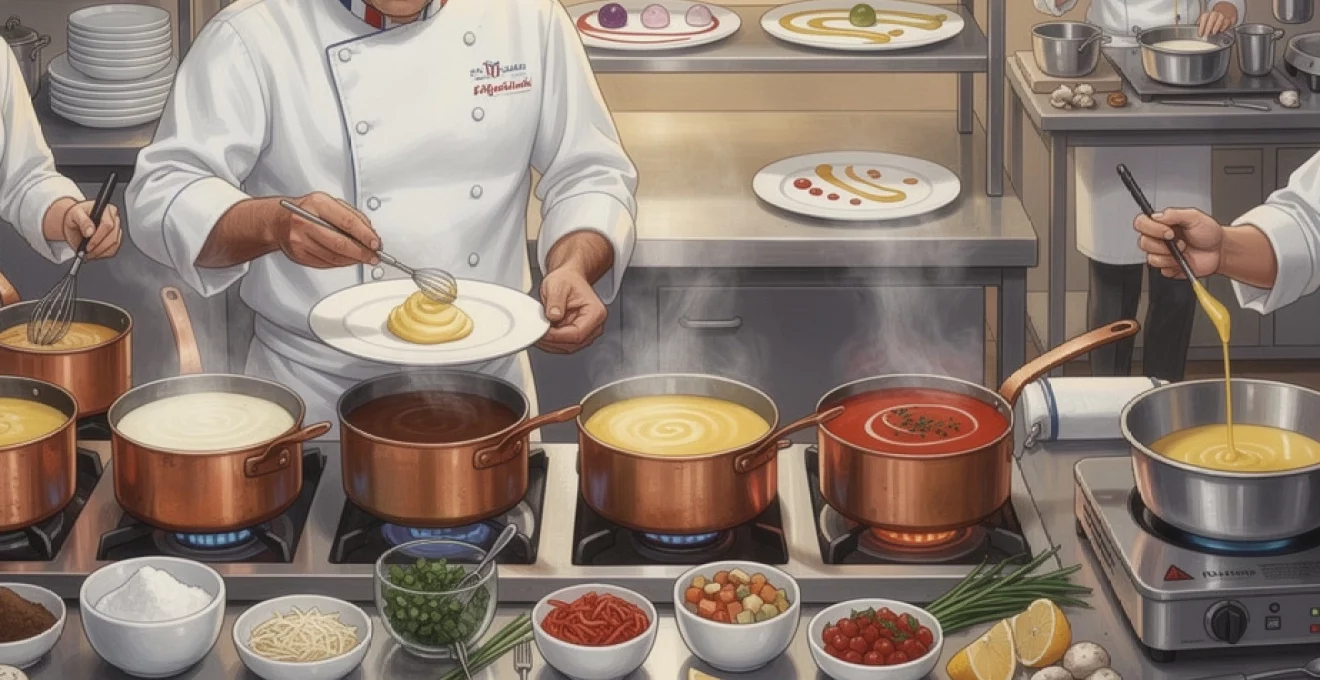
French cuisine has earned its reputation as the pinnacle of culinary artistry through centuries of refinement, precision, and unwavering dedication to technique. At the heart of this gastronomic excellence lies a fundamental understanding of sauce-making, an art form that transforms simple ingredients into complex, harmonious flavours that define classical French cookery. The mastery of sauce preparation represents more than mere technique; it embodies the philosophical approach to cooking that elevates ingredients beyond their individual components into something transcendent.
The science and artistry behind French sauce-making demonstrates how traditional culinary wisdom continues to influence contemporary gastronomy. Professional chefs worldwide recognise that understanding these foundational preparations unlocks the door to infinite culinary possibilities, making sauce mastery an essential skill for anyone serious about haute cuisine. From the bustling kitchens of Parisian bistros to Michelin-starred establishments across the globe, these time-honoured techniques continue to shape modern culinary excellence.
Mother sauces: escoffier’s five fundamental classifications
Auguste Escoffier’s revolutionary classification system, established in the late 19th century, identified five fundamental sauce preparations that serve as the architectural foundation for virtually every sauce in classical French cuisine. These sauces mères represent a systematic approach to understanding how different base preparations can be transformed through specific techniques and ingredient additions into countless derivative sauces.
The genius of Escoffier’s system lies not merely in categorisation, but in providing a logical framework that enables chefs to understand the underlying principles governing sauce construction. Each mother sauce employs distinct thickening agents, base liquids, and flavouring components, creating unique textural and flavour profiles that serve specific culinary purposes. This classification system revolutionised professional kitchen organisation and training, establishing protocols that remain relevant in contemporary culinary education.
Understanding the mother sauces provides the foundational knowledge necessary to create hundreds of derivative preparations with confidence and precision.
Béchamel: white roux foundation and milk integration techniques
Béchamel represents the archetypal cream sauce, constructed through the careful integration of milk into a white roux base. This preparation requires precise temperature control and constant attention to prevent scorching, which would compromise both flavour and texture. The sauce achieves its characteristic velvety smoothness through proper roux preparation and gradual milk incorporation, techniques that demand patience and understanding of protein coagulation principles.
The success of béchamel depends heavily on achieving the correct consistency through proper flour gelatinisation and milk protein suspension. Traditional preparations incorporate bay leaf and nutmeg during the simmering process, creating subtle aromatic complexity that distinguishes professional-quality sauce from amateur attempts. Modern techniques often employ temperature monitoring to maintain optimal heat levels throughout the preparation process.
Velouté: Stock-Based blonde roux applications in classical cookery
Velouté sauce demonstrates the versatility of stock-based preparations, utilising white stocks from chicken, fish, or veal combined with blonde roux to create a neutral foundation capable of supporting numerous flavour modifications. The sauce derives its name from the French word for ‘velvety,’ reflecting the smooth, refined texture achieved through proper preparation techniques and careful straining procedures.
Professional preparation of velouté requires understanding stock quality and concentration levels, as weak or poorly prepared stocks will result in insipid sauce lacking the body necessary for derivative preparations. The blonde roux used in velouté provides subtle nutty flavours that complement rather than compete with the stock base, creating a harmonious foundation for herb, wine, or vegetable additions.
Espagnole: brown sauce mastery through mirepoix and tomato concassé
Espagnole sauce represents perhaps the most complex mother sauce, requiring extended preparation time and sophisticated understanding of flavour development through caramelisation and reduction techniques. The preparation begins with brown roux combined with rich brown stock, mirepoix vegetables, and tomato concassé, creating layers of flavour that develop through slow simmering and careful skimming procedures.
The complexity of espagnole makes it rarely used as a finished sauce, instead serving as the foundation for derivative preparations like demi-
demi-glace and a variety of red wine or mushroom-based sauces. Mastery of espagnole hinges on disciplined reduction, which concentrates both flavour and natural gelatin to produce a sauce with glossy sheen and luxurious mouthfeel. In professional French kitchens, espagnole functions as a strategic flavour base, allowing chefs to build complex, meat-driven sauces efficiently during service while maintaining consistency across multiple dishes.
Precision in mirepoix preparation, tomato concassé integration, and roux colouring directly influences the final profile of this classical French sauce. Over-caramelisation can introduce bitterness, while insufficient cooking produces a sauce lacking in depth and savoury complexity. By closely monitoring heat, skimming impurities, and tasting regularly throughout the reduction process, you develop the sensory awareness required to adjust seasoning and texture before espagnole becomes the backbone of finished preparations.
Hollandaise: emulsification science in butter and egg yolk liaisons
Hollandaise stands apart from the other mother sauces because it relies on emulsification rather than starch-based thickening. Constructed from egg yolks, clarified butter, and acid (typically lemon juice or reduction of vinegar and shallots), this warm emulsion demands precise temperature control and constant agitation. The culinary science behind hollandaise involves suspending microscopic droplets of butterfat within a continuous phase of egg yolk and acid, creating a stable, silky sauce that coats ingredients with remarkable richness.
The critical challenge in hollandaise preparation lies in managing heat to prevent the egg yolks from scrambling while still cooking them enough to achieve safe consumption and optimal viscosity. Most professional kitchens maintain the yolk mixture between 60°C and 70°C (140–158°F), whisking vigorously while gradually incorporating clarified butter. If you have ever wondered why some brunch kitchens produce inconsistent hollandaise, it often comes down to this narrow thermal window and the precision required to maintain it throughout service.
Stability in hollandaise can be enhanced by using a small amount of water at the start, which helps distribute heat more evenly and gives the emulsion greater tolerance to slight temperature fluctuations. Some modern chefs incorporate a touch of mustard or use immersion blenders to create more reliable emulsions during high-volume service. Yet, even with modern tools, understanding the underlying emulsification science remains essential to troubleshoot issues like splitting, excessive thickness, or lack of acidity.
Tomato sauce: provençal techniques and modern interpretations
Escoffier’s tomato sauce, or sauce tomat, reflects a classical French approach to what many today associate with Italian cuisine. Traditionally, this mother sauce begins with pork fat, mirepoix, and a brown roux, followed by the addition of tomatoes, stock, and aromatics such as bay leaf, thyme, and garlic. Slow simmering transforms the naturally high water content of tomatoes into a concentrated, savoury base with balanced acidity, sweetness, and umami depth. The result is far more structured and sauce-like than a simple tomato stew.
Regional Provençal influences are evident in lighter variations that feature olive oil, garlic, and herbs such as basil, thyme, and rosemary, often omitting the roux to create a fresher, more Mediterranean profile. These Provençal tomato sauces highlight the importance of quality ingredients and seasonality, as the sugar-acid balance of tomatoes shifts throughout the year. In professional kitchens, chefs may adjust with a pinch of sugar, a splash of vinegar, or additional reduction to achieve the ideal flavour equilibrium for their specific application.
Modern interpretations of classical tomato sauce frequently cater to evolving dietary preferences and global influences. You will increasingly see roasted tomato bases, smoked tomato elements, or even fermented tomato preparations used to layer complexity into contemporary French-inspired dishes. While the structure of Escoffier’s sauce tomat remains a reference point, today’s chefs adapt the technique to lighter, plant-focused cooking and fusion concepts, proving that the mother sauces are frameworks rather than rigid formulas.
Roux preparation mastery: temperature control and flour gelatinisation
Roux is the technical cornerstone of three of the five mother sauces and a critical concept in classical French sauce-making. At its simplest, a roux is equal parts fat and flour cooked together, but the nuances of temperature, timing, and fat choice determine whether your sauce achieves the desired body and flavour. The cooking process transforms raw flour, first eliminating its starchy taste and then developing nutty, toasted notes as colour deepens from white to blond to brown.
From a scientific perspective, flour gelatinisation begins when starch granules absorb fat and then swell in the presence of liquid at controlled temperatures, creating viscosity. White roux, cooked just long enough to remove raw flavour, offers maximum thickening power and is ideal for béchamel. Blond roux, with its pale golden hue, loses a small degree of thickening capacity but gains subtle complexity, making it perfect for velouté. Brown roux, essential to espagnole, delivers stronger roasted notes while sacrificing additional thickening strength, which is why brown sauces often rely more heavily on reduction for body.
Temperature control is paramount during roux preparation. Excessive heat can scorch the flour and fat, resulting in a bitter, acrid base that will taint any sauce built upon it. Professional chefs typically maintain medium to medium-low heat, stirring continuously with a flat-edged spatula to ensure even cooking and prevent sticking. Think of roux like building a foundation for a house: once it is flawed, no amount of decoration can fully correct the structure above it.
For cooks seeking consistent results, weighing flour and fat yields more predictable outcomes than relying on volume measurements, particularly when scaling recipes for professional service. Clarified butter is preferred in many French kitchens because its higher smoke point and pure butterfat content offer better flavour and stability than whole butter. Once you understand how colour, aroma, and texture signal each stage of roux development, you can confidently tailor your preparation to the specific mother sauce or derivative you wish to create.
Classical derivative sauces: regional variations and technical applications
Once the mother sauces are mastered, derivative sauces—often called petites sauces or daughter sauces—open up an expansive world of flavour possibilities. These classical derivatives showcase how French chefs use wine reductions, aromatics, herbs, and additional fats to adapt a base sauce to specific ingredients or regional preferences. While the techniques appear sophisticated, they follow predictable patterns that you can learn to apply intuitively.
Understanding these derivatives also reveals how regional French cuisines express identity through subtle adjustments to common foundations. A béchamel from Normandy, enriched with local cream and butter, will differ from one served in Provence, which might be lighter and paired with Mediterranean vegetables. By studying a few key derivatives in depth, you gain a toolkit for adapting sauce structures to your own cooking context, from home kitchens to high-volume restaurants.
Mornay and soubise: béchamel-based cheese and onion integrations
Mornay sauce demonstrates how a simple béchamel can be transformed into a luxurious cheese sauce with minimal additional technique. Traditionally made with grated Gruyère and sometimes Emmental, Mornay is gently enriched off the heat to prevent the proteins in the cheese from seizing or becoming grainy. The residual warmth of the béchamel melts the cheese slowly, creating a smooth, cohesive sauce ideal for gratins, croque-monsieur, and classic dishes such as eggs Florentine.
To achieve professional-quality Mornay, chefs often add the cheese in small handfuls, whisking thoroughly between additions and ensuring the base sauce is not boiling. A splash of cream can further stabilise the emulsion and provide a silkier mouthfeel. If you have ever struggled with split or oily cheese sauce, controlling temperature and using a well-seasoned béchamel foundation are the key corrective steps.
Soubise, by contrast, illustrates how onions can bring both sweetness and aromatic depth to a béchamel derivative. This sauce is prepared by slowly sweating finely sliced or minced onions in butter until they become soft, translucent, and almost jam-like in texture, then folding them into béchamel. Some classical versions blend the onions into a smooth purée for an elegant, uniform sauce, while rustic interpretations leave a subtle texture.
Technically, the success of soubise hinges on proper onion cooking: browning introduces unwanted bitterness and changes the flavour profile from sweet and mellow to harsh and caramelised, which is not the intention in this classical French sauce. When executed with patience, soubise pairs beautifully with roast lamb, poultry, and delicate vegetables, offering a gentle, aromatic counterpoint that elevates simple ingredients into refined dishes.
Bercy and poulette: velouté transformations with wine and herb infusions
Sauces Bercy and Poulette show how velouté can be adapted with wine, herbs, and cream to create refined accompaniments for fish and poultry. Sauce Bercy, traditionally paired with fish, begins with a reduction of white wine and shallots, which is then folded into fish velouté. A final enrichment of cold butter and fresh parsley just before serving yields a bright, aromatic sauce that balances the richness of the stock with acidity and herbaceous freshness.
From a technical standpoint, the wine reduction in Bercy serves multiple purposes: it concentrates flavour, burns off harsh alcohol notes, and reduces volume so the liquid integrates seamlessly into the velouté without excessively diluting its texture. Controlling this reduction is crucial; reducing too far can concentrate bitterness, while insufficient reduction results in a thin, insipid sauce that overwhelms delicate fish rather than complementing it.
Sauce Poulette, commonly served with poultry or mushrooms, demonstrates a different route to complexity. Built on chicken velouté, it incorporates mushroom cooking juices, lemon juice, and a liaison of egg yolk and cream added at the end of cooking. This liaison must be handled carefully: the sauce is tempered by gradually whisking hot liquid into the yolk-cream mixture before returning it to the pan over very low heat, ensuring it thickens without curdling.
For cooks learning classical French sauces, Poulette offers a practical lesson in both flavour layering and temperature management. The combination of velouté, mushroom essence, acidity, and rich liaison creates a sauce that is simultaneously structured and delicate. Once you are comfortable with the technique, you can adapt it with regional herbs or different mushroom varieties, making this French sauce a versatile template for modern menus.
Bordelaise and chasseur: espagnole derivatives with mushroom and wine reductions
Bordelaise sauce embodies the deep connection between French sauces and regional wine traditions. Originating in Bordeaux, this derivative of espagnole or demi-glace incorporates red wine—often Bordeaux—along with shallots, thyme, bay leaf, and bone marrow or butter. The wine is reduced with aromatics until almost syrupy, then blended into the base sauce, producing a glossy, intensely flavoured accompaniment for grilled or roasted red meats.
The technical heart of Bordelaise lies in achieving the right reduction of wine before it meets the espagnole. Reducing too quickly at high heat can introduce harsh, tannic notes, while a slow, controlled simmer allows fruit, acidity, and subtle oak characteristics to concentrate harmoniously. Bone marrow, when used, must be carefully poached and added at the last moment to maintain its luxurious texture and avoid greasiness, underscoring how small technical details define the quality of classical French sauces.
Sauce Chasseur—literally “hunter’s sauce”—is another important espagnole-based derivative that showcases mushrooms, white wine, and often tomato concassé. It begins with sautéed mushrooms and shallots, deglazed with wine, then combined with espagnole and sometimes a touch of cream. The result is a robust, earthy sauce that pairs especially well with game birds, chicken, and pork, reflecting its rustic origins in countryside cooking.
From a practical perspective, Chasseur teaches you how to harness pan drippings and deglazing techniques to build flavour efficiently. By browning proteins first, then constructing the sauce in the same pan, you capture caramelised residues that would otherwise be lost. This approach aligns perfectly with modern sustainability goals in professional kitchens, minimising waste while maximising flavour—a principle that is as relevant today as it was in Escoffier’s era.
Béarnaise and maltaise: hollandaise variations through herb and citrus modifications
Béarnaise is perhaps the most celebrated derivative of hollandaise, transforming the base warm emulsion with an aromatic reduction of white wine vinegar, white wine, shallots, and tarragon. This reduction is strained and then used as the acidic component for the egg yolk base. The finished sauce is often finished with fresh tarragon and chervil, creating a bright, anise-kissed profile that complements grilled steaks, lamb, and even rich fish such as salmon.
Because Béarnaise depends so heavily on its herb and vinegar reduction, attention to balance is crucial. Too much vinegar results in an aggressive, sharp sauce, while insufficient reduction leaves the flavour unfocused and watery. By tasting the reduction before incorporating it into the yolks, you can adjust seasoning and intensity, ensuring that the final Béarnaise achieves the ideal harmony between richness, acidity, and herbal freshness.
Maltaise, another classical derivative of hollandaise, highlights the use of citrus to add complexity and seasonal character. Traditionally made with the juice and zest of blood oranges, Maltaise offers a slightly sweeter, more aromatic profile than standard hollandaise, making it an exceptional partner for asparagus, poached fish, or delicate poultry. The citrus is usually added after the emulsion has formed to prevent curdling and to preserve its fresh, vibrant notes.
These hollandaise derivatives illustrate how minor modifications—changing the acid source, adding herbs, or introducing citrus—can drastically shift the personality of a sauce while preserving its structural foundation. Once you are confident in producing a stable hollandaise, experimenting with different reductions and aromatics becomes an accessible way to innovate, whether you are cooking a classic steak Béarnaise or designing a modern brunch menu.
Emulsification techniques: permanent and temporary sauce structures
Emulsification is a central concept in French sauce-making, governing everything from hollandaise and mayonnaise to vinaigrettes and pan sauces finished with butter. At its core, an emulsion is a mixture of two normally immiscible liquids—such as oil and water—stabilised by agitation and, often, emulsifying agents like egg yolks or mustard. Understanding the difference between permanent and temporary emulsions helps you predict how a sauce will behave during preparation, plating, and service.
Permanent emulsions, like mayonnaise or cold sauce hollandaise variants, rely on emulsifiers that create stable structures capable of holding their form for extended periods. In these sauces, tiny droplets of fat are suspended within an aqueous phase and locked in place by lecithin and proteins from egg yolks or other stabilisers. As long as temperature and mechanical stress remain within reasonable limits, these emulsions retain their creamy texture and do not readily split.
Temporary emulsions, by contrast, are more fragile and short-lived. Classic vinaigrettes and pan sauces finished with whole butter fall into this category: they appear unified immediately after whisking or swirling, but will separate over time without continuous agitation. In professional kitchens, chefs use these emulsions strategically, assembling them just before plating so that diners experience their full, glossy richness at the table.
From a practical standpoint, avoiding broken sauces comes down to three factors: temperature control, gradual incorporation, and appropriate ratios. Adding fat too quickly, overheating an emulsion, or drastically changing its consistency with sudden liquid additions can all cause separation. One helpful analogy is to think of building an emulsion like constructing a suspension bridge—you must add supports (emulsifiers and small, incremental additions of fat) at each stage to prevent collapse.
When an emulsion does begin to split, all is not necessarily lost. Often you can rescue a sauce by whisking a small amount of warm water or another egg yolk in a clean bowl, then gradually incorporating the broken emulsion as if starting anew. This recovery technique is widely used in professional kitchens and underscores why understanding emulsification science is more powerful than simply memorising recipes.
Contemporary french sauce innovation: molecular gastronomy and modern interpretations
As French cuisine has evolved in the 21st century, chefs have embraced modern techniques and scientific insights to reinterpret classical sauces. Molecular gastronomy—once considered avant-garde—has become an accepted part of the French culinary toolkit, offering new textures, service formats, and flavour delivery systems while still respecting the foundations laid by Escoffier. You will now find traditional profiles like Béarnaise or Bordelaise expressed as foams, gels, or encapsulated spheres in cutting-edge restaurants.
One widely adopted technique involves using hydrocolloids such as xanthan gum, agar-agar, or carrageenan to stabilise sauces or create novel textures. For example, a light Bordelaise foam can be produced by incorporating a small amount of stabiliser and using a siphon charged with gas cartridges, allowing a deep, wine-based flavour to be delivered in an ethereal, aerated form. Similarly, citrus or herb-infused oils can be turned into fluid gels that bring concentrated flavour and striking visual appeal to the plate.
Modern French sauce innovation also reflects broader trends toward lighter, healthier dining. Heavy flour-based thickeners are often replaced or reduced in favour of vegetable purées, reductions, or dairy alternatives. A contemporary velouté might rely on gently cooked cauliflower or celeriac blended with stock to achieve body without the need for large quantities of roux. This aligns with increasing consumer interest in plant-forward cuisine while maintaining the core principle of balancing richness, acidity, and aroma.
Global influences further enrich the modern French sauce repertoire. Soy, miso, yuzu, and spices from North Africa or the Middle East are now seamlessly integrated into classical French structures. A hollandaise might be scented with yuzu instead of lemon, or an espagnole derivative may incorporate miso for added umami. These reinterpretations demonstrate that the mother sauces serve not as rigid rules but as versatile frameworks adaptable to new ingredients, techniques, and cultural contexts.
Professional kitchen implementation: sauce station organisation and quality control
In a professional French kitchen, the sauce station—traditionally overseen by the saucier—is one of the most technically demanding positions on the brigade. This role requires not only mastery of classical French sauces but also exceptional organisational skills and the ability to maintain consistency under intense time pressure. A well-run sauce station operates like a laboratory and an orchestra combined, with mise en place, reductions, and finishing elements harmonised to support the entire menu.
Effective organisation begins with clear differentiation between base preparations and finishing components. Mother sauces, stocks, and reductions are typically prepared in larger batches during mise en place, then held at safe, controlled temperatures. Smaller garnishing elements—such as herb butters, wine reductions, and citrus zests—are portioned and labelled for rapid access during service. By structuring the station this way, the saucier can assemble complex derivative sauces in minutes without sacrificing quality.
Quality control for sauces in a professional environment relies heavily on standardised recipes and rigorous tasting routines. Many modern kitchens implement tasting protocols at multiple points during service to ensure that seasoning, texture, and temperature remain within defined parameters. This might include checking the nappe consistency of a velouté before service, verifying the acidity of a Béarnaise mid-service, and adjusting reductions as stock-based sauces naturally concentrate over time.
Temperature management is another critical aspect of sauce station success. Bain-marie setups, heat lamps, and induction units are calibrated to keep sauces above food-safe thresholds while avoiding over-reduction or scorching. Inaccurate holding temperatures can quickly ruin even the most carefully prepared French sauce, so professional teams often assign specific responsibilities for monitoring and adjusting equipment throughout service.
Ultimately, implementing classical French sauces in a modern kitchen is not just about reproducing historical recipes; it is about designing systems that guarantee reliability, speed, and excellence plate after plate. When organisation, technique, and quality control work together, sauces fulfil their intended role in French gastronomy: unifying components on the plate, amplifying flavour, and transforming well-executed cooking into truly memorable cuisine.