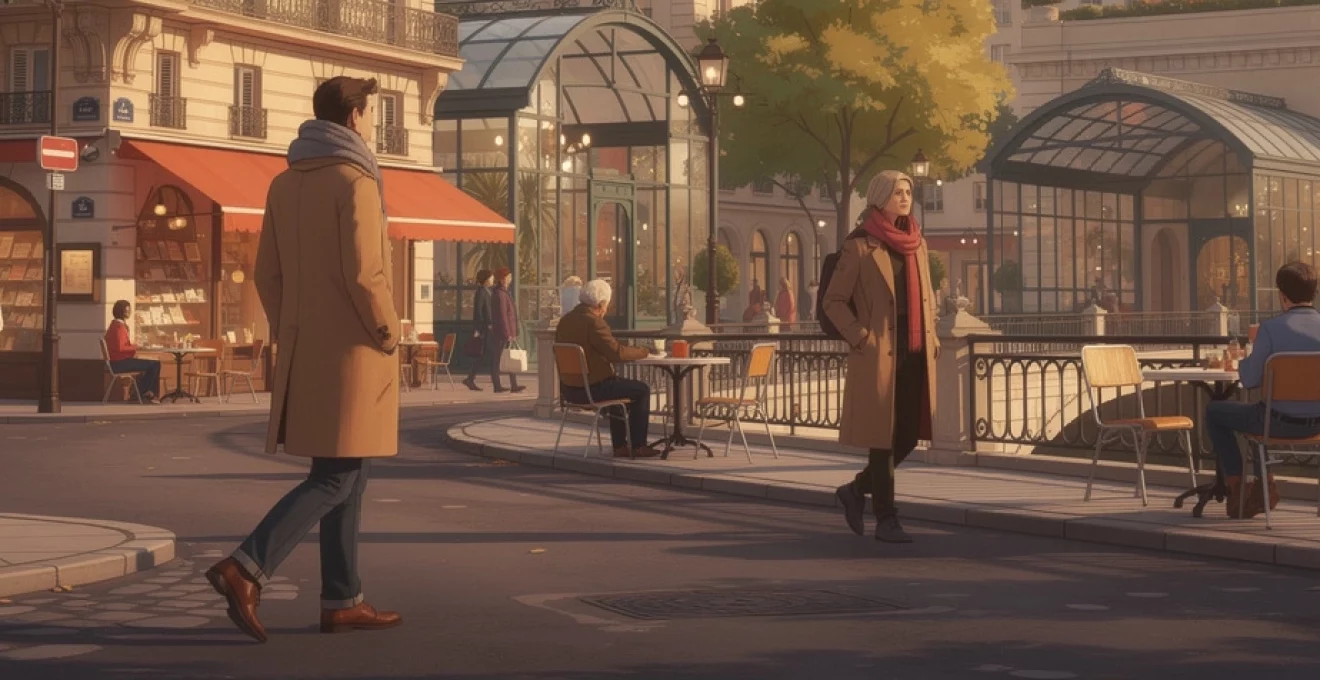
In an age defined by digital distraction and relentless productivity, the French concept of flânerie offers a radical counterpoint—a deliberate practice of unhurried urban wandering that transforms city streets into galleries of lived experience. This nineteenth-century Parisian tradition, far from being mere aimless walking, represents a sophisticated form of mindful observation that reconnects you with the architectural poetry, social rhythms, and temporal layers embedded in European urban landscapes. As contemporary life accelerates, the flâneur’s approach to navigating French cities has evolved from a literary archetype into a practical methodology for reclaiming attention, cultivating presence, and discovering the extraordinary within the quotidian fabric of urban life.
The practice requires neither special equipment nor athletic prowess—simply a willingness to abandon destination-oriented thinking and embrace the philosophy that French writer Honoré de Balzac articulated perfectly: “To stroll is to vegetate, to flâner is to live.” Recent studies indicate that mindful walking practices reduce cortisol levels by up to 28% whilst simultaneously enhancing creative problem-solving abilities by approximately 60%, validating what nineteenth-century French writers intuitively understood about the cognitive benefits of contemplative pedestrianism.
Historical origins of flânerie in baudelaire’s Nineteenth-Century paris
The flâneur emerged as a distinct cultural figure during a pivotal moment in Parisian history, when Baron Georges-Eugène Haussmann’s ambitious urban renewal projects (1853-1870) demolished the medieval city’s labyrinthine quarters and replaced them with wide boulevards designed for circulation, surveillance, and commercial display. This architectural transformation created unprecedented opportunities for pedestrian observation, establishing the physical infrastructure that made systematic urban wandering possible on a grand scale.
Charles baudelaire’s “the painter of modern life” and the birth of urban observation
Charles Baudelaire’s 1863 essay Le Peintre de la vie moderne crystallized the flâneur’s philosophical essence through his analysis of Constantin Guys, an artist who documented Parisian street life with journalistic immediacy. Baudelaire described the flâneur as someone for whom “the crowd is his element, as the air is that of birds and water of fishes”—a formulation that positioned urban observation not as passive spectatorship but as active immersion in modernity’s sensory abundance. The flâneur, in Baudelaire’s conception, possessed the paradoxical ability to remain “hidden from the world” whilst simultaneously positioning himself “at the centre of the world,” achieving what he termed “passionate observation” through cultivated detachment.
This dual consciousness—simultaneously engaged and distanced—enabled the flâneur to function as what Baudelaire called “a kaleidoscope gifted with consciousness,” transforming the mundane spectacle of urban life into aesthetic material worthy of artistic interpretation. The practice demanded more than physical mobility; it required developing what Baudelaire described as “the gastronomy of the eye,” a refined capacity to extract meaning, beauty, and social insight from the ephemeral encounters that constitute metropolitan existence.
Walter benjamin’s arcades project: documenting parisian passages and boulevards
German cultural critic Walter Benjamin expanded Baudelaire’s vision in his monumental (and unfinished) Arcades Project, which examined nineteenth-century Paris through the lens of its passages couverts—glass-roofed shopping galleries that served as proto-consumerist spaces. Benjamin recognized the flâneur as modernity’s essential observer, someone who could decode the social relations and commodity fetishism embedded in urban architecture. His analysis positioned flânerie as a form of resistance against capitalism’s increasing rationalization of time and space, with the flâneur’s refusal to pursue instrumental goals representing a subversive alternative to bourgeois productivity.
Benjamin’s work documented how these arcades functioned as “dwelling places” for the flâneur, offering shelter from weather whilst providing endless visual stimulation through shop windows, café terraces, and the parade of diverse social types. The arcade’s architectural form—simultaneously interior and exterior, public and private—perfectly suited the flâneur’s liminal social position, enabling what Benjamin described as “botanizing
botanizing on the asphalt”—a metaphor that crystallized how the flâneur collected impressions, gestures, and fragments of speech the way a naturalist might gather rare plants.
In Benjamin’s reading, the Parisian arcade was not simply a commercial passage but a psychological landscape, shaping and reflecting the desires of modern crowds. By drifting through these glass-roofed galleries without buying, the flâneur subtly subverted their consumerist logic, transforming a marketplace into a site of reflection. This reframing of urban space anticipates contemporary discussions about how we inhabit shopping malls, transport hubs, and digital platforms, reminding us that how we walk—and what we choose to notice—can challenge dominant economic rhythms.
Haussmann’s urban renewal and the creation of pedestrian-friendly boulevards
Haussmann’s renovation of Paris did more than rationalise traffic and improve sanitation; it choreographed new possibilities for slow strolling. The wide, tree-lined boulevards of the Second Empire were explicitly designed for promenading, with continuous pavements, arcades, and cafés that encouraged lingering observation rather than mere transit. Street lighting, uniform building heights, and visual perspectives that ended in monuments or squares turned walking into a quasi-theatrical experience, with every turn offering a carefully composed vista.
For the flâneur, these boulevards became open-air corridors of perception, where one could follow the flow of the crowd while maintaining a reflective distance. The regularity of Haussmannian façades acted like a musical baseline, against which the improvisations of daily life—street vendors, newspaper kiosks, café terraces—stood out in sharper relief. When you walk along Boulevard Haussmann or Boulevard Saint-Michel today with no fixed destination, you are still participating in this nineteenth-century urban script: a slow, observational drift along axes originally planned for both circulation and display.
The flâneur as literary archetype in french modernist literature
As the physical city transformed, the figure of the flâneur migrated from essays and criticism into the heart of French modernist literature. Novelists such as Honoré de Balzac and Émile Zola populated their works with characters who moved through Paris as investigative observers, decoding class tensions, gender roles, and the psychological effects of industrial modernity. In these narratives, walking was not just a means of getting from one scene to another; it was an epistemological method—a way of knowing the city by feeling its tempo underfoot.
Later writers and thinkers reinterpreted the archetype. For Virginia Woolf, whose essays and novels were deeply influenced by the French tradition, the flâneur (or flâneuse) became a tool for exploring interior states through exterior movement. In the twentieth century, Walter Benjamin’s reading of Baudelaire turned the flâneur into a critical lens on consumer culture, while contemporary authors such as Lauren Elkin have reclaimed flânerie as a feminist practice of occupying public space. This literary lineage underscores a central point for anyone practising flânerie in French cities today: your slow stroll is part of a long conversation between streets and stories.
Contemporary flânerie routes through paris’s historic arrondissements
Translating the theory of flânerie into practice begins with how you choose to move through the city. Paris, with its dense layering of history and compact, walkable neighbourhoods, remains the ideal laboratory for urban wandering. Instead of approaching the city as a checklist of monuments, you can structure your time around loose “flânerie routes”—not rigid itineraries, but suggestive paths that invite detours, digressions, and moments of stillness. Think of them as starting melodies you are free to improvise on as the mood, light, and street life change.
Saint-germain-des-prés: tracing existentialist footsteps from café de flore to les deux magots
On the Left Bank, Saint-Germain-des-Prés offers a compact stage for practising attentive, slow-paced flânerie in a district historically associated with philosophers, writers, and jazz musicians. Begin near the Church of Saint-Germain-des-Prés and choose a café terrace—Café de Flore or Les Deux Magots—not as sightseeing destinations, but as observation posts. Order a single coffee and give yourself permission to sit as long as you like; in Parisian café culture, time is included in the price of your cup. Watch how waiters navigate tight spaces, how locals fold their newspapers, how light shifts on the tabletops—each detail becomes part of a lived archive.
From there, drift along Boulevard Saint-Germain and into the side streets—Rue Bonaparte, Rue Jacob, Rue de Buci—allowing façades, shop windows, or a snatch of conversation to determine your turns. A practical technique is to occasionally “look up” beyond ground-floor displays to study cornices, wrought-iron balconies, and rooftop silhouettes, which often reveal older layers of the quartier’s architecture. Ask yourself: how does this street feel different at mid-morning compared with dusk? By repeating the same loose circuit at different times of day, you begin to sense the district’s social rhythms, a key element of authentic flânerie in Paris.
Le marais medieval streets: rue des rosiers to place des vosges walking circuit
On the Right Bank, Le Marais offers a contrasting texture—denser, more medieval in its street plan, and rich in layered identities from aristocratic residences to Jewish and LGBTQ+ communities. Start near Rue des Rosiers, where the narrowness of the street compresses sound and smell, making every step feel more intense. Walk slowly enough that you can distinguish the competing aromas of falafel stands, bakeries, and perfumeries, using your senses as a guide rather than a map app. When a courtyard gate stands ajar, pause and glance inside; many conceal seventeenth-century hôtels particuliers now used as schools, galleries, or administrative offices.
From Rue des Rosiers, let yourself drift toward Place des Vosges, perhaps following a façade that catches the light or a fragment of music from an open window. Once in the square, resist the urge to cross directly; instead, trace the arcades under the brick-and-stone houses, stopping to study keystones, shopfront typography, or the way children use the central lawn. This slow circuit turns Place des Vosges from a postcard view into an evolving scene. If you return later in the day—or on another trip—you may notice that your own mental state alters the square as much as any change in weather or crowd, an insight at the heart of urban flânerie.
Montmartre’s artistic heritage walk: from sacré-cœur to moulin de la galette
Montmartre invites a more vertical form of wandering, where staircases and slopes become part of the contemplative experience. Rather than climbing straight up to the Sacré-Cœur and leaving, approach the hill from its lower flanks—say, from Rue des Martyrs or Boulevard de Clichy—and allow side streets to pull you upward in a zigzag. The change in elevation creates constant shifts in perspective: roofs slide into view, distant monuments appear between buildings, and the texture of paving stones underfoot alternates between smooth and irregular. This is flânerie as a gentle workout, where the physical effort of climbing slows your pace and sharpens your focus.
Once near Sacré-Cœur, instead of joining the crowds on the main steps, explore the quieter streets behind the basilica, such as Rue du Chevalier-de-la-Barre or Rue Cortot. Here you can practise what might be called “micro-observation”: traces of former artists’ studios, ghost signs painted on walls, or small community gardens tucked between houses. Drift slowly downhill toward the historic Moulin de la Galette, paying attention to how tourist-oriented façades gradually give way to more residential scenes. The goal is not to reconstruct the Montmartre of Renoir or Picasso with nostalgic precision, but to sense how artistic myth and everyday life still intersect on these slopes.
Canal saint-martin to parc des buttes-chaumont: post-industrial landscape strolling
For a different register of urban experience, the Canal Saint-Martin and the route toward Parc des Buttes-Chaumont illustrate how flânerie adapts to post-industrial landscapes. Begin along the quays of the canal, where old warehouses coexist with contemporary cafés, street art, and repurposed bridges. Walk at the pace of the water, pausing on pedestrian bridges to watch barges navigate locks or to observe how residents claim the canal banks for picnics, fishing, or quiet reading. This slow engagement with a working waterway reveals Paris not as a frozen museum but as an evolving ecosystem.
From the canal, drift northeast toward Parc des Buttes-Chaumont, allowing green spaces, elevated views, or sounds of play to guide you. The park itself, with its artificial cliffs, grotto, and suspension bridge, offers rich opportunities for what urbanists call “prospect and refuge”: moments where you can both overlook the city and withdraw into sheltered corners. Try choosing a bench and simply staying put for 15 minutes, noting how joggers, families, and solitary walkers choreograph the space. This combination of movement and stillness—crossing former industrial zones, following the contour of water, then resting in designed nature—is particularly well suited to twenty-first-century flânerie in Paris.
Practising mindful pedestrianism in lyon’s traboules and vieux lyon
While Paris may have given birth to the classic flâneur, other French cities offer distinct terrains for mindful urban wandering. Lyon, with its Renaissance core, hidden traboules (covered passageways), and steep hillside districts, invites a more introspective style of pedestrianism. Here, flânerie becomes less about dissolving into a large, anonymous crowd and more about slipping between visible and invisible networks of streets, stairs, and courtyards. The slower pace of Lyon compared to Paris can make it easier to notice how architecture, topography, and local habits shape daily life.
Renaissance-era traboules: hidden passageways as contemplative walking routes
Lyon’s famous traboules, particularly in Vieux Lyon and the slopes of Croix-Rousse, were originally practical shortcuts for silk workers and merchants. Today, many remain accessible to the public during daylight hours, functioning as semi-private corridors that invite quiet exploration. To use them as flânerie routes, you might start on a main street—such as Rue Saint-Jean—and look for discreet plaques indicating a traboule entrance. Stepping through a modest doorway often leads into unexpected courtyards, vaulted passageways, and stairwells that compress sound and change the quality of light.
Walking these passages slowly, you can treat each transition—street to courtyard, courtyard to stair, stair to new street—as a small meditation on thresholds. How does your breathing change when you leave traffic noise behind? What architectural details emerge when you linger on a landing for a few extra seconds? Because traboules are also residential spaces, flânerie here demands an ethical awareness: keep your voice low, respect signs indicating private areas, and understand that you are temporarily sharing someone else’s everyday environment. This combination of curiosity and discretion is central to practising authentic, respectful urban wandering.
Presqu’île district: rue de la république to place bellecour slow walking methodology
On the Presqu’île—the peninsula between the Rhône and Saône rivers—Lyon offers a more classical, Haussmann-like setting for slow strolling. Rue de la République, a broad pedestrian shopping artery, can at first seem dominated by chain stores and hurried foot traffic. Yet with a flâneur’s mindset, it becomes a laboratory for observing contemporary urban consumption. One practical method is to walk the length of Rue de la République at half your usual speed, intentionally focusing on upper-floor façades, balcony railings, and rooftop lines rather than shop windows.
As you approach Place Bellecour, one of Europe’s largest open squares, the space suddenly expands, offering a sharp contrast to the narrower commercial streets. Rather than crossing diagonally in a straight line, trace the perimeter first, noting how cyclists, commuters, and children on scooters each claim different zones of the square. Try pausing at several points to rotate 360 degrees, using the surrounding architecture as a kind of compass: Fourvière hill in one direction, the Rhône in another. This simple exercise transforms Place Bellecour from a transit space into a dynamic stage, where your slow movements reveal patterns invisible at normal walking speeds.
Croix-rousse pentes: navigating lyon’s silk workers’ historical quarter
The slopes (pentes) of Croix-Rousse, historically home to Lyon’s silk workers (canuts), offer a more rugged terrain for flânerie, where staircases often replace streets. Starting from the base near Place des Terreaux, follow your curiosity uphill, choosing between stairways and sloping streets whenever possible. The physical effort required naturally slows your pace, encouraging more frequent pauses to catch your breath and survey the evolving cityscape below. This is where flânerie begins to resemble a walking meditation, with each step a negotiation between body and environment.
Along the way, you will encounter long interior passages, steep courtyards, and workshops converted into galleries or apartments. Pay attention to traces of industrial history: tall windows that once accommodated weaving looms, faded signage, or murals depicting labour struggles. As you wander, ask yourself how the social history of these slopes—the fight for workers’ rights, the transition from industry to creative economies—continues to shape the atmosphere you feel today. By aligning your route with historical curiosity rather than sightseeing checklists, you cultivate a form of flânerie that honours both past and present.
Architectural observation techniques for urban slow walking
Flânerie is often described as an attitude, but it also benefits from concrete techniques that sharpen your perception of urban form. Architecture provides a particularly rich field for this, since façades, doorways, and rooflines carry visible traces of political regimes, economic cycles, and shifting aesthetic values. Learning even a few basic observation methods can transform a casual stroll into an ongoing, informal seminar in architectural history. You don’t need expert knowledge; you need a willingness to look longer and to ask quiet questions of the buildings you pass.
Haussmannian façade analysis: recognising second empire architectural elements
In many French cities, and especially in Paris, the Haussmannian façade forms a kind of visual grammar for nineteenth-century urbanism. As you walk, you can train your eye to recognise recurring elements: aligned cornices at consistent heights, stone balconies encircling the second or fifth floor, and mansard roofs punctuated by regularly spaced dormer windows. Notice how ground floors typically house shops with large display windows, while the étage noble—usually the second floor—has higher ceilings and more elaborate ornament, reflecting a social hierarchy literally built into the vertical structure of the building.
A simple exercise is to select a block and “read” it from bottom to top, rather than left to right as we do with text. Ask yourself: where would the wealthiest residents have lived when this building was completed, and how does that compare to its current use? Are there signs of later modification—replaced windows, added balconies, rooftop extensions—that hint at economic changes over time? This kind of façade analysis turns each Haussmannian block into a layered document, allowing you to practise historically informed flânerie without ever opening a guidebook.
Art nouveau entrances: identifying guimard-style métro stations and building details
At the turn of the twentieth century, Art Nouveau introduced a more organic, curvilinear language to French cities, and learning to spot its signatures can add another dimension to your urban wandering. In Paris, the most iconic examples are Hector Guimard’s Métro entrances, with their sinuous iron railings, plant-like lamp posts, and lettering that seems to grow from the structure itself. When you encounter one of these stations—such as Abbesses or Porte Dauphine—pause and walk around it slowly, treating it as a three-dimensional drawing in space rather than a mere piece of infrastructure.
Beyond the Métro, look for Art Nouveau details in residential and commercial façades: whiplash curves in balcony railings, floral motifs around windows, or doorways where stone seems to ripple like fabric. You might make a mental game of it—how many such details can you find on a single street? This playful, pattern-seeking approach turns flânerie into a kind of urban treasure hunt, where the reward is not a photographed “sight” but the quiet satisfaction of having seen what others overlook.
Medieval to belle époque stratification in french urban landscapes
One of the greatest pleasures of flânerie in French cities is experiencing how different historical periods coexist within a few minutes’ walk. In many centres, you can move from a medieval alley to a Renaissance square to a Belle Époque boulevard simply by following your curiosity. To make this temporal stratification more explicit, try choosing a short route that deliberately crosses stylistic boundaries—for example, from the half-timbered houses of Vieux Lyon to the nineteenth-century façades of the Presqu’île, or from the Gothic towers of Notre-Dame-de-la-Garde in Marseille down to twentieth-century port warehouses.
As you walk, imagine the city as a geological cross-section, with each architectural style representing a distinct layer laid down by different social and technological forces. What happens when tram lines cut through medieval fabrics, or when glass-and-steel additions perch on stone foundations? This analogy with geology can help you appreciate that urban landscapes are never finished; they are ongoing processes, constantly reworked. Recognising these layers doesn’t require expert dating skills—just a habit of noticing shifts in materials, proportions, and decorative language as you move.
Phenomenological aspects of dérive in marseille’s le panier and vieux-port
While flânerie emphasises attentive, often gently paced observation, the related concept of dérive—developed by Situationist thinker Guy Debord—adds an experimental dimension to urban wandering. In a dérive, individuals or small groups allow themselves to be drawn by the “psychogeographical” currents of a city: invisible forces of atmosphere, function, and social use that make some areas feel inviting, others repellent. Marseille, with its dramatic topography, intense light, and strong neighbourhood identities, provides an especially vivid context for exploring these phenomenological aspects.
In Le Panier, the city’s oldest district above the Vieux-Port, narrow streets, sudden staircases, and small squares create constant shifts in enclosure and exposure. To experience a dérive here, you might begin at a neutral point—say, near the Vieille Charité—and then let minor cues decide your path: which alley is cooler, where do voices echo more, which direction carries the smell of the sea? Instead of trying to “see” Le Panier, you are effectively mapping how it feels in your body—how your pace quickens or slows, how your mood lifts in a sunlit square or contracts in a shadowed passage. This is flânerie attentive not just to what is seen, but to how space acts upon us.
Descending toward the Vieux-Port, the atmosphere changes again: wider horizons, the glitter of water, the noise of traffic and boat engines. Here, a dérive might invite you to linger where land and sea intersect—on the quay under Foster’s mirrored pavilion, or along the steps leading down to the ferry. Ask yourself: where do you naturally want to pause, and where do you feel pushed to keep moving? These subjective impressions, when noticed and perhaps later written down, become valuable data about the experiential qualities of urban space. In this sense, practising dérive in Marseille complements classic flânerie, deepening your awareness of how French cities choreograph not just movement, but emotion.
Digital detox strategies for authentic flânerie in french urban environments
In the nineteenth century, the flâneur’s primary challenge was to maintain inner detachment amidst the growing spectacle of the modern city. Today, our main obstacle is different: the constant pull of digital devices that fragment attention and flatten experience into maps, ratings, and photos. To rediscover the art of flânerie in French cities, we need practical digital detox strategies that protect our capacity for unstructured observation without rejecting technology altogether. Think of it less as going “off-grid” and more as renegotiating your relationship with your phone, so that it serves your stroll rather than directing it.
One effective tactic is to designate specific “no-screen zones” or time blocks during your walk. For example, you might check your map before leaving your hotel, then put your phone on airplane mode for the next 45 minutes, allowing yourself to get slightly lost within a defined area. If you feel anxious without GPS, carry a small paper map as a psychological safety net. Another option is to assign your device a single, analogue-like function during a given stroll—camera only, or audio recorder for brief spoken notes—resisting the temptation to check messages or social media. By narrowing its role, you preserve the open-ended quality of your attention.
You can also turn technology into an ally for deeper flânerie by building in deliberate delays. Instead of posting photos in real time, take images sparingly and review them only at the end of the day, when you can reflect on what drew your eye. Keep a small notebook or use your phone’s offline notes to jot down sensory impressions—sounds, smells, overheard phrases—that would never appear in a standard travel feed. Ask yourself, as you stroll: what would I notice here if I couldn’t document it at all? This simple question re-centres presence over performance.
Finally, remember that genuine flânerie values serendipity over optimisation. Rather than searching for “the best café near me,” allow your intuition and the look of a terrace or bakery window to guide your choice. Accept that you may occasionally end up somewhere average—or unexpectedly wonderful. Research from behavioural science suggests that leaving room for chance experiences can increase overall satisfaction with travel, because it creates a sense of discovery rather than consumption. By gently loosening digital control over your movements in French cities, you make space for the very qualities that defined the original flâneur: curiosity, openness, and a willingness to let the streets write part of your story.