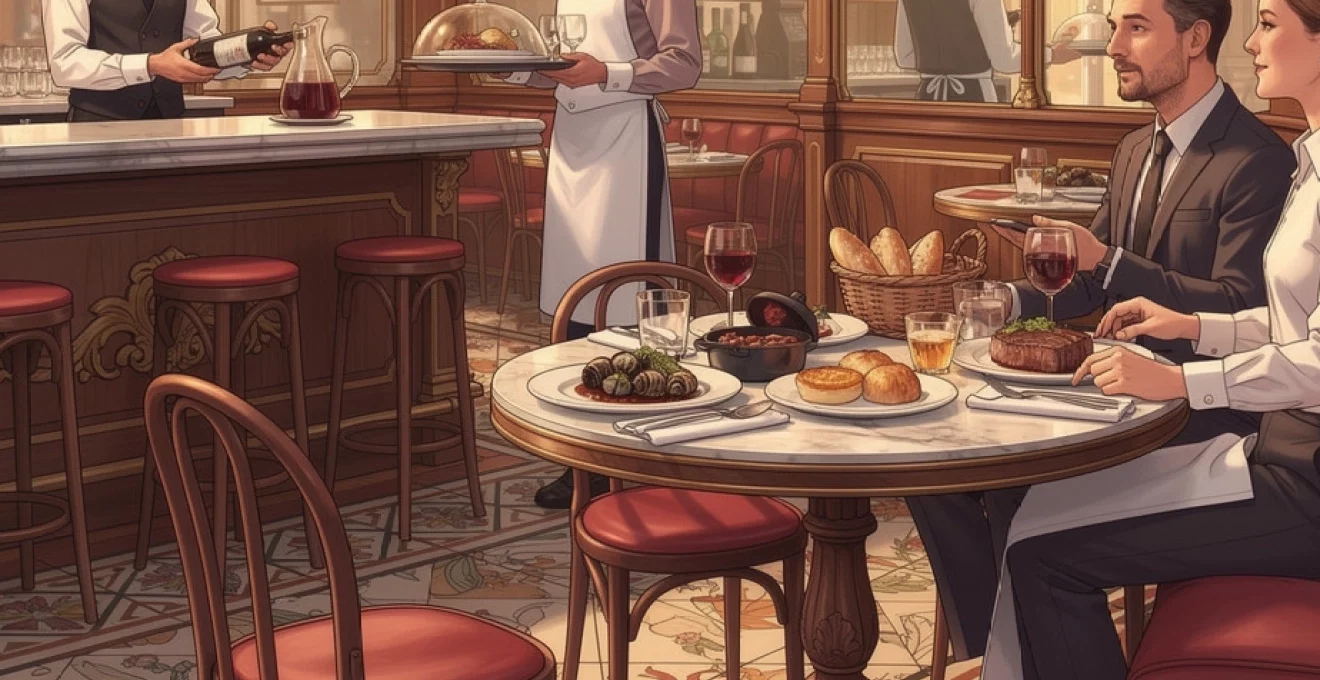
The Parisian bistro represents far more than a simple dining establishment—it embodies a cultural institution that has shaped the city’s culinary identity for over a century. From the gleaming zinc counters to the handwritten chalkboard menus, these intimate venues offer an experience that transcends mere sustenance. Understanding the nuances of bistro culture, from architectural elements to service protocols, reveals a world where tradition meets innovation, and where every meal becomes a celebration of French art de vivre. The bistronomy movement, pioneered by visionary chefs like Yves Camdeborde in the 1990s, revolutionised this landscape by making haute cuisine techniques accessible within casual settings, creating a dining philosophy that now defines modern Parisian gastronomy.
Today’s Parisian bistro scene continues to evolve whilst maintaining its essential character. Whether you’re settling into a banquette at a century-old establishment in Saint-Germain-des-Prés or discovering a contemporary bistronomic gem in the Marais, you’ll encounter the same fundamental principles: quality ingredients sourced from local markets, unpretentious presentations, carefully curated wine selections, and an atmosphere that encourages lingering conversations over multiple courses. This guide explores the architectural aesthetics, service traditions, iconic dishes, and cultural significance that make dining in a Parisian bistro an unforgettable experience.
Architectural aesthetics and interior design elements of traditional parisian bistros
The visual identity of a traditional Parisian bistro creates an immediate sense of place, transporting diners to a world where Belle Époque elegance meets everyday accessibility. These design elements, refined over generations, contribute significantly to the authentic bistro experience that both locals and visitors cherish.
Zinc-topped bar counters and belle époque brass fixtures
The iconic zinc counter, or comptoir en zinc, serves as the heart of traditional bistro architecture. This distinctive feature emerged in the late 19th century when zinc became widely available as an affordable, hygienic surface material. The metal’s naturally antimicrobial properties made it ideal for food service establishments, whilst its lustrous patina developed character over decades of use. You’ll notice how the zinc catches and reflects light, creating a warm glow that enhances the convivial atmosphere. Many establishments polish their zinc counters daily, maintaining the mirror-like finish that has become synonymous with authentic Parisian bistros.
Complementing these counters, Belle Époque brass fixtures—from door handles to coat hooks, light fittings to coffee machine components—add layers of historical authenticity. These elements weren’t merely decorative choices but represented the craftsmanship standards of their era. The brass develops a rich patina over time, each scratch and mark telling stories of countless meals served and conversations shared. Contemporary bistros seeking authenticity often source original fixtures from architectural salvage specialists, recognising that genuine period details cannot be convincingly replicated.
Banquette seating configuration and Marble-Topped guéridon tables
The strategic placement of banquette seating maximises space efficiency whilst creating intimate dining zones within compact interiors. Traditional bistro banquettes feature deep burgundy or forest green leather, often buttoned or tufted, providing comfortable support for extended dining sessions. This seating arrangement serves practical purposes—accommodating more diners per square metre than individual chairs—whilst fostering the social atmosphere central to bistro culture. You’ll find that banquette positioning along walls creates natural sightlines, allowing diners to observe the room whilst maintaining conversational privacy.
Marble-topped guéridon tables pair perfectly with banquette seating, their cool, smooth surfaces providing ideal platforms for serving traditional French cuisine. These small, round or square tables typically feature cast-iron bases, often ornately designed with scrollwork or geometric patterns. The marble—usually Carrara white with grey veining or dramatic black varieties—requires minimal maintenance whilst offering exceptional durability. Many establishments retain original marble tables over a century old, the stone’s surface bearing subtle stains and marks that serve as testament to countless plats du jour enjoyed over generations.
Art nouveau tilework and Mirror-Panelled wall treatments
Art Nouveau ceramic tilework
Art Nouveau ceramic tilework often lines the lower half of bistro walls and sometimes extends across the floors, creating a visual rhythm that guides you through the space. Typical motifs include whiplash curves, stylised vines, and floral patterns in muted greens, creams, and ochres, echoing the organic forms popular at the turn of the 20th century. These tiles are not only beautiful but highly practical: glazed surfaces are easy to clean and resistant to spills, an important consideration in busy dining rooms. When you look down in a historic Parisian bistro, you may notice slightly uneven tiles and worn edges—subtle signs that thousands of guests have passed before you. Contemporary bistronomic venues often pay homage to this tradition with reproduction tiles or geometric patterns inspired by original Art Nouveau designs.
Above the tilework, mirror-panelled wall treatments amplify natural light and visually enlarge what are often compact interiors. Large bevelled mirrors framed in dark wood or gilt mouldings create reflections of chandeliers, wine bottles, and passing waiters, adding to the sense of energy in the room. Mirrors also encourage a certain kind of Parisian people-watching: you can discreetly observe other tables, read the room, and feel part of a shared experience without leaving your seat. From a design standpoint, this is a clever solution to the narrow footprints typical of older buildings in neighbourhoods like Le Marais and Saint-Germain. The interplay between reflective surfaces, warm lighting, and patinated materials is key to the timeless ambience of the classic Parisian bistro.
Chalkboard menu displays and vintage typography characteristics
Chalkboard menus are perhaps the most instantly recognisable visual cue that you’ve entered a true Parisian bistro. Typically mounted above the bar or carried from table to table, these boards list the plats du jour, seasonal specials, and sometimes a short selection of wines by the glass. Handwritten in looping script or precise block letters, they communicate not only what’s fresh that day but also the chef’s philosophy: concise descriptions, minimal embellishment, and a focus on ingredients rather than elaborate marketing language. Because chalk is easily erased, these boards signal that the menu can change at a moment’s notice in response to the morning’s market offerings.
Typography plays a subtle yet powerful role in shaping the bistro’s identity. Traditional venues favour vintage letterforms reminiscent of early 20th-century Paris: elongated serifs, ornate capitals, and slightly irregular hand-painted signage on windows declaring Vins Fins, Café, or Bistrot. Modern bistronomy addresses may reinterpret this look with cleaner sans-serif fonts or minimalist black-and-white palettes, but they often retain some nod to history, such as gold-leaf window lettering or enamel street-style plaques. These graphic elements, combined with the tactile charm of chalk on slate, create a cohesive visual language that feels both nostalgic and current. When choosing where to dine, you can often rely on these details as quiet indicators of how much care an establishment invests in its overall experience.
Classic bistro service protocol and french dining etiquette
Beyond architecture and decor, the art of dining in a Parisian bistro is defined by its service rituals and unspoken etiquette. Understanding these customs helps you navigate your meal with confidence and ensures a more relaxed, enjoyable experience. While each establishment has its quirks, most follow a recognisable structure rooted in service à la française, where timing, sequence, and respectful interaction are as important as what appears on the plate.
Le service à la française: sequential course progression standards
In a traditional Parisian bistro, meals follow a logical, unhurried progression that reflects the French belief that dining is a moment to be savoured, not rushed. Typically, you begin with an apéritif—perhaps a glass of champagne or a kir—while you study the menu and chalkboard specials. Once you order, courses tend to arrive in sequence: a starter (entrée), followed by a main course (plat), then cheese or dessert, and finally coffee or a digestif. Unlike some Anglo-Saxon dining cultures, side dishes such as vegetables or salad may be served as part of the main plate rather than in separate bowls, underscoring the chef’s control over composition.
It’s important to remember that in many Parisian bistros, the table is yours for the duration of the service. You won’t be hurried out, and you generally won’t receive the bill until you explicitly request it with a polite “L’addition, s’il vous plaît.” This slower pace is a core element of the Parisian bistro experience, allowing conversation and courses to unfold naturally. If you’re used to faster restaurant turnover, think of this as shifting from a sprint to a leisurely stroll along the Seine: you may need to adjust your expectations, but the reward is a more immersive encounter with French dining culture.
Sommelier wine pairing recommendations and carafe service traditions
Wine service in a Parisian bistro is typically more relaxed than in formal gastronomic restaurants, yet it’s still guided by a strong sense of tradition. Many bistros do not have a full-time sommelier, but the owner, manager, or a knowledgeable server often fulfils this role, curating a concise wine list that focuses on regional appellations like Bordeaux, Burgundy, and the Loire. When in doubt, you can simply describe what you enjoy—light and fruity reds, crisp whites, or something fuller-bodied—and the staff will suggest a suitable bottle or glass. Asking for a recommendation is not only acceptable; it is often the best way to discover small producers you might never encounter at home.
Carafe service remains an integral part of bistro wine culture. Instead of ordering a full bottle, you can request un quart (25 cl), un demi (50 cl), or un pichet of house wine, usually served in simple glass jugs. This tradition reflects the bistro’s democratic spirit: good wine should be accessible, not intimidating. While house wines are no longer the rough-and-ready blends they once were, they still offer excellent value, especially at lunch. If you’re planning several courses, carafes allow you to pair different wines with different dishes without committing to full bottles, much like building a tasting menu of glasses throughout your meal.
Table setting conventions: cutlery placement and napkin presentation
At first glance, a bistro table setting may appear deceptively simple, but it follows clear conventions that signal the rhythm of the meal. You’ll typically find a small bread plate or simply a section of the table set aside, a knife and fork placed on either side of the main plate area, and a neatly folded cloth napkin. Glassware usually includes one wine glass and a water glass, with additional stems brought as needed if you order different wines. In many neighbourhood bistros, settings are assembled just before you sit down, reinforcing the relaxed, everyday nature of the experience.
Napkin etiquette is straightforward yet telling: you place your napkin on your lap as soon as you’re seated and keep it there throughout the meal. When stepping away from the table, you can lightly fold it and leave it on your chair; placing it on the table signals that your meal is finished. Cutlery is replaced between courses only when necessary, and you typically rest your knife and fork on your plate rather than on the tablecloth. These subtle gestures help the staff read where you are in the meal without intruding on your conversation. Think of the table setting as a quiet language—once you understand it, you and your server can “speak” without words.
Server-client interaction customs and tipping practices in parisian establishments
The relationship between servers and guests in Parisian bistros is shaped by mutual respect and a certain professional distance. You might not receive the exuberant friendliness common in some countries, but you should expect courtesy, efficiency, and a touch of formality. A simple “Bonjour, monsieur / madame” when you enter and a “Merci, au revoir” when you leave go a long way toward establishing goodwill. Many servers appreciate it when you at least attempt to order in French, even if your vocabulary is limited; this small effort signals that you respect local customs and are willing to meet them halfway.
Tipping practices in Paris differ from those in North America and some other regions. By law, a service charge (service compris) is included in menu prices, so staff are paid a fixed wage. That said, it’s customary to leave a small additional tip in cash if you’ve enjoyed the experience—typically rounding up the bill or adding 5–10% in mid-range bistros. For example, on a €48 bill, leaving €50 or €52 is both generous and appropriate. There is no obligation to match the 18–20% often expected elsewhere, which can make dining in a Parisian bistro feel surprisingly reasonable once you factor in the total cost.
Iconic parisian bistro menu staples and regional provenance
The soul of any Parisian bistro lies in its menu, which balances comforting classics with seasonal market specials. While each chef brings a personal touch, certain dishes appear so frequently that they have become shorthand for the bistro experience itself. Understanding the origins and preparation of these staples not only enriches your appreciation but also helps you order with confidence, especially when faced with a handwritten French menu.
Steak frites au poivre: charolais beef preparation techniques
Steak frites is arguably the most emblematic Parisian bistro dish, and when prepared au poivre, it becomes a masterclass in simplicity executed with precision. Most serious bistros favour Charolais beef, a heritage breed from eastern France known for its fine grain and rich flavour. Cuts such as entrecôte (ribeye) or rumsteck (rump) are seasoned generously with coarse salt and often crusted with crushed black peppercorns before searing in a hot pan. The result is a caramelised exterior encasing a tender, juicy interior—typically cooked saignant (rare) or à point (medium rare) unless you specify otherwise.
The pepper sauce that distinguishes steak au poivre is usually built in the same pan, using the meat’s browned bits as a flavour base. Shallots, green or black peppercorns, a splash of cognac or Armagnac, and a reduction of cream or veal stock combine to create a sauce that is both pungent and luxurious. On the side, you’ll almost always find a generous portion of frites, hand-cut and fried in small batches until crisp on the outside and fluffy within. When you encounter this dish on a chalkboard menu, it’s often a reliable benchmark of the kitchen’s skill: if they respect the basics of beef quality, cooking temperature, and sauce balance, you can trust the rest of the menu.
Coq au vin and boeuf bourguignon: slow-braised burgundian specialities
Burgundy has gifted the Parisian bistro with two of its most beloved comfort dishes: coq au vin and boeuf bourguignon. Both rely on long, slow braising in red wine to transform humble ingredients into deeply flavoured classics. Coq au vin was traditionally made with an older rooster, whose firmer flesh benefitted from extended cooking, though today you’re more likely to find it prepared with chicken thighs. The meat is marinated and then simmered with Burgundy wine, lardons, mushrooms, and pearl onions until it becomes meltingly tender, the sauce thickened slightly to coat each bite.
Boeuf bourguignon follows a similar logic but uses beef—often cheek, shoulder, or another well-worked cut—slow-cooked with red wine, carrots, onions, and aromatic herbs. In a well-executed version, the sauce achieves a glossy depth that reflects hours of gentle reduction, and the beef yields easily to a fork without falling apart into strands. Both dishes illustrate a key principle of bistro cuisine: time is treated as an ingredient. By allowing flavours to develop gradually, chefs extract maximum character from relatively modest components. When you see these Burgundian specialities listed as the plat du jour, it’s often because the chef has spent the entire morning tending to their pots.
Escargots de bourgogne with persillade butter composition
For many visitors, ordering escargots de Bourgogne is a rite of passage in the Parisian bistro. These Burgundy snails arrive nestled in dimpled plates or their own shells, each cavity brimming with vivid green persillade butter. Far from being a simple garlic butter, this mixture combines finely chopped flat-leaf parsley, garlic, shallots, and sometimes a touch of anchovy or white wine, whipped into softened butter and seasoned with salt and pepper. As the snails bake, the butter foams and infuses them with intense aroma, creating a dish that is far more about the sauce than the mollusc itself.
If you’re hesitant, think of escargots as a vehicle for one of the most flavourful butters you’ll ever taste, rather than as an exotic ingredient. The proper technique is to use snail tongs (if provided) to hold the shell and a small fork to extract the meat, then tear off pieces of baguette to mop up the remaining butter. Many locals would argue that the true pleasure lies in this ritual of dipping and sopping, which turns a potentially intimidating dish into something deeply comforting. In terms of wine pairing, a crisp Burgundy white such as a Mâcon-Villages or Chablis makes a classic companion, cutting through the richness of the butter.
Tarte tatin and crème brûlée: traditional dessert execution methods
Desserts in Parisian bistros tend to favour tradition over novelty, with tarte Tatin and crème brûlée occupying pride of place on many menus. Tarte Tatin, an upside-down caramelised apple tart from the Loire region, is assembled by cooking apples in butter and sugar until they take on a deep golden hue, then covering them with a layer of pastry and baking until the crust is crisp. Just before serving, the tart is inverted so the tender apples sit on top, often accompanied by a spoonful of crème fraîche or a scoop of vanilla ice cream. A well-made version balances slight bitterness from the caramel with the natural sweetness and acidity of the fruit.
Crème brûlée, by contrast, showcases the elegance of simplicity. A base of egg yolks, cream, sugar, and vanilla is slowly baked in a water bath until set but still trembling at the centre, then chilled. Just before serving, a thin layer of sugar is sprinkled on top and caramelised with a blowtorch or under a grill, forming the famous glass-like crust. The ideal texture is silky and smooth beneath a crisp, evenly browned top. When you crack through that caramel with your spoon, you’re participating in a small but cherished ritual that has delighted diners for generations.
Historic parisian bistro districts and notable establishments
Location plays a significant role in the character of a Parisian bistro. Different neighbourhoods—each with its own history, demographics, and architectural fabric—have nurtured distinct bistro cultures over time. Exploring these districts allows you to experience how the same fundamental template adapts to varied contexts, from aristocratic boulevards to former working-class hillsides.
Le marais quarter: chez janou and L’Ami louis legacy venues
Le Marais, straddling the 3rd and 4th arrondissements, offers a dense concentration of Parisian bistros nestled among medieval alleyways and elegant 17th-century mansions. Here, institutions like Chez Janou embody the convivial, almost theatrical side of bistro dining, with crowded terraces, generous portions, and a famously extensive pastis list. The menu leans toward Provençal-inspired comfort food—think daube, grilled fish, and heaping bowls of chocolate mousse—served in a space decorated with vintage posters and well-worn wooden chairs. It’s the kind of place where tables are close together and strangers frequently strike up conversations.
A short walk away, L’Ami Louis represents another facet of the Marais bistro tradition: the cult classic. Famous for its roast chicken, foie gras, and unapologetically rich cooking, this small, wood-panelled restaurant has attracted an international clientele of chefs, celebrities, and devoted regulars. Prices reflect its reputation, but so does the intensity of its flavours and the old-world charm of its dining room. Visiting such legacy venues is like stepping into a living museum of Parisian dining—yet they remain very much part of the city’s contemporary gastronomic conversation.
Saint-germain-des-prés: brasserie lipp and les deux magots cultural significance
Saint-Germain-des-Prés, on the Left Bank, has long been associated with intellectuals, writers, and artists, and its bistros and brasseries reflect this history. Brasserie Lipp, founded in 1880, is renowned for its Art Deco interior, mirrored walls, and traditional Alsatian-inspired dishes. While technically a brasserie rather than a small bistro, it functions in a similar cultural role: a place where Parisian life unfolds at tightly packed tables under glowing globe lamps. Politicians, journalists, and literary figures still frequent Lipp, continuing a tradition that stretches back to the days when Simone de Beauvoir and Jean-Paul Sartre walked the neighbourhood streets.
Nearby, Les Deux Magots occupies a special place in Parisian mythology. Once a haunt of surrealists, philosophers, and avant-garde painters, it today balances its touristic fame with a genuine sense of café-bistro history. Sitting on its terrace, you can observe the choreography of Saint-Germain: locals reading newspapers, students debating, and visitors quietly absorbing the atmosphere. Prices here reflect the prestige of the address, but the experience—sipping a glass of wine or enjoying a simple croque-monsieur while gazing at the church of Saint-Germain-des-Prés—is hard to replicate elsewhere.
Montmartre neighbourhood: le consulat and la maison rose artistic heritage
Montmartre, once a village outside Paris and now folded into the 18th arrondissement, retains a distinctly bohemian spirit that permeates its bistros. Le Consulat, with its red-and-white façade and traditional signage, has been immortalised in countless paintings and photographs. It channels the neighbourhood’s 19th- and early 20th-century artistic heyday, when figures like Picasso, Modigliani, and Utrillo roamed the cobbled streets. Inside, you’ll find a classic bistro setting: wooden chairs, simple tables, and a menu of crowd-pleasing French staples designed to sustain long evenings of conversation.
Just around the corner, La Maison Rose offers a softer, pastel-tinted vision of Montmartre life. Its pink exterior and green shutters have made it an Instagram favourite, but behind the façade lies a more serious commitment to seasonal, locally sourced cooking. Dishes highlight ingredients from small producers and often showcase lighter, vegetable-forward interpretations of traditional recipes. Dining here, you sense how the Parisian bistro can evolve without losing touch with its roots, much like Montmartre itself—a hill where tourism and authenticity coexist in a delicate, constantly renegotiated balance.
French wine and apéritif culture in bistro settings
No exploration of the art of dining in a Parisian bistro would be complete without considering wine and apéritifs. These beverages frame the entire experience, from the opening clink of glasses to the final sip that concludes the meal. In bistro culture, wine and apéritifs are less about conspicuous consumption and more about enhancing conviviality, stimulating the appetite, and complementing the food.
Bordeaux and burgundy AOC classifications for bistro wine lists
Most serious bistro wine lists are anchored by bottles from Bordeaux and Burgundy, two regions whose Appellation d’Origine Contrôlée (AOC) systems help you decode style and quality. In Bordeaux, AOCs such as Médoc, Saint-Émilion, and Pessac-Léognan indicate blends dominated by Cabernet Sauvignon or Merlot, offering structured reds that pair well with rich meat dishes like boeuf bourguignon or magret de canard. Entry-level Bordeaux or Bordeaux Supérieur often provide excellent value on bistro lists, giving you a taste of the region without the grand cru price tag.
From Burgundy, you’ll frequently encounter appellations like Bourgogne Rouge or Blanc, Mâcon-Villages, and Chablis. These wines, made primarily from Pinot Noir and Chardonnay, tend to be more terroir-driven and nuanced, making them ideal matches for dishes such as escargots, roasted chicken, or creamy cheeses. While top-tier crus can command high prices, bistros often focus on accessible village-level wines that deliver character and balance. When reading a wine list, don’t hesitate to ask how a particular AOC might pair with your chosen dish—staff are usually happy to translate technical classifications into practical guidance.
Kir, pastis, and pernod: pre-dinner apéritif ritual preparation
Apéritifs serve as both a social and physiological prelude to the meal, gently awakening the palate and setting a relaxed tone. Among the most iconic in Parisian bistros is the kir, a blend of dry white wine (traditionally from Burgundy) and crème de cassis. Its balance of acidity and blackcurrant sweetness makes it a refreshing choice, particularly in warmer months. Variations like kir royal, which substitutes champagne for still wine, appear frequently on bistro chalkboards as celebratory options.
In many more traditional or neighbourhood-focused bistros, you’ll also see pastis and Pernod on the apéritif list. These anise-flavoured spirits are typically served with a carafe of chilled water, which you add slowly to the glass. As the water dilutes the spirit, it turns from clear to milky, releasing complex herbal aromas. This simple ritual—pour, watch the transformation, then sip—embodies the unhurried ethos of French dining. You might think of it as a sensory warm-up, preparing you for the flavours and conversations to come.
Wine service temperature standards and decanting protocols
Proper serving temperature is crucial to wine enjoyment, and Parisian bistros generally adhere to practical, time-tested norms. Red wines are often served slightly cooler than room temperature—around 15–18°C—so their fruit and structure remain in balance rather than becoming flabby or overly alcoholic. Whites and rosés typically arrive well-chilled but not icy, at about 8–12°C, preserving aromatics and freshness. If your wine feels too cold, simply let the glass rest on the table for a few minutes; Parisian rooms are rarely refrigerated to extremes.
Decanting in bistros tends to be reserved for older or more robust reds, or when a wine needs aeration to open up. In smaller venues with limited storage space, you may see staff quickly carafing younger wines to help them breathe before serving. If you’re ordering a special bottle, you can politely ask whether the server recommends decanting; their answer will often reflect both the wine’s age and their practical experience with it. As with many aspects of bistro dining, the approach is pragmatic rather than ceremonial: the goal is simply to make the wine taste its best alongside the food.
Seasonal menu evolution and marché sourcing practices
One of the most rewarding aspects of returning to the same Parisian bistro over time is observing how the menu evolves with the seasons. Rather than offering a static list, many chefs build their daily specials around what they find at the market, allowing local produce, game, and seafood to dictate the direction of the cuisine. This commitment to seasonality is not just a trend but a long-standing principle of French cooking.
Rungis international market: daily ingredient procurement networks
Behind nearly every plate of food in a Parisian bistro lies a complex supply chain that often converges at the Rungis International Market, located just south of the city. Covering more than 230 hectares, Rungis is the world’s largest wholesale food market, handling over 1.7 million tonnes of produce annually. In the early hours of the morning, buyers for bistros and restaurants walk its cavernous halls, selecting fish, meat, vegetables, and cheese from specialist wholesalers who focus solely on their category. This is where many chefs decide what will appear on that day’s chalkboard menu.
Because Rungis operates at such scale, it can offer both incredible diversity and stringent quality control, enabling even modest bistros to access exceptional ingredients. When you see poisson du jour or légumes du marché listed as specials, it’s often a direct reflection of what looked best at Rungis only a few hours earlier. For diners, this means your experience is subtly connected to a vast but largely invisible network of producers, traders, and transporters—all working in concert to supply the city’s tables by lunchtime.
Autumn game season: venison and wild boar menu integration
As the weather cools and leaves begin to fall, Parisian bistros embrace autumn’s robust flavours, particularly game meats that appear for a limited season. Dishes featuring venison (chevreuil) or wild boar (sanglier) start to pop up on chalkboards, often in the form of slow-cooked stews, roasts with juniper and red wine, or terrines served with pickled vegetables. These preparations echo rural French traditions, where hunting and preserving game were integral to winter survival. Today, they offer urban diners a chance to taste something wilder and more intense than everyday beef or pork.
Game dishes pair naturally with fuller-bodied red wines from regions like the Rhône or southwest France, making autumn a particularly satisfying time for red wine enthusiasts to explore bistro menus. If you’re unsure whether you’ll enjoy the stronger flavour of game, you might start with a shared plate of terrine de campagne or civet de sanglier before committing to a full portion. In many ways, autumn bistro menus function like seasonal storybooks, narrating the transition from late harvest sunshine to the deeper, contemplative flavours of the colder months.
Spring vegetable harvest: white asparagus and artichoke specialities
In spring, Parisian bistros shift toward lighter, brighter dishes that celebrate the first tender vegetables of the year. White asparagus, a prized delicacy in France, often takes centre stage, served simply with hollandaise sauce, vinaigrette, or shaved into salads. Its subtle, almost nutty flavour and silky texture are a reminder that luxury in French dining can be as much about produce at its peak as about complex technique. When white asparagus season is in full swing—usually from April to June—many bistros highlight it prominently on their menus.
Artichokes also feature heavily in spring offerings, appearing as artichauts poivrade (baby artichokes) braised with herbs, or as classic artichaut vinaigrette, where the vegetable is served whole with a mustardy dressing. These preparations invite you to engage with your food, peeling leaves one by one or carefully nibbling at the tender heart. Paired with a glass of crisp Loire white or a light Burgundy, such dishes capture the essence of seasonal Parisian bistro dining: simple ingredients, handled with respect, that persuade you—if only for an hour—that time moves at the pace of the harvest rather than the clock.