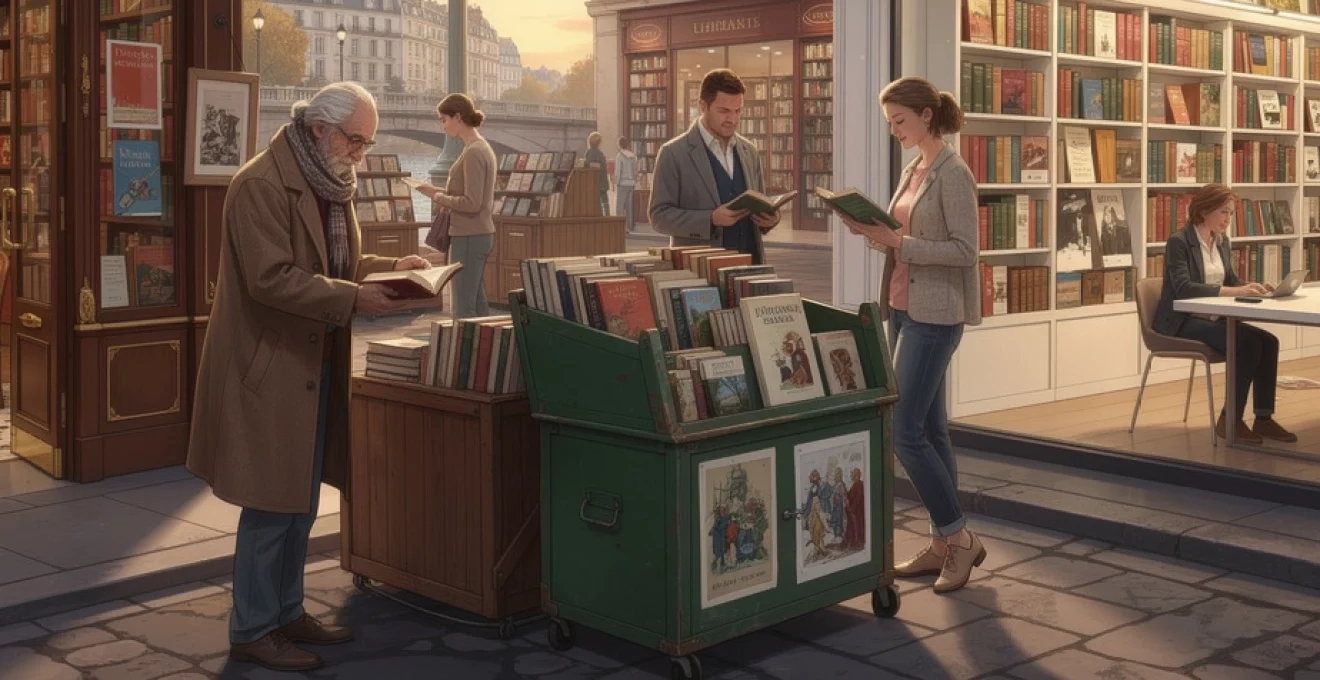
French bookshops represent far more than simple retail establishments where literary transactions occur. They embody centuries of intellectual tradition, architectural heritage, and cultural identity that continues to shape the way readers engage with the written word. From the iconic green stalls lining the Seine’s embankments to the Belle Époque storefronts adorning Parisian boulevards, these spaces serve as living museums where commerce, artistry, and scholarship converge. The experience of browsing through a French librairie transcends the mere act of purchasing books—it becomes a sensory journey through carefully curated collections, historical architecture, and the unmistakable atmosphere that only decades of literary passion can create. Understanding the nuances of these spaces, their organizational systems, and the unwritten protocols that govern them transforms casual visitors into knowledgeable bibliophiles capable of appreciating the depth and complexity these institutions offer.
Architectural typology of traditional french librairies and bouquinistes
The physical structures housing French bookshops tell stories as compelling as the volumes they contain. Each architectural style reflects distinct periods of French history, economic conditions, and evolving relationships between readers and literature. These spaces have adapted remarkably to changing commercial landscapes while maintaining their essential character and historical integrity.
Belle époque shop fronts: delamain and galignani design elements
The Belle Époque period (roughly 1871-1914) produced some of Paris’s most recognizable bookshop façades, characterized by ornate ironwork, carved wooden panels, and expansive display windows designed to showcase literary treasures. Establishments like Delamain and Galignani exemplify this architectural approach, with their distinctive features including hand-painted signage in gold leaf, mahogany display cases, and mosaic-tiled entryways that have survived over a century of urban transformation. The vitrine (display window) became an art form during this period, with booksellers arranging volumes like jewellers presenting precious stones, often accompanied by vintage lithographs and period decorative objects.
These shop fronts typically featured recessed doorways that created transitional spaces between the bustling street and the hushed interior. The doors themselves, often constructed from bevelled glass panels set in brass or bronze frames, allowed natural light to flood the interior while maintaining visual connection with passing pedestrians. Many retained their original gas lamp fixtures, later converted to electricity but preserving their historical aesthetic. The colour palettes favoured deep greens, burgundies, and navy blues—hues that conveyed sophistication and intellectual gravitas whilst remaining welcoming rather than intimidating.
The bouquiniste stall system along seine’s parisian quais
The bouquinistes represent perhaps the most democratized form of book commerce in France, with their iconic dark green boxes lining approximately three kilometres of the Seine’s banks. This UNESCO-recognized tradition dates back to the 16th century, though the standardized stall design emerged in 1891 when Paris authorities regulated their dimensions and appearance. Each bouquiniste operates within a strictly defined space, typically consisting of four boxes measuring 2 metres in length, mounted on the parapet walls overlooking the river.
The engineering of these stalls demonstrates remarkable practicality: hinged lids that lift to create weatherproof display surfaces, internal compartments for inventory storage, and padlock systems that secure everything when the bookseller departs. During operating hours, you’ll observe the transformation as sellers arrange their wares—antiquarian books, vintage posters, historical postcards, and ephemera—creating miniature outdoor galleries. The positioning along specific quais carries significance, with locations near Notre-Dame or the Louvre commanding premium status within the bouquiniste community. Recent estimates suggest approximately 240 bouquinistes operate along the Seine, collectively managing around 900 stall boxes and offering roughly 300,000 books at any given time.
Passage des panoramas and covered arcade bookshop heritage
Paris’s covered passages, constructed primarily during the early 19th century, created protected shopping environments where bookshops flourished alongside other luxury retailers. The Passage des Panoramas, opened in 1800 and later enhanced with gas lighting (becoming one of Europe’s first illuminated public spaces),
became a model for a new kind of urban promenade. Within these glass-roofed galleries, librairies capitalised on stable light, controlled temperatures, and a steady flow of bourgeois flâneurs shielded from mud and rain. Narrow shopfronts with deep interiors allowed booksellers to stack shelves up to the cornices, using rolling ladders and high mezzanines to maximise every square metre. Many retained original ceramic floor tiles and cast-iron support columns, which today contribute to the nostalgic ambiance that bibliophiles find so compelling.
In the Passage des Panoramas and neighbouring arcades like Galerie Vivienne, the spatial rhythm of alternating bookstores, stamp dealers, and print sellers created an ecosystem of printed culture. You move through a kind of open-air bibliography, where each façade announces a speciality: philately, theatre programmes, 19th‑century travelogues, illustrated children’s books. For those interested in the architectural typology of traditional French librairies, these covered passages offer a textbook example of how small-scale commercial units adapt to evolving reading habits while maintaining historical continuity. Exploring them is a reminder that, long before online shopping, Paris had already invented the climate-controlled, curated browsing experience.
Contemporary minimalist interventions at la hune and volumes
Not all French bookshops trade on patina and period charm. Contemporary spaces such as the reborn La Hune in Saint‑Germain‑des‑Prés and the community-driven Volumes in the 19th arrondissement embrace a minimalist vocabulary: clean lines, pale wood, polished concrete, and track lighting. Here, the architectural typology of the librairie shifts from cosy grotto to gallery-like white cube, where books are treated almost as design objects. Wide aisles and generous sight lines encourage slow browsing, while modular shelving systems can be reconfigured for readings, workshops, or exhibitions at short notice.
At La Hune, photography and art books are displayed face-out on long, low tables, echoing contemporary art galleries where works are given breathing room rather than crammed spine-to-spine. Volumes, which combines coworking space, café, and bookshop, reflects a different evolution in French book culture: the librairie as third place, somewhere between home and office. You may find yourself sipping coffee at a shared table, laptop open, with a wall of independent graphic novels behind you and an impromptu writing group at the next desk. This minimalist approach does not erase the past; instead, it overlays a flexible, digital-era sensibility on the enduring ritual of browsing physical books.
Curated collection navigation at landmark parisian bookshops
Once inside, understanding how to navigate the curated collections of major Parisian bookshops can transform a casual visit into a far richer experience. Each store reflects its own philosophy of classification, often combining traditional library logic with idiosyncratic systems that only make sense once you have spent a little time exploring. Rather than overwhelming you with sheer volume, these landmark librairies guide you through French literature, philosophy, and art in ways that reveal both breadth and depth. Knowing how sections are organised will help you locate what you want—and, perhaps more importantly, stumble on what you did not know you needed.
Shakespeare and company’s antiquarian section organisation
Shakespeare and Company, just opposite Notre‑Dame, is famous for its labyrinth of rooms and beds tucked between shelves, but its antiquarian section follows a surprisingly disciplined structure. Tucked away from the main ground-floor crush, rare and older volumes are grouped first by language, then by broad subject: modern first editions, poetry, drama, travel, and philosophy. Within these categories, staff often create micro-displays dedicated to key Anglophone authors in Paris—think Hemingway, Joyce, or Baldwin—making it easier for you to trace the city’s literary expatriate history.
Because shelf labels are sometimes handwritten and the topography of the shop can feel maze-like, the most effective navigation technique is to ask a bookseller directly. Their mental map of the inventory often functions like a living card catalogue, pointing you toward an overlooked nook or upstairs alcove. You may discover that a “miscellany” shelf hides early Penguin paperbacks, or that the antique travel corner is organised by country rather than period. Treat the space almost as a human-powered search engine: instead of typing keywords, you offer a theme—“lost generation Paris” or “post-war British poetry”—and let an experienced bookseller curate a short list on the spot.
Librairie galignani’s bilingual literary classification system
Librairie Galignani on rue de Rivoli presents a more classical, almost library-like organisation model, especially useful if you are navigating bilingual collections. The store is physically divided into French and English zones, but within each, fiction and non-fiction follow standard subject hierarchies: literature, history, art, design, politics, and philosophy. For English-language readers, shelves labelled “Literature in English” are then broken down by country—UK, US, Commonwealth—before being ordered alphabetically by author. This makes Galignani one of the easiest places in Paris to locate a specific English title on short notice.
What makes the bookstore particularly interesting from a typology standpoint is the way it cross-references French and English material. Major authors who straddle languages—Camus, Proust, Beckett—often appear in parallel in both sections, allowing you to compare translations or pick up a bilingual reading project. Art and architecture shelves blend French and international titles without strict separation, reflecting the global nature of visual culture. If you are trying to improve your French reading skills, Galignani’s classification system lets you find a novel you know in English, then locate its French counterpart just a few steps away.
Abbey bookshop’s canadiana and niche subject taxonomy
Hidden in a narrow Latin Quarter street, the Abbey Bookshop offers a very different experience: an almost topographical organisation that mirrors the stacked, cave-like interior. Run by a Canadian bookseller, the shop gives pride of place to Canadiana, with dedicated shelves for Canadian fiction, history, and Indigenous studies. These sections may occupy only a small physical footprint, but they form a clear thematic island in the middle of a more organic, overflow-heavy taxonomy. Around them, English-language literature spills into philosophy, essays, and travel in a way that feels intuitive once you relax into the space.
Rather than relying on strict Dewey-style codes, Abbey Bookshop uses what you might call a “pathway” system: narrow aisles dedicated to specific constellations of subjects. You might turn left into a corridor of theology and church history, then emerge into a pocket of science fiction and fantasy stacked in waist-high piles. Niche interests—Celtic studies, mountaineering, political pamphlets—often claim their own corners or low tables. Here, the best navigation strategy is exploratory: give yourself time, be ready to dig a little, and do not hesitate to ask the owner, who will often know exactly which pile hides the obscure out-of-print title you seek.
Gibert joseph’s multi-floor genre stratification model
At the other end of the spectrum sits Gibert Joseph, whose former flagship on boulevard Saint‑Michel (now split into several nearby sites) exemplified the multi-floor stratification model typical of large French chains. Floors were allocated by broad category: one level for literature and humanities, another for sciences and textbooks, another for music, comics, or used books. Within each floor, signage and colour-coding helped you move from, say, “Littérature française” to “Policier,” “Science-fiction,” or “Poches” (mass-market paperbacks). For visitors accustomed to smaller independent shops, this vertical hierarchy may feel more like a department store—but it has a logic worth understanding.
The great advantage of this model is clarity when you are hunting for a precise genre or edition, especially if you are researching for French exams or university courses. Used and new copies are often shelved together but clearly labelled, making price comparison straightforward. You might, for example, find three different editions of the same Balzac novel: a scholarly annotated paperback, a budget Livre de Poche, and a handsome hardback. Treating each floor as its own specialised librairie allows you to focus: you can head straight to the “Occasions” level if you are building a cheap French library, or linger on the comics floor to explore the rich world of bande dessinée.
Regional bibliophile destinations beyond the capital
While Paris often dominates discussions about the art of browsing French bookshops, some of the most rewarding experiences lie beyond the capital. Mid-sized cities and university towns have developed their own ecosystems of librairies, each responding to local history, language, and readership. If you are planning a literary-themed journey through France, understanding these regional destinations will help you balance headline landmarks with quieter, more personal discoveries. Think of Paris as the hardback first edition and the regions as the annotated, lived-in paperbacks that tell you how people actually read today.
Lyon’s rue de la république antiquarian book quarter
Lyon, historically a major centre of printing and humanist scholarship, maintains a rich network of bookshops clustered around Rue de la République and the Presqu’île. While this grand 19th‑century boulevard is now home to mainstream chains, the surrounding side streets hide antiquarian dealers and specialist librairies focusing on regional history, gastronomy, and silk trade archives. Many shopfronts retain high wooden doors and old typography, signalling decades—sometimes centuries—of continuous operation. Stepping inside, you are likely to find shelves dedicated to early printing in Lyon, maps of the Rhône valley, and out-of-print monographs on local architecture.
To make the most of this quarter, it helps to adopt the slow pace of a researcher rather than a shopper in a hurry. Ask about sections labelled “Vieux papiers” or “documents régionaux,” where ephemera such as theatre programmes, menus, and commercial catalogues reveal how everyday life has changed. Some booksellers may allow you to consult fragile items at a dedicated table rather than handling them freely. If you are interested in the material history of books—paper quality, typefaces, binding techniques—Lyon offers an ideal complement to Paris’s more international focus, grounding your browsing in a specific urban and economic story.
Montpellier’s sauramps cultural flagship experience
In Montpellier, the Sauramps bookshop complex functions as a cultural flagship akin to a compact department store of ideas. Its main site, historically in the Polygone shopping centre, sprawls across several levels and combines general literature with strong offerings in philosophy, social sciences, and foreign languages. For language learners attending immersion courses in the city, Sauramps often becomes a second classroom: you can move from graded readers and bilingual editions to full-length novels and essay collections as your confidence grows. The store’s generous seating and open-plan layout invite you to stay, browse, and test-drive books before committing.
Sauramps also embodies the French tradition of the librairie as civic actor. Beyond simple retail, it organises regular author events, debates, and reading groups that draw on the city’s large student population. If you time your visit with the local book festival or a major national prize announcement, you may find prominent titles highlighted in dedicated “Sélection” tables, alongside staff recommendations. For those exploring the art of browsing French bookshops outside Paris, Sauramps illustrates how a regional flagship can blend commercial scale with the intimacy of knowledgeable, genre-specific staff.
Strasbourg’s kléber and alsatian literary heritage stores
Strasbourg, perched on the Franco-German border, offers a uniquely bilingual book culture. Librairie Kléber, overlooking the central square of the same name, is both an architectural landmark and a hub for Alsatian and German-language literature. Its interior combines modern glass and light wood with more traditional reading nooks, creating distinct zones for French, German, and local dialect publications. Dedicated shelves highlight the city’s role in European institutions and cross-border cultural exchange, from EU political theory to Rhine valley travel narratives.
Beyond Kléber, smaller shops specialise in regional heritage: Alsatian folk tales, bilingual children’s books, and studies in local architecture and viticulture. Browsing here is a reminder that “French bookshop culture” is not monolithic but braided with regional identities. You may encounter sections labelled “Patrimoine” or “Alsatiques,” where slim volumes capture everything from half-timbered house restoration to traditional recipes. Asking booksellers for suggestions in this area can lead you to titles unavailable elsewhere, turning your visit into a form of literary souvenir hunting that goes far beyond the usual postcard.
Aix-en-provence’s book in bar hybrid concept spaces
Aix-en-Provence, with its student population and café-lined streets, has embraced hybrid concept spaces that blur the lines between bookshop, bar, and cultural salon. Venues such as Book in Bar—a well-known English-language café-bookshop—combine shelves of international literature with comfortable armchairs, coffee, and sometimes wine. Architecturally, these spaces often occupy former townhouses, using high ceilings and tall windows to flood reading areas with Provençal light. The result is a relaxed, almost domestic atmosphere where you can linger over a novel as you would in a friend’s living room.
From a browsing perspective, hybrid concept librairies reward curiosity. Sections might be organised by theme (“Travel & Exile,” “Food Writing,” “Feminist Essays”) rather than strict genre, encouraging you to wander across disciplines. Regular language exchanges, reading groups, and screenings turn the shop into a social node where locals and visitors connect over shared interests. If you are seeking to improve your French through immersion, these spaces offer a low-pressure environment: you can alternate between French and English books, overhear conversations at the next table, and gradually tune your ear while your hands are occupied with pages rather than screens.
Etiquette protocols and customer-bookseller interaction codes
Navigating French bookshops is not only about architecture and classification; it also involves subtle codes of etiquette that shape how customers and booksellers interact. Observing these unwritten rules can make your experience smoother and more rewarding, especially if you are used to more informal retail cultures. At the most basic level, a simple “Bonjour, Madame/Monsieur” as you enter—and “Au revoir, merci” as you leave—even if you buy nothing, signals respect for the space and the person running it. Many first-time visitors underestimate how much this brief ritual frames the interaction that follows.
Browsing itself is usually welcomed, but there are limits. In antiquarian shops and among the bouquinistes, it is polite to handle older volumes gently, avoiding spine-cracking or placing books on the ground. If a book is behind the counter, you should ask before reaching for it; the same applies to locked display cases where rare editions are stored. When in doubt, a quick “Je peux regarder ?” (May I take a look?) goes a long way. You will notice that some regulars engage in long conversations with booksellers about authors, translations, or literary prizes; if the shop is busy, it is courteous to keep questions concise so staff can help others as well.
Requesting recommendations is not only acceptable but often deeply appreciated, provided you give booksellers enough information to work with. Rather than asking for “something good,” try explaining what you enjoyed recently or what level of French you feel comfortable reading. Librarians and independent booksellers often see themselves as matchmakers between reader and text, and you may leave with suggestions you would never have found on your own. However, aggressive price haggling is generally frowned upon, except perhaps at flea markets or with certain bouquinistes when buying multiple items. A respectful tone and a sense of shared love for books will usually unlock the most generous service.
Rare edition identification techniques for collectors
For collectors, the art of browsing French bookshops includes learning how to recognise rare or valuable editions among more ordinary printings. Even if you are not building a formal collection, understanding a few key identification techniques can turn a casual stroll into an educational treasure hunt. Think of it as developing an eye for vintage fashion: the cut of the jacket, the stitching, and the label all reveal whether you are holding a mass-produced item or a sought-after piece. In the world of French publishing, certain imprints and series—Gallimard’s NRF, the Bibliothèque de la Pléiade, early Livre de Poche—carry particular weight.
Éditions gallimard NRF first printing authentication
Among French collectors, first printings from Éditions Gallimard’s Nouvelle Revue Française (NRF) series are akin to blue-chip stocks. To identify a potential first printing, start with the copyright and colophon pages. You are looking for the original year of publication without a long sequence of subsequent reprint dates, and often a mention of “Achevé d’imprimer le…” followed by a specific day, month, and year. Early printings may also indicate the size of the print run, which can be a strong value indicator if the number is low.
Pay close attention to the dust jacket and spine: the typographic style of the Gallimard logo, the placement of the NRF monogram, and the price printed on the back can all help you date the edition. Many collectors carry small reference guides or rely on specialist websites to cross-check this data. If you are serious about acquiring valuable NRF first printings, it can be worth building a photographic reference folder on your phone with known examples, allowing quick comparison when you encounter a likely candidate in a second-hand shop. And of course, when in doubt, a reputable antiquarian bookseller will often be willing to explain why a given copy is—or is not—considered a true first printing.
Pléiade collection binding and provenance verification
The Bibliothèque de la Pléiade series published by Gallimard occupies a special place in French literary culture, combining compact format with high-quality paper and scholarly apparatus. From a collector’s standpoint, the leather binding and gilt spine are only the beginning. To verify authenticity, inspect the grain and colour of the leather (each era and author series has slight variations) and check that the gilt titling on the spine is crisp and evenly applied. Inside, thin India paper should be supple yet opaque enough to prevent distracting bleed-through from the opposite page.
Provenance also plays a key role. Pléiade volumes sometimes include original étuis (slipcases) and promotional “bibliothèque en construction” brochures, which can increase desirability. Look out for discreet ex‑libris stamps, bookplates, or dedication notes that link a copy to a notable previous owner; such marks can enhance rather than diminish value, provided they are historically interesting. Because Pléiade volumes are still in print, pay attention to the “date de la présente édition” and the list of previously published volumes at the back, which help situate your copy in the publication timeline. As with fine wine, older is not always better: a clean, well-preserved, slightly later printing may be more attractive than a battered first issue with loose signatures.
Out-of-print livre de poche series value assessment
At first glance, mass-market paperbacks from the Livre de Poche series may not seem like collector material. Yet certain out-of-print numbers, especially from the mid‑20th century, have acquired niche value among enthusiasts. Identification usually begins with the series number printed on the spine or the title page, along with the original cover price. Early covers feature distinctive graphic designs and typography that make them appealing as design objects, even when the text itself remains easily available in newer formats.
When assessing potential value, condition is crucial. Unlike leather-bound volumes, Livre de Poche paperbacks were not meant to last decades, so intact spines, unfaded covers, and minimal browning can command a premium. Online price databases and auction archives provide ballpark figures, but in-store conversations with specialist bouquinistes often yield more nuanced insights. Sometimes, a modestly priced paperback you pull from a Seine-side stall may fill a gap in a themed collection—say, all Simenon novels in their first Livre de Poche appearance—making it more significant than its sticker price suggests. Treat these pocket books as snapshots of reading history, where graphic design trends and changing canons are recorded as clearly as in more luxurious editions.
Seasonal literary events and in-store programming cycles
One of the pleasures of mastering the art of browsing French bookshops is learning to align your visits with the country’s seasonal literary calendar. Far from being static shelves of paper, librairies participate in an annual rhythm of prize announcements, new releases, festivals, and signing tours. If you time your trip well, you can witness how a single title moves from discreet pre-publication buzz to front-window prominence and heated discussion at the counter. These cycles shape not only what you see on display, but also how booksellers talk about literature and how readers make choices.
La rentrée littéraire september launch protocols
Every late August and September, France experiences the rentrée littéraire, a concentrated burst of new novel releases timed with the end of summer holidays. Hundreds of titles—often 400 to 500 in a single season—arrive within a few weeks, transforming bookshop tables into dense, colourful topographies of fresh covers. Independent libraires spend months in advance reading advance copies, selecting which authors to champion, and preparing thematic displays. When you walk into a bookshop at this time, you are effectively entering a curated response to a national wave, rather than a random pile of novelties.
From a browsing perspective, the rentrée littéraire is both exhilarating and overwhelming. How do you choose among so many unfamiliar names? One strategy is to look for highlighted staff picks, often marked with handwritten notes or special “Coup de cœur” labels. Another is to follow the early longlists for major prizes, which many shops display prominently. Asking a bookseller, “Qu’est-ce que vous conseillez pour la rentrée cette année ?” opens the door to passionate, up-to-the-minute recommendations tailored to your taste and language level. Even if you mainly read in English, paying attention to this September protocol offers insight into which contemporary French voices are shaping current debates.
Prix goncourt and prix femina in-store promotions
As autumn progresses, France’s major literary prizes—especially the Prix Goncourt and Prix Femina—shift from industry news to bookshop reality. Shortlisted titles are typically gathered on dedicated tables, often with posters or shelf talkers explaining the significance of each prize. When the winners are announced, you will notice almost immediate reconfigurations: winning books move to windows, stack up near the entrance, and may even merit special stand-alone displays. Sales can skyrocket by several hundred percent within days, turning previously modest print runs into national bestsellers.
For readers interested in discovering contemporary French literature efficiently, these in-store promotions can serve as a shortcut. Of course, not every prize-winning novel will align with your personal taste, but browsing the shortlist sections allows you to sample a curated cross-section of styles and themes dominating current literary conversations. Booksellers often have strong opinions about whether a prize committee “got it right” in a given year; asking for their view can lead to lively exchanges and alternative suggestions. Watching how different stores highlight or downplay certain prizes also teaches you a lot about their editorial line: some may foreground the more experimental Prix Médicis, while others bet on the commercial gravity of the Goncourt.
Author signing sessions at fnac and independent venues
Finally, author events and signing sessions punctuate the French literary year, offering moments when the usually quiet act of reading becomes public performance. Large chains like Fnac and Cultura host high-visibility signings for blockbuster authors, often with long queues, promotional posters, and strict time limits per reader. The atmosphere can feel almost like a concert meet-and-greet, with stacks of the latest release waiting to be signed at industrial speed. If you are keen to collect signed first editions from contemporary French writers, following Fnac’s event calendar can be an efficient tactic.
Independent librairies, by contrast, tend to organise smaller, more intimate encounters: readings followed by Q&A, roundtable discussions, or thematic evenings around a particular region or topic. Here, you may have time to chat briefly with the author, ask a question, or request a personalised dedication. Some shops coordinate with local festivals or university departments, creating rich, cross-disciplinary programming that extends beyond straight fiction launches. For someone learning French, attending these sessions—even as a quiet listener—can be an invaluable way to hear literary language spoken aloud, pick up idiomatic turns of phrase, and see how contemporary authors position their work within France’s long, ongoing conversation about books.