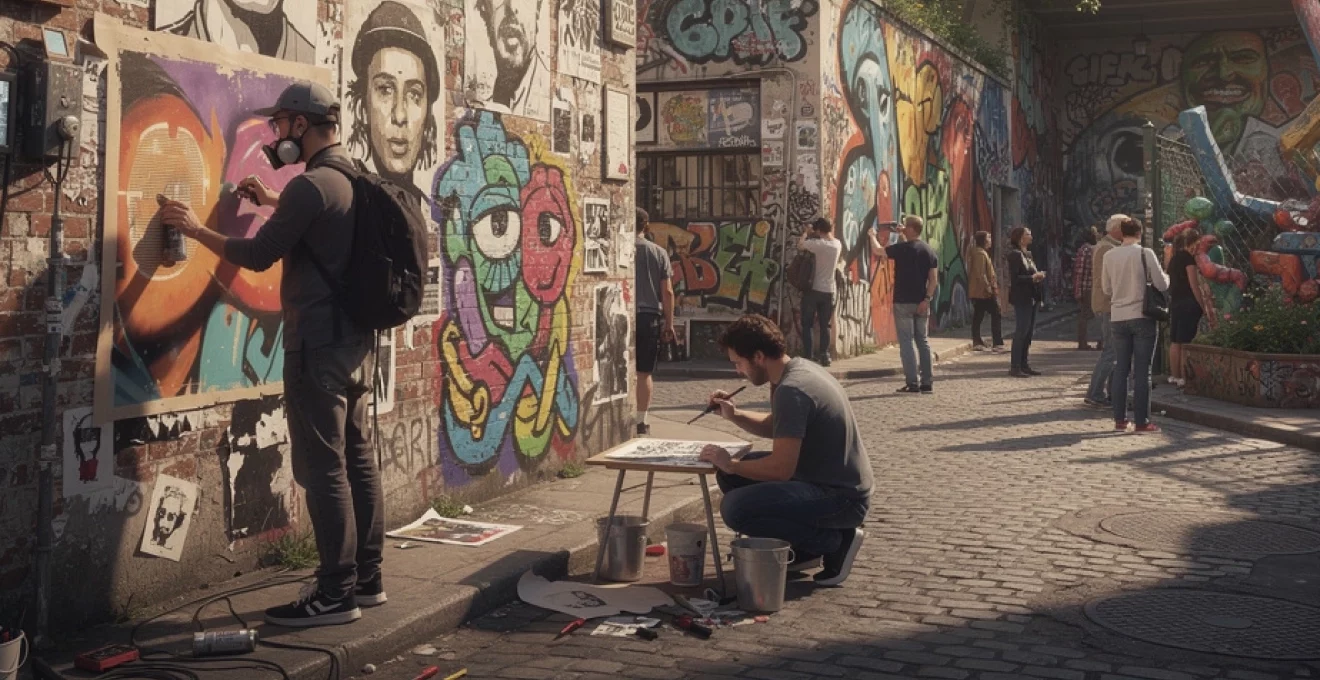
Nestled in the northeastern quarters of Paris, Belleville stands as a testament to the transformative power of urban art. This multicultural neighbourhood, spanning across the 10th, 11th, 19th, and 20th arrondissements, has evolved from a working-class immigrant enclave into one of Europe’s most vibrant street art destinations. The district’s narrow cobblestone streets, weathered brick facades, and community spaces have become an open-air gallery where creativity flourishes without traditional boundaries. Artists from around the globe have found sanctuary in Belleville’s authentic atmosphere, creating a dynamic ecosystem where legal installations coexist with spontaneous expressions of urban rebellion.
The neighbourhood’s artistic renaissance reflects broader societal shifts within contemporary Paris. As gentrification pressures mount throughout the capital, Belleville maintains its role as a cultural sanctuary where artistic expression serves both as community voice and economic catalyst. The walls tell stories of migration, identity, and social transformation through layers of paint, paste, and pixel art that continuously evolve with each passing season.
Historical evolution of belleville’s street art scene from immigration quarters to creative hub
Belleville’s transformation from industrial suburb to artistic haven began in the 1860s when Baron Haussmann incorporated the former village into Paris proper. The annexation brought waves of rural French workers seeking employment in the expanding city, followed by successive immigrant communities throughout the 20th century. North African families arrived in the 1960s and 1970s, establishing the neighbourhood’s multicultural foundation that would later prove essential to its artistic identity.
The emergence of street art in Belleville coincided with broader urban art movements across Europe during the 1980s. However, unlike the heavily policed central arrondissements, Belleville’s peripheral location and working-class demographics created a more permissive environment for artistic experimentation. Local authorities, recognising the neighbourhood’s economic challenges, adopted a pragmatic approach to unauthorized art, viewing it as a potential tool for urban regeneration rather than mere vandalism.
By the late 1990s, pioneering artists had begun establishing informal studios in abandoned industrial spaces throughout the district. These early adopters, many of whom were immigrants or children of immigrants, used street art as a means of cultural expression and social commentary. Their work addressed themes of displacement, identity, and belonging that resonated deeply with local communities experiencing similar struggles.
The neighbourhood’s artistic reputation solidified during the 2000s as property developers and municipal planners recognised street art’s potential to attract cultural tourism and stimulate local economies. This period witnessed the establishment of legal graffiti zones and the first official street art festivals, marking Belleville’s transition from underground art scene to recognised cultural destination.
Renowned street artists and collectives shaping belleville’s urban landscape
The artistic landscape of Belleville reflects contributions from both internationally acclaimed artists and emerging local talents who have collectively transformed the neighbourhood into a living gallery. These creators represent diverse backgrounds, techniques, and philosophical approaches to urban art, yet they share a common commitment to authentic community engagement and artistic innovation.
C215’s stencil portraits and social commentary throughout rue dénoyez
Christian Guémy, known professionally as C215, has established himself as one of Belleville’s most recognisable artistic voices through his intricate stencil portraits that celebrate the neighbourhood’s diverse population. His work predominantly features elderly residents, immigrants, and children rendered with remarkable technical precision and emotional depth. C215’s portraits serve as visual testimonies to Belleville’s multicultural heritage, elevating everyday community members to the status of public monuments.
The artist’s methodology involves extensive community engagement, spending weeks in conversation with potential subjects before creating their portraits. This approach ensures that his work reflects authentic community narratives rather than external perceptions of neighbourhood identity. His stencils, typically executed using between fifteen and twenty-five separate layers, demonstrate technical mastery that rivals traditional portraiture while maintaining the immediacy and accessibility that defines street art.
Invader’s pixel art mosaic installations along boulevard de belleville
The anonymous artist known as Invader has contributed significantly to Belleville’s artistic reputation through strategically placed ceramic tile installations that reference classic video game imagery.
These pixelated characters often appear high on building corners or tucked above street signs, rewarding those who constantly scan the urban skyline. Along Boulevard de Belleville and the surrounding streets, Invader’s mosaics punctuate everyday architecture with flashes of colour and nostalgia. For many visitors, hunting for these pieces becomes a kind of urban treasure hunt, turning a simple walk through Belleville into an interactive game. The artist’s systematic approach – each piece is catalogued and “scored” – has even inspired dedicated apps and fan communities, adding a playful digital layer to the neighbourhood’s physical street art.
Beyond their visual charm, Invader’s works open a conversation about how we inhabit cities and interact with digital culture. By bringing pixel art into the streets, he blurs the boundaries between virtual and physical worlds, a theme that resonates strongly in a hyper-connected district like Belleville. For urban art enthusiasts, spotting one of his mosaics along Boulevard de Belleville or near Métro stations like Belleville and Ménilmontant is often a highlight of any street art tour.
Local collective works by 9ème concept and belleville crew
While international names draw global attention, local collectives such as 9ème Concept and various Belleville crews have been instrumental in shaping the district’s visual identity. Founded in the 1990s, 9ème Concept brings together painters, illustrators, and graffiti artists who collaborate on large-scale murals, design projects, and cultural events. Their collaborative walls in Belleville often combine typography, figurative elements, and abstract patterns, creating dense visual tapestries that reward close inspection.
Local Belleville crews, sometimes less publicised but equally influential, use collective murals to claim space and assert neighbourhood identity. Their works frequently appear on side streets off Rue de Belleville or near Rue des Cascades, where entire facades become joint canvases. These collaborations function almost like neighbourhood conversations: styles overlap, characters interact, and new layers respond to older ones. When you walk through these streets, you are essentially reading an ongoing visual dialogue between generations of artists.
Collective projects also play a social role, especially in a neighbourhood facing rapid gentrification. Workshops with local youth, community painting days, and participatory murals help foster a sense of ownership over public space. For visitors, recognising the signatures or recurring motifs of these crews adds another layer of understanding to Belleville’s urban landscape, beyond the big international names.
International artists’ contributions during belleville street art festival
Periodic street art festivals and curated events have turned Belleville into a magnet for international artists seeking new walls and audiences. During these gatherings, artists from Europe, Latin America, North Africa, and Asia converge on the neighbourhood to create site-specific works. Murals produced during such events often occupy prominent facades along Boulevard de Belleville, Rue Oberkampf, and the slopes leading up to Parc de Belleville, temporarily transforming the area into a dense concentration of fresh pieces.
These festivals function as cultural exchanges, where techniques, themes, and visual languages cross borders as easily as the artists themselves. It is not uncommon to see a Brazilian artist’s vibrant, tropical colour palette sharing a wall with the monochrome realism of a Northern European painter. The result is an evolving outdoor museum of global street art styles, accessible free of charge to anyone willing to walk a few extra blocks from central Paris.
For travellers interested in planning a street art tour in Belleville, checking festival schedules or recent event maps can be a strategic move. Fresh murals often attract photographers, bloggers, and local residents, creating a lively atmosphere around newly painted walls. Even outside official festival dates, the legacy of past editions remains visible, as many large-scale works become temporary landmarks in the urban landscape until they are eventually replaced.
Technical analysis of dominant street art techniques in belleville’s urban environment
The richness of Belleville’s urban creativity lies not only in its themes but also in the technical diversity of its street art. Walking through the neighbourhood, you will encounter everything from quick marker tags to complex multi-storey murals created with cranes and projectors. Understanding the main techniques used – wheat paste, aerosol, stencils, and mixed media – can dramatically change the way you read these walls. Instead of seeing “just” a colourful surface, you start to perceive the planning, labour, and experimentation behind each piece.
For many visitors, this technical lens turns Belleville into an open-air classroom of contemporary urban art. You might ask yourself: how does a paste-up survive a rainy Paris winter, or how do artists achieve flawless gradients on rough stone? By paying attention to drips, layers, and textures, you can often deduce the tools and methods behind the work. This section unpacks the dominant techniques you are likely to encounter, offering practical insights you can use on your next self-guided walk.
Wheat paste application methods on brick and concrete surfaces
Wheat paste – a simple adhesive made from flour, water, and sometimes sugar or glue – is one of the most common techniques in Belleville, especially around Rue Denoyez and side streets like Rue des Envierges. Artists print or hand-paint their designs on paper, then apply them to walls using large brushes and buckets of paste. On old brick and porous stone, the mixture seeps into micro-cracks, creating a surprisingly durable bond. Many of the intricate black-and-white illustrations you’ll notice near cafés and doorways began life in an artist’s studio as fragile sheets of paper.
However, Belleville’s climate – with its rain, temperature swings, and pollution – poses real challenges for wheat paste art. To improve longevity, some artists print on heavier, slightly coated paper or add wood glue to the paste for extra strength. Others embrace impermanence, viewing tearing, peeling, and weathering as part of the artwork’s life cycle. Much like leaves decomposing in a forest, paste-ups decay, revealing older layers beneath and encouraging new artists to reclaim the space.
If you are experimenting with wheat paste yourself, choosing the right surface is crucial. Rough concrete and unpainted brick generally hold paste-ups better than glossy paint or metal shutters. Applying a generous first coat of paste on the wall, then another over the paper, helps eliminate air bubbles and ensures good adhesion. As you explore Belleville, look closely at the edges of posters and collages – you can often see brush strokes, overlapping layers, and even fingerprints from late-night installation sessions.
Aerosol spray painting techniques for large-scale murals
Aerosol spray paint remains the backbone of large-scale murals in Belleville, particularly on expansive facades along Rue de Ménilmontant and Boulevard de Belleville. Professional muralists typically work with a wide range of caps – interchangeable nozzles that control the width and softness of the spray. Fat caps allow for rapid background fills, while skinny caps create razor-sharp lines and delicate details. On a sunny day, you might even witness artists testing caps on a scrap of cardboard at the base of a wall before moving higher up on scaffolding.
Creating smooth gradients and realistic shading on rough urban surfaces is a technical art in itself. Many Belleville muralists build their compositions in layers, starting with loose sketch lines, then blocking in colours, and finally adding highlights and shadows. To correct mistakes, they often paint over sections with the background colour and rework details, a process that can leave subtle “ghosts” visible up close. From a distance, a multi-storey mural may look almost airbrushed; step closer and you will see overlapping strokes and directional sprays that reveal the artist’s hand.
Another advanced technique common in Belleville is the use of grids or digital projections to scale up designs. Artists may sketch on a tablet, print a small version, and then recreate it on the wall using a numbered grid system. Others project the image at night and trace outlines directly. For anyone studying urban creativity, recognising these methods helps demystify how such precise, complex images end up on surfaces several storeys high.
Stencil cutting precision for multi-layer compositions
Stencilling is one of Belleville’s signature street art techniques, visible from C215’s portraits to smaller anonymous works scattered around doorways and electrical boxes. At its most basic, a stencil is a single sheet cut with a design and sprayed in one colour. Yet many of the most impressive stencil pieces in Belleville rely on multi-layer compositions, where each layer represents a different colour or shade. When perfectly aligned, these layers produce surprisingly detailed images with rich depth and texture.
Creating such stencils requires meticulous planning and patience. Artists often start with a photograph, convert it to high-contrast layers using graphic software, then print and transfer each layer to sturdy materials like acetate, mylar, or thick cardstock. The cutting itself demands precision: one slip of the blade can ruin hours of preparation. To ensure accurate registration on the wall, some artists add small alignment marks or use low-tack tape to keep layers in place during spraying.
As you walk through Belleville, pay attention to the sharpness of edges and the subtle overlaps of colour within stencil works. Can you spot where one layer ends and another begins? In areas like Rue Denoyez or near Métro Belleville, you may find walls hosting dozens of stencilled images, stacked and layered over months or years. These surfaces function almost like collaborative screens, where each artist adds a new frame to an ongoing animated film.
Mixed media integration with found objects and digital elements
Belleville’s most experimental artists frequently push beyond paint and paper, incorporating found objects, sculptural additions, and even digital elements into their work. You might encounter small ceramic faces emerging from cracks in walls, wooden cut-outs bolted to façades, or three-dimensional lettering constructed from reclaimed metal. These interventions turn flat murals into hybrid artworks that blur the line between street art, sculpture, and installation.
Found-object pieces often reflect the neighbourhood’s everyday life: broken tiles from nearby renovations, discarded toys from local markets, or obsolete electronics embedded into compositions. In some cases, QR codes or augmented reality markers are discreetly integrated into murals, allowing viewers to scan them with a smartphone and unlock hidden animations, soundtracks, or artist interviews. Belleville thus becomes not only a visual but also a multimedia experience, especially for tech-savvy visitors.
For creators interested in experimenting with mixed media, Belleville offers a kind of open laboratory. The key challenge is durability: how do you ensure that a fragile object survives rain, frost, and the occasional collision with a delivery cart? Many artists use robust adhesives, concealed screws, or metal brackets to secure pieces. When you spot a three-dimensional work, examine how it is attached and how the paint integrates with the object – these details reveal a lot about the artist’s craftsmanship and long-term vision.
Geographical mapping of key street art locations and commissioned wall spaces
Understanding Belleville’s geography is essential if you want to make the most of its street art. Rather than a single compact cluster, the neighbourhood’s artworks are spread across a network of streets, alleys, staircases, and courtyards. Each micro-zone has its own character: some function as legal or semi-legal playgrounds where pieces change weekly, while others host long-standing commissioned murals that have become part of the local identity. Mapping these spaces can turn your visit into a structured exploration rather than a random wander.
Think of Belleville as a series of overlapping circuits that you can combine depending on your time and interests. One route might focus on Rue Denoyez and adjacent streets for dense, ever-changing graffiti. Another could climb towards Parc de Belleville for panoramic views and large murals. A third might dive underground into Métro stations for officially commissioned works. The following subsections outline the key areas to include in your personal Belleville street art map.
Rue dénoyez’s authorised graffiti zone and rotating artist displays
Rue Dénoyez remains the beating heart of street art in Belleville. This narrow, cobbled lane near Métro Belleville has long been recognised as an authorised graffiti zone, meaning artists can paint here with relative freedom. Almost every surface – walls, shutters, flowerpots, even pipes – is covered in layers of tags, characters, and large-scale pieces. Because new works appear constantly, the street looks different from one month to the next, making it a must-see stop on any return visit.
The rotating nature of Rue Dénoyez’s displays creates a unique tension between creation and disappearance. A mural that dominates the street one week might be partially covered the next, replaced by another artist’s vision. For photographers and content creators, this constant renewal offers endless material but also demands quick reactions: if you see a piece you love, capture it before it vanishes. Early mornings, especially on weekends, are ideal times to explore, as shutters are down and foot traffic is lighter.
Although the street has faced redevelopment pressures and partial demolition in recent years, local associations and residents have fought to preserve its creative spirit. When you visit, take a moment to look beyond the most obvious pieces: smaller stickers, miniature sculptures, and poetic paste-ups often hide at eye level or just above. Rue Dénoyez is not just a wall of colour; it is a layered archive of the neighbourhood’s artistic memory.
Villa castel’s hidden courtyard murals and access points
In contrast to the high-traffic energy of Rue Dénoyez, Villa Castel offers a more intimate, almost secretive street art experience. This small residential passage, located off Rue des Pyrénées and not far from Rue de l’Ermitage, hides a series of courtyard walls that have gradually become canvases for local artists. Access can be slightly confusing at first – entrances may look like private gateways – but during the day, many remain open, inviting curious passersby to peek inside.
Murals in Villa Castel tend to be more figurative and narrative, often referencing everyday life, childhood memories, or dreamlike scenes. Because the space is semi-enclosed, works here usually last longer than those on busy main roads, giving artists the confidence to invest more time in details and complex compositions. You might find delicate characters, surreal animals, or lyrical typography winding along the walls, set against potted plants and laundry lines.
When exploring hidden spots like Villa Castel, it is important to remain respectful of residents’ privacy. Keep noise levels low, avoid photographing inside windows or private gardens, and remember that you are walking through someone’s home environment. In return, you gain access to one of Belleville’s most atmospheric micro-galleries, where street art and domestic life quietly coexist.
Parc de belleville’s sculptural street art installations
Perched on one of Paris’s hills, Parc de Belleville is best known for its sweeping view of the city skyline. Yet for street art enthusiasts, the park and its surrounding slopes also offer a different kind of creative encounter. While you will see painted works on staircases and walls leading up to the park, inside the green space itself you will occasionally come across sculptural installations, playful interventions, and design-oriented urban furniture that echo the spirit of street art.
These pieces might take the form of abstract metal structures, colourful seating, or integrated artworks that blur the line between sculpture and playground. Unlike the more rogue interventions on nearby streets, many of these installations are commissioned or approved by the city, reflecting a growing acceptance of urban creativity within official urban planning. They contribute to making Parc de Belleville feel like an outdoor cultural space rather than just a recreational area.
For visitors, the park offers an excellent break during a long street art walk. You can climb up from Rue des Envierges or Rue Piat, stopping to observe murals on the way, then rest on the terraces while scanning nearby buildings for additional pieces. As you sit facing the panorama of Paris, it becomes clear how Belleville’s creative energy fits into the broader fabric of the city.
Métro belleville station’s commissioned underground art corridor
Belleville’s creativity is not confined to the surface; it extends underground into the Métro network. Métro Belleville, served by lines 2 and 11, features commissioned artworks and decorative interventions that echo the neighbourhood’s vibrant street art scene. While the station retains the classic white tiles of the Paris Métro, selected corridors and platforms host murals, mosaics, or graphic designs created in partnership with artists and cultural institutions.
These underground pieces serve several functions. Aesthetically, they break the monotony of daily commutes, bringing colour and narrative into otherwise utilitarian spaces. Symbolically, they acknowledge the artistic importance of the district, turning the station into a gateway to Belleville’s open-air gallery. For tourists arriving by Métro to begin a Belleville street art tour, the station itself becomes the prologue to the experience above ground.
When you pass through Métro Belleville, take a few extra minutes to walk the full length of the platforms and connecting tunnels. Look for panels detailing the history of the area, graphic motifs referencing migration and music, or contemporary design elements that subtly transform the atmosphere. In many ways, these works represent a meeting point between grassroots street art and institutional recognition.
Cultural impact assessment of street art on belleville’s gentrification process
Street art in Belleville is not just decoration; it plays a complex role in the neighbourhood’s social and economic transformation. On one hand, murals and creative projects have helped challenge negative stereotypes about the area, attract visitors, and support local businesses such as cafés, galleries, and independent boutiques. On the other hand, the very success of Belleville as a cultural hotspot has contributed to rising rents and increased interest from real estate developers, putting pressure on the communities that made the district interesting in the first place.
This dynamic raises an important question: is street art a tool for resistance, or does it inadvertently fuel the very gentrification it often criticises? The answer, as always, is nuanced. Many local artists use walls to highlight issues such as housing insecurity, migration, and social inequality, giving voice to residents who might otherwise be unheard. At the same time, curated tours and Instagram-friendly murals can turn these same streets into commodities, marketed to tourists and investors as signs of a “cool” up-and-coming neighbourhood.
From a cultural perspective, Belleville functions as a laboratory where these tensions are negotiated in real time. Community-led projects, such as participatory murals or workshops for local youth, attempt to ensure that the benefits of street art – visibility, pride, creative opportunities – are shared among long-standing residents. Some collectives collaborate with social housing associations or neighbourhood councils to secure wall spaces that remain accessible rather than being reserved for high-profile commissions.
For visitors, being aware of this context can shape more responsible ways of engaging with the area. Supporting local businesses, choosing tours that employ neighbourhood artists, and treating residential streets with respect are simple but meaningful actions. When you admire a mural of a Belleville resident or read a politically charged slogan on a wall, you are not only appreciating an aesthetic object but also entering a conversation about who gets to live, work, and create in the city.
Legal framework and municipal policies governing street art expression in belleville
The presence of street art on nearly every corner of Belleville might suggest a completely free-for-all environment, but in reality, it operates within a complex legal and policy framework. Under French law, unauthorised painting or marking of public and private property is technically considered vandalism and can lead to fines or legal action. However, enforcement varies widely, and in districts like Belleville, authorities have increasingly adopted a more flexible, context-sensitive approach, distinguishing between destructive tagging and high-quality murals that contribute to the urban landscape.
Over the last two decades, the City of Paris and the 20th arrondissement’s town hall have experimented with several strategies to balance control and creativity. These include designating legal graffiti zones such as sections of Rue Denoyez, issuing temporary permits for large-scale murals, and collaborating with cultural associations to curate walls on public buildings. In some cases, building owners actively invite artists to paint façades, signing agreements that clarify responsibilities for maintenance and potential repainting.
Municipal policies also intersect with broader cultural initiatives. Paris has supported festivals, artist residencies, and educational programs that promote street art as a legitimate form of contemporary creation rather than a marginal subculture. This institutional recognition has opened doors for many Belleville artists to exhibit in galleries, participate in international projects, or receive commissions for public works. At the same time, it raises questions about co-option: what happens to the rebellious spirit of street art when it becomes part of official cultural policy?
For artists working in Belleville today, navigating this legal landscape involves strategic choices. Some prefer to operate entirely within legal or semi-legal frameworks, focusing on commissioned walls and authorised zones. Others continue to paint clandestinely, accepting the risks in exchange for full creative freedom and the thrill of unsanctioned expression. Visitors should keep in mind that not all visible works are officially approved, and refrain from interfering with artists at work unless invited to interact.
Looking ahead, the evolution of municipal policies will likely play a decisive role in Belleville’s urban creativity. As real estate values rise and redevelopment projects advance, debates about which walls are preserved, who decides what gets painted, and how much spontaneity is tolerated will intensify. For now, the neighbourhood remains one of Paris’s most compelling examples of how law, policy, and grassroots culture can coexist in a fragile but fertile balance.