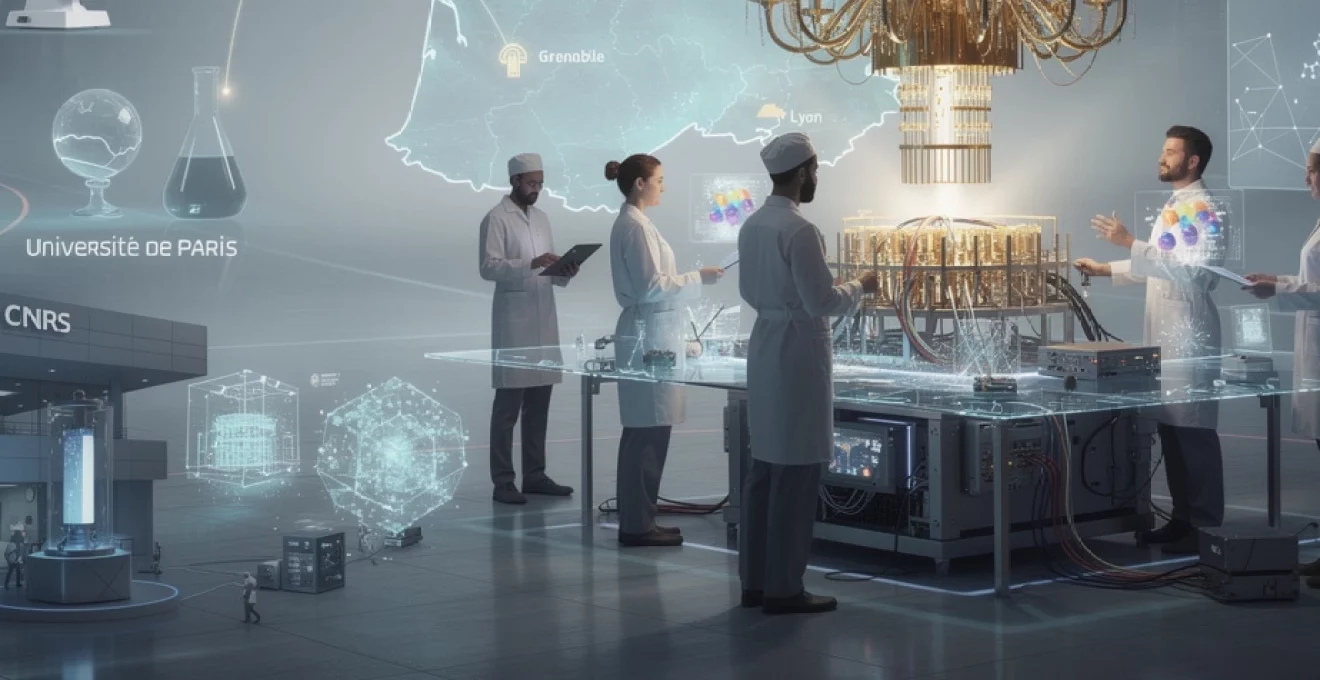
France stands at the forefront of a quantum revolution that promises to reshape computing as we know it. With its rich scientific heritage and ambitious national strategy, the country has positioned itself as a major player in the global race to harness quantum mechanics for computational breakthroughs. The convergence of cutting-edge research institutions, innovative startups, and substantial government investment has created a thriving ecosystem that challenges traditional computing paradigms.
The quantum computing landscape in France represents a fascinating intersection of theoretical physics and practical engineering challenges. From the laboratories of prestigious institutions like CNRS to the industrial applications being developed by companies such as Atos and Thales, French quantum initiatives are tackling some of the most complex problems in modern science and technology. This technological frontier offers unprecedented opportunities for solving computational challenges that have long remained beyond the reach of classical computers.
French quantum computing research ecosystem: leading institutions and programmes
The French quantum research ecosystem operates through a sophisticated network of interconnected institutions, each contributing unique expertise to the national quantum effort. This collaborative approach has proven particularly effective in addressing the multidisciplinary nature of quantum computing, which requires expertise spanning physics, engineering, computer science, and materials research. The integration of fundamental research with applied development has become a hallmark of the French approach to quantum innovation.
France’s quantum research infrastructure benefits from decades of investment in fundamental physics research, providing a solid foundation for quantum technology development. The country’s commitment to long-term scientific research has cultivated a generation of researchers who are now leading quantum breakthroughs. Research excellence in quantum optics, atomic physics, and quantum information theory has positioned French institutions as world leaders in several quantum computing approaches.
Cea-leti quantum technologies division and silicon spin qubit development
The Commissariat à l’énergie atomique et aux énergies alternatives (CEA) through its Leti division has emerged as a powerhouse in silicon-based quantum computing research. Their work on silicon spin qubits represents a particularly promising approach that could leverage existing semiconductor manufacturing infrastructure. This research direction offers significant advantages in terms of scalability and integration with classical electronics, making it highly attractive for commercial quantum computing applications.
CEA-Leti’s quantum research programme focuses on developing quantum processors that can operate at higher temperatures than many competing technologies. Their silicon spin qubit platform has achieved remarkable coherence times and fidelity rates, bringing practical quantum computing applications closer to reality. The division’s expertise in semiconductor fabrication provides a unique advantage in creating the precise nanostructures required for quantum devices.
CNRS quantum information networks laboratory Paris-Saclay
The Centre National de la Recherche Scientifique (CNRS) operates several quantum research laboratories, with the Paris-Saclay site serving as a central hub for quantum information networks research. Professor Romain Alléaume’s work on the European Quantum Communication Infrastructure project exemplifies the laboratory’s commitment to developing secure quantum communication systems. These efforts are crucial for protecting sensitive data and communications in an era of increasing cyber threats.
The laboratory’s research encompasses quantum cryptography, quantum key distribution, and the development of quantum internet protocols. Their work on scaling quantum networks from laboratory demonstrations to real-world deployments has achieved significant milestones, including quantum communication links spanning hundreds of kilometres. This practical approach to quantum research ensures that theoretical breakthroughs translate into tangible technological benefits.
Université de paris quantum optics research at laboratoire kastler brossel
The Laboratoire Kastler Brossel at Université de Paris has established itself as a world-renowned centre for quantum optics research. Their work on photonic quantum computing and quantum sensing applications has contributed fundamental insights into quantum mechanics while developing practical quantum technologies. The laboratory’s research spans from basic quantum phenomena to advanced quantum computing architectures.
Recent developments at the laboratory include breakthrough work on quantum error correction and the development of hybrid quantum systems that combine different quantum technologies. Their photonic quantum computing platform offers unique advantages for certain types of quantum algorithms, particularly those involving quantum simulation and optimisation problems. The integration of theoretical research with experimental validation has made this laboratory a key contributor to France’s quantum computing capabilities.
École normale sup
École normale supérieure lyon cold atom quantum computing projects
At École Normale Supérieure (ENS) de Lyon, cold atom quantum computing projects are pushing the boundaries of how we can control and manipulate matter at ultra-low temperatures. By using lasers and magnetic fields to cool atoms to near absolute zero, researchers can trap and arrange them in highly ordered arrays that behave as programmable quantum systems. This approach is particularly well suited to quantum simulation, where complex materials and quantum phases of matter can be emulated in a controlled environment.
ENS Lyon teams are working on arrays of neutral atoms that can act as qubits, exploring how to scale from tens to hundreds or even thousands of controllable atomic sites. The challenge is similar to building with microscopic Lego bricks: every atom must be precisely positioned and individually addressed without disturbing its neighbours. These experiments contribute to a better understanding of decoherence, error rates, and the trade-offs between coherence time and qubit connectivity. As their work matures, cold atom platforms developed in Lyon are expected to feed directly into industrial efforts led by French quantum startups.
Inria quantum software engineering initiative and algorithm optimisation
While hardware often attracts the spotlight, Inria plays a crucial role on the software side of the French quantum computing ecosystem. Through dedicated teams and programmes such as Quantum@Inria, the institute focuses on quantum software engineering, compilation techniques, and algorithm optimisation. Their objective is to bridge the gap between abstract quantum algorithms and the noisy, resource-constrained quantum processors we can actually build today.
Inria researchers develop tools for quantum programming languages, automatic circuit optimisation, and hybrid quantum–classical workflows. Much like a compiler optimises classical code for a specific processor, these tools seek to minimise the number of quantum gates, reduce circuit depth, and adapt algorithms to particular qubit topologies. This is essential for near-term quantum computers, where every gate saved can dramatically improve the probability of a successful computation. Through collaborations with industry and European projects, Inria helps ensure that French quantum hardware is supported by a mature and efficient software stack.
Industrial quantum computing applications across french sectors
French industry has not remained on the sidelines of this technological shift. Large groups in finance, energy, defence, and aerospace are actively exploring how quantum computing can give them a competitive edge. Most current projects are based on so-called noisy intermediate-scale quantum (NISQ) devices or on high-performance quantum simulators, but they already provide a valuable testbed for new workflows and business use cases. By experimenting early, French companies aim to be ready for the moment when fault-tolerant quantum computers become commercially viable.
These industrial initiatives often rely on hybrid architectures, where classical high-performance computing is combined with specialised quantum hardware or emulators. This hybridisation mirrors what we have seen with GPUs and AI accelerators over the last decade. It allows companies to start integrating quantum routines into existing pipelines for optimisation, risk analysis, or materials discovery. For you as a practitioner or decision-maker, understanding these early deployments can help identify where quantum computing might eventually fit in your own sector.
Atos quantum learning machine integration in financial modelling
Atos has positioned itself as a European leader by providing the Atos Quantum Learning Machine (QLM), a powerful quantum simulator designed for algorithm development and benchmarking. In the financial sector, QLM is used to prototype quantum algorithms for portfolio optimisation, risk assessment, and derivative pricing. Rather than waiting for large-scale hardware, banks and insurance companies can already test how quantum-inspired methods perform on real-world financial data.
One concrete use case involves rewriting complex Monte Carlo simulations as quantum algorithms that, in theory, could achieve a quadratic speedup. Using QLM, quants can estimate the number of qubits and gate operations required, evaluate algorithm robustness, and refine their models. This is a bit like using a flight simulator before building the actual aircraft: you can test scenarios, train teams, and avoid costly mistakes. As Atos integrates QLM with classical HPC resources, financial institutions can gradually build hybrid workflows where quantum routines complement traditional numerical methods.
Thales quantum key distribution systems for defence communications
In the defence and critical infrastructure sectors, Thales has become a key player by developing quantum key distribution (QKD) systems. QKD exploits the properties of quantum mechanics to distribute encryption keys in a way that makes any eavesdropping attempt physically detectable. For military communications and governmental networks carrying classified information, this offers a security level that is fundamentally different from classical cryptography based solely on mathematical hardness assumptions.
Thales collaborates closely with research laboratories such as CNRS and Télécom Paris on both fibre-based and free-space QKD links. Pilot projects connect secure sites over tens to hundreds of kilometres, often integrated into existing optical networks. As part of larger initiatives like the European Quantum Communication Infrastructure, these systems are being designed to interoperate across borders and with satellite-based nodes. For organisations concerned with long-term data confidentiality, QKD is emerging as an early, concrete application of quantum technologies in France.
Total energies quantum chemistry simulations for molecular discovery
TotalEnergies is exploring quantum computing to enhance its capabilities in quantum chemistry and materials discovery. Many phenomena in catalysis, battery materials, and CO₂ capture are governed by complex quantum interactions between electrons, which are notoriously difficult to simulate accurately on classical supercomputers. Quantum algorithms for chemistry promise to model these systems more precisely, potentially accelerating the discovery of more efficient catalysts or high-performance materials.
In practice, TotalEnergies works with academic partners and quantum hardware providers to run small-scale instances of variational quantum eigensolver (VQE) algorithms on today’s devices and simulators. These proof-of-concept studies help identify which classes of molecular problems might see the earliest benefits from quantum computing. Think of it as using a prototype microscope that currently has a limited field of view but already reveals details that were previously blurred. Over time, as qubit numbers and quality improve, these workflows could translate into shorter R&D cycles and more targeted experimentation in the lab.
Airbus quantum computing applications in aerospace material sciences
Airbus, another major French-linked industrial player, is actively investigating how quantum computing can transform aerospace engineering. One promising area is aerospace material sciences, where quantum algorithms may enable the design of lighter, stronger, and more heat-resistant materials for aircraft and spacecraft. Even small gains in weight reduction can translate into significant savings in fuel consumption and emissions, aligning with broader decarbonisation goals.
Beyond materials, Airbus teams also explore quantum optimisation for flight routing, aircraft configuration, and maintenance scheduling. By framing these operational challenges as complex optimisation problems, quantum-inspired algorithms can sometimes offer better heuristics than conventional methods. In a sector where safety, reliability, and efficiency are paramount, such improvements are not merely theoretical. They could eventually influence how entire fleets are managed, from initial design to end-of-life operations, with quantum computing acting as a new optimisation engine in the background.
French quantum computing startups and commercial ventures
Alongside major industrial groups, a dynamic ecosystem of French quantum startups is taking shape. These young companies translate academic breakthroughs into market-ready products, often emerging from joint laboratories between universities and institutions like the CNRS. They cover the full spectrum of quantum technologies, from hardware platforms based on neutral atoms, trapped ions, and superconducting circuits to software, middleware, and cybersecurity solutions.
Pasqal, for example, develops quantum processors based on neutral atoms arranged in two- and three-dimensional arrays, a technology born at the Institut d’Optique and CNRS. The company has already opened an office in Sherbrooke, Quebec, illustrating the international pull of French expertise and the strength of France–Canada quantum collaborations. Other startups focus on quantum-safe cryptography, quantum sensing, or cloud-based access to quantum resources. For you as a potential user or investor, these ventures provide concrete entry points into quantum computing, often through proof-of-concept projects and pilot deployments.
Government investment strategies and national quantum plan implementation
France’s progress in quantum computing is underpinned by a robust and long-term public investment strategy. The national quantum plan announced in January 2021 earmarked around €1.8 billion over five years for quantum technologies, spanning computing, communications, sensing, and enabling technologies such as cryogenics and photonics. This plan complements broader recovery and innovation programmes, ensuring that quantum research and industrialisation are treated as strategic priorities.
Rather than scattering funds across isolated projects, the French approach emphasises coordinated programmes, shared infrastructures, and strong links between academia and industry. Flagship projects bring together universities, public research bodies like CEA and CNRS, and corporate partners. This structure aims to accelerate technology transfer while preserving France’s recognised strength in fundamental research. The question policymakers keep asking is simple yet crucial: how can we turn scientific excellence into sustainable economic and strategic advantage?
France relance quantum technologies funding allocation framework
The France Relance recovery plan, launched in response to the COVID-19 crisis, integrated quantum technologies as part of its innovation and industrial sovereignty agenda. Funding was allocated to reinforce key components of the quantum value chain, from chip fabrication and cryogenic equipment to software tools and demonstrator systems. This framework ensured that quantum projects did not remain confined to laboratories but moved towards pilot lines and early market offerings.
In practical terms, calls for projects encouraged consortia of startups, SMEs, and large industrial players to collaborate on targeted objectives. For example, some funding rounds focused on securing strategic components for quantum hardware, while others favoured applications in cybersecurity or high-performance computing. By tying financial support to clear milestones and collaborative structures, France Relance has helped de-risk private investment and build the industrial capabilities needed for future large-scale quantum deployments.
European quantum flagship programme french participation metrics
At the European level, France is a major contributor to the €1 billion Quantum Flagship programme, which spans a ten-year period. French teams coordinate or participate in a significant number of Flagship projects in areas such as quantum communication, computing, simulation, and metrology. Institutions like CNRS, CEA, Inria, and leading universities are deeply embedded in these European consortia, ensuring that French priorities are aligned with broader EU strategies.
This strong participation has several advantages. It provides French researchers and companies with access to cross-border networks, shared experimental platforms, and complementary expertise from partners in Germany, the Netherlands, Italy, and beyond. It also helps avoid duplication of effort and fosters standardisation in areas like quantum communication protocols and control software. For readers considering European collaborations, the Quantum Flagship framework is a powerful lever to scale joint projects and access additional funding streams.
Quantum computing infrastructure development through france 2030
The France 2030 investment plan further reinforces the country’s ambition to build world-class quantum infrastructure. Significant resources are devoted to establishing quantum testbeds, national computing facilities integrating quantum accelerators, and specialised fabrication capabilities. These infrastructures are designed not only for researchers but also for startups and industrial partners who need access to advanced equipment they could not finance alone.
For instance, France 2030 supports the deployment of quantum processors in high-performance computing centres, enabling hybrid workloads where classical supercomputers and quantum devices work side by side. It also funds pilot lines for advanced semiconductor processes tailored to spin qubits or superconducting circuits. By 2030, the goal is to have a mature, end-to-end ecosystem where designing, fabricating, programming, and operating quantum hardware can all be done within French and European borders, reducing dependency on external suppliers.
Public-private partnership models for quantum technology transfer
One of the distinctive features of the French quantum strategy is the emphasis on public–private partnerships (PPPs). Joint laboratories between CNRS or CEA and industrial partners serve as incubators where ideas can transition from academic publications to demonstrator systems and commercial products. These PPPs often involve shared governance, co-funded PhD positions, and joint intellectual property agreements that clarify how innovations will be valorised.
For startups and large firms alike, this model offers faster access to expertise and infrastructure, while researchers gain real-world constraints that sharpen their scientific questions. The France–Canada International Research Network on Quantum Science and Technology is a good example of how such collaborations can extend across borders, with shared supervision of doctoral students and coordinated workshops. If you are considering entering the quantum field, engaging with these PPP structures can dramatically shorten your learning curve and increase your chances of building impactful solutions.
Technical challenges and hardware development limitations
Despite impressive progress, quantum computing in France and worldwide still faces substantial technical challenges. Current devices are limited in qubit number, coherence time, and gate fidelity, which constrains the complexity of algorithms that can be run reliably. Error correction schemes, while theoretically well understood, require far more physical qubits than are available today, often by several orders of magnitude. As a result, practical, large-scale, fault-tolerant quantum computers remain a medium- to long-term objective.
Engineering challenges are equally daunting. Quantum processors typically operate at temperatures close to absolute zero, demanding sophisticated cryogenic systems and highly stable control electronics. Integrating thousands of control lines into a compact, scalable architecture is a bit like trying to wire a skyscraper with hair-thin cables while keeping every room at a different, extremely precise temperature. French teams at CEA-Leti, CNRS, and industry partners are working on advanced packaging, new materials, and control techniques to address these issues. For now, however, anyone exploring quantum computing should be aware that most near-term value will come from hybrid approaches and carefully chosen use cases rather than general-purpose replacements for classical computing.
International quantum computing collaboration networks and strategic partnerships
Quantum technologies evolve in a global landscape, and France has chosen to embrace international collaboration as a strategic asset rather than a risk. The CNRS-led French–Canadian International Research Network (IRN) on Quantum Science and Technology, officially launched in 2023, links sixteen universities across both countries. It builds on decades of successful cooperation, including the Quantum Frontiers Laboratory (LFQ) in Sherbrooke, an International Research Laboratory dedicated to quantum materials and circuits. These structures enable the exchange of researchers, co-supervised PhDs, and shared access to large-scale research infrastructures such as ESRF and the Soleil synchrotron.
Beyond Canada, France maintains strong ties with quantum communities in Japan, Singapore, China, Australia, and the United States, often through International Research Laboratories and joint projects. Within Europe, initiatives like the Quantum Flagship and the emerging European Quantum Communication Infrastructure provide a framework for coordinated action and interoperability. For young scientists and companies alike, these networks are invaluable: they open doors to complementary expertise, reduce duplication of effort, and create opportunities to test ideas on a much larger scale. As quantum computing moves from prototypes to deployed systems, such strategic partnerships will be crucial to ensure that French and European solutions remain competitive and interoperable in a rapidly evolving global market.