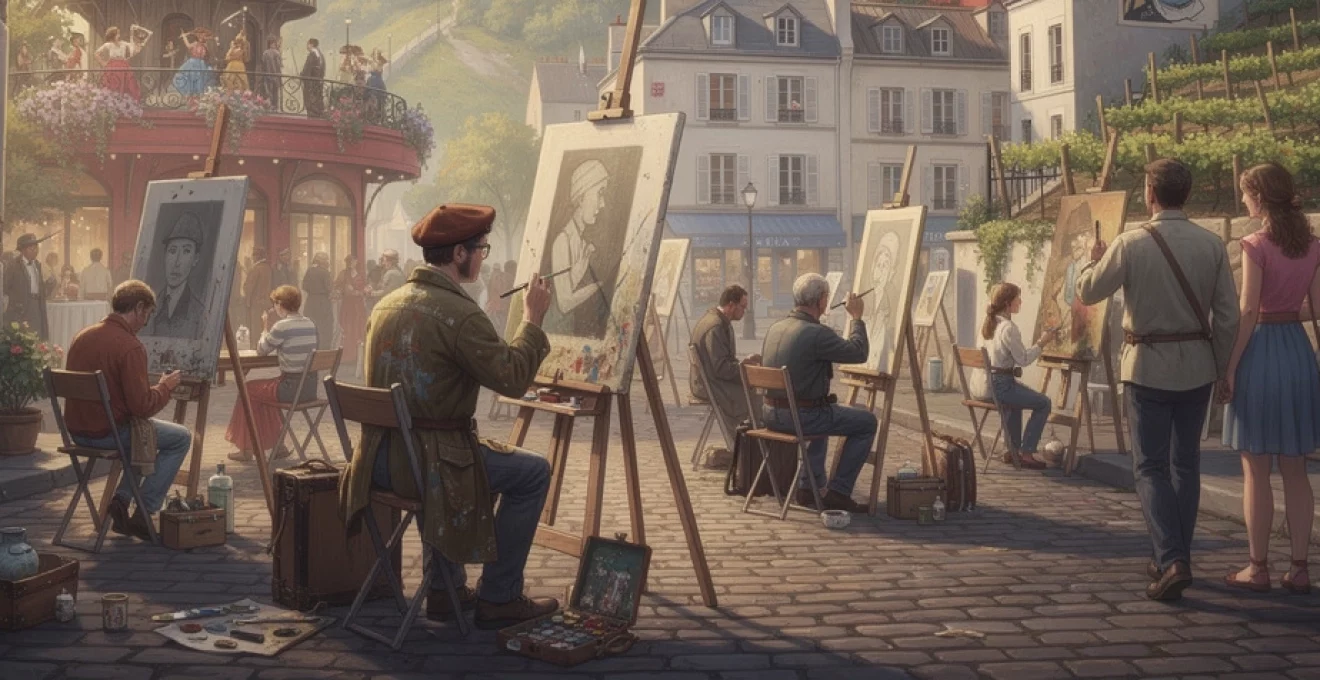
Montmartre stands as one of the most legendary artistic quarters in the world, a hillside neighbourhood in Paris where creativity and bohemian spirit converged to reshape the entire trajectory of modern art. Between the 1870s and 1920s, this cobblestoned district became the epicentre of revolutionary artistic movements that would define the twentieth century. The steep, winding streets and affordable studios attracted struggling painters from across Europe, creating an unprecedented concentration of creative genius. From Impressionism to Cubism, from the melancholic introspection of Picasso’s Blue Period to the daring fragmentation of form that would follow, Montmartre witnessed the birth of artistic revolutions that continue to influence contemporary visual culture. Today, you can still walk these same cobblestones, discovering the exact locations where masterpieces were conceived and artistic manifestos were born.
The Bateau-Lavoir studios: picasso’s rose period and the birth of cubism
The Bateau-Lavoir at 13 Rue Ravignan represented the beating heart of avant-garde artistic innovation in early twentieth-century Paris. This ramshackle wooden structure, whose name translates to “Laundry Boat” due to its resemblance to the Seine’s floating washhouses, housed an extraordinary concentration of artistic talent between 1904 and 1909. The building offered minimal comforts—a single water tap served all twelve studios, heating was virtually non-existent, and the structure creaked ominously in strong winds. Yet despite these hardships, the Bateau-Lavoir became synonymous with artistic breakthrough and radical experimentation. The thin walls between studios facilitated constant dialogue, critique, and collaboration among residents, creating an intellectual pressure cooker that accelerated artistic development at an unprecedented rate.
Picasso’s transition from blue period melancholy to rose period optimism at 13 rue ravignan
When Pablo Picasso moved into the Bateau-Lavoir in 1904, he was still painting in the melancholic blue tones that had characterised his work since the suicide of his friend Carles Casagemas in 1901. The sombre palette reflected not only grief but also the harsh realities of poverty that Picasso endured during his early Parisian years. His studio at the Bateau-Lavoir was perpetually cold, forcing him and his partner Fernande Olivier to layer clothing and huddle near a meagre wood-burning stove during winter months. Yet something transformative occurred within those walls. Gradually, warmer tones began infiltrating his palette—pinks, oranges, and earth tones that signalled an emotional thaw.
The Rose Period, which emerged between 1904 and 1906, marked Picasso’s growing emotional stability and his deepening relationship with Olivier. His subjects shifted from the hollow-cheeked beggars and prostitutes of the Blue Period to circus performers, acrobats, and harlequins. The magnificent Family of Saltimbanques (1905) epitomises this period, depicting itinerant performers in a desolate landscape with Picasso himself represented as the harlequin figure. The painting’s warm terracotta tones and the dignified bearing of its subjects reflect a newfound sympathy for humanity’s struggles, replacing the earlier work’s clinical detachment with tender observation. This evolution wasn’t merely aesthetic—it represented Picasso’s psychological journey from isolation toward community within Montmartre’s artistic brotherhood.
Georges braque’s collaborative cubist experiments in montmartre’s artist commune
Georges Braque’s arrival in Montmartre in 1907 catalysed one of art history’s most significant collaborations. Initially shocked by Picasso’s revolutionary Les Demoiselles d’Avignon—comparing the experience to “drinking petrol”—Braque soon recognised the painting’s radical potential. The two artists embarked on an intensive period of joint experimentation that would fundamentally transform how painting represented three-dimensional space on a two-dimensional surface. Their collaboration was so intimate that they later described themselves as “roped together like mountaineers,” jointly ascending toward unexplored aesthetic peaks.
<p
Working side by side in and around the Bateau-Lavoir, Picasso and Braque broke with centuries of perspective by analysing objects from multiple viewpoints at once. In early Cubist landscapes and still lifes painted in Montmartre, they reduced houses, guitars and café tables to interlocking planes, muted ochres and greys, and tightly packed compositions that feel almost architectural. If traditional painting was like looking through a window, early Cubism was more like holding an object in your hands and turning it slowly under the light. As you stand today on Place Émile-Goudeau, in front of the modest building that once housed these studios, it is hard to imagine that such a quiet square could have hosted one of the loudest revolutions in modern art.
Juan gris and the synthetic cubism movement within the bateau-lavoir collective
Among the younger artists drawn to this ferment was Juan Gris, who moved into a studio at the Bateau-Lavoir in 1906. While Picasso and Braque pioneered what art historians call Analytical Cubism—dissecting forms into a kaleidoscope of small facets—Gris became a leading figure of Synthetic Cubism, which emerged around 1912. Rather than breaking reality apart, he began to reassemble it, introducing clearer shapes, brighter colours and, crucially, fragments of real-world materials such as newspaper, wallpaper or printed labels into his canvases.
In works like Still Life with Checkered Tablecloth (1915), you can see how Gris fused painted illusion and actual collage elements into balanced, almost musical compositions. His precise geometry and refined sense of colour made his Cubist paintings more legible to the public than many of his contemporaries’ experiments. Walking through Montmartre today, imagine how radical it must have been to see a café table evoked not only with paint, but with real snippets of café menus and newsprint glued directly onto the canvas. Gris’s approach anticipated many later developments in modern art, from Dada photomontage to Pop Art’s embrace of mass media imagery.
For visitors interested in tracing this evolution on foot, the area around Place Émile-Goudeau and Rue Ravignan still offers a tangible link to these radical years. While the Bateau-Lavoir itself was rebuilt after a fire in 1970, the footprint of the square, the steep streets and the compressed urban views remain largely unchanged. As you climb the hill, the close-packed roofs and abrupt shifts of viewpoint echo the very Cubist cityscapes that Gris and his peers developed within these humble studios.
Amedeo modigliani’s portrait work and the bohemian life at place émile-goudeau
Amedeo Modigliani arrived in Paris in 1906 and soon gravitated to the Montmartre community clustered around Place Émile-Goudeau. Though he never fully embraced Cubism, his elongated portraits and nudes show how deeply he absorbed the period’s appetite for stylisation and simplification. Modigliani spent time in and around the Bateau-Lavoir, drinking in local cafés with Picasso, Utrillo and the poet Guillaume Apollinaire, and sketching constantly in charcoal before returning to his studio to refine the most promising studies in oil.
His characteristic portraits—with almond-shaped eyes, swan-like necks and mask-like faces—owe as much to African and Cycladic sculpture as to Renaissance painting. In Montmartre’s cramped studios, he experimented with reducing his sitters to essential lines and volumes, much like a sculptor carving a figure from a single block of stone. The neighbourhood’s mix of models, writers, fellow artists and café owners provided him with an endless supply of subjects, many of whom he portrayed repeatedly over the years.
Standing on Place Émile-Goudeau today, it is worth pausing to picture Modigliani crossing the square with his easel or sketchbook, perhaps slightly unsteady after a late night at the Lapin Agile. The quiet façades you see now once hid a whirlwind of parties, arguments and artistic rivalries. If you are planning an art history walking tour of Montmartre, this square offers a perfect spot to evoke the bohemian lifestyle that shaped Modigliani’s brief but intense career.
The moulin de la galette: renoir’s impressionist masterpiece and belle époque society
A short walk from the Bateau-Lavoir brings you to one of Montmartre’s most iconic sites: the Moulin de la Galette. Perched on the hill at the corner of Rue Lepic and Rue Girardon, this former windmill was transformed in the nineteenth century into a popular open-air dance hall. On Sunday afternoons, workers, artisans, shopgirls and the occasional bourgeois visitor would flock here to dance, drink cheap wine and enjoy the panoramic views over Paris. For painters drawn to modern life, the Moulin offered an ideal subject: sunlight filtering through chestnut trees, swirling skirts, straw hats, and a cross-section of Belle Époque society gathered in one lively, colourful scene.
Pierre-auguste renoir’s “bal du moulin de la galette” plein air technique
Pierre-Auguste Renoir’s Bal du Moulin de la Galette (1876) is perhaps the most famous painting associated with Montmartre. Executed largely en plein air, or outdoors, the canvas captures a typical Sunday afternoon dance with a shimmering play of light and colour. Renoir used quick, broken brushstrokes and a high-key palette to suggest dappled sunshine flickering across faces, dresses and tabletops. Rather than meticulously outlining each figure, he let contours dissolve into surrounding tones, producing a sense of movement and immediacy that was radical for its time.
When the painting was first exhibited, critics were divided. Some praised its modernity; others complained that the figures appeared unfinished or blurred. Yet what they were reacting to was precisely what makes Impressionist painting of Montmartre so compelling today: the attempt to fix on canvas the fleeting sensations of a specific moment. If you visit the current restaurant at the Moulin de la Galette, you can still stand roughly where Renoir positioned his easel. Look at how the sloping ground, the trees and the tightly packed tables compress the space; suddenly the complex composition of his painting begins to feel less like an invention and more like an accurate translation of what he saw.
For those interested in plein air painting techniques, this spot offers an instructive case study. Notice how the late afternoon light changes the colour of the stone walls and the leaves overhead. Try to imagine reducing these subtle shifts to a handful of decisive brushstrokes, as Renoir did, working quickly before the light moved on. In many respects, the Moulin de la Galette functioned as an open-air studio for him, just as it can for today’s visiting sketchers and photographers.
Vincent van gogh’s post-impressionist interpretations of the moulin gardens
A few years after Renoir, Vincent van Gogh arrived in Paris and took a room at 54 Rue Lepic, a short walk downhill from the Moulin de la Galette. Between 1886 and 1888, he produced several paintings of Montmartre’s windmills and gardens, filtering the same motifs through his increasingly personal, expressive style. In works such as Le Moulin de la Galette and Montmartre: Quarry and Windmills, van Gogh simplified forms and intensified colour contrasts, foreshadowing the highly charged canvases of his later Arles period.
While Renoir revelled in the social bustle of the dance floor, van Gogh often chose quieter vantage points, focusing on the windmill’s silhouette against the sky or the patchwork of vegetable gardens and quarries that still covered much of the hill. His thick, directional brushstrokes give the impression that the very air of Montmartre is in motion, whipping at the sails of the mill and rustling through the garden plots. In this way, he turned an everyday urban landscape into a vehicle for emotional expression, a hallmark of Post-Impressionist painting.
Today, as you climb Rue Lepic toward the surviving windmills, it is still possible to sense the semi-rural character that attracted van Gogh. Try looking past the cafés and souvenir shops to the underlying topography: the steep inclines, unexpected vistas and patches of greenery. If you bring reproductions of his Montmartre paintings with you, comparing them on-site can be a powerful way to see how he translated real streets and gardens into his distinctive pictorial language.
Henri de toulouse-lautrec’s cabaret lithography at nearby moulin rouge
Just below the hill, on Boulevard de Clichy, another venue was making Montmartre famous in a very different way: the Moulin Rouge. Opened in 1889, this exuberant cabaret with its red windmill façade quickly became the symbol of Parisian nightlife. No artist is more closely associated with the Moulin Rouge than Henri de Toulouse-Lautrec, who produced a series of lithographic posters and paintings that immortalised its dancers, singers and clientele. His bold, flat colours and cropped compositions were influenced by Japanese prints, yet his subject matter was unmistakably Montmartre.
Lautrec’s posters for the Moulin Rouge turned advertising into high art. Works like La Goulue at the Moulin Rouge and Jane Avril capture performers mid-kick or mid-turn, their silhouettes set against stark backgrounds and vivid typography. These printed works were plastered on walls throughout Paris, spreading the image of Montmartre as a place of daring entertainment and artistic experimentation. For visitors tracing Montmartre’s art history on foot, the present-day Moulin Rouge offers a chance to stand where Lautrec once sketched frenetically from a corner table, translating music, smoke and movement into lines and colour blocks.
If you are interested in printmaking or graphic design, Lautrec’s cabaret lithographs remain essential reference points. They demonstrate how an artist can condense the energy of a place into a few simplified shapes and colours—much like a logo captures the essence of a brand. Walking along Boulevard de Clichy, you might ask yourself: how would you reduce today’s neon signs, traffic lights and crowds into a similarly powerful visual shorthand?
Maurice utrillo’s white period architectural paintings of rue lepic
While Renoir, van Gogh and Lautrec focused on figures and nightlife, Maurice Utrillo turned his attention to the architecture of Montmartre itself. Born in the neighbourhood in 1883, possibly the son of Suzanne Valadon, Utrillo grew up surrounded by artists but struggled with alcoholism and mental illness. During his so-called “white period” (roughly 1909–1914), he created hauntingly beautiful views of Montmartre streets, often including the façades of humble houses, churches and cafés rendered in thick, chalky paint.
Rue Lepic appears repeatedly in Utrillo’s work, its steep slope and irregular buildings lending themselves to dramatic compositions. He frequently used a limited palette dominated by whites, greys and muted earth tones, evoking the effect of plastered walls catching diffuse light on an overcast day. Rather than celebrating bustling crowds, his paintings often show empty or sparsely populated streets, emphasising the quiet dignity of everyday architecture. This focus on vernacular buildings made Utrillo a key figure in the development of urban landscape painting in the early twentieth century.
As you walk up or down Rue Lepic today, you can still recognise the outlines of many scenes Utrillo painted. Pay attention to how the street curves, how staircases cut across it, and how façades step up the hill in uneven rhythms. For travellers interested in photography, trying to frame the street as Utrillo might have done—cropping out most of the sky, focusing instead on façades and pavements—can be an engaging way to connect with his particular vision of Montmartre.
Place du tertre: open-air atelier traditions and contemporary portrait artists
At the very top of Montmartre lies Place du Tertre, a small square that has long served as an open-air studio for painters. In the late nineteenth and early twentieth centuries, artists would bring their easels here to work from life, sketching fellow bohemians, tourists and the surrounding rooftops. Today, Place du Tertre is still filled with portraitists and caricaturists offering quick likenesses to passing visitors, maintaining a living link with Montmartre’s artistic past.
While some may find the square crowded or commercial, it remains a fascinating spot to observe how the tradition of portrait painting in Montmartre has evolved. You can see artists employing techniques that range from rapid, gestural sketches to highly polished, hyper-realistic renderings. In a sense, the square functions as an open-air survey of contemporary drawing styles, all condensed into a few dozen easels. If you are planning a walking tour of Montmartre’s artistic heritage, allowing some time simply to watch these painters at work—or even to sit for a portrait yourself—can be an engaging way to experience the neighbourhood’s enduring role as a creative laboratory.
From a historical perspective, Place du Tertre also invites reflection on how art and tourism intersect. Just as Renoir and Lautrec responded to the spectacle of leisure in their time, today’s Montmartre artists negotiate the expectations of a global public. How do you capture an individual face in a matter of minutes, while still conveying something of the sitter’s personality? Observing how different painters answer this question in real time can deepen your appreciation for portraiture as both craft and performance.
Sacré-cœur basilica: romano-byzantine architecture as artistic subject matter
Dominating the skyline above Place du Tertre, the Sacré-Cœur Basilica is one of Paris’s most recognisable landmarks and a frequent subject for painters of Montmartre. Built between 1875 and 1914 in a Romano-Byzantine style, the church’s gleaming white domes and arcades contrast sharply with the more modest houses that surround it. For artists, this contrast of scale and style, combined with the spectacular views over Paris from the basilica’s steps, has made Sacré-Cœur an irresistible motif.
Interestingly, the basilica’s history is closely entwined with the turbulent politics of the late nineteenth century. Erected partly as an act of penance after the Franco-Prussian War and the Paris Commune, it was controversial from the outset. Yet whatever one thinks of its symbolism, there is no denying that Sacré-Cœur has become a key component of Montmartre’s visual identity. Painters have responded to it in various ways: some emphasise its monumental presence; others integrate it gently into panoramic cityscapes, using it as a focal point on the horizon.
Maurice utrillo’s church façade studies and atmospheric perspective techniques
Among the many artists who depicted Sacré-Cœur, Maurice Utrillo stands out once again. During his white period and beyond, he painted the basilica from multiple angles, often focusing on its façade rising above nearby streets. In works such as La Basilique du Sacré-Cœur, Utrillo used his characteristic thick paint and muted palette to render the church’s limestone as a mass of softly modulated whites and greys. Rather than highlighting its decorative details, he treated the basilica as a solid, almost sculptural presence looming through atmospheric haze.
Utrillo’s handling of atmospheric perspective—the way distant forms appear lighter and less contrasted than those in the foreground—plays a key role in these compositions. By subtly fading the basilica into a pale sky while keeping foreground buildings and lampposts darker and more sharply defined, he conveyed both depth and the particular light of northern Paris. If you stand on the steps below Sacré-Cœur on a cloudy day, you can see exactly how this effect occurs in nature, as the city gradually dissolves into bluish-grey tones on the horizon.
For aspiring painters and photographers alike, Utrillo’s church studies offer useful lessons. Try observing how the colour of Sacré-Cœur changes with the time of day: warm in late afternoon, almost icy at noon, softly glowing under streetlights at night. Translating these shifts into your own images can help you move beyond postcard clichés toward a more personal interpretation of this much-depicted monument.
Suzanne valadon’s female gaze perspectives from rue cortot studios
Just a few steps from Sacré-Cœur, on Rue Cortot, you will find the former home and studio of Suzanne Valadon—model, muse and eventually accomplished painter in her own right. Valadon began her career posing for Renoir, Degas and Toulouse-Lautrec before turning to painting herself. Living and working in Montmartre, she brought a distinctly female gaze to subjects that her male contemporaries had often treated more voyeuristically: the female nude, domestic interiors and everyday working-class life.
From her Rue Cortot studio, Valadon painted vigorous, unapologetic nudes that emphasised strength and presence over idealised beauty. She also produced views of Montmartre streets and gardens that reveal a keen eye for pattern and structure. Unlike some of her peers who focused on nightlife or picturesque corners, Valadon was unafraid to depict the messiness of real life: unmade beds, washing lines, women at their toilette. Her vantage point as a woman who had herself been objectified as a model gave her a different relationship to her subjects, one that many contemporary viewers find refreshingly modern.
Standing outside the building on Rue Cortot today, you can imagine Valadon and her son Maurice Utrillo working in adjacent rooms, each shaping their own vision of Montmartre. For visitors interested in gender and art history, this address is a key stop on any walking tour of Montmartre’s artistic legacy. It invites us to ask: whose perspectives have been most celebrated in the neighbourhood’s mythology, and whose are only now receiving their due?
The musée de montmartre’s collection of plein air landscape studies
The former Valadon-Utrillo residence at 12–14 Rue Cortot now houses the Musée de Montmartre, a small but rich museum dedicated to the neighbourhood’s history and artistic heritage. Its collections include paintings, drawings and posters by many of the artists who lived and worked on the hill, as well as photographs and documents that bring the bohemian era vividly to life. Particularly noteworthy are the plein air landscape studies that show Montmartre before it was fully absorbed into the modern city: sloping vineyards, wooden shacks, windmills and dirt paths.
These studies offer a fascinating counterpoint to the more polished Salon works that made some of these artists famous. Often executed quickly on small panels or sheets of paper, they record first impressions of changing light, weather and urban development. For example, you might see the same view of Sacré-Cœur’s site before, during and after construction of the basilica, or compare different artists’ takes on the same street corner. For anyone preparing an art-themed walking itinerary, the museum provides invaluable context and a welcome pause from the bustle outside.
Practical tip: because the Musée de Montmartre is less crowded than major Paris museums, you can often stand quite close to the works and examine brushwork and surface details carefully. This makes it an ideal place to deepen your understanding of plein air technique before heading back out into the actual streets and gardens that inspired these studies.
Rue des saules vineyard: clos montmartre and pastoral motifs in urban painting
Descending slightly from Rue Cortot, you arrive at one of Montmartre’s most surprising sights: a working vineyard tucked into the hillside, known as Clos Montmartre. Planted in the 1930s as a symbolic gesture to preserve the area’s winemaking heritage, the vineyard now produces a small quantity of wine each year, auctioned for charity during the Fête des Vendanges harvest festival. For artists, the juxtaposition of neat vine rows against surrounding apartment blocks offers a striking example of pastoral motifs persisting within an urban environment.
Historically, the slopes of Montmartre were covered in vineyards and small farms, and painters of the late nineteenth century often depicted this semi-rural character. Today’s Clos Montmartre allows visitors to glimpse something of that lost landscape. From certain angles on Rue des Saules, you can frame the vines with the dome of Sacré-Cœur in the background, creating images that echo older paintings while acknowledging the neighbourhood’s transformation. It is a perfect spot to reflect on how artists have long used motifs like vines, gardens and orchards to explore themes of growth, tradition and change within the modern city.
If you are sketching or photographing, consider how the geometry of the vineyard—its parallel lines, terraced levels and enclosing fences—interacts with the more irregular shapes of roofs and trees around it. Much like a Cubist still life combines man-made and organic forms, this small patch of green on Rue des Saules offers a microcosm of Montmartre’s broader dialogue between nature and urbanity.
The legacy of atelier cormon: toulouse-lautrec and van gogh’s academic training
While Montmartre is often associated with rebellion against academic norms, many of its most famous painters passed through rigorous studio training before launching their avant-garde careers. One influential institution in this regard was Atelier Cormon, the studio-school run by painter Fernand Cormon. Located not far from Montmartre’s hill (historically on Boulevard de Clichy), the atelier attracted ambitious young artists from across Europe, including Henri de Toulouse-Lautrec and Vincent van Gogh.
Atelier Cormon provided solid grounding in drawing from the live model, anatomy, composition and historical subject matter—all essential skills, even for those who would later overturn academic conventions. Toulouse-Lautrec, for example, used his academic training to construct complex multi-figure compositions in his cabaret scenes, even as he flattened space and exaggerated gestures for expressive effect. Van Gogh honed his figure drawing and sense of structure there before moving towards the more expressive brushwork and colour of his mature style.
For visitors today, the exact locations associated with Atelier Cormon may be less immediately visible than sites like the Moulin Rouge or Sacré-Cœur. Nevertheless, understanding this layer of Montmartre’s artistic ecosystem enriches any walking tour. It reminds us that the radical innovations born on the hill were not created in a vacuum; they built upon and reacted against a shared foundation of academic technique. As you walk between the cafés, studios and cabarets, imagine young artists hurrying from life-drawing classes to night-time sketching sessions at the Moulin Rouge—a daily rhythm in which discipline and experimentation went hand in hand.