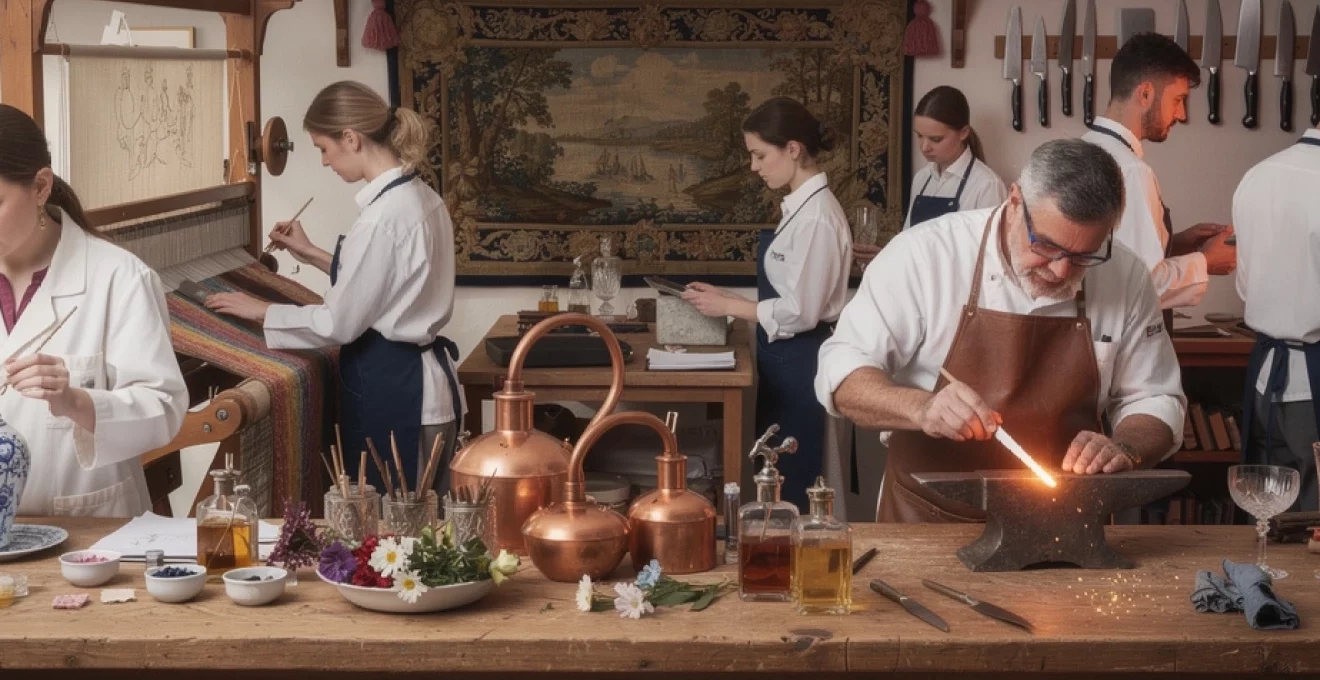
French craftsmanship represents far more than skilled manual labour—it embodies centuries of cultural identity, artistic expression, and intergenerational knowledge transfer that continues to shape the nation’s heritage today. From the delicate porcelain workshops of Limoges to the crystal furnaces of Baccarat, traditional French artisans maintain techniques that have been refined over generations, creating a living bridge between past and present. This preservation of savoir-faire extends beyond mere production methods; it encompasses an entire cultural ecosystem of apprenticeships, regional specialisations, and institutional frameworks designed to safeguard France’s artisanal heritage.
The contemporary landscape of French craftsmanship faces both unprecedented challenges and remarkable opportunities. Globalisation and mass production threaten traditional techniques, yet growing consumer appreciation for authentic, handmade goods creates new markets for artisanal excellence. Digital technologies now offer innovative preservation methods, whilst luxury brands increasingly collaborate with traditional ateliers to maintain their authenticity. Understanding how these ancient crafts adapt whilst preserving their essential character reveals the dynamic nature of cultural heritage in the modern world.
Artisanal métiers d’art: UNESCO recognition and legal protection frameworks
The French government has established comprehensive legal frameworks to protect and promote traditional craftsmanship, recognising these skills as vital components of the nation’s intangible cultural heritage. UNESCO’s 2003 Convention for the Safeguarding of Intangible Cultural Heritage provides the international foundation for these efforts, emphasising the preservation of skills and knowledge rather than merely the objects themselves. French legislation builds upon this framework through specific programmes targeting artisanal expertise, creating a multi-layered protection system for traditional crafts.
The regulatory approach focuses on encouraging artisans to continue producing traditional crafts whilst passing their expertise to future generations. This emphasis on knowledge transmission rather than object preservation reflects a sophisticated understanding of how cultural heritage operates in practice. Legal protections extend to workshop spaces, traditional materials access, and intellectual property rights, ensuring that communities can maintain their craft traditions within sustainable economic frameworks.
Maître d’art designation system and State-Sponsored preservation initiatives
Established by the Ministry of Culture in 1994, the Maître d’Art programme represents France’s most prestigious recognition system for exceptional traditional craftsmanship. This designation rewards artisans who demonstrate mastery of rare skills whilst committing to transmit their knowledge to apprentices within working ateliers. The programme explicitly targets endangered techniques that no longer benefit from formal training institutions, creating direct master-to-student relationships that preserve critical knowledge.
Each Maître d’Art receives substantial state funding to support their teaching activities, including workshop space, materials, and apprentice stipends. The current strategy aims to significantly increase the number of designated masters to address growing concerns about skill loss in traditional crafts. Recipients must demonstrate not only technical excellence but also pedagogical ability and commitment to preserving specific regional or national craft traditions.
Entreprise du patrimoine vivant label requirements and certification process
The Living Heritage Company (Entreprise du Patrimoine Vivant) label identifies businesses that excel in traditional French craftsmanship whilst maintaining economic viability in contemporary markets. Companies seeking EPV certification must demonstrate exceptional savoir-faire, maintain production facilities within France, and contribute significantly to their local economic ecosystem. The certification process involves rigorous evaluation of technical capabilities, innovation capacity, and cultural heritage preservation efforts.
Current government objectives aim to double the number of EPV-certified companies to 2,500 by 2025, reflecting growing recognition of these enterprises’ economic and cultural value. Certified companies benefit from preferential access to government contracts, international trade mission participation, and specialised business development support. The label serves as both quality assurance for consumers and competitive advantage for companies in increasingly crowded luxury markets.
Fondation bettencourt schueller grant programmes for traditional craft revival
Private philanthropic foundations complement state initiatives through targeted funding programmes supporting craft preservation and innovation. These grants typically focus on emerging artisans who demonstrate exceptional talent whilst committing to traditional techniques, bridging generational gaps in craft communities. Foundation support often emphasises experimental approaches to traditional methods, encouraging innovation within established frameworks rather than complete
reinvention. For example, the Fondation Bettencourt Schueller’s “Prix pour l’intelligence de la main” rewards both established artisans and innovative collaborations that reinterpret traditional skills for contemporary design, architecture, and scenography. Beyond prize money, laureates receive tailored support for workshop modernisation, international exposure, and training programmes, helping them secure long-term viability rather than short-lived visibility.
These grant programmes often prioritise projects rooted in specific regions, where traditional craftsmanship underpins local identity and tourism. By funding residencies, research into historic techniques, and cross-disciplinary partnerships with designers or scientists, the foundation helps ensure that rare savoir-faire does not fossilise but evolves. In this sense, private patronage acts as a flexible complement to public policy, backing risk-taking projects that might fall outside conventional funding schemes while still reinforcing the core objective of preserving French cultural heritage.
Institut national des métiers d’art documentation and classification standards
The Institut National des Métiers d’Art (INMA) plays a central role in documenting, classifying, and promoting the métiers d’art across France. Working closely with the Ministry of Culture and professional chambers, the INMA maintains an official list of over 200 recognised artistic craft professions, from tapestry restoration to luthier work. This taxonomy provides a reference framework for training policy, funding eligibility, and legal recognition, ensuring that emerging or hybrid practices can be integrated into the broader ecosystem of French craftsmanship.
Beyond classification, the INMA coordinates research, publishes reference guides, and organises events such as the European Artistic Craft Days (Journées Européennes des Métiers d’Art). Its documentation efforts increasingly rely on digital tools to record gestures, materials, and workshop environments, creating a long-term archive of endangered knowledge. For artisans, being included within INMA’s categories and databases is more than symbolic: it can open doors to support schemes, international networks, and collaborative projects that keep their workshops economically viable while reinforcing their contribution to national heritage.
Regional craft specialisation: terroir-based manufacturing techniques
French craftsmanship is inseparable from the notion of terroir—the unique combination of geography, climate, and local history that shapes materials and methods. Just as wine reflects the character of a specific vineyard, regional crafts embody the distinct identity of their landscapes and communities. From Limoges porcelain to Grasse perfume, these artisanal traditions emerge from centuries of experimentation with local resources, refined into codified techniques.
Understanding terroir-based manufacturing techniques helps us see why certain crafts could only have developed in specific regions. The presence of kaolin deposits near Limoges, aromatic flower fields around Grasse, or pure silica sand in Lorraine did more than provide raw materials—they structured local economies, social hierarchies, and even urban planning. When you purchase an object labelled “Made in France” from these areas, you are often buying into a sophisticated regional ecosystem where environment and expertise are tightly intertwined.
Limoges porcelain hand-painting methods and kaolin clay processing
Limoges porcelain owes its global reputation to a combination of geological luck and meticulous craftsmanship. The discovery of kaolin clay near Saint-Yrieix-la-Perche in the 18th century enabled local manufacturers to produce hard-paste porcelain that could rival Chinese imports. This kaolin is carefully extracted, washed, purified, and blended with feldspar and quartz before being shaped and fired at temperatures exceeding 1,300°C, producing a dense, translucent body prized by collectors and luxury hotels alike.
Hand-painting remains one of the most distinctive aspects of Limoges savoir-faire. Artisans apply mineral-based pigments with ultra-fine brushes, often using grand feu techniques, where decoration is fired at very high temperatures to fuse with the glaze. Motifs range from delicate florals and gold filigree to contemporary graphic designs, each requiring perfect control of brush pressure and pigment density. Watching a Limoges painter work can feel like observing a calligrapher: every movement counts, and a single misplaced stroke can mean starting again from scratch.
Aubusson tapestry low-warp weaving and cartoon transfer techniques
Aubusson, in the Nouvelle-Aquitaine region, has been synonymous with tapestry weaving since at least the 15th century. Recognised by UNESCO as Intangible Cultural Heritage, Aubusson tapestry production is based on low-warp (basse-lisse) looms, where the weaver works horizontally from the back of the textile. The design, known as a “cartoon”, is first painted at full scale, then placed beneath the warp threads or reflected in a mirror system so that the weaver can follow it while interlacing coloured wefts.
The transfer from painted cartoon to textile requires constant interpretation, rather than mechanical copying. Weavers decide how to translate brushstrokes into colour gradations using blends of wool, sometimes enriched with silk or metallic threads. Subtle shading techniques, called “hachures”, create depth and volume, much like cross-hatching in drawing. One large tapestry can take months, even years, to complete, turning the workshop into a space where time stretches—an apt reminder that cultural heritage often survives precisely because it refuses to be rushed.
Grasse perfumery enfleurage process and essential oil extraction methods
Grasse, perched above the French Riviera, has long been known as the world capital of perfume. Its mild microclimate favours the cultivation of jasmine, rose centifolia, tuberose, and other fragrant flowers that historically fed local perfumeries. Traditional extraction methods such as enfleurage—spreading petals on odourless fat to absorb their scent—illustrate how artisans once worked with fragile blooms before modern distillation and solvent techniques became widespread.
Today, most Grasse perfumers rely on steam distillation, solvent extraction, or CO₂ extraction to obtain highly concentrated essential oils and absolutes. Yet the artisanal spirit persists in the careful timing of harvests (often at dawn), the selection of local growers, and the blending of natural essences with synthetic molecules to create complex accords. Master perfumers, or nez, train for years to recognise thousands of olfactory notes and to compose fragrances that are both commercially viable and rooted in regional identity. When you attend a workshop in Grasse to create your own fragrance, you are briefly stepping into this intricate world of terroir-based alchemy.
Thiers cutlery forging protocols and damascus steel pattern welding
In the volcanic landscapes of Auvergne, the town of Thiers has forged its reputation as France’s cutlery capital. For more than 600 years, local workshops have produced knives, scissors, and surgical instruments, drawing on the region’s access to water power and iron resources. Traditional forging protocols involve heating steel billets to high temperatures, then hammering and shaping them into blades before hardening and tempering, a delicate balance between strength and flexibility.
Some Thiers artisans specialise in Damascus steel, using pattern-welding techniques that layer different steels and repeatedly fold and forge them to create distinctive swirling patterns. This process, akin to marbling in bookbinding or laminated dough in pastry, combines aesthetics and performance: the contrasting layers can improve edge retention while giving each blade a unique visual identity. Handles crafted from horn, local wood, or composite materials complete the knife, making each piece a small sculpture designed for daily use.
Baccarat crystal furnace temperature control and lead crystal formulation
In Lorraine, the village of Baccarat has become a global symbol of French crystal excellence. Since the 18th century, its furnaces have transformed sand, potash, and lead oxide into luminous crystal renowned for its clarity and resonance. Precise control of furnace temperatures—often around 1,400°C—is essential to ensure homogeneity and avoid bubbles or structural weaknesses. Master glassmakers, working in intense heat, gather molten crystal on blowpipes, shape it with wooden moulds and tools, then pass it to cutters and engravers.
Lead crystal formulation, traditionally around 24% lead oxide, gives Baccarat’s pieces their characteristic weight and brilliance, although environmental regulations are encouraging experimentation with alternative compositions. After annealing to relieve internal stresses, each object goes through painstaking cutting and polishing stages, where artisans carve geometric facets or floral motifs that capture and refract light. Watching a chandelier arm or wine glass emerge from this process, you can see why such objects are more than luxury goods—they are condensed expressions of regional industrial and artistic heritage.
Intergenerational knowledge transfer mechanisms in french ateliers
If materials and landscapes provide the raw foundation of French craftsmanship, it is intergenerational transmission that keeps traditions alive. Knowledge in French ateliers is rarely confined to manuals or blueprints; it lives in gestures, tacit skills, and shared workshop routines. How does one learn the exact pressure required to cut crystal without shattering it, or to tension warp threads for a tapestry that will hang straight for centuries? The answer lies in long-term, structured forms of apprenticeship.
France has developed sophisticated systems to support knowledge transfer, from historic compagnonnage networks to renowned schools such as École Boulle. These mechanisms not only train artisans technically but also transmit ethical values around quality, patience, and respect for materials. In a world where many professions are becoming increasingly digital and dematerialised, the continuity of these hands-on learning models offers a powerful counterpoint.
Compagnonnage apprenticeship structure and tour de france certification
The tradition of compagnonnage dates back to the Middle Ages and remains one of the most distinctive features of French craft training. Organised through historic brotherhoods, compagnonnage combines on-the-job learning in workshops, theoretical instruction, and a Tour de France during which apprentices travel from region to region. At each stage, they work under different masters, discovering regional techniques in fields as varied as stone masonry, carpentry, pastry, and metalwork.
The culmination of this journey is the creation of a “chef-d’œuvre”, a masterwork that demonstrates technical and artistic mastery. Acceptance of this work by peers leads to formal recognition as a compagnon, a title that opens professional doors and reinforces an ethos of lifelong learning. For cultural heritage, compagnonnage is invaluable: it ensures that techniques are not only preserved but tested and adapted across contexts, preventing skills from becoming static or purely academic.
Maître-apprenti mentorship models in luxury goods manufacturing
In luxury sectors such as haute couture, watchmaking, or fine leather goods, the maître-apprenti (master-apprentice) model remains central. Large maisons may run dedicated training ateliers, but the underlying logic is similar to that of small workshops: a senior artisan takes responsibility for guiding a younger colleague over several years. This mentorship covers not only manual skills—stitching, engraving, mounting—but also quality standards, client expectations, and workshop culture.
Many luxury brands now formalise these pathways through internal academies or partnerships with vocational schools, offering salaried apprenticeships that combine practice and classroom learning. For the apprentice, this provides a clear career trajectory in a sector often perceived as glamorous yet opaque. For the brand, it secures a pipeline of skilled workers capable of upholding the “Made in France” promise. As consumer demand for traceability grows, these mentorship models become part of a broader narrative that connects product, person, and place.
École boulle furniture design pedagogy and traditional joinery instruction
Founded in 1886, École Boulle in Paris is one of Europe’s leading institutions for furniture design, interior architecture, and applied arts. Its pedagogy blends rigorous technical training with creative exploration, ensuring that students master both traditional joinery and contemporary design tools. In woodworking workshops, learners practice mortise-and-tenon joints, dovetails, and marquetry inlays using hand tools, before moving on to CNC machines and digital modelling software.
This dual approach reflects a core principle of sustainable craftsmanship: innovation should build upon, not replace, ancestral skills. By understanding how a 17th-century commode was constructed, students are better equipped to design durable, repairable furniture for today’s interiors. The school also maintains close ties with industry and heritage institutions, enabling internships in restoration workshops, luxury brands, and design studios. As a result, École Boulle graduates contribute not only to preserving historical furniture but also to shaping the future of French decorative arts.
Cnam conservatoire technique documentation and skills preservation archives
The Conservatoire National des Arts et Métiers (CNAM) supports craftsmanship not only through teaching but also via extensive technical documentation and archives. Its collections include historical tools, machines, and prototypes that chart the evolution of manufacturing techniques in France. For artisans and researchers, these resources provide concrete references: how were early lathes designed, what alloys were used in 19th-century watchmaking, or how did textile machinery evolve alongside hand-weaving traditions?
CNAM’s role in skills preservation is increasingly digital. By recording processes in high-resolution video, 3D scanning tools, and detailed technical notes, the institution helps safeguard crafts at risk of disappearing. This archival work acts like a “black box” for traditional know-how: even if a workshop closes, its methods can still be studied, taught, and potentially revived. For anyone interested in how craftsmanship underpins French industrial history, CNAM offers a bridge between museum culture and living practice.
Contemporary market integration: luxury brand collaborations and artisan economics
While legal frameworks and training structures are vital, French craftsmanship can only survive if artisans can make a living from their work. In recent years, collaborations between luxury brands and small ateliers have become a key strategy for integrating traditional crafts into global markets. Major fashion houses commission embroidery, pleating, feather work, or metalwork from specialised workshops, creating stable demand for highly skilled labour.
These partnerships, however, raise complex economic questions. How can small workshops negotiate fair prices and reasonable lead times when working with powerful international brands? How do they scale up without sacrificing quality or exhausting their teams? Some artisans respond by diversifying their client base, combining B2B work with limited-edition collections sold directly to consumers via e-commerce or pop-up boutiques. Others obtain EPV status or join regional clusters that offer shared marketing and export support.
For consumers seeking to support authentic French craftsmanship, the key is to look beyond the logo. Asking where and how an object was made, prioritising traceability, and accepting slower production timelines can make a tangible difference. As you might expect, an embroidered jacket that takes 200 hours to complete cannot compete with fast fashion on price—but it offers a very different kind of value: durability, repairability, and a human story embedded in every stitch.
Digital documentation strategies: 3d modelling and virtual reality preservation
Digital tools are reshaping how we document and transmit French craftsmanship, without replacing the essential role of the hand. 3D modelling, high-resolution scanning, and photogrammetry now allow institutions and artisans to capture the exact geometry of objects, tools, and even workshop layouts. This data can then be used for restoration projects, design prototyping, or educational resources that show how a piece is assembled step by step.
Virtual reality (VR) and augmented reality (AR) go a step further by immersing users in simulated ateliers or heritage sites. Imagine putting on a headset to stand beside a master glassmaker at the furnace, or to observe a tapestry weaver’s hands from different angles. These experiences cannot fully replicate the tactile learning that occurs in a real workshop, but they can spark curiosity among younger generations and make complex processes more accessible. In some projects, motion-capture suits even record artisans’ gestures, turning intangible skills into analysable data that future learners can study.
Digital documentation also supports risk management. In the event of disasters, pandemics, or workshop closures, archives of 3D models, videos, and technical notes can help reconstruct lost knowledge. The challenge, of course, is to ensure that these digital repositories remain open, interoperable, and ethically managed, respecting artisans’ intellectual property. When used thoughtfully, technology becomes less a threat to tradition and more a powerful ally in safeguarding living heritage.
Cultural tourism impact: artisan workshops and heritage site designation
Cultural tourism has become one of the most visible interfaces between French craftsmanship and the wider public. Visitors increasingly seek experiences rather than simple souvenirs: a morning in a pottery studio, a guided tour of a crystal manufacture, or a perfume-making workshop in Grasse. For rural regions affected by depopulation, such activities can generate significant income while reinforcing local pride in traditional skills.
Heritage site designations—whether from UNESCO, the French state, or regional authorities—often act as catalysts for this form of tourism. When a craft or site gains official recognition, it tends to attract new audiences, funding, and educational projects. Yet there are risks: excessive visitor numbers can strain small communities, and pressure to “perform” tradition for tourists may lead to oversimplification. The most successful initiatives therefore strike a balance, offering well-framed visits, small-group workshops, and clear interpretation while preserving the integrity of daily production.
For travellers, engaging respectfully with artisan workshops means treating them as workplaces rather than mere attractions. Booking in advance, avoiding intrusive photography, and purchasing directly from the maker when possible are simple ways to support sustainable cultural tourism. In doing so, you participate in a virtuous circle: your curiosity and spending help craftsmen maintain their ateliers, transmit their skills, and continue enriching the living tapestry of French cultural heritage.