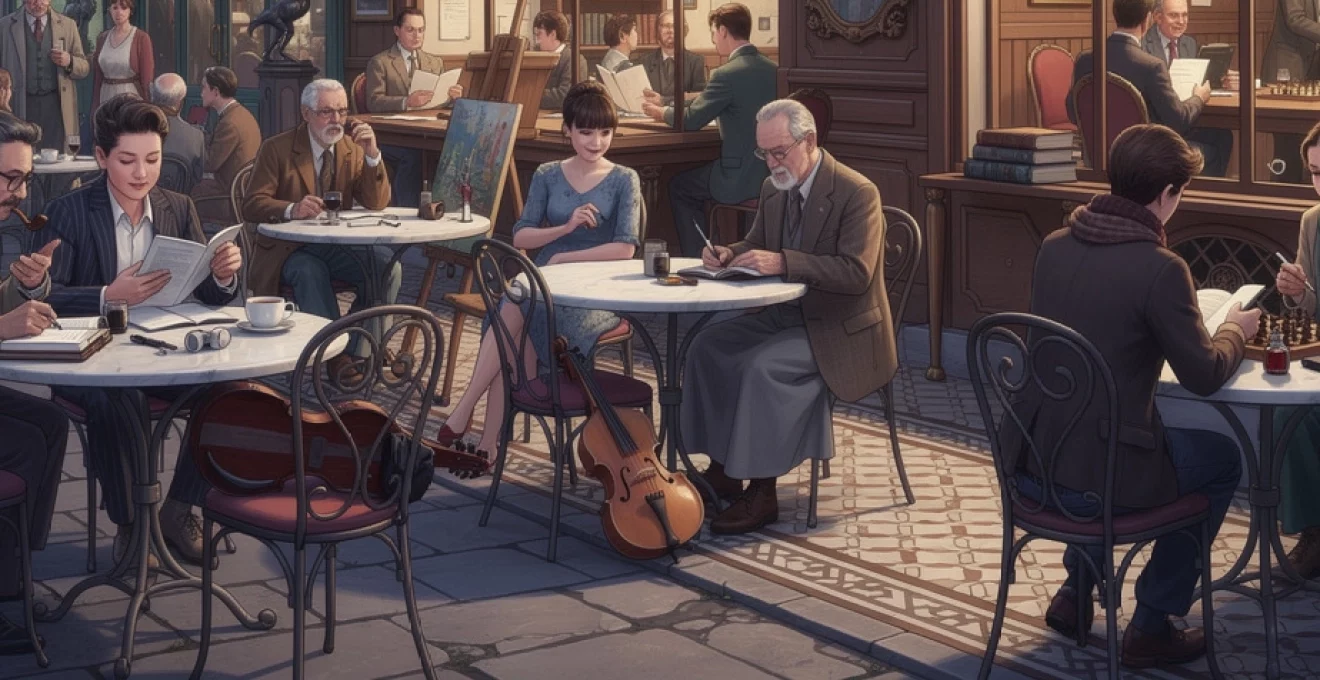
Paris has long served as a magnetic force for writers, philosophers, and artists seeking intellectual stimulation and creative inspiration. The city’s legendary cafés became more than mere establishments serving coffee and conversation—they transformed into incubators of literary movements, philosophical discourse, and artistic revolution. From the cobblestone streets of Saint-Germain-des-Prés to the bohemian boulevards of Montparnasse, these venues witnessed the birth of existentialism, surrealism, and countless literary masterpieces that continue to shape our cultural landscape today.
The significance of Parisian café culture extends far beyond simple hospitality. These establishments provided affordable refuge for struggling artists, neutral ground for heated intellectual debates, and informal salons where creative minds could flourish. The tradition continues today, as modern literary tourism seeks to preserve and celebrate the rich heritage of these iconic meeting places.
Saint-germain-des-prés literary establishments and their intellectual legacy
The Saint-Germain-des-Prés district emerged as the intellectual heart of Paris during the 20th century, hosting an unprecedented concentration of literary talent. This Left Bank neighbourhood’s narrow streets and historic architecture created an atmosphere conducive to deep thought and creative expression. The area’s proximity to the Sorbonne and various publishing houses made it a natural gathering point for academics, writers, and intellectuals seeking stimulating discourse.
The district’s cafés developed distinct personalities and clienteles, each contributing uniquely to the broader tapestry of Parisian intellectual life. Competition between establishments often spurred innovation in programming, from literary prizes to evening readings, creating a vibrant ecosystem that nurtured emerging talent whilst celebrating established masters. The enduring appeal of these venues lies not merely in their historical significance, but in their continuing role as cultural ambassadors for French literary tradition.
Café de flore’s role in existentialist philosophy development
Café de Flore stands as perhaps the most significant philosophical laboratory of the 20th century, where existentialism took shape through countless hours of debate and contemplation. The café’s intimate atmosphere, with its burgundy banquettes and art deco fixtures, provided the perfect setting for Jean-Paul Sartre and Simone de Beauvoir to develop their revolutionary ideas about human existence, freedom, and responsibility.
The existentialist movement found its natural home at Flore, where philosophers could engage with writers, artists, and intellectuals from diverse backgrounds. The café’s upstairs rooms hosted regular gatherings where complex theoretical concepts were tested against real-world experiences, creating a unique synthesis of academic rigour and practical application that characterised existentialist thought.
Les deux magots as Jean-Paul sartre and simone de beauvoir’s creative sanctuary
Les Deux Magots earned its reputation as the intellectual rival to Café de Flore, attracting many of the same luminaries whilst maintaining its distinct character. The establishment’s iconic Chinese figurines, from which it derives its name, presided over discussions that would reshape Western philosophy and literature. Sartre and Beauvoir frequently moved between the two venues, treating the entire square as their extended office.
The café’s Prix des Deux Magots, established in 1933, demonstrated its commitment to nurturing literary talent beyond simply providing meeting space. This prestigious award continues to recognise innovative writing that challenges conventional academic approaches, maintaining the establishment’s tradition of supporting avant-garde artistic expression. The prize’s selection process reflects the café’s historical role in identifying and promoting revolutionary literary voices.
Brasserie lipp’s political discourse and literary patronage system
Brasserie Lipp distinguished itself through its unique blend of culinary excellence and political engagement, attracting writers who sought to understand the intersection of literature and social change. The establishment’s Alsatian heritage provided a distinctive cultural flavour that appealed to intellectuals interested in exploring questions of national identity and cultural authenticity.
The brasserie’s patronage system created informal mentorship relationships between established authors and emerging talents, facilitating knowledge transfer that extended far beyond formal literary education. Regular patrons included political figures alongside writers, creating a dynamic environment where literary ideas could be tested against practical governance challenges and social realities.
Café
Bonaparte exemplified the quieter side of Saint-Germain’s literary life, functioning less as a stage for public performance and more as an intimate backdrop for post-war reflection. In the years following the Second World War, it drew young writers, critics, and editors who were grappling with questions of reconstruction, memory, and modern identity. Away from the more theatrical scenes at Flore or Deux Magots, Café Bonaparte offered a slightly more discreet environment in which new voices could test ideas that did not yet have a place in the academy or the major publishing houses.
Its location, at the crossroads between art galleries, bookshops, and universities, meant that conversations here often blended visual arts, politics, and literature into a single, ongoing dialogue. Informal editorial meetings took place at corner tables, where manuscripts were passed across saucers and pages annotated in fountain pen. In this sense, Café Bonaparte acted as an incubator for post-war French literary movements, from the rise of nouveau roman experimentation to early structuralist criticism, shaping a generation of writers who would redefine the French novel in the 1950s and 60s.
Montparnasse bohemian café culture and artistic collaboration networks
While Saint-Germain-des-Prés became synonymous with philosophy and publishing, Montparnasse developed its reputation as the bohemian engine room of Parisian creativity. In the early 20th century, rents were lower here, studios were larger, and cafés opened late into the night, making the district ideal for painters, sculptors, and writers whose schedules rarely followed office hours. The neighbourhood’s cafés became informal “open studios” where sketches were traded, short stories read aloud, and new artistic alliances forged over cheap wine.
These Montparnasse cafés formed dense collaboration networks that extended across national borders. American, Russian, Italian, and Eastern European artists mingled with French poets and critics, generating a cosmopolitan, sometimes chaotic atmosphere in which movements like Cubism, Surrealism, and modernist literature could cross-pollinate. For contemporary visitors interested in literary café culture, walking from one Montparnasse brasserie to another is like tracing the nervous system of early 20th-century avant-garde art.
La rotonde’s international artist community and cross-cultural exchange
La Rotonde, founded in 1903, quickly became a magnet for the international artist community, especially in the years before and after the First World War. Its generous terrace and relatively tolerant management allowed penniless painters and aspiring writers to linger for hours over a single drink, turning the café into a kind of informal academy of modern art. Figures like Modigliani, Chagall, and Diego Rivera, alongside writers and critics, helped make La Rotonde one of the most vibrant crossroads of cross-cultural exchange in Paris.
Language barriers at La Rotonde were often overcome with sketches, gestures, and a shared visual vocabulary pinned to café tables or drawn on napkins. This daily, improvised dialogue helped ideas travel quickly between disciplines: a painter might borrow narrative techniques from a novelist, while a poet, listening to expatriate conversations, absorbed foreign rhythms and imagery into their verse. For today’s literary tourist, sitting at La Rotonde offers a tangible sense of how an open, international café setting can accelerate creative innovation much like a modern co-working space for artists and writers.
Café de la paix’s literary salon traditions and publisher meetings
Although geographically closer to the Opéra than to Montparnasse, Café de la Paix functioned as a crucial bridge between bohemian creativity and the more formal literary establishment. From the late 19th century onwards, its opulent Napoleon III décor and central location made it a natural venue for literary salons and publisher meetings. Editors from major Parisian houses could step out of nearby offices to meet authors in a setting that lent a sense of occasion to contract negotiations and manuscript discussions.
Regular gatherings at Café de la Paix often blurred the line between social ritual and professional opportunity. A novelist might be introduced to a critic at one table, then find themselves in conversation with a theatre director or newspaper editor at another. This salon-like circulation of people and ideas transformed the café into a vital node in the city’s literary network, where careers could be launched or revived over a single afternoon. For anyone exploring Paris’s literary cafés today, the venue still offers a glimpse of the polished, public-facing side of literary life, in contrast to the more bohemian haunts further south.
Le select’s role in american expatriate writers’ social integration
Le Select, opened in 1923, became one of the key “arrival points” for American expatriate writers seeking to embed themselves in Parisian life. Its relatively affordable prices at the time, long opening hours, and central position on Boulevard du Montparnasse made it an ideal place to meet fellow expatriates and local artists alike. For many, Le Select served as a social orientation centre: newcomers were introduced to French customs, local publishers, and the unspoken rules of café etiquette that underpinned literary café culture.
Within this environment, American writers such as Ernest Hemingway, F. Scott Fitzgerald, and John Dos Passos found not only companionship but also a kind of informal support system. Advice on agents, translation opportunities, and magazine submissions was exchanged as readily as opinions on boxing matches or the latest art exhibition. You can think of Le Select as a 1920s equivalent of a creative networking platform, where personal introductions and repeated encounters eased the integration of foreign writers into the Parisian literary ecosystem.
La closerie des lilas and ernest hemingway’s creative writing process
La Closerie des Lilas occupies a special place in both Parisian and international literary history, thanks in large part to its role in Ernest Hemingway’s creative process. Situated slightly away from the busiest Montparnasse crossroads, the café offered a quieter, more concentrated atmosphere that suited Hemingway’s disciplined approach to writing. He famously described working here until he felt “empty and both sad and happy,” a state that, for him, signalled that he had pushed a story as far as it could go that day.
The physical environment of La Closerie—its sturdy tables, soft light, and relative calm compared to neighbouring brasseries—helped foster the kind of sustained concentration that long-form writing demands. Hemingway would draft or revise pages of what would become The Sun Also Rises and other works, then reward himself with oysters and wine, using simple sensory pleasures to mark the transition from work to rest. For writers today, this routine offers a practical model: choosing a consistent café setting, establishing clear boundaries between drafting and leisure, and using small rituals to maintain creative stamina over months or years.
Latin quarter academic cafés and intellectual discourse hubs
The Latin Quarter, anchored by the historic Sorbonne and numerous other universities, developed a café culture shaped first and foremost by academic life. Here, café tables doubled as extension counters of the library, piled high with philosophy treatises, law codes, and notebooks. Students, professors, and independent scholars gathered to debate ideas that would later find their way into lectures, essays, and eventually books, turning these cafés into living laboratories of intellectual discourse.
Unlike the more celebrity-driven atmosphere of Saint-Germain or Montparnasse, Latin Quarter cafés often fostered a more democratic exchange of ideas. An undergraduate might share a table with a visiting lecturer; a young poet might overhear a heated argument about structural linguistics and weave its vocabulary into their next poem. For visitors interested in the intellectual history of Paris, spending time in these academic cafés offers insight into how everyday conversation, fuelled by affordable coffee and surrounded by stacks of books, can gradually reshape entire disciplines.
Architectural elements and interior design impact on literary creativity
The architecture and interior design of Parisian literary cafés have always done more than simply please the eye; they actively shape how people think and write within them. High ceilings and large windows, common in 19th-century cafés, create a sense of openness that encourages expansive thinking, while intimate back rooms and mezzanines offer the seclusion needed for focused drafting. This balance between visibility and privacy is one reason so many writers have preferred cafés to cramped apartments for their daily work.
Décor also plays a subtle psychological role. Warm wood panelling, soft lighting, and worn leather banquettes can produce a feeling of continuity with the past, helping writers tap into a longer literary tradition. In contrast, the gleam of marble tables, brass fittings, and mirrored walls at more opulent establishments like Café de la Paix reflects an atmosphere of spectacle and public life, better suited to observation and note-taking than to introspective composition. In both cases, the design acts as a kind of silent collaborator, nudging the writer toward either introspection or engagement.
Acoustic qualities matter as well. A low hum of conversation can function like white noise, masking distractions and allowing the mind to wander productively, whereas harsh echoes or loud music can make sustained concentration difficult. Many historic cafés unintentionally perfected this balance through their combination of heavy fabrics, wooden furnishings, and tiled floors. For anyone seeking their own ideal writing café in Paris today, paying attention to sound, light, and seating layout can be as important as the menu itself.
Contemporary preservation efforts and literary tourism development
As Parisian literary cafés have shifted from everyday workplaces for struggling writers to coveted destinations for visitors, preserving their authenticity has become a complex challenge. Rising property prices, changing consumption habits, and the impact of global tourism all exert pressure on these historic establishments. In response, a range of public and private initiatives has emerged to protect not only the buildings themselves but also the stories and practices that give them meaning.
At the same time, literary tourism has grown into a significant cultural and economic force. According to recent estimates from European cultural tourism studies, thematic travel centred on literature and heritage now represents a growing niche segment of urban tourism, with visitors seeking immersive experiences rather than simple sightseeing. For Paris, this means that café owners, heritage organisations, and city authorities increasingly collaborate to balance commercial viability with respect for the cafés’ historical role in nurturing writers and artists.
UNESCO cultural heritage recognition and protection measures
One of the most important milestones for Parisian café culture came in 2010, when UNESCO recognised the “gastronomic meal of the French” as part of the Intangible Cultural Heritage of Humanity. While this inscription does not single out specific cafés, it emphasises the broader social practices of eating, drinking, and conversing that these venues embody. In practical terms, this recognition strengthens arguments for preserving traditional café spaces as living environments where cultural transmission continues to occur.
Local and national authorities have complemented UNESCO’s symbolic recognition with concrete protection measures. Many literary cafés are located in listed buildings subject to strict regulations regarding façade alterations, signage, and interior architectural features. In some cases, historical plaques and guided walking routes highlight a café’s connections to particular authors or movements, ensuring that visitors understand they are entering not just a business, but a site of cultural memory. For café owners, this heritage status can be both an asset and a responsibility, encouraging sensitive renovations that respect original layouts and design elements.
Digital documentation projects for parisian literary café history
In parallel with physical preservation, a growing number of digital documentation projects seek to capture the evolving story of Parisian literary cafés. Online archives compile photographs, letters, and first-hand testimonies from writers and patrons, offering searchable databases that allow researchers and enthusiasts to trace who met where, and when. Interactive maps let you follow in the footsteps of Hemingway or Beauvoir with a smartphone in hand, transforming the city into an open-air literary museum.
Universities, libraries, and independent scholars often collaborate on these initiatives, combining archival research with oral history interviews and crowd-sourced material. Such projects act as a safeguard against the inevitable changes that café interiors and neighbourhoods undergo over time. Even if a particular table is moved or a décor element replaced, high-resolution images, recorded memories, and annotated timelines ensure that future generations can still access the layered histories of these spaces. For readers planning a literary trip to Paris, these digital tools provide practical, up-to-date information and deepen the experience beyond a simple photo opportunity.
Modern literary events and writer residency programmes
Far from being frozen in the past, many Parisian cafés continue to host contemporary literary events that echo their historic role as creative hubs. Regular readings, book launches, and small-scale festivals bring together established authors, emerging voices, and curious readers in settings that feel both intimate and rooted in tradition. Some cafés partner with independent bookshops or small presses, creating circuits of cultural activity that mirror the collaboration networks of the early 20th century.
In recent years, writer residency programmes linked to café culture have also begun to appear, sometimes organised by municipalities or cultural associations. These residencies may provide authors with a stipend, accommodation nearby, and, crucially, a “home café” where they are encouraged to work regularly and engage with local communities. By formalising what was once an informal practice—writing daily at the same table—such programmes help sustain the living connection between cafés and literary production.
For visitors, seeking out these contemporary events offers a way to participate in, rather than simply observe, the ongoing story of Parisian literary cafés. Attending a reading at Les Deux Magots, listening to a debate at a Latin Quarter café, or joining a workshop hosted in a Montparnasse brasserie allows you to experience firsthand how these historic spaces continue to inspire new writing, new ideas, and new conversations.