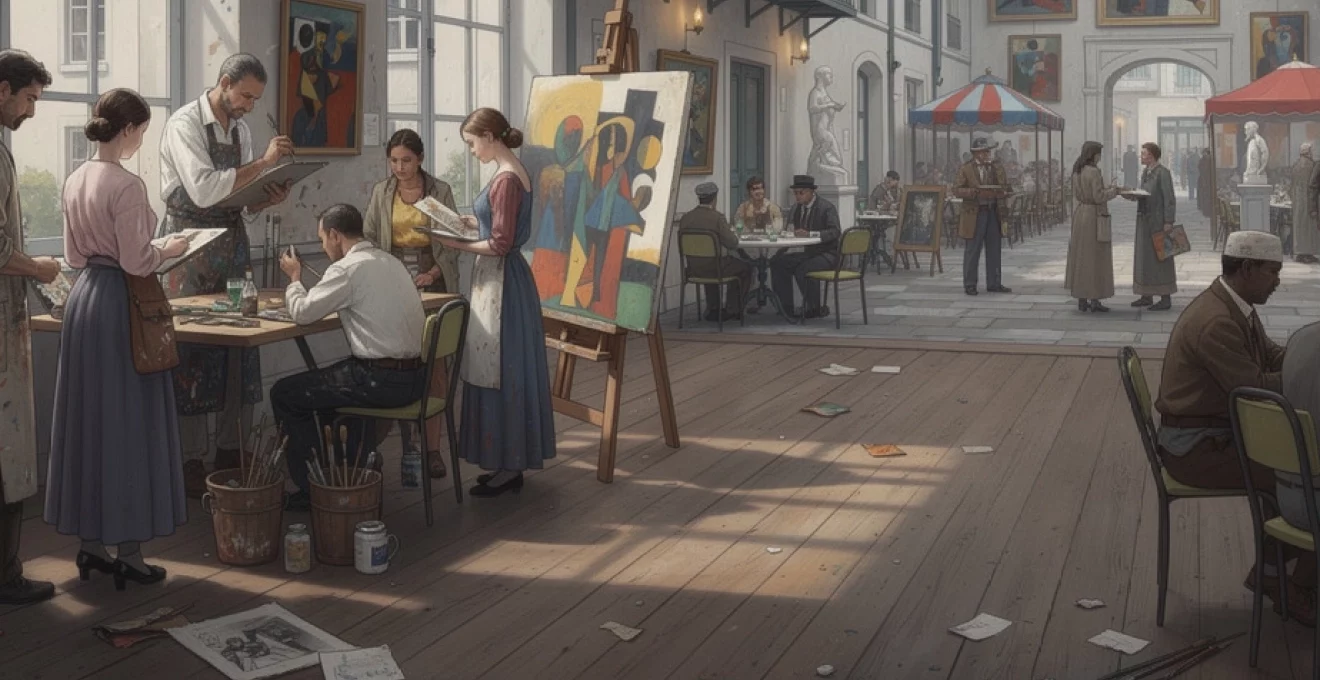
Between 1900 and 1940, Montparnasse transformed from a quiet Parisian neighbourhood into the epicentre of modernist revolution. This unassuming district south of the Seine became home to an extraordinary concentration of creative genius, where artists from across Europe and beyond gathered in cramped studios, smoky cafés, and communal workshops. The architectural fabric of Montparnasse—its narrow impasses, converted industrial spaces, and purpose-built ateliers—provided the physical infrastructure for artistic experimentation that would reshape twentieth-century art. Understanding this neighbourhood means exploring not just the masterpieces that emerged from its studios, but the material conditions, social networks, and exhibition spaces that made such innovation possible. The legacy of Montparnasse continues to influence contemporary art markets, museum programming, and our understanding of what it means to be an artist in a cosmopolitan metropolis.
The birth of montparnasse as paris’s Avant-Garde epicentre: 1900-1920
The transformation of Montparnasse from agricultural periphery to artistic nucleus occurred with remarkable speed during the early twentieth century. By 1910, the neighbourhood had eclipsed Montmartre as Paris’s primary creative quarter, attracting a new generation of artists who rejected academic convention in favour of radical experimentation. This geographical shift reflected deeper changes in artistic practice and patronage. Whereas Montmartre had hosted the Belle Époque’s café-concert culture and the established studios of Impressionist veterans, Montparnasse offered affordable accommodation, fewer restrictions, and a cosmopolitan atmosphere that welcomed foreigners without prejudice. The arrival of the Métro in 1906 connected the district to central Paris, whilst remaining sufficiently distant from bourgeois surveillance to permit bohemian lifestyles that would have scandalised the Right Bank.
Economic factors played a crucial role in this migration. Studio rents in Montparnasse averaged between 200 and 400 francs annually during the 1910s—roughly half the cost of comparable spaces in Montmartre. This affordability attracted impoverished young artists from Eastern Europe, Russia, and Italy, creating an international community that would later be romanticised as the École de Paris. The demographic composition of Montparnasse distinguished it from earlier artistic colonies: approximately sixty percent of artists working in the district between 1910 and 1914 were foreign-born, compared to less than thirty percent in Montmartre. This diversity fostered cross-cultural exchange and stylistic hybridisation that proved essential to modernist innovation.
La ruche: the beehive colony where chagall, soutine and modigliani revolutionised modern art
La Ruche—literally “The Beehive”—exemplified Montparnasse’s unique contribution to early twentieth-century art. Constructed from salvaged materials following the 1900 Exposition Universelle, this circular building in the Passage de Dantzig housed 140 wedge-shaped studios arranged around a central staircase. The sculptor Alfred Boucher purchased the site in 1902 with the explicit intention of providing affordable workspace for struggling young artists, charging nominal rents that often went uncollected when residents fell into financial difficulty. Between 1910 and 1914, La Ruche became home to an astonishing concentration of talent: Marc Chagall occupied studio number 64, Chaïm Soutine worked in cramped quarters on the third floor, whilst Amedeo Modigliani maintained a space he rarely used, preferring to work in cafés and borrowed studios across the neighbourhood.
The physical conditions at La Ruche were notoriously harsh. Most studios lacked heating, forcing artists to work wearing overcoats during winter months. Water supplies were communal and unreliable, whilst the building’s original function as a wine pavilion meant its structure was never intended for year-round habitation. Yet these hardships fostered a sense of shared purpose and mutual support. Artists traded materials, shared models, and critiqued each other’s work with brutal honesty that would have been impossible in more formal academic settings. The linguistic diversity of La Ruche—residents conversed in Russian, Yiddish, Italian, French, and a dozen other tongues—created what one historian
described as a “Tower of Babel of paint and plaster.” This polyglot environment had tangible consequences for art history: Chagall’s dreamlike combinations of Russian folklore and Parisian street life, Soutine’s violently expressive landscapes, and Modigliani’s elongated, mask-like portraits each bear traces of conversations held in stairwells and shared suppers in freezing studios. If Montparnasse functioned as an incubator for the modern art we know today, La Ruche was one of its most concentrated petri dishes.
For the contemporary visitor retracing the artistic soul of Montparnasse, La Ruche remains largely closed to the public, its courtyard only occasionally accessible during heritage days. Yet even from the street, its distinctive circular form and patchwork façades evoke the improvisational quality of early twentieth-century bohemian life. Thinking of it as an early co-working hub can be helpful: instead of laptops and shared Wi‑Fi, artists pooled canvases, pigments, and models, generating a dense network of influence that still shapes how museums and collectors value works labelled “Montparnasse school” today.
Académie de la grande chaumière and the shift from beaux-arts tradition
While La Ruche embodied the informal side of artistic training, the Académie de la Grande Chaumière represented a deliberate alternative to France’s official Beaux-Arts system. Founded in 1904 on Rue de la Grande-Chaumière, this private academy rejected rigid entrance exams, hierarchical ateliers, and prize-driven competitions in favour of open life drawing sessions and flexible instruction. The model was simple yet radical: artists could pay by the month or even by the day, drop in to draw from nude models, and choose whether to seek critique from instructors or work in solitude.
This pedagogical freedom attracted a remarkable roster of students and teachers. Amedeo Modigliani, Alberto Giacometti, Louise Bourgeois, and Alexander Calder all passed through its studios, as did countless lesser-known painters and sculptors who contributed to Montparnasse’s avant-garde fabric. The academy’s emphasis on observation, experimentation, and individual sensibility mirrored broader shifts in modern art away from academic history painting towards personal vision. In practical terms, it also lowered barriers to entry for foreign and female artists who found the École des Beaux-Arts inhospitable.
Seen from today’s perspective, the Académie de la Grande Chaumière anticipated many characteristics of contemporary art schools and residencies. Its pay-as-you-go model resembles modern open studios; its tolerance for diverse styles prefigures today’s pluralistic art world; and its location, a short walk from major Montparnasse cafés and studios, placed it at the heart of a creative ecosystem. For travellers interested in understanding how artists were trained in Montparnasse, visiting the still-functioning academy offers a rare link between historic avant-garde practice and current educational methods.
Café du dôme and la rotonde: where artistic manifestos were born over absinthe
If the studios and academies of Montparnasse were laboratories, its cafés were the debating chambers where ideas were tested in public. Café du Dôme, on the corner of Boulevard du Montparnasse and Boulevard Raspail, and La Rotonde just a few steps away, became legendary meeting points for the international bohemia. Painters, critics, poets, and dealers gathered at small marble tables, ordering cheap drinks they could stretch for hours while arguing about Cézanne, Cubism, and the latest Salon scandal.
At Café du Dôme, German, Russian, and Scandinavian artists formed informal groups that would later dominate exhibitions in Berlin and Munich. La Rotonde, immortalised by writers like Hemingway, served as both office and living room for broke painters who could not afford heating in their studios. Accounts from the period describe waiters accepting sketches in lieu of payment and café owners quietly allowing artists to nurse a single coffee all day. In these environments, manifestos were drafted, alliances forged, and reputations made or broken long before works reached a gallery wall.
For you as a twenty-first century visitor, sitting at a table in La Rotonde or Le Dôme offers more than nostalgic charm. These spaces demonstrate how crucial informal networks were to the rise of Montparnasse as an avant-garde centre. Think of them as analog social media feeds: information about a new exhibition, a visiting collector, or a controversial critic spread from table to table faster than any printed review. Understanding this café culture helps explain why certain artists—those adept at conversation and self-promotion—rose quickly, while others, equally talented but more reserved, remained on the margins until rediscovered by later scholarship.
The Bateau-Lavoir exodus: why artists migrated from montmartre to montparnasse
The shift from Montmartre to Montparnasse did not occur overnight, nor was it purely a matter of cheaper rents. In the 1890s and early 1900s, the Bateau-Lavoir, a ramshackle building on Place Ravignan in Montmartre, had been the cradle of Cubism and early modernism. Picasso painted Les Demoiselles d’Avignon there in 1907, surrounded by a circle that included Braque, Apollinaire, and Max Jacob. Yet by the eve of the First World War, many of these figures had either left Montmartre or began spending significant time in Montparnasse.
Several factors propelled this migration. Urban redevelopment and rising property values in Montmartre made studios more expensive, while the construction of new apartment blocks in Montparnasse created fresh opportunities for improvised ateliers. The south-of-the-Seine district also offered better transport connections to emerging exhibition venues and collectors’ homes on the Left Bank. Perhaps most importantly, the social atmosphere differed: whereas Montmartre’s artistic life was increasingly entangled with tourist entertainment and cabarets, Montparnasse fostered a more international, intellectually driven scene.
From an art-historical standpoint, we can view this exodus as a generational changing of the guard. Artists associated with Analytic Cubism and early abstraction found in Montparnasse a context better suited to their experimental, often austere work. Younger painters arriving from Russia, Poland, and Italy followed suit, perceiving Montparnasse as more open to outsiders than the by-then mythologised Montmartre. When you walk today from the hill of Sacré-Cœur down towards the flat boulevards of Montparnasse, you are effectively retracing this movement from picturesque bohemia to a more modern, cosmopolitan conception of the artist’s role in the city.
Atelier architecture and the material culture of montparnasse studios
Beyond cafés and academies, the very architecture of Montparnasse played a defining role in how art was made and lived. Purpose-built ateliers, improvised sheds, and converted industrial spaces created a distinctive urban fabric that shaped daily routines as much as stylistic choices. Understanding these buildings—how they were oriented, heated, lit, and shared—allows us to look at famous canvases not just as isolated masterpieces, but as products of specific material conditions.
In many ways, the atelier functioned like a carefully tuned instrument: a slight change in ceiling height or window orientation could alter the quality of light falling on a canvas, just as different strings change the timbre of a violin. For artists in Montparnasse, where budgets were tight and comfort often minimal, the negotiation between architectural constraint and creative ambition was a constant concern. When we speak of the “soul” of Montparnasse, we are also speaking of zinc roofs, drafty stairwells, and makeshift partitions that quietly framed the production of modern art.
Impasse ronsin and rue Campagne-Première: architectural blueprints of bohemian workspaces
Two addresses encapsulate the spatial logic of Montparnasse ateliers: Impasse Ronsin and Rue Campagne-Première. Impasse Ronsin, a dead-end alley near Rue de Vaugirard, housed a cluster of low wooden and brick studios that survived, in various forms, from the early 1900s until their demolition in the 1970s. Constantin Brâncuși worked there for decades, joined later by avant-garde figures such as Yves Klein and Niki de Saint Phalle. The irregular plots and patchwork constructions gave the alley a village-like atmosphere, mirroring the intimate yet experimental character of the works produced within.
Rue Campagne-Première, by contrast, displayed a more vertical model of artistic habitation. Tall, north-lit buildings with large glass façades lined the street, offering stacked ateliers accessible via narrow staircases and internal courtyards. Man Ray lived and worked here, as did painters and photographers drawn by the promise of consistent natural light. The façades themselves became part of Montparnasse’s visual identity: huge window panes revealed easels, plaster casts, and silhouettes of artists at work, turning the street into a kind of open-air gallery for passers-by.
For today’s reader planning a visit, it can be helpful to think of these streets as prototypes of later creative districts around the world, from New York’s SoHo to Berlin’s Kreuzberg. In each case, modest, sometimes dilapidated buildings offered the raw space necessary for experimentation, only to become, decades later, premium real estate precisely because of the artistic cachet they accumulated. This historical cycle has direct implications for contemporary art market valuations: provenance linking a work to an Impasse Ronsin or Campagne-Première studio can significantly enhance its desirability at auction.
North-facing windows and zinc roofing: technical design elements of artist ateliers
Why did so many Montparnasse ateliers feature vast north-facing windows and characteristic zinc roofs? The answer lies in a blend of technical necessity and local building practice. North light, in the northern hemisphere, provides a steady, cool illumination that changes little throughout the day, avoiding the harsh shadows and colour shifts associated with direct sunlight. For painters concerned with subtle tonal relationships—think of Bourdelle’s modelling in clay or Modigliani’s compressed palettes—such consistency was invaluable.
Zinc roofing, widely used in Paris since the mid-nineteenth century, offered a lightweight, relatively inexpensive material that could span large studio spaces without heavy internal supports. Its reflective quality also contributed to the diffusion of light within upper-floor ateliers, bouncing illumination back into the room. However, these advantages came at a cost: zinc roofs amplified rain noise and poorly insulated interiors, producing the familiar stories of artists shivering through winters and sweltering in summer heat.
From a contemporary standpoint, these technical features carry more than anecdotal value. Conservation scientists and curators often consider studio lighting conditions when analysing pigment ageing or reconstructing original colour balances in works now displayed under museum LEDs. Collectors, too, sometimes seek canvases painted in “true north light” studios, believing—rightly or wrongly—that such conditions yield particular chromatic stability. For anyone curious about the practical side of creativity, recognising a north-facing window or zinc mansard as you wander Montparnasse can be as revealing as reading a wall label in a gallery.
Cité falguière’s communal living model and its impact on collaborative practice
While individual studios shaped the work of single artists, communal complexes like Cité Falguière influenced the very notion of what it meant to be an artist in Montparnasse. Founded in the late nineteenth century off Rue de Falguière, this modest cul-de-sac contained rows of small workshops packed closely together, with shared courtyards and minimal private amenities. Marie Vassilieff, Modigliani, Soutine, and many others lived or worked here at various points, forming an intense micro-community bound by circumstance as much as by choice.
The physical closeness of Cité Falguière encouraged forms of collaboration and mutual aid that went beyond occasional studio visits. Artists cooked in each other’s rooms, borrowed tools across doorways, and sometimes co-signed works or jointly organised small exhibitions. Vassilieff’s famous canteen, which offered discounted meals to struggling artists during the First World War, turned domestic space into a support structure—part soup kitchen, part salon, part informal art school. This hybrid model blurred boundaries between work, life, and social activism in ways that resonate with today’s interest in collective artistic practices.
For researchers and collectors concerned with provenance, the communal nature of Cité Falguière presents both opportunities and challenges. On the one hand, works associated with the cité carry a strong narrative appeal, evoking solidarity amid hardship. On the other, shared models, materials, and even motifs can complicate attributions, especially for early, undocumented pieces. When you read auction catalogues referencing “Cité Falguière period” works, you are encountering not just a geographical label but a shorthand for this dense web of shared labour and influence.
Conversion of industrial spaces: from forge to brâncuși’s sculpture workshop
Alongside purpose-built ateliers and communal courts, Montparnasse saw numerous industrial and commercial buildings repurposed as studios. Blacksmiths’ forges, carriage houses, and small warehouses offered robust structures with high ceilings and large doors—ideal for sculptors working on monumental pieces. Constantin Brâncuși’s celebrated workshop, now reconstructed at the Centre Pompidou, began life as such a modest industrial space near Impasse Ronsin, gradually transformed through improvisation and necessity into an integrated environment of tools, plinths, and finished works.
Brâncuși treated his studio not merely as a place of production but as a total artwork in its own right, constantly rearranging sculptures and pedestals to explore new relationships between forms. Visitors like Duchamp and Le Corbusier commented on the almost sacred atmosphere of the space, where raw plaster and polished bronze coexisted with workbenches and vises. This merging of workshop and exhibition site anticipated later installation art and invites us to reconsider the conventional separation between the making and display of sculpture.
Today, the story of industrial-to-studio conversion in Montparnasse offers a useful analogy for anyone thinking about adaptive reuse in contemporary cities. Just as tech start-ups now occupy former factories, early twentieth-century sculptors turned forges into creative engines. For the art market, a documented link to such spaces can add another layer of value: a Brâncuși conceived in his Montparnasse forge-studio, for example, carries with it the aura of that experimental environment, which curators and catalogues are careful to highlight.
Landmark exhibitions that defined montparnasse’s international reputation
Studios and cafés generated ideas, but it was through exhibitions that Montparnasse artists reached broader publics and foreign markets. Between 1905 and the early 1920s, a series of landmark shows in Paris and abroad propelled works from modest Left Bank ateliers onto the global stage. These exhibitions not only shocked contemporary audiences; they also established the reputational frameworks and price structures that still underpin how Montparnasse modernism is collected and displayed today.
Understanding these key moments helps us see how local experiments became international reference points. Just as a viral post today can catapult an unknown creator into global visibility, a strategically placed painting in an influential Salon or gallery could alter an artist’s career overnight. The following exhibitions—from the Salon d’Automne to the 1913 Armory Show—form a kind of roadmap tracing Montparnasse’s ascent from peripheral neighbourhood to avant-garde brand.
Salon d’automne 1905: fauvism’s explosive debut at the grand palais
The 1905 Salon d’Automne, held at the Grand Palais on the Right Bank, might seem geographically distant from Montparnasse, but its impact reverberated powerfully through the studios south of the Seine. In Room VII, works by Matisse, Derain, Vlaminck, and others were hung together in a riot of saturated colour and simplified form. A critic, confronted with this chromatic onslaught, famously dubbed them fauves—wild beasts—giving a name to the new movement. Many of these painters lived or worked near Montparnasse or would soon gravitate there, drawn by the district’s affordable spaces and tolerant atmosphere.
For young artists in Montparnasse, the 1905 Salon signalled that radical departures from naturalistic colour and academic drawing could achieve high-profile visibility. It also underscored the strategic importance of alternative Salons, such as the Salon d’Automne and the Salon des Indépendants, which offered more flexible jury systems than the official Salon. We might compare these venues to today’s independent biennials or artist-run spaces that serve as launching pads for experimental work outside mainstream institutional circuits.
From a market perspective, the 1905 Salon d’Automne also marked the beginning of a new pattern: collectors willing to take risks on controversial works could, within a decade, see exponential appreciation in both cultural and financial value. This dynamic, first visible with Fauvist canvases, would later apply to Cubism and other Montparnasse-linked movements, setting precedents that continue to shape speculation around emerging art today.
Galerie weill and berthe weill’s pioneering support for the école de paris
While grand Salons drew the headlines, smaller Left Bank galleries quietly performed the patient work of discovery and promotion. Among them, Berthe Weill’s gallery on Rue Victor Massé, later operating near Montparnasse, played a crucial role in championing artists now central to the story of the École de Paris. Weill was one of the first dealers to show Picasso in Paris and was instrumental in giving exposure to Modigliani, Kees van Dongen, and numerous Jewish and immigrant painters facing institutional prejudice.
Weill’s approach differed from that of larger dealers like Paul Durand-Ruel or Daniel-Henry Kahnweiler. Operating on slim financial margins, she often took significant risks on unproven talent, hanging controversial nudes and experimental works that scandalised bourgeois visitors. Her 1917 exhibition of Modigliani’s reclining nudes, shut down by police on grounds of indecency, has become legendary as an example of how far ahead of public taste some Montparnasse artists were. Yet sales were rare and modest, and Weill herself died in relative poverty despite her visionary eye.
For students of the art market, Berthe Weill’s story offers a sobering counterpoint to the triumphalist narrative of avant-garde success. It reminds us that supporting radical art often entails real financial risk and that many key intermediaries in Montparnasse remained marginal in their own lifetimes. At the same time, provenance linking early Cubist or École de Paris works to Weill’s gallery now adds significant scholarly and monetary value, with auction catalogues carefully noting such early exhibitions as proof of an artist’s integration into the Montparnasse avant-garde network.
The 1913 armory show connection: how montparnasse artists conquered new york
The International Exhibition of Modern Art, better known as the Armory Show, opened in New York in February 1913 and introduced American audiences to European modernism on an unprecedented scale. Although it included works from various Parisian districts, Montparnasse-associated artists and movements—Cubism, Fauvism, and the broader École de Paris—dominated both press coverage and public controversy. Duchamp’s Nu descendant un escalier n°2, conceived in a Montparnasse studio, became a lightning rod for mockery and fascination, while works by Matisse, Picasso, and Brâncuși challenged transatlantic assumptions about what art could be.
For artists working in cramped Montparnasse ateliers, the Armory Show represented a sudden expansion of their potential audience from a few Parisian collectors to an entire continent of new patrons. Although sales figures were uneven—many radical works returned to Europe unsold—the exhibition laid the groundwork for later American patronage of French and expatriate artists. By the 1920s and 1930s, wealthy collectors and museum curators from New York, Chicago, and Philadelphia were regular visitors to Montparnasse, seeking out studios they first encountered in Armory Show catalogues.
Looking back, we can see the 1913 exhibition as an early example of globalisation in the art world, with Montparnasse functioning as both content hub and brand. Just as a contemporary gallery might seek visibility at Art Basel or Frieze to reach international clients, early twentieth-century artists understood that presence in high-profile foreign shows could dramatically alter their career trajectories. For today’s collectors and visitors, tracing which Montparnasse artists participated in the Armory Show offers a useful lens on who was considered most representative of Parisian innovation at that pivotal moment.
Léonce rosenberg’s galerie de l’effort moderne: cubism’s commercial breakthrough
While early Cubist experiments found support from a few visionary dealers, it was Léonce Rosenberg’s Galerie de l’Effort Moderne that helped transform Cubism from a scandalous novelty into a commercially sustainable movement. Operating primarily from Rue de la Baume but drawing heavily on artists based in Montparnasse, Rosenberg systematically organised solo and group shows for painters such as Fernand Léger, Juan Gris, and Henri Laurens. His catalogues framed Cubism not as a passing fad but as a rigorous, intellectually grounded language capable of depicting modern life.
Rosenberg’s strategy combined careful curation with savvy promotion. He commissioned theoretical texts, cultivated relationships with foreign collectors, and emphasised series-based production that lent itself to coherent exhibitions. Many of the works he showed were conceived in modest Montparnasse studios but marketed through a discourse of international modernity that resonated with clients from Brussels to Buenos Aires. In effect, he acted as a translator between the rough-and-tumble world of café debates and the drawing rooms of the European bourgeoisie.
For the contemporary art market, Rosenberg’s role has lasting consequences. Provenance lists featuring Galerie de l’Effort Moderne carry considerable weight at auction, signalling early institutional support and helping to establish price benchmarks for Cubist works. For you as a reader seeking to understand how Montparnasse aesthetics entered mainstream culture, Rosenberg’s gallery illustrates the crucial intermediary function of dealers who believed not only in individual artists but in entire movements. Without such commercial “effort,” the radical geometries born in Left Bank ateliers might never have achieved their current museum canonical status.
The école de paris phenomenon: immigrant artists and cross-cultural synthesis
The term École de Paris does not designate a formal school so much as a loose constellation of mostly foreign-born artists who converged on Paris—especially Montparnasse—between 1905 and 1939. Chagall from Belarus, Soutine from Lithuania, Kisling from Poland, Foujita from Japan, and countless others arrived with diverse visual traditions and personal histories marked by migration, poverty, and, increasingly, antisemitism. In the cramped studios and cafés of Montparnasse, their experiences intertwined, producing a hybrid visual language that fused Russian folk motifs, Jewish iconography, Fauvist colour, and Cubist structure.
Crucially, the École de Paris phenomenon emerged not only from aesthetic experimentation but also from social marginality. Many of these artists were excluded from official institutions and faced xenophobic criticism from segments of the French press, which sometimes used “École de Paris” in a pejorative sense to suggest foreign encroachment on national culture. Yet this very outsider status pushed them towards tight-knit support networks, cooperative exhibitions, and an intense work ethic that later contributed to their post-war mythologisation as heroic modernists.
When we look today at a Soutine landscape or a Chagall wedding scene in a museum, it is easy to forget the precarious conditions under which such works were made—unheated rooms, intermittent food, and, for Jewish artists, the looming threat of persecution. Many École de Paris painters would later be forced into exile or perish during the Holocaust, a tragedy that lends their Montparnasse years a poignant, almost sacred aura in retrospective narratives and auction catalogues. This historical context is one reason why works by key École de Paris figures have seen sustained price growth over the past two decades, particularly as museums and private collectors seek to address previous gaps in representation.
For visitors walking through Montparnasse today, traces of this immigrant presence remain visible in street names, former studio plaques, and the cosmopolitan mix of languages still heard around Boulevard Raspail. Engaging with this history encourages us to see Montparnasse not merely as a picturesque quarter of Paris but as an early laboratory of cultural globalisation—one whose lessons about migration, identity, and creative exchange remain urgently relevant.
Female artists breaking barriers in montparnasse’s male-dominated sphere
Despite the enduring image of Montparnasse as a haven of freedom, its artistic world remained largely dominated by men, with women often relegated to the roles of muse, model, or companion. Yet a number of female artists used the relative openness of the district to carve out professional spaces, challenge gender norms, and leave lasting bodies of work. Figures such as Marie Vassilieff, Chana Orloff, Tamara de Lempicka, and later Dora Maar and Lee Miller each navigated the café-studio circuit on their own terms, balancing economic survival with artistic ambition.
Vassilieff, for example, not only painted and sculpted but also ran the aforementioned canteen that fed impoverished artists during the First World War. Her studio in the Chemin du Montparnasse became a social and political hub where questions of class, gender, and national identity intersected with discussions of Cubism and Futurism. Chana Orloff, a sculptor of Ukrainian-Jewish origin, established a successful portrait practice from her Montparnasse atelier, depicting sitters ranging from Matisse to anonymous children, and proving that a woman could sustain herself as a professional artist without reliance on male patronage or marriage.
Photographer Lee Miller offers another instructive case. Initially known as a model and collaborator of Man Ray, she opened her own studio in Montparnasse in 1930, producing fashion shoots, portraits, and surrealist experiments that affirmed her independent vision. Her later work as a war correspondent further destabilised traditional gender roles, extending the Montparnasse ethos of experimentation into the realm of journalism and documentary photography. Today, retrospectives of Miller’s work and renewed interest in artists like Vassilieff and Orloff are gradually rebalancing our understanding of who shaped the artistic soul of Montparnasse.
From a contemporary perspective, the careers of these women also raise important questions about recognition and value. Many female Montparnasse artists sold work to survive, often at low prices, while their male counterparts benefited from more systematic gallery support. As museums and collectors now seek to “rediscover” these overlooked figures, works that once circulated modestly in local markets are entering major collections and achieving record prices. For you as a visitor or reader, learning their names and visiting their former studios where possible offers a way to participate in this overdue widening of the Montparnasse canon.
The legacy of montparnasse studios in contemporary art market valuations
Today, the aura of Montparnasse extends far beyond the physical boundaries of the neighbourhood, influencing how works are catalogued, priced, and displayed across the global art market. Auction houses routinely highlight a painting’s “Montparnasse period” or specify that a sculpture was conceived in a particular studio, using such details to signal authenticity, historical relevance, and narrative appeal. Just as a vintage car gains value from documented racing history, a canvas linked to Cité Falguière, La Ruche, or Impasse Ronsin carries an intangible premium derived from its proximity to the legendary avant-garde milieu.
Data from major auction houses over the past decade indicate that works with strong Montparnasse provenance—especially those tied to the 1900–1939 period—tend to outperform similar pieces without such documentation. This effect is particularly pronounced for École de Paris artists, whose market visibility surged in the 1990s and 2000s as institutions and private collectors sought to correct earlier neglect. At the very top end, masterpieces by Chagall, Modigliani, and Soutine associated with specific Montparnasse studios have fetched tens of millions of dollars, but even mid-range works can see significant price differentials when accompanied by compelling studio-related stories.
Of course, this emphasis on Montparnasse provenance also has its complications. As demand grows, so does the risk of embellished narratives or contested attributions, making rigorous research and expert consultation essential. Provenance scholars, archivists, and conservators play a crucial role in verifying studio addresses, exhibition histories, and ownership chains, ensuring that romantic tales of smoky cafés and freezing garrets do not overshadow factual accuracy. For serious collectors or institutions, investing in such due diligence is no longer optional; it is part of responsible stewardship of cultural heritage.
For the general visitor or reader, the market afterlife of Montparnasse offers an instructive reminder that places continue to exert power long after their physical fabric has changed. When you stand today outside a quiet apartment block that once housed a bustling atelier, you are not only engaging with urban history; you are also touching one of the invisible forces that shape museum acquisitions, exhibition programming, and even the headlines about record-breaking sales. In that sense, the artistic soul of Montparnasse lives on—not just in paintings and sculptures, but in the stories we continue to tell, buy, and believe about what it meant, and still means, to make art in this corner of Paris.