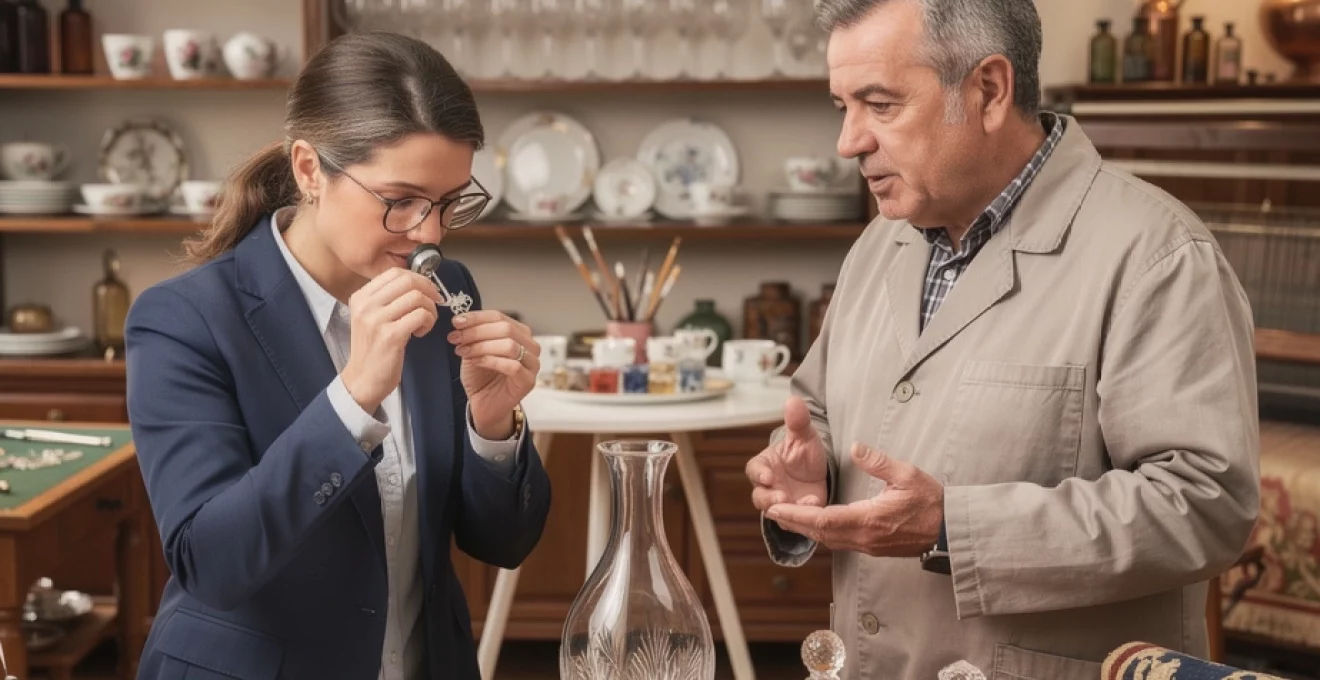
French artisanal craftsmanship represents centuries of refined techniques, jealously guarded secrets, and uncompromising standards that have earned global recognition. Yet in today’s marketplace flooded with reproductions and mass-produced imitations, distinguishing genuine French craftsmanship from clever counterfeits requires more than casual observation. The stakes are particularly high when investing in luxury items where authenticity directly impacts both aesthetic value and financial worth.
From the porcelain workshops of Limoges to the crystal furnaces of Baccarat, authentic French artisanal pieces carry distinctive markers that reveal their origins to those who know where to look. Understanding these indicators becomes essential whether you’re acquiring a single statement piece or building a comprehensive collection. The difference between authentic French craftsmanship and skilled reproductions often lies in subtle details that speak to centuries of regional specialisation and traditional manufacturing methods.
Collectors and enthusiasts increasingly face sophisticated counterfeits that can deceive even experienced buyers. However, French artisanal production operates within established systems of certification, regional specialisations, and material standards that create a framework for authentication. Recognising these markers transforms what might seem like overwhelming complexity into a systematic approach to verification.
Hallmarks and certification systems in french artisanal production
France maintains some of the world’s most rigorous certification systems for artisanal goods, creating a network of official marks and designations that authenticate genuine craftsmanship. These systems evolved over centuries to protect both artisans and consumers, establishing clear standards that distinguish authentic French production from imitations. Understanding these certification frameworks provides the foundation for recognising legitimate French craftsmanship across diverse product categories.
Poinçon de maître recognition for precious metals and jewellery
The Poinçon de Maître system represents one of France’s oldest and most prestigious marking traditions for precious metals and jewellery. Each registered master craftsman receives a unique symbol that must be stamped on all pieces meeting specific quality thresholds. These marks typically appear alongside standard hallmarks indicating metal purity, creating a dual authentication system that verifies both material quality and artisan credentials.
Authentic French silver pieces manufactured after 1838 display the maker’s mark alongside official assay marks confirming metal content. The positioning and depth of these stamps reveal manufacturing authenticity – genuine marks appear crisp and consistent, while counterfeit versions often show irregular depth or blurred edges. Master craftsmen’s marks follow strict registration protocols, making verification possible through official databases maintained by French assay offices.
Appellation d’origine contrôlée (AOC) authentication for luxury goods
While traditionally associated with wine and food products, the AOC system extends to specific luxury goods that demonstrate clear regional characteristics. Certain French perfumes, textiles, and decorative objects qualify for AOC protection when they meet strict criteria regarding origin, materials, and production methods. This designation requires that all significant production stages occur within defined geographical boundaries using traditional techniques.
AOC authentication involves rigorous inspection protocols that examine raw material sources, manufacturing processes, and final product characteristics. Products bearing legitimate AOC marks undergo regular audits to ensure continued compliance with established standards. The certification appears as official seals or labels that include specific regional designations and authentication codes verifiable through governing body databases.
Entreprise du patrimoine vivant (EPV) label verification process
The EPV label identifies companies demonstrating exceptional artisanal or industrial expertise rooted in French cultural heritage. This prestigious designation requires businesses to prove their mastery of traditional techniques, commitment to innovation, and contribution to cultural preservation. EPV status involves comprehensive evaluation of technical expertise, cultural significance, and economic performance over sustained periods.
Verification of EPV credentials involves examining official documentation that accompanies certified products. Legitimate EPV-labelled items include detailed information about the company’s heritage, specific techniques employed, and the cultural significance of their craft. This certification system provides particularly valuable authentication for contemporary pieces that maintain traditional manufacturing standards while incorporating modern innovations.
Chambre de métiers et de l’artisanat registration standards
French artis
ans registered with the Chambre de Métiers et de l’Artisanat (CMA) must meet defined professional standards relating to training, legal status, and craft category. When you see a workshop or artisan referencing their CMA registration number, it signals that they operate within France’s formal artisanal framework rather than as an informal hobbyist or resale outlet. For buyers, this registration acts as a first filter: you can verify the business, its address, and its officially declared craft through CMA directories.
When assessing authentic French craftsmanship, look beyond a simple “made in France” claim and ask whether the maker is registered with the CMA and under which category. A genuine artisan will usually be transparent about their numéro SIRET and their craft classification (artisan d’art, goldsmith, ceramicist, upholsterer, etc.). While CMA registration alone does not guarantee masterpiece-level quality, its absence in high-end “French artisanal” marketing should prompt closer scrutiny.
Traditional french manufacturing techniques and regional specialisations
Authentic French craftsmanship is inseparable from place. Certain regions have developed highly specialised techniques over centuries, and serious workshops still adhere to these traditional methods even when they integrate modern tools. Learning the key regional specialisations not only helps you recognise the real thing, it also allows you to ask the kind of specific questions that quickly expose vague marketing claims.
You will notice that authentic makers talk in detail about processes: the time in the kiln, the number of firings, the loom type, the wool grade. Counterfeiters tend to stay at the level of style labels and broad adjectives. As you read the following examples, consider how you might translate their principles to your own future purchases of French ceramics, textiles, glass, or decorative objects.
Limoges porcelain hand-painting and firing methods
Authentic Limoges porcelain begins with kaolin-rich clay sourced from the Limousin region, which gives the finished piece its characteristic whiteness and translucency. After forming, pieces undergo a first high-temperature firing (often around 1,350°C) that vitrifies the body and creates a dense, resonant structure. A clear glaze is then applied, followed by a second firing that fuses the surface into a smooth, glass-like finish; additional overglaze decorations may require third or even fourth firings at lower temperatures.
Hand-painted Limoges decoration reveals itself in subtle irregularities—the fine variation in brushstroke thickness, slight differences in repeated motifs, or tiny pauses where the painter lifted their brush. By contrast, transfers or decals often look too perfect, with a uniform sheen and edges that sit on top of the glaze rather than sinking slightly into it. If possible, tilt the piece under natural light: genuine hand-painted work will show minute relief where pigment has built up, whereas printed designs appear flatter and more mechanical.
Grasse perfumery enfleurage and distillation processes
The town of Grasse in Provence is synonymous with authentic French perfumery, particularly for its traditional methods of extracting fragrance from delicate flowers such as jasmine, tuberose, and orange blossom. Historically, enfleurage involved placing petals in layers of purified fat on glass plates, allowing the fat to absorb the scent over days or weeks before being washed with alcohol to capture the aromatic compounds. Although this method is now rare due to cost, serious Grasse houses still reference and sometimes revive it for limited editions.
Today, steam distillation and solvent extraction are more common, but in Grasse they are often performed with an almost surgical precision: low, controlled temperatures to protect fragile molecules and careful separation of the “heart” of the distillation from less refined fractions. When a perfume claims Grasse origin, ask which raw materials are locally sourced and how the essences are extracted. An authentic Grasse perfume house will be able to describe its distillation processes with the same specificity a winemaker uses for their vineyards and barrels.
Lyon silk weaving jacquard loom operations
Lyon has been the beating heart of French silk weaving since the Renaissance, and its workshops pioneered the use of the Jacquard loom in the early 19th century. This programmable loom, guided originally by punched cards, allows complex patterns to be woven directly into the fabric rather than printed onto its surface. Authentic Lyon silk often features intricate damasks, brocades, and lampas weaves, where the design is visible in the structure of the cloth itself.
When assessing a “Lyon-style” silk, turn the fabric over. Genuine Jacquard-woven patterns reveal themselves on the reverse side through floats and binding points that mirror the front design. Printed imitations look flat from the back and lack the dense, slightly weighty hand of a woven pattern. You may also see minute irregularities where thread tension varies slightly—an echo of human oversight that no digital printer can convincingly fake.
Aubusson tapestry haute-lisse and basse-lisse techniques
Aubusson, in central France, is famed for its tapestries and rugs, historically produced on two types of looms: haute-lisse (vertical) and basse-lisse (horizontal). In both cases, the weaver works from the back of the tapestry, following a painted cartoon placed behind the warp threads. Coloured wool (and sometimes silk) wefts are passed by hand, line by line, to build up detailed scenes, floral borders, and architectural vistas. This is laborious work: a single square metre can represent weeks of weaving.
Authentic Aubusson tapestries show nuanced shading created by “hachures”—small, angled passes of different coloured threads that blend tones much like brushstrokes in a painting. Machine-woven copies tend to have abrupt colour transitions and repetitive, pixel-like patterns when viewed up close. Vintage and antique examples may display subtle irregular edges and minor distortions, the visual equivalent of a hand-written letter compared with a laser print.
Baccarat crystal mouth-blowing and lead crystal composition
Baccarat, one of France’s most renowned crystal manufacturers, has built its reputation on precise formulas and mouth-blown techniques. Traditional lead crystal from Baccarat contains a high percentage of lead oxide (typically around 30%), which increases refraction and gives the glass its distinctive brilliance and weight. Skilled glassblowers shape each piece by hand, often using wooden or graphite moulds, before cutters facet the surface to maximise light play.
To evaluate Baccarat-style crystal, consider three sensory cues: weight, sound, and light. Genuine lead crystal feels heavier than ordinary glass, emits a clear, lingering ring when gently tapped, and breaks light into crisp, prismatic flashes. Look closely at the cutting: hand-cut facets should be sharp yet refined, with crisp intersections and a clarity that mass-produced pressed glass cannot achieve. Authentic Baccarat pieces also carry an acid-etched or stamped mark that corresponds to specific production eras, which you can cross-check against published reference guides.
Material authentication and quality assessment criteria
Even when hallmarks and regional stories are persuasive, the true test of authentic French craftsmanship often lies in the materials themselves. High-quality French artisanship depends on carefully selected woods, metals, pigments, textiles, and glass formulas that behave in recognisable ways over time. Learning to read those material signatures is like learning a new language: at first it feels abstract, but with practice you begin to “hear” the story a piece is telling you.
For buyers, material authentication offers two advantages. First, it provides an independent check against labels and marketing narratives. Second, it helps you judge not just whether something is French, but whether it is good French craftsmanship worthy of long-term investment. Below are key criteria to consider when examining furniture, silver, ceramics, and textiles.
French oak provenance testing for furniture and cooperage
French oak, especially from forests such as Tronçais, Limousin, and Allier, is prized for its tight grain and slow growth, which contribute to both structural stability and aesthetic appeal. In high-end French furniture and cooperage (barrels for wine and spirits), authentic French oak is typically quarter-sawn to reveal fine, straight medullary rays and a subtle, even texture. Counterfeit pieces may use faster-growing oak or mixed hardwoods with coarser, irregular grain patterns and more pronounced knots.
Advanced buyers sometimes turn to scientific methods such as dendrochronology (tree-ring dating) or isotopic analysis to confirm provenance and age of significant pieces, particularly in museum or high-value trade contexts. For most of us, practical observation is sufficient: examine end grain for tight growth rings, run your hand along surfaces to feel for raised grain that betrays lower-quality cuts, and compare interior and hidden structural parts with visible faces. Authentic French oak furniture and barrels tend to age with a warm, honeyed patina rather than the orange or dull brown often seen on mass-produced coatings.
Sterling silver assay mark verification and oxidation patterns
Authentic French sterling silver is generally marked with the Minerva head assay mark, introduced in 1838, indicating a silver fineness of at least 950/1000 for first standard or 800/1000 for second standard. This official mark is usually accompanied by a maker’s Poinçon de Maître, forming a reliable duo for verification. When evaluating French silverware, always check for both marks and consider their coherence with the object’s claimed date and origin.
Beyond marks, genuine sterling silver develops characteristic oxidation patterns over time. High points on relief decoration become naturally polished through handling, while recesses darken, creating depth and contrast that imitators often try to fake with artificial patination. Look for gradual transitions rather than abrupt, painted-looking blackening. Machine-polished reproductions can appear overly bright, with softened details where repeated aggressive cleaning has worn away fine chasing and engraving.
Natural pigment analysis in hand-painted ceramics
Traditional French ceramics—whether Rouen faience, Nevers earthenware, or Limoges porcelain—historically relied on mineral-based pigments and oxides such as cobalt blue, iron red, copper green, and manganese violet. These natural pigments behave differently from modern synthetic colours: they can exhibit slight granulation, subtle variation in tone, and small halos where the pigment has diffused slightly into the glaze.
Under magnification or even close naked-eye inspection, genuine hand-painted ceramics show minute irregularities in colour density, especially where the artist loaded or unloaded the brush. In contrast, modern printed decorations often have uniform, dot-matrix patterns when seen very close up, similar to newsprint. If you are considering a high-value piece, professional labs can conduct non-destructive pigment analysis using techniques such as X-ray fluorescence (XRF) to determine whether the materials align with the claimed period and region.
Wool grade classification in aubusson and savonnerie carpets
Authentic Aubusson and Savonnerie carpets are renowned for their fine, tightly twisted wool yarns, often sourced from specific European breeds known for soft yet resilient fleece. High-grade wool used in these French workshops is carefully sorted by fibre length, diameter, and cleanliness before spinning, resulting in a pile (or flat-woven surface, in the case of Aubusson) that feels dense, smooth, and elastic under the hand. Cheaper copies may use coarser wool blends or even synthetic fibres, which age and wear very differently.
Run your fingertips across the surface and gently bend the carpet to expose the base of the fibres. Quality French wool will spring back and show consistent colour down to the root; lower-grade yarns can appear dull, with a matte, fuzzy surface that pills quickly. Knot count and weave regularity are also key indicators: while not every authentic French carpet is extremely fine, the best Savonnerie pieces, for example, show a high density of knots and remarkably precise outlines in floral and scroll motifs, unlike blurred or jagged forms in mass-produced imitations.
Workshop provenance and artisan lineage documentation
One of the most powerful tools for identifying authentic French craftsmanship is workshop provenance—the paper (and sometimes digital) trail that connects an object to a specific maker, atelier, or family of artisans. In fields such as cabinetmaking, tapestry, jewellery, and haute couture, workshop names carry as much weight as materials. For serious collectors, artisan lineage can transform an attractive object into a historically significant one.
When a seller cites a particular workshop or master, ask to see documentation: original invoices, certificates of authenticity, exhibition catalogues, repair records, or correspondence. In France, long-established houses often maintain detailed archives, and some belong to professional organisations or guilds that can confirm membership and active dates. Even contemporary artisans may issue signed certificates, photograph production stages, or keep numbered logs of each piece they create, especially for limited editions.
Think of provenance like the biography of an object. A well-documented biography does not have to be dramatic, but it should be coherent: the dates, signatures, stylistic details, and materials should align rather than contradict one another. Be wary of vague attributions such as “school of” or “in the style of” presented as equivalent to workshop confirmation, and do not hesitate to request time to verify claims with external experts or institutional archives when a significant sum is involved.
Price point analysis and market value indicators
Authentic French craftsmanship exists within a market ecosystem where price reflects not only materials and labour but also scarcity, historical importance, and brand or workshop reputation. Understanding typical price ranges helps you distinguish between a promising opportunity and an offer that is suspiciously cheap—or unjustifiably inflated. While markets fluctuate, especially for highly collected names, certain patterns remain consistent over time.
Consider how many hours of skilled work a piece likely required. Hand-woven Aubusson tapestry, hand-chased silver, or mouth-blown and hand-cut crystal all involve labour-intensive processes that cannot be compressed without sacrificing quality. If a seller offers a large “hand-woven Aubusson-style” wall hanging for a fraction of the price asked by established galleries or auction houses, ask yourself: where was the time saved, and at what cost to authenticity?
At the same time, do not assume that the highest price always signals genuine craftsmanship. Some contemporary brands trade heavily on a “French” image while outsourcing production or simplifying techniques. Compare multiple sources: auction results, specialist dealer listings, and price histories from reputable galleries. Substantial, unexplained deviations from the prevailing market—either far below or far above—warrant additional questions about condition, restoration, provenance, and authenticity.
Red flags and common counterfeiting methods in french luxury goods
As French craftsmanship has become synonymous with luxury worldwide, it has also attracted sophisticated counterfeiters. While some fakes are easy to spot, others deliberately target knowledgeable buyers by mimicking hallmarks, copying archive designs, or artificially aging materials. Recognising red flags allows you to slow the process, ask better questions, and, when necessary, walk away.
Be especially cautious of pieces that combine a flawless, “just out of the box” appearance with claims of significant age or artisanal complexity. Authentic antiques usually show layered signs of use—minor variations in patina, wear consistent with function, and repairs that correspond to plausible histories. In contrast, artificially aged goods may display uniform scratching, chemically induced tarnish that smells harsh or looks flat, or inconsistent wear (for example, heavily distressed edges but pristine hinges and interiors).
Common counterfeiting methods include stamping spurious Poinçon de Maître marks onto pieces made from lower-grade alloys, applying transfer-printed designs onto mass-produced porcelain while marketing them as hand-painted Limoges, or labelling industrially woven textiles as “Jacquard-woven Lyon silk.” Some sellers also exaggerate geographical connections, using phrases like “French-inspired,” “Paris boutique quality,” or “Aubusson-style” in ways that sound authoritative but avoid concrete claims.
Ultimately, the most reliable defence is a combination of knowledge, patience, and a willingness to verify. Ask for close-up photographs of marks and details if buying online, request written descriptions that specify production methods and materials, and favour dealers and artisans who welcome scrutiny rather than deflect it. Authentic French craftsmanship is built on transparency of skill and tradition; when a seller resists clear questions, that resistance itself becomes the clearest sign to reconsider your purchase.