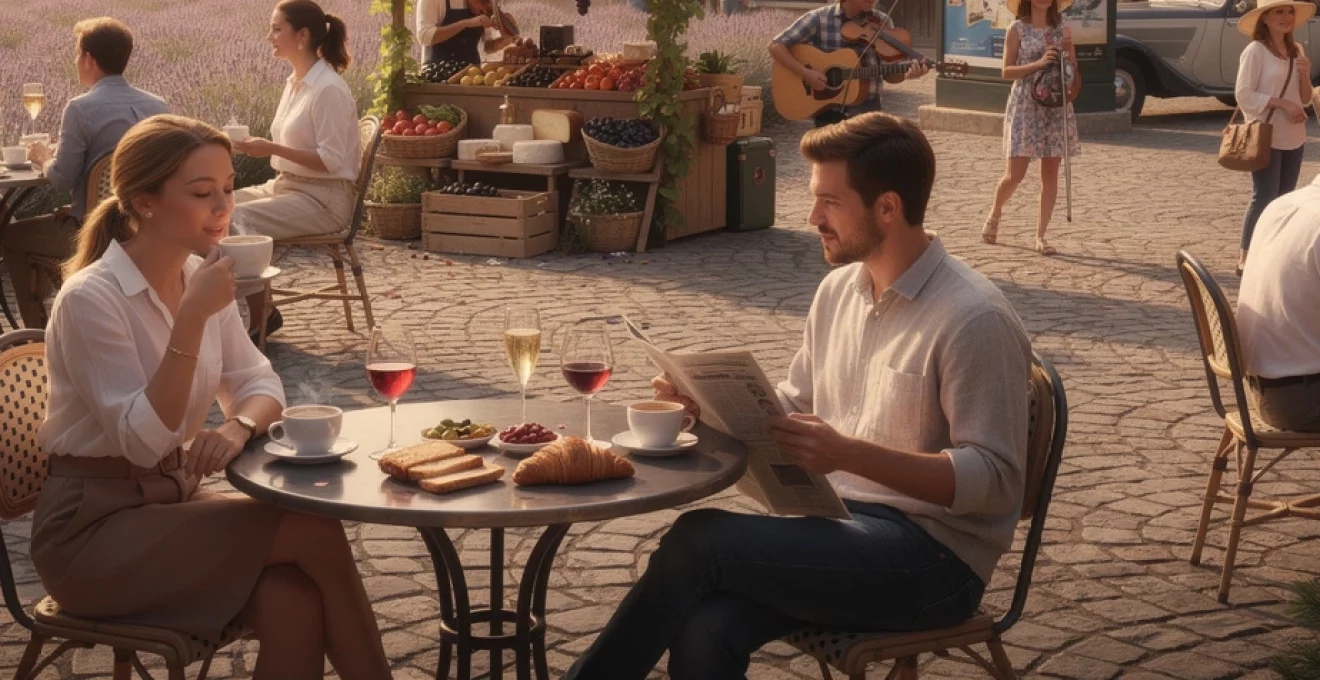
The gentle clink of café cups on cobblestone terraces, the unhurried ritual of selecting the perfect baguette, the sacred pause of apéritif hour—these seemingly simple moments form the foundation of French cultural identity. France has mastered an art that much of the world struggles to comprehend: the elevation of ordinary experiences into profound celebrations of existence. This approach to living, deeply embedded in French society, transforms daily routines into meaningful ceremonies that honour both individual wellbeing and community connection.
While many cultures rush through their days, the French have cultivated a sophisticated understanding of temporal luxury—the recognition that time itself is a precious resource to be savoured rather than consumed. This philosophy manifests in countless micro-celebrations throughout French life, from the morning market ritual to evening neighbourhood gatherings. Each moment becomes an opportunity to engage with beauty, community, and the sensory richness of human experience. The French approach reveals that celebration need not require special occasions; instead, it emerges from mindful attention to the present and deliberate cultivation of joy within everyday experiences.
L’art de vivre: traditional french rituals for daily celebrations
The concept of l’art de vivre—the art of living well—permeates French culture through carefully maintained daily rituals that transform routine activities into celebratory moments. These practices reflect centuries of cultural refinement, where French society has developed sophisticated methods for extracting maximum pleasure and meaning from ordinary experiences. Understanding these rituals provides insight into how French communities have successfully maintained their distinctive approach to life satisfaction despite modern pressures.
Le Petit-Déjeuner rituel: croissant culture and morning mindfulness
The French morning begins not with hurried consumption but with deliberate ceremony. The traditional petit-déjeuner represents more than mere breakfast; it establishes the day’s rhythmic foundation through careful attention to quality, presentation, and temporal boundaries. French families gather around tables set with proper cups, cloth napkins, and freshly procured pastries, creating a sacred space that separates night’s rest from day’s activities.
This morning ritual demonstrates the French mastery of what psychologists term “mindful consumption.” Rather than eating whilst multitasking, French breakfast culture encourages full sensory engagement with food’s textures, aromas, and flavours. The buttery layers of a croissant become an opportunity for appreciation, whilst the bitter complexity of café au lait provides a moment of contemplative pause. Such practices cultivate what researchers identify as “positive emotional regulation”—the ability to generate satisfaction from simple experiences.
Apéritif hour: sacred evening transition ceremonies
Perhaps no French tradition better exemplifies the celebration of small moments than the evening apéritif hour. This practice, observed across France’s diverse regions, creates a formal boundary between work and leisure whilst establishing community connection through shared ritual. The apéritif serves multiple psychological functions: stress reduction, social bonding, and the deliberate cultivation of anticipation for the evening meal ahead.
The apéritif hour represents a masterclass in temporal architecture, where French communities have created a structured pause that honours both individual transition and collective gathering.
During apéritif hour, French neighbours gather on terraces, in cafés, or within private gardens to share simple refreshments—perhaps a glass of pastis, small plates of olives, or regional specialities like tapenade. The conversation flows unhurriedly, touching on daily observations, local news, or philosophical musings. This practice demonstrates how French culture has institutionalised what modern wellness experts advocate: the importance of regular social connection and stress-reduction practices embedded within daily routines.
Sunday market philosophy: weekly community gathering traditions
French markets represent far more than commercial transactions; they function as weekly community celebrations where relationships, traditions, and seasonal awareness converge. The Sunday market experience embodies the French approach to slow commerce—purchasing decisions made through conversation, sensory evaluation, and relationship building rather than efficiency optimization.
Market vendors become cultural educators, sharing knowledge about seasonal produce, preparation techniques, and regional variations. Customers engage in what anthropologists term “social foraging”—gathering not only provisions but also information, gossip, and community connection. Children learn through observation how to evaluate cheese ripeness
and freshness, why certain fruits only appear for a few precious weeks, and how climate has shaped local recipes. In this way, the simple act of buying tomatoes or chèvre becomes a living lesson in geography, ecology, and heritage. For many French people, the ritualised Sunday market stroll is less about efficiency and more about reaffirming their place within a wider community web.
The Sunday market philosophy also highlights a core dimension of French lifestyle: the deliberate embrace of imperfection and spontaneity. Produce may be oddly shaped, availability changes with the weather, and conversations can lengthen shopping time considerably. Yet these variables are not seen as inconveniences but as essential ingredients of the experience. By accepting that not everything can be planned or standardised, the French open space for pleasant surprises—an unfamiliar cheese, a new recipe suggestion, or an impromptu coffee with a neighbour.
Café terrace sociology: public space contemplation practices
Café terraces function in France as semi-public living rooms, bridging the gap between private life and civic engagement. Sitting at a café table, facing the street rather than one’s companions, is a deliberate social posture: you are both participant and observer. Sociologists describe this as “informal urban theatre,” where everyday life becomes a spectacle to be quietly appreciated rather than rushed past.
On a practical level, the café terrace creates structured opportunities for reflection that many of us rarely schedule into our daily lives. With a single espresso or a glass of wine as a modest ticket to occupy the space, people read, write, think, and watch the city unfold. This form of public contemplation allows individuals to feel connected to the rhythm of their neighbourhood without the pressure of constant interaction. In an age of digital distraction, this analogue form of people-watching offers a powerful reminder that presence itself can be a celebration.
Café culture also democratises celebration. One does not need a special event, large budget, or elaborate plan to enjoy an hour at a terrace. Students, retirees, professionals, and tourists all share the same pavement and the same slow unfolding of time. The French understanding of how to celebrate life’s small moments is embedded here: joy is found not only in exceptional experiences, but in ordinary afternoons where nothing “happens” except the quiet pleasure of being.
French seasonal celebration methodologies throughout the calendar year
Beyond daily rituals, French culture structures the year through a series of seasonal celebrations that anchor communities in natural cycles. Rather than viewing the calendar as a neutral grid of workdays, the French imbue each season with distinctive festivities, foods, and communal practices. These cyclical celebrations create what anthropologists call “temporal landmarks”—predictable moments that shape memory and provide emotional orientation throughout the year.
From the grape harvest to summer holidays and winter markets, each period invites specific forms of joy and togetherness. Interestingly, many of these seasonal celebration methodologies emerged long before modern wellness trends, yet they align closely with contemporary research on happiness: regular breaks, outdoor time, social connection, and sensory richness. By observing how the French move through their calendar, we gain a blueprint for structuring our own year around intentional micro-celebrations rather than endless productivity.
Vendange period: harvest season community bonding techniques
The autumnal vendange, or grape harvest, is one of the most emblematic examples of French seasonal celebration. In wine regions from Bordeaux to Burgundy and Alsace, villages reorient their entire rhythm around the vines. The harvest is physically demanding, yet it is also festive, punctuated by shared meals, songs, and jokes between rows of grapes. For many participants, the reward is as much social as economic.
Community bonding techniques during the vendange are subtle but effective. Mixed teams of family members, seasonal workers, and friends work side by side, flattening social hierarchies for the duration of the harvest. Long tables are laid outdoors for midday meals, where the conversation ranges from weather patterns to village gossip. Newcomers quickly learn that they are not merely labourers but temporary members of a close-knit community. This creates powerful memories: studies in rural sociology show that participation in traditional harvests increases individuals’ sense of belonging and place attachment.
For visitors, many domaines now offer adapted versions of the vendange experience, allowing you to spend a day picking, tasting freshly pressed juice, and sharing a communal meal. While these experiences may be curated, they still convey a core French principle: hard work can itself be a celebration when framed by good food, collective effort, and an awareness of seasonal change. It raises a useful question for all of us: where in our own calendar might we transform necessary effort into shared ritual?
Fête de la musique: nationwide cultural expression frameworks
Every 21 June, the Fête de la Musique turns towns and cities across France into open-air concert halls. Originating in 1982 as a Ministry of Culture initiative, this nationwide event invites both professional and amateur musicians to perform freely in public spaces. Streets, squares, church steps, and even hospital courtyards become stages, creating an impressive framework for spontaneous cultural expression.
The structure of the Fête de la Musique is deliberately decentralised. While municipalities coordinate basic logistics, most performances are self-organised, reflecting a belief that culture thrives when citizens are co-creators rather than passive audiences. You might encounter a conservatory string quartet on one corner and a teenage rock band on the next, each contributing to a polyphonic celebration of creativity. Participation is the priority, not perfection.
This celebration methodology offers several lessons. First, it lowers barriers to artistic expression: music is no longer confined to ticketed venues but returned to the streets where everyday life unfolds. Second, it embodies the French conviction that culture is a public good, to be shared widely and freely. And finally, it demonstrates how a single date can unify the country while allowing extreme local variation—a jazz trio in Paris, folk songs in Brittany, electro in Lyon. For anyone seeking to celebrate life’s small moments, the Fête de la Musique suggests that giving space to everyday creativity may be as important as consuming polished performances.
Les vacances d’été: summer break leisure philosophy implementation
Perhaps no French institution is as misunderstood abroad as the long summer holiday. Les vacances d’été, often stretching for several weeks, are not simply extended tourism; they represent a national philosophy of rest, reconnection, and rebalancing. When shops close for much of August and offices operate with skeletal staff, it is a collective affirmation that leisure is not a luxury but a structural necessity.
The implementation of this leisure philosophy is both practical and symbolic. Families return to the same seaside town or mountain village year after year, creating intergenerational traditions that act as emotional anchors. Children build sandcastles with cousins they may only see in summer, while adults engage in slow activities—reading, walking, long meals—that are often sidelined during the rest of the year. Sociological surveys regularly show that French people rank these recurring summer rituals among their most cherished memories, regardless of budget or destination.
From an analytical perspective, les vacances function as a large-scale reset for the entire society. By pausing work en masse, France creates a shared temporal horizon: you know that your colleagues, neighbours, and even public institutions are also in a slower rhythm. This reduces the guilt or anxiety that can accompany taking time off in more work-centric cultures. For those of us outside France, the key takeaway is not necessarily the duration of the holiday, but the intentionality: can we ring-fence time where rest and simple pleasures are treated as non-negotiable, communal values rather than individual indulgences?
Marché de noël traditions: winter solstice commercial celebration models
As winter approaches, French towns illuminate their streets and squares with marchés de Noël, or Christmas markets, that blend commerce with ritual. Originating in Alsace and influenced by neighbouring German traditions, these markets now appear across the country, each with regional nuances. Wooden chalets offer handcrafted gifts, mulled wine, roasted chestnuts, and seasonal pastries, turning ordinary public spaces into temporary festive villages.
From a cultural perspective, the marché de Noël represents a distinctive commercial celebration model. It reframes shopping as an experiential, sensory activity rather than a purely transactional one. Families stroll together, children ride carousels, and friends meet for hot chocolate under strings of lights. Even those who buy little still gain the emotional benefits of shared atmosphere and seasonal anticipation. Urban planners note that these markets strengthen city-centre vitality at a time of year when cold and early darkness might otherwise discourage lingering outside.
Crucially, the French approach often resists excessive spectacle in favour of warmth and intimacy. Rather than prioritising enormous installations, many markets focus on regional products—Alsatian bredele biscuits, Provençal figurines for nativity scenes, or Savoyard cheeses. This local emphasis transforms year-end consumption into an act of cultural continuity. For anyone eager to celebrate the winter season more meaningfully, the French model suggests shifting focus from volume of purchases to quality of atmosphere and connection.
Regional french micro-celebration techniques across metropolitan territories
France may be a unified republic, but its celebration styles are profoundly regional. Each territory layers national customs with local micro-rituals, shaped by climate, history, and geography. Understanding how Provence, Alsace, Brittany, or the Loire Valley celebrate life’s small moments reveals that there is no single “French way” to enjoy life—rather, there is a shared philosophy expressed in diverse forms.
These regional micro-celebrations demonstrate what cultural theorists call “glocalisation”: universal values (like conviviality and beauty) interpreted through specific local resources. Lavender fields become stages for festivals; rugged coastlines frame maritime gatherings; Renaissance châteaux host garden soirées. For travellers and residents alike, paying attention to these nuances transforms a simple trip into an immersive exploration of how different communities enact their art of living.
Provence lavender festival customs: sensory experience cultivation
In Provence, the lavender season from late June to early August is not only a visual spectacle but a carefully cultivated sensory celebration. Villages such as Valensole or Sault host lavender festivals where stalls sell soaps, oils, and honey, and parades honour the plant that has shaped local identity for centuries. The air is saturated with scent, creating a rare alignment of sight, smell, and touch.
These festivals illustrate the French talent for transforming agricultural cycles into multi-sensory rituals. Demonstrations of traditional distillation techniques invite visitors to witness the transformation from plant to essential oil, connecting them with the craftsmanship behind everyday products. Music, folk dances, and communal meals extend the experience beyond simple tourism, engaging the body and emotions. It is a reminder that celebrating small moments can involve deliberately amplifying one sense—here, smell—to anchor memory and presence.
On a practical level, Provence’s lavender customs also highlight sustainable celebration strategies. Many producers emphasise organic cultivation and biodiversity, understanding that the long-term survival of their signature crop depends on ecological care. For those of us outside France, the lesson is twofold: first, that sensory focus (lighting a particular candle, using a favourite soap) can turn daily routines into rituals; and second, that our most meaningful celebrations are often rooted in respectful relationships with local landscapes.
Alsatian wine route ceremonies: terroir-based celebration systems
In Alsace, the famed Route des Vins weaves through storybook villages, vineyards, and half-timbered houses. Along this route, micro-celebrations punctuate the year: harvest festivals, cellar open days, and tasting events linked to specific grape varieties. Each village cultivates its own iteration of a terroir-based celebration system, showcasing how geology, climate, and human skill converge in the glass.
These ceremonies are structured to deepen visitors’ and locals’ understanding of place. Guided tastings often include discussions of soil composition, exposure, and historical vineyard classifications, turning pleasure into informal education. Yet the atmosphere remains relaxed, anchored by shared platters of tarte flambée or local charcuterie. The result is an elegant balance between expertise and conviviality: wine is taken seriously, but never solemnly.
In many ways, the Alsatian wine route is a living example of how to celebrate everyday luxuries with intention. Rather than drinking mindlessly, participants learn to pay attention— to texture, aroma, and story. This mindful consumption parallels practices in other areas of French life, from coffee to cheese. If we apply this approach at home, even a simple glass of wine or piece of chocolate can become a micro-ceremony when we know and honour its origins.
Brittany coastal gathering protocols: maritime community connection methods
On the rougher coasts of Brittany, celebration often gathers around the sea. Coastal villages maintain customs such as blessing-of-the-boats ceremonies, seafood festivals, and informal gatherings on the quay when the day’s catch comes in. These practices function as maritime community connection methods, reinforcing the bond between residents and the waters that sustain them.
Protocols at these gatherings blend practicality and symbolism. Fishermen share weather updates and safety advice alongside stories of storms and near-misses. Families teach children how to recognise different shellfish or tie basic knots. Shared meals—platters of oysters, bowls of fish soup, butter-heavy crêpes—turn potentially harsh landscapes into spaces of comfort and warmth. As in many French contexts, food is the glue that binds individuals into a collective.
For visitors, participating respectfully in these coastal rituals can transform a simple seaside walk into a cultural encounter. Observing how Bretons watch the tide, read the sky, or discuss the quality of seaweed reveals a level of environmental awareness that urban dwellers may have lost. It suggests that one way to celebrate life’s small moments is to deepen our relationship with the elements around us—whether ocean, forest, or city park—and to share that awareness within our own communities.
Loire valley château garden party etiquette: aristocratic leisure traditions
The Loire Valley, dotted with Renaissance châteaux and manicured gardens, preserves another facet of French celebration culture: aristocratic leisure traditions. While modern life has democratised many aspects of society, garden parties, open-air concerts, and summer evening picnics on château lawns still evoke a refined approach to enjoying time. Here, the micro-celebration is less about spectacle and more about setting.
Garden party etiquette in this context emphasises elegance without ostentation. Guests may dress neatly but comfortably, arriving with simple yet carefully chosen picnic baskets: a bottle of local wine, a crusty baguette, a well-selected cheese. The focus lies on conversation, strolling through topiary-lined paths, and watching the changing light on stone façades. It is less an escape from everyday life than an amplified version of it, where the same values—good food, good company, meaningful surroundings—are simply given more space.
For those inspired by this aristocratic heritage, you do not need a château to adopt its underlying principles. Setting a table outside, using your “good” plates on an ordinary weeknight, or arranging fresh flowers can recreate the feeling of occasion. The Loire teaches that beauty is not frivolous; it is a framework that helps us pay attention. When we surround ourselves with thoughtfully arranged environments, we are more likely to notice and celebrate the fleeting, delicate moments that compose our days.
French culinary micro-moment celebration strategies
Culinary culture sits at the heart of how the French celebrate life’s small moments. Yet contrary to stereotypes, this is not only about elaborate restaurant meals or complex recipes. Many of the most meaningful celebrations occur in what we might call “culinary micro-moments”: the choice of a particular cheese, the way bread is sliced and shared, or the decision to pause for dessert even on an ordinary Tuesday.
French culinary micro-moment strategies rest on three pillars: quality, ritual, and sharing. Quality does not always mean expensive, but it does mean considered—choosing seasonal fruit at its peak, a simple yogurt from a known producer, or dark chocolate with a satisfying snap. Ritual appears in the repetition of small behaviours: setting a table even when alone, serving cheese as a separate course, offering coffee after a meal as a gentle transition. Sharing need not involve large groups; even dividing a pastry between two people turns eating into an act of connection rather than consumption.
One useful way to visualise these strategies is to imagine each meal as a series of “frames” in a film. Instead of blending everything together, the French often create distinct moments: the apéritif, the entrée, the main course, the cheese, the dessert, the coffee. Each frame invites a small reset—a chance to check in with hunger, mood, and conversation. This segmentation, supported by research on mindful eating, can reduce overconsumption while increasing satisfaction. It is an approach anyone can experiment with: serving dinner in two simple courses instead of one, or pausing briefly between dishes to reflect on taste and company.
Social architecture of french neighbourhood celebration networks
Underlying all these rituals is a less visible but crucial layer: the social architecture that makes celebration possible. French neighbourhoods often function as informal networks of mutual recognition and support. The boulanger knows regular customers by name; the café owner remembers preferred drinks; neighbours exchange brief greetings or stop for short conversations. These micro-interactions accumulate into what sociologists call “social capital”—trust, reciprocity, and a sense of belonging.
Celebration networks emerge from this dense web of light connections. Because people see each other regularly in markets, schools, and public spaces, it becomes natural to organise collective events: street apéritifs, courtyard barbecues, book exchanges, or shared childcare arrangements. Many buildings in cities like Paris host annual fête des voisins (Neighbours’ Day) gatherings in their courtyards or on the pavement, where residents bring dishes and drinks to share. Even when participation is modest, these events signal that everyday cohabitation can extend into genuine community.
Interestingly, this social architecture does not require everyone to be best friends; respect and regular contact are sufficient foundations. For readers wondering how to recreate French-style celebration networks elsewhere, a gradual approach works best. Start by frequenting the same local businesses, learning a few names, and initiating small rituals (a weekly coffee at the same time, a brief chat with a neighbour about shared concerns). Over time, these threads can be woven into more intentional gatherings. Think of it as designing the “infrastructure” of joy: the more bridges between people, the easier it becomes to celebrate together.
Contemporary digital integration with traditional french celebration frameworks
As in the rest of the world, digital technologies have reshaped daily life in France. Yet what is striking is how often they are used to support, rather than replace, traditional celebration frameworks. Neighbourhood WhatsApp groups coordinate in-person apéritifs; Instagram accounts highlight local markets and artisans; online booking platforms make it easier to attend small concerts or workshops. The digital layer functions as an amplifier and organiser for offline joy.
Of course, there are tensions. Smartphones can intrude on the very moments meant to be savoured, and French commentators regularly debate the impact of screens on café culture and family meals. However, many people consciously negotiate these boundaries: phones are kept off the table during dinner, or used briefly to photograph a beautiful dish before being set aside. The prevailing aim is integration rather than domination—technology as tool, not master.
From a methodological perspective, we might think of this as “blended celebration design.” Digital tools handle logistics—finding a time that suits everyone, sharing directions, discovering events—while the substance of celebration remains resolutely embodied and local. For you as a reader, the opportunity lies in adopting this selective approach. Use apps to discover your city’s markets or concerts, to follow accounts that celebrate slow living, or to maintain contact with faraway friends. Then, when the moment of gathering arrives, allow yourself the French luxury of undivided attention. In doing so, you participate in a contemporary evolution of l’art de vivre: honouring timeless rituals while adapting them to the realities of modern life.