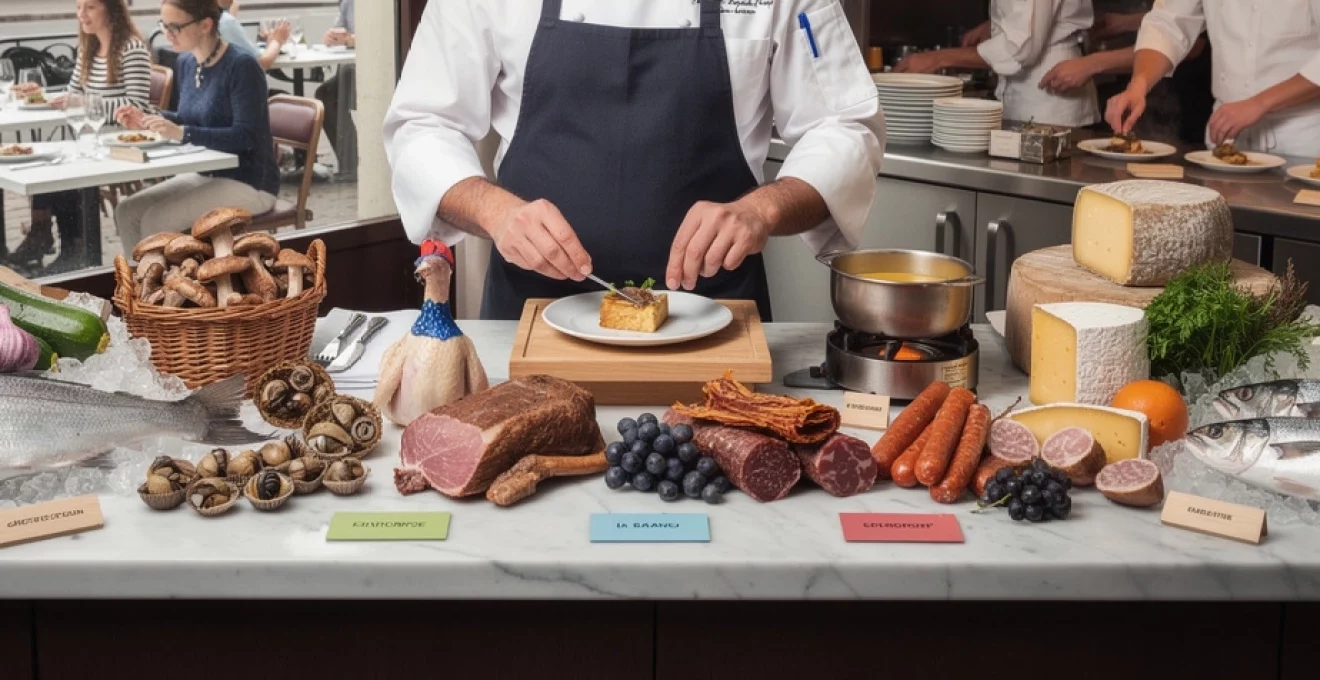
French gastronomy has long held an unshakeable position as the world’s most influential culinary tradition, and at its core lies a profound respect for seasonal ingredients. This isn’t merely a trendy farm-to-table movement or marketing gimmick—it represents centuries of culinary philosophy deeply rooted in the concept of terroir and the natural rhythm of agricultural cycles. From the bustling stalls of Rungis Market at dawn to the meticulously plated dishes emerging from Michelin-starred kitchens, seasonality dictates not just what appears on French menus, but fundamentally shapes how restaurants operate, how chefs innovate, and how diners experience French cuisine. The seasonal menu isn’t simply a practical consideration in French restaurant culture; it’s an expression of national identity, regional pride, and culinary excellence that separates authentic French dining from mere imitation.
La saisonnalité culinaire: foundation of french gastronomic philosophy
The French approach to seasonal eating extends far beyond contemporary sustainability concerns. It represents a gastronomic philosophy codified over centuries, where the quality and flavour of ingredients at their peak ripeness take precedence over year-round availability. This principle, known as saisonnalité culinaire, fundamentally differentiates French restaurant culture from the globalized food systems prevalent elsewhere. When you dine at a traditional French establishment, the absence of tomatoes in winter or asparagus in autumn isn’t an oversight—it’s a deliberate statement of culinary integrity.
This seasonal discipline creates a unique dining dynamic. French diners don’t expect to find the same dishes year-round; instead, they anticipate the arrival of specific ingredients with genuine excitement. The first white asparagus of spring, the summer cherries from Provence, the autumn game from the forests, the winter truffles from Périgord—each season brings its celebrated arrivals. This cyclical approach transforms dining into a temporal experience, connecting diners to the natural world and agricultural calendars in ways that frozen, imported alternatives simply cannot replicate.
UNESCO’s recognition of the French gastronomic meal as intangible cultural heritage in 2010 specifically highlighted this seasonal dimension. The designation acknowledged that French dining culture involves selecting products according to the seasons and matching wines appropriately—practices that distinguish it from merely eating well. Statistics from France AgriMer indicate that approximately 73% of French consumers consider seasonality an important factor when dining out, compared to just 48% in other European markets. This cultural expectation creates both challenges and opportunities for restaurant operators who must constantly adapt their offerings while maintaining quality standards.
Terroir-driven menu engineering in Michelin-Starred establishments
Elite French restaurants have transformed seasonal menu development into a precise science, balancing creativity, logistical complexity, and economic viability. The engineering behind these quarterly rotations involves sophisticated planning that begins months before ingredients reach the kitchen. Menu development in Michelin-starred establishments isn’t spontaneous improvisation—it requires strategic thinking about supplier relationships, staff capabilities, and customer expectations while maintaining the artistic vision that earns coveted stars.
Alain ducasse’s Market-to-Table rotation strategy at plaza athénée
Alain Ducasse’s revolutionary “naturalité” philosophy at Le Plaza Athénée exemplifies how seasonal thinking can redefine haute cuisine. When Ducasse restructured the restaurant’s menu in 2014, he eliminated meat entirely, focusing exclusively on fish, vegetables, and grains—each selected at peak seasonality. This wasn’t merely about health trends; it represented a return to essential flavours and a challenge to the traditional protein-centric French fine dining model. The kitchen now works with over 60 specialized suppliers, each providing ingredients during their optimal seasons.
This approach requires extraordinary coordination. The restaurant’s brigade receives daily market reports and adjusts preparations accordingly. If the sea bass quality drops unexpectedly, the team pivots to alternative species within hours. This flexibility demands highly trained staff who understand not just recipes, but the underlying principles of flavour pairing and technique application. The economic model also shifts—rather than negotiating annual contracts at fixed prices, the restaurant accepts market fluctuations in exchange for guaranteed peak quality, a calculated risk that pays dividends in customer satisfaction and critical acclaim.
Seasonal sourcing networks:
Seasonal sourcing networks for Parisian fine-dining restaurants extend far beyond a single farm or fishmonger. At the centre sits the vast Marché de Rungis, just south of Paris, often described as the beating heart of French restaurant supply. Covering more than 230 hectares and hosting over 1,200 companies, Rungis allows chefs to access hyper-seasonal produce—from first-of-season morels to late-summer stone fruit—within hours of harvest. For a restaurant like Plaza Athénée, dedicated buyers visit the market before dawn, selecting based on ripeness, aroma, and visual quality rather than simply on price or volume.
But the most respected seasonal menus never rely solely on Rungis. Ducasse’s teams cultivate direct relationships with small-scale producers across France: line fishermen in Brittany, vegetable growers in Provence, cereal producers in the Beauce, and foragers in the Drôme. These regional networks allow the restaurant to secure limited micro-seasons—like wild asparagus that may only be available for two weeks—creating dishes that cannot be replicated outside a precise calendar window. In this sense, seasonal menus become a cartography of French terroirs, with each supplier contributing a distinct chapter to the restaurant’s evolving story.
Building and maintaining these sourcing networks demands long-term trust and logistical discipline. Chefs must anticipate when producers will reach their peak output, commit to purchasing volumes in advance, and adapt menus when weather disrupts harvests. For operators outside France looking to “eat like the French” in their own markets, the lesson is clear: seasonal menus depend less on one large distributor and more on a mosaic of specialized partners aligned with the restaurant’s calendar.
Menu costing and yield management for quarterly rotations
The romance of seasonal menus often hides a harsher reality: constant change can wreak havoc on margins if not managed with precision. In Michelin-starred French restaurants, menu costing for quarterly—or even monthly—rotations is handled almost like financial portfolio management. Each new ingredient is evaluated not only for flavour and prestige, but for yield, trim loss, and price volatility across the season. A spring menu built around white asparagus, for example, must consider that up to 30% of the stalk weight is discarded in preparation.
To maintain profitability, chefs and F&B directors work with detailed costing sheets that link each dish to its ingredient seasonality curve. Early-season produce tends to be scarce and expensive, with prices dropping at peak harvest before rising again as supply diminishes. Smart French restaurants design dishes that can subtly evolve with this curve: initial menus might feature smaller portions or supporting ingredients with lower cost, before shifting to more generous servings when prices stabilise. By the time scarcity returns, the dish is often phased out in favour of the next seasonal highlight.
Yield management in seasonal French cuisine also involves cross-utilisation. Trimmings from filleted fish may become rillettes for an amuse-bouche; offcuts from prime vegetables can be turned into veloutés or garnishes for staff meals. This approach echoes the traditional cuisine de ménage of French households, where nothing is wasted. For restaurateurs implementing seasonal menus, treating each ingredient like a “mini asset” to be fully leveraged across the menu is essential to keep food costs in check while still celebrating seasonality.
Carte des saisons: designing progressive tasting menus
The most emblematic expression of seasonal French restaurant culture is the progressive tasting menu. Rather than offering an extensive, static à la carte, many modern French establishments publish a carte des saisons—a menu that narrates the current moment in the agricultural year. Courses are sequenced to mirror the rhythm of a meal and the arc of the season, often moving from raw and delicate preparations to richer, more comforting dishes, before returning to brightness with fruit-led desserts.
Designing these seasonal tasting menus involves more than simply listing ingredients that happen to be available. Chefs consider how the progression should feel for the diner: early-spring menus lean into bitter greens, young roots, and the first fragile herbs; autumn compositions foreground umami, woodland aromas, and slow-cooked textures. Wine pairings are structured accordingly, drawing on appellations whose own production cycles resonate with the plate—Chablis with oysters in winter, robust Rhône reds with game in November.
For chefs, the carte des saisons is both a creative constraint and a storytelling device. Limited ingredient palettes push them to rediscover forgotten vegetables, heritage grains, and underused fish species. For diners, returning several times a year offers an entirely different experience, reinforcing loyalty and deepening their understanding of French seasonal gastronomy. If you are building your own restaurant menu, thinking in terms of “chapters of the year” rather than fixed signatures can be a powerful way to keep your offer alive and culturally grounded.
Regional seasonal cycles across french culinary landscapes
While Paris may be the showcase of French restaurant culture, the logic of seasonal menus truly comes to life when you consider France’s regions. Each area follows its own agricultural and climatic rhythm, which in turn dictates how local restaurants structure their offerings. You could travel from Provence to Burgundy, then up to the Alps and across to the Loire, and experience four entirely different expressions of the same season. This regional seasonality is one of the reasons French cuisine still feels so varied despite a shared national canon.
Understanding these regional cycles is crucial for chefs designing “tour de France” menus, as well as for travellers who want to dine like locals rather than tourists. Should you order bouillabaisse in January or wait until the Mediterranean’s late-summer bounty? Is there a right month for Bresse chicken, or for Loire asparagus? By looking at how regional restaurants answer these questions, we see how deeply seasonality shapes both daily operations and long-term culinary identity.
Provençal summer menus: bouillabaisse variations and mediterranean harvests
In Provence, summer is not just a season; it’s a full sensory experience. Coastal restaurants from Marseille to Cassis build their menus around Mediterranean fish, ripe tomatoes, fragrant basil, and sun-soaked stone fruits. The most iconic example is bouillabaisse, the fisherman’s stew that has become a litmus test for authenticity in Provençal dining. True bouillabaisse is resolutely seasonal: it relies on small rockfish and gurnard that are most plentiful in warmer months, along with ripe tomatoes and fennel that give the broth its characteristic depth.
Many Provençal chefs now play with “deconstructed” or modernised bouillabaisse, yet they remain faithful to its seasonal logic. You might see chilled versions in the height of August heat, or tasting portions paired with rosé from Bandol during terrace lunches. Around this anchor dish, summer menus highlight stuffed vegetables (petits farcis), grilled sardines, and salads loaded with local olives and goat’s cheese. Dessert often celebrates the apricot and peach harvest, sometimes preserved as sorbets or compotes to extend the taste of summer into early autumn.
For restaurant owners outside France inspired by this model, the key takeaway is not to copy bouillabaisse itself, but to identify your own “hero dish” that crystallises local summer produce. Just as Provençal chefs align their entire offer with the Mediterranean harvest, you can build your seasonal menu around one or two emblematic preparations that tell the story of your region at its sunniest moment.
Burgundian autumn offerings: escargot, game, and bresse chicken preparations
If Provence is the flavour of summer, Burgundy is the undisputed kingdom of autumn. As temperatures drop and vineyards blaze orange and gold, restaurant menus shift decisively toward earthier, more opulent dishes. Escargots bathed in garlic-parsley butter reappear as a staple starter, symbolising both local terroir and the return of comfort food. Game—hare, venison, wild boar—features prominently in slow-cooked stews, often perfumed with red wine from nearby appellations such as Gevrey-Chambertin or Pommard.
Perhaps no product captures Burgundian seasonal pride more than Bresse chicken, considered by many chefs to be the finest poultry in the world. While Bresse is technically in neighbouring Ain, its birds are deeply integrated into Burgundy’s gastronomic landscape. Autumn and winter are prime periods for richer preparations: poulet de Bresse à la crème, with mushrooms and vin jaune, or roasted whole birds carved at the table. These dishes are rarely seen in the same form in spring or summer; chefs respect the calendar of both animal rearing and diner appetite.
For menu planners, Burgundy illustrates how a region’s seasonal menu can orbit around a few iconic ingredients without feeling repetitive. Escargot, game, and Bresse chicken appear year after year, but the garnishes, sauces, and plating evolve with contemporary tastes. This balance between permanence and seasonal nuance is a central pillar of French restaurant culture and a useful model for any regionally focused concept.
Alpine winter cuisine: savoyard fondue culture and preserved mountain products
Head east to the French Alps, and winter menus tell a story of survival, ingenuity, and conviviality. In Savoie and Haute-Savoie, restaurant culture has long been shaped by the need to endure long, snowy months with limited fresh produce. The solution was preservation: cheese, cured meats, and potatoes became the backbone of mountain cuisine. Dishes like fondue savoyarde, raclette, and tartiflette now define the Alpine winter dining experience, particularly in ski resorts where visitors expect hearty, shareable meals after a day on the slopes.
From a seasonal perspective, these dishes represent a clever inversion of the farm-to-table logic: instead of celebrating what is just harvested, they highlight what was preserved at peak quality months earlier. Cheeses such as Beaufort and Abondance are produced in high pastures during the summer, then aged until winter. When they finally hit restaurant tables, they still express the flora of Alpine meadows, but in concentrated form. This time lag shows that seasonality in French cuisine is not only about immediacy; it is also about understanding when preserved products reach their ideal maturity.
Operationally, Alpine restaurants illustrate how seasonal menus can be built around a relatively narrow ingredient palette while still delivering variety. One establishment might serve fondue with different cheese blends, raclette with distinct charcuterie selections, or tartiflette variations featuring smoked trout instead of bacon. The result is a winter menu that feels both anchored in tradition and responsive to modern dietary preferences, without ever losing its seasonal soul.
Loire valley spring specialities: asparagus, shad, and early season vegetables
The Loire Valley, often called the “Garden of France,” comes into its own each spring. As the river emerges from winter floods, restaurants along its banks pivot toward delicate, green-forward dishes. White and green asparagus become star ingredients, featured in veloutés, tarts, and simply grilled preparations dressed with vinaigrette or hollandaise. Their relatively short season—usually from April to June—creates a sense of urgency among diners who know they will disappear as quickly as they arrived.
Another seasonal highlight is alose (shad), a migratory fish that returns to the Loire in spring to spawn. Historically abundant, it has become more regulated due to conservation efforts, which makes its presence on menus even more symbolic of spring’s arrival. Chefs may prepare it grilled, stuffed with sorrel, or in more contemporary cured or smoked formats. Alongside these, early peas, radishes, and baby carrots from local farms round out plates with colour and crunch, emphasising freshness over richness.
For restaurants beyond France, the Loire model demonstrates the power of a “spring awakening” menu built around one or two fragile seasonal products. By openly acknowledging the brevity of asparagus or shad season, Loire chefs encourage repeat visits within a narrow window. You can apply this principle by clearly communicating on your own menus which dishes are here “for a few weeks only,” turning agricultural cycles into a compelling marketing narrative rather than a logistical constraint.
Regulatory framework and quality certifications governing seasonal practices
Seasonal French menus are not dictated by chefs alone; they are also shaped by a dense regulatory framework designed to protect quality, authenticity, and environmental resources. Far from being bureaucratic red tape, these rules often act as guardrails that keep seasonal restaurant culture aligned with long-term sustainability. Understanding designations such as AOC, AOP, Label Rouge, and European fishing quotas is essential for any professional who wants to grasp why a particular cheese, poultry, or fish appears on a French menu only at certain times of the year—or not at all.
These certifications and regulations influence everything from when Mont d’Or cheese can be sold, to how long Bresse chickens must be reared, to which days certain species may be landed by small boats. For restaurateurs, compliance is non-negotiable; failure to respect these timeframes can mean legal penalties, damaged reputation, and a loss of trust with an increasingly informed clientele. For diners, however, this framework is largely invisible—they simply experience it as a sense that “things taste right when they are supposed to.”
AOC and AOP designations: temporal restrictions on product availability
The French and European systems of controlled designations—AOC (Appellation d’Origine Contrôlée) and AOP (Appellation d’Origine Protégée)—are often discussed in terms of geography, but they also carry significant temporal implications. Many AOC/AOP products have strict rules governing production periods, maturation times, and even release dates. For example, seasonal cheeses like Mont d’Or (or Vacherin du Haut-Doubs) can only be sold between roughly September and May, as they are made from winter milk and matured for a minimum period before reaching the market.
Similarly, certain AOP goat cheeses from the Loire or Provence have defined production windows aligned with the natural lactation cycles of the animals. This means a restaurant committed to authentic seasonal menus simply cannot offer these cheeses year-round without compromising either legality or quality. Instead, they structure cheese boards to evolve, showcasing young, fresh cheeses in spring, semi-hard varieties in summer, and more robust, aged options in winter.
For chefs, learning the “calendar within the label” is as important as knowing the flavour profiles themselves. If you aim to bring elements of French-style seasonality into your own operation, you might not use AOP products, but you can still adopt the underlying principle: respect the natural cycle of production and maturation, and allow it to dictate when items appear on the menu.
Label rouge standards for seasonal poultry and livestock
Label Rouge, France’s prestigious quality mark for agricultural products, plays a key role in shaping the seasonal rhythm of meat and poultry on restaurant menus. Unlike generic industrial production, Label Rouge schemes set minimum rearing periods, outdoor access requirements, stocking densities, and feed standards. Chickens, for instance, must be raised significantly longer than their industrial counterparts—often 81 days or more—which inherently creates a slower, more seasonal production cycle.
This extended timeline has direct operational consequences. A chef who wants Label Rouge poultry for a special Christmas menu must coordinate orders months in advance, aligning slaughter dates with planned dishes. In some regions, seasonal demand spikes—like the end-of-year rush for capons and turkeys—are balanced by lower output at other times. This ebb and flow discourages year-round overconsumption and nudges restaurants toward rotating preparations as animals reach their ideal age and weight.
From a menu-planning perspective, Label Rouge standards serve as both a guarantee and a constraint. You gain superior flavour and stronger marketing credibility, but you also accept that you cannot endlessly scale or de-seasonalise your meat offer. For many French restaurateurs, this trade-off is precisely what keeps their cuisine honest and aligned with the broader ethos of saisonnalité culinaire.
European fishing quotas impact on coastal restaurant menus
Nowhere is the intersection of regulation and seasonal menus more visible than in French coastal restaurants, where European fishing quotas and local bans dictate what can be served from week to week. Quotas for species like cod, hake, and sole are set annually at EU level, with further regional restrictions on mesh size, fishing zones, and closed seasons. On top of that, temporary bans may be implemented to protect spawning periods or fragile stocks, dramatically altering what lands at the fish market on any given morning.
For chefs in Brittany, Normandy, or the Mediterranean coast, these rules are not abstract policy—they directly determine daily blackboard specials. A bistro in Saint-Malo might feature line-caught sea bass in late summer, then pivot to mackerel and shellfish as quotas tighten or weather conditions change. In Marseille, certain rockfish essential for traditional bouillabaisse may be subject to stricter limits, encouraging chefs to innovate with lesser-known species while still respecting the dish’s character.
If you have ever wondered why French menus often specify “according to arrival” (selon arrivage) next to fish dishes, this is the regulatory reality behind the phrase. For restaurant operators outside the EU, adopting a similar flexible wording can be a practical way to manage expectations while committing to responsible, quasi-seasonal seafood sourcing in your own context.
Chef-driven seasonal innovation in contemporary french bistronomy
Over the past 15 years, a new generation of French chefs has reinterpreted seasonality through the lens of bistronomie—a hybrid style that blends bistro conviviality with gastronomic ambition. These chef-owners run smaller dining rooms, work with tighter teams, and change their menus at an almost frenetic pace, sometimes daily. Rather than relying on the static signatures of classic brasseries, they place seasonal products at the centre of constantly evolving small plates, encouraging diners to return often to taste the latest iteration of a favourite ingredient.
This movement has had a profound impact on how seasonality shapes French restaurant culture. Paris addresses like Septime, Frenchie, and Le Chateaubriand have shown that you don’t need white tablecloths or three Michelin stars to take seasonal cooking seriously. Instead, they rely on creativity, direct relationships with producers, and agile menu engineering to deliver experiences that feel alive, immediate, and deeply rooted in the present moment of the market.
Bertrand grébaut’s septime: hyper-seasonal small plate methodology
At Septime in eastern Paris, chef Bertrand Grébaut exemplifies hyper-seasonal thinking. His menu is famously concise—often just a handful of starters, mains, and desserts—and can change several times a week depending on what arrives from suppliers. Rather than designing dishes and then ordering ingredients to fit, Grébaut inverts the process: he starts with what small producers bring him and builds the menu outward from there. This “market-first” approach is the logical extreme of French seasonal cuisine, turning the chef into a kind of conductor orchestrating whatever nature provides.
The small plate format is crucial to this methodology. Because portions are moderate and the number of covers limited, Septime can work with tiny quantities of exceptional produce: the last crate of sun-sweetened tomatoes from a biodynamic farm, or a single delivery of wild herbs picked that morning. Once those ingredients are gone, the dish disappears from the menu, sometimes never to return in the same form. For diners, this ephemerality is part of the appeal—it feels less like ordering dinner and more like catching a fleeting performance.
For restaurateurs aspiring to similar agility, the lesson is that a shorter menu and smaller plates can dramatically increase your capacity to work seasonally. Instead of committing to a broad, fixed card that demands large volumes of stable supply, you can narrow your focus and respond quickly to the most inspiring products your network can offer.
Neo-bistro movement: frenchie and le chateaubriand’s daily menu philosophy
The neo-bistro movement—often associated with restaurants like Frenchie (Gregory Marchand) and Le Chateaubriand (Inaki Aizpitarte)—has taken the seasonal philosophy even further by embracing fixed-price daily menus. Rather than letting guests choose among dozens of options, these establishments typically offer a single tasting progression at lunch or dinner, announced just hours beforehand. This model gives chefs maximum control over purchasing, preparation, and waste, all of which are critical when dealing with fragile, short-lived seasonal ingredients.
At Frenchie, for instance, you might find a spring menu that moves from peas and fresh goat cheese to line-caught fish with asparagus, then onto veal with morels, finishing with rhubarb in early May. A fortnight later, the same framework might feature entirely different components as certain products vanish from the market. At Le Chateaubriand, Aizpitarte’s global influences—Latin America, Japan, the Middle East—are channeled through French seasonal produce, proving that respecting the local calendar does not preclude cosmopolitan creativity.
From an operational standpoint, the daily menu philosophy acts like a pressure valve. By cooking only what they have sourced that day, in quantities calibrated to reservations, neo-bistros keep food costs tight and waste minimal. For you as a restaurant operator, even adopting a “chef’s menu” one or two nights a week can be an effective way to experiment with more daring seasonal dishes while limiting financial risk.
Fermentation and preservation techniques for year-round seasonal expression
One challenge of strict seasonality is its inherent brevity: what happens when you want the flavour of peak summer tomatoes in January, or the brightness of spring herbs in late autumn? Contemporary French chefs have increasingly turned to age-old techniques—fermentation, pickling, curing, and lacto-fermentation—to extend the life of seasonal products without resorting to industrial processing. These methods, once associated with peasant frugality, are now central to the flavour vocabulary of modern bistronomy.
At restaurants like Septime, Frenchie, and countless smaller wine bars, you will encounter pickled radishes in winter salads, fermented chilli pastes made from summer peppers, or vinegars infused with spring flowers. These preserved elements act like punctuation marks on the plate, adding acidity, umami, or aromatic complexity where fresh versions would be out of season or inferior. In effect, chefs are “banking” the essence of each season in jars, crocks, and bottles, to be withdrawn strategically throughout the year.
For professionals, the analogy to a larder-based savings account is useful: the more thoughtfully you invest in preservation at peak season, the more creative capital you have to spend during leaner months. Even simple steps—such as making herb oils, quick pickles, or frozen fruit purées when ingredients are abundant—can dramatically expand your ability to maintain a French-style seasonal identity without sacrificing variety in the off-season.
Economic and operational implications of seasonal menu structures
While the cultural and gastronomic arguments for seasonal menus are compelling, their adoption has concrete economic and operational consequences. Changing menus four times a year—or more frequently—demands additional training, tighter inventory control, and careful customer communication. Yet when executed well, this model can actually stabilise costs, improve staff engagement, and increase guest loyalty. The key is to treat seasonality not as a series of ad hoc changes, but as a structured, recurring process woven into the restaurant’s business model.
In France, many successful operators now plan their year around “menu seasons” the way retailers plan around fashion collections. Each quarter has its own product focus, marketing angle, and operational checklist. For you as a restaurateur or chef, thinking in these cycles can help you anticipate rather than react, turning what might seem like constant upheaval into a predictable, even energising, rhythm for your team.
Staff training protocols for quarterly menu transitions
Every new seasonal menu is, in effect, a mini relaunch of the restaurant. Front-of-house and back-of-house teams must learn new dishes, new stories, and sometimes new techniques. In French establishments that take seasonality seriously, training for these transitions is approached with the same rigour as opening a new venue. Kitchen brigades run full tastings and timed services on test days, while service staff attend detailed briefings on ingredient origin, preparation methods, and recommended wine pairings.
Effective training goes beyond memorising dish descriptions. Staff are taught the broader narrative of the menu: why certain products are featured now, what makes this spring different from last year’s, and how the restaurant’s sourcing partners are involved. This empowers servers to answer diners’ questions with confidence and enthusiasm, turning each table interaction into a micro-lesson in seasonal French dining culture. As a result, guests feel part of something dynamic rather than merely consuming food.
If you’re implementing quarterly rotations, consider formalising a “season changeover” protocol: lock in the new menu at least two weeks prior, schedule tasting and briefing sessions, and provide concise written materials for staff to review. Investing in this preparation not only reduces mistakes during service; it also reinforces a sense of shared purpose around your restaurant’s seasonal identity.
Inventory management systems for perishable seasonal ingredients
Seasonal menus hinge on perishable, often fragile ingredients that have a narrow window of optimal use. Without robust inventory management, the risk of waste—and thus eroded profit—rises sharply. French restaurants that excel at seasonality typically combine traditional chef’s intuition with modern tools: digital stock systems, par-level controls, and close coordination between purchasing and reservations. By analysing past seasons’ data, they can more accurately predict how much asparagus, strawberries, or wild mushrooms they will actually sell in a given week.
A key strategy is aligning inventory cycles with menu design. If a particular vegetable appears in both a starter and a side dish, the restaurant benefits from economies of scale and reduced risk of overstocking. Conversely, highly volatile or expensive seasonal products may be reserved for limited specials announced on the day, allowing quantities to be tightly controlled. Many French operators also establish “second lives” for ingredients approaching the end of their shelf life—transforming surplus fruit into sorbets, or herbs into pestos and oils.
For your own operation, adopting even a basic weekly inventory review focused on seasonal items can pay dividends. Ask yourself: which products had the highest waste this week, and can they be cross-utilised or portioned differently? Which items sold out early, suggesting opportunity to increase orders or menu prominence? Treating seasonal inventory as a living system that evolves with guest demand will keep your menu both fresh and financially sound.
Customer expectation management and repeat visitation patterns
Finally, seasonal menus profoundly shape how customers relate to a restaurant over time. In France, regulars often time their visits to coincide with particular culinary moments: the start of oyster season, the arrival of Beaujolais Nouveau, the appearance of wild strawberries or black truffles. Restaurants amplify this behaviour by communicating upcoming seasonal shifts through newsletters, social media, or even printed “coming soon” notes on the menu. The result is a virtuous cycle where guests return not out of habit alone, but out of anticipation.
Of course, seasonality also means certain beloved dishes will disappear, which can generate disappointment if not managed tactfully. French restaurateurs address this by clearly signalling that some preparations are “for a limited time” and by offering new seasonal alternatives that feel like a natural evolution rather than a loss. Over time, guests learn to trust the rhythm: they know the tomato tart they loved in August will be replaced by pumpkin velouté in October, and that both will be worth the trip.
If you want to foster stronger repeat visitation, consider how you talk about your seasonal changes. Do you frame them as constraints—or as invitations to discover something new? By borrowing from French restaurant culture and turning your menu into a living reflection of the year’s progression, you give customers a reason to return not just once, but at every season.