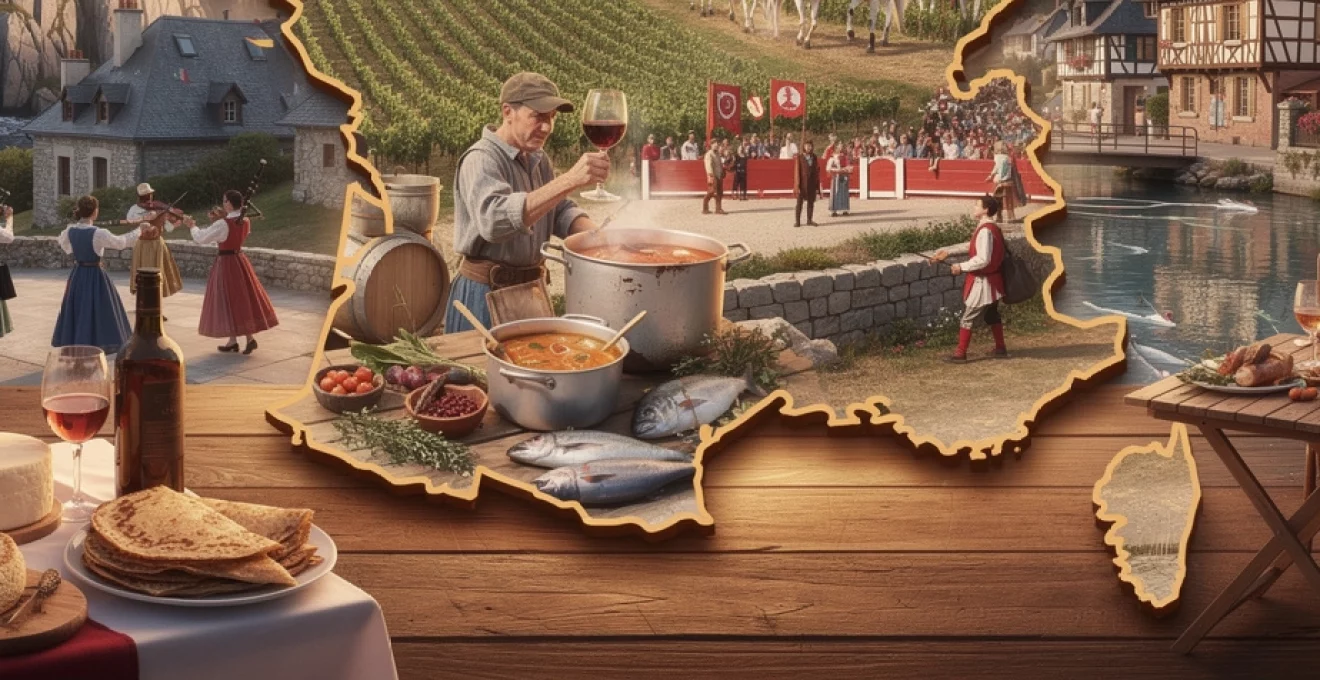
France’s cultural landscape extends far beyond the stereotypical image of Parisian boulevards and Eiffel Tower vistas. Beneath the veneer of centralized French republicanism lies a tapestry of regional identities, each contributing distinctive linguistic traditions, culinary expertise, architectural styles, and cultural practices that have survived centuries of homogenization. From the Celtic-influenced coastlines of Brittany to the Germanic valleys of Alsace, from the sun-drenched Mediterranean shores of Provence to the rugged mountains of Corsica, France’s regions offer a remarkable diversity that challenges the notion of a monolithic French identity. This regional richness represents not a threat to national unity but rather an invaluable cultural asset that demonstrates how cosmopolitanism and local traditions can coexist harmoniously.
Recent surveys reveal a fascinating shift in French attitudes toward regional identity. A remarkable 68% of French citizens now believe local authorities lack sufficient power, while 73% support adapting national laws to regional realities. Perhaps most striking is the 71% approval rate for federalist principles, a proportion that would have been unthinkable just decades ago. These statistics reflect a growing recognition that France’s strength lies not in enforced uniformity but in celebrating the particularities that make each region unique. As younger generations increasingly identify with their regional heritage, understanding these diverse cultural expressions becomes essential to comprehending contemporary French society.
Linguistic diversity across french regions: from occitan to breton
The French linguistic landscape encompasses far more than standard French. Despite centuries of centralized language policies that sought to erase regional dialects, approximately 77% of French citizens support official recognition of regional languages, a figure that has remained remarkably stable since 1999. This persistent support demonstrates the deep emotional and cultural connection many French people maintain with their linguistic heritage, even when they may not speak these languages fluently themselves.
Occitan language revival in provence and Languedoc-Roussillon
Occitan, once the language of troubadours and medieval courts, dominated southern France for centuries before French linguistic centralization relegated it to regional status. Today, this Romance language with approximately 1.5 million speakers across southern France experiences a quiet renaissance. The Occitan cultural zone stretches from the Atlantic to the Alps, encompassing regions where distinctive dialects such as Provençal, Languedocien, and Gascon developed unique characteristics while maintaining mutual intelligibility.
Modern Occitan revival efforts focus particularly on education, with calandretas (Occitan-medium schools) providing immersive instruction to thousands of children. These educational initiatives represent more than linguistic preservation; they embody a commitment to maintaining cultural diversity within the French republic. The language appears increasingly in public signage, cultural festivals, and regional media, demonstrating that minority languages can thrive without threatening national cohesion.
Breton celtic heritage in brittany’s cultural landscape
Brittany’s Celtic linguistic heritage distinguishes it dramatically from the rest of France. Breton, closely related to Welsh and Cornish, serves as a living reminder of the region’s pre-French history. Although speaker numbers declined dramatically during the twentieth century, reaching a low point of approximately 200,000 native speakers, recent decades have witnessed renewed interest. Approximately 48% of Bretons now support reattaching Loire-Atlantique to Brittany, reflecting strong regional consciousness.
The Diwan school network, established in 1977, provides bilingual education in Breton and French, nurturing a new generation of speakers. These immersive programs demonstrate remarkable success, with students achieving fluency in both languages while maintaining academic performance comparable to monolingual peers. Beyond education, Breton appears increasingly in contemporary music, literature, and digital media, adapting an ancient language to modern communication needs.
Alsatian germanic influences along the rhine valley
Alsace’s position along the Franco-German border has created a unique linguistic situation where Alsatian, an Alemannic German dialect, coexists with standard French. Historical fluctuations between French and German sovereignty have shaped complex linguistic attitudes, with older generations often trilingual in Alsatian, French, and German. An impressive 90% of Alsatians support official recognition of their regional language, while 80%
favor stronger regional institutions. This enthusiasm translates into concrete initiatives: optional bilingual schooling in Alsatian and French, cross-border cooperation programs with Germany and Switzerland, and local media broadcasting in the regional language. Yet Alsatian also illustrates the fragility of linguistic heritage, as intergenerational transmission has declined sharply since the mid-twentieth century. Many families shifted to French at home to improve their children’s social mobility, a pattern seen in several French regions. Today’s revival efforts must therefore rebuild not only linguistic competence but also confidence that speaking Alsatian enriches, rather than undermines, French identity.
Corsican autonomy and its distinct romance vernacular
Corsica offers one of the clearest examples of how regional identity, politics, and language intertwine in contemporary France. The Corsican language, corsu, is a Romance vernacular closely related to Tuscan Italian and Sardinian, reflecting centuries of Mediterranean exchange. While exact figures vary, several hundred thousand islanders understand or speak Corsican to varying degrees, and 93% of residents support official recognition of the language. In parallel, nearly three-quarters of Corsicans back the bill to grant the island “autonomy within the Republic,” with support rising to an impressive 87% among younger generations.
Language is central to this push for autonomy. Bilingual signage, Corsican-language media, and expanding instruction in schools signal a desire to anchor public life in local culture. At the same time, most Corsicans remain bilingual in French and corsu, embodying the possibility of being both proudly regional and fully French. Political debates often focus less on ethnic difference than on control over land use, environmental protection, and economic development in tourism and agriculture. For visitors and observers, Corsica demonstrates how a strong regional identity can coexist with, and even invigorate, a broader national project when local voices feel genuinely heard.
Basque identity in pays basque and cross-border cultural continuity
Along France’s southwestern Atlantic coast, the Basque Country (Pays Basque) presents one of Europe’s most distinctive cultural areas. The Basque language, Euskara, is a linguistic isolate unrelated to Indo-European languages, reinforcing a powerful sense of uniqueness. In the French Basque Country, decades of centralized policies once marginalized Euskara, yet support for cultural recognition is now robust: over 90% of residents in the broader Basque region favor official status for regional languages. Cross-border ties with the Spanish Basque Country are intense, creating a cultural continuum that ignores administrative frontiers.
Immersion schools (ikastolak) have driven a remarkable revival of Basque, with thousands of children receiving schooling primarily in Euskara while mastering French. Cultural festivals, choral music, and traditional sports such as pelota reinforce this sense of continuity across the Pyrenees. Rather than threatening French sovereignty, these cross-border dynamics highlight how regional identities can benefit from European integration, which makes it easier to collaborate on transport, tourism, and environmental projects. When you stand in a Basque village square, listening to conversations blend French, Basque, and Spanish, you experience firsthand how linguistic diversity enriches everyday life.
Gastronomic terroir: regional cuisine as cultural expression
If language tells us how people think, regional cuisine tells us how they live. French gastronomy is famously codified, but its foundations lie in local products and culinary techniques shaped by geography, climate, and history. The concept of terroir—the unique combination of soil, climate, and tradition—captures how regional identity flavors every plate and glass. Recent opinion surveys show that many French people view multinational fast-food chains as a greater threat to their culinary heritage than immigration, underlining just how central food is to regional pride. Exploring these gastronomic landscapes helps us understand why defending local cheeses or wines can become an act of cultural resistance.
Norman camembert and calvados: dairy and orchard traditions
Normandy’s misty pastures and apple orchards have given rise to two emblematic products: Camembert and Calvados. Authentic Camembert de Normandie, made from raw cow’s milk, reflects centuries of dairy expertise transmitted through small-scale farms. Its flavor varies subtly from village to village, much like regional accents in language. Calvados, the apple brandy distilled from cider, captures the region’s orchard traditions, where dozens of apple varieties are blended to achieve complex aromas.
Both products benefit from protected geographical indications that legally tie them to their terroir. These designations do more than support marketing; they preserve landscape management practices, biodiversity, and artisanal know-how. When you taste a slice of Camembert paired with a glass of Calvados, you are effectively consuming a piece of Norman history. In an era of global supply chains, such anchored products reassure consumers who seek authenticity and traceability, while providing rural communities with economic leverage and cultural visibility.
Burgundian wine classification and appellations d’origine contrôlée
Burgundy’s vineyards epitomize how regional identity can be mapped onto the landscape with extraordinary precision. The region’s famous climats—small, meticulously delimited plots—have been cultivated and classified for centuries, culminating in the modern system of Appellations d’Origine Contrôlée (AOC). Each appellation encodes not only grape variety and soil type, but also centuries of human labor and local custom. It is no coincidence that UNESCO has listed the “Climats, terroirs of Burgundy” as World Heritage, recognizing the region as a living cultural landscape.
This rigorous classification system has inspired similar schemes worldwide, yet remains deeply rooted in local practices. Family estates often span only a few hectares, and knowledge about pruning, harvesting dates, and vinification techniques is transmitted across generations. For Burgundy’s winemakers, defending the integrity of appellations is akin to defending a regional language: dilution or standardization would erase the nuances that make their culture distinctive. For wine lovers, learning to distinguish a Chablis from a Corton-Charlemagne becomes a way of decoding the region’s cultural map.
Provençal bouillabaisse and mediterranean culinary techniques
In Provence, culinary identity draws heavily on the Mediterranean Sea and sunshine. Bouillabaisse, the famous fish stew of Marseille, illustrates how regional cuisine can transform humble ingredients into a symbol of place. Traditionally made with several species of rockfish, olive oil, saffron, and garlic, the dish was once a fisherman’s meal, using unsold catch that had little market value. Over time, it has evolved into a ritualized experience with codified serving sequences, yet still evokes the conviviality of shared coastal life.
Provençal cuisine more broadly showcases techniques that favor freshness and simplicity: grilling over open flames, slow stews enriched with herbs like thyme and rosemary, and generous use of olive oil. Dishes such as ratatouille, aïoli, and pissaladière highlight how Mediterranean influences blend with French culinary structure. For many urban French consumers, Provençal products—olive oils, tapenades, rosé wines—offer an imagined escape to a sunlit, slower-paced lifestyle. In this sense, regional food functions almost like a postcard you can eat, carrying with it sensory memories of place.
Alsatian choucroute and franco-germanic fusion gastronomy
Alsace’s cuisine mirrors its borderland history, blending Germanic heartiness with French refinement. Choucroute garnie, the iconic dish of sauerkraut cooked with sausages and smoked meats, embodies this fusion. While fermented cabbage and pork products recall Central European traditions, Alsatian chefs often present the dish with a level of attention to plating and wine pairing typical of French gastronomy. Local white wines—particularly Riesling and Pinot Gris—are crafted to complement these robust flavors.
Bakeries in Alsace display kougelhopf brioches and pretzel-shaped breads, while Christmas markets serve spiced biscuits and mulled wine, reinforcing a cultural atmosphere that feels both French and German. The region’s strong support for federalist ideas and for leaving the amalgamated “Grand Est” region reflects a deeper desire to preserve these specific customs and tastes. By defending dishes like baeckeoffe or flammenkueche, Alsatians are also defending their right to interpret French identity through their own historical lens.
Architectural vernacular: built heritage reflecting regional climates
Architecture offers another window into how regional identities enrich French culture. Before the advent of standardized construction techniques, buildings were shaped primarily by local materials, climate constraints, and social organization. This produced an extraordinary diversity of rural and urban forms, from slate-roofed Breton houses to sun-baked Provençal farmsteads. Even today, these architectural styles influence tourism, real estate values, and local pride. When we ask why a Basque village “feels” different from a Savoyard one, we are really asking how built heritage encodes regional character.
Basque colombage half-timbered houses in aquitaine
In the Basque Country, traditional houses known as etxe stand out with their whitewashed facades and bold red or green timber framing. These half-timbered constructions, often featuring overhanging roofs and carved wooden balconies, reflect both climatic adaptation and family-centered social structures. Historically, the etxe symbolized more than a dwelling: it represented a lineage, with inheritance rules that kept property intact across generations. This deep connection between house and family explains why architectural preservation is so emotionally charged in the region.
Local building regulations in many Basque communes still require new constructions to respect specific color palettes and design elements. This can create tensions with contemporary architectural innovation, but it also ensures visual coherence that supports cultural tourism. Walking through villages such as Ainhoa or Sare, you quickly sense that uniform door and shutter colors are not mere decoration; they are visual markers of a shared identity. In a way, Basque timber-framed houses function like a regional costume worn by the landscape itself.
Provençal mas farmhouses and stone construction methods
Across the plains and hills of Provence, the mas farmhouse is a defining feature of the rural landscape. These elongated stone buildings, with thick walls and small north-facing openings, are ingeniously adapted to hot, dry summers and mistral winds. By limiting windows on the exposed side and orienting living spaces toward sheltered courtyards, the mas maintains interior coolness without modern air conditioning. Local limestone and terracotta tiles give each structure a warm, earthy palette that blends seamlessly into surrounding fields of lavender, olives, or vines.
Many historic mas have been converted into guesthouses or second homes, becoming powerful symbols of Provençal lifestyle in global imagination. This gentrification can bring economic benefits, but also risks pricing out local residents and altering village life. Urban planners and heritage organizations thus face a delicate balancing act: how to preserve traditional construction forms while allowing for contemporary needs such as energy efficiency and accessibility. The ongoing popularity of the mas shows, however, that regional architectural identity remains a valuable cultural and economic asset.
Alpine chalets in savoie and mont blanc region
In the alpine regions of Savoie and around Mont Blanc, the wooden chalet has become almost synonymous with mountain France. Traditionally built from local timber with heavy stone bases and broad sloping roofs, chalets are designed to withstand heavy snowfall and cold winters. Large eaves prevent snow build-up near walls and protect stacked firewood, while balconies, often intricately carved, provide drying space and scenic viewpoints. Inside, compact layouts and generous use of wood create a sense of warmth and intimacy suited to harsh climates.
The twentieth-century development of ski tourism has both popularized and transformed the chalet model. In some resorts, standardized pastiche construction threatens to turn a once-authentic vernacular into a theme-park aesthetic. Yet many communes and regional parks now impose design guidelines that promote the use of traditional materials and forms, updated with modern insulation and seismic standards. When you book a stay in a Savoyard chalet today, you are not just securing accommodation; you are participating, however briefly, in a living architectural tradition shaped by snow, stone, and wood.
Breton granite structures and coastal defensive architecture
Brittany’s windswept coasts and stormy seas have forged an architecture of resilience. Traditional houses in many coastal villages are built from local granite, with thick walls and low, compact forms that resist Atlantic gusts. Roofs covered in slate or thatch, and small window openings, help protect interiors from driving rain. The resulting aesthetic, often perceived as austere, reflects a broader cultural association of Bretons with toughness and endurance, much like their hardy sailing and fishing traditions.
Along the shoreline, you also encounter a dense network of lighthouses, fortifications, and coastal batteries that speak to Brittany’s strategic importance. Structures such as Vauban forts or nineteenth-century signal towers testify to centuries of military investment in the region. Today, many of these defensive works have been converted into museums or cultural centers, repurposing a martial heritage for peaceful tourism and education. Standing on a granite rampart overlooking the sea, you sense how architecture can embody both vulnerability and defiance in the face of natural and political forces.
Folk traditions and festivals: living expressions of regional identity
Beyond language, food, and buildings, regional identities in France are kept alive through festivals and folk traditions. These events transform public spaces into stages where music, costume, and ritual reaffirm community bonds. Unlike museums, which preserve objects from the past, festivals are dynamic performances that adapt to contemporary tastes while retaining core symbols. They also attract visitors from other regions and countries, turning local customs into shared experiences that question rigid boundaries between “insider” and “outsider.”
Fest-noz celtic dance gatherings in lower brittany
The fest-noz (“night festival”) is one of the most vibrant expressions of Breton culture. Originating as rural gatherings to celebrate harvests or family events, these dance evenings have been revitalized since the 1960s folk revival. Dancers join hands or form chains to perform circle and chain dances to live music, typically featuring instruments such as the bombarde, bagpipes, and fiddle. In 2012, UNESCO inscribed the fest-noz on its list of Intangible Cultural Heritage, recognizing its role in maintaining social cohesion and linguistic transmission.
Many Bretons, including younger generations who may not speak fluent Breton, learn traditional songs and dance steps at these events. The fest-noz thus functions like an open-air classroom in which participants absorb vocabulary, stories, and values through embodied practice. For visitors, joining a dance line can feel daunting at first, but locals are usually eager to guide newcomers—an example of how regional pride can be generous rather than exclusive. As the music accelerates and the floor vibrates with synchronized steps, you feel how collective movement transforms cultural heritage into lived experience.
Feria de nîmes and camargue bullfighting culture
In southern France, particularly around Nîmes and the Camargue, bull-related festivities represent another contested yet deeply rooted regional tradition. The Feria de Nîmes, held twice a year, attracts hundreds of thousands of visitors for several days of bullfights, concerts, and street celebrations. In the nearby Camargue, distinctive practices such as the course camarguaise—a bloodless form of bull game where participants attempt to snatch rosettes from a bull’s horns—reveal a different relationship between humans and animals than in Spanish-style corridas.
These events generate heated debates about animal welfare and the place of violence in public festivities. Supporters argue that bull culture is a key component of regional identity and rural economy, linking breeders, artisans, and hospitality workers in a shared ecosystem. Critics contend that tradition should not shield practices from ethical scrutiny. As in other regional controversies, the challenge is to negotiate change without erasing local memory. Whether one approves or not, understanding the Feria de Nîmes offers insight into how strongly people can feel about the right to shape their own cultural landscape.
Carnival of nice and mediterranean festive traditions
On the Côte d’Azur, the Carnival of Nice showcases a more playful facet of regional identity. One of the world’s oldest and largest carnivals, it fills the city with parades of giant satirical floats, illuminated night processions, and the famous “Battle of Flowers,” during which performers on decorated vehicles throw thousands of blossoms to the crowd. Themes often comment on current events or caricature public figures, blending local humor with global awareness. In this sense, the carnival is both deeply Niçois and cheerfully cosmopolitan.
The event also highlights Mediterranean values of outdoor sociability, color, and spectacle. Local artisans, costume designers, and float builders spend months preparing visual creations that draw on regional symbols such as lemons, olive trees, or maritime motifs. For residents, participating in the carnival can reinforce a sense of belonging to a specific urban community distinct from both Paris and neighboring Italian cities. For tourists, it offers a vivid entry point into a regional culture where irony and celebration go hand in hand.
Artistic movements rooted in regional landscapes
Regional identities in France have also inspired major artistic movements that, in turn, shaped national and international perceptions of those regions. Painters, writers, and filmmakers often draw inspiration from specific landscapes, climates, and local customs, transforming them into powerful symbols. Just as a particular grape variety expresses its terroir, artistic styles emerge from the interaction of creative individuals with their immediate environment. Recognizing these roots helps us see that “French art” is, in fact, a mosaic of regional sensibilities.
Impressionism, for example, grew out of painters’ fascination with changing light along the Seine and Normandy coasts, while Post-Impressionists like Van Gogh and Cézanne mined the intense colors and rugged forms of Provence. In Brittany, the Pont-Aven school associated with Paul Gauguin and Émile Bernard translated Celtic mysticism and peasant life into bold, flattened compositions. In the twentieth century, filmmakers such as Marcel Pagnol and later Robert Guédiguian depicted Marseille and Provence as distinctive worlds with their own speech rhythms, moral codes, and social tensions.
Regionalist literature, from Corsican novels dealing with clan loyalties to Alsatian tales exploring border identities, continues to enrich the French literary canon. Many contemporary authors write in both French and a regional language, or weave dialect words into their prose to capture nuances of place that standard French cannot fully convey. For readers abroad, these works offer a more granular understanding of France, countering the tendency to reduce the country to a single urban model. When you read about a mistral-swept hill or a Basque fishing harbor, you are entering not just a geographical location but a cultural universe.
Economic regionalism: craft industries and protected designations
Finally, regional identities in France have significant economic implications. Craft industries, from watchmaking in the Jura to textile production in the Basque Country, depend on reputations built over generations. Protected designations such as AOC, AOP (Protected Designation of Origin), and IGP (Protected Geographical Indication) link products to specific territories, allowing producers to command higher prices and resist unfair competition. These labels act a bit like passports for goods, certifying their origin and cultural authenticity in a global marketplace that often favors standardization.
Surveys indicating that 68% of French people feel local authorities lack sufficient power, and that 71% support federalist ideas, reflect not only cultural concerns but also economic ones. Regions with strong identities—Alsace, Brittany, Corsica, the Basque Country, Savoie—see greater autonomy as a way to better protect their industries and manage tourism, agriculture, and environmental resources in line with local priorities. Federal-style arrangements, whether formal or informal, can facilitate policies “à la carte” that adapt taxation, infrastructure, and education to regional specificities. For example, promoting bilingual vocational training in areas where tourism depends on both French and regional languages can improve employment prospects while strengthening cultural capital.
For consumers and travelers, paying attention to labels and craft origin stories is a simple but effective way to support this economic regionalism. Choosing an AOP Ossau-Iraty cheese over an anonymous industrial product, or purchasing ceramics from a small workshop in Vallauris, helps maintain the ecosystems of skills that make France’s regions distinctive. In the long run, these choices contribute to a model of development where diversity is not an obstacle to national unity but a resource—much like a diversified investment portfolio is more resilient than a uniform one. By valuing regional identities in our economic decisions, we help ensure that France remains not just a centralized state, but a constellation of living cultures.