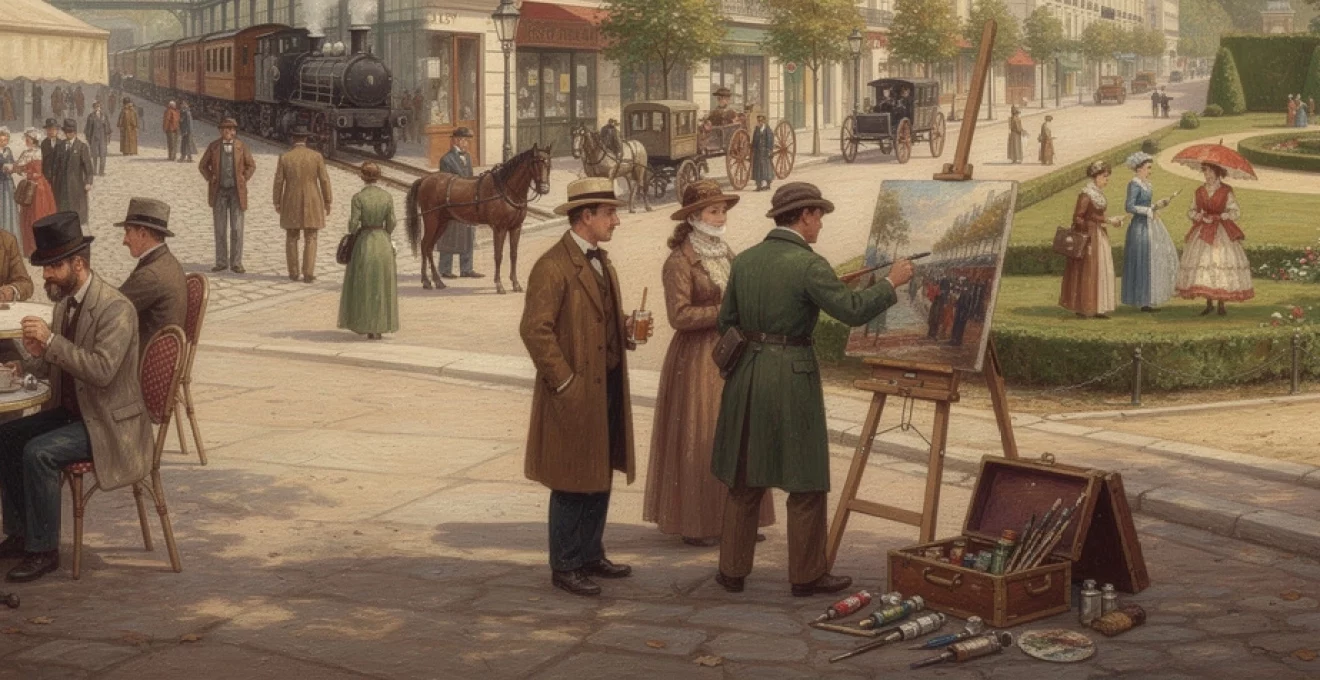
The transformation of Paris into the epicentre of Impressionism represents one of art history’s most fascinating convergences of social, technological, and cultural forces. During the second half of the 19th century, the French capital evolved from a medieval labyrinth into a modern metropolis, creating the perfect conditions for an artistic revolution that would reshape Western painting forever. This metamorphosis wasn’t merely coincidental—it was the result of deliberate urban planning, technological innovations, and a generation of artists bold enough to challenge centuries of artistic tradition.
The luminous quality that gives Paris its nickname “City of Light” became instrumental in nurturing the Impressionist movement. The buff limestone buildings, wide boulevards, and reflective surfaces created by Baron Haussmann’s urban renovation provided artists with unprecedented opportunities to study natural light and its effects. These physical changes, combined with new artistic techniques and materials, established Paris as the undisputed capital of modern painting.
Pre-impressionist artistic landscape in 19th century paris
Before Impressionism emerged as a revolutionary force, the Parisian art world operated under strict hierarchical systems that dictated both artistic training and public reception. The mid-19th century witnessed several significant challenges to these established traditions, creating the intellectual and practical foundation upon which Impressionism would flourish. Understanding this pre-Impressionist landscape reveals how radical the movement truly was and why Paris provided the ideal environment for its development.
Academic salon system and école des Beaux-Arts dominance
The École des Beaux-Arts dominated French artistic education throughout the 19th century, enforcing rigid standards that emphasised historical and mythological subjects painted in carefully controlled studio environments. Students learned through copying classical sculptures and Old Master paintings, developing technical precision that prioritised smooth brushwork and idealised forms. The institution’s influence extended far beyond its walls through the annual Salon, France’s only major public exhibition venue where artists could display their work to potential buyers and critics.
The Salon’s jury system, comprised primarily of Academy members, maintained strict aesthetic standards that favoured large-scale history paintings, religious scenes, and classical subjects. Genre painting depicting everyday life ranked lower in the official hierarchy, while landscape painting occupied an even more marginal position. This systematic exclusion of contemporary subjects and innovative techniques would eventually drive progressive artists to seek alternative exhibition venues, laying the groundwork for the independent shows that became synonymous with Impressionism.
Barbizon school’s plein air precedent at fontainebleau forest
The Barbizon School, active from approximately 1830 to 1870, established crucial precedents for the plein air painting techniques that would become central to Impressionism. Artists like Théodore Rousseau and Charles-François Daubigny regularly travelled to Fontainebleau Forest, approximately 60 kilometres southeast of Paris, to paint directly from nature. Their commitment to capturing natural light and atmospheric conditions in outdoor settings challenged the Academy’s insistence on studio-based composition and preparatory sketching.
These pioneering landscape painters developed innovative approaches to colour and brushwork that influenced the next generation of artists. Their emphasis on spontaneous observation and direct engagement with natural subjects provided a bridge between traditional landscape painting and the more radical experiments of the Impressionists. Many future Impressionist painters, including Camille Pissarro and Auguste Renoir, studied Barbizon techniques before developing their own distinctive approaches to outdoor painting.
Gustave courbet’s realist movement challenge to classical hierarchy
Gustave Courbet’s Realist movement fundamentally challenged the Academy’s subject matter hierarchy by elevating everyday scenes to the scale and prominence traditionally reserved for historical painting. His monumental canvas “A Burial at Ornans” (1849-50) depicted ordinary villagers attending a funeral with the same artistic seriousness previously accorded only to biblical or mythological subjects. This democratisation of artistic subject matter opened new possibilities for depicting contemporary urban life that would become central to Impressionist practice.
Courbet’s rejection of idealisation and his commitment to painting only what he could observe directly established important precedents for the Impressionists’ focus on modern life. His bold brushwork and willingness to leave visible traces of the painting process also influenced younger artists who would push these techniques even further. When the Academy
When the Academy rejected Courbet’s submissions or hung them in unfavourable positions, he responded by organising his own exhibitions, most famously his Pavilion of Realism at the 1855 Exposition Universelle. This gesture of independence directly foreshadowed the later decision of Monet, Renoir, Pissarro and their circle to bypass the Salon altogether. Courbet showed that an artist in Paris could confront official taste, paint contemporary reality on a monumental scale, and still attract attention and patrons. His Realist ethos—painting the world as it is, not as tradition dictates it should be—helped clear intellectual space for the Impressionists’ focus on modern Parisian streets, cafés and railway stations.
Charles baudelaire’s art criticism and modernité philosophy
While painters such as Courbet challenged academic norms on canvas, the poet and critic Charles Baudelaire did so in words. In his influential essay “Le Peintre de la vie moderne” (The Painter of Modern Life, 1863), Baudelaire argued that true modern art should capture modernité—the fleeting, transitory experience of life in the rapidly changing city. Rather than glorifying ancient myths, he urged artists to paint the crowds, fashion, streets and fleeting impressions of contemporary Paris. This call to embrace the present moment resonated deeply with the young generation that would become the Impressionists.
Baudelaire’s writings legitimised subjects that the Académie considered trivial: a woman promenading along the boulevard, a café terrace at dusk, a smoky railway station. His admiration for quick, suggestive drawing and for capturing movement validated loose, sketch-like handling that critics would later attack in Impressionist painting. By framing modern urban life as a worthy, even urgent, artistic subject, Baudelaire provided a philosophical foundation that helped Paris become the natural home of Impressionism.
Haussmann’s urban transformation and impressionist subject matter
As these intellectual currents gathered strength, Paris itself was being physically transformed. Between 1853 and 1870, Baron Georges-Eugène Haussmann oversaw a vast urban renewal project that demolished medieval alleyways and replaced them with broad boulevards, uniform limestone façades and expansive public parks. This “Haussmannisation” created a new visual stage on which modern life unfolded—a stage that Impressionist painters would eagerly adopt as their primary subject matter. The interplay of light, stone and sky in the rebuilt city turned Paris into both a model of modernity and an open-air studio.
For artists in search of new motifs, the renovated capital offered almost endless possibilities. Wide avenues created long sightlines where they could explore perspective and atmospheric effects, while glass-roofed arcades and railway stations filtered light in novel ways. The very features that some contemporaries criticised as destroying old Paris—its straight streets and uniform buildings—gave painters like Monet and Caillebotte the clean geometries and luminous surfaces they needed to explore the “impression” of a moment. Without Haussmann’s radical redesign, Paris might never have become the quintessential Impressionist city.
Boulevard Saint-Germain and grands boulevards as painting locations
The newly built boulevards on the Right and Left Banks quickly became favourite locations for Impressionist painters. Boulevard Saint-Germain, cutting through the Left Bank’s historic neighbourhoods, offered views of elegant façades, bustling traffic and fashionable strollers. On the Right Bank, the Grands Boulevards—Boulevard des Capucines, Boulevard Haussmann, Boulevard Montmartre—formed a continuous ribbon of theatres, cafés and department stores that embodied modern consumer culture. Artists were drawn to these spaces not only for their compositional possibilities but also because they symbolised the new pace and character of urban life.
Claude Monet’s “Boulevard des Capucines” (1873–74), painted from a balcony at number 35 where the first Impressionist exhibition would soon be held, shows a throng of Parisians reduced almost to shimmering strokes. Gustave Caillebotte’s “Paris Street; Rainy Day” (1877) focuses on the newly created Place de Dublin, with its carefully aligned façades and wet cobblestones reflecting light like a mirror. These works demonstrate how Haussmann’s boulevards, initially conceived as tools of traffic management and social control, became central motifs in the visual language of Impressionism and helped brand Paris as the capital of modern painting.
Gare Saint-Lazare railway terminal in claude monet’s series
Among all the new structures of Haussmann’s Paris, few fascinated the Impressionists as much as the railway stations. Gare Saint-Lazare, in particular, became a landmark of modernity—and a cornerstone of Impressionist imagery. Located at the edge of the Batignolles district, it connected Paris with Normandy and the expanding suburbs, symbolising mobility, industry and the shrinking of distances. Monet, who lived nearby for a period, recognised its potential as a subject where steam, glass and iron interacted dramatically with light.
In 1877, Monet created a celebrated series of at least twelve canvases devoted to Gare Saint-Lazare, exhibiting seven of them at the third Impressionist exhibition that same year. In these paintings, locomotives emerge from clouds of vapour, smoke dissolves into the sky, and sunlight filters through iron-and-glass canopies. Rather than depicting trains as engineering marvels in meticulous detail, Monet focused on the atmospheric effects: the blurred silhouettes, changing colours and transient veils of steam. By transforming a working railway terminal into a theatre of light and movement, he asserted that even the most industrial corners of Paris could be subjects of poetic, modern art.
Café culture at café guerbois and Nouvelle-Athènes
Haussmann’s renovation did not only change streets and stations; it also encouraged a flourishing café culture that gave Impressionism its social backbone. Establishments like Café Guerbois on Avenue de Clichy and Café de la Nouvelle-Athènes on Place Pigalle became regular meeting points for painters, writers and critics. Here, Édouard Manet, Edgar Degas, Pierre-Auguste Renoir, Claude Monet, Émile Zola and others debated aesthetics, criticised each other’s work and planned strategies to circumvent the Salon. The cafés were effectively informal academies, replacing the rigid hierarchy of the École des Beaux-Arts with a more fluid, collaborative network.
These venues also provided subjects for many Impressionist works. Degas painted café-concerts with singers bathed in stage light and audiences half-lost in shadow, while Manet’s barmaids and waiters captured the ambiguity of modern social spaces—half public, half intimate. In these interiors, the glow of gas or early electric lighting mingled with reflections in mirrors and polished surfaces, offering new challenges for rendering artificial light. For us today, it’s easy to overlook how radical it was to make a simple café table or a beer glass the centre of a serious painting; yet these scenes of everyday life helped define Paris, in the eyes of the world, as the cradle of modern urban experience.
Parc monceau and tuileries gardens as bourgeois leisure spaces
Alongside boulevards and cafés, Haussmann-era parks and gardens became prime locations for observing the city’s growing bourgeois class at leisure. Parc Monceau, in the affluent 8th arrondissement, offered manicured lawns, winding paths and ornamental structures that attracted middle-class families, nurses with children and elegant strollers. The Tuileries Gardens, stretching between the Louvre and Place de la Concorde, served as a transitional space between royal heritage and republican modernity. For Impressionist painters, these green spaces set within the stone city provided ideal laboratories for studying sunlight filtered through leaves, colourful clothing against grass, and shifting crowds.
Claude Monet’s views of the Tuileries and Gustave Caillebotte’s scenes from Parc Monceau capture the intersection of nature, architecture and social ritual that defined these sites. By focusing on promenades, children’s games and relaxed conversations, the artists highlighted how Haussmann’s redesign had created new rituals of urban leisure. For contemporary viewers, these paintings also functioned as recognisable “postcards” of modern Paris, reinforcing the city’s reputation abroad. When we think today of Paris as the capital of Impressionism, it is hard not to picture these bright, open gardens where art, light and bourgeois life converged.
Revolutionary painting techniques and materials innovation
The transformation of Paris provided the stage, but it was technical innovation that allowed Impressionist painters to capture the city’s changing light with unprecedented immediacy. Advances in pigments, painting equipment and scientific colour theory coincided with the rise of the movement, giving artists new tools for representing visual experience. At the same time, they developed distinctive brushwork and compositional strategies that broke decisively with academic finish. The result was a radical new style that seemed to vibrate with energy—perfectly suited to the rapid rhythms of modern Paris.
To understand how Paris became synonymous with Impressionism, we need to look not only at where the artists painted, but also how they painted. Their approach relied on speed, spontaneity and careful observation of optical effects. Like photographers experimenting with exposure times, Impressionist painters sought to fix fleeting moments on canvas, using an arsenal of innovations that would soon spread to studios far beyond France.
Portable paint tubes and chevreul’s colour theory application
One of the most important but often overlooked factors in the rise of Impressionism was the invention of pre-mixed, portable paint in metal tubes. Developed commercially in the 1840s, these collapsible tubes allowed artists to easily carry vibrant, stable colours into the countryside or city streets. No longer tied to the laborious process of grinding pigments in the studio, painters could respond directly to changing light and weather. This technical shift made true en plein air work practical on a large scale and helped lock Parisian Impressionists into their close relationship with outdoor motifs.
At the same time, scientific discoveries about colour perception influenced how artists orchestrated their palettes. Michel-Eugène Chevreul, a chemist at the Gobelins Manufactory in Paris, published his “Law of Simultaneous Contrast of Colours” in 1839, showing how adjacent hues affect one another in the eye. Impressionists applied these principles intuitively and sometimes consciously, placing complementary colours side by side to intensify vibrancy. Rather than mixing pigments to a dull grey on the palette, they let the viewer’s eye do the mixing, especially in shadows and reflections. This marriage of portable materials and optical science generated the shimmering surfaces that came to define Impressionism in Paris and beyond.
Broken brushstroke technique and optical colour mixing
Academic painting in mid-19th century Paris prized invisible brushwork and polished surfaces. The Impressionists turned this ideal on its head. They adopted a broken brushstroke technique—short, visible marks laid down quickly and often without careful blending. From up close, a Monet or Renoir canvas appears almost abstract, a patchwork of coloured dashes; from a few steps back, these strokes resolve into a coherent scene. This method relied on what we now call optical mixing: allowing the viewer’s perception to fuse separate touches of colour into a single impression.
This approach suited the chaotic visual experience of modern Paris. Think of the sparkle of light on the Seine, the flurry of umbrellas on a boulevard, or the steam clouds at Gare Saint-Lazare. It would be almost impossible to record such transient phenomena with smooth, finished modelling. By treating the canvas as a field of vibrating marks, the Impressionists captured not the precise outline of objects but the sensation of seeing them in time. For viewers accustomed to academic clarity, these paintings initially looked unfinished, like sketches. Yet that very “unfinished” quality is what makes them feel so immediate to us today.
En plein air method in bois de boulogne and seine riverbanks
The flexibility and spontaneity offered by paint tubes and broken brushwork found their fullest expression in the practice of en plein air painting. Rather than composing pictures solely in the studio, Impressionists set up their easels directly in parks, along the Seine, and on the edges of the expanding city. The Bois de Boulogne, a vast park west of central Paris redesigned under Napoleon III, became a favoured site for studying both nature and society. Here, artists could paint rowers on the lakes, carriages following leafy avenues, and fashionable women walking beneath dappled light.
The Seine riverbanks, stretching through the heart of Paris and out toward suburban villages like Argenteuil and Chatou, also became essential settings. Boats, bridges and barges provided motifs that changed with every passing cloud, while the water’s surface mirrored the city’s architecture and sky. Working outdoors required the painters to work quickly and make bold decisions, reinforcing the emphasis on capturing an “impression” rather than a carefully finished tableau. This method, pioneered around Paris, would become one of the movement’s most recognisable hallmarks worldwide.
Japanese ukiyo-e influence through siegfried bing’s collection
While Impressionism is often described as a purely French phenomenon, its visual language was profoundly shaped by global exchange—particularly through Japanese art. After Japan opened to Western trade in the 1850s, woodblock prints known as ukiyo-e flooded into Paris. Dealers such as Siegfried Bing, who opened his gallery “L’Art Nouveau Bing” in the 1890s, amassed important collections of Japanese prints that were eagerly studied by avant-garde artists. These images, with their flat colour areas, bold outlines and unconventional perspectives, offered an alternative to the Western academic tradition rooted in Renaissance illusionism.
Impressionists and their close contemporaries absorbed many of these features. Cropped compositions that cut off figures at the edge of the canvas, high vantage points overlooking streets or gardens, and asymmetrical arrangements all echo Japanese models. Degas’s views of dancers seen from the wings, or Monet’s paintings of bridges at Giverny, clearly show this influence. In a sense, Paris became a crossroads where Eastern and Western pictorial traditions met, and Impressionism emerged as a hybrid language. This fusion helped make Paris not only a capital of Impressionism, but also a laboratory of global modern art.
Salon des refusés and independent exhibition movement
Even as their techniques and subjects evolved, Impressionist painters faced a formidable obstacle: the conservative jury of the Paris Salon. Rejections were frequent and public, often accompanied by scathing criticism in the press. The breaking point came in 1863, when a wave of refusals—including works by Manet and his circle—provoked such an outcry that Emperor Napoleon III ordered a separate exhibition of rejected works. This Salon des Refusés (Salon of the Refused) marked a turning point in the relationship between artists and institutions in Paris.
The Salon des Refusés showed that there was a curious audience for experimental art, even when official bodies disapproved. Manet’s “Le Déjeuner sur l’herbe”, while ridiculed, became a lightning rod for debate about modern painting. Encouraged by this precedent, a group of younger artists—Monet, Renoir, Pissarro, Sisley, Berthe Morisot and others—eventually decided to bypass the Salon altogether. In 1874, they organised their own exhibition in the former studio of photographer Nadar on Boulevard des Capucines, under the name “Société Anonyme des Artistes Peintres, Sculpteurs, Graveurs, etc.”
This first Impressionist exhibition, which included Monet’s “Impression, Sunrise”, crystallised the movement’s identity. The critic Louis Leroy used the word “Impressionists” mockingly, but the artists adopted the term as a badge of honour. Over the next twelve years, they held seven more group shows in various Parisian venues, establishing an independent exhibition circuit parallel to the Salon. These events cemented Paris’s reputation as a place where artists could challenge academic power structures and define new forms of modern art on their own terms.
Montmartre’s artistic community and commercial art market development
While Haussmann’s boulevards and the Right Bank’s elegant districts provided settings for many Impressionist scenes, the hilltop neighbourhood of Montmartre nurtured a different, more bohemian side of Parisian art. Annexed to the city only in 1860, Montmartre retained a semi-rural character well into the late 19th century, with windmills, vegetable gardens and modest homes. Cheap rents attracted painters, writers and musicians who gathered in studios, cabarets and cafés. Over time, this district became a crucible not only for Impressionism’s later developments, but also for Post-Impressionism and the avant-garde movements that followed.
Venues like the Lapin Agile and, later, the Moulin Rouge fostered a lively nightlife that offered artists abundant subject matter. Although the first generation of Impressionists often lived elsewhere, their successors—such as Toulouse-Lautrec, Van Gogh and early Picasso—built on their legacy in Montmartre. The area also played a key role in the evolution of the commercial art market. Smaller dealers and gallery owners began to support experimental artists, selling works in more intimate settings rather than relying solely on the Salon. This shift gradually created an ecosystem in which independent painters could survive financially, helping secure Paris’s status as the central marketplace for modern art.
For collectors, Montmartre symbolised authenticity and creative freedom—an antidote to the formality of the Académie. Artists could paint both the everyday lives of workers and the entertainments of the growing middle class, often blurring social boundaries in their depictions. In this sense, Montmartre complemented the Impressionist vision developed on the boulevards and in parks, adding a more gritty, popular dimension to the picture of modern Paris. Together, these overlapping communities and markets helped transform the city into a dynamic ecosystem where new styles could emerge, be seen and eventually sold.
International recognition through Durand-Ruel gallery network
Despite their innovations and the support of a few progressive critics, the Impressionists struggled financially in Paris during the 1870s. Many works failed to sell, and some artists lived in chronic poverty. The turning point came with the involvement of the art dealer Paul Durand-Ruel, who had already supported painters from the Barbizon School. Recognising the potential of the new movement, Durand-Ruel began buying Impressionist works in bulk, sometimes acquiring hundreds of canvases by Monet, Pissarro, Sisley and Renoir. His galleries in Paris and later abroad became essential vehicles for transforming local experimentation into an international phenomenon.
Durand-Ruel’s strategy was visionary: he staged solo exhibitions, published catalogues, and built relationships with collectors in London, New York and other major cities. By the 1880s and 1890s, he had organised Impressionist shows that introduced British and American audiences to the luminous views of Parisian boulevards, gardens and riverbanks. In a way, he exported not just paintings, but an entire image of Paris as the capital of modernity and light. The commercial success that eventually followed—Monet’s prices, for instance, rose dramatically in the 1890s—validated the movement and ensured its long-term influence.
Today, when we visit the Musée d’Orsay or major museums around the world, we often encounter these works as canonical treasures. It is easy to forget how risky they once seemed, and how crucial Durand-Ruel’s network was in legitimising them. By the early 20th century, thanks to this dealer-driven expansion, Impressionism had become an international language of painting. Yet its heart remained in Paris—the city whose transformed streets, speculative galleries and bold artists together forged a new chapter in the history of art.