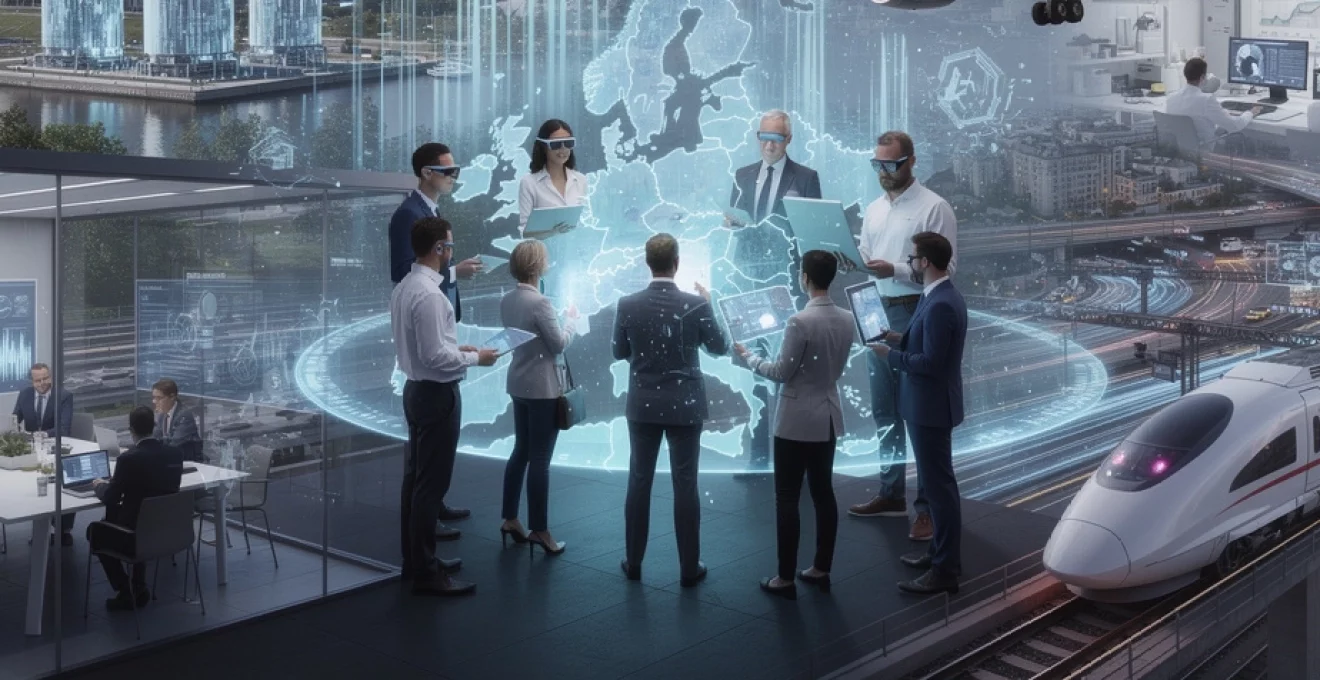
France has emerged as a technological powerhouse driving innovation across Europe, establishing itself as a cornerstone of the continent’s digital transformation. With a dynamic digital market generating €70 billion in turnover and an impressive projected compound annual growth rate of 13.50% through 2032, French technology companies are reshaping industries from artificial intelligence to aerospace engineering. The nation’s commitment to technological sovereignty, backed by substantial government investment including the €10 billion France 2030 plan, positions French innovations at the forefront of European technological advancement. This comprehensive ecosystem encompasses everything from quantum computing breakthroughs to sustainable energy solutions, making France an indispensable contributor to Europe’s competitive edge in the global technology landscape.
French deep tech ecosystem driving european digital transformation
The French deep tech ecosystem represents one of Europe’s most sophisticated technological environments, characterised by substantial investment in research and development across strategic sectors. French companies have collectively raised €1.1 billion in funding, with over €130 million invested specifically in R&D during 2024 alone. This financial commitment has generated significant intellectual property, with French tech companies holding 353 patents that contribute to Europe’s technological sovereignty.
The French Tech 2030 programme exemplifies France’s strategic approach to technological development, selecting 80 emerging companies that address critical challenges in artificial intelligence, cybersecurity, quantum computing, and robotics. These companies represent the next generation of European technology leaders, developing solutions that protect personal data, prevent disinformation, and secure critical infrastructure across the continent. The programme’s rigorous selection criteria ensure that only companies with proven technological maturity and strategic importance receive support.
Station F paris: europe’s largest startup campus accelerating innovation
Station F stands as Europe’s largest startup campus, creating an unparalleled ecosystem for technological innovation that extends far beyond France’s borders. This massive facility brings together government bodies, investors, and emerging companies under one roof, facilitating connections that drive European-wide technological advancement. The campus hosts entrepreneurs from across Europe, providing them with access to French expertise whilst simultaneously spreading French innovation methodologies throughout the continent.
The impact of Station F extends through its comprehensive support programmes, which have nurtured numerous companies that now operate across multiple European markets. The campus’s approach to cross-border collaboration has created a blueprint for innovation hubs that other European countries are now replicating, demonstrating France’s leadership in developing sustainable startup ecosystems.
Bpifrance investment strategies in quantum computing and AI technologies
BpiFrance’s investment strategies have positioned France as a leader in quantum computing and artificial intelligence technologies that benefit the entire European Union. The organisation’s targeted funding approach focuses on companies developing breakthrough technologies with applications across multiple industries. French quantum computing companies like Quandela have successfully sold quantum computers to major European cloud providers, demonstrating the practical impact of these investments.
The strategic focus on dual-use technologies ensures that French innovations serve both commercial and defence applications, strengthening Europe’s technological independence from non-European suppliers. BpiFrance’s comprehensive support extends beyond funding to include technical expertise and market access facilitation, creating a model that other European investment agencies are adopting.
French tech visa programme impact on european talent acquisition
France’s Tech Visa programme has revolutionised talent mobility across Europe, creating streamlined pathways for international professionals to contribute to European technological development. The programme encompasses three distinct categories: founders, employees, and investors, each designed to address specific talent needs within the European tech ecosystem. Since its launch in 2017, the programme has attracted thousands of international professionals who bring diverse expertise to French companies.
The Welcome to la French Tech initiative complements the visa programme by providing comprehensive support for international talent settling in France. This one-stop approach has become a model for other European countries seeking to attract global tech talent, demonstrating France’s leadership in creating inclusive technological ecosystems that benefit the entire continent.
Systematic paris and criteo’s AdTech influence across european markets
French advertising technology companies have established significant influence across European digital markets, with companies like Criteo leading innovation in programmatic advertising and data analytics. These companies have developed sophisticated algorithms that optimise advertising performance across multiple languages and cultural contexts, addressing the unique challenges of Europe’s diverse
audiences. By leveraging privacy-centric advertising models and compliance-by-design approaches to GDPR, French AdTech firms help brands navigate complex European data protection rules while still delivering personalised user experiences. The Systematic Paris-Region competitiveness cluster reinforces this impact by connecting AdTech startups, research labs, and large corporates, accelerating the transfer of cutting-edge research into scalable products. Together, these players shape standards for responsible advertising technology that many other European markets subsequently adopt.
Aerospace and defence technology leadership through thales and airbus group
France holds a central position in Europe’s aerospace and defence landscape, largely through the influence of Airbus, Thales, Safran, and Dassault Systèmes. These companies are not only industrial giants; they are also innovation engines that set technical benchmarks for the entire European Union. Their work in avionics, space systems, defence electronics, and digital engineering drives cross-border collaboration and shared R&D programmes. As Europe seeks greater technological sovereignty in defence and space, French technology provides core capabilities that smaller member states can plug into.
Joint programmes such as the Future Combat Air System (FCAS) and pan-European satellite constellations demonstrate how French aerospace innovation translates into shared European capabilities. Rather than acting in isolation, French firms work through European industrial consortia, ensuring that new technologies—whether advanced radar systems or digital twins—are integrated across multiple national supply chains. This cooperative model means that when France advances in aerospace technology, the benefits ripple through the entire European innovation ecosystem.
Airbus A350 carbon fibre manufacturing revolutionising european aviation
The Airbus A350 programme, largely driven from the company’s French sites in Toulouse and elsewhere, has transformed European aviation through its extensive use of carbon fibre reinforced polymer (CFRP). More than 50% of the A350’s structure is made from composite materials, dramatically reducing weight compared with traditional aluminium airframes. For airlines across Europe, this translates into lower fuel consumption, reduced CO₂ emissions, and improved operational economics on long-haul routes. In an era of strict climate targets, that kind of efficiency gain is not just an engineering achievement; it is a regulatory and commercial necessity.
The industrial processes behind A350 carbon fibre manufacturing have also spurred innovation among European suppliers. Advanced automated fibre placement (AFP) machines, robotic assembly lines, and non-destructive testing techniques developed in France are now used by partner plants in Spain, Germany, and the UK. You can think of the A350 supply chain as a “learning network” where production challenges push continuous improvements in materials science, robotics, and quality assurance across borders. This know-how is now being reused in next-generation aircraft and even in adjacent industries such as wind turbines and high-performance automotive components.
Thales ground transportation systems integration across EU rail networks
Thales, headquartered in France, plays a decisive role in modernising European rail infrastructure through its Ground Transportation Systems division. Its signalling, control, and communication technologies underpin high-speed and urban rail networks across the EU, from Paris and Madrid to Oslo and Warsaw. By integrating advanced signalling systems such as ETCS (European Train Control System) and CBTC (Communication-Based Train Control), Thales helps increase capacity on existing rail lines without the need for entirely new tracks. This is crucial for Europe’s modal shift strategy, which aims to move passengers and freight from road to rail to reduce emissions.
From a digital innovation perspective, Thales contributes sophisticated software platforms that manage complex traffic flows in real time, much like an air traffic control system for trains. These platforms aggregate data from sensors, rolling stock, and track equipment, using algorithms to optimise routes, reduce delays, and improve safety. The result is a more interoperable European rail network where trains can cross borders with fewer technical barriers. For cities and regions, adopting Thales technology means gaining access to a mature, secure digital backbone that supports smart mobility services and future autonomous train operations.
Safran LEAP engine technology advancing european commercial aviation
Safran, through its CFM International joint venture with GE Aerospace, has developed the LEAP engine family, which powers a large share of the latest-generation single-aisle aircraft used by European airlines. Built and tested extensively in France, LEAP engines deliver double-digit fuel-burn reductions compared with previous models, thanks to innovations such as 3D-printed fuel nozzles and composite fan blades. For European carriers under pressure to cut emissions and operating costs, these efficiency gains are a major competitive advantage.
The LEAP programme also catalyses innovation within European supply chains, from advanced manufacturing SMEs to materials research labs. As suppliers adopt additive manufacturing, high-temperature composites, and predictive maintenance analytics to meet Safran’s requirements, those capabilities spill over into other industrial sectors. In this way, French engine technology acts like a “skills accelerator” for European industry, raising the overall digital and engineering maturity of hundreds of companies. It also contributes directly to Europe’s climate objectives by making short- and medium-haul flights significantly cleaner.
Dassault systèmes 3DEXPERIENCE platform transforming industrial design
Dassault Systèmes, another French flagship, has reshaped industrial design and product lifecycle management (PLM) with its 3DEXPERIENCE platform. Used by thousands of companies across Europe—from automotive OEMs in Germany to shipbuilders in Italy—the platform provides an integrated environment for 3D design, simulation, data management, and collaboration. Instead of separate tools for CAD, CAE, and manufacturing planning, European engineering teams can work on a unified “virtual twin” of their products and factories.
This virtual twin approach is particularly powerful for European SMEs that need to innovate but cannot afford extensive prototyping or physical testing. By simulating complex systems—from aircraft wings to smart factories—on 3DEXPERIENCE, they can explore design options faster and at lower cost. You might compare it to a flight simulator for engineers: a safe, digital environment where they can experiment, fail, and iterate without real-world risk. The widespread adoption of Dassault Systèmes tools across Europe thus boosts industrial productivity, accelerates time-to-market, and supports the reindustrialisation of European regions through advanced manufacturing.
Nuclear energy innovation and small modular reactor development
France’s long-standing expertise in nuclear energy gives it a unique role in Europe’s low-carbon transition, especially as countries seek reliable baseload power to complement intermittent renewables. French firms such as EDF, Orano, and Framatome are at the forefront of new reactor designs, fuel-cycle technologies, and safety systems. Their innovations underpin many of the nuclear plants that supply roughly a quarter of the EU’s electricity, contributing to energy security and emissions reduction. As Europe debates how to meet climate goals without compromising grid stability, French nuclear technology provides both practical solutions and a wealth of operational experience.
One of the most promising areas is the development of small modular reactors (SMRs), compact nuclear units designed for factory production and easier deployment. France has launched the NUWARD SMR project, backed by EDF and other industrial partners, which aims to deliver a 340 MW twin-unit design suitable for both European and international markets. SMRs could be deployed near industrial sites, remote regions, or decommissioned coal plants, providing flexible, low-carbon power with enhanced safety features. For European countries that lack the resources or political consensus to build large reactors, access to French SMR technology could be a game-changer.
Innovation is not limited to reactor hardware. French nuclear research also explores advanced fuel cycles, waste management solutions, and digitalisation of plant operations. For example, AI-driven predictive maintenance and digital twins of nuclear plants, often built using French software tools, can extend asset lifetimes and improve safety. While nuclear energy remains politically sensitive in parts of Europe, the technical contributions from French engineers, regulators, and researchers help shape EU-wide safety standards and research roadmaps. If you are looking at Europe’s path to net-zero emissions by 2050, it is hard to ignore how deeply French nuclear innovation is woven into the continent’s strategy.
Artificial intelligence research excellence at INRIA and école polytechnique
Artificial intelligence is an area where French institutions have had outsized impact on global and European innovation. Organisations such as INRIA (the French National Institute for Research in Digital Science and Technology) and École Polytechnique are recognised as leading centres for machine learning, computer vision, and data science. Their research groups collaborate closely with European partners through Horizon Europe projects, joint laboratories, and industrial chairs, ensuring that cutting-edge AI techniques find their way into healthcare, transport, finance, and public services across the EU.
France’s AI strategy, backed by dedicated funding within the France 2030 plan, emphasises both scientific excellence and ethical responsibility. This dual focus is particularly relevant in the European context, where regulations like the EU AI Act require robust governance frameworks. By combining fundamental research with applied projects in areas such as trustworthy AI, explainability, and privacy-preserving computation, French labs help shape the technical standards that European policymakers rely on. For companies and public authorities seeking to deploy AI responsibly, this blend of theory and practice is invaluable.
Inria’s machine learning algorithms powering european healthcare systems
INRIA has developed numerous machine learning algorithms that are now embedded in European healthcare systems, research networks, and MedTech startups. From image analysis tools that assist radiologists in detecting tumours to predictive models that optimise hospital resource allocation, INRIA’s work demonstrates how AI can serve public health objectives. Many of these solutions are developed in partnership with university hospitals and European consortia, ensuring that they are tested on diverse datasets and comply with strict data protection standards.
One notable example is INRIA’s contribution to federated learning and privacy-friendly AI for medical data. Instead of centralising patient records—which is often difficult or illegal under EU rules—algorithms are trained locally within each hospital and only share model updates. You can imagine it as doctors from different cities sharing their medical experience without ever handing over patient files. This approach allows European healthcare providers to benefit from large-scale AI learning while respecting GDPR and patient consent. As a result, French machine learning research directly enables secure, cross-border innovation in digital health.
Yann LeCun’s convolutional neural network contributions to meta AI
French scientist Yann LeCun, a pioneer of convolutional neural networks (CNNs), has profoundly influenced global AI through his work at Meta AI and earlier academic research. CNNs underpin many of the computer vision and pattern recognition systems used today, from facial recognition to autonomous vehicles. While LeCun’s career is international, his education and early research in France highlight how French scientific training can feed into world-leading breakthroughs. These breakthroughs, in turn, are integrated back into European applications via open-source frameworks and collaborative research projects.
The widespread use of CNN-based architectures in European industry—from manufacturing quality control to smart city surveillance—owes much to this foundational work. Meta AI’s open publications and tools, shaped by LeCun’s leadership, are adopted by European startups, universities, and corporates that build domain-specific solutions. In this sense, French talent acts as a bridge between global tech platforms and local European innovation ecosystems. When you see a European company using deep learning to inspect railway tracks or detect fraud, there is a good chance that underlying methods can be traced back to contributions by French researchers like LeCun.
École polytechnique quantum information processing research impact
École Polytechnique is a key actor in Europe’s emerging quantum technology landscape, conducting cutting-edge research in quantum information processing, quantum communications, and quantum sensing. Its laboratories collaborate with CNRS, CEA, and industry partners to develop quantum algorithms and hardware that could eventually power next-generation computing and secure communications systems. As part of broader European initiatives such as the Quantum Flagship, École Polytechnique helps ensure that Europe remains competitive in a field dominated by US and Asian players.
The practical impact of this research can already be seen in French and European startups working on photonic quantum computers, quantum key distribution, and cryogenic electronics. By training highly skilled quantum engineers and physicists, École Polytechnique feeds talent into these companies and into research centres across Europe. You can think of the school as a “quantum foundry” where fundamental physics is turned into prototypes and, ultimately, industrial products. As quantum technologies mature, this early investment in research and human capital will give Europe more control over strategic computing and cryptography infrastructure.
French natural language processing advances in multilingual european applications
Natural language processing (NLP) is another area where French technology plays a pivotal role, particularly given Europe’s linguistic diversity. Research groups in Paris, Grenoble, and other hubs have developed multilingual language models and tools that handle dozens of European languages, including low-resource ones. These models power applications such as cross-border customer support, European Parliament translation workflows, and content moderation for platforms operating in multiple EU member states. Without robust multilingual NLP, building truly pan-European digital services would be far more complex and costly.
French startups and labs contribute open-source libraries and datasets that make it easier for SMEs to integrate language technologies into their products. For example, sentiment analysis tools tailored to French, German, Spanish, and Italian social media help brands monitor reputation and respond quickly to local issues. In public administration, NLP solutions assist with document classification, e-government services, and citizen feedback analysis, making EU institutions more accessible. By lowering the language barrier, French NLP research effectively “stitches together” Europe’s digital market, enabling innovation to flow more freely across borders.
Green technology breakthroughs in renewable energy and carbon capture
As Europe intensifies its efforts to combat climate change, French green technology companies and research institutes are delivering innovations in renewable energy, energy storage, and carbon capture. France has developed strong capabilities in offshore wind, grid-scale batteries, and smart grids, often through collaborations between utilities such as EDF, startups, and engineering schools. These projects feed into European energy markets via interconnected grids and shared regulatory frameworks, helping to stabilise supply as the share of renewables grows.
One area of rapid progress is carbon capture, utilisation, and storage (CCUS). French firms and laboratories are experimenting with new sorbent materials, modular capture units for industrial sites, and ways to transform captured CO₂ into synthetic fuels or building materials. Much like SMRs in the nuclear sector, these modular solutions can be deployed across diverse European industrial clusters, from steel in Germany to cement in Spain. This creates a scalable toolkit for decarbonising hard-to-abate sectors, guided by technical standards and pilot projects originating in France.
Beyond heavy industry, French innovation in green IT and eco-responsible digital infrastructure is influencing Europe’s approach to sustainable digitalisation. Data centres in France increasingly use advanced cooling technologies and renewable power, while companies such as Back Market promote refurbished electronics and circular economy principles. For organisations across Europe seeking to reduce the carbon footprint of their digital operations, these French initiatives provide both technological blueprints and business models. If you are planning a sustainability roadmap for your own company, looking at how French firms combine regulation, innovation, and user adoption can offer practical inspiration.
Biotechnology and pharmaceutical innovation through sanofi and institut pasteur
France is also a major contributor to Europe’s strength in biotechnology and pharmaceuticals, anchored by global players like Sanofi and world-renowned research institutions such as Institut Pasteur. These organisations have a long history of developing vaccines, therapies, and diagnostic tools that are deployed across the continent. During health crises, from seasonal influenza to emerging pandemics, French R&D capabilities and manufacturing sites play a crucial role in ensuring timely access to medicines for European citizens.
Institut Pasteur’s research in virology, immunology, and infectious diseases feeds into European and global surveillance networks, helping identify and track new pathogens. Its collaborations with hospitals and universities across the EU accelerate the translation of laboratory findings into clinical practice. Sanofi, for its part, invests heavily in biologics, mRNA platforms, and rare disease treatments, often through partnerships with European biotech startups. This networked innovation model means that breakthroughs made in French labs quickly propagate through clinical trials, regulatory approvals, and distribution channels in other member states.
Biotechnology innovation in France also extends to digital health and personalised medicine. Companies and research centres are using AI, genomics, and big data analytics to tailor treatments and improve diagnostic accuracy, often leveraging the secure data infrastructures promoted by French and European regulators. Think of it as moving from “one-size-fits-all” medicine to a more precise, data-driven approach. For European healthcare systems under pressure from ageing populations and rising costs, these French-led innovations offer new ways to deliver better outcomes with limited resources. Taken together, the contributions of Sanofi, Institut Pasteur, and the broader French biotech ecosystem significantly enhance Europe’s capacity to innovate in life sciences and protect public health.